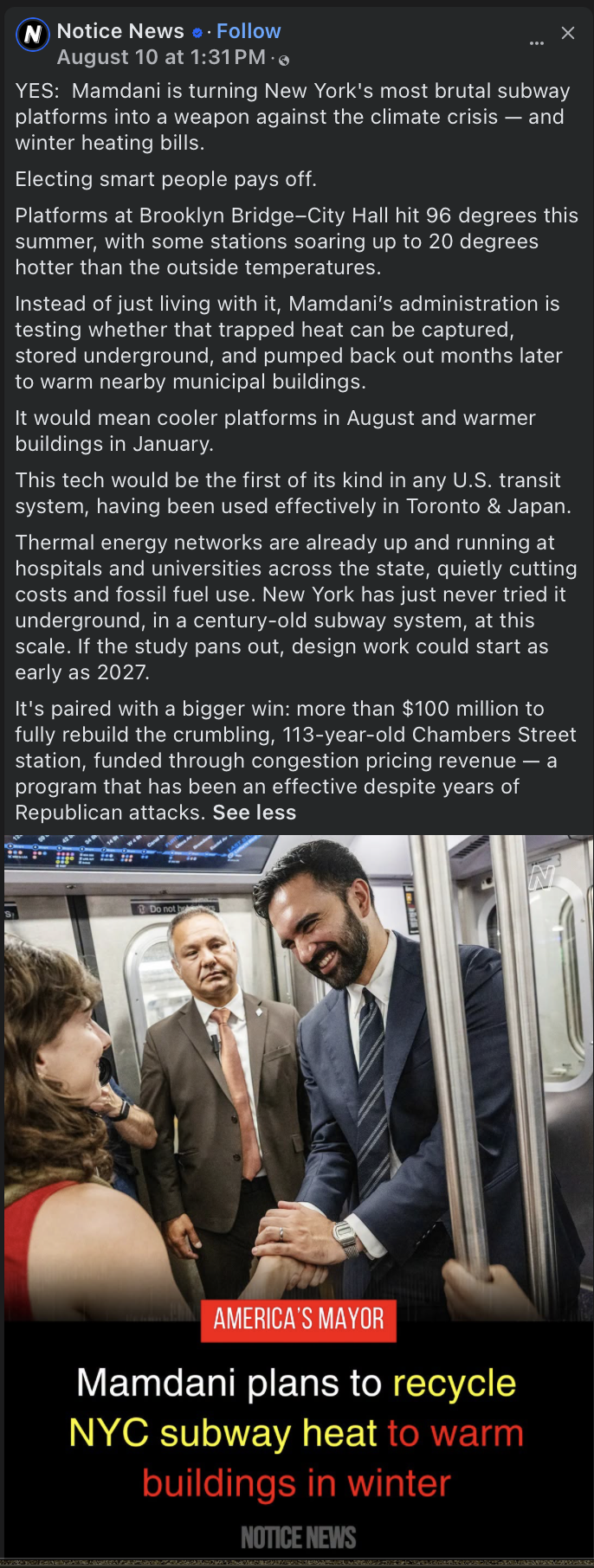
Thermal Energy Network in NYC Subway?

Comments
-
I sent this article to an energy specialist and got this reply:
"Nice idea, but the cost to move such low-grade energy from A to B will likely dwarf any financial benefits from it, e.g., saving on heating fuel in adjacent facilities.
Many decades ago an engineering firm reviewed how subways were heated in winter. It found that heat from running the trains was sufficient to shut off subway heating. However, it was also found that the subway trains acted like pistons that move their heat around and through the tunnels such that they were an inconsistent source of heat outside the transit system.
Yeah, fine to re-visit the concept, but I expect that the cost of natural gas (primary source of NYC building heat) is far too low to justify the engineering and costs involved in using subway system waste heat for other purposes. Keep in mind that electricity would be needed to grab/enhance/direct that flow, and air is not the best medium to do so."
 1
1 -
I believe the primary source of building heat in NYC is Steam.
now source of that steamIs oil and gas.
0 -
Nothing short of a 1,000 ton+ ice battery or a sand battery for one station will make much of a difference. The problem of finding a place to build it would be a major stumbling block.
The ice battery or sand battery would have to be built above ground due to the flooding risk.
The chilled air or heated air would have to be pushed underground with forced draft positive displacement turbine fans and the exhaust air pulled up by a second exhaust turbine to create the proper ratio of fresh air exchange to maintain the needed oxygen levels for breathing air in the subway section as the carbon dioxide levels must remain at a very low percentage.
Ideally for an ice battery to work it would have to be housed above ground with the chiller and heat exchanger at least three stories above ground to prevent flooding damage.
As far as chilled air exchange and forced air heating; a second option would be to employ air handlers at the surface using the ice batteries with their chilled water in the warmer months and heated water in the cold months and pipe this water to garage heaters in the subway stations.
The problem of routing the piping to the garage heaters and back to the surface raises more than a few issues; (1) does the pumped water from the surface follow the staircases into the subways with victalic pipe and fittings attached to the staircase railings at the step level or a drilled bore hole to the platform ceiling for the piping?
Installing the victalic pipe at the staircase speeds installation but the at the surface pipe joints and along the staircase railing would have to be made tamper proof by tack welding the pipe clamp nuts. The pipe in the ceiling would not be subject to this.
The 3 phase power load needed for the number of garage heaters required would have to be determined by each stations available power to determine if the load center at the subway station can tolerate the additional loading of X number of water to air garage heaters for proper heating and cooling if there is head room to install them along the exposed walls of the subway station.
Another option would be to use exposed fin tubing along the ceiling walls avoiding X numbers of water to air garage heaters still using the victalic piping to connect to the fin tube piping that would be the length of the station platform with the return loop of fin tube pipe directly under the chilled water pipe back to the staircase landings ceiling.
The pumps would be at the heat exchangers/air handlers away from the subway itself and out of flooding danger.
The problem becomes where to put the sand or ice battery and the air handlers and water pumps. Ideally they would be directly over each subway station staircase.
Mining out a single cavern for the entire subway system below the entire system in deep bedrock would be ideal for the ice battery as the ground temperature in the rock would be ideal for heat exchange using an ice battery.
A large diameter concrete lined drop shaft mined out below the subway station could use simple piping and chilled water for heat exchange to the water to air heat exchangers that would use water to water exchangers with only one 2 pipe deep well jet pump in an enclosed area over the deep well. away and next to the subway.
This is based on a 52 degree rock temperature for simple heat exchange using a huge amount of water mass without a gas based heat pump. The problem of possible flood damage is still there but wiring the jet pump and a circulator with explosion proof/water wiring would reduce the possibility of damaging the jet pump.
For cooling, installing a small pump jack over the mined out drop shaft would also work and it would only require a single pipe to pull water up out of the shaft and then push the water to the fine tube pipe and the water would fall back by gravity to the well pit. NOT Perfect but it will work using simple physics and 220 volt power. The piping will gurgle but the needed repairs will not be complicated when the time comes to change the packings in the piston of the pump jack.
2 -
i notice that isn't from say the ap or reuters ore even gothamist. or a city of new york press release.
 1
1 -
If only a feasibility study were done first…
0 -
Here's the press release:
Forum Moderator
0 -
I agree that before this big announcement—which also covers the rehabilitation of a big subway stop—a feasibility study should have been done to forestall disappointment if it turns out to be a problematic political liability.
0 -
oh, it is worded weird. they are just dumping the heat in to the district steam or hot water system with a heat pump.
0


Categories
- All Categories
- 87.7K THE MAIN WALL
- 3.3K A-C, Heat Pumps & Refrigeration
- 59 Biomass
- 430 Carbon Monoxide Awareness
- 129 Chimneys & Flues
- 2.2K Domestic Hot Water
- 6K Gas Heating
- 122 Geothermal
- 170 Indoor-Air Quality
- 3.8K Oil Heating
- 79 Pipe Deterioration
- 1.1K Plumbing
- 6.6K Radiant Heating
- 396 Solar
- 16K Strictly Steam
- 3.5K Thermostats and Controls
- 56 Water Quality
- 51 Industry Classes
- 51 Job Opportunities
- 17 Recall Announcements