90%+ Boiler vs 80% boiler

My dad owns 2 buildings that are essentially exactly the same. They were built at the same time and are next door to each other. One of them still has an 80% Burnham from the 80s heating it and the other has a Ultra Series 2 that was installed a few years ago. They both have a wireless sensor system monitoring temperature and regulating based on that. The temperature is set to 73 in both buildings in the winter. Both buildings have the same water heater BTUs installed as well. I cleaned the exchanger on the Ultra last year, although once I opened it I found it wasn't very dirty. The Ultra does NOT have any kind of "Boiler Buddy" tank.
As far as I can tell everything is the same, the only difference is the boiler system installed.
However, when we look at the heating bills they are very close, sometimes the Ultra boiler building is noticeably higher. Is this normal? Or is there something wrong with the Ultra?
I've attached photos of the Therm usage. I'll get photos of the boiler setups.
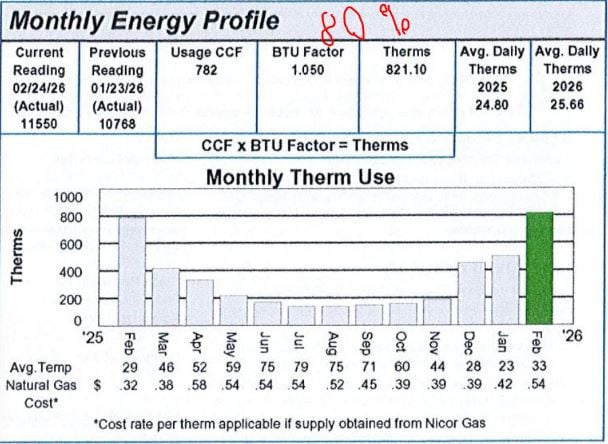
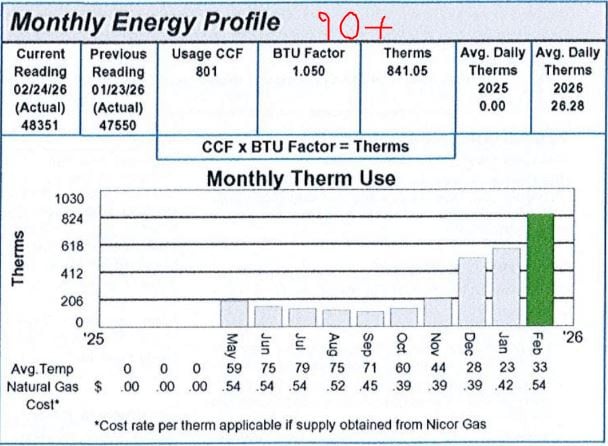
Owner
Steamnowrockford.com
Comments
-
what kind of heating system is it attached to? in order to get the 90+ efficiency the boiler has to be able to run with low return water temp si the system needs to have enough area in the emitters to work with low water temps. something like radiant floors or some cast iron radiator systems. fin tube baseboard or convectors usually can't do that.
if the outdoor reset isn't set yup on the mod con that also will reduce efficiency.
water heating with an indirect water heater usually is not don with temps that keep it in the higher efficiency area.
what is the outside exposure of both buildings? is it the same?
1 -
Both buildings are tube fin. Both buildings have outdoor resets. And they both have independent water heaters. One is a little higher on a hill, but I think the exposure is comparable. If anything the one with the older building is more exposed.
Is this a case where a boiler buddy would be helpful? I've been researching those for another install coming up this summer. I need to go through the site to learn when to use those.
Owner
Steamnowrockford.com
0 -
Don't know how large the buildings are but 800,000 btu/month in the winter is not that much gas. Are these houses?
0 -
More likely than not the high efficiency boiler isn't running at high efficiency — as noted above, it has to have relatively cool return temperatures to do that, and it probably isn't set up and controlled to do that Iif it even can — depends on the radiation which it is powering).
Br. Jamie, osb
Building superintendent/caretaker, 7200 sq. ft. historic house museum with dependencies in New England 2
2 -
@EBEBRATT-Ed the graph is in therms. So it's 80,000,000 btus. These are 11 family buildings.
Owner
Steamnowrockford.com
0 -
Is that what the boiler buddy is for? To artificially increase the load on the boiler to get that efficiency?
Owner
Steamnowrockford.com
0 -
The Series 2 Ultra was more than a few (15?) years ago. Does the Ultra have supply and return sensors on the manifolds? Minimum and maximum firing rate? Were combustion tests done on both boilers? Whats the net BTU ratings on both boilers? Are they similar?
0 -
make sure the max firing rate is limited to the output of the baseboards if not less, set up the reset curve to make it run long cycles, if it is short cycling that will make your efficiency worse. if it has anti short cycle settings make sure those are configured. ho does it match the heat loss of the building and the amount of heat the baseboard can output? knowing the heat loss of the building from a manual j calculation or from fuel use calculations will help in dialing in the boiler settings. if it is constantly turning on and off that will kill your efficiency.
 2
2 -
If it is a zoned system, 11 zones? The Ultra on a properly adjusted ODR should be more efficient.
#1 it can modulate to loads, if it is zoned?
#2 ODR might let it run in condensing mode for some of the season, depending on the fin tube lengths.
I don't see the Boiler Buddy doing much of anything on the Ultra.
If the cast boiler is cycling it's brains out on a multi zoned system, that is where so buffer might help.
Putting both buildings in identical load conditions with 11 units, if they have their own thermostats would be nearly impossible. Even if t stats were locked to 70°, occupancy use would vary substantially.
Maybe the bills are mixed up :)
Bob "hot rod" Rohr
trainer for Caleffi NA
Living the hydronic dream0 -
@HVACNUT I don't know how the original installers set it up. I'll take a look at it. I believe the ratings for both is the same. I've started reading the manual to understand the setup better. Is there anywhere else with good info on these 90+. Most of the ones I maintain are 80%ers and I'm not as familiar with these 90%ers.
Owner
Steamnowrockford.com
0 -
@hot_rod While these 2 buildings have 11 units. None of them have individual controls, all of the valves are manually locked open with a sensor in place to monitor temp back to a central control and average the building. I didn't choose to set it up this way, but that's how it is right now.
It's possible the gas provider has the 2 buildings mixed up, I've seen crazier things.
Owner
Steamnowrockford.com
0 -
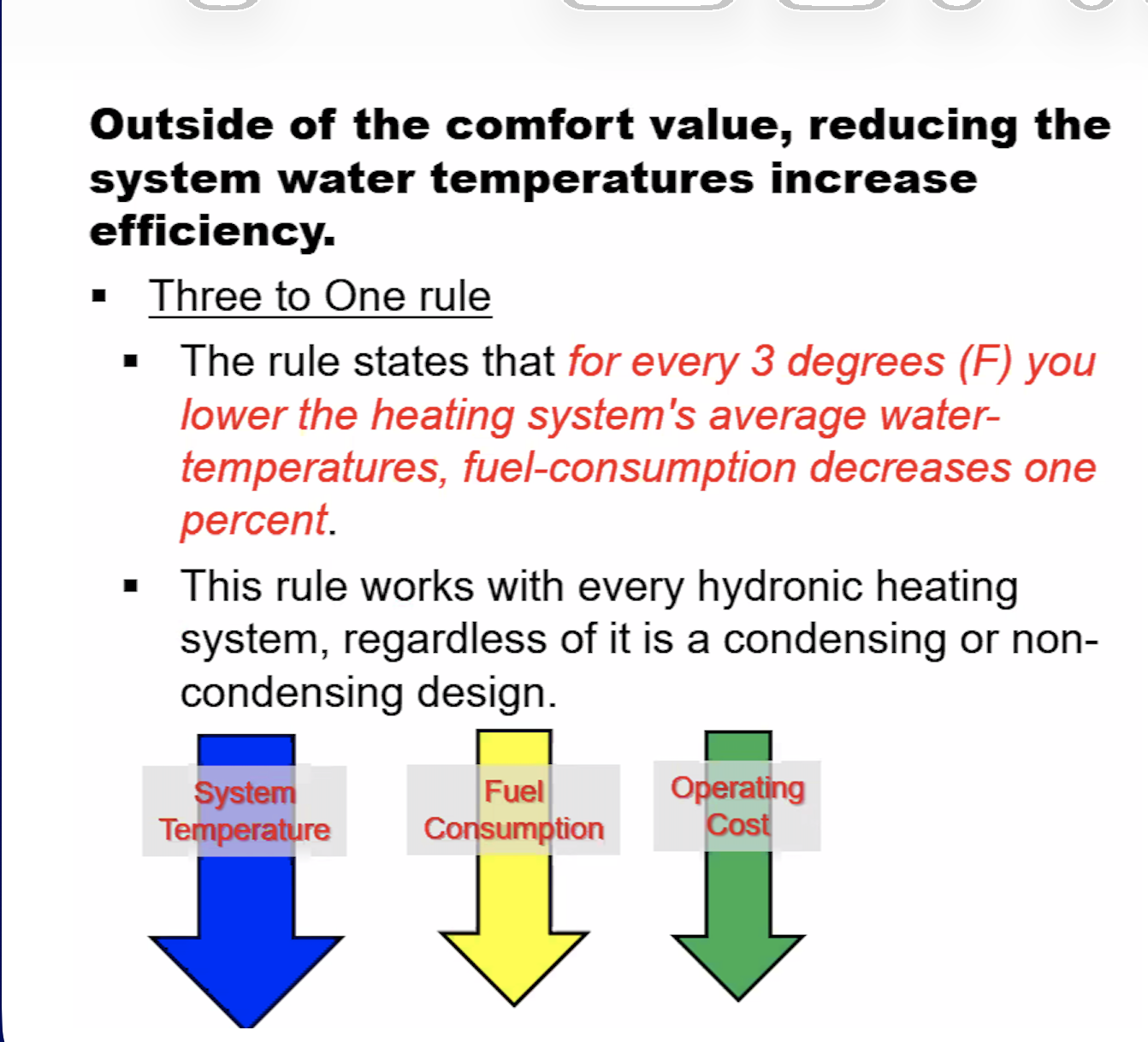
The boiler buddy may give you longer cycles — but unless you can get the operating return temperature below 140 F or so — and lower is better — you'll do no better with a high efficiency boiler than with a regular one.
And doing that depends on whether you have enough radiation (you mention fin tube — so that would be total length of fin tube) to heat the structure adequately at low temperatures. Heating systems are SYSTEMS — not random collections of components — and how well they work depends very much on the whole system being considered as a whole, not just a boiler here and some radiation there! You may simply not have enough radiation installed to make a "high efficiency" boiler work at high efficiency.
Br. Jamie, osb
Building superintendent/caretaker, 7200 sq. ft. historic house museum with dependencies in New England1 -
where is this building located?
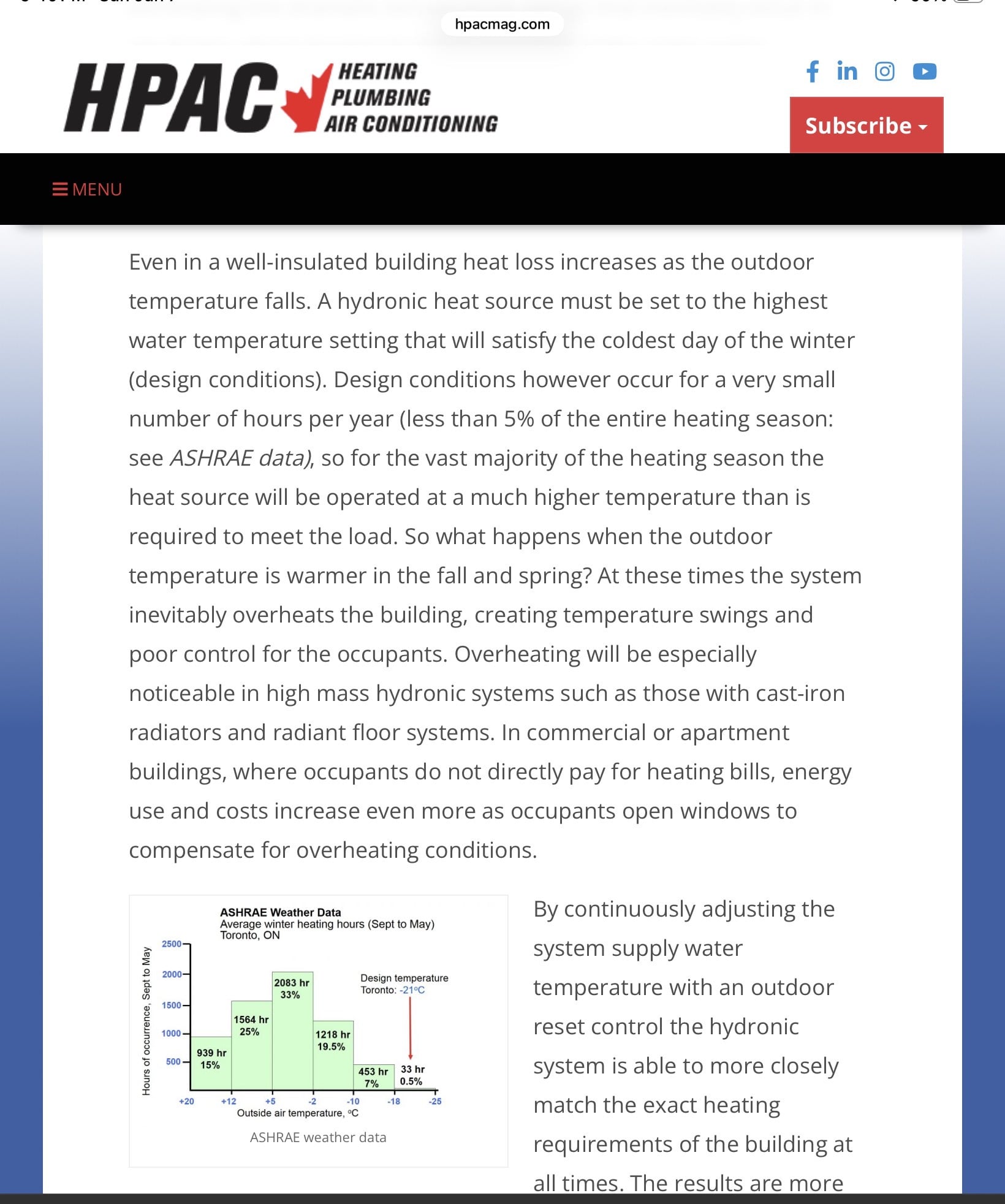
Even if the fin tube was sized for 180 SWT on design day maybe 85- 90% of the heating season it a could run at a lower temperature. On a mild or moderate load day you could perhaps supply 140 at. 20 delta that would allow the Ultra to condense and get into the 90% efficiency.
It’s rare to find a building at design condition all heating season
It really depends on how the control was setup as far as fuel savings potential.
Find weather data for your location to get an idea of % at design. The example below shows Toronto at design condition about 33 hours September- May
 Bob "hot rod" Rohr
trainer for Caleffi NA
Living the hydronic dream0 -
A heat loss of the buildings will provide the answer along with a radiation survey. Anything else is a guess.
1 -
also if the boiler is grossly oversized it may not be able to modulate down to the mild day conditions.
0 -
I'm thankful for this post because it tells me in even stronger terms to just stick with a cast iron boiler for the rest of my life (if I do ever move away from my steam house)
NJ Steam Homeowner.
See my sight glass boiler videos: https://bit.ly/3sZW1el0 -
If you ever find yourself in the position with a condensing boiler and baseboard I would encourage you to adjust your reset curve to condense as much as possible. Not trying to sway the general opinion of what you like, just pointing out that you CAN condense with baseboard. I do for the vast majority of the year (every time I've checked anyway, even around -10f) that being said I can definitely understand why a contractor might set up a boiler in a multifamily building to just supply 180, or never condense, it's harder to predict what your tenants will want to do and much easier than getting a complaint.
0 -
a modcon is the obvious choice for radiant or a gravity conversion. it can also work very well with panel radiators if they are designed for it. with baseboard or convectors there is more to consider like does a modcon avoid spending thousands on fixing a chimney or does the radiation allow you to run low water temps for a significant portion of the year.
0 -
Not to hijack this thread, but I wish this knowledge was more widely known, that a modcon is (almost always?) the correct choice for a gravity conversion.
When I recently had my boiler replaced (before I had discovered this forum and Dan's books), I specifically selected my contractor because he walked through my home, took measurements, looked at all my radiators, and did a manual J, while others didn't. He talked me out of a modcon, on the theory that I'd only be in condensing temperatures during shoulder season, and that it wouldn't be worth the extra cost. However, as I document in other threads here, my home is massively over-radiated, and is, as @mattmia2 says, "obviously" a good candidate for a modcon. But instead I got a cast iron boiler, with (initially) no low return temperature protection.
As a homeowner you are usually advised to follow the wisdom of experts, which I thought I was doing…. But then I found HH ;)
2 -
even if the swt ultimately has to be high temp, gravity conversions still need to deal with return water temp protection on conventional boilers and that isn't particularly simple or inexpensive. it isn't super complicated but there is some complication and additional maintenance when combined with the ability to have odr built in generally tips the scale to a modcon unless there isn't a place to get the powered vent out of the building or something like that.
0 -
Thank you everyone for the very helpful replies. This is confirming what I was starting to think. That because the building is most likely designed for a higher water temperature that the newer boiler will never be able to run at the efficiency designed for because there is not enough radiation for it to heat the building while maintaining low water temperatures.
I will do a manual J and then measure the radiation in the building and see if there's anything worth doing. We probably won't do anything, because the building is Heating and the tenants are happy. It's more of a learning opportunity.
Owner
Steamnowrockford.com
0 -
I think you are missing the point of a condensing boiler. It will condense and run 90% plus on some, maybe most of the year. But we don’t have enough specifics on you application
Location, heat loss of the building, amount of fin tube, boiler sizes)
A short cycling cast boiler on a mild day may be running low 70%, while the mod con on the mild days 90%.
A WAG of 25 btu/ft X 4500 sq ft =112,500 load on design day.
Ultras are available from 80-399,000
Assume someone sized it correctly, a 155,000 Ultra would be adequate. It turns down to 30,000
I doubt the cast iron has any turndown, so on a low load day it is 10 times too big, maybe more if it is oversized.
Care to share anymore data? At this point the comparison is just which type you like better, no data to base a best decision.
If efficiency is the goal, which seems why you started the post?
Bob "hot rod" Rohr
trainer for Caleffi NA
Living the hydronic dream0 -
are you going to be working on the boiler after it’s installed
Condensing boilers can save in fuel usage for 1/2 or more of the year depending on several factors. No if you have to pay for the repair and maintenance a lot if not all the savings can be lost.
 2
2 -
One of the minor arguments for condensing boilers is that they can run in condensing mode "most of the year" even on systems which need hotter water some of the time.
This is perfectly true. It is also misleading as to how much one is going to save, as perhaps I may be permitted to point out that "most of the year" the boiler won't be running that much, if at all, anyway.
Mind you, I am not opposed to a mod/con boiler powering radiation sized to the heat loss of the house and sized to operate on the low water temperatures, and controlled with an outdoor reset with indoor trim capabilities and variable capacity pumping and all the bells and whistles. Not at all. You can save as much as 10% of your fuel use that way, which can be significant.
Will it pay for the more expensive boiler and more expensive maintenance? Um… I am open to being convinced, but I can't make the numbers work.
Br. Jamie, osb
Building superintendent/caretaker, 7200 sq. ft. historic house museum with dependencies in New England 2
2 -
for fin tube or convectors the cast iron boiler is the less expensive boiler to install in most cases. i'm not convinced that is the case in more complicated systems like high mass gravity conversions or radiant systems although we're drifting off a bit here.
0 -
Got some numbers on that less to install comment @mattmia2 How many of each type of boiler do you install? How many have you purchased lately?
This sounds like a one zone on thermostat installation. It is possible with some flow calcs that a firetube mod con may not need P/S or a sep?
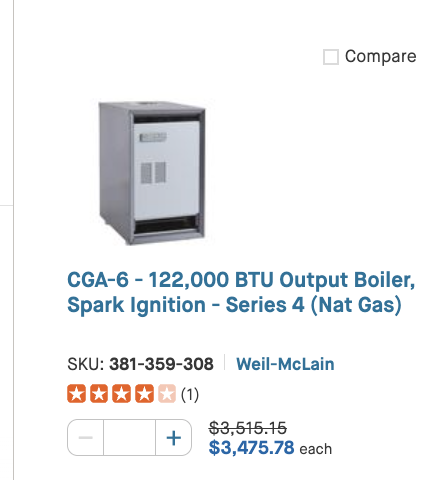
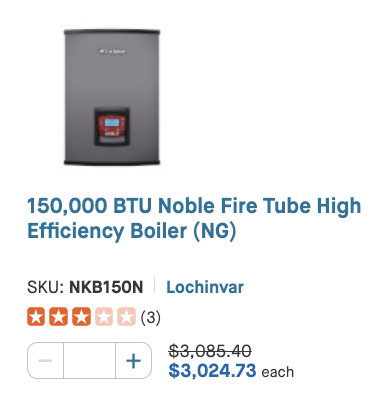
As for cost of the boiler itself. The mod con will have a lot more control functions, ODR, Ramp delay, SH limiting, data logging for cleaning notifications and error code storage.r, some are wi fi enabled for remote monitoring.
For $400.00 less with this mod con you can buy a lot of PVC or Centrotherm venting. Which is the main installation difference.
A conventional boiler will need B vent and combustion air.
Once trained the maintenance is really not that hard. A couple hours to breakedown a mod con. If they run clean and inhale clean air you may go 2, 4 or more years before you break one down. We see examples of mod cons with 10, 15 years before a major breakdown and cleaning.
If the main criteria is simplicity, go with the horse and buggy technology :)
 Bob "hot rod" Rohr
trainer for Caleffi NA
Living the hydronic dream0 -
I agree once trained but if that training is not used yearly, monthly, weekly how much is retained.
I’ve had training on equipment that I did for 1, 5, 10 years. Yes I remember “Most” of it. Do I remember something I don’t use or used only for a short time. No!1 -
i think the total cost of ownership might be a little better with the ci boiler on a high temp system due to the longer life but i have nothing against putting a mod con on it either. I was more arguing that a mod con had very clear benefits in simplifying a lot of the complication on a gravity or radiant system.
2 -
An $800 blower motor and blower wheel can eat up a bunch of fuel savings. Don't forget to add the labor cost and the mark up.
3 -
I’ll tell you guys two stories about a stupid homeowner (couldn’t have been me!) with a modcon:
One cold February, they noticed the pressure relief valve was dripping. So they tried to reseat it by opening it and flushing it a couple times…. Which made it 10 times worse and then the leaking was filling a 5 gallon bucket once a day. It stayed that way for a week while the new relief valve was being shipped. Then the homeowner (swear it wasn’t me) drained more of the system than was necessary because they didn’t understand which shutoff valve was which (combo boiler with a domestic shutoff lol).
In another similar scenario, they had a leaking automatic air vent on top, dripping down the unit out onto the floor. Took about a week to get the replacement part and fix it again.
In both scenarios there was lots of makeup water being added to a boiler that is certainly sensitive to it. And after the second story, the homeowner learned that perhaps the feed water valve should not be left open year round. (That was year three of owning the house).
Anyway, I’m just a dumb homeowner, but I’ve done the math for myself. Based on a 15-20 year life of a modcon, professional maintenance at least every 2 years, initial cost, and current natural gas prices, the cost of ownership of a cast iron boiler with professional maintenance every 4 years and an expected life of 25-30 years comes out slightly lower. Theoretically.Couple caveats would be that: having to repair or improve a chimney for a cast iron boiler would change things, temperature control on a cast iron boiler without ODR might be less granular (but also, aren't wives kinda like reptiles that like to be kept warm under a heat lamp?), you’re theoretically locking in your heating choice for your entire period of ownership (and maybe part of the next guys) while there are new technologies advancing and becoming viable, and a bigger chunk of the cost of ownership is paid to the gas company instead of a local HVAC company.
It’s not black and white, but I prefer things to be simple so I think a cast iron boiler is a better fit for me. But who the heck really knows until you live with for 30 years!
2 -
@hot_rod Yeah, I've done the breakdown and maintenance on it last year. It was pretty simple to follow the instructions. I am leaning toward the buildings having been designed for a higher water temp. I'll look into the interior radiation later. Running a basic ManualJ gives me some estimates for the usage. I'll compare that to the radiation and back calculate what water temp is necessary.
Owner
Steamnowrockford.com
0 -
I was look at a modcon a while back that did have an outdoor sensor installed but the unit itself was set to 170F fixed operation. Not much condensation on a setup like that.
Also all buildings are like snowflakes, every one is unique. Unless you have done a blower door test and an energy audit on both places, even though they might look the same, the usage could be very different.
Add in a multiplex with variable occupant load, like that one guy that keeps the windows open in the winter, makes the comparison even harder.
I would check that the modcon is setup up properly once the colder weather hits. In milder weather, the unit should be producing buckets of condensate even if feeding baseboard heaters.
0 -
you can stop the auto air vent from dripping by screwing the cap down. it won't vent but it also won't leak until you can get a new one.
0 -
All of these things you mentioned are not unique to a modcon…Leaking relief valve, you don't try to reseat it, any boiler tech will have half a dozen generic relief valves on the van (they are same as on CI boiler, local hardware stores carry them). Air vents fail on CI systems, leaky systems with open fill valves will also destroy a cast iron boiler. not trying to change your mind on what works best for you personally, just recognize that none of these things are unique to a modcon, you just had poor techs involved imo. And somewhere along the lines those techs made you feel like a "dumb homeowner" and yet here you are trying to learn more about your heating system. That isn't dumb at all, and you should not feel like you are.


 3
3 -
Yes, that's part of the reason I'm wary of the manual J's I've done some of these older buildings. I think they're only good to really get me in the ballpark. Because in a lot of cases you don't know some of the details of how the exterior walls were built. You don't know if they have extra insulation and you have to do physical testing in order to actually get a super accurate test. So I would estimate that they would only be accurate to 10 to 20% of real world load.
There's also the fact that some of these apartment buildings are grossly oversized for capacity. Just doing a simple quick manual J and allowing for the inaccuracy you'll get a heat load that is half to 2/3 of the heating capacity in the building. And using the gas bills you'll see that the manual J is much closer.
I've been at buildings where there are another two sister buildings and one has 450,000 BTUs and the one that had the boiler replaced within 10 years has 300,000 BTUs and they both Heat equally well.
Owner
Steamnowrockford.com
0 -
over the history of of the building have all the units been able to maintain temperature on the coldest days?
That temperature data history is available online. as is www.degreedays.net
If so the building/ rooms have adequate radiation
If you know or could measure the fin tube, use 170 AWT, that give you a good idea of the boiler size required. And some might say the building design load
So no reason to have more boiler output than the connected heat emitters. If it is a heat only boiler.
Of course the structure dictates the heat load, any improvement lower the load can reduce fuel consumption. But not necessarily the cost of heating, with utility prices on the rise
Bob "hot rod" Rohr
trainer for Caleffi NA
Living the hydronic dream0 -
@hot_rod yep, no issue heating. When it was -13f for a couple days I guess they did, but i don't count that. There has been attic insulation added, but this was long after the boilers were installed. I'll try to do more testing when it's cold to see what might account for the differences
Owner
Steamnowrockford.com
0




Categories
- All Categories
- 87.8K THE MAIN WALL
- 3.3K A-C, Heat Pumps & Refrigeration
- 60 Biomass
- 430 Carbon Monoxide Awareness
- 133 Chimneys & Flues
- 2.2K Domestic Hot Water
- 6K Gas Heating
- 124 Geothermal
- 170 Indoor-Air Quality
- 3.9K Oil Heating
- 79 Pipe Deterioration
- 1.1K Plumbing
- 6.7K Radiant Heating
- 397 Solar
- 16.1K Strictly Steam
- 3.5K Thermostats and Controls
- 56 Water Quality
- 51 Industry Classes
- 51 Job Opportunities
- 18 Recall Announcements