Exterior insulation on foundation wall
Comments
-
@hot_rod said:
pretty much any detail you see on a stucco building is foam, with the stucco over it.
Here in Utah the on/ off ramps are built with foam blocks, paved over.it’s almost as if the whole thing isn’t a big deal at all!! 😅
NJ Steam Homeowner.
See my sight glass boiler videos: https://bit.ly/3sZW1el0 -
It's not rated for ground contact
NJ Steam Homeowner.
See my sight glass boiler videos: https://bit.ly/3sZW1el 1
1 -
It’s a nice product. I’ve used Densglass to build up architectural details. It’s often used under the stucco / foam layer for commercial builds.
1 -
NJ has had a separate "energy code" as part of the the building permit for over 20 years. I had to do one back in the mid 00's and not a couple years earlier.
Continuous exterior insulation is not required in NJ. You can do it but it is not required. Lots of ways to meet the requirements
I know from experience that the biggest energy loss in a basement is going to be those few feet out of the ground. If the building is framed above the foundation — air leaking is often a larger problem vs any insulation. Very few contractors spend much time other than rolling out some thin foam. IMO — it's not thick enough even when the top of the masonry is relatively flat to seal the top plate. Most of my early projects were in NJ including a block/ brick faced house from the 50's that I made into my first home/ office. It was a large house with a huge full basement that allowed 1/2 to become my office. There was no air leaking into the basement — when we did the heat load calculations adding only R13 the numbers were so low I had to check them a couple of times. The big problem with basements is water. The basement floor in that building was not cold because the soil under it was dry. Water changes everything especially if you are trying to heat the slab.
IMO — 2x6 walls w/ closed cell foam and plywood sheathing. Good windows and 5/8 rock. Most of my projects have been restorations with additions and I have given up on wood for the additions other than the windows and it's trim. Closed foam stops air leaking — you need to understand it's use in an old building — it's a real problem solver.
Foam under stucco has a long history and one with no shortage of problems. Buildings leak — best have a way for them to dry. Especially when you create two vapor barriers. Look how long they pushed plastic VB for energy savings — how many walls rotted away in cold climates? This can be a problem in roof structures if the wrong ice and water shield is used all over a roof deck (more is better — right?)
0 -
Panel roof construction is all about the same — typically osb and some type of foam w/ 2x material on the sides and ends — make sure you follow the manufacturers recommendations to the letter. Especially the internal sealing of the panel joints to the heated space.
0 -
If you look at most of the spray foam, it gets applied to places where air doesn't leak like directly over OSB panels and it doesn't cover some of the big leaks like wall corners and foundation/wall joint.
You can get much better air seal with a couple of rolls of fancy tape (ie Zip or 3M8067) and an hour or two of elbow grease by taping all outside seams. It is THE easiest/cheapest enegy improvement one can make.
This avoids the cost of spray foam plus the risk of a bad spray foam job (~1%, remediation is impossible without demoing) .
Your insulation dollars are better spend on getting high density batts which give you a small R value bump plus much easier to get a grade one install.
Spray foam is definitely great when dealing with old structures and rubble foundation basements. For new construction/addition, gets you nothing.
0 -
I'm not sure if it's been mentioned or not, but one of the benefits of my leaky basement is there's never a shortage of combustion air.
Or a breeze for that matter.
@ethicalpaul Have you considered how you're going to bring in combustion air for your boiler after all of this is complete? Knowing you, you did months ago.
Single pipe 392sqft system with an EG-40 rated for 325sqft and it's silent and balanced at all times.
 1
1 -
This addition on its own will in fact reduce the air intrusion through the old wood plank door (under the Bilco) that was at the rear of the basement. This is where the addition is going. And I assume the new basement door (I'm keeping the Bilco door, but in the addition part) will be much more airtight than the old one. So the change in available combustion air is a concern.
Luckily, I have an old dryer vent port near the boiler from when the washer and dryer was down there that I can re-purpose into a combustion air vent.
NJ Steam Homeowner.
See my sight glass boiler videos: https://bit.ly/3sZW1el1 -
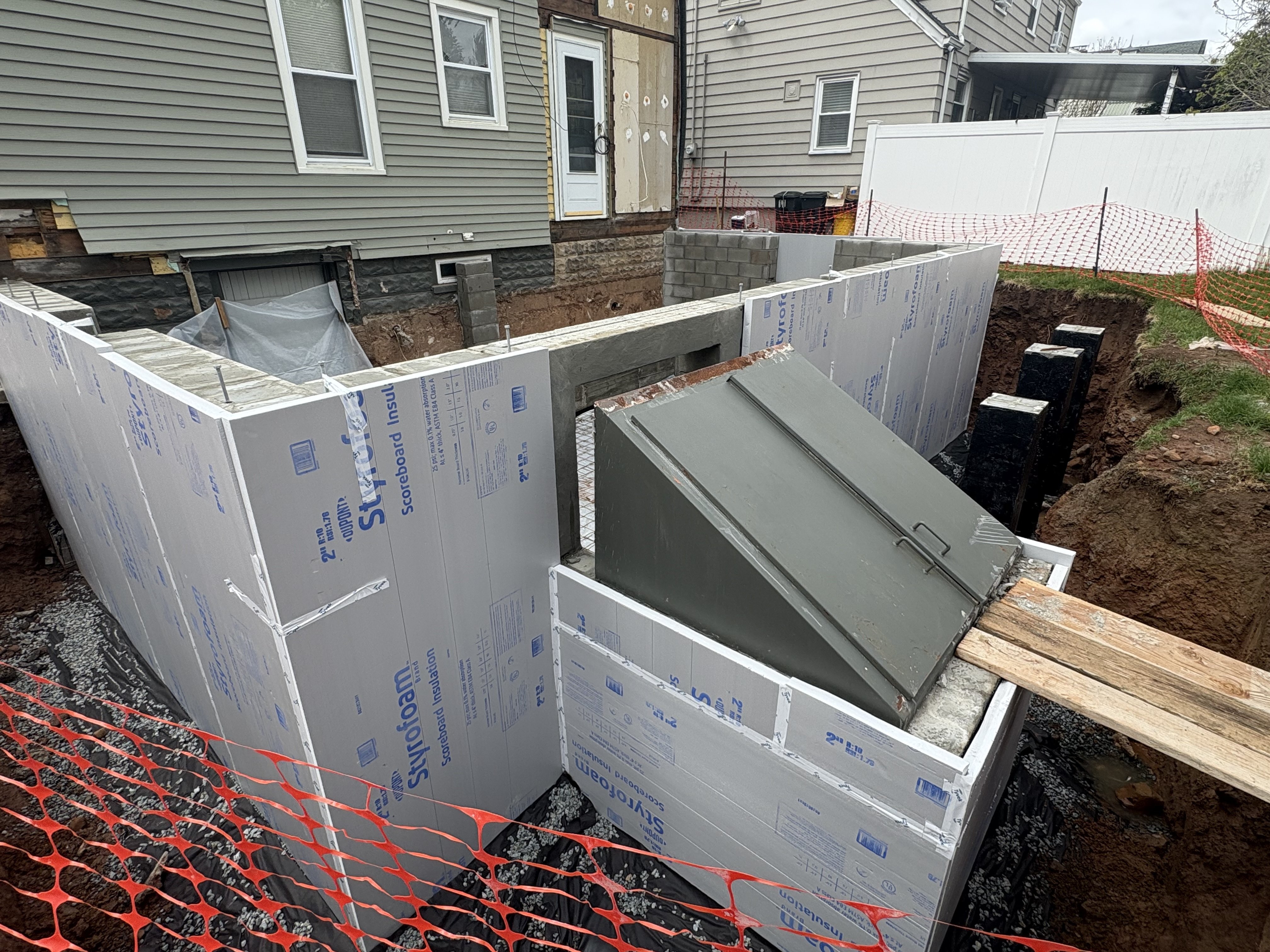
Foam in place, against all odds
NJ Steam Homeowner.
See my sight glass boiler videos: https://bit.ly/3sZW1el
 4
4 -
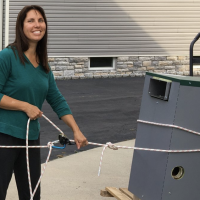
Well, take a look at that now.
 1
1 -
How are you going to insulate the door and around it? It looks like a big hole in the insulation right now.
0 -
There's a really big hole on top of the foundation right now too.
Single pipe 392sqft system with an EG-40 rated for 325sqft and it's silent and balanced at all times.
1 -
I'm sure the builder will figure it out, I'll let you know
NJ Steam Homeowner.
See my sight glass boiler videos: https://bit.ly/3sZW1el0 -
If building from scratch what's wrong with insulation on inside of block wall?
0 -
nothing is wrong with it but putting it on the exterior is easier and better
When you insulate the exterior, you have fewer issues with exposed areas causing condensation
You also don’t lose interior space
And I can still insulate the interior as well of course
NJ Steam Homeowner.
See my sight glass boiler videos: https://bit.ly/3sZW1el0 -
Insulation on both sides seems like it would be an issue like double vapor barriers.
You can't do that, you trap moisture / water.
I guess you could do fiberglass / wool without a vapor barrier.
Single pipe 392sqft system with an EG-40 rated for 325sqft and it's silent and balanced at all times.
0 -
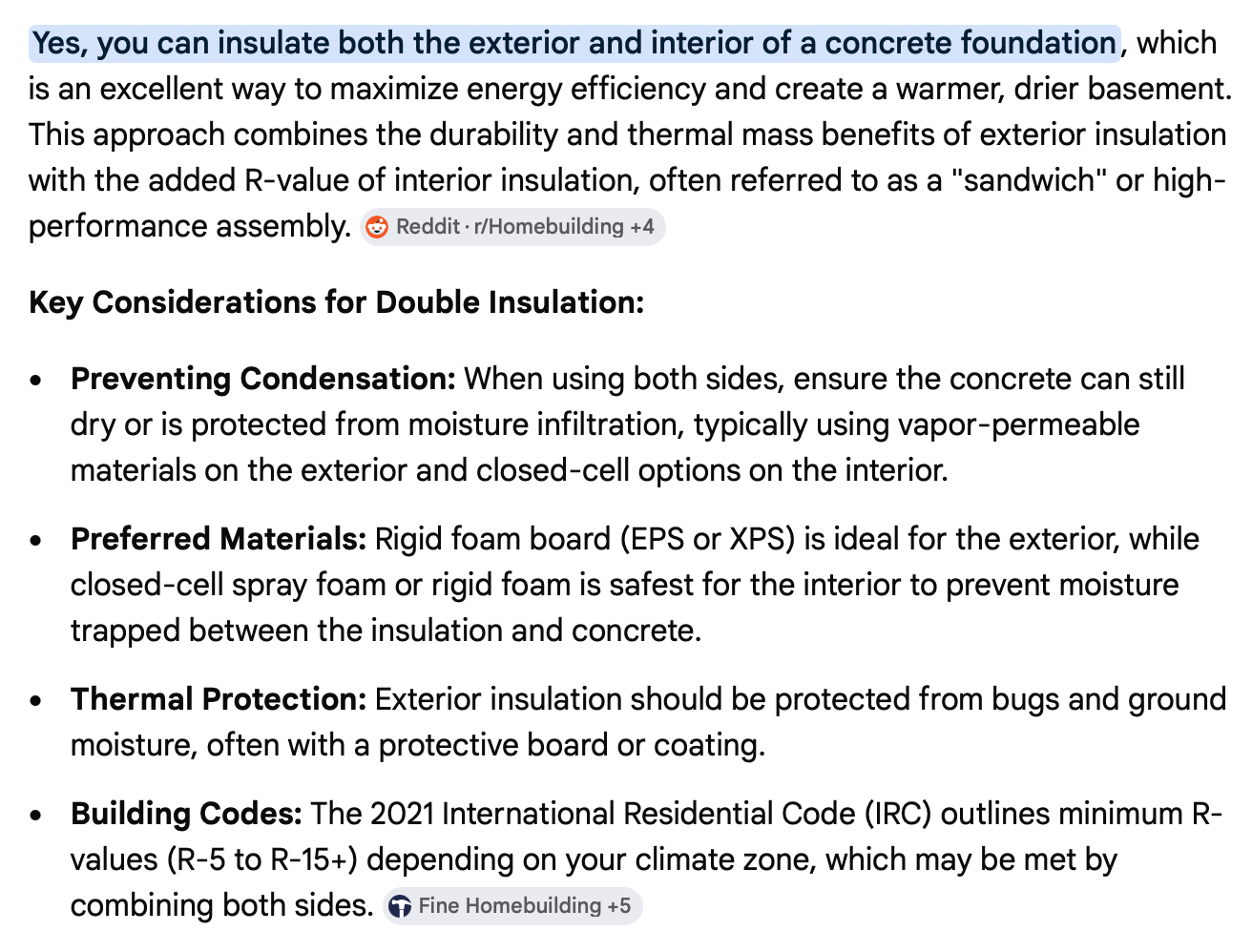
Sorry to haul out the AI, but this is a solved problem:
NJ Steam Homeowner.
See my sight glass boiler videos: https://bit.ly/3sZW1el0 -
AI told you you could use closed cell spray foam to prevent moisture from being trapped.
That kind of proves it's completely wrong, doesn't it?
Single pipe 392sqft system with an EG-40 rated for 325sqft and it's silent and balanced at all times.
0 -
I don’t think it said that. It said you could used closed cell spray foam on the interior
NJ Steam Homeowner.
See my sight glass boiler videos: https://bit.ly/3sZW1el0 -
Correct.
But the interior is where it should be "venting" moisture towards.
The outside is sealed via styrofoamfoam, caulk, tape etc.
You can't put a moisture / vapor barrier on the outside and inside.
Single pipe 392sqft system with an EG-40 rated for 325sqft and it's silent and balanced at all times.
0 -
You make a good point also because the exterior has a water resistant tar-like coating on it regardless of insulation there. So I would have to make a vapor permeable insulation layer on the interior in any case, right?
NJ Steam Homeowner.
See my sight glass boiler videos: https://bit.ly/3sZW1el0 -
I think so, yeah.
Single pipe 392sqft system with an EG-40 rated for 325sqft and it's silent and balanced at all times.
1 -
I agree trapped moisture can be a problem but I wonder if it is for concrete blocks? In the sixties common practice was to parge and coat exterior and styrofoam (slabs) interior. The latter was for semi-basements.
1 -
Hi, I'd like to see the concrete able to dry, if just because it might prevent or slow rusting of the rebar in it.
Yours, Larry
1 -
I'm not sure how dry it will get being in contact with the cold wet clay under my house….yes there is a moisture barrier on the foundation walls, but the footers are sitting in wet clay for a good part of (or all of) the year.
NJ Steam Homeowner.
See my sight glass boiler videos: https://bit.ly/3sZW1el0 -
Hi, There's a whole lot of physics going on! You insulated the exterior, so the concrete will warm some. This will speed evaporation from the interior. Water has to be wicked up from footer to foundation faster than it evaporates for the concrete to stay wet. With luck it will dry faster than it takes up water.
I'm talking very long term in thinking about evidence of rust damage. Spalling happens when the rebar is close to the surface of the concrete, but yours is inside of the block. There should be little or no salt in the mix, so nothing to speed rusting. Spalling is more common in coastal areas. I just like to build in a way that can last and remain functional for hundreds, not tens of years. I've never been a "lipstick flipper" type.😉
Yours, Larry
1 -
some of the excess water in the mix evaporates within a day or so. Concrete actually cures, a chemical reaction which can go on for months.
Bob "hot rod" Rohr
trainer for Caleffi NA
Living the hydronic dream1 -
Doesn't it take a month for concrete to get to 80% strength?
0 -
isn't the colorado damn still curing?
known to beat dead horses0 -
About
30–40% of the final strength
is typically achieved by
3 days
, and
65–70% by 7 days
. The
28-day strength
is considered the standard benchmark, as concrete reaches
95–99% of its ultimate strength
by this time
NJ Steam Homeowner.
See my sight glass boiler videos: https://bit.ly/3sZW1el0 -
What @ethicalpaul posted.
It gains most of it in like a week.
And if memory serves, if it loses water content needed or freezes the curing stops at that point and that's all she wrote. So if it freezes in a day that's the strength it'll be forever.
Actually I think Paul's info is "extra safe" because I think it's even faster than that under most conditions.
Single pipe 392sqft system with an EG-40 rated for 325sqft and it's silent and balanced at all times.
1 -
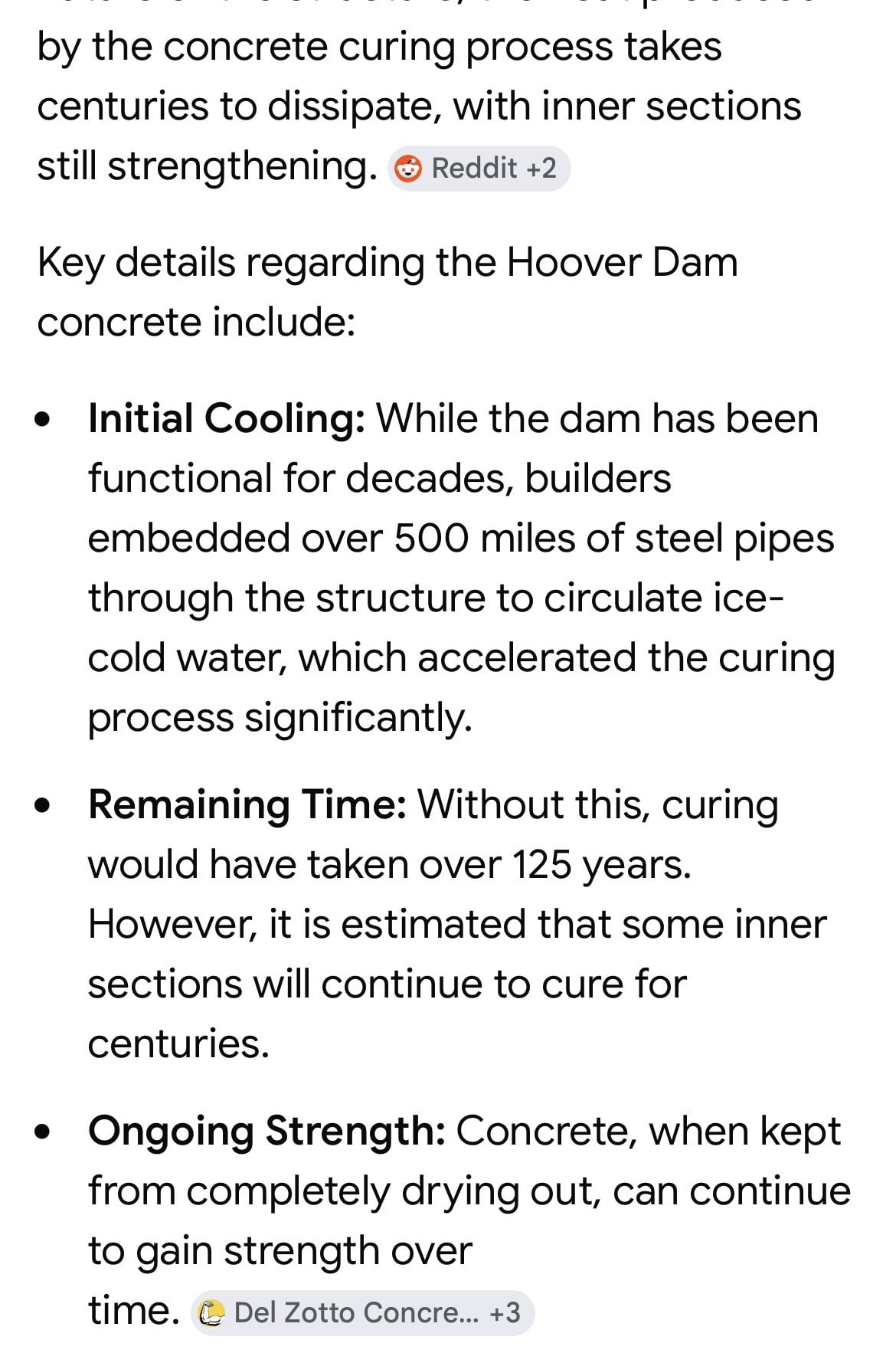
125 years for the Hoover Dam to fully cure. The embedded piping reduced the time a bit
 Bob "hot rod" Rohr
trainer for Caleffi NA
Living the hydronic dream0 -
I do not think anyone on this forum is building a hydroelectric dam.
If they are I'm impressed.
Single pipe 392sqft system with an EG-40 rated for 325sqft and it's silent and balanced at all times.
0 -
I was just gonna say, I have paid off some of my debt from creating past off-topic replies with this thread 😂
The strength and longevity of my foundation is literally the least of possible concerns
NJ Steam Homeowner.
See my sight glass boiler videos: https://bit.ly/3sZW1el0 -
yeah,
but that was fun,
known to beat dead horses0 -
500 miles of pipe in the dam.
Just tell me they threaded it all by hand LOL.
Wonder if it was leak tested😂😂😂😂
0 -
It was the deadmen, they never made mistakes or leaks. They were perfect.
Single pipe 392sqft system with an EG-40 rated for 325sqft and it's silent and balanced at all times.
1






Categories
- All Categories
- 87.6K THE MAIN WALL
- 3.3K A-C, Heat Pumps & Refrigeration
- 59 Biomass
- 430 Carbon Monoxide Awareness
- 125 Chimneys & Flues
- 2.2K Domestic Hot Water
- 5.9K Gas Heating
- 120 Geothermal
- 170 Indoor-Air Quality
- 3.8K Oil Heating
- 78 Pipe Deterioration
- 1K Plumbing
- 6.6K Radiant Heating
- 396 Solar
- 16K Strictly Steam
- 3.5K Thermostats and Controls
- 56 Water Quality
- 51 Industry Classes
- 51 Job Opportunities
- 18 Recall Announcements