No Header, No Equalizer, No Problem!
Comments
-
I agree with you to some extent but then again I am comparing a minimum of 207 days of data for each of the 3 years of comparison. Much of the wind, sun, opening doors/windows etc… impacts averages out with the volume of data though of course not all of it. 1 minute dataloggers with temperature at your house, with wind speed each minute and some form of sunlight quantification sure would be nice but I'll let someone else like yourself do that. I would more question a comparison trying to compare one month this year to the same month last year which I heard being proposed. I'm not saying this is perfect (if I wanted a higher confidence level I would be willing to go back and forth with the setups 3 times for 6 more years) but again I have not seen anyone present anything else better. Maybe there is and I just have not seen it.
 1
1 -
This thread is about the importance of water quality, not degree-days. I guess I'll just keep saying that 😅
NJ Steam Homeowner.
Free NJ and remote steam advice: https://heatinghelp.com/find-a-contractor/detail/new-jersey-steam-help/
See my sight glass boiler videos: https://bit.ly/3sZW1el 2
2 -
OK, then how does one measure quality?
0 -
My guess is, if the boiler seems to run normal and doesn't blow all of it's water up into the mains and shutdown on low water, it's probably fine.
I've also seen too much water treatment cause my pressure to go from 0.25 - 0.50" to 8-10". No idea why, but it did. So I'm going to also say, low pressure in the boiler is a good sign assuming venting (oh boy) is good.
Single pipe 392sqft system with an EG-40 rated for 325sqft and it's silent and balanced at all times.
 1
1 -
Yeah if you're not carrying over as evidenced by a diving water line, you are basically making the best steam that any low pressure residential boiler can make.
NJ Steam Homeowner.
Free NJ and remote steam advice: https://heatinghelp.com/find-a-contractor/detail/new-jersey-steam-help/
See my sight glass boiler videos: https://bit.ly/3sZW1el0 -
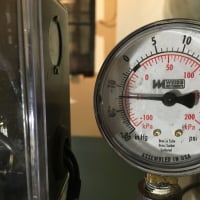
Guys, If you talk to anyone that works in a steam plant or for a company like Con Edison. Their steam quality is very important. The way that they measure steam quality or dryness is with a vortex metering device. There are two other methods but my point is I do not think anyone on this forum has ever or will ever use one. The boiler manufacturers have these devices and advise the size and length of near boiler piping accordingly.

 2
2 -
Never make assumptions about what folks on this forum may or may not have done, @ARobertson13
Br. Jamie, osb
Building superintendent/caretaker, 7200 sq. ft. historic house museum with dependencies in New England0 -
Ah well check mate. none of us have a superheated high pressure steam plant to test with, so the water quality must not matter? come on!
0 -
How do you know I'm not running a triple expansion in my basement as we speak!?!
Single pipe 392sqft system with an EG-40 rated for 325sqft and it's silent and balanced at all times.
1 -
My point is that if you do not have the equipment no matter how smart or well trained you are you really do not know.
1 -
No, no I'm not running a triple expansion engine in my basement.
Single pipe 392sqft system with an EG-40 rated for 325sqft and it's silent and balanced at all times.
 2
2 -
I visited a 32 unit building last week at the request of my heating maintenance company. The boiler supplied steam and hot water. I do not believe it was in the best interest of the Coop board to estimate the hot water usage like everyone else. I used an ultrasonic clamp on flow meter and a data logger to tell me exactly what is going on in that building so I could properly tell the contractors what the peak usage was. So they could chose the correct boiler and water coils. I do not think anyone on this site owns a vortex steam metering equipment or would install one in their or clients system. I was not trying to in any way put any one down.
 2
2 -
As far as @ethicalpaul and the "lost btus". I myself am confused about where they are going. I think there is something to it.
All I know is HW or steam the boiler will run to limit and continue to cycle and will not heat the house with plugged, missing or non-working vents. I have seen these many times. And the fuel used has got to go up.
1 -
Oddly enough, in terms of accounting for all the energy inputs and losses, and figuring what is truly a loss and all that, working with a small (relatively) system such as a residence is far more difficult than working with a power system. Not only are there more paths for energy to go, but they are more significant in the smaller systems.
Also there is a real problem both with defining the terms used — efficiency means different things to different people, for instance, and there is no real harm to that except it makes it hard to discuss — but there are major problems in defining the system with which one is working.
"Lost" BTUs is a marvelous example, and trust me I'm not trying to stir up trouble here. Depending on how the system is defined, for residential heating, one can argue that the only lost BTUs is the heat content of the stack gas where it exits the building envelope. But with another definitionone can state that any heat which doesn't turn up in a radiator is lost. Then you can go on and say that the heat left in the boiler when the burner stops firing is lost. And so on. And everyone is right — by their definition (implied or stated) as to what the system is — even though the numbers they come up with are radically different.
Br. Jamie, osb
Building superintendent/caretaker, 7200 sq. ft. historic house museum with dependencies in New England0 -
this thread is about the importance of water quality vs boiler piping in existing installations.
The only lost BTUs I’m talking about are the ones that Capt Who says are lost due to so-called “wet steam”.
It’s all in the thread but I have to try to keep things focused 😅
NJ Steam Homeowner.
Free NJ and remote steam advice: https://heatinghelp.com/find-a-contractor/detail/new-jersey-steam-help/
See my sight glass boiler videos: https://bit.ly/3sZW1el2 -
In the commercial world they talk about "fuel to steam" efficiency. The # of BTUs from the fuel versus the # of lbs of steam produced over a given time.
Could be a new video for @ethicalpaul 🤔🤔
Plug all your vents, run the boiler, clock the gas meter and measure the condensate produced for a given time. Then do it with the vents installed.
Would be tough to collect the condensate without losing steam though
0 -
isn’t that just the 83% or whatever that goes into the boiler? All of that goes to making steam (once the water is 212F depending on elevation, I’ll add for the pedants), right?
At least in our boilers
NJ Steam Homeowner.
Free NJ and remote steam advice: https://heatinghelp.com/find-a-contractor/detail/new-jersey-steam-help/
See my sight glass boiler videos: https://bit.ly/3sZW1el0 -
Either an electromagnet flow meter or ultrasonic flow meter for partial filled pipe would need to be put into the condensate return lines to attempt to measure condensate return quantity.
I thought the questions here, at least the contentious ones were whether piping leading to high steam velocities 1) can produce steam with a higher water content (say 5% vs 2%) and,
2) whether this does or does not matter in the btu's required to keep a house at a given level of comfort
Question one I am not sure is completely answered b the experiments because the experiments rely on being able to see visually the difference. I at least have no idea what % of water content difference becomes visually apparent.
Question two requires some kind of quantification of the btu usage for a given amount of heat transferred to the living area for comfort. That too remains an open question. I think the hypothesis for both questions was NO but I have not seen quantified proof through these experiments. I do give @ethicalpaul credit though since he has tried as hard as anyone. Would love to see the next steps to proof.
2 -
The steam created by a residential steam boiler even with ridiculous piping definitely has enough heat energy to heat a house regardless of the liquid water content, which we can't really measure and definitely can't control even if we could measure, so this whole topic is moot is what I would say. Thanks for the kind words!
NJ Steam Homeowner.
Free NJ and remote steam advice: https://heatinghelp.com/find-a-contractor/detail/new-jersey-steam-help/
See my sight glass boiler videos: https://bit.ly/3sZW1el0 -
To which I might add — the only practical problem resulting from excessive liquid — however it might have gotten there — in the steam flow is collection at points of poor drainage and water hammer.
Br. Jamie, osb
Building superintendent/caretaker, 7200 sq. ft. historic house museum with dependencies in New England1 -
very true and those conditions will cause their problems regardless of how “wet” the steam actually is, due to the normal condensation process, again rendering the “wetness” issue to be moot
NJ Steam Homeowner.
Free NJ and remote steam advice: https://heatinghelp.com/find-a-contractor/detail/new-jersey-steam-help/
See my sight glass boiler videos: https://bit.ly/3sZW1el0 -
My position is and always will be that you cannot make measurements in a steam system or any other unless you have the proper equipment and know how to use it.
1 -
Sure, but then what do you do with them? Do you think we can “dry” the steam without adding additional heat to it?
NJ Steam Homeowner.
Free NJ and remote steam advice: https://heatinghelp.com/find-a-contractor/detail/new-jersey-steam-help/
See my sight glass boiler videos: https://bit.ly/3sZW1el0 -
I agree with @ARobertson13 — but also with @ethicalpaul . The answer to @ethicalpaul 's question is — only if you do nothing to extract heat from it. Under otherwise adiabatic conditions (no heat transfer) any anergy loss in the steam flow will result in condensation, if you start with saturated steam. Which we normally do. As soon as you add superheat, the game changes — a lot.
I think the debate surrounding @ARobertson13's comment is quite valid, but for most of us is overridden by practical considerations: does it matter? This is very much the same kind of thing which I dealt with for years as a practicing engineer: the distinction between book or continuing ed. learning and boots on the ground learning. I admit to being rather biased about that, being an ancient fossil… who got his licenses the hard way, in the field!.
Br. Jamie, osb
Building superintendent/caretaker, 7200 sq. ft. historic house museum with dependencies in New England2 -
Problem is those instruments are far from cost effective for hobbyist experimentation. Wetter steam (ie. lower dryness fraction) will have greater friction losses and condensate load in the piping and higher pressure drop and will take longer to push the air out, so why not measure the amount of time from when the supply coming out of the boiler hits 200 F until the supply valve on the most distant radiator in the house hits 200 F. It will not measure dryness fraction directly but I wager it will be a measurably and significantly longer time for steam which is significantly wetter like in ethicalpaul's video where the velocity was about 39.4 fps and can be compared to the time for the original double supply drop header setup with the lower velocity of around 9.2 fps..
This Vortex Flowmeter based device from Endress Hauser can measure Energy Flow Rate of Steam as well as Dryness Fraction, but it is up around $9,000 before all the accessories lol. https://www.us.endress.com/en/field-instruments-overview/flow-measurement-product-overview/vortex-flowmeter-prowirl-f200-7f2c?t.tabId=product-overview
0 -
Too many variables, @Captain Who !
Br. Jamie, osb
Building superintendent/caretaker, 7200 sq. ft. historic house museum with dependencies in New England0 -
Just because you cannot afford a device to do a measurement does not justify making conclusions and assumptions without it. The people who manufacture boilers and associated equipment run all kinds of test and issue instructions based one them so that you the operator does not. And for anyone who is interested, I went to a vocational technical school in New York City, Then graduated from community college and then to CCNY school of engineering where I because of finances had to drop out in my senior year. I was a technician in electronics manufacturing and had to leave because of bad reactions to chemicals. I went to the service sector and I was promoted to engineer at T mobile and after 10 years left to go to the defense contractor Northrop Grumman and retired as a principal engineer after 13 years. I did prototyping, Quality assurance, Quality control, Test and measurements and design. I did it the hard way. The problem with steam heating is that too many contractors and others associated with it do not really know their trade.
2 -
"The problem with steam heating is that too many contractors and others associated with it do not really know their trade."
Really? Granted, some don't. However, I know some right here on the Wall who most assuredly do…
Br. Jamie, osb
Building superintendent/caretaker, 7200 sq. ft. historic house museum with dependencies in New England0 -
that’s a tiny percentage of total contractors on this forum. Look at the piping we see here, it’s shameful. There are clearly too many who don’t know their trade—and the manual comes with every boiler as we know, but they don’t open it.
Then I purposely desecrate my piping to show that steam even can work then, it’s a weird world 😅
NJ Steam Homeowner.
Free NJ and remote steam advice: https://heatinghelp.com/find-a-contractor/detail/new-jersey-steam-help/
See my sight glass boiler videos: https://bit.ly/3sZW1el1 -
Mattmich, you are spot on, so I won’t quarrel with you but perhaps quibble with you.
Getting rid of oil in a new boiler after it is installed is not merely a long term problem as you are experiencing, it is a Sisyphean task. In my 4th season, I skim my Peerless boiler every 8-10 weeks for 35-45 mins. I did use washing soda to flush the boiler 2-3 times in the first season and once during the second season. I also skimmed the boiler no fewer than a dozen times during the first year and perhaps half a dozen times during the second year.
The way it behaves now, for a couple of weeks after skimming, the rads heat quite rapidly and quietly @0 psi and little surging. But that gradually fades as a pink colored oil slick appears to float on top of the water in the sight glass. This is accompanied by 3-4” of drop in the water level and the pressure reaching 0.6psi. The boiler runs longer to hit the set temp. I had severe rust problem with this boiler and believed that the latter might be the reason for wet steam and the gurgling rads, but thanks to Paul, the 8-way seems to working after 3 yrs of use. Now I am skeptical that it is rust and am inclined think it is oil. The sight glass water is clear.The downside of skimming your boiler with clockwork precision means you have to add fresh water to the boiler, which adds chlorine and oxygen that cause more rust, and to combat that rust you add more 8-Way, which in turn reduces rust, but then the oil is back and it is time to skim again and so you follow your instincts and mindlessly repeat the process. There must be an escape velocity to leave this orbit. Any suggestions?
Before I proceeded to game this, I posed this dilemma to the latest version of Claude LLM, reputed to have reasoning capabilities, and it dutifully responded with a witty rejoinder- keep skimming, it builds character.
0 -
@PhilKulkarni You have a Peerless 63-03 ? Similar to @ethicalpaul 's boiler ? @ethicalpaul would probably have an idea how long normal skimming should take unless you added a lot more new piping to the system. 3 years seems very excessive to have an oil issue.
National - U.S. Gas Boiler 45+ Years Old
Steam 300 SQ. FT. - EDR 347
One Pipe System1 -
Yes this is a very different experience than I had.
I ran my new install for like 15 minutes with tsp in it, then skimmed and drained it in that order. Then I skimmed it one or two more times in the next week.
And that was it! After that I added some oil to it to show it surging for a video and skimmed that once and it was fine after that.
One difference I can think of is oil was never puked into my main. I had the sight glasses on the supplies so I could see if it ever started to surge, that helps a lot.
I don’t think 8-way helps with an oil problem, but then I can’t hardly imagine an oil problem lasting through all those skims that @PhilKulkarni describes either. It’s a weird one. @Captain Who reports a similar repeating surging issue that he asserts is dissolved solids even though he uses distilled, boiled water and 8-way and I can’t explain that either
NJ Steam Homeowner.
Free NJ and remote steam advice: https://heatinghelp.com/find-a-contractor/detail/new-jersey-steam-help/
See my sight glass boiler videos: https://bit.ly/3sZW1el0 -
@ethicalpaul I never said "dissolved" solids. Nothing mysterious about it. It is most certainly the obvious in a single pipe steam system with 100 year old radiators and piping, namely loosely adhering ferric oxide (2Fe2O3H2O), aka Hematite, aka red rust. That is not dissolved solids TDS, it is suspended solids TSS. Ferrous oxide (Fe3O4) aka Magnetite also forms slowly from ferric oxide above 120 F, but the reaction is slow, but that is a more tightly adhering layer that protects the base metal. The ferric oxide tends to be what forms more in the condensate part of the system and the magnetite tends to form more in the boiler itself.
PS: My boiler is 21 years old and I only used distilled water in it last year and this one, and my municipal water is reported by water company to be as much as 389 ppm Total Hardness, which I never tested for myself. I never tested alkalinity either and they don't report it. The more bicarbonates and carbonates you have in your water the more carbonic acid you get in your condensate and the more carbonic acid the more hematite. So, maybe my situation will get better over time.
Pretty good paper here:
0 -
please forgive my careless error.
I admit I’m not sure how compounds in boiler water can affect what’s in the condensate. I’ll ask chatgpt
Edit: I read the paper you linked which helped me understand, thanks!
NJ Steam Homeowner.
Free NJ and remote steam advice: https://heatinghelp.com/find-a-contractor/detail/new-jersey-steam-help/
See my sight glass boiler videos: https://bit.ly/3sZW1el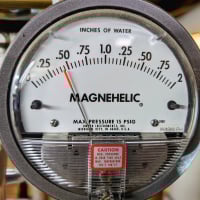 2
2 -
There are magnetic particle catchers used in hydronic systems.
What about centrifugation to separate water and oil? No need to add water at each skimming.
(I know there are system to remove a little bit of water from fuel and here it is the other way around).
A circulator would be needed.
0 -
Separating water from fuel is easy, its just a cup that the fuel flows through. The water drops to the bottom of the cup while the system is in operation. I would say getting the oil off the top of the water in a boiler while it is boiling and misbehaving is more difficult.
National - U.S. Gas Boiler 45+ Years Old
Steam 300 SQ. FT. - EDR 347
One Pipe System1 -
The problem is not getting the oil out of the boiler… that's easy and effective, demonstrably so.
The problem is the dispersed oil that was in the carryover and is all over the main, and is taking its sweet time returning home to the boiler. My mean time between skimming and surging went from days to a couple weeks to now over a month.. but it took a good two dozen skimmings and two seasons to get there.
I will say that performance has been fine throughout, no problem with having hot radiators and dry vents.0 -
Part of the reason I skim the boiler 2-3 times during the season is that my MOM vents are stuck open as a result of rust particles carried by the steam. The Ventrites on the other hand are stuck closed, despite the fact that they both have floats. Most of the time washing with water restores them until it doesn’t and I have to buy new ones.
I did get 2 drips installed 3 months after replacing the boiler, but this time, I had the installer use soap to get rid of all cutting oil and had him use minimal amount of goop at the start of the thread along with teflon to minimize contamination from the new joints. This was the second time I used washing soda in the first season.
BTW the skimming protocol I use now is to raise the level of water over the water mark and turn off the boiler while the water is very hot but not steaming. I then drain with the flow adjusted to dump 2 gallons in 35 mins. Earlier, I used to skim for over an hour, reheating the water. In one session I forced a nozzle through the 1.25” tap and washed with cold water at 15psi while draining from the bottom.
All this water used during skimming I drain completely, replace with store bought distilled water and toss in some 8-way for good measure. This gives me a chance to enjoy a well behaved steam system for a few precious weeks.
0 -
Part of the reason I skim the boiler 2-3 times during the season is that my MOM vents are stuck open as a result of rust particles carried by the steam.
Do you mean carried by the carried-over water? After reading this whole thread I hope so. Steam alone doesn't carry particles of rust.
This gives me a chance to enjoy a well behaved steam system for a few precious weeks.
Something weird is going on here and I can't think of what it is but it is not typical.
NJ Steam Homeowner.
Free NJ and remote steam advice: https://heatinghelp.com/find-a-contractor/detail/new-jersey-steam-help/
See my sight glass boiler videos: https://bit.ly/3sZW1el 1
1 -
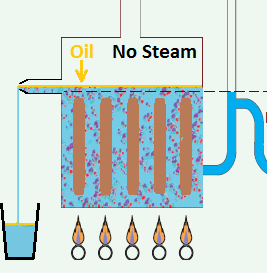
@PhilKulkarni Not sure whats going on with your system. When skimming the water should be kept as hot as possible, but not steaming (no turbulence). The skimming water line should be above any obstructions inside the boiler so the oil's exit path is not obstructed. Some folks use a pipe reducer on the end of the skim port pipe as a Dam to raise the skimming water line.
My boiler has not been skimmed in over 50 years. I wonder if you have too much 8-Way in the boiler.
 National - U.S. Gas Boiler 45+ Years Old
Steam 300 SQ. FT. - EDR 347
One Pipe System0


Categories
- All Categories
- 87.6K THE MAIN WALL
- 3.3K A-C, Heat Pumps & Refrigeration
- 59 Biomass
- 429 Carbon Monoxide Awareness
- 124 Chimneys & Flues
- 2.2K Domestic Hot Water
- 5.9K Gas Heating
- 119 Geothermal
- 168 Indoor-Air Quality
- 3.8K Oil Heating
- 78 Pipe Deterioration
- 1K Plumbing
- 6.6K Radiant Heating
- 394 Solar
- 16K Strictly Steam
- 3.5K Thermostats and Controls
- 56 Water Quality
- 51 Industry Classes
- 50 Job Opportunities
- 18 Recall Announcements