Welcome! Here are the website rules, as well as some tips for using this forum.
Click here to Find a Contractor in your area.
If our community has helped you, please consider making a contribution to support this website. Thanks!
No Header, No Equalizer, No Problem!
So many people come here with various real steam problems and we always say "show us pictures of your boiler's piping". Then we tell them all the things wrong with their boiler piping. And we often tell them they need to have expensive repiping performed.
But are we doing them a disservice?
It's become more and more apparent to me that perfect boiler piping just isn't necessary to have a perfectly fine steam system. This is not new thinking! All the old timers have seen boilers with outrageously bad piping that just seem to work.
It has become clear to me that the much more important aspect is water quality.
Watch the video that I made today and see what you think.
NJ Steam Homeowner.
See my sight glass boiler videos:
https://bit.ly/3sZW1el


Comments
-
Your videos are awesome!
Wouldn't that S curve at some point completely fill out with water??
»»» See my steam heat YouTube videos:
https://www.youtube.com/@HeatingBlog1 -
Thanks! I shared your concern in the video and we'll have to see the next video to get the answer on that!
But more importantly, what did you think about my findings and thoughts about the piping?
NJ Steam Homeowner.
See my sight glass boiler videos: https://bit.ly/3sZW1el0 -
In general I think your findings are fine — although I'm much less concerned about water quality than I think you are.
As a friend of mine who does towing has said, there are many ways to get to 10. That applies to steam. In my view, while there are preferred ways to do things — particularly in near boiler piping — so long as the basic principles are there the thing will work. What are these? There has to be provision to allow any carryover splashing to get bacck to the boiler without getting into the steam mains. Lots of ways to do that. There hase to be ways for air to get out of the steam mains and radiators. Lots of ways to do that. There have to be ways for the condensate to get back to the boiler reasonably freely (I expect well over half the problems we see are here). And there has to be a small but controlled pressure difference to allow the steam and air to move.
That's it.
Br. Jamie, osb
Building superintendent/caretaker, 7200 sq. ft. historic house museum with dependencies in New England 1
1 -
Weather it is steam or anything else one of the most difficult things for me at least is to go into a cobbled up job where they are having problems and it looks like it was piped by a bunch of monkey's. Usually looks like crap, the pipe sizes may be wrong, it may be the wrong material (copper) the wrong size boiler etc etc.
Where do you start is the difficult thing.
If you a building owner or homeowner you can piecemeal the thing and take all the time you need to try this or try that and try to make it work.
But if your a contractor you can't do that. Labor prices are too high (not to mention the material). If you go in and try and tweak it and it doesn't work then you get called back so you try something else and that doesn't fix it either.
Now the customer gets the bill and explodes because it still isn't fixed. Better to go in and fix it get in get out get paid,
No win situation sometimes.
If you fix it and they pay a big bill (yeah that sucks) but if its fixed in the long run they will say "yeah it cost a lot but its fixed"





 7
7 -
then you have ones where it looks more or less ok but still has a problem like that 2 pipe system someone posted a couple months ago where there must have been enough steam velocity to keep the condensate from following the pitch in a counterflow main.
1 -
@ethicalpaul Great video, I wish I had that drive and motivation.
I think on a forum like this best practice should be to promote best practice. Will steam heating still work with near boiler piping that is not optimum, we all know it will. To me when troubleshooting any system, steam, electrical, etc. observe all the deficiencies, oddities and defects, deal with the easy, quick, inexpensive stuff first like obvious poor water quality, pipe pitch, see where it leads.
At the time of installing a new boiler best practice should be to promote best practice.
National - U.S. Gas Boiler 45+ Years Old
Steam 300 SQ. FT. - EDR 347
One Pipe System4 -
First of all, let me say, I admire your tenacity creativity and exploring the arcane world of steam boilers. 💨
In my world the OEM requirements for configuration are gospel unless signed off by a the OEM FAI. I understand that low pressure residential steam boilers can operate under non-optimal configurations but I agree with @EBEBRATT-Ed and @109A_5 that excluding elements of the recommended OEM configuration exposes contractor to risk and liability.
1 -
Are you all under the impression that I am saying that installation instructions should be ignored? (this is an honest question, I can't tell! 😅)
I’m not sure why people keep hearing this.
I’m talking about how best to assist people who come here with issues.
I have shown that most piping errors do not prevent good operation, but rather, it is water quality that is the root cause.
NJ Steam Homeowner.
See my sight glass boiler videos: https://bit.ly/3sZW1el 2
2 -
Confusion reigns! (What else is new?). No, I don't think you are saying installation instructions should be ignored, @ethicalpaul . At least I don't read it that way. I think that what you are doing is exploring some fascinating corners of steam heat — which, as I have said before but without the hand-on fiddling yuo are doing, is incredibly forgiving.
I think it's clear enough that if you are installing a new boiler, you'd , be slightly nuts not to follow the manufacturer's recommendations — as an absolute minimum (you'd be amused at the overkill we did when installing Cedric).
Where it gets difficult is, as the folks above have said, is where you are dealing with an existing installation which is having problems. This becomes a judgement .call, and has to be based on a combination of experience and overall cost, as much as anything. Sometimes the best approach is to rip the whole thing out and start all over. Each situation will be a new challenge.
Br. Jamie, osb
Building superintendent/caretaker, 7200 sq. ft. historic house museum with dependencies in New England 3
3 -
@ethicalpaul My compliments on another nice video.
Dry steam for definition purposes may equal the least amount of water vapor where wet steam would have the most before it changes state back to water. When steam and condensate travel in the same pipe it is a counterflow system changing state as the temperature changes in that pipe.
When I see a video like this I tend to think that I have customers, manufacturers, and inspectors and payroll to satisfy when changing and piping a steam boiler. I have to get it right. These videos give me some grace in thinking that I might have some leeway in the process. However, to satisfy the above I am bound by rules that work in the customers favor and there for my own. Again liked the video, heck, all of your videos.
3 -
You fill the “10th Man“ role for the residential steam community, challenging assertions so we don’t fall into group think!
3 -
Technically, dry steam equals superheated steam—that is, steam with no water content at all. (but maybe not)
To make the point more clear, I go back to the definition of a BTU. One BTU is the amount of energy necessary to raise one pound of water by one degree Fahrenheit. We know that when water reaches 212°F, it will turn into a gas at sea-level atmospheric pressure.
To turn an entire pound of water from 212°F liquid to 212°F gas, it requires 970 BTU of energy. So when you add one more BTU of energy to that pound of water, the steam becomes superheated gas. That would be dry steam.
If you have a container (a boiler and radiator connected with pipes is effectively a container) and there is any amount of liquid water present, then you do not have superheated steam. By definition, you have wet steam.
If this were any other substance (like a refrigerant), we would say the system is saturated. The liquid is at the boiling point and the vapor is at the condensing point at the same time within that container.
To follow up on (but maybe not) We treat steam a little differently from other elements and compounds for some reason.
Dry steam is actually saturated steam with little or no liquid water carried with it. That is what we are trying to achieve in a steam heating system. We do not want to make superheated steam that stays superheated. We want to make steam that is as close to 100% vapor as possible as it leaves the boiler, and then have that steam condense back to water when it reaches the radiator so we can reap the benefits of all that heat energy in the rooms of our buildings.
At that point we want the steam to condense and give off all that heat into the rooms. The goal is for the piping system to deliver that saturated steam from the boiler to the radiators with as little energy loss as possible.
So, to be more clear about “dry steam,” we are really looking for what Paul is calling “wet steam” with as little “wet” in it as possible.
We still use the terms wet steam and dry steam the way they were used historically, back when the science was not widely understood. The average steam fitter knew that you needed a clean water surface, clean water, and large boiling surfaces to get the job done.
The detailed science of steam only became necessary when a problem appeared and someone needed to analyze it more deeply. So we use the term dry steam when we actually mean saturated steam that is almost completely a gas, even though we have found the science that defines our antiquated terms to be incorrect.
We still use many terms incorrectly, like sunrise and sunset, when we now know that the sun is not doing any moving at all to create that phenomenon. And a Shooting Star is not really a star at all, but we still use that term.
Edward Young Retired
After you make that expensive repair and you still have the same problem, What will you check next?
 4
4 -
Thanks @Jamie Hall and @PC7060 and others, you get me 😂
I did want to reply to one thing Jamie wrote:
Where it gets difficult is, as the folks above have said, is where you are dealing with an existing installation which is having problems. This becomes a judgement .call, and has to be based on a combination of experience and overall cost, as much as anything. Sometimes the best approach is to rip the whole thing out and start all over. Each situation will be a new challenge.
But I think I'm showing that there is really almost never any need to rip anything out and start over (at least until the next boiler replacement). I will assert that almost any boiler installation will make good steam as long as the water quality is good.
Look how good my steam is in this video with a direct 1-1/4" pipe directly from the boiler to the main. Heck, even that ridiculous S-curve isn't causing any fuss. This is because my water is good. If I put a tablespoon of oil in there I would have a main full of liquid water.
NJ Steam Homeowner.
See my sight glass boiler videos: https://bit.ly/3sZW1el 2
2 -
Curious.
Does anyone have the installation manual to an Ideal Red flash boiler for steam? I wasn't able to find one last time I tried.
There's a reason I'm asking and it relates to this thread I promise. I'm not that senile yet.
Single pipe 392sqft system with an EG-40 rated for 325sqft and it's silent and balanced at all times.
 4
4 -
@EdTheHeaterMan 's comments up there on "dry" and "wet" steam are absolutely correct, and thank you for going down that rabbit hole. I've caused enough trouble with comments on naming returns that I didn't want to…
Saturated steam — which is all we ever work with in residential use — has some fascinating properties, but being an ideal gas or even close isn't one of them. This can cause all kinds of merriment when people try to treat it as such…
Br. Jamie, osb
Building superintendent/caretaker, 7200 sq. ft. historic house museum with dependencies in New England2 -
No, I don't think you mean anyone should ignore the boiler MFG instructions at all.
If you thought that you wouldn't have a pristine boiler. You're looking at a bad install and trying to figure out the most important thing to fix….most bang for the buck.
I haven't watched the video yet but am looking foreword to it on my day off……but that's another story
1 -
I have did not watch the video yet. But, of course, I trust your summary (you are ethical afterall). To summarize, there are two ways to keep water out of the steam piping and radiators. Clean water or proper piping. Achieving clean water, and maintaining clean water, can be a lot harder than it seems. As we all know, boilers often need multiple skimmings and/or flushings, to achieve properly clean water. And there's no guarantee that it will stay clean. There is stuff washing in through the returns. Many boilers, are fed on a somewhat regular basis. Whatever that means. The feed water can often be various degrees of contaminated. And most homeowners, are really clueless. Which is fine. Most people are clueless about industries that they are not involved in. Which is why we have varying industries and we don't just have everyone doing everything by themselves. It is not necessarily cost-effective, to hire professionals for multiple visits, to clean boilers. Just some food for thought. A one-time repipe, with a basic skimming and flushing, might be a more cost-effective and a more true blue method
0 -
I sure hope no one's portable water has oil in it?
Single pipe 392sqft system with an EG-40 rated for 325sqft and it's silent and balanced at all times.
1 -
Have you guys been sneaking into my basement? It sounds like you're describing my boiler! 45 year old Peerless that is way oversized. No header, no equalizer, no hartford loop.
I've contemplated re-piping it myself multiple times but I'm not sure if it is worth the effort. The system works pretty good and doesn't give me much trouble. Would I have dryer steam? Maybe. Would the system heat up quicker? Maybe. Would I save some fuel? Maybe. Would I damage the 45 year old boiler trying to take apart the old pipes? Maybe.
Two risers. Each one goes to its own main. No equalizer, no header. Single pipe counterflow. System works great!
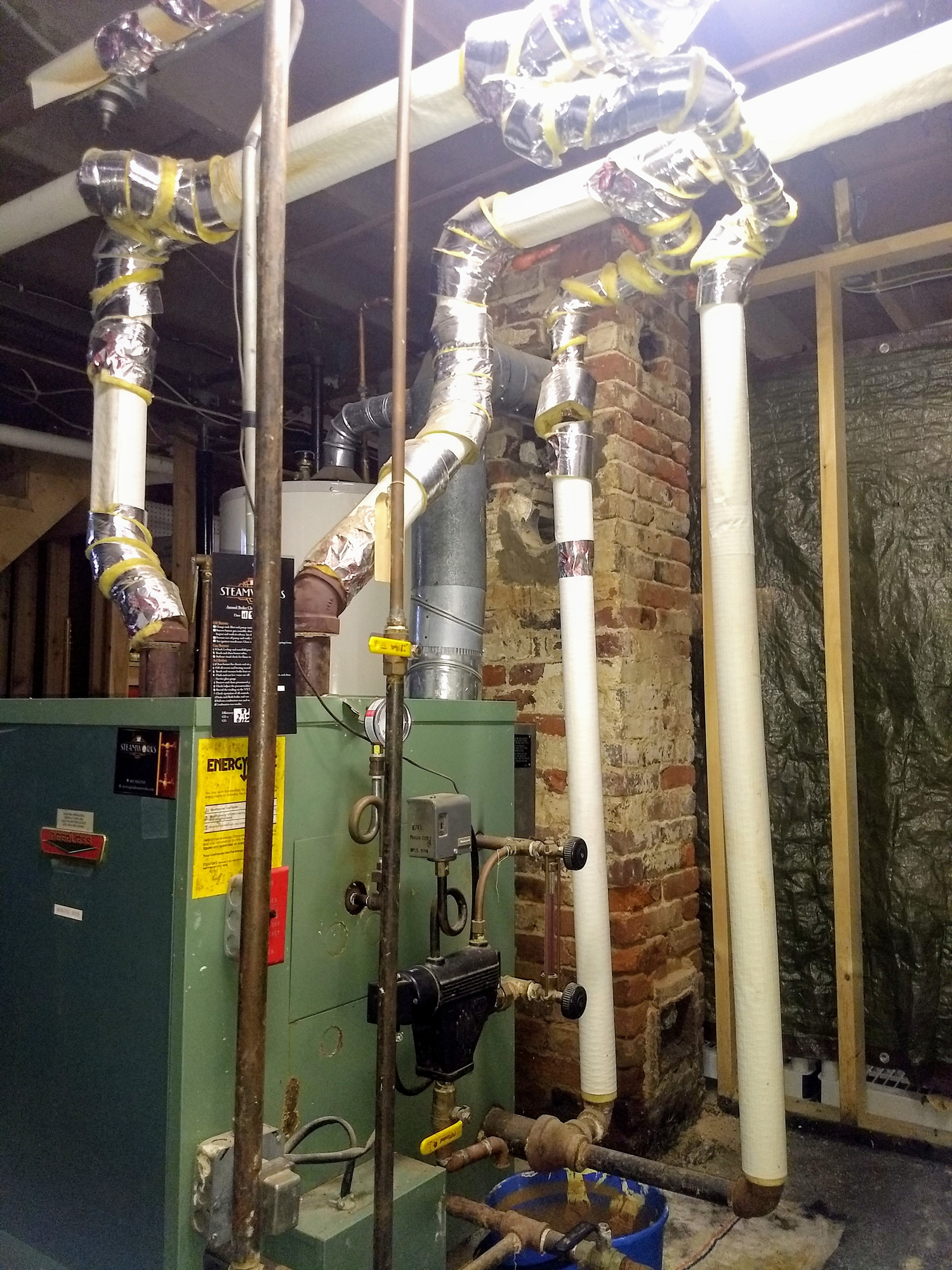
 2
2 -
Would I have dryer steam?
No.
Did you watch my video? My system now looks like yours 😂
NJ Steam Homeowner.
See my sight glass boiler videos: https://bit.ly/3sZW1el0 -
A lot depends upon the velocity at the takeoffs, even with pristine water quality. What is the evaporation rate spec for your boiler in GPM and Net Steam Output in Btu/hr and what are the sizes of those 2 takeoffs? Dan recommends 15 fps or less as we know and says that boiler manufacturers stopped being able to achieve that at some point due to AFUE requirements which forced smaller boilers with smaller outlets. I would say that 15 fps guideline would have to be even stricter (maybe 10 fps to 12 fps?) in a counterflow situation like yours, and the recommended main pipe sizes are one size larger for counterflow vs. parallel flow and that is of course with an equalizer which you don't have. You do have drips though, which is a good thing!
 1
1 -
A lot depends upon the velocity at the takeoffs, even with pristine water quality.
Evidence shows that not much depends on the velocity at the takeoffs. The failure point I saw had nothing to do with velocity and had everything to do with increase of pressure in the boiler. When velocity increases, condensate is indeed pushed harmlessly to the main, but water is never "sucked out" as we have repeatedly read and been told (but never shown) occurs.
If @AdmiralYoda 's pressure is remaining nice and low at least until his vents start closing, then he is fine. His takeoffs would have to be on the order of 1/2" each before he saw any problem.
NJ Steam Homeowner.
See my sight glass boiler videos: https://bit.ly/3sZW1el0 -
@ethicalpaul That is an old picture but I've installed a vaporstat as the primary pressure control with the pressuretrol being the backup. 16oz cut-out and about 4oz cut in. It does cycle on pressure during long calls for heat due to being oversized but I'm fine with that.
I've reduced the cut-out down to 10oz and the system works just fine but it cycles a lot which annoys me.
1 -
If you're going to do it, do it right. If someone else did it poorly and it's not working properly it's our job to make it work properly within the owners budget. I get your point @ethicalpaul and love your videos. The proof is in the pudding. We've all been to terrible rotten ugly installs that are working, Have been working for years.
Miss Hall's School service mechanic, greenhouse teacher, dog walker and designated driver
0 -
If you want to pull water out it's easy. Close your supply and return valves and let pressure build then open the valves wide open.
Single pipe 392sqft system with an EG-40 rated for 325sqft and it's silent and balanced at all times.
0 -
That's not the same. That's the entirety of the water flashing to steam just like in the Weil-McLain videos.
NJ Steam Homeowner.
See my sight glass boiler videos: https://bit.ly/3sZW1el0 -
That's where I got the idea.
To be fair I think it's a common situation in large commercial boilers. Might also happen with zone valves.
Single pipe 392sqft system with an EG-40 rated for 325sqft and it's silent and balanced at all times.
0 -
Sure if the owner has extra cash around and wants to do it that's great, but as in @AdmiralYoda 's case, it's completely optional since good operation can be achieved without all those parts and labor. I wouldn't feel right telling a homeowner they must do something when their system could work well without it.
NJ Steam Homeowner.
See my sight glass boiler videos: https://bit.ly/3sZW1el1 -
My focus is residential. There is all kinds of crazy stuff that is different in commercial.
NJ Steam Homeowner.
See my sight glass boiler videos: https://bit.ly/3sZW1el0 -
@Grallert said: "The proof is in the pudding"
Now who is putting pudding in their steam boiler?
Putting Pudding in piping isn't possible to perpetuate proper placement of peaceful pleasant poaching of passageway, pantry or penthouse from your steam boiler to the radiators.
Edward Young Retired
After you make that expensive repair and you still have the same problem, What will you check next?
1 -
I agree. It's counter productive to bring up issues or critique an installation if the problem is elsewhere. You know, have someone repiping a boiler is expensive and if it's not the issue and is financially out of reach leave it.
Miss Hall's School service mechanic, greenhouse teacher, dog walker and designated driver
1 -
You know if I don't say it someone else will and it'll be skewed in some way or another.
Single pipe 392sqft system with an EG-40 rated for 325sqft and it's silent and balanced at all times.
1 -
I still want to know, "Who is puttin' puddin' in pipin' of steam boilers @Grallert. I hope it isn't @Peter Piper
Edward Young Retired
After you make that expensive repair and you still have the same problem, What will you check next?
0 -
It's @ethicalpaul 's pudding and he's proving it :)
Miss Hall's School service mechanic, greenhouse teacher, dog walker and designated driver
2 -
Don't let it annoy you too much. As long as the pressure is remaining above zero then you aren't having to purge any air from your system and be so happy you aren't burning fuel unnecessarily. Oil may be different but a gas valve is good for 100K+ cycles and doesn't cost THAT much.
NJ Steam Homeowner.
See my sight glass boiler videos: https://bit.ly/3sZW1el0 -
I use butterscotch because it makes the house smell amazing.
1 -
So, @AdmiralYoda What is your net boiler rating, maybe 77,000 BTU/hr and 0.158 GPM and you have two 2 in. takeoffs?
If so, your velocity should be around 12.6 fps at 0psig, which is good, assuming you have equal distribution to the two takeoffs. That is quite a bit less than Dan's 15 fps or less for "dry" steam.
On the other hand, in Paul's experiment, where you could see wet steam in the sight glasses even with pristine boiler and pristine water, he would've had about 39.4 fps at 0psig !! That's for a single 1-1/4 in. takeoff with 0.11 GPM evaporation rate which is the rating for the 63-03L. That's way way over Dan's target of 15 fps or less.
Using 2 psig (vs. 0 psig) would be less then 5% less than these figures.
1 -
Old Peerless G-461
It says Max Btu Input Per Hr: 120,000
Gross Output BTU/Hr: 97,000
Net 305 sq.ft. of steam
IBR: 72,800 BTU/Hr Steam.
I have about 210-ish Sq ft of EDR connected to the system.
0 -
you don’t see wet steam in my video, except that it’s all wet having come from a big pot of water just a few inches below it.
The liquid water you see is condensate collecting in the fittings that is no different than the condensate that is forming and flowing in every pipe of every steam system
NJ Steam Homeowner.
See my sight glass boiler videos: https://bit.ly/3sZW1el1







Categories
- All Categories
- 87.8K THE MAIN WALL
- 3.3K A-C, Heat Pumps & Refrigeration
- 60 Biomass
- 430 Carbon Monoxide Awareness
- 133 Chimneys & Flues
- 2.2K Domestic Hot Water
- 6K Gas Heating
- 124 Geothermal
- 170 Indoor-Air Quality
- 3.9K Oil Heating
- 79 Pipe Deterioration
- 1.1K Plumbing
- 6.7K Radiant Heating
- 397 Solar
- 16.1K Strictly Steam
- 3.5K Thermostats and Controls
- 56 Water Quality
- 51 Industry Classes
- 51 Job Opportunities
- 18 Recall Announcements