No Header, No Equalizer, No Problem!
Comments
-
You can ignore good piping practice all over the place, and many of your jobs will work.
Some will work fine.
Some won't.
Some will be more costly to run than if they were piped properly.
Some will hammer.
Some will partially heat.
Some won't return condensate.
We see this all the time in the field. Few fitters pipe these systems properly these days. We fix these problems all day long. They pay my bills.
From a commercial and professional standpoint, knowing what will work properly and what will cost extra money with no return is important in pricing your work and protecting your reputation. Cutting corners or working efficiently? Call it what you want.
This is an interesting thread.
 1
1 -
the point of the video and the thread is not to promote non-recommended piping
It’s to provide better advice to homeowners who may have existing not great piping.
I’ve shown that absolute crap piping performs fine with good water quality.
NJ Steam Homeowner.
Free NJ and remote steam advice: https://heatinghelp.com/find-a-contractor/detail/new-jersey-steam-help/
See my sight glass boiler videos: https://bit.ly/3sZW1el2 -
Define "performs fine". In your video you said "everything's fine". One of the most important things to the persons paying the bill is fuel efficiency. Like I said in your video comments why don't you take it further and do some measurements of fuel efficiency? It may be a bit late in the season for this now but you would keep it going for an entire billing cycle and compare to the same month last year accounting for degree days. Solar insolation matters too but I don't know how you'd factor that in or get the data. If you do this you would prove your claim that no BTUs are lost. It would also be interesting to put your thermal imaging camera on a tripod and capture video of a radiator over a full boiler cycle for comparison for when you switch back to your overbuilt double takeoff drop header installation with 9.2 fps velocity.
Also, your water quality and boiler are pristine to a level that is simply not realistic when compared to the situations that are out in the field. You used distilled water and 8 way from day one of this installation. Your TDS and TSS are practially nill. You should throw some iron oxide particles into the boiler to simulate 50 to 100 ppm TSS that is probably very common in people's real world installs and with the lack of maintenance that is rampant out there.
 1
1 -
There is a fire under my boiler.
17% of the energy goes up the chimney.
83% goes into the boiler water.
When the boiler water gets to 212F all that energy makes steam.
The steam can only go into my pipes and radiators.
There is no possible loss in efficiency.
If you can show such a loss, do it. I can’t because it’s not there.
NJ Steam Homeowner.
Free NJ and remote steam advice: https://heatinghelp.com/find-a-contractor/detail/new-jersey-steam-help/
See my sight glass boiler videos: https://bit.ly/3sZW1el2 -
He has a cast iron boiler full of water that is getting distilled water returned from 100 year old radiators, you don't think there's iron in it?
I'm not sure about Paul's, but my boiler full of Steamaster still ends up with a rusty film on the gauge glass after winter, I assume from the water returning from the radiators, and probably some from the boiler too. All the water treatment in the world isn't protecting everything above the water line.
Single pipe 392sqft system with an EG-40 rated for 325sqft and it's silent and balanced at all times.
 1
1 -
And you said something similar to the person @MikeC_3 whose mother's house was experiencing very historically large bills and he correctly diagnosed it as a main venting problem. That was apparently causing her boiler to run longer to satisfy the thermostat. When he replaced the main vent the problem was solved and her bills plummeted. I know it isn't the exact situation and I am not saying it is but it proves that the "no Btus lost" mantra is faulty and overly simplistic when it comes to fuel efficiency of heating the house.
 0
0 -
my water is clean but no cleaner than lots of others out there. I didn’t use distilled from day one. I have fouled it several times for experiments. Anyone can get clean water, and a lot cheaper than a repipe.
But all that is irrelevant. Even with bad water, even with carryover, the BTUs still go into the system and are not lost.
Balancing might not be ideal but the house gets all the heat.
NJ Steam Homeowner.
Free NJ and remote steam advice: https://heatinghelp.com/find-a-contractor/detail/new-jersey-steam-help/
See my sight glass boiler videos: https://bit.ly/3sZW1el1 -
I have monitored this forum for almost 3 years and I have read statements about how persons make various claims about efficiency, water quality, steam output, ect. I have questioned many of these claims because I know from experience that few have the equipment or the training to make such assessments. I got into a dispute with a heating contractor who I replaced in my Coop. I own Data loggers [Temperature, pressure, current ect.], Combustion Analyzer [commercial grade], Soot tester, Ultrasonic Flow meters. What did he have? Even with all of this equipment and training in test and measurement, I am reluctant to make some of the claims that I have seen in this forum.
3 -
Thank you for your comment and allowing me to clarify since you didn't understand me. He probably has much lower ppm of TSS and TDS than the typical boiler out there and I believe he has, with the exception of a few brief experiments (which were cool), used 8-Way and distilled since install time. He has said that his one pipe steam system has totally clear water coming out of his returns. That is a far cry from the mud that comes out of mine even though I have on my best behavior in maintenance the past few years. What I am saying which you somehow didn't get is that until ppm of TSS gets up around 50 ppm and above, there is usually minimal problems which would present themselves as wetter steam initially. 100 ppm and above is said to probably cause carry over. Have you measured paul's TSS in his boiler? What is it? Most people who replenish lost water with municipal water have ever climbing TDS in the boiler. I only recently stopped using my municipal water which has total hardness of 382 ppm.
0 -
I am also misunderstanding, you are disagreeing with Pauls point that water quality is important in a steam system by arguing that his water quality is so good that it doesn't cause him problems? So it would certainly seem that you agree with the original claim Paul made? You are in agreement that most steam boilers have poor water quality that causes them potential issues?
"It has become clear to me that the much more important aspect is water quality."
I'm unsure what exactly you are in disagreement about
2 -
You'd think fixing the water would be much easier than repiping a poorly installed boiler.
Single pipe 392sqft system with an EG-40 rated for 325sqft and it's silent and balanced at all times.
3 -
I explained myself clearly I believe, 2 comments above this one. You might have read it because you disagreed with it.
0 -
Agreed and that is what I have done. I no longer have dirty boiler water spewing out of my 1st floor radiators, which happened beginning of last season. The worst of my two mains actually is actually fed by a more or less a vertical run with undersized 2 in. copper pipe and the undersized 2 in. header leading to the larger main teed off of it and the equalizer. That's the one in my 63-04L that is most prone to carry over. I am hoping my steam is pretty dry with the distilled water and 8-Way plus diligent draining and flushing every season beginning. My sight glass is moving up and down less than 1/4 in.. At the beginning of this season, even with the distilled plus 8-Way it was starting to carry over as proven by the plummeting sight glass and pressure on the gauge well before any radiators got steam and draining along with multiple back flushes of the boiler and the returns fixed the problem again. I caught it before anything spewed from the radiator in question but it was not heating.
0 -
I'm glad we agree that even with bad piping you can get good performance simply by improving your water quality.
NJ Steam Homeowner.
Free NJ and remote steam advice: https://heatinghelp.com/find-a-contractor/detail/new-jersey-steam-help/
See my sight glass boiler videos: https://bit.ly/3sZW1el0 -
Yes we do agree on that point, although I have gone to extreme measures by only using preboiled rebottled distilled water with 8-way, for initial fill and makeup water. That is something that very few will do and no boiler mfg's installation manual even hints that it may be advisable in some cases where the TDS of the municipal water is excessively high and the particulate contamination makes the TSS too high during normal operation due to the dirty 100 year old radiators and pipes.
The caveat is that I do not know if I have dry steam, aka less than 2% liquid. I do not know what my fuel efficiency improvement might be if I had proper, or even overbuilt, near boiler piping like you have. For me to say "good performance" the steam needs to be dry and fuel efficiency matters. That's where we differ and I totally disagree with the "no btus lost" mantra.
0 -
I disagreed with that comment specifically because you are asking Paul to make his water "dirty" to show that the system will work less effectively with bad water, which is the entire claim Paul has made from the start, again you seem to be fully in agreement that poor water quality is an issue.
0 -
I was making a point that it will make the steam wetter, which should show as even more fogginess in the interior volumetric space of his sight glass and would be more realistic compared to people's real world systems in their houses who don't go to his and my extremes with water. He has done it before, as in adding oil. I wasn't suggesting that and it is entirely up to him. Adding iron oxide would be less damaging to the system and is pretty easily flushed out. He picks his experiments. I have said that a scientist makes the proper "measurements" to back up their claims, or even see if they can disprove them.
0 -
Yes we do agree on that point, although I have gone to extreme measures by only using preboiled rebottled distilled water with 8-way, for initial fill and makeup water.
I don't think you have to go to that extreme, even though I personally do just to keep introduced chemicals and minerals to a minimum.
Out of the dozen or so people's boilers I have seen, I haven't seen one that didn't perform well after getting the water into shape.
Water situations that Paul thinks can work, including caveats:
- Plain old household water (caveat: it will get muddy and eventually could carry over requiring drain and refill—but it will certainly work)
- Plain old household water plus 8-way (caveat: it has to be clean before you bother adding 8-way, then mud (corrosion) production will be greatly reduced—it will work very well for a long time)
- Preboiled distilled water (caveat: I think it will produce less corrosion than plain household water, but more than 8-way treated water)
- Preboiled distilled water plus 8-way (caveat: it will just plain work for an indeterminate amount of time, like a long time!)
Water situations that have to be remedied:
- Oil in water. Causes carryover (I don't say "wet steam" because it's confusing). Skimming required.
- Really brown mud water. Can cause carryover and certainly can if 8-way is added. Can cause sediment to form on the lower parts of boiler. Drain and refill required.
- Some treatments might counter-intuitively cause carryover. I have a video where Surge-X did but I can't be sure there wasn't something in my boiler that combined with it…but Surge-X is supposed to reduce surging, not increase it, so regardless I do think some additives aren't great. Drain and refill required.
The road to clean water can be bumpy. Even boilers with water that looks clean in the gauge glass can have built up sediment or scale that will then get freed up by 8-way. If this happens you may have to drain and refill then retreat with 8-way and perhaps repeat that process.
I have said that a scientist makes the proper "measurements" to back up their claims, or even see if they can disprove them.
I'm not a scientist, but another thing that scientists do if they disagree with another's findings is to run their own experiment to disprove it.
NJ Steam Homeowner.
Free NJ and remote steam advice: https://heatinghelp.com/find-a-contractor/detail/new-jersey-steam-help/
See my sight glass boiler videos: https://bit.ly/3sZW1el0 -
My experience over the past 21 years has proven otherwise to me. This is the cure (draining and flushing at beginning of season plus distilled water and 8-way only) for a horrible heating season for me, with my 389 ppm total hardness municipal water, 100 year old (probably was lots of carryover) dirty radiators and pipes, 278 ppm chlorides, etc.. People really don't like when you tell them what they have seen with their own eyes isn't true. Not everyone's situation is the same.
0 -
Here's what I said:
Water situations that Paul thinks can work, including caveats:
I am not saying what you saw isn't true, I said what I believe. You would say I'm not allowed my beliefs? I certainly can't blame you for using basically the same practices that I do! Even if I do think that those practices aren't necessary.
NJ Steam Homeowner.
Free NJ and remote steam advice: https://heatinghelp.com/find-a-contractor/detail/new-jersey-steam-help/
See my sight glass boiler videos: https://bit.ly/3sZW1el0 -
Just for laughs.
Cedric — almost old enough to vote now — was skimmed when he was installed. Otherwise he has never run on anything other than pure well water (pH right around 7, moderately hard). Granted, he is beautifully piped (for historical reasons, drop header plus a large steam drum). Also granted, he is a commercial boiler — Weil-McClain 80 series.
I forget the last time he was drained and flushed — was quite a while back — although the MM LWCO is blown down weekly (and, by the way, needs to be replaced — 10 years old and gotten a bit sticky).
I'd watch out for distilled or deionized water — unless inhibitors are added it is remarkably corrosive. And I'd watch out for adding chemicals, unless a buffer is needed for some reason — and then only just enough. Too much is worse than too little in that game.
Br. Jamie, osb
Building superintendent/caretaker, 7200 sq. ft. historic house museum with dependencies in New England1 -
I think we've discussed this before, but my bad memory I can't remember.
If distilled water is so bad, why are most cast iron steam radiators still fine after 90-120? years? And all of the piping as well?
Single pipe 392sqft system with an EG-40 rated for 325sqft and it's silent and balanced at all times.
1 -
Too much is worse than too little in that game.
I do feel bad for Cedric sitting at 7pH!!
NJ Steam Homeowner.
Free NJ and remote steam advice: https://heatinghelp.com/find-a-contractor/detail/new-jersey-steam-help/
See my sight glass boiler videos: https://bit.ly/3sZW1el0 -
@ethicalpaul
I have to disagree with one thing, but I admit I have no way to prove I am right or wrong. People complain about high fuel bills with lack of or inoperative vents. So the "lost" btus have to go somewhere. I have been in basements with lack of venting, and the basements are usually warm, sometimes very warm. Maybe it's from the boiler short cycling on pressure increasing the jacket loss.
Either way they burn a lot of fuel.
Another example of this is I am dealing with a HW system with no vents on the rads and no way to purge it,
This was a converted vapor system so their were no vents on the rads. The guy did the conversion and never put vents on. The system was heating this winter but I had to drain it to move a couple of pipes. I refilled it and it won't heat well. It has a Spiro vent so maybe in time the air will work its way out. It must because it was heating. The house is vacant and I am rewiring it so it isn't a big deal I am waiting for it to warm up to work on the heat. (if it ever warms up this year)
My point of all this is If I turn the boiler on and call for heat it just runs and run and hits limit shuts down and restarts. Same thing with steam . You burn a lot of fuel for nothing the house is cold upstairs and the basement is cold too.
1 -
that’s fine Ed I am not having any argument there. Those BTUs aren’t lost, they are put into the basement.
My problem is with the idea that so-called wet steam can rob heat energy and stash it…somewhere
NJ Steam Homeowner.
Free NJ and remote steam advice: https://heatinghelp.com/find-a-contractor/detail/new-jersey-steam-help/
See my sight glass boiler videos: https://bit.ly/3sZW1el0 -
If Cedric were my boiler, I'd remove the plugs from tappings F2 and P (see the manual), use F2 for a primary probe LWCO (with remote probe if needed to clear the sight glass) and P for the secondary one. Then I'd get rid of the float LWCOs. We install them new that way, since a lot of folks who are not on the Wall don't blow down float LWCOs.
All Steamed Up, Inc.
Towson, MD, USA
Steam, Vapor & Hot-Water Heating Specialists
Oil & Gas Burner Service
Consulting1 -
plus you wouldn’t have to be adding all that fresh water
NJ Steam Homeowner.
Free NJ and remote steam advice: https://heatinghelp.com/find-a-contractor/detail/new-jersey-steam-help/
See my sight glass boiler videos: https://bit.ly/3sZW1el0 -
And some of it goes up the flue and how can you say that was not lost? How is having a higher heating bill not a loss? Many people do not have finished basements that are insulated and energy efficient and lots of that heat is lost to the concrete walls and slab, and leaky energy inefficient windows and it doesn't help to satisfy the thermostat. I realize this will continue to be brought up over and over, no matter how many times it is said. Why tell someone who has non functional main vents that their bill can't be higher because of that because No BTUs are lost?
0 -
That's an area Paul and I disagree on. I feel main vents should be sized by firing the boiler up, letting the system heat and then shutting it down, waiting 5 minutes and firing it again to see how much backpressure there is. There should be very little, 1" WC give or take, with nice hot pipes.
If your venting is slow, pressure will build and there's a very obvious change in the system's behavior. Besides being noisy, annoying and possibly slow, I'm not sure how much it effects efficiency. I'm not sure anyone has ever shown a way to figure it out? My assumption is it's wasteful,annoying and unnecessary.
What actual real world effects does building 2 psig of steam pressure have on efficiency vs free flowing at half an ounce or less?
I would be nice to see some actual real numbers on that vs "It's less efficient". If it's 0.1% less efficient no one's going to care.
Single pipe 392sqft system with an EG-40 rated for 325sqft and it's silent and balanced at all times.
0 -
come now. We all know 17% or whatever goes up the flue. We are talking about the mystery loss from liquid water that is in all the steam that every residential boiler makes.
This thread is not about main vents. You tried to hijack it that way and apparently succeeded
NJ Steam Homeowner.
Free NJ and remote steam advice: https://heatinghelp.com/find-a-contractor/detail/new-jersey-steam-help/
See my sight glass boiler videos: https://bit.ly/3sZW1el1 -
Captain, you're clouding the issue with logic.
You're letting old fashioned facts enter into this…
1 -
I'm sorry, I thought we were on the other thread by AdmiralYoda. The titles are very similar.
I wouldn't have responded had I realized it was this thread.
Single pipe 392sqft system with an EG-40 rated for 325sqft and it's silent and balanced at all times.
1 -
I'll chime in on a couple points:
Regarding the "lost" energy — I agree with Paul, it's going somewhere in the house. It is not lost up the chimney — that portion is accounted for in the efficiency of the boiler itself. The cited example at someone's mother's house, where the boiler ran longer due to a venting issue — it probably went to heat the basement, and out through poorly insulated basement windows.Regarding the water quality vs. piping issue. Again I agree with Paul's basic statement, with some caveats.
First is the "professional" aspect, which @EDEBRATT-Ed brought out on page one. No need to expand on that.
The second is, once you have an oil problem, you're in for long-term issues. I still have issues two seasons into my new boiler. My own fault, and it's getting better, but while I'm working it out, my overdone piping is helping keep things humming along.My only disagreement is with the idea to "just" fix the water quality. Just is a four-letter word.
My sin was that I neglected to wash out my new boiler with TSP. I also added a lot of new piping without washing it. All that oil spread around the system, and skimming only removes a little at a time. Right after skimming, a long heat cycle takes between one-and-a-half and two gallons of water from the boiler. Early in the process, it took a couple, three days for the waterline to recede by 5 gallons and more, after more oil returned from the system. That's carryover alright, and having an "equalizer" helped keep more of it close by. My LCWO has never yet kicked in. Whenever the water gets > 5 gallons low, I skim.
Early this season — the boiler's second — it took two weeks to get to that point. I'm there again, now five weeks after the last skimming. So this is converging, but it's taking two seasons and counting. We have soft water, so I'm just heating it to near boiling and I treat it with 8-way. Rust and sludge are minimal. I hope to get to the point where I'm done skimming forever.
Round numbers, I skimmed a couple dozen times in the first season, and six times so far in the second. That's a lot of wasted energy and water and time.
This was a really long way to say, when a homeowner shows up here with problems, oil in the water can be a long-term consideration.
cheers -matt
1 -
No. I said it was just an example of where you incorrectly told the person "no btus lost" so that can't raise their heating bill. I'm going to again say that, if you are expending fuel in a way that doesn't heat the room as efficiently it takes longer to satisfy the thermostat and we know that every extra minute that you inefficiently operate the boiler in excess of what time you would operate the boiler to more efficiently heat the room and satisfy the thermostat, means that more % of energy in the fuel is lost up the flue because that is a known % loss. That's in addition to more heat loss to the basement which is in most case not insulated or finished and not an energy efficient space which means that heat is in turn lost from the building through the concrete walls, non energy efficient windows etc..
0 -
You definitely have moved around a lot in this discussion. The original point is in my original post for anyone confused about this topic.
NJ Steam Homeowner.
Free NJ and remote steam advice: https://heatinghelp.com/find-a-contractor/detail/new-jersey-steam-help/
See my sight glass boiler videos: https://bit.ly/3sZW1el0 -
All good ideas — I'm ging to pass them along to @Gary P when he comes to clean.
Br. Jamie, osb
Building superintendent/caretaker, 7200 sq. ft. historic house museum with dependencies in New England0 -
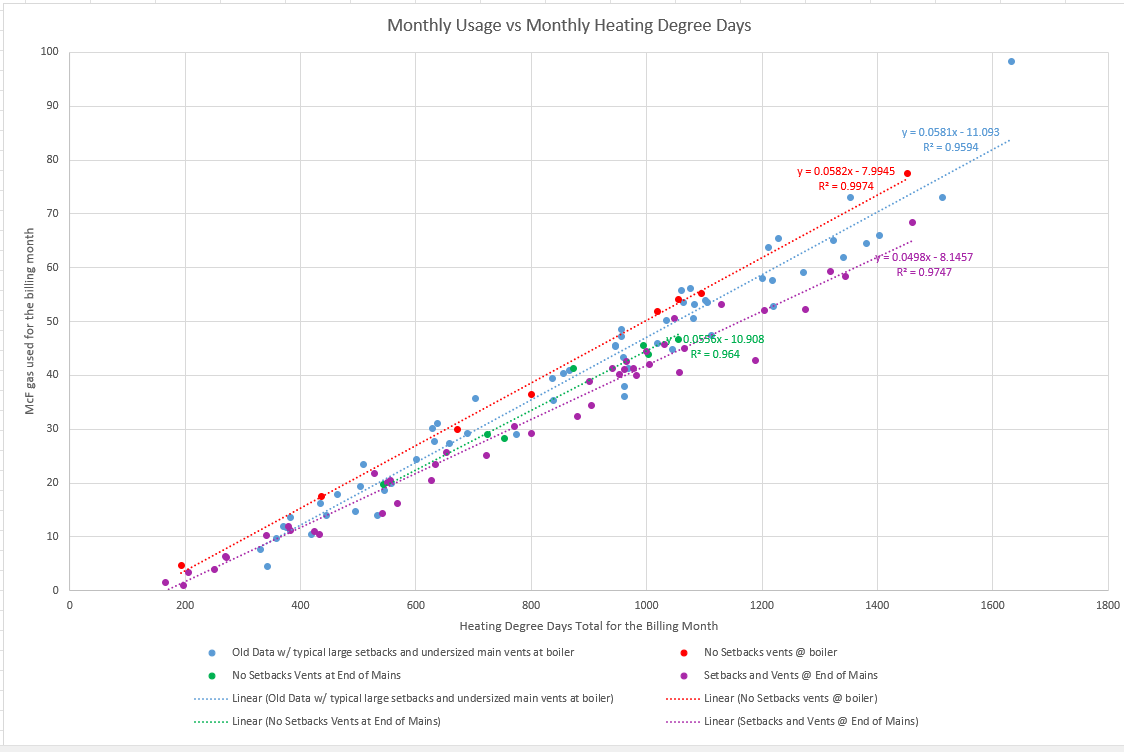
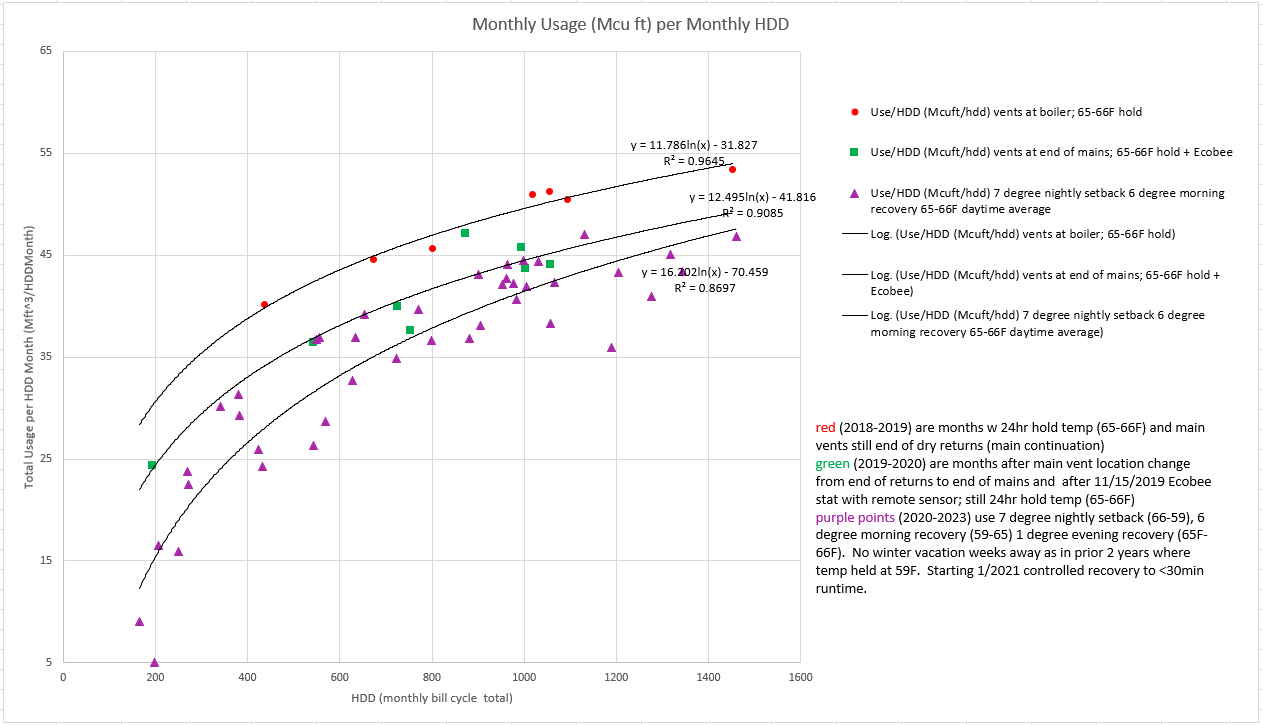
How quickly you get steam to the radiators does indeed improve total gas usage to satisfy the thermostat (I am avoiding the word efficiency here on purpose. As many of you know I have carefully recorded my gas usage vs HDD on a monthly basis for over 15 years now dedicating 3 entire years to comparisons of setbacks and main vent location. Pertinent to this discussion is the main vent location which in my case shortened time to main vent closure and delivery of steam to the runouts. The difference is quantifiable. Unfortunately, I did not have a simple comparison of poor vs good main venting since my main venting changed soon after getting a new boiler, changing my setback process, swapping out a bad sunroom radiator and adding some storm windows. All these factors are subsequently largely unchanged for the period comparing the baseline (no setback and vents at boiler - red) vs no setback vents at end of mains (green) vs setbacks with vents at end of mains. The conclusions were moving the main vents to end of the mains on an average winter month of about 800 total HDD with a constant hold temperature thermostat control I saved about 6 McF of gas use per month vs baseline. Going to a setback with the mains at end of the mains also showed an improvement but it was primarily just on more moderate temperature months with less impact on the coldest months. The two different plot styles below (same data) are used because the second one with the logarithmic curve fits shows the seasonal impact of setbacks more clearly.
If someone has some better data please share.
 0
0 -
@dabrakeman BOOM ! Nice work. Looking at the upper graph, it is pretty indisputable that the least mean squares line representing the Red Dots is definitely above and has higher slope compared to the one for Green Dots (about 10% less for your situation). If only we had some data for wet steam of a known % vs dry steam of a known %. Someone who is industrious enough could definitely do it for "Calculated Takeoff Velocity". Your data certainly disproves the faulty energy conservation argument of "no Btus lost
tofrom the house". 1
1 -
Main venting is not related to this thread.
"no Btus lost to the house". is not what I said at all. In fact I said the opposite.
NJ Steam Homeowner.
Free NJ and remote steam advice: https://heatinghelp.com/find-a-contractor/detail/new-jersey-steam-help/
See my sight glass boiler videos: https://bit.ly/3sZW1el1 -
I do not mean to be picky but when I see anyone making any conclusions using "degree Days" i know they do not understand how to properly analyze any thing involving heating or cooling systems. We have the ability with data loggers at 1 minute intervals and determining average temperature. Also, It is not an easy task to measure the water droplet content of steam in a pipe or "wet steam". I remember a study put out by the federal government involving steam heating systems in 2012. It looked really good until I looked into the data. It was flawed. It did not include: Sunlight window effects, Wind, If windows were opened or closed before or after a baseline was established and the location of the indoor sensors height above floor and distance from the radiators and windows. You must compare data before and after any changes to similar Temperature, Sunlight and wind conditions.
2




Categories
- All Categories
- 87.6K THE MAIN WALL
- 3.3K A-C, Heat Pumps & Refrigeration
- 59 Biomass
- 429 Carbon Monoxide Awareness
- 124 Chimneys & Flues
- 2.2K Domestic Hot Water
- 5.9K Gas Heating
- 119 Geothermal
- 168 Indoor-Air Quality
- 3.8K Oil Heating
- 78 Pipe Deterioration
- 1K Plumbing
- 6.6K Radiant Heating
- 394 Solar
- 16K Strictly Steam
- 3.5K Thermostats and Controls
- 56 Water Quality
- 51 Industry Classes
- 50 Job Opportunities
- 18 Recall Announcements