A word about Design Day and not-so-warm homes.

In the world of Heating and Cooling, there is a temperature that gets thrown into the mix of both longhand calculations and computer models that establish the BTU outputs of all our equipment. It’s called a “design temperature” and it varies as we follow typical climate variations going north and south, and up and down in elevation. In our part of the world in 2026, the design temperature is 13°F.
That means that heating systems are designed to maintain an indoor temperature of 70°F when the outdoor temperature is 13°F.
Efficiency is defined many ways by the different industries that use the term but in fuel-burning boilerspeak, peak efficiency means the boiler runs at 100% of its output at design temperature, and never shuts off while hovering around that outdoor temperature, and combustion is steady with minimal standby or flue losses at the boiler which factor heavily into manufacturers' published efficiency ratings. In other words, the two most *efficient* boiler heating cycles will have the boiler never come on, or have the boiler maintain the 70° indoor temperature by never shutting off. We call that a "Design Day" heating condition.
So, what happens when the outdoor temperature drops below design temperature? Like lots of days these past two weeks? Well for us professionals, the first thing that happens is all our online forums and message boards start blowing up with warnings to each other about trouble coming, and stories of engineers on current projects nervously considering supplemental heat sources in their designs.
But the bottom line is design temperature is often an average of the ten coldest days of the year and it is well known and expected that there will be be a handful of days colder than the median or average cold day. And so it is accepted that the internal ambient temperature of some of those structures operating on design have the potential drop below 70°. Does that sound like a failure? Maybe. But what you have to consider is that aside from the heating system, there are plenty of other things in the home or building that give off heat to the space. Cooking a pot of stew adds heat energy to a space for hours. Lights, TVs, computers, cable boxes, solar gain, hair dryers… all these things being in place or running add BTUs to the home and take some of the onus off the boiler or furnace. So, this high-design-temperature-vs-low-outdoor-temperature thing is rarely ever an actual problem. To design a home heating system with significantly higher heating capacity, or to change the design temperature to 5° or less will often change the design greatly, increasing installation costs substantially and operating costs permanently.
If you feel you are getting close a to problem caused by low outdoor temperatures versus your system’s design, you would be well advised to do what you can to close that gap. Literally. A tight building envelope will outperform even the most highly efficient of boilers and furnaces. You heat your home only with the BTUS you keep inside. The rest are gone instantly and forever. A lot of words for a Sunday morning but I hope this helps someone.
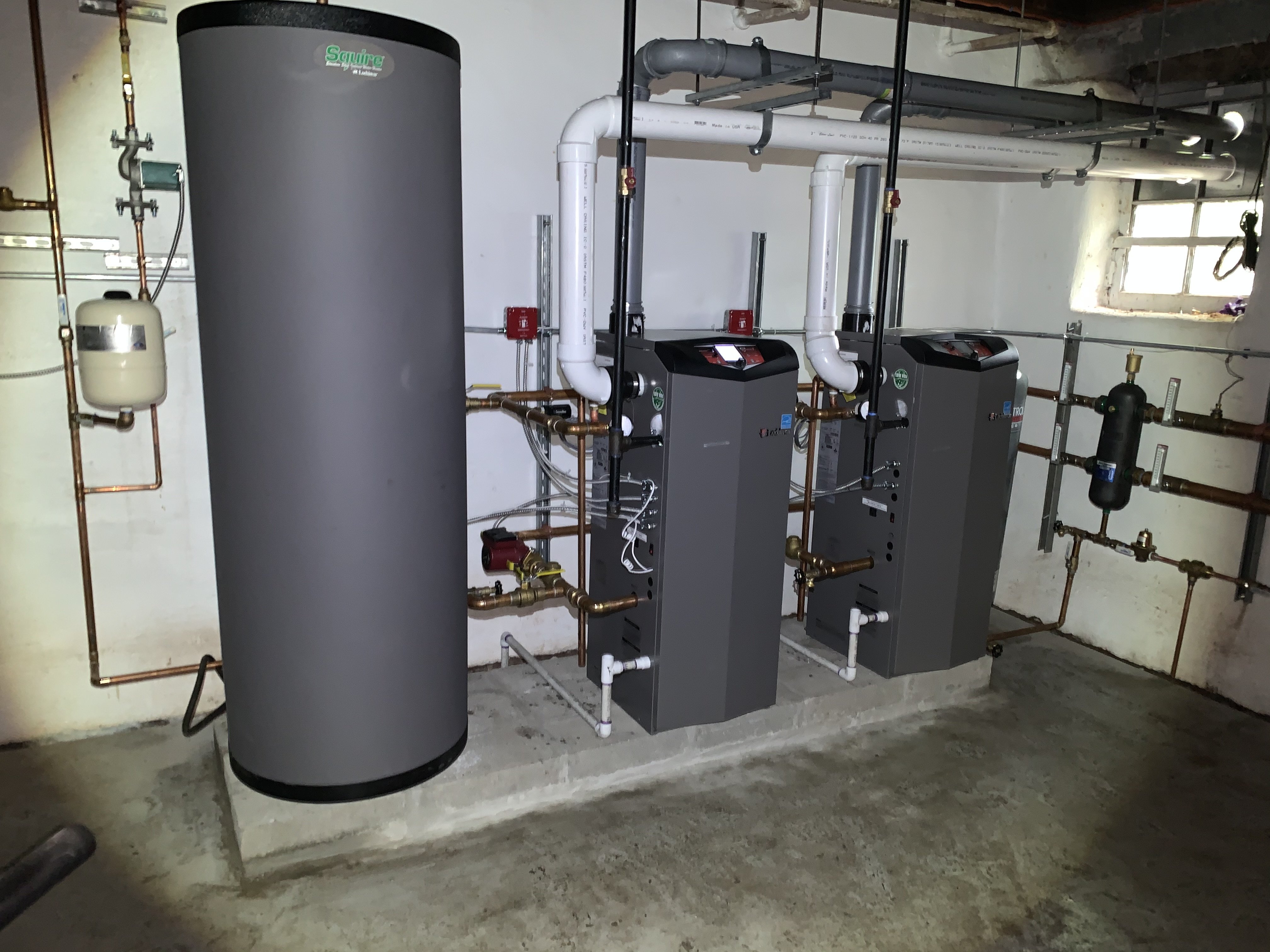
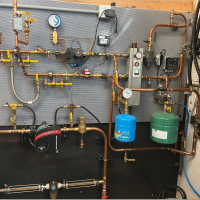
(In the photo below, two boilers provide redundancy to make heat and hot water. Multiple smaller boilers tend to burn fuel at higher efficiency than a single larger one due to something called "turn-down-ratio" limitations so each of these units is sized for 75% of the home's peak demand. If the primary boiler can't meet the target temperature, the secondary unit kicks on at 10% intervals. The full capacity of both boilers being 150% of the demand means the home's heating zones are always satisfied in the most efficient way possibly.)
Consulting & Troubleshooting
Heating in NYC or NJ.
Classes







Comments
-
Usually the only time I've seen a properly sized system not keep up on design day is when there was a power outage. The indoor temp fell maybe 10 degrees or more before power was restored and it took a very long time to get back up to temperature. Happens more on hydronic systems then forced air.
I try to remind customers not to use set backs when we approach design temp.1 -
@HydronicMike I wrote this for a local homeowners' Facebook group after several posts stating their boilers/furnaces were running and seemed fine but their homes weren't reaching thermostat settings.
This recent cold snap was particularly brutal. We must've gone above freezing today because we're fielding calls for floods and burst pipes more than any previous day this season.
Contact John "JohnNY" Cataneo, NYC Master Plumber, Lic 1784
Consulting & Troubleshooting
Heating in NYC or NJ.
Classes 7
7 -
My son gets some of his income from oil burner repair and maintenance. His wife Angela works for a government agency and her fellow employees were complaining about the cold weather. She mentioned that her husband loves the cold weather. They all looked at her and asked "Does he like snow skiing?" Her reply was a classic:
"No, he likes frozen pipes"
Edward Young Retired
After you make that expensive repair and you still have the same problem, What will you check next?

 2
2 -
The calculation also uses infiltration and conduction numbers based on some amount of wind. If it is calm most of the time but below design temp there will still be less loss than is calculated because of the factor added for wind.
And a bunch of the numbers that go in to the calculation are just a best guess.
And the equipment isn't exactly the size of the calculation so it is the next closest size over the calculation.
So unless a bunch of other things besides just below design temp stack up the equipment will still be bigger than the load even before you account for solar gain and electrical utilization in the structure.
0 -
This was my landlords house over the weekend. Her indirect hot water heater thermostat got stuck on so the taco zone valve controls wouldn't run her heat zones. I fixed the hot water thermostat for her but the house had already cooled down 16 degrees by that point and it took until the next day and several more concerned calls from her before her house was back to a balmy 76 degrees.
0 -
Around here it isn't usually when it gets abover freezing, just when it gets a bit less below freezing, it is usually when it starts getting in to the teens after a few days of staying around 0 that the frozen pipes thaw and start leaking.
0 -
When we bought the house 35 years ago, the W-M 133 kbtu boiler was doing its job just fine. I replaced it with a Lochinvar Knight first edition 80 k btu unit after running all the numbers with the Slant Fin software. We are in Minnesota and our design day temp was -16. I used -20 and an indoor temp of (if i remember correctly) 75 and still had a need for only about 60k worth of boiler output. It was recently -21 and not where anyone would want to spend any time outside. The house kept the 72 degree setting with no problem and was close, but not running at 100 percent output during that time. So I guess if you have a system that was designed and installed and maintained correctly, life will be good. As always, thank you to everyone here on the Wall that has taught me so much.

 4
4 -
But then you may get the homeowner that says they weren't consulted in the design and their system should have been designed for a 100 year low temperature.
Since we can only install condensing equipment here in the Bay Area and since I like to see my boilers condense as much as possible, I size my radiators for low water temperatures. My supplier once told me that I order larger radiators than anyone else. I also design for 4° lower than our local design temperature. That gives me a lot of leeway should conditions change.
I like your writing, @JohnNY.
8.33 lbs./gal. x 60 min./hr. x 20°ΔT = 10,000 BTU's/hour
Two btu per sq ft for degree difference for a slab6 -
Thank you, @Alan (California Radiant) Forbes
Yes, it's true. Designing for doomsday just makes some people happier.Contact John "JohnNY" Cataneo, NYC Master Plumber, Lic 1784
Consulting & Troubleshooting
Heating in NYC or NJ.
Classes 1
1 -
Design temperature here is 36℉ and we've seen a few times below that over the years. So yes, we've had a few doomsdays.
8.33 lbs./gal. x 60 min./hr. x 20°ΔT = 10,000 BTU's/hour
Two btu per sq ft for degree difference for a slab4 -
i believe design temp here is 6f and i've seen -19f here
1 -
data from my ecobee thermostat from this past sunday when it was single digit degrees in the Philadelphia area. Orange blocks are the calls for heat.
the next gas bill is going to be absolutely brutal, but the house stayed warm! 0
0 -
A lot of houses (not homes) I service have that setup… except for the efficiency part. In these houses each boiler by itself has the capability to heat the house it's in, PLUS the neighbors house. On the condensing boilers I can at least adjust max output for the space heating and keep it 100% for the domestic. But the atmospheric boilers are fuel eaters.
The 75% + 75% is smart, but isn't feasible for a lot of people for a lot of reasons. Cost. Space restrictions. The smallest mod con is still too big. Nowhere to run one exhaust, never mind two. Ect.
Excellent work BTW @JohnNY , if that's your install.
1 -
The whole design day thing fascinates ne. The number one uses — let's say -10 F — is almost certainly in error for the particular application, to begin with. Not deliberately — there are very good people doing very good work to come up with the number. But there are several things wrong with it. First place, it is a statistical artifact, derived from data which are changing over the years. Second, and perhaps more important, it is site-specific. In the hills where I live, for instance, the "correct" design temperature can differ by 10 degrees in a mater of a few miles. Third, it does not take into account exposure — again, a local example, Cedric's home is fully exposed to the north and west, and wind speeds on a cold day in the 40 mph range are normal. A few miles away, sheltered in a valley, very little wind. Then there is solar….
So the number itself needs to be taken with a good deal of caution.
Then there is the determination of heat loss based on design day. Manual J and its friends are wonderful — but again, there are assumptions baked in, never mind dubious data being used to do the calculations.
Then there is the matter of how the system is expected to perform. Is it intended to maintain a steady state? Or is it possible that it will be expected to recover to that steady state from some lower temperature — say a setback or a power failure. That will give very different results — a system which can just maintain a steady state cannot recover to that state, at least not in a reasonable time frame.
Then there is the little question of what is "satisfactory". In the engineering disciplines I'm licensed in — and in others I know something about — the definition is actually fairly simple: the design is going to do the job, every time, without exception. Failure is simply not an option — however you define failure (in aeronautical or civil "failure" often means somebody died…).
And yet we often seem— in HVAC — to underdesign and deliberately accept that no, our system is not going to do the job from time to time. Live with it.
Interesting…
Br. Jamie, osb
Building superintendent/caretaker, 7200 sq. ft. historic house museum with dependencies in New England1 -
As some of you know, I have an 8 minute shut-off that occurs on my system if my pressure reaches a set value (currently 10 inches of water column).
All last week there were times when it couldn't hold the thermostat. When it's 0F outside, my thermostat can hold like 67F instead of 70F.
My wife wasn't happy, but I was because I don't like pressure building up in my system. If I let it run to 2.5 or 3 PSI or so it would have held the thermostat.
I asked her to put on a sweater 😅
NJ Steam Homeowner.
Free NJ and remote steam advice: https://heatinghelp.com/find-a-contractor/detail/new-jersey-steam-help/
See my sight glass boiler videos: https://bit.ly/3sZW1el0 -
@Jamie Hall I believe the overall intent of the system is to stop guys from installing 120,000 btu/h heating systems in a house that needs 40,000 and 3 tons of cooling in a house that needs 1.5 ton.
It's not perfect but it's better than what we had before.
Single pipe 392sqft system with an EG-40 rated for 325sqft and it's silent and balanced at all times.
0 -
Oh quite, @ChrisJ ! Wildly overbuilt is not good practice, either.
Br. Jamie, osb
Building superintendent/caretaker, 7200 sq. ft. historic house museum with dependencies in New England0 -
"Third, it does not take into account exposure."
Modern codes require new construction to have levels of air sealing that pretty much negate the effect of wind.
1 -
If you dig in to how the manual j calculations are figured, there is some wind speed that is used to calculate the heat loss off a surface due to conduction and convection.
The infiltration will also vary with wind speed and the number you should be using for ach isn't the number on a calm day.
1 -
@JohnNY : "That means that heating systems are designed to maintain an indoor temperature of 70°F when the outdoor temperature is 13°F."
I'm going to quibble with that. First, the ASHRAE standard specifies that systems be sized 25% above the design capacity. Second, the calculation excludes any other gains like occupant behavior and solar gain. Third, equipment comes in discrete sizes, you're allowed to go up to the next available size.
What I think is more interesting is the method used in California, Title 24. My understanding is that are requiring that heat pumps used for heating be sized between the design temperature and the mean annual minimum temperature — the lowest temperature seen in a typical year. This balances the desire for appropriate sizing with the realization that sizing for the design day is going to result in undersizing.
The regulatory motivation for this is grid stability. If you have a bunch of people with heat pumps that are sized for design day and there's a cold snap, there's going to be a spike in demand as everyone turns on their supplemental heat all at once.
0 -
any thoughts on BTU/hr for internal gains? Cooking, laundry, people computers, etc.
10,000 btu/hr for a family of 4, for example??
Bob "hot rod" Rohr
trainer for Caleffi NA
Living the hydronic dream0 -
I have a customer whose wife smokes one cigarette per day after dinner. He's a professional studio vocalist. His sound board and equipment require near constant cooling in the room because of the heat it emits 24/7.
So, that happens.
Meanwhile, in another part of the house at his insistence, his wife fully opens a 30" wide window while she smokes her nightly cigarette. You can't design for this stuff.
The process of heating a home can be somewhat arbitrary. If you make a science project of it, what you save on fuel you end spending on sweaters like @ethicalpaul does.
Mod-cons made it all a little easier and did wonders for plumbers who ain't too good at math. Still, I'm happy to have some benchmarks, like design temperatures and universal hydronic formulas. We've also got some good rules of thumb to work with: TDH, BTU/psf, etc.
A lot of them work well enough. Is that sacrilege?Contact John "JohnNY" Cataneo, NYC Master Plumber, Lic 1784
Consulting & Troubleshooting
Heating in NYC or NJ.
Classes
 6
6 -
Not sacrilege at all, @JohnNY . Every engineer I've ever met does that!
Slide rules and spread sheets and all that are marvelous for impressing the client, but there comes a time when "yeah, that feels right" wins.
Off topic legend: Boeing was having quite a time designing what became the B-47 bomber, a truly ground-breaking aircraft. Sketches. Models. Wind tunnels. The whole works. Until one day, one sketch literally on a napkin at lunch, and… "that's IT!" and it was. Literally every jet you fly in today owes much of it's lineage to that one sketch.
Br. Jamie, osb
Building superintendent/caretaker, 7200 sq. ft. historic house museum with dependencies in New England1 -
she already owned the sweater…no additional outlay! 😅
NJ Steam Homeowner.
Free NJ and remote steam advice: https://heatinghelp.com/find-a-contractor/detail/new-jersey-steam-help/
See my sight glass boiler videos: https://bit.ly/3sZW1el3 -
typically our winner seasons range from mid 30s during the day to low 20s at night. We will get drops down into low teens which is pretty close to our design day temp. Under those conditions, the mod con boiler will heat the house just fine running at about 50% capacity producing 115F SWT with a 8F delta T.
The last couple weeks I relearned the difference between a periodic deep dip and steady state, single digit environment. Once the cold saturated the ground and the thick masonry exterior, the delta T increased to 12F and boiler had to step up to 80% capacity to produce 115SWT. Wife was happy, but I’m pretty sure none of us would froze to death even if it dropped to 65F.
Ourgreatgrandparents would’ve thought that was a huge luxury.0 -
If you look at how utilities size power distribution systems my guess is it isn't much. You might have a 200a service and you might sometimes actually pull over 100a from it for half an hour or hour or so while you're using some appliance or piece of equipment but I think utilities figure the average utilization of that service that can provide 50kw at a couple kw.
1 -
Manual J adds 230 BTU/hr sensible per occupant and 200 BTU/hr latent.
1 -
So the reason for the two boilers in the above design is redundancy? That looks like an older home with most likely cast radiators. How do you get the efficiencies w/ condensing boilers at high temp water for the old radiators?
I grew up in a stone monster on Philly's main line and did a rehab of a large stone house in Chestnut Hill, PA in the 90's. Both houses were built just after WWI and both were originally coal. Both required high temp water. When I did the Chestnut Hill house I was able to incorporate some radiant floor/ wall and panel radiators in areas of the house being gutted but most of the main living spaces were not touched. I used two cast iron Buderus boilers w/ ODR — one having an auto mixing valve for a second water temp to supply the radiant. I had been helped by a local guy a few years earlier on odd property that became my first home/ office. He did a room by room design temp heat load and that was an eye opener. I was a bit worried because the BTU's he said were required seemed too low. The existing forced air system was 2x the size. We did radiant in most of the first floor — panel radiators in lower level and 2nd floor. All the panels were designed for lower temp water (I think 150). I trusted him when he did the same for me at the Chestnut Hill house … we were lucky that the original design of the house had slightly oversized radiators. Also, a surprise how well constant circulation and ODR worked in that house. Interesting — I still own the first place and a friend bought the Chestnut Hill house. The original boilers are still in place — Is a condensing boiler going to last 30 years?
What is the future for hot water anyway ? My last project with full radiant is almost 4500sf and it uses the smallest Viessmann boiler available. With spray foam and modern windows the heat load per square foot is getting very low …. almost too low in many parts of the country for radiant. It made no economic sense to do any type of hot water in the outbuilding — uses a heat pump.
It seems that the majority of high efficiency boilers are installed in older buildings and are pumping out high temp water — what is the real efficiency of those units and what is the life span?
The place I grew up in had mostly all enclosed radiators in what one would call the public areas and all kids of odd ones in other areas. But they all needed very hot water — some were ducted and took air from outside. What is the lifespan of very large condensing boilers ?
1 -
we see many people here with systems where the size of the radiators in the gravity system is such that they heat the house with low temp water most to all of the time and they are challenging to connect to a conventional boiler without it condensing because of the sustained low water temps. where condensing boilers don't do so well is on systems with fin tube baseboard because the output of that falls dramatically when the water temp falls and they are generally designed for 150f-180f water so when modcons are used with baseboard they usually don't spend much time in condensing mode.
0 -
In my area the design temperature is +5F. If I follow the ASHRAE BINS method I find that roughly 50% of a homes heat loss occurs less than 97% of the winter heating hours and only 3% of the operation hours are at temperatures lower which need the additional 50% of the system capacity to meet the heat demand. Modulating boilers or furnaces are the best bet for this situation and help to avoid the classic "Bigger Is Better" analogy of oversizing equipment. The last thing any customer needs is a "Top Fuel Dragster" in the basement that fires for 5 min and then shuts down only to fire again in another 10 to 15 minutes.
You may also note that the coldest outdoor temperatures are during high pressure systems with clear night sky and bright sunshine days. The home envelope may see those -15 overnight conditions but with sunrise the surface warms causing snow to melt on exposed surfaces even with cold temperatures. The solar gain on the house surface is warming it well above the design temperature.
1 -
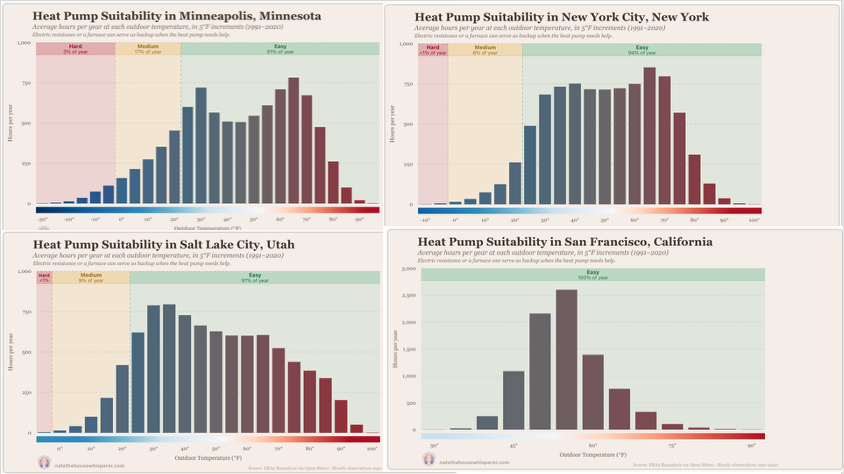
Natethehousewhisper.com put a link to a temperature database.
This is important when considering a mod con, or HP, on a high temperature requirement system. How many days do you actually need that 180°F SWT?
Outdoor temperature and required SWT track fairly consistent, a 1:1 setback is commonly used for ODR setting..
So if at 0° you need 180, drop 1° SWT for every drop in outdoor. If so on a 30° day, 150 or so SWT should cover the load.
4 examples I tried
 Bob "hot rod" Rohr
trainer for Caleffi NA
Living the hydronic dream0 -
Computers copiers, refrigerator condensers, people, lights all give off heat. You need to figure this in for a cooling load but don't count it for heating.
We did some work in a Macey's store in Enfield CT years ago in a mall. They had old gas fired boilers they had abandoned and hadn't run in years. They didn't need heat. That mall is pretty much empty now.
The lighting load was so large it heated the store.
When they converted the fluorescents to modern lamps and ballasts the 'lighting " could no longer heat the building and we were called in to get the boilers running again.
Things change the pendulum swings.
Because of the increase in LED lighting the new 2026 electrical code is now allowing 10-amp circuits (15 amp had been the smallest circuit for forever) and they will be making #16 Romex if not made already.
Also doing an electrical load calculation for a residence for general use receptacles and lighting this is figured a 3va/square foot.
They have now reduced it to 2 va /square ft. It has been a 3 forever. But the service still must be capable of providing 3 VA/square foot. The 2 VA reduces the # of circuits, unless you run 10 amp circuits.
Its amazing with all the wiring that the calculation show that most houses could run on 50 amps.
I had an elderly lady about 30 years ago her husband had passed away and she couldn't open or close the big garage door and she wanted a door opener. So the door company installed one but the garage had no power and it was detached. So I ran power out there. When I first looked in the basement for the electrical panel there wasn't one. Just a couple of plug fuses in a box,
Her house had a 30 amp 120 volt service. She had a boiler, a washing machine, refrigerator and a 5000 btu air conditioner in her bedroom. Never had an issue. "I just don't run everything at the same time"
2 -
lots of people used to have an electric range and electric dryer on a 60a service.
1 -
I'd have to argue that refrigerator and freezer condensers aren't really giving off much heat.
Most of the heat they give off came from the space the unit is in in the first place. Aside from cooling off cooked foods etc.
As you said, lights not so much anymore either. TV's were decent, CRTs and especially large plasma tvs, but those are gone too.
People give off a decent amount for sure.
Single pipe 392sqft system with an EG-40 rated for 325sqft and it's silent and balanced at all times.
0 -
the heat removed doesn't come from the fridge but the 200w or whatever the compressor uses is contributed as heat.
My guess would be that the lights and fridge and crt tv and the people and all that stuff combined was like 1000w. Cooking and things like that can intermittently contribute much more.
0 -
Going by a typical 30kwh per month use of electric, taking that to roughly 1kw per day and dividing by 24 I get a whoppingh 142 btu/h.
Single pipe 392sqft system with an EG-40 rated for 325sqft and it's silent and balanced at all times.
0 -
I had a guy once that was adding a 3 ton AC in a house with a 60 amp service and he knew he needed an upgrade. I was just doing the electrical.
The existing meter socket and conduit (1 1/4"RGS) were in good shape and had the siding cut around it. I didn't want to change the meter socket or the conduit and make a mess of the siding if I didn't have to.
So I did a load calculation:
3 ton ac
electric stove
electric drier
electric water heater
Plus the other normal stuff.
It came out he could get by with a 100 amp service. Since I could get 3 #2 cu in the existing 1 1/4 and meter sockets have no rating I did a 125 amp service which the power company no longer allows around here.
0 -
I have to respectfully disagree.
This post shows how to use the data from NEEP.org to model a house's heating load: https://www.greenbuildingadvisor.com/question/how-to-model-and-predict-electricity-usage-for-a-heat-pump
While it's targeted at heat pumps, the load part of the calculation works the same for any heating source.
Using that method for Boston, 50% of the annual heating occurs below 33F. There are 1557 hours in a typical year below 33F. Design temperature for Boston is 13F and mean annual minimum is -6F.
In Washington, DC, 50% of annual heating occurs below 37F, there are 1303 hours per year below that temperature. Design temperature is 22F and MAMT is 5F.
If you're heating with combustion, a BTU is a BTU, but if you're heating with a heat pump BTU's a colder temperatures take more electricity. In Boston, if you were heating with a heat pump half of the annual electricity usage would be in the 1129 hours below 30F. In Washington, it would be in the 937 hours below 34F.
0 -
@hot_rod: "Natethehousewhisper.com put a link to a temperature database.
How Much of the Year Will a Heat Pump Work In My City?"
That's an unhelpful characterization. Basically he's taking a complicated subject and simplifying it in a way that's not useful.
First, it's just the wrong way to think about it to say when does a heat pump "work." It won't stop working until the refrigerant stops being able to boil, which is going to be around -40F. When does a heat pump stop being practical to run? That's a complicated question that depends upon your climate, the construction of the house, the choice of equipment and the local cost of electricity and competing fuels.
But Nate chooses to just say that heat pumps don't work below 25F.
As a first-order approximation, anyone who quotes a specific temperature as the point where heat pumps stop being practical, without bringing in all of the other factors, doesn't understand heat pumps.
 2
2





Categories
- All Categories
- 87.5K THE MAIN WALL
- 3.3K A-C, Heat Pumps & Refrigeration
- 61 Biomass
- 430 Carbon Monoxide Awareness
- 122 Chimneys & Flues
- 2.1K Domestic Hot Water
- 5.9K Gas Heating
- 118 Geothermal
- 170 Indoor-Air Quality
- 3.8K Oil Heating
- 78 Pipe Deterioration
- 1K Plumbing
- 6.6K Radiant Heating
- 395 Solar
- 15.9K Strictly Steam
- 3.5K Thermostats and Controls
- 57 Water Quality
- 51 Industry Classes
- 51 Job Opportunities
- 18 Recall Announcements