Back-up/supplemental heat
Comments
-
I didn't say "poor insulation," I said "poorly insulated."
I'm in Washington, DC. There are lots of houses built in the 19th century, almost all of them are poorly insulated. The winter design temperature is 21F. Every few years we get a cold snap in the single digits, pipes are freezing all over town when that happens.
0 -
it depends on the exact model of baseboard but most permanent baseboard electric heat has an accessory thermostat that can be installed in the junction box. usually they are installed with the power passing through a wall box with a thermostat but most can have a thermostat directly on the baseboard unit.
0 -
When you buy standard baseboard heaters most wire them to a wall mounted stat.
But they (the same BB manufacture) will sell thermostats that mount directly on the baseboard.
They are simple thing usually with just #s on them. A bit inconvenient to have to bend over to adjust the temp
0 -
so after all of this discussion, I have decided to duct tape the problem for this winter and take @EBEBRATT-Ed advise on electric space heaters. I found 1500watt electric ceramic heaters on sale for $33 each and bought six of them. My math says that will give me nearly 31,000 BTU’s. My plan is to locate them throughout the house, each on separate/unused circuits, prior to leaving this winter for a couple of months. If the heat goes down, my house monitor can just turn them all on and contact a repair person. In addition I am also going to use 3 of them in my great room the next cold snap and see the effect of adding an additional 15,000 BTU’s to the room does.
I will sleep better knowing the $200 I just spent on heaters, could possibly prevent a serious problem with frozen water pipes while waiting to get the system back up and running while I’m away.
This also gives me plenty of time to figure out what’s next for a more permanent solution in needing additional BTU’s in my great room and a backup heat source.
 1
1 -
If I were you I would cut the original molded plugs off every one of those heaters and put on industrial grade plugs that are much less likely to overheat.
Portable space heaters are really not meant to be used unattended, and that is cheap insurance against the plugs melting down (I have seen this happen) and catching fire.—
Bburd 1
1 -
i am really far more concerned about the 30 cent receptacle that is push backwired than the crimp on to the cord. if it is made with good tooling the crimp connection is fine.
0 -
You raise a good point about the receptacle itself; but I have seen the difference more than once in the running temperature of plugs on space heaters and in one case a 120 V clothes dryer after the original molded plug was replaced with an industrial grade plug with solid screw terminals.
—
Bburd0 -
they usually use 16 awg hpn for the cord and use the 90c rating of the cord to get the needed ampacity for the space heater while the receptacle is usually required to be considered 60c by various decrees in the code so that is kind of a problem (although the receptacles are usually actually rated 75 c or 90c by the manufacturer). the temp you have to use for the ampacity calculations is the lowest of the terminations of that wire.
0 -
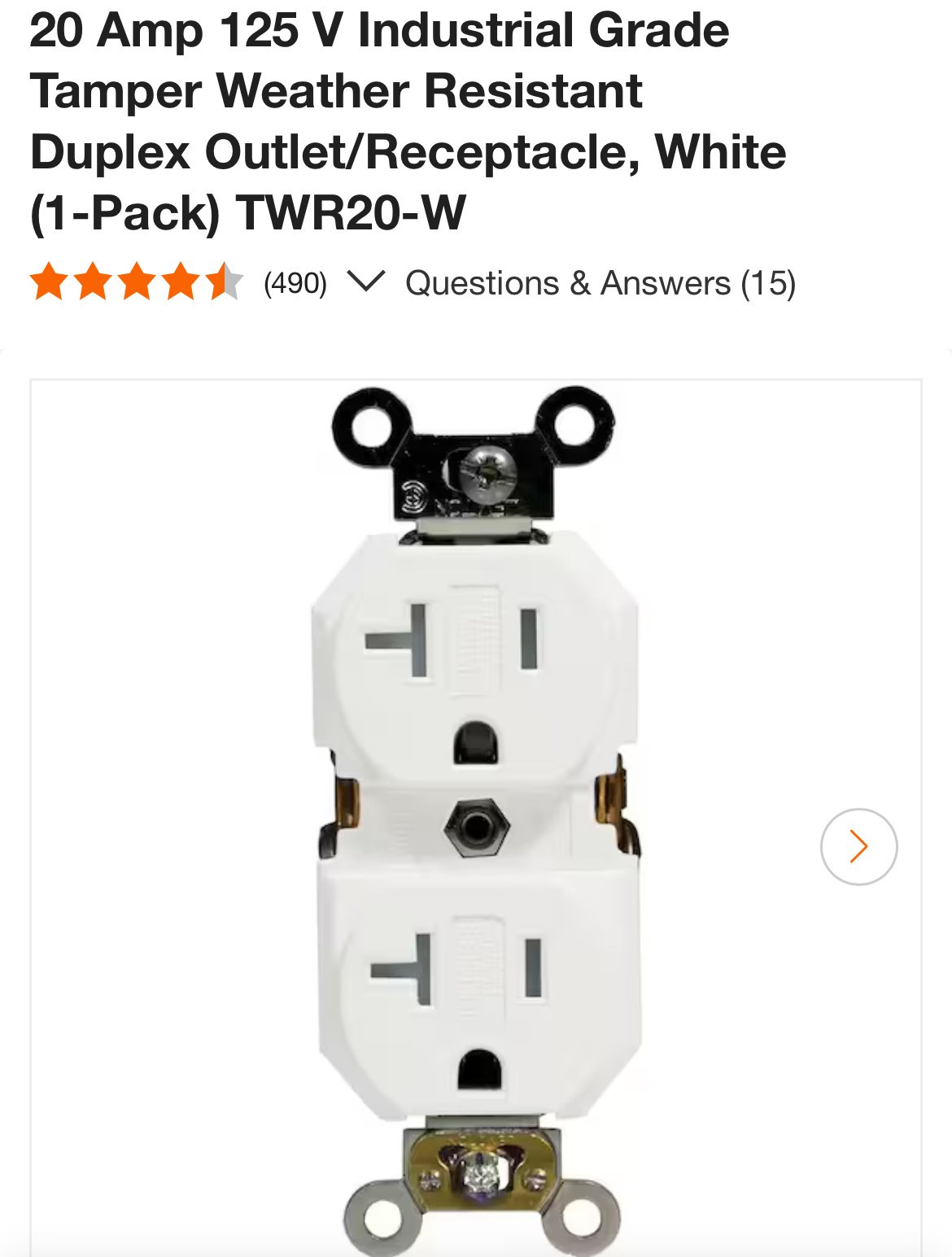
If he has 20 A circuits, as noted they should have 20 amp receptacles, which would handle those heaters easily
 Bob "hot rod" Rohr
trainer for Caleffi NA
Living the hydronic dream0 -
20a general purpose receptacle circuits are not required to have 20 a receptacles unless there is a single receptacle on the circuit. if i remember right the terminals and bridging tab on 15 a receptacle are rated for 20a specifically for this reason although as of around 20 years ago you are no longer allowed to bridge 20a branch circuits through a device.
0 -
@mattmia2 that may still be true, but in my house, receptacles fed by 20A circuits get 20A receptacles. That way I can tell by looking at the receptacle how much current is available in that circuit.
All Steamed Up, Inc.
Towson, MD, USA
Steam, Vapor & Hot-Water Heating Specialists
Oil & Gas Burner Service
Consulting1 -
the only time you need a 20 a receptacle is if you have utilization equipment that uses over 1500w and has a 5-20p or 2-20p plug.
0 -
You can have all the 20 A circuits you have ability to provide from the breaker panel
I don’t think the code requires 15A plug circuits?
Kitchens have 20A, every circuit in my shop is 20 except lights
I think the OP suggested he had 20A circuits throughout his rooms?
If he has 20A circuits and receptacles and follows @Steamhead suggestion to upgrade the cord caps, that should provide piece of mind
Bob "hot rod" Rohr
trainer for Caleffi NA
Living the hydronic dream0 -
there is nothing that prohibits you from using a 5-20r on a 20 a circuit but in most cases they aren't required. i suspect that other than the shape of one of the contacts, there is little difference between a spec grad 5-15r and 5-20r.
0 -
I wired the house when it was built in 2002. All receptacle runs were 12-2 with 20 amp receptacles and all were individually pigtail feed and screw connected and not pushed in. I also installed a 200 amp house service and may have over killed receptacle circuits with many rooms with 2 or 3 circuits particularly my kitchen, which I think there 5 or 6. I spent most of my life’s work as a industrial electrical maintenance person, though not a licensed electrician.
I am not intending the 1500 watt heaters to be anything other than a emergency back-up in the event of the main heating system going down and stop gap until my son-in law can get a tech into make repairs while I’m away.
Being on 24 hr call my whole working life I know extremely well how frequent emergency situations can happen and if the temps were -20*f and boiler goes down, its an emergency. Knowing that if its a power outage I have a 5kw ready as well as a 3kw Honda generator and then 30k BTU’s of portable back-up heat, I will sleep better while away. I also know its not 100% fool proof.
1 -
No need to have the HA worry about them, just set their internal thermostat lower than the heating thermostat. One less point of failure (I'm suspicious of HA), and only the places that need heat get it.
0 -
If I understand your comments correctly, you are suggesting leaving the portable heaters on and in the correct locations, with the stats on them set below main heat, say 10* below. So they will just automatically kick on if the temp in their area drops for whatever reason “ circulator, thermostat or boiler down etc “ ?
0 -
Correct. Independent control, so any issues with the HA won't cause a total no-heat failure.
 1
1 -
Depends on your idea of aesthetically pleasing but I have and like one of these vented gas stoves. Can plug it in for AC ignition but also have a couple D-cell batteries in it for when you go away and it will then ignite even if power goes out.
https://www.napoleon.com/en/ca/fireplaces/products/gas-stoves
0 -
@dabrakeman "Depends on your idea of aesthetically pleasing"
I have to say, those are beautiful and putting out 44K BTU's is impressive. I will have to give those some thought. The only problem is the Great Room of my house, which needs some extra BTU's has a wood burning fireplace.
Maybe I should be kicking around a gas insert, if they make such a thing as one with a room thermostat to kick on automaticaly when away?
0 -
Look. I realise that I am somewhat contrarian — and worse, have a conflict of interest, but…
As I have said before in response the the backup heat when going away for a couple of months, there are really only two choices as regards freezeups.
One, drain the structure. While this won't help with other types of damage, it will prevent the pipes from freezing and thus prevent catastrophic damage when they thaw. And I do mean catastrophic, as in a total loss of the house and everything in it — and years of litigation with the insurance people about contents (they're usually pretty good about replacing the structure, but as cheaply as possible).
Two HIRE a local individual to check the house. That doesn't mean drive by once a week. That means going there, going in, verifying everything is working and secure, at least once a week and after any major outage. This is where the conflict of interest is, as my daughter does just this for several high value properties in our area. And it's not free. She's bonded and insured. Four wheel drive trucks. Tools. Portable generators. Contractors known to her and on retainer on her 'phone. Very good relationships with the power company . Available (she or I or her husband) 24/7.
Br. Jamie, osb
Building superintendent/caretaker, 7200 sq. ft. historic house museum with dependencies in New England
 3
3 -
@ColdHouse said "The only problem is the Great Room of my house, which needs some extra BTU's has a wood burning fireplace."
That's not a problem, it's an opportunity. A wood burning fireplace is (1) a waste of space when not in use, and (2) a waste of heat when in use, as most of the heat goes up the chimney.
If this were my house, I'd put a stainless steel liner in the chimney and install a Jotul Lillehammer or similar gas stove with a standing pilot and a millivolt thermostat (no batteries anywhere). A freestanding stove radiates more heat into the room and loses less heat up the chimney than an insert. And with a standing pilot, the stove works the same way a gas water heater does in many people's basement. Water heaters with standing pilots are often left unattended for years.
Light the pilot, set the milivolt thermostat to 55 or 60 for backup heat, and you're done. Or if you're home and want to use the room, turn the thermostat up to 68 and enjoy the fire.
1 -
I agree with the thrust but I'd say remote monitoring has a role to play as well.
0 -
Oh I agree. And in fact the properties my daughter cares for do all have remote monitoring — which notifies her if it senses a problem. It's part of the contracts. That said, it doesn't always work… and, if the person notified happens to be in Florida or the Bahamas or somewuch, it just causes concern but doesn't solve anything.
Br. Jamie, osb
Building superintendent/caretaker, 7200 sq. ft. historic house museum with dependencies in New England0 -
What type of house is it? Is there a full attic? One story or two? You could ditch the ductless system and install a whole house CAC system. With it install a high temperature hydro coil for secondary heat. Its not a separate heat source because you're still relying on the boiler, but it will put out the BTU's to boost the temperature.
1 -
A lot of great advice here. I use most of them for a second home.
When I lost faith in the safety of our gas furnace , I ran to Lowes and bought four oil fill radiators. They did a remarkable job keeping an 900sq ft ranch home comfortable. We never left them on when house was unoccupied. But before that, we never left furnace on either. It was oversized and expensive. When we leave, we closed main water valve and drained everything and then add RV anti freeze to toilets and sink traps. I also ran a circuit for a twelve foot heat trace for the pipe in front of and behind main water valve, insulated with fiberglass. We did replace the furnace with a 90%efficient Rheem furnace and installed wifi and a nest so in addition to all the above, the nest will turn furnace on if the inside of house drops to 45. This was a twenty year evolution. The only change is we no longer use antifreeze. we still drain the house in case ice interupts electrical power.
Never had a problem with temps dropping into single digits at night . I’d say 99% fool proof; 1% luck as I knock on wood
1 -
I’m in Maine, and comments on a couple things:
- I was surprised that your minisplits can’t heat below 30°. I have 4 single zone 33+ SEER Mitsubishi hyper heat minisplits that have no trouble heating well below zero. As one said, these will heat 100% down to zero, and 93% to 13 below zero. I installed single zone units only so that if one ever failed, others would still run. I installed the first one about 20 years ago, the second about 15 years ago, the third about 10 years ago, and the fourth about 5 years ago. I only added the 3 others for a more even distribution of heat and cooling. They have all performed flawlessly, and the most I’ve ever had to do is a light cleaning.
2. For your application, I think electric baseboard placed along under the windows might be a reasonable choice for the least upfront cost. They will cost more to operate, but if you’re only using them as a supplement or backup, it makes sense.
0 - I was surprised that your minisplits can’t heat below 30°. I have 4 single zone 33+ SEER Mitsubishi hyper heat minisplits that have no trouble heating well below zero. As one said, these will heat 100% down to zero, and 93% to 13 below zero. I installed single zone units only so that if one ever failed, others would still run. I installed the first one about 20 years ago, the second about 15 years ago, the third about 10 years ago, and the fourth about 5 years ago. I only added the 3 others for a more even distribution of heat and cooling. They have all performed flawlessly, and the most I’ve ever had to do is a light cleaning.
-
I have about made a living advising folks to not “change” heat but to add to what you have. In your circumstance a Rinnai Energysaver direct vent wall furnace is the best option for that addition. Quiet, cool to the touch, simple install without disruptive venting and a nice feature set. In addition they are about bullet proof. Another nice feature of the Energysavers in the low electric consumption. The EX22 takes a between 33 & 55 watts so can run off an appropriate battery or small generator in outages. The larger 38 model is about double that. Vent clearance is 9” to a door or window. As such I always install mine below a window as they are generally difficult to decorate under and open into the room. I have had an Energysaver since ‘92 in all of my homes. Living room, basement, garage, shop and have been well served by all of them.
As well, you are getting good advise on trying to get more out of your current system here, as is typical. FYI, should you choose to upgrade your Fujitsu’s, it is not necessary to go to Mitsu. Fujitsu’s do everything that Mitsu’s do. Mini-splits are great but you really have to understand the capacities of the individual units. I think that change would be your worst alternative.
1 -
I neglected to add a disclaimer. I introduced the Rinnai’s in the six New England States in ‘91, representing them in that market for 20 yrs and consulting with them until ‘19. Retired now I’m sitting in front of my Rinnai New Zealand Fireplace which sadly and mistakenly, imho;) Rinnai US dropped in ‘08 during the crash. The EX-22 operates in my Gara/shop. Anyway, my bias is noted, but so too, I hope, is my affection for the products.
0 -
What you describe is not unusual in a space with lots of glass. I have a Florida room in one house and decreased the PEX spacing along the three exterior walls when pouring the concrete for the final limestone floor. You always do this if there is a patio door or larger glass area — The decreased spacing increases the BTU's in that location. It's not huge but you can feel it. I even did an additional PEX loop that's on a separate zone piped off the same manifold that feeds the panel radiators — gives much hotter water to that loop and can flood the area with a band of heat.
Ideally, You want to figure out the heat load on the space. This will give you the actual BTU's needs. My guess you may get a decent idea just playing with the space heaters — since you know the BTU output.
The nice thing about radiant is — silence. Most space heaters are loud. That's my issue with those hydronic kick space heaters or even the sealed combustion cabinet heaters — they make a lot of noise. I use an empire sealed combustion unit in one of the garage spaces. They are easy to install since they pipe right through the outside wall behind th unit.
Unless I missed the description. What type of floor ? Is there any space under the room — crawl or basement for any additional equipment? Do the windows go to the floor ?
Money solves many problems. Wrapping the room or doing strategic placement of common electric baseboard is always going to be the cheapest way to get lots of BTU's into a space. Just the most expensive way to make heat. My power in PA is over $.20 KW. That adds up quick. Still could be the answer depending on how much you need and how often it has to be used. It's math. Spending $15k more for another solution buys a lot of KW's.
The Florida room house also has panel radiators that are controlled through a boiler with outdoor reset and constant recirculation. I oversized the panels to work with 150 f water vs the typical 180 f. That only works if you have the space — doing them with 130 f would most likely be a problem. The other solution would be some form of baseboard. I have used various Runtal units and wrapped spaces under windows with the two tube units — it gets expensive and they have low output. That's what you have figure out that make up number.
Another nice thing about radiant in a space with tall ceilings — lower amount of wasted heat. w/ forced air and very high ceilings you need a ceiling fan to bring down all that hot air that quickly goes to the top.
IMO — don't discount mini splits. I love my Mitsubishi hyper heats — again it's math. How much heat do you need and at what outside temp. Mine work great — but my norm cold is very low single digits. If you have the space they make ducted units — they also make a floor unit. Remember you are not heating the space — your are adding to it. Properly positioned you just want to flood the area with warm air.
My project of a few years ago was a church conversion and we could only get ductwork into about 75% of the space — the whole thing is radiant heat. I used mini splits in some areas and the ducted system has both a heat pump and furnace. This house is also in PA and Propane — the heat pump always wins the cost game with propane. We use the heat pumps in the shoulder season and turn the radiant on when it stays cold. This is a house we only use part time and the radiant maintains a mid 60 temp and we use the heat pumps to bring it up when are going to be there.
Do you have Internet at the house ? That's the way we monitor our vacation homes and there are many ways to manage the temp control of secondary heaters. They make plugs that will turn on a heater when the temp drops and you can get internet switches/ outlets/ even plug in switch blocks to turn on a 15amp load based on washed temp. It's also typically easy to have ways to drain odd pipes to winterize — it takes a long time for the core parts of a building to cool.
0 -
isn't there a significant clearance from operable windows for the direct vent?
0 -
The kickspace heaters I've installed all have blowers which are controlled by a "klixon-" type thermostat which only energizes the blower motor when the coil achieves 140ºF; this may not work with a radiant loop, which often operates at considerably lower temps. As for supplemental heat separate from the main system, you already have a propane installation; the excellent console-style vented space heaters made by Rinnai may well be worth considering. I would strongly recommend AGAINST an unvented heater, however, for obvious reasons.
0 -
Not necessarily. The Jotul Lillehammer DV stove I installed in our sunroom needs only 9 inches clearance from an operable window. I was surprised how close it could be. Our local building inspector checked and passed it without raising an eyebrow.
0 -
Yes, NFPA 54 says that a direst vent appliance <50kbtu has a 9” clearance to a door or window. 50+kbtu is 12”
0 -
They used to require several feet of clearance. Is this a recent change?
All Steamed Up, Inc.
Towson, MD, USA
Steam, Vapor & Hot-Water Heating Specialists
Oil & Gas Burner Service
Consulting 1
1 -
My Jotul manual specifying 9" clearance was printed in 2000.
0 -
How about NFPA 54?
All Steamed Up, Inc.
Towson, MD, USA
Steam, Vapor & Hot-Water Heating Specialists
Oil & Gas Burner Service
Consulting0 -
@Steamhead I haven't read NFPA 54, but Google's AI summary says there have been some changes back and forth in recent years between 12 inches and 4 feet for appliances over 150,000 BTU, so maybe that's what you're thinking of. But for appliances under 50,000 BTU, it sounds like NFPA 54 has required only 9 inches for many years, probably pre-dating my 2000 Jotul manual.
1 -
i think my 2000 40,000 btu/hr water heater required the 4'
0 -
It seems NFPA 54 treats direct vent and mechanical draft appliances differently. Here's the NFPA 54 edition of 2002. See para 10.8.2 and 10.8.3 where mechanical draft appliances are required to have 4-foot clearance, while direct vent appliances can have 9-inch to 12-inch clearances.
0





Categories
- All Categories
- 87.6K THE MAIN WALL
- 3.3K A-C, Heat Pumps & Refrigeration
- 59 Biomass
- 429 Carbon Monoxide Awareness
- 124 Chimneys & Flues
- 2.2K Domestic Hot Water
- 5.9K Gas Heating
- 119 Geothermal
- 168 Indoor-Air Quality
- 3.8K Oil Heating
- 78 Pipe Deterioration
- 1K Plumbing
- 6.6K Radiant Heating
- 394 Solar
- 16K Strictly Steam
- 3.5K Thermostats and Controls
- 56 Water Quality
- 50 Industry Classes
- 50 Job Opportunities
- 18 Recall Announcements