How to pull wire over ceiling
Comments
-
It's reaching one hundred years. All the homes on the street were built in the same year. What are the five wire cables usually used for?
If the wire was pulled after the wall was plastered, they must have an method to pull the wires. From the outside, that was as deep as the probe could reach, on the inside, no trace is visible on the wall. Will see if a compass could help trace the wires.
0 -
Looks like a modern 5 conductor stat wire to me. Red is 24vac hot, blue common, white heat, green fan, yaller cool.
 1
1 -
agree, looks like thermostat wire
0 -
2 Snakes
Sash weight chains
Sinker and fishing line.
there are several ways of getting wire from point A to B.0 -
Why need a tstat outdoor?
0 -
This cable is dropping from a higher position, so a weight chain will not be able to trace it. Need an antigravity chain.
0 -
If it goes around a corner somewhere… good luck.
Br. Jamie, osb
Building superintendent/caretaker, 7200 sq. ft. historic house museum with dependencies in New England0 -
if you say so.
0 -
"Why need a tstat outdoor?"
Nobody told the wire it must be used for a thermostat.
What were the uses of those colors again?
Doesn't matter… electric is colorblind!
So, you want to add a doorbell today, and you have 10 rolls of wire on your truck. Three of them are 14-gauge, 2-conductor wire with a green ground wire (AKA 14-2). Another two rolls are 12-2, and another roll is range cable. They all seem like overkill for a doorbell.
On the other side, there are two rolls of coax for CCTV or TV Cable, and another roll of 22-gauge, 4-wire cable for a telephone landline. Then there is one 500-foot roll of 16-8 thermostat wire that you use for heat pump thermostats, and one 16-5 for gas heat with AC thermostats.
Alas, there is no 2-conductor, 16-gauge thermostat wire that would be perfect for the job.
Now, the closest supply house is 23 miles away, and you're on the job. You need to get the doorbell working to get paid for the complete new wiring job. Your boss told you, “Don't return without the check. Do whatever it takes to get the job done.”
There is one reason for a 5-conductor wire to be in that wall when a 2-conductor wire would do just fine.
Edward Young Retired
After you make that expensive repair and you still have the same problem, What will you check next?

 2
2 -
Does the house have a 2nd floor or maybe an unfinished attic above the first floor. Sometimes the long way is the only easy way. It may go up because the access was there. Up into the attic or a crawl space then over horizontally then drop down into the basement following the path of the waste pipe chase or another easy path. Look around for the other end.
National - U.S. Gas Boiler 45+ Years Old
Steam 300 SQ. FT. - EDR 347
One Pipe System0 -
There is a second floor above. Where could the vertical passage for wires be located?
Does the cable usually terminate in a junction box? If so that could be the junction box of the ceiling light at the entrance.
0 -
NO
Low voltage and high voltage wires must be separated unless same gauge and insulation.
Any junction boxs need 24 / 7 access meaning you cant bury them behind sheetrock.
The wires for my unit run from the basement to the attic then down to the t-stat.
0 -
I wouldn't be at all surprised, if that house has a timber frame, if it were balloon framed — or if the exterior walls are solid brick, they are brick right up to the plate for the rafters. In either case, the simplest way for someone to run a wire would have been a hole in the plate and just run the wire straight down — nothing to block it, and with accurate placement of the hole in the plate it wouldn't have been that hard to catch the wire at the bottom.
Modern platform framing is a different matter — you'd have to punch a hole in the second floor platform, and that would be a bore. But not balloon…
On the other hand, if someone has blown insulation in there, it could be more difficult but still not impossible. I'll bet you find the top of the wire in the attic, at the plate, right over the opening by the door…
Br. Jamie, osb
Building superintendent/caretaker, 7200 sq. ft. historic house museum with dependencies in New England0 -
The rafter plate sits on top of the wall. How could a wire run straight down after going through a hole in this plate?
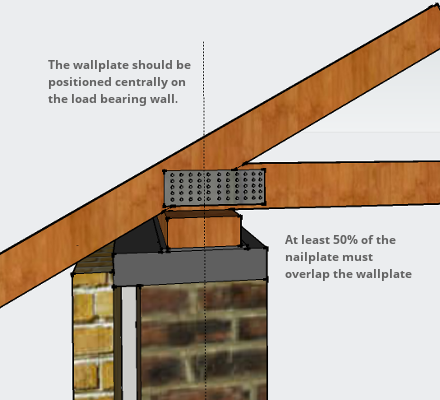
The first floor does not have an attic.
The second floor has a very low attic and a flat roof, the photo shown below is the looks before finishing. Now the attic is finished and has no access.
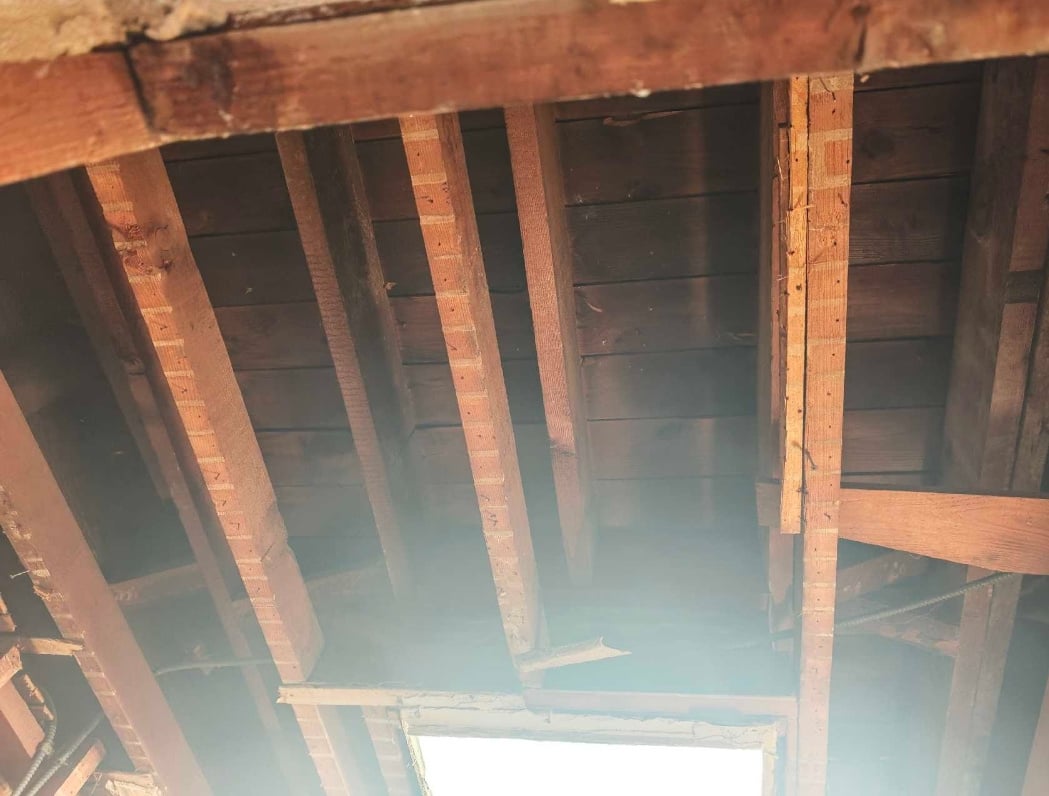
It seems the boiler room in the basement is the place for that transformer. If that cable runs back to the boiler room, I can use it to power the doorbell. Otherwise it will be easier to surface mount the transformer above the front door than to pull a new wire to the boiler room.
0 -
they make a battery operated door bell!
1 -
So. Solid masonry wall then? No interior plaster or other finish on furring? No air space and facade brick? A bit unusual, but possible…
Your diagram, by the way, references modern practice. Your house doesn't, though the plate most likely did rest on the wall, but not necessarily centred.
Br. Jamie, osb
Building superintendent/caretaker, 7200 sq. ft. historic house museum with dependencies in New England0



Categories
- All Categories
- 87.8K THE MAIN WALL
- 3.3K A-C, Heat Pumps & Refrigeration
- 59 Biomass
- 430 Carbon Monoxide Awareness
- 133 Chimneys & Flues
- 2.2K Domestic Hot Water
- 6K Gas Heating
- 124 Geothermal
- 170 Indoor-Air Quality
- 3.9K Oil Heating
- 79 Pipe Deterioration
- 1.1K Plumbing
- 6.7K Radiant Heating
- 396 Solar
- 16.1K Strictly Steam
- 3.5K Thermostats and Controls
- 56 Water Quality
- 51 Industry Classes
- 51 Job Opportunities
- 18 Recall Announcements