Manual J Calc Question

I am looking to potentially replace my boiler which was grossly oversized by the heating contractor who installed it in 2022. I engaged with a 3rd party to perform a manual J calculation for my house. I know, I know, this should have been done back in 2022 before they installed my current boiler. I have properly educated myself now and installer needs some refresher courses too!
3rd party determined that the heat load is 49,476, btu/hr. They also did a manual S calc to determine the proper size boiler for my house. I have a Burnham AL50SL indirect hot water heater. In performing the manual S calc, they multiplied the heat load by 1.4 to come up with a requirement of 70,000 btu/hr. Hmmm. When I asked why they did that, this was the reply:
"When you get into manual s you have overages to account for cold days and other variables in the design. So typically heat load you can add 140% to the load. So, if you multiply the total load 50,000 x 1.4 = 70,000. Based on this you will never find a boiler that is exact to your load so you pick the closest one. However, when you have an indirect water heater you need to size the boiler to that spec. this is why I gave you all the information. The boiler they are looking to install does meet the needs of the indirect and they should have it set to priority."
They also went on to say:
"You should use the home's manual J space heating load to size the boiler, provided the indirect water heater's required input does not exceed that heating load. If the indirect tank's minimum required BTU recovery rate is larger than the house heating load, you size the boiler to the larger of the two loads" Again, hmmm.
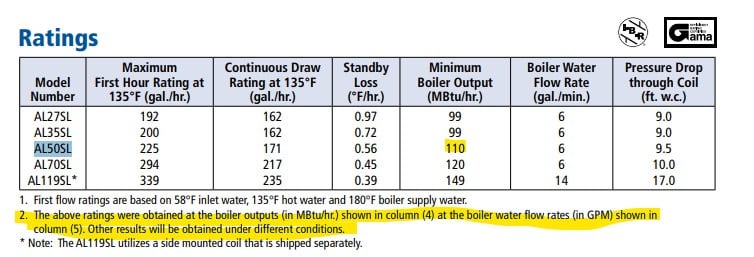
Per the Burnham spec sheet for the AL50SL, it states the minimum heat source should be 117,000 btu/hr. If I had a boiler installed to meet this I would be oversized by over 2X for what my heating load needs.
So, here are my questions:
- Is what I am being told accurate with the manual S calc or should I just go with a boiler that is closest to the 49,476 btu/hr load my house needs for heat? I also keep telling everyone that I consider my hot water demand low. Just me and my wife 90% of the time which means 2 showers in the morning. This is a 2nd home, so not here all the time. Run the dishwasher every 2 days or so when here. Laundry once in a while to do sheets and towels. Could we move here sometime in the future full-time, possibly but not likely. Wife wants to be near the future grandchildren.
- Should I consider replacing the indirect instead of the boiler with a reverse indirect like the TurboMax to eliminate the current short cycling. My understanding is that the reverse indirect would provide more thermal mass and thus increase cycle times. I do notice that when we do take showers that the boiler cycles are much increased unlike when the boiler is just supplying heat. I also have a couple of what you guys would consider "micro zones" for a few of the heating zones. Also, forgot to mention that my baseboard is fin-tube.
Appreciate any feedback and guidance.
Comments
-
There is validity to the “size to the DHW demand” idea in some cases. Your home only needs 50,000 BTU NET. That is not the boiler size.
The boiler size is usually stated by the input rating, which is the amount of fuel the boiler uses every hour of operation. On a 140,000 BTU oil boiler, that might be about 1.00 gallon per hour. On a gas boiler, that would be approximately 136 to 141 cubic feet per hour, depending on the chemical makeup and heating value of the natural gas.
After you burn that gas or oil, most of the heat goes into the water in the boiler, and the rest is lost through the vent pipe. That determines the output of the boiler.
Then there will be some additional heat loss through the piping between the boiler and the radiators. That is called the piping and pickup loss. On steam systems, the standard allowance is 30%. On hot-water radiator systems, the standard allowance is 15%.
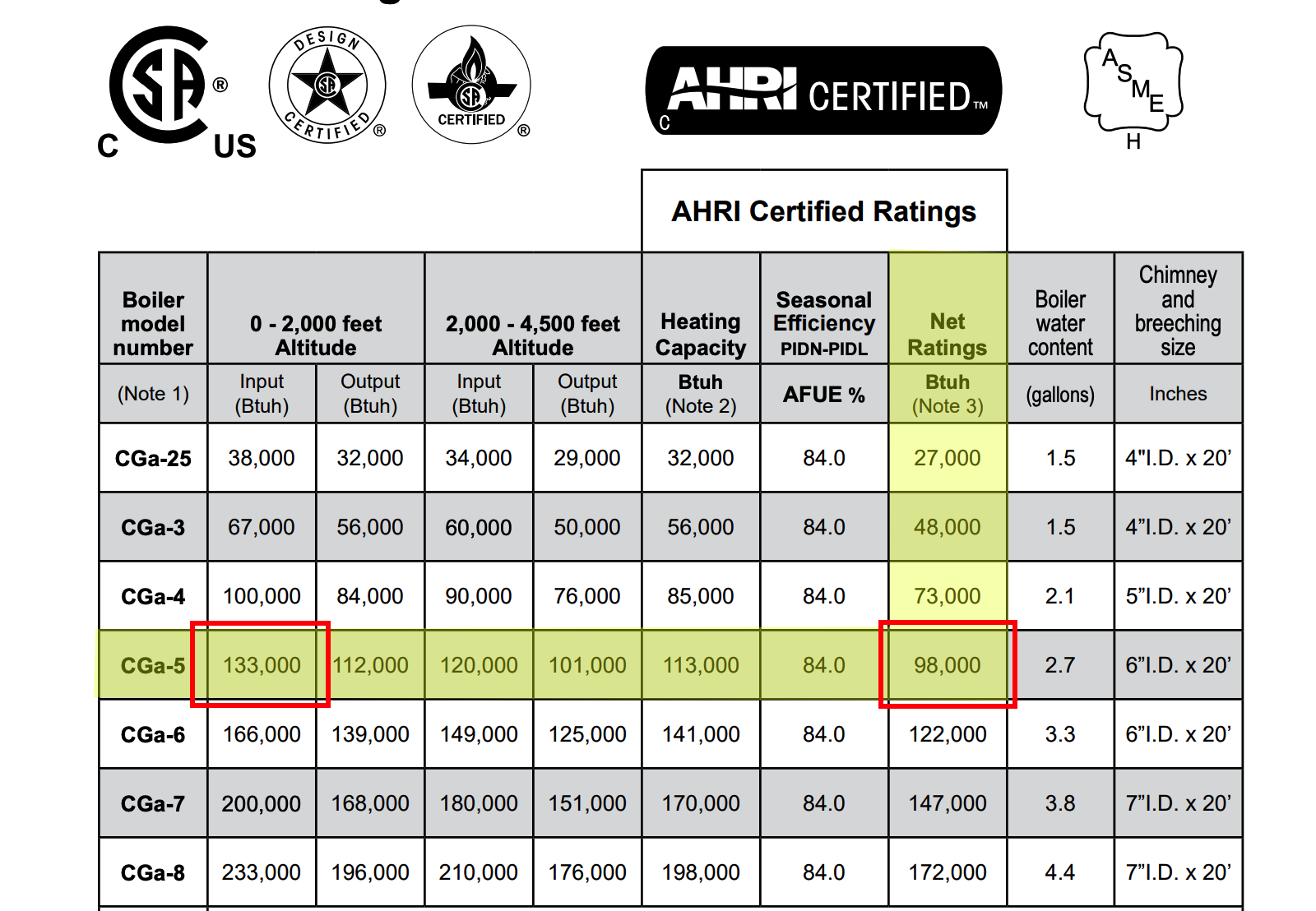
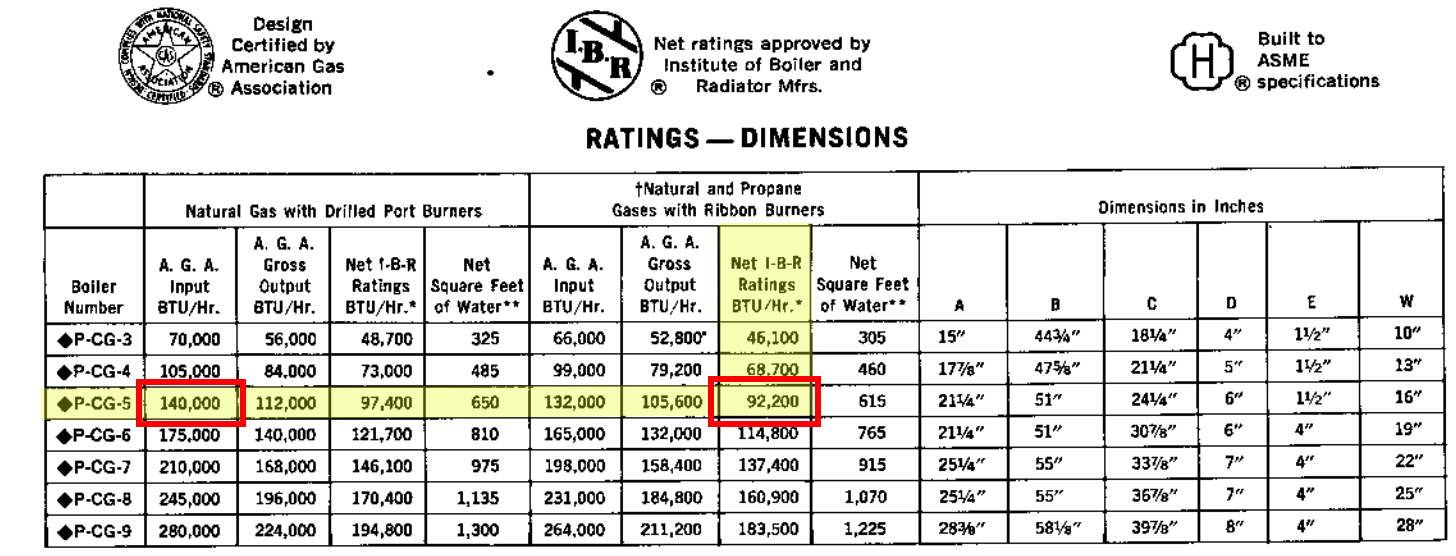
After those allowances are deducted, you arrive at the AHRI NET rating. On older equipment, this was called the I=B=R NET rating.
Now, those fixed percentages are not necessarily the actual piping and pickup losses in every house. They are more of a standardized, somewhat worst-case allowance. Many homes will have actual piping and pickup losses below those percentages, but these are the standardized numbers used when sizing a boiler from a heat-loss calculation.
Here is an example showing the AHRI NET rating and the older I=B=R NET rating.
NEW Equipment
Older Equipment:
Now, here is where the difference with an indirect water heater comes in. If you use a smaller boiler with only 49,000 to 50,000 BTU of NET output, the indirect water heater will not operate at its full rated capacity.
If you select a larger boiler with a higher NET output, the indirect can receive more heat from the boiler. That allows it to recover faster and produce more hot water in a given amount of time.
That difference is shown on this chart:
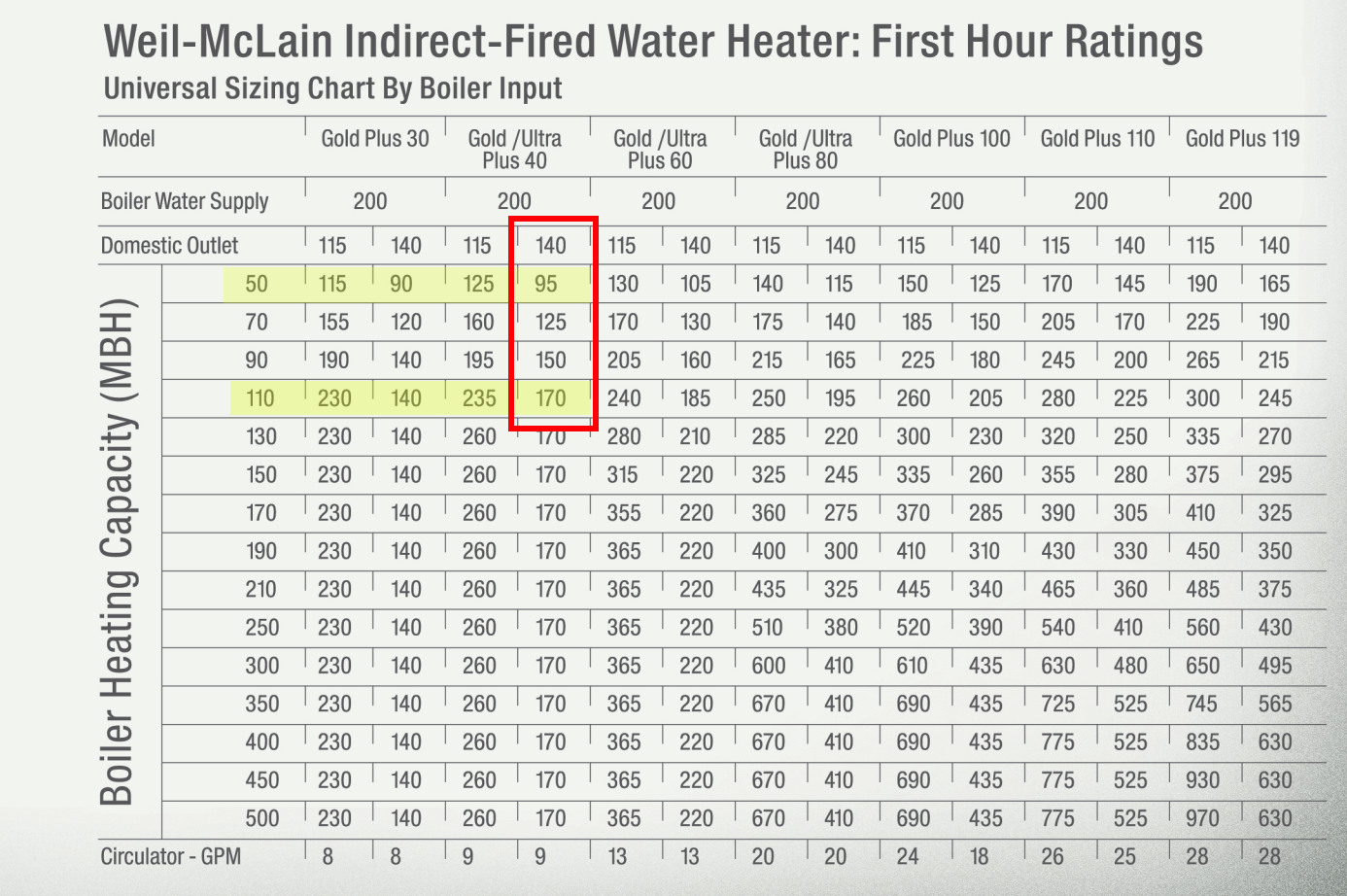
See how the same water heater provides less hot water when connected to the smaller boiler? With the larger boiler, the water heater can produce up to a 170-gallon First Hour Rating. But the tank itself also has a limit. Once you reach that limit, installing an even larger boiler will not increase the rating beyond 170 gallons.
But do you really need that extra capacity? Maybe not.
I grew up in a house with a 30-gallon gas water heater and a 30,000 BTU burner. There were six of us—Mom, Dad, and four kids—and I rarely remember running out of hot water. With a 50,000 BTU NET boiler and a 40-gallon indirect tank, you would already have more hot-water capacity than we had.
If you want to use the 40-gallon indirect to its full rated capacity, then you may need a boiler larger than your home actually requires for heating. Personally, I don't think that is necessary. A reasonable compromise may be to choose the boiler size in between.
Just remember: once you select the boiler size, you cannot easily increase its output later. If you eventually discover that you truly need more hot-water capacity, increasing the boiler size would usually mean replacing the boiler.
I hope this makes sense after you read it 7 times.
Edward Young Retired
After you make that expensive repair and you still have the same problem, What will you check next?
0 -
Well, you never mentioned what boiler you presently have.
However, unless you have an unusually high domestic load, the boiler should be sized to the space heating load.
Let me explain: modern boilers are setup to give priority to domestic heating. In other words, the total output capacity of the boiler is directed entirely to the indirect during a domestic call. If the boiler has an output capacity of 50k btus, then that’s what going to the indirect. If you have a 50 gallon indirect with 50k btus going to it, that’s about the same as a 50 gallon gas water heater with a 48k btu burner. And that is more than sufficient for the average household.
The minimum btu rating on an indirect is simply the minimum btus needed to get the minimum rated output from it. It doesn’t mean that it won’t function with a lesser input. It’s just a tank of water and it’s doesn’t know whether the btus are coming from an internal hot water coil fed from a boiler or from a gas burner directly.
A btu is a btu!
BTU: British Thermal Unit = the amount of heat needed to raise the temperature of one pound of water one degree Fahrenheit. Usually measured per hour.
Whoever told you that nonsense doesn’t know what they’re talking about.
Here’s another wrinkle: I’m only aware of one or maybe two manufacturers who presently offer mod/cons in the 50k range. Most start around 80k.
Bob Boan
You can choose to do what you want, but you cannot choose the consequences.


 4
4 -
an indirect does not really have a minimum requirement (unless burnham does something weird!). your DHW usage and requirements dictate the required BTU/hr delivered to the indirect. That all being said most of what the 3rd party told you is true. not sure why they randomly added 40% though! in my experience, when done correctly, manual J is already applying a safety factor.
checking your Burnham the wording is just strange, they do not actually require a minimum boiler output, that's just to meet the ratings shown on that sheet. so no they aren't doing anything weird, you still calculate your space heating needs, and your DHW needs, and size the boiler on the largest of the 2.
 1
1 -
Use a boiler with about 50,000 btu Net capacity Heating output. With two people your indirect will be fine.
It is normal for the boiler MFGs to tell what boiler size to use for an indirect but in you case that is not a concern. No boiler needs to be upsized for DHW unless you have a hot tub or some other high usage item.
The 3rd party is CYA.
Calculating the heat loss of the house is pretty straightforward. Everyone's DHW use is different. But with a 2 person house no upsizing is needed.
How large is your old boiler? It is a shame to throw out a 4 year old boiler. If the boiler is otherwise ok I would work to resolve the short cycling issue and keep the boiler.
Going to a smaller boiler any energy savings will be negligeable.
JMHO

 5
5 -
If there's nothing wrong with your boiler, I'd add a buffer tank.
 1
1 -
Yeah, I'd want to know what's wrong with the existing boiler and try to fix that before replacing one that's four years old.
0 -
@Ironman : "I’m only aware of one or maybe two manufacturers who presently offer mod/cons in the 50k range. Most start around 80k."
This is going to be the real issue. You can make the Manual J as accurate as you can, but at the end of the day you're limited to the equipment that's available. Most installers have lines that they work with so you'll be limited to what they have.
1 -
be advised a Mon con is only high efficiency when operating below 140*F. Above that and it’s back to the mid 80’s.
what did they base the manual “J” on, 140 or 180 Supply water?0 -
Manual J estimates heating load of the building and is independent of equipment. Manual S sizes equipment.
3 -
With most mod cons you can limit the firing to your exact load
An 80,000 mod con with a 10-1 turn down could be limited to 8,000
So it is pretty rare the have a mod con be oversized
If you do limit the mod con , it still ramps up to full output for a dhw call.
A typical gas fired 40 or 50 gallon tank is 37,000 btu/ hr. At maybe 78% efficiency, as a comparison
Bob "hot rod" Rohr
trainer for Caleffi NA
Living the hydronic dream0 -
Existing boiler is a Buderus G115WS/5. It cycles for about 2-3 minutes. Was installed by a local heat contractor. About 2 years ago a larger regional heat company acquired the smaller local contractor. New company has agreed that previous company oversized it and have offered to replace it with a PurePro P4ES on their dime. I know, it doesn't make sense that they would do this. But, who am I to refuse this offer. However, this PurePro is a 4 section boiler and still seems way oversized to me. That is why I engaged a 3rd party to perform a manual J calc. Why swap out an oversized boiler for another one that is oversized. As they say, "fool me once shame on you, fool me twice shame on me."
The Buderus works, but it drives me crazy hearing it fire up 8-10 times in a hour in the middle of January and Februrary. It is so loud I can literally hear it in my bedroom which is directly above it on the 2nd floor. I also understand that it is not ideal for the longevity of the boiler to be doing this.
Adding a buffer tank instead of a swapping out of the boiler seems interesting to me, but I am not excited about adding another piece of equipment in my basement that I need to maintain. I also have a well tank and a water softener down there.
The reverse indirect has me intrigued. Swapping out the Burnham indirect for this doesn't take up anymore space, doesn't add more equipment to maintain and I would expect longer cycle times from the boiler as well. I also have a few heating zones that are small. One zone is literally for one bedroom. Not sure why the original owner or builder did this. This is a 2100 sq ft house with 5 heating zones. But, it does allow a high level of control throughout the house.
Thoughts on the reverse indirect?
Or should I just get a good set of ear plugs!
Thanks.
0 -
If the company is willing to put in a new boiler on their dime take it .
But don't take a P4-ES.
Get the P3Es 1 size smaller it has a heating capacity of 75,000 btu/hour and is probably the smallest oil boiler there is. It would be fine.
Since you have 5 zones you may still want a buffer tank to minimize the short cycling.
DO NOT get the P4-ES that just puts you back where you are
Work a deal with the company for the P3-ES. Then you buy the buffer tank and have them install it.
If you provide more information, we can size the buffer tank
There is no maintenance for a buffer tank, and you will not need a large one.
Measure the feet of Fin tube baseboard you have on each zone. (Fins only not the cover) and make a list.
zone 1 20 feet, zone 2 30 feet etc

 2
2 -
Not a heating pro, just a homeowner/mechanical engineer, but I would take @EBEBRATT-Ed 's advice to go smaller and get the buffer tank too. Otherwise you will still be short cycling on zones with short lengths of baseboard. My sister bought a house last year with a 100,000 BTU/hr cast iron gas boiler running too many zones of too little baseboard radiation, with the result that the boiler short cycled all winter. A buffer tank would have solved that problem.
0 -
The key to maximizing a buffer tank is a wide ∆. If you could run the tank to 180 and pull the load off with ODR that would help.
Here is a simple buffer sizer from Lochinvar Toolkit. 15 minute run with 106,000 boiler 15,000 load, typical 20 ∆. Not a good option with 135 required tanki

Or a sizer that allows more inputs
Trying to get to a 10 minute run with a 15,000 load. A 60 gallon tank with the boiler running 145- 180 gets you 11 minute run, 68 minute burner off. I don't know if that boiler control allows a delta that wide. If not control it with a optional setpoint control, Ranco for example.
Keep in mind that smallest load is at a design day condition. Milder days will change the cycling.

Here with a tiny 1500 btu/hr load. A mistake that I don't know how to remove from a post??

Here is the buffer formula if you want to do it long hand.
 Bob "hot rod" Rohr
trainer for Caleffi NA
Living the hydronic dream0 -
5 zones on 2500 square feet is a lot of zones. Don't know the layout but you have the manual J, hope it is room x room.
i know this defeats the zoning but maybe you can tie a couple of zones on 1 stat. It would probably reduce the buffer tank size.
0 -
@EBEBRATT-Ed - thanks for the feedback.
Here are the lengths of the baseboard with just the fin-tube part:
First Floor:
Zone 1 - 1st floor bedroom = 8'
Zone 2 - Rest of 1st floor = 23.7'
Second Floor:
Zone 3 - Master bedroom & bath = 15'
Zone 4 - 2 bedrooms & bath = 16.6'
Basement
Zone 5 - finished part & bathroom = 18.7'
Burnham Indirect
Zone 6
The manual J calc was done room by room. In the report I was provided, they grouped the rooms into the heatings zones as described above.
Thanks.
0 -
That first floor bedroom is what we call a micro-zone. It is less than 15% of the total load if all zones were calling at once. I might rewire that first floor 8' bedroom zone so it does not operate the boiler. It only opens the zone valve, or operate the circulator pump. That means another zone must call for heat to turn on the boiler for that 8' zone to get heat. The thermostat is only there to shut off that 8' zone if the temperature gets to the set point so it does not overheat.
Edward Young Retired
After you make that expensive repair and you still have the same problem, What will you check next?
0 -
Using the formula above, I calculate the following:
t= 10 min cycle time
Qhs= 75,000 btu/hr for the PurePro P3ES
Qloadmin = 8' of fin-tube x 500 btu/hr/ft = 4000 btu/hr
deltaT = 20 deg F
Buffer tank Vol = 10(75,000-4000)/500(20) = 71 gal tank min
So, based on these numbers I am looking at an 80 gal buffer tank sized for my smallest zone and using the PurePro P3ES?
Does this seem correct @EBEBRATT-Ed and @hot_rod ?
If I were to combine the 1st floor bedroom zone with the rest of the 1st floor, then my master zone would be the smallest zone at 15' of fin-tube. Running the numbers again, I come up with a min buffer tank size of 67.5 gal., which from what I see online still leads me to an 80 gal buffer tank. So, it seems that I am better off just leaving the 1st floor bedroom zone as is. Correct?
0 -
IMHO I would make 4 zones. FF, 2d floor, basement and indirect.
but if you want to go with the buffer tank that is fine.
You have to balance comfort versus the cost of the tank installed along with any added maintenance cause by short run times. I would prefer a longer run time of 20 min and sacrifice some comfort to get it.
But that's just my opinion.
Others will have other opinions.
Its not a right or wrong answer.
0 -
most boilers need 15 minuets run time for peak performance.
how long will your car last running it for 5 or 10 minutes thenLet it sit for 15 or 20 hour after hour day after day.
0 -
The other number you can play with is the delta
Does that boiler have an adjustable aquastat??
If not you could add an external control and try a 25 or 30 delta with that 80 gallon tank 185- 155, for exampleOne of the nice features of hydronics is the zone ability. If that is what you want the buffer tank provides that with the longer run cycle.
You get around 17 minutes with a 30∆
17 x 71,000 ÷ 15000= 80.4 gallon
The key would be the fin tube output at the low end temperature of the tank, the fin tube at 155 SWT, you are down around 325 btu/ ft. If the fin tube is oversized for the various room loads, you may be okay.
 Bob "hot rod" Rohr
trainer for Caleffi NA
Living the hydronic dream0


Categories
- All Categories
- 87.8K THE MAIN WALL
- 3.3K A-C, Heat Pumps & Refrigeration
- 60 Biomass
- 430 Carbon Monoxide Awareness
- 133 Chimneys & Flues
- 2.2K Domestic Hot Water
- 6K Gas Heating
- 124 Geothermal
- 170 Indoor-Air Quality
- 3.9K Oil Heating
- 79 Pipe Deterioration
- 1.1K Plumbing
- 6.7K Radiant Heating
- 397 Solar
- 16.1K Strictly Steam
- 3.5K Thermostats and Controls
- 56 Water Quality
- 51 Industry Classes
- 51 Job Opportunities
- 18 Recall Announcements