Sealing an arcoliner

I did a repair on an Arcoliner recently and I will be going back to do an annual service and tune up. I did a quick combustion analysis before I left and even when I had what could be called a good looking Flame there is way too much excess air. The draft in the pipe is between -.03 and - 05. I haven't tested the draft over the fire but I'll bet good money that it's higher than what I want it to be.
Right now I'm assuming the excess air is coming from the doors that are no longer fully sealing themselves. Any ideas on a removable method of sealing up around those doors? I don't want to gob them up with furnace cement and then have to chip it off every year in order to service it. What would be ideal would be a high temp stays flexible, putty. I just don't know anything like that but maybe some of you do or have another idea for me.
Comments
-
Are the doors just flat to flat contact without a gasket groove?
If so, I have gotten some almost flat or small diameter temp rated gasket and taped it in place with blue painters tape. Close the door and cut off the excess showing if you wish.
Next time opening the gasket will probably just fall out and maybe reusable.
1 -
Sounds like the barometric draft regulator might need adjustment too.
—
Bburd1 -
Yes, flat to Flat contact just as you described. I like your idea I'm going back tomorrow
0 -
Actually the draft regulator was laying on the floor lol. I repaired it and plan on replacing it. However on the spot I did get the draft adjusted to the readings I posted earlier. But tomorrow I will be looking at the draft over the fire. And making the proper adjustment
 1
1 -
This is the boiler with the front double doors? Its been a long time but isn't there a groove around the perimeter of the doors for kaowool rope.
0 -
Two ways:
Red RTV hi temp silicone in a caulking tube or
You can by Kao wool flat tape or round rope.
I put it on by quickly wire brushing the cast iron and spray it and the rope with 3M contact cement. Let it dry and then stick the rope on
If you have a lot of air leaking in the Co2 will be low. Draft in the flue doesn't matter much over the fire should be -.02ish. Could be leaking around the doors between the sections or into the fire box.
Take a Co2 over the fire (don't burn up the tester). If over fire is higher Co2 than at the breech you have air leaking in.
1 -
What model Arcoliner? What burner is on it? What nozzle are you using?
0 -
if you do it right with the silicone you can oil or wax one of the surfaces and clean the other surface and get it to stick to one surface but not the other and make a gasket that will come away with the door.
also look carefully at all of the other various seams and dampers and such and especially where the burner is mounted.
I think @EBEBRATT-Ed mentioned a type of furnace cement you could chip off and mix with water and stick back on. although that really just sounds like clay.
1 -
Yes, this has double front doors I didn't notice a Groove for a gasket but I will look at that when I go back. Thank you
0 -
the label plate is rough but as best I can tell its a 0 154 7. series IBT J2. Beckett AF burner. and of course I did not make note of the nozzle
 1
1 -
Should be a 4-section. Dry-base or wet-base? Hint- if the return line connects just above the floor, it's wet-base. If it connects 12-18" above the floor, it's dry-base.
1 -
Even if there's no groove, small diameter kaowool rope or flat gasket. The rope can have tape adhesive but spray adhesive might be better. There's a lot of play in the hinges on those doors with not a very secure latch.
1 -
Its a wet base. Had a 75-60B in it. I got better results with a 75-60A and pushing the pump pressure to 150. When It cools down, I'm going to go back and try some other nozzles. I think it will do better with and 80 degree. I was baking those four people out of their house
0 -
If the AF has a fixed head, you may be better off with an 80° nozzle, unless the firebox is very narrow. For that firing rate, the proper fixed head is the F3.
With the F3, if you're using a hollow (A) nozzle because the solid (B) one caused the flame to slam into the back of the firebox, you will likely get better results by switching to a larger static plate on the drawer assembly. Use the #3384:
This will create a more hollow air pattern to match the nozzle. I sometimes gain a half percentage point on my CO2 readings with zero smoke, and get a much more stable flame, with this change.
1 -
A Beckett AF with an F head should not be firing a 60° nozzle. 70° or 80° hollow spray up to 1.00 GPH. Assuming the chamber size and dimensions are correct. The flame is probably impinging.
How is the burner mounted? Is it bolted to a flange or sitting on a pedestal and the air tube is cemented in place? If on a pedestal, make sure the head is 1/4" to 1/2" back from the face of the chamber. They have a tendency to walk by themselves sometimes.
1 -
I'm definately going back and starting with an 80. It is a bolted flange.
0 -
I agree, I was starting with what was there, assuming someone did it for a good reason. I found out who was there last and unfortunately, it is someone that goes out to do 5 cleanings with 4 nozzles in their pocket. Now that Ive cleaned the old firebox out and cleaned out all the crud, its nice and wide with plenty of room for a wide flame. Thanks for the knowledge on the head and static plate selection. I realy appreciate it.
0 -
The best nozzle is the one that combustion tests the best.
1 -
I just want to follow up with what I did on this boiler.
Sealed both upper doors with high temp RTV on the flange and a light coating of oil on the door, as suggested.
Sealed around the burner door with gasket material and furnace cement. Replaced the burner flange gasket.
Tried a few different nozzles and got the best results with an 85-80A.
MFR
Arcoliner
model
0 154 T
Burner
Beckett AF
nozzle
85-80A
Pump Pres
150
Firing Rate
= 1.04
Draft Breach
-0.04
Draft OF
-0.02
Tstack
502
O2
7.6
CO
49
CO AF
= 77
EFF
81
ExAir
53
CO2
10
AT
73
Net Stack
429
Smoke
Trace - 1
Thanks again for all the help!
0 -
#s are not too bad. Probably does have some air leaking in. You can only do so much.
0 -
Not bad, @Robert_H . But a "trace" of smoke is still smoke. We need to get to zero smoke, which the AF was designed to do. Then there will be little if any cleaning to do next year, and the customer will love you.
The stack temp is higher than it should be. You might try placing a standard brick in each flueway (behind the upper door) to slow down the hot flue gases and make them wipe the cast-iron better, as they did during World War II when oil was rationed. Remember, the Arcoliner was designed for coal as well as oil, and that required larger flueways than oil does. Make sure you still have a good over-fire draft with the bricks in place.
And try changing the static plate as I mentioned earlier. You can get by with less excess air if the air pattern more closely matches the nozzle.
 2
2 -
Only zero smoke is acceptable. What are the chamber dimensions? What head is on the burner? That boiler is easy enough to clean. Is it clean?
0 -
that is a Trace minus one, meaning -1% CO2. That's the way I annotate it in the app for my analyzer. Sorry for the confusion . And I did note all your previous recommendations and I will be experimenting with baffles in the heat exchanger when the heating season comes around.
0 -
It'sIt's a zero-1. Meaning 0 - 1% CO2. That's the way I annotate it in my analyzer app. Sorry for the confusion. Yes the boiler is clean
 1
1 -
Ahhh. That's how I do it- find the point at which you get a trace of smoke, add a bit of air to get to zero, then drop one percentage point to leave enough headroom to get you through the season while staying at zero. When you do that, there will be little if any cleaning to do next year.
1 -
I think a 429 net stack is not bad.
2 -
-
When I worked for the family business in the 1980s, we were replacing ten or more oil burners each week. The federal government subsidized many of these jobs for low-income homeowners.
We often retrofitted old “snowman” boilers, Arcoliner boilers, Holland furnaces, and even boilers originally designed for coal that had been sold as oil-fired units in the 1940s and 50s. Some were equipped with Arcoflame burners using the old piggyback-style burner motor and fuel pump.
Many of these boilers had air leaks between the sections. To receive payment under the government program, we had to achieve at least 80% combustion efficiency using a Bacharach wet-kit combustion kit. We developed a procedure that helped us obtain an accurate measurement.
First, we would:
- Thoroughly clean the heat exchanger and remove as much soot as possible.
- Install a new combustion chamber.
- Remove the boiler jacket and seal the seams between the sections with furnace cement.
- Install new insulation and replace the jacket.
- Seal the boiler doors to eliminate air leakage. We would place a 1/4- to 3/8-inch bead of furnace cement around each door and carefully close it, allowing the cement to form a gasket-like seal.
- Install a new vent connector and barometric draft regulator.
Even after completing all this careful sealing, some air leakage could still remain. A combustion-efficiency calculation assumes that all combustion air enters through the burner and that only this air is included in the flue-gas sample taken at the vent connector as shown on the left. If we had too many leaks as shown on the right the flue gas measurement was incorrect and much lower carbon-dioxide percentage.
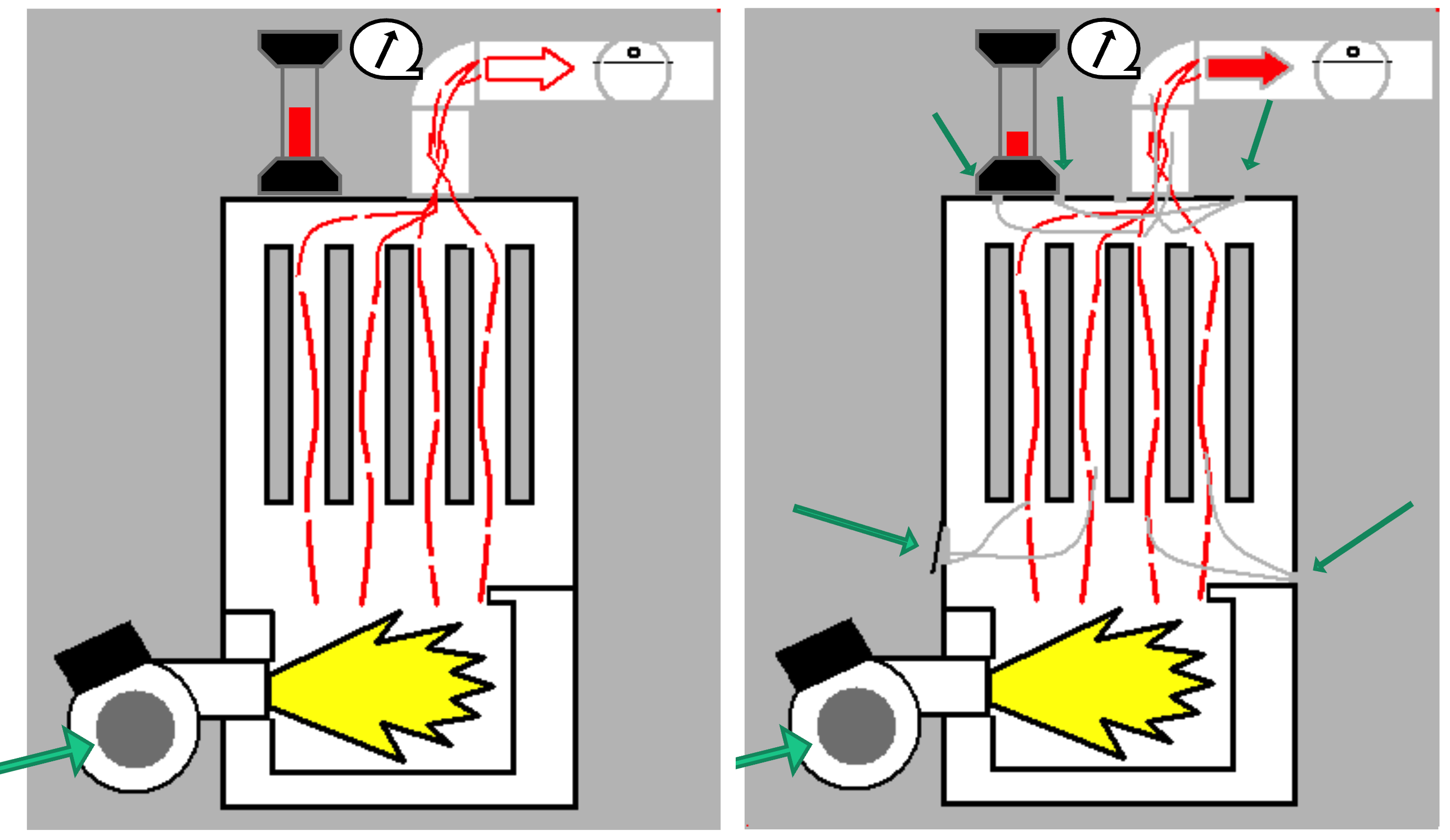
Because that was not always possible to get an air-leak free boiler, we used a temporary testing method to determine the actual flame efficiency without dilution air from the remaining section leaks. For the test only, we operated the burner with slight positive pressure in the combustion chamber. If the boiler still had leaks, the airflow would then move outward through them instead of being drawn inward and diluting the flue-gas sample.
We accomplished this by temporarily removing the barometric draft regulator or propping it open and/or partially restricting the chimney connector. Once we obtained approximately +0.01 inches water column over-fire pressure, we performed the combustion test and recorded the actual carbon dioxide or oxygen reading and the stack temperature.
Immediately after completing the test, we restored the vent connector to its normal, unrestricted operating condition and returned the barometric draft regulator to proper operation. The final operating draft would normally be approximately –0.01 to –0.02 inches water column over the fire.
This procedure gave us a more accurate measurement of the burner’s actual flame combustion efficiency. Any air entering through small remaining leaks during normal negative-draft operation would lower the measured combustion-efficiency result, but it would not significantly change the flame inside the combustion chamber. The heat produced by that flame would still be absorbed by the boiler, with only a relatively small efficiency loss resulting from the remaining air leakage.
Government inspectors simply needed to witness an actual combustion test showing an efficiency reading of 80% or higher on the instruments and calculator before signing off on the job. Once the test was completed and the system was restored to its normal operating condition, we made sure the equipment would operate safely. Our own service technician would then sign off on the job. With both signatures in place, the U.S. Treasury checks would start rolling in.
The bottom line was that we took a system operating at 60% combustion efficiency or less, equipped with an old, wasteful burner, and made it burn less fuel while still providing all the comfort the homeowner needed. The work cost less than half as much as installing a new gas boiler and often produced similar fuel savings. At the same time, we were able to keep a fuel-oil customer from converting to gas heat.
I hope this information helps you in determining the result of your work. Your combustion numbers don't need to be as high as you think to get the lowest fuel usage
Edward Young Retired
After you make that expensive repair and you still have the same problem, What will you check next?
2 -
The old way with the wet kit was to take a Co2 in the breeching and take one over the fire. If the OTF was a better Co2 you had air leaking in.
If I remember right this was in Burkhardt's book.
Since the OP has-.04 in the breeching and -.02 otf you can't do much with bricks or baffles or you might get short on draft.
Depending on the load on the boiler he may be able to lower the nozzle 1 size to.75 which would lower the stack temp and get better combustion with longer run time
2 -
of course that many of those original materials were ACMs wasn't considered a problem then(also possibly some of the new materials you were using, it seems like a lot of products through the 90's or so they didn't remove the asbestos they just stopped mentioning it, or they made liberal use of the rule that products containing less than 1% asbestos were not ACMs). i'm pretty sure i've got asbestos gaskets in gasket sets long after they should have gone away.
1 -
Great conversation gentlemen, I am the current owner of the same unit and it just keeps on ticking (not literally, lol).
Im in need of a new blank off plate for the former water coil location.
Any help would be appreciated and boy do i wish the aouthor of this topic lived on Long Island. I would pay to have him review the unit.
1 -
if you want to blank off the tankless coil location you would have to fabricate a plate out if steel, if the current tankless coil is too damaged to seal the opening.
0 -
Amazing you can probably still get a coil for that boiler but not just the plate.
0 -
That is amazing!
0 -
I wish I lived closer, but have you tried Find a Contractor on this site
Right off the bat, I see:
Scully's Plumbing & Heating(516) 887-1122
65 Tucker Lane
Malverne, NY 11565Good luck!
Robert
0 -
@Danny Scully is great. There are about 5 others here too which are all some of the best that will work on Long Island.
1


Categories
- All Categories
- 87.9K THE MAIN WALL
- 3.3K A-C, Heat Pumps & Refrigeration
- 60 Biomass
- 430 Carbon Monoxide Awareness
- 133 Chimneys & Flues
- 2.2K Domestic Hot Water
- 6K Gas Heating
- 124 Geothermal
- 170 Indoor-Air Quality
- 3.9K Oil Heating
- 80 Pipe Deterioration
- 1.1K Plumbing
- 6.7K Radiant Heating
- 397 Solar
- 16.1K Strictly Steam
- 3.5K Thermostats and Controls
- 56 Water Quality
- 51 Industry Classes
- 51 Job Opportunities
- 18 Recall Announcements