Steam Boiler Calculator

I've been working on a steam boiler excel sheet to help size boiler systems and predict performance. It's not done and I have other features I plan on adding. I thought I would upload it here if anyone is interested in using/giving feedback on the calculator. I'll be using the sheet this winter on a few boilers that are already installed that I have access to see how accurate it is.
How it works: Inputs are in orange, outputs are in blue.
The Main sheet takes the GROSS BTU/HR, the water in the boiler when filled to the water line(gal), operating pressure(psig), the weight of the boiler(lbs). The pipe size and count of the risers(the ID is accounted for each pipe size), the size and length of the main line(feet). The main vent that is installed and the number of vents.
The Radiators sheet has a heat load(%) calculation so that after you input the radiator information for the building you can change the heatload on the system. You have the option of radiator type: Column, tube, cast iron radiator/convetor and copper cabinets. Each of these radiator types references EDR tables using the height, number of tubes, and number of sections. You can also input the length of the upfeed pipe from the main, the size of pipe will automatically calculated. Finally the vent/trap can be selected. It takes data from vent tables from the venting capacity chart(at 3oz).
The volume of each radiator type is accounted for, the volume of the main, and the upfeed to the radiator is also accounted for. The radiation off the main and off the upfeed is calculated, right now it assumes no insulation, I may change that later. However, when I put in the data for an actual radiator system I have access to I did get a pickup factor of 1.6, which is a reasonable answer.
Finally the pressure drop is calculated using the appropriate steam charts. This should predict the necessary system pressure to read the farthest radiator. It isn't perfect because the way it is calculated right now all of the radiators come off the very end of the main line and are fed individually.
More to be added:
The heat of enthalpy is dependent on pressure. This is calculated for the boiler, but it will be different in each radiator. But the math is more difficult and right now it is set to 970btu/lb.
Insulation options for the mains and upfeeds.
A selectable list of boilers with all of the applicable performance information.
With the data available for the vents it should be possible to extrapolate and model the vents and traps as orifices for more pressure variation. But may be dependent on low reynolds number effects and may not be accurate.
It should be possible to calculate how long the boiler needs to run to get to pressure and how long it will be off before it turns back on. But that will take a lot of work.
Right now the calculator does NOT work for single pipe steam. I figure they are so small that it's not worth the effort.
Owner
Steamnowrockford.com


Comments
-
Tough job. So many variables in a steam system not sure what it will show but very interesting.
1 -
I agree there are many variables, however in my engineering career I have been able to make reasonable simplifications to a system and still arrive at an accurate solution. The same must be possible with steam systems. The enormous cost of these systems when originally installed tells me that they must have done engineering estimates before installation. The same physics is still known, from many steam tables for steam properties and pipe radiation. I do not pretend it will be easy, only possible. Mr Holohan discusses the steam systems using basic physics, of course there are rules of thumb, but the physics has not changed and should be repeatable.
Owner
Steamnowrockford.com
 1
1 -
fairly large 1 pipe steam systems are common in some areas.
0 -
Interesting set of comments. There is one key element about steam heating: it is incredibly forgiving. We often make a fairly big production out of getting the header "just right" or making sure the insulation — if any — is properly accounted for and all of that. But, at the end of the day, it turns out that steam systems — whether one pipe or two, or "normal pressure" or "vapour" work most of the time with careful craftsmanship and attention to detail.
I have no beef with @SteamNow 's efforts here — in fact, I applaud them. And, of course, his comment that it must be possible to apply more rigorous engineering to them is quite correct. That said, however, there is a classic engineering problem here: there is a very large number of variables, and some of them have a very large impact on exactly how the system will operate on a given day. That wouldn't be too bad, except that… most of these variables are very poorly quantified (e.g. the heat output of a radiator on a given day) and may have rather large uncertainties (plus or minus 10% would be quite reasonable for some of them). So while the output of a mathematical set of calculations such as is proposed may appear to have great precision, the accuracy may be rather poor. Not through any fault of the computations, but simply because even the known data are poorly quantified.
This makes the engineering of a heating system quite unlike some other engineering disciplines — some branches of mechanical or aeronautical or electrical come to mind — where accuracies on the better than one percent level are to be expected routinely, this is much more like geotechnical or most of civil engineering, where coming within 10 percent of the real world on a given day is cause for considerable celebration.
I do have one perhaps minor disagreement with one statement, however: it is stated "It should be possible to calculate how long the boiler needs to run to get to pressure and how long it will be off before it turns back on." If by "get to pressure" is meant "get to an equilibrium operating pressure on start up of a cycle", then one can expect to calculate it, subject to the comments I made above; both the ambient environment and the preexisting conditions of the system will have a major effect on the time and must be taken into account (just an example for Cedric, my most-studied system: on a cold day, from a genuinely cold start, it will take about 10 minutes to reach running stable pressure (four ounces gauge), but on the same cold day, but when the system has running at capacity in the previous 15 minutes, it will take around one minute). The second half of that quote states "how long it will be off before it turns back on", which implies that the system will turn off — which simply isn't true of a well adjusted system. Such a system will operate at the running stable pressure indefinitely until the control device — usually a thermostat — is satisfied. On the other hand, on systems which are not so well adjusted and which cycle on pressure before the thermostat is satisfied, the time lapse between when the pressure control turns off the boiler and when it turns back on will be governed — or should be governed — by the characteristics of the pressure control device and the particular burner controls (Cedric again, which is not perfectly adjusted): in the situation where he does cycle off on pressure while the thermostat is still calling, which occurs at between 45 minutes and an hour into a cycle, depending on ambient factors, the pressure drops to "cutin" pressure (two ounces gauge) within 10 seconds, but the burner post purge/prepurge cycle controls and is one minute.
To follow the cycle point further a bit (sorry!), many if not most steam boilers have a constant firing rate. Thus the only way in which they can modulate to match the load (the radiation) is by cycling on and off. Provided that the "cutout" pressure is reasonable (no ore than twice the running pressure — Cedric again, 7 ounces gauge) the duty cycle is a direct result of the mismatch between the power output of the boiler and the power absorbing capacity of the system — and the latter is, as I noted above, variable, but if the both are known to some level of accuracy, the duty cycle may, of course, be calculated quite easily.
Br. Jamie, osb
Building superintendent/caretaker, 7200 sq. ft. historic house museum with dependencies in New England 1
1 -
then there are large 2 pipe systems that are zoned, frequently by room, that use pressure to modulate or cycle the burner because they don't otherwise know what load is currently connected.
i kind of have this same sort of problem with heat loss calculations. you proably are only going to get within 20% or so.
even in electrical engineering you are usually within 20% or so, there are usually things you can't control or measure or other real world factors that mean you aren't calculating things to a couple percent.
1 -
@mattmia2 if I find that it is somewhat accurate after finishing the two pipe systems. I'll add in the one pipe. This was mostly born out of a desire to accurately calculate the EDR pickup in the building. And I figured as long as I was already calculating that and trying to add in piping that I already had a bunch of other information I could add in and see if it was going to be accurate.
Owner
Steamnowrockford.com
1 -
@Jamie Hall I definitely agree there are a lot of variables that need to be taken into account. I am working on a version which will take into account the mass of the cast iron of the boiler of the radiators and of the steel of the piping. This should help account for the specific heat required to heat up all of the metal in the system. And then this would account for the difference in time for the boiler to get to any set pressure because more Steam will be condensing when it is heating up the system. And once the system is heated up and the metal is already hot it will not take long comparatively to reach pressure again.
Owner
Steamnowrockford.com
1 -
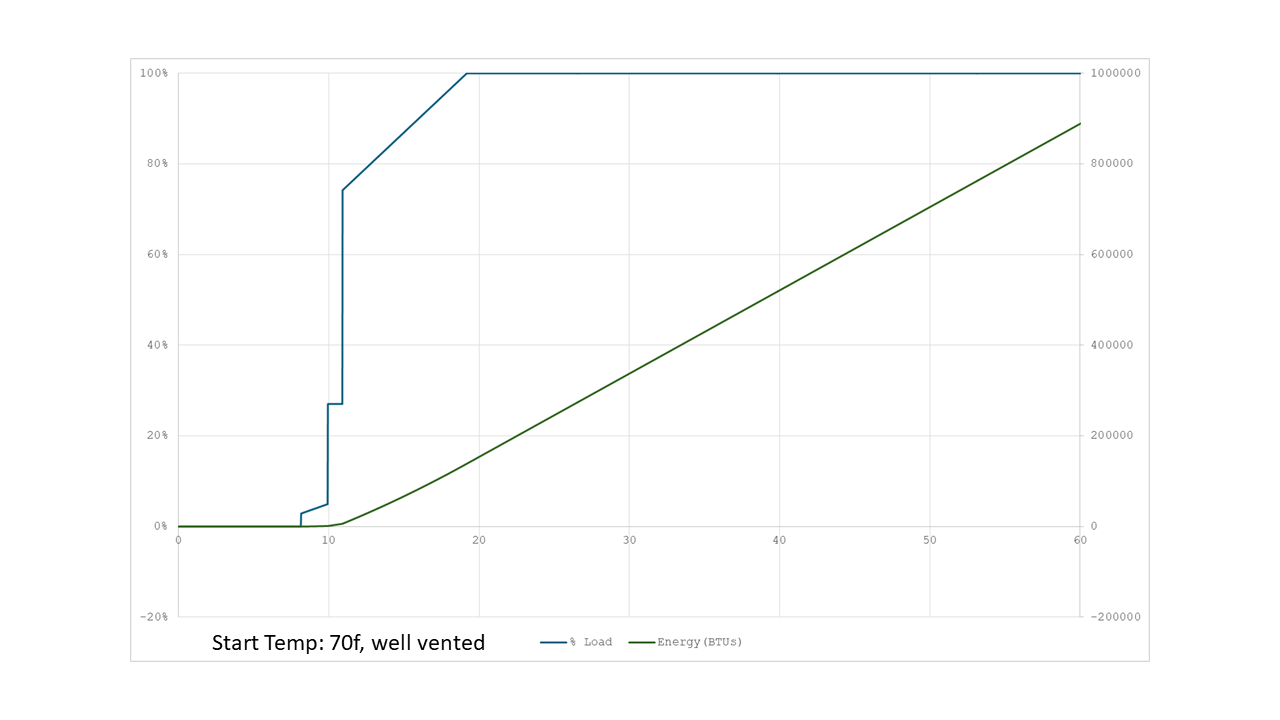
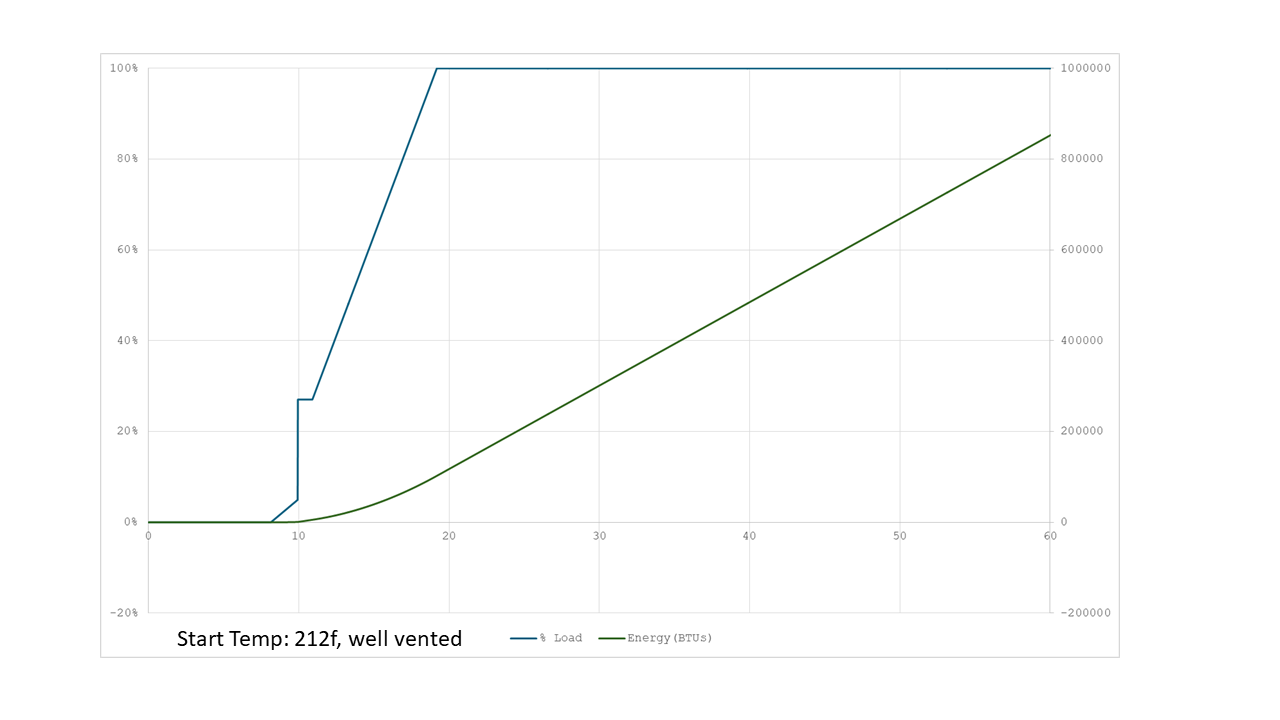
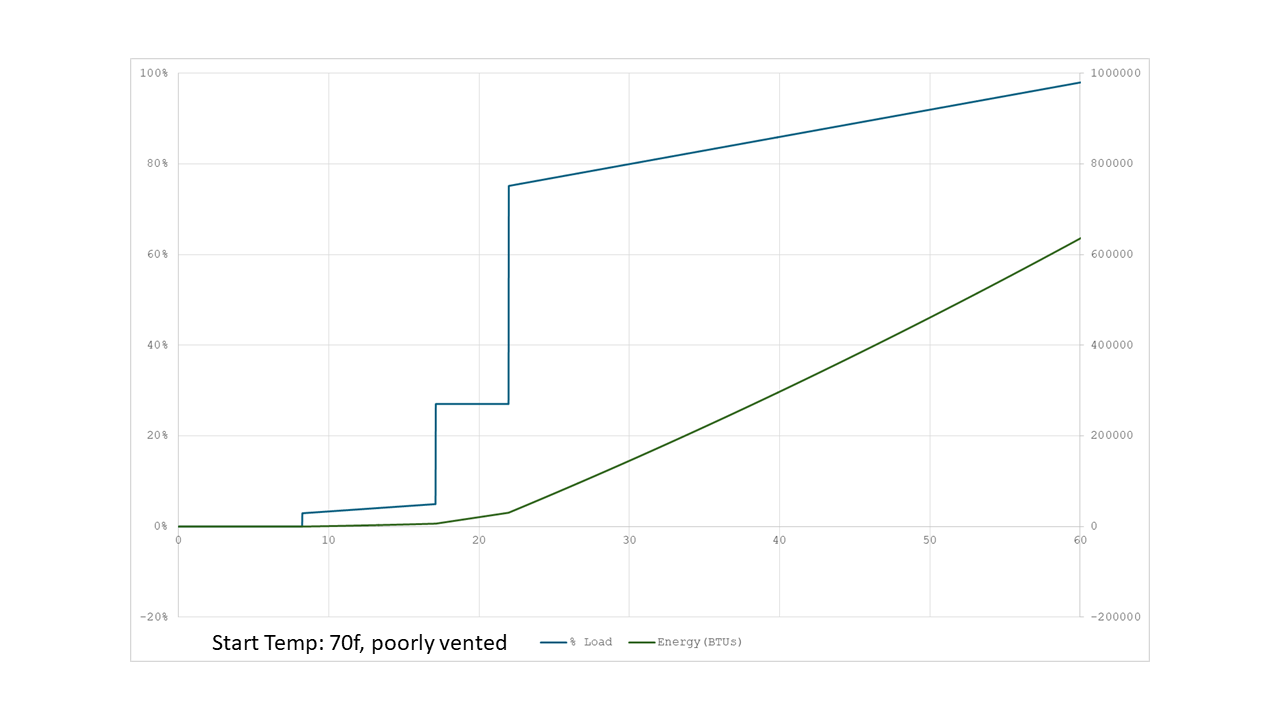
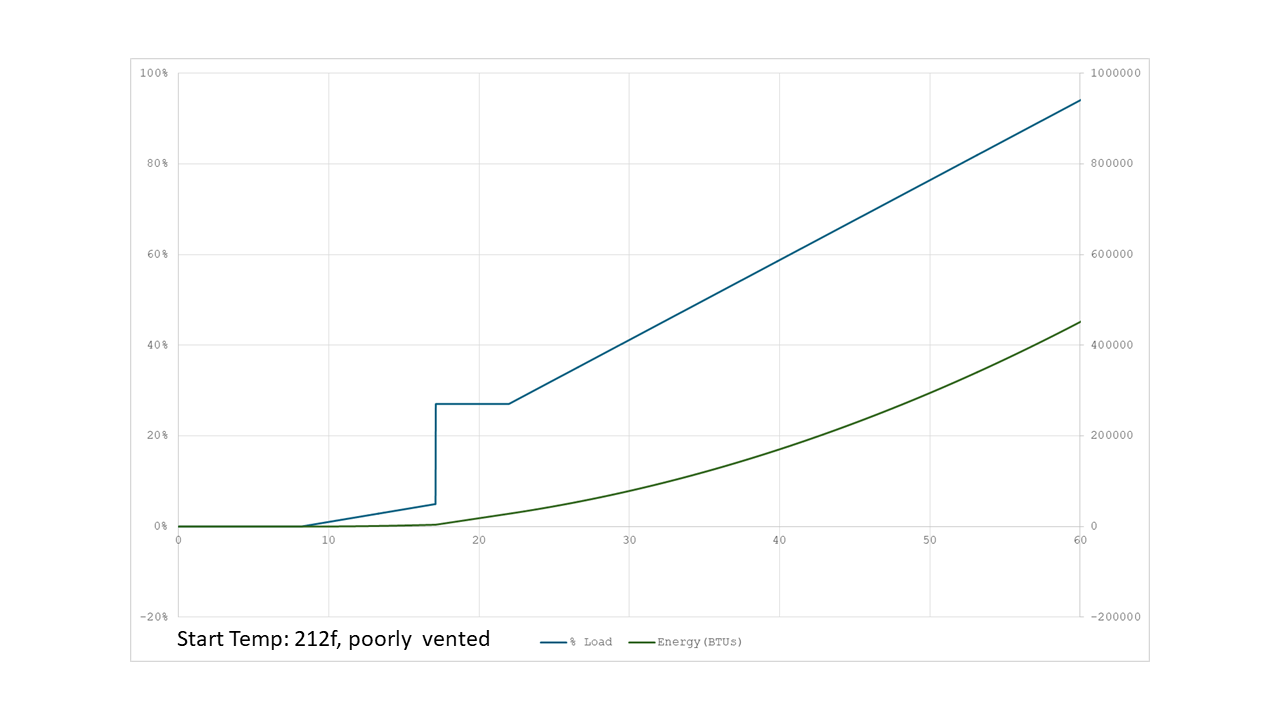
Been doing more work. The system I'm modeling is a 4 floor building built in the early 1900s which has the original Kewanee, but currently runs on an LGB-12. It currently has a single Gorton 2 main vent. The return has a 1 inch nipple for venting. Based on the vent tables 5 Gorton 2's max out a 1inch vent capacity. This simple analysis looks at 2 variables: venting - using 1 vent(current setup) vs 5 vents; and startup temperature - one at 70F, one at 212F.
In this analysis the boiler is running the entire time simulated(60 minutes). The %load(% radiation the system is absorbing and radiating based on its total EDR) and the total summed Btu(the radiated heat that is being output to the building and the heat required to warm the cast iron and steel). So the higher the BTU ratings during this hour analysis is generally better, as more heat is being transferred, minus the warming heat.
Now, I always new that venting helps with heating, but I didn't realize how much. There is a near 50% decrease in first-hour radiation output if the system is poorly vented. Although this exact analysis is limited to this particular system.
Edit: I found an error with the supply line radiation plot, but it doesn't affect the findings. The step is smoothed to slopes though.
Owner
Steamnowrockford.com
1 -
are you accounting for the mass and specific heat of the piping?
0 -
Great analysis. I have always found this to be true as well. It is best practice to just get out of The Steam's Way! Mad Dog
1 -
@mattmia2 yep, you can see the beginning of each graph is flat and that is the time it takes the boiler to heat up the water and the cast iron which is specific to each different boiler model. And then it takes into account the steel for all of the piping and then the cast iron for the radiators.
Owner
Steamnowrockford.com
 2
2 -
I believe the precise adjustment of boiler output is dependant on thermostat activity over time. Start up has to be longer to heat the system piping and radiators from cold to warm. Attaching a laptop to monitor behavior of systerm for a day or two allows for data collection which will indicate what software variable factor ranges can be adjusted for the particular building. Once set you forget it. This compensates for design inaccuracies, oversized boilers and state of insulation. Important of course is to assure that radiators or properly vented or trapped.
John Cockerill Exquisite Heat www.exqheat.com Precisions boiler control from indoor reset.0 -
Nice graphs. One does have to wonder a little, though — or maybe it's just me being a curmudgeon — how on earth we managed with just a good low pressure gauge and patience…
Br. Jamie, osb
Building superintendent/caretaker, 7200 sq. ft. historic house museum with dependencies in New England 1
1 -
@Jamie Hall oh, NONE of this necessary. The hands on way is perfectly adequate(and more accurate) and that's what I use for actual work. This is something I'm doing to learn about the systems more. I also have a hope that I can come up with an estimate of efficiency loss from broken traps to help explain things to customers.
Owner
Steamnowrockford.com
0 -
I read you loud and clear. It seems that these days you really can't sell something without beautiful graphs and a computer calculation.
Br. Jamie, osb
Building superintendent/caretaker, 7200 sq. ft. historic house museum with dependencies in New England0 -
adjusting fire time hour to hour from thermostat activity will keep fuel use to a minimum.
John Cockerill Exquisite Heat www.exqheat.com Precisions boiler control from indoor reset. 1
1 -
You helped me with this 25 years ago. Thank you
John Cockerill Exquisite Heat www.exqheat.com Precisions boiler control from indoor reset.1 -
Yah. Steam head.
John Cockerill Exquisite Heat www.exqheat.com Precisions boiler control from indoor reset.1 -
-
Was I involved with this? Can't remember……………
0 -
I believe so. I had consulted you on how we could adopt our hydronic control to steam. We had discussed the difficulty of monitoring temperature at the boiler as a control data point. After our duscussion I discovered the applicability of establishing variable fire times to control steam for variation of heat loss in buildings. I hope it was you. As you probably know every control company has tried to get it right. They say they have it, but they don't. If I am wrong that it was you, my apologies.
John Cockerill Exquisite Heat www.exqheat.com Precisions boiler control from indoor reset.0 -
They say the memory is the second thing to go as we age- I've forgotten what the first one was…………..
 2
2 -
Could be him! I'll mention this when I see him.
0 -
Ok, I've been doing work on adding failed steam traps into the calculations. So far the best way I've come up with to estimate how much steam loss you get is as follows:
I took the flow rate venting data from HH and used the orifice equation to back calculate the equivalent orifice diameter for each vent and trap. Then I used the standard isentropic orifice expansion equation to calculate the flow of steam through the traps modeled as orifices. I did not use the napier equation as it isn't applicable until you have a pressure of ~15psig in the boiler, and that shouldn't happen. From there I can calculate the amount of steam each failed trap is contributing to the return based on the pressure in the radiator and the model trap installed.
We know the BTU/Hr per ft for all pipe sizes from standard tables. Then we can take the size and length of the return and calculate how many BTU/HR the return will output at 212f. Now we have a maximum BTU/HR that the return can condense. Anything higher than what won't be able to condense and will leave through the vent.
While the results seem pretty reasonable using this method, it will require testing. In my example system, which is modeled on a real system I have regular access to, having 50% of the traps failed still doesn't release steam out of the system. The heat is retained in the building, it's just released in the wrong place. Now, if all of the traps are failed then the savings are still only 0.7% of the total boiler output. I'm not sure that's right. It seems low, but I've been told you can't promise heat savings from trap replacement. I would wager that the heat savings comes from getting the heat solely to the radiators and not heating the basement. Although at the point where all traps are failed you will be having other issues in the system as well.
Now, this is only for the radiator traps, no main traps, that I think would be a much larger issue. But the calculator has data on more than 180 traps and vents so that might be possible later.
Owner
Steamnowrockford.com
0 -
@Gordo doesn't remember this either……….. do you remember about when this was?
0 -
Quite correct. A failed trap or traps does NOT lose efficiency, so long as efficiency is defined for the overall system (building plus heating etc.) and not, as it so often is incorrectly, just for one part of it. Also correct in that the problem isn't a loss in efficiency, but losing control over where the heat is within the envelope (radiators not heating, hot returns, that sort of nonsense).
Br. Jamie, osb
Building superintendent/caretaker, 7200 sq. ft. historic house museum with dependencies in New England1 -
I'm back with more stupid questions.
In the pickup factor, how much are we dedicating to heating up the metal? How much of a difference does that make? If seems regardless of boiler sizing within reason it will take ~20-30 minutes to warm the metal.
Owner
Steamnowrockford.com
0 -
I'm not entirely sure what you mean by "heating up metal"
Adding extra boiler to "heat piping" isn't needed.
The entire boiler is available to heat the piping up initially as no radiators should have any steam in a properly balanced system until all, or very close to all piping is hot.Heating up radiator mass, 100% of that ends up back in the living space as the stuff cools and extra boiler isn't needed for that either as it's the boiler's primary purpose.
Single pipe 392sqft system with an EG-40 rated for 325sqft and it's silent and balanced at all times.
0 -
Not a stupid question at all — and one which has popped up from time to time every since the first kettle over the first fire.
And is guaranteed to start a debate, if not just get it going again.
There are, I think, a number of ways to look at a ""pickup" factor. In principle it isn't needed at all; once a system is up and running, if there were not heat losses anywhere the boiler should be sized to supply exactly the power that the radiation is absorbing — essentially a pickup factor of zero. But even with a system up and running stably at equilibrium, there are losses — primarily from the piping, but also from the boiler jacket and other miscellany., as well as malfunctioning traps and the like Thus sizing the boiler exactly to the radiation will be underpowered — not much, perhaps, but it will be.
Then also, at equilibrium, there will be a variable and very difficult to quantify loss in combustion.
So… seen from that standpoint, a pickup factor would be much more accurately called a safety factor — or for those who prefer to call spades spades, a fudge factor. Unlike most safety factors, however, there is a real and present downside to getting it too big — the boiler will overpower the radiation and be forced to cycle. Not desirable.
The notion that it is in some ways related to heating up the metal isn't actually that farfetched, however, and has merit. While the heating up metal bit pretty well disappears once the system reaches equilibrium, it is a factor during the time when the system is warming up, and some additional capacity a that time is helpful in getting live steam to the radiators faster. In larger systems, even with insulated piping, this can be a significant factor — and with uninsulated piping it takes an astonishing amount of heat and time just to get the steam to the radiators.
And last… for now anyway — the "pickup" factor advised has changed over time. Years ago 550% was often quoted. When I started playing this game, the commonly accepted value — which I believe is still baked into the boiler's EDR or square feet of steam rating — was 30%. A number of people have argues quite successfully for using a smaller value — say 10% or so. Fortunately most oil boilers and power gas boilers can be downfired during the commissioning process, so starting somewhat over where you think you really should be is not a problem.
Br. Jamie, osb
Building superintendent/caretaker, 7200 sq. ft. historic house museum with dependencies in New England1 -
550%………….I knew you guys were using what I considered to be ridiculous numbers, but holy smokes.
Single pipe 392sqft system with an EG-40 rated for 325sqft and it's silent and balanced at all times.
1 -
I think that was a typo. @Jamie Hall ?
0 -
Fat fingers. 50%
Br. Jamie, osb
Building superintendent/caretaker, 7200 sq. ft. historic house museum with dependencies in New England0 -
I agree unless the boiler is located in a freezer the 1.33 PU factor is probably more than is needed. I have often thought of it the same as @Jamie Hall .
On the coldest days when the boiler is running a lot the piping has no time to cool off so little if any PU is needed
0 -
It also depends on the size of a system. A large, sprawling single level commercial building has a lot more piping surface area to lose heat than a typical house.
0 -
But such a building also has a much larger boiler too.
So, does it have a lot more, or is it just the same system scaled up?
Single pipe 392sqft system with an EG-40 rated for 325sqft and it's silent and balanced at all times.
1 -
@Jamie Hall I have seen what you're talking about with an oversized boiler in our church. I haven't checked in detail but I know it is significantly larger than it should be and we have to run it a little more than two PSI so it's not cycling every 2 minutes. If I keep it at two abs a quarter PSI I can push the cycling to every 15 minutes or so. I don't know of any other way to fix that unless this thing gets replaced.
Owner
Steamnowrockford.com
0 -
large commercial boilers usually can be downfired more than residential boilers.
0


Categories
- All Categories
- 87.9K THE MAIN WALL
- 3.3K A-C, Heat Pumps & Refrigeration
- 60 Biomass
- 430 Carbon Monoxide Awareness
- 133 Chimneys & Flues
- 2.2K Domestic Hot Water
- 6K Gas Heating
- 124 Geothermal
- 170 Indoor-Air Quality
- 3.9K Oil Heating
- 80 Pipe Deterioration
- 1.1K Plumbing
- 6.7K Radiant Heating
- 397 Solar
- 16.1K Strictly Steam
- 3.5K Thermostats and Controls
- 56 Water Quality
- 51 Industry Classes
- 51 Job Opportunities
- 18 Recall Announcements