10 day vacation. Should I turn off oil boiler? ( tankless coil hot water)

Steam heat is off for summer, but boiler runs all year for hot water. Old boiler and Carlin burner. 10 day vacation. Should I turn off oil boiler to save oil? ( tankless coil hot water). Any risk? Do I just flip red emergency light switch? How do I restart when I return, just flip switch back on, or is there more involved?
Comments
-
yes
0 -
Yes and when you get back get a standalone electric water heater and turn off the boiler all summer
NJ Steam Homeowner.
See my sight glass boiler videos: https://bit.ly/3sZW1el 0
0 -
No thanks. Seems like a major project that could involve major plumbing, electrical, permits, and drywall work. $10-$20k, I'd imagine. My electric is $0.31/kWh too.
 0
0 -
Also shut off the water main.

 2
2 -
At your electric rates… yeah, an electric water heater is mildly insane.
Just turn off the boiler ("emergency" switch) Then just turn it on when you get home. No hassle.
You can also shut off the water as @HVACNUT suggests — provided that the main shutoff valve actually works…
Br. Jamie, osb
Building superintendent/caretaker, 7200 sq. ft. historic house museum with dependencies in New England0 -
Sprinkers auto run
0 -
Can't you isolate the house from the sprinkler system?
0 -
@ethicalpaul is at it again about a tankless coil. He does not understand that not every oil heater is a dinosaur that blows all kinds of smoke into the atmosphere and uses hundreds of gallons of oil just to give you the option of taking a shower whenever you want. I don't know what his experience was with some old, fuel-wasting oil heater in the past, but his answer to a tankless coil is always the same, no matter what the cost is to the homeowner. Every tankless coil in a boiler is just wrong in his opinion, even after I have offered him facts to the contrary. Some folks just like to stick their heads in the sand and believe they are right no matter what.
You are correct to reject his advise. And as far as turning off the boiler for 10 days… that is a great idea.
Edward Young Retired
After you make that expensive repair and you still have the same problem, What will you check next?
1 -
Anyone can do what they want. The oil company loves a tankless coil that’s for sure.
NJ Steam Homeowner.
See my sight glass boiler videos: https://bit.ly/3sZW1el0 -
If there's lawn sprinklers, additional valves should have been installed. You should always be able to isolate the irrigation from the house.
0 -
A brief word, if I may, about tankless coils and warm start boilers in the summer. And, for that matter, oil fired water heaters. Yes it does take some oil to keep a warm start boiler warm in the summer, and this does appear to be wasteful. But — how much is it, really? Has @ethicalpaul ever actually measured the run time of such an arrangement? I very much doubt it. Let's suppose, though, that the burner needs to run about 10 minutes every four hours, for a total of an hour a day, and let's also suppose that it is a more or less typical residential boiler at perhaps with a 1 gph nozzle. OK. At current prices around here, that's a whopping $5.00. Let's also suppose that the electric water heater needs to generate about the same number of BTU. Again, around here — at $.40 per kW, — that's around $16.00 worth of electricity.
Um… and just what is wrong with that tankless coil again, @ethicalpaul
And kindly don't get me started on heat pump water heaters. I have nothing against them — for new installations, or all-electric homes or jurisdictions where all-electric is mandates. Unless they have huge tanks, they WILL drop into resistive heat mode or give you a cold shower for any use more than two people in a flat, but they do save energy. They also cost a lot up front. And have a relatively short life (10 years?).
Br. Jamie, osb
Building superintendent/caretaker, 7200 sq. ft. historic house museum with dependencies in New England
 4
4 -
Basically agree, but the idle loss on boiler will be more than an electric tank. Not enough to alter the decision but a factor.
0 -
And kindly don't get me started on heat pump water heaters.
That's a strange way to have a discussion! But OK, I won't!
NJ Steam Homeowner.
See my sight glass boiler videos: https://bit.ly/3sZW1el0 -
I put my water heater and boiler on pilot. I have an auto water shut off installed as well.
 1
1 -
I can understand @ethicalpaul ’s position. A lot of people had that same experience in the years around the turn of the century, when electricity was relatively inexpensive and oil prices were going through one of their periodic spikes. In many cases, a tankless coil on an inefficient oil-fired boiler was an expensive way to make domestic hot water. That was especially true when the coil was limed up with calcium deposits and could no longer deliver enough hot water for a decent shower. The plumber would come in, install a 40-gallon electric water heater, and voilà—more hot water and, quite often, a lower operating cost.
In those situations, the old oil boiler might have had an effective water-heating efficiency, or energy factor, of only about 0.40. With electricity at roughly 8 cents per kWh, the electric water heater could easily win the operating-cost comparison.
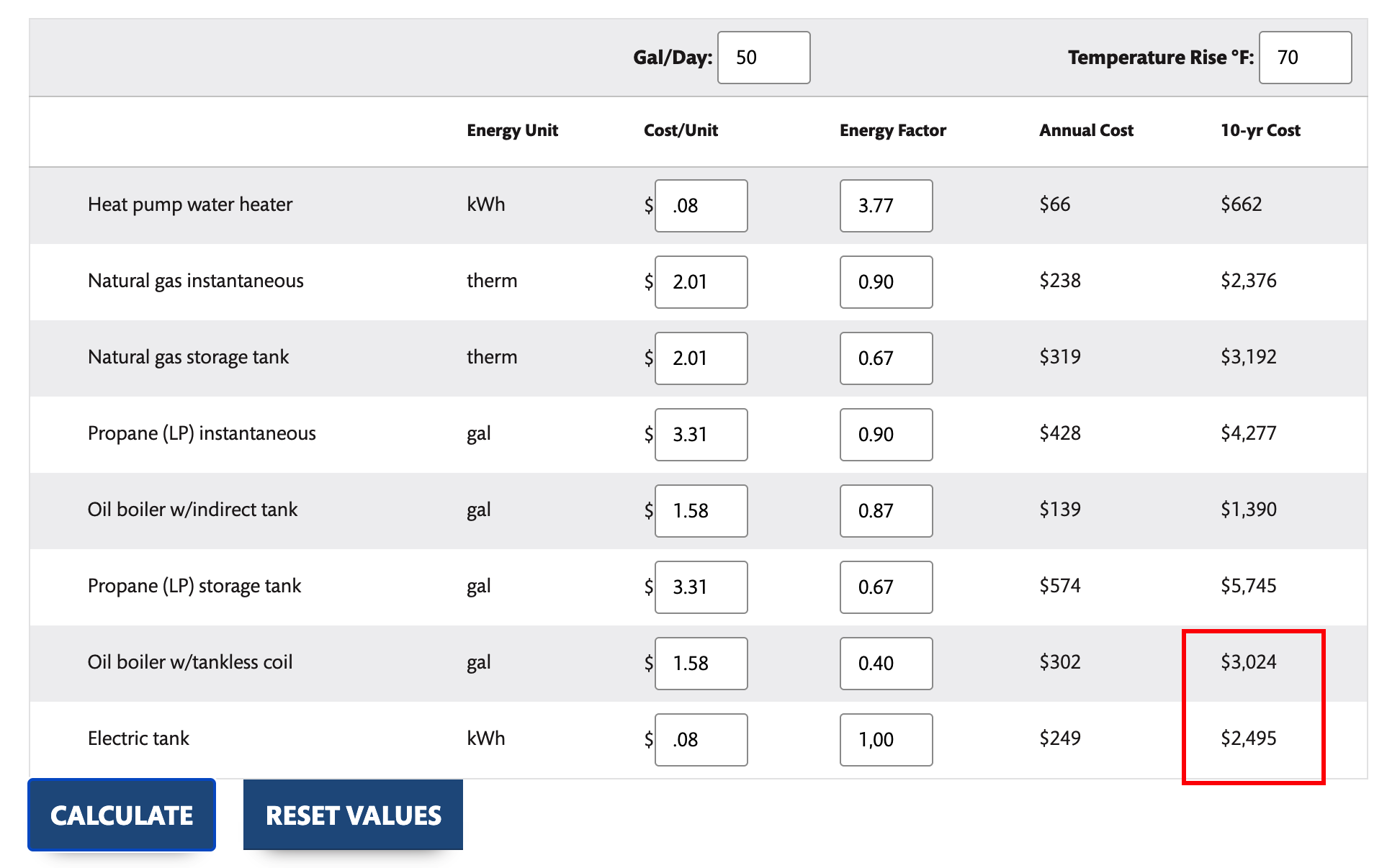
Inefficient Oil Boiler energy factor = 0.40 Electric is about 8 cnets for a kWh
The important point, however, is that the oil-fired boilers Paul formed that opinion around are, for the most part, no longer representative of what is commonly installed or operating today. A modern oil-fired boiler with a tankless coil—such as a Weil-McLain, Peerless, or Burnham—can typically operate in the range of 80% to 85% combustion efficiency when properly set up. If we then account for additional standby and off-cycle chimney losses, the effective water-heating efficiency may still end up somewhere around 0.70. At that level, depending on current oil and electric rates, the tankless coil can be competitive with—or even less expensive to operate than—an electric water heater.
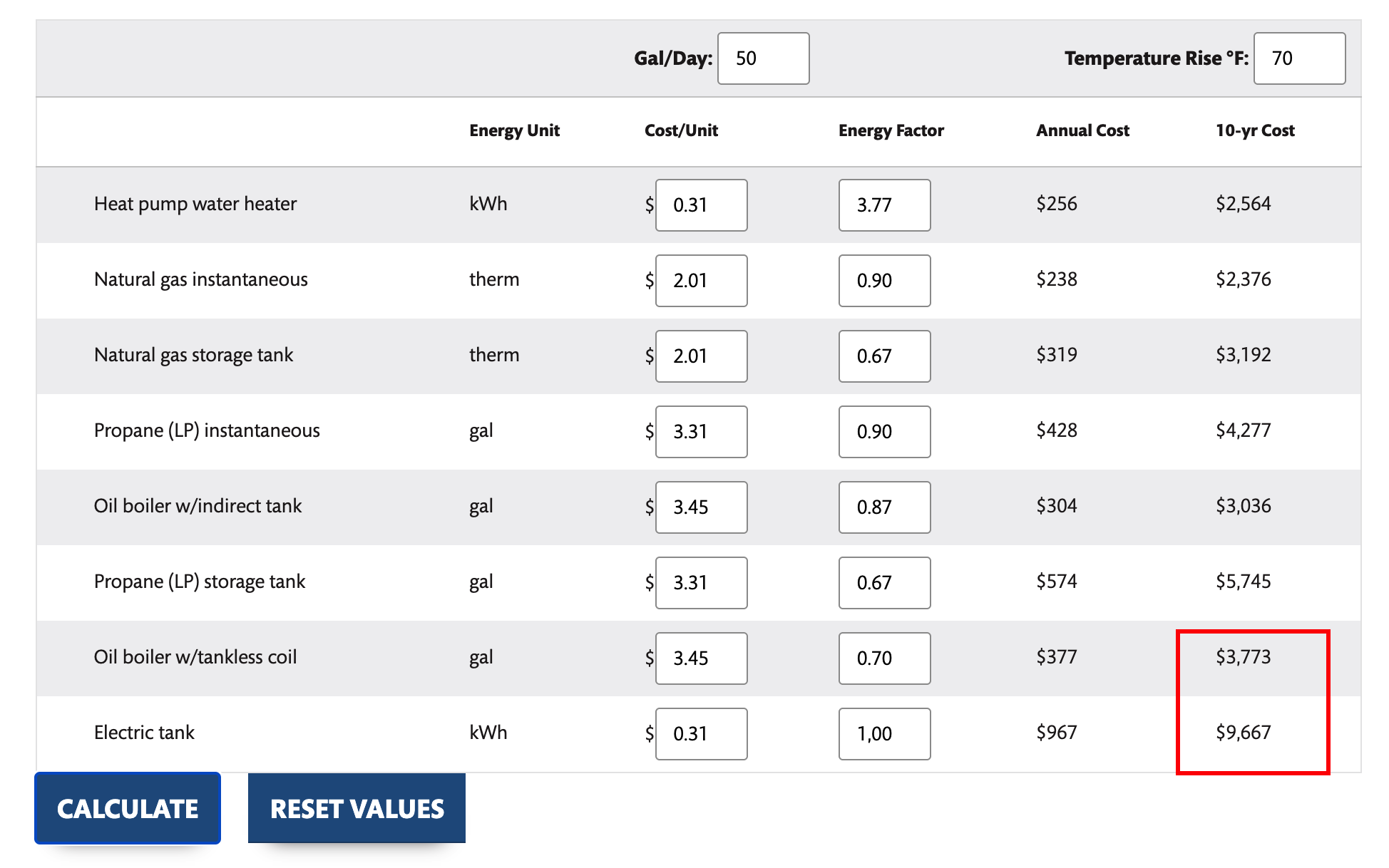
Current Day Oil Prices and Electric Cost comparison
That is the part of the discussion I believe Paul either does not see, or chooses not to accept. His conclusion is based on a real experience, but it is not universally applicable. As long as he continues to evaluate the subject through the lens of a heat pump water heater in his own basement, he is unlikely to be persuaded that his solution is not the right one for everyone. Oil would need to cost almost $9.00 per gallon to make Paul's argument valid when looking at a $0.31 kWh price for electricity.
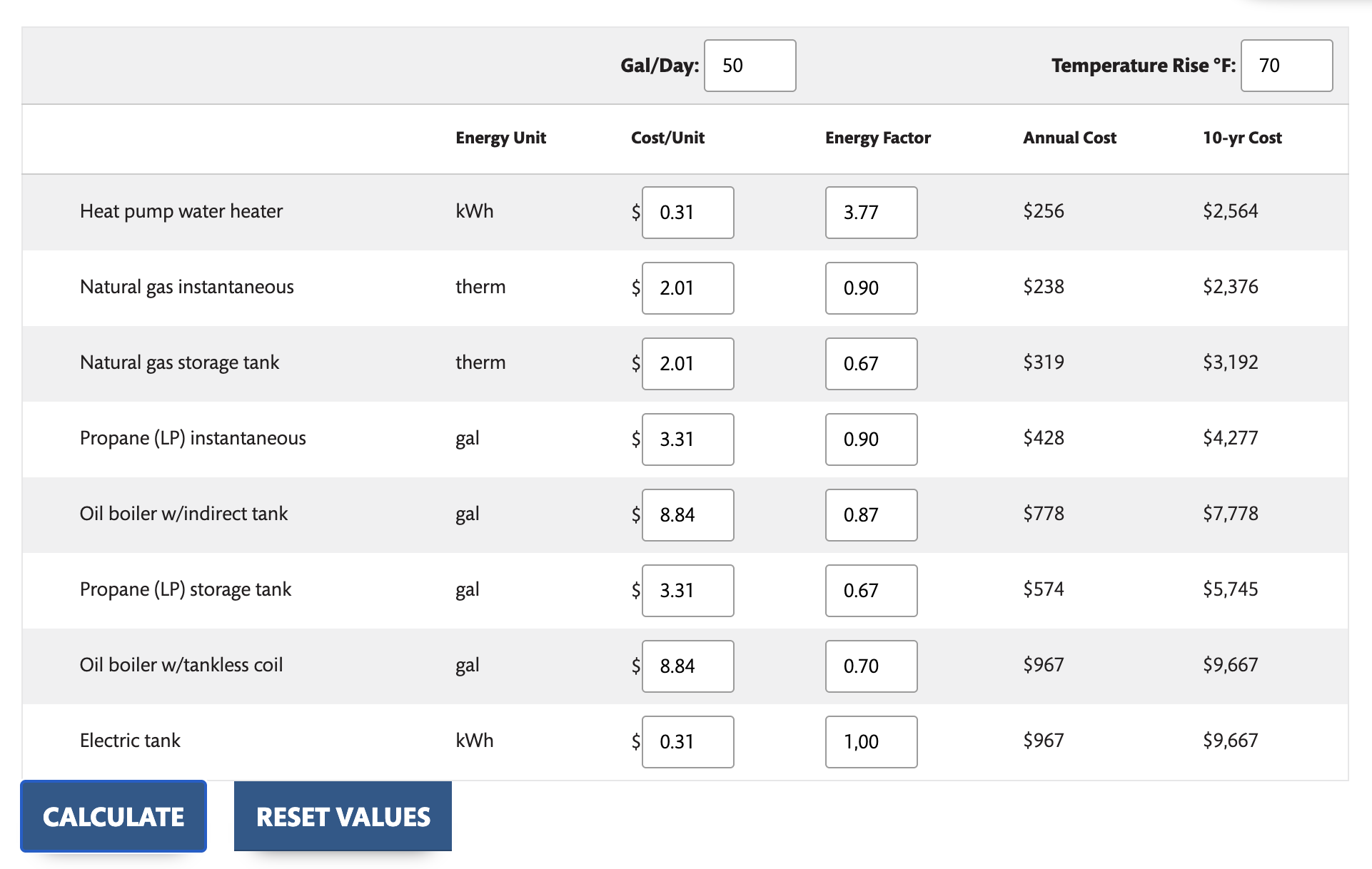
As long as Paul continues to promote the “tankless coil elimination” theory as a blanket rule, I believe some of his otherwise valuable information—particularly on steam—will continue to be undermined by that overly broad and, in many cases, erroneous position on domestic hot water production.
I believe this is the 12th time I have given Paul the facts, and each time I never get the "AH-HA" moment from Paul, the way I got when he did his "Dimension A" video on his Steam Boiler. But can we be sure that the video was not altered just to prove his point?
Edward Young Retired
After you make that expensive repair and you still have the same problem, What will you check next?
 1
1 -
But can we be sure that the video was not altered just to prove his point?Anyone is free to try to find a dimension A, I look forward to their findings.

NJ Steam Homeowner.
See my sight glass boiler videos: https://bit.ly/3sZW1el0 -
LoL…are you guys trying to coax @ethicalpaul to make another one of his very informative videos?
0 -
As Paul misses the point with the reply about my spoof on the "Dimension A" video.
Paul, Your video convinced me that the "Dimension A" that I was taught over 40 years ago hat was not altogether true, but the video did give me an “a-ha” moment. I genuinely respect the work you do and the help you provide to others. What I still do not understand is your strong opposition to tankless coils in oil-fired boilers. And even more on the more efficient indirect fired water heater
You referenced your heat-pump water heater and showed how much less it costs to operate.
This is from my proof about electric water heater above
I then raised the question of the installation cost and how long it would take for the energy savings to recover that additional investment.
You mentioned rebates and incentives and said that, once those were considered, there was very little additional cost.
However, when I looked into the current rebates and incentives, I found that they are no longer as generous as they apparently were when you installed your system.
You then pointed out that a heat-pump water heater is not the only option.
I looked at the cost of other types of water heaters, but even the least expensive standard electric water heater may cost more to operate than the existing oil-fired tankless coil.
At that point, the discussion seemed to end without addressing the actual numbers I presented. I am still looking for a realistic example showing that removing a properly functioning tankless coil and replacing it with another water-heating system is financially beneficial to the homeowner.
The operating cost matters, but so do the installation cost, available incentives, expected equipment life, maintenance, and the length of time required to recover the investment. Ultimately, the homeowner—not the person recommending the change—must pay both the installation cost and the monthly utility bills.
I am not claiming that a tankless coil is always the best option. I am simply saying that replacing one is not automatically the best financial decision in every home. The answer depends on the actual equipment, fuel and electric rates, installation costs, available incentives, and the homeowner’s individual circumstances.
I’m waiting for Paul to show me the numbers that prove my support for less expensive tankless coils and more expensive indirect water heaters is better than the alternatives are wrong.
There are also mitigating circumstances to consider. In this case, the original poster already has a working water heater. That is different from someone considering replacement options because the existing water heater is defective and needs to be replaced anyway.
In the second scenario, the cost of the least expensive replacement water heater can be deducted from the price of the more efficient option when determining whether the additional expense is justified. That is not the situation here.
You are as stubborn as @pecmsg on Nest thermostats when it comes to oil heat for domestic hot water. Where is your experience on this topic?
Edward Young Retired
After you make that expensive repair and you still have the same problem, What will you check next?
 1
1 -
I owned a rental home with a tankless coil in an oil-burning hot water boiler. The mixing valve failed and sent 180 degree water into the fixtures. That was the straw that broke the camel's back—keeping that thing running all summer even though I wasn't paying for it just struck me as an oil company's dream and a homeowner's nightmare. Call me stubborn…I think people are stubborn about tons of things (such as refusing to believe that a heat pump water heater is cheap to run), it's human nature.
> As Paul misses the point with the reply about my spoof on the "Dimension A" video.
You brought it up and seemed to suggest that I faked the video. Of course I focused on that.PS: I do like and respect you, just like so many other people in my life with whom I don't agree with about every topic
NJ Steam Homeowner.
See my sight glass boiler videos: https://bit.ly/3sZW1el1 -
NEST
S
U
C
K
S😁
3 -
@CoachBoilermaker It's ok to switch your boiler off at the stairway or at the boiler. You can put other units in vacation mode if they have that option. Let others know where the switches are if they don't already, just in case.
@ethicalpaul Above, you mention a "mixing valve" failed and sent 180deg. water to the fixtures? Are you sure it was a mixing valve and not a tempering valve? Maybe a Watts 70A, for example? That valve would indeed fail to hot and could scald. A mixing valve would have a thermostatic mix and be called a thermostatic mixing valve. If a true mixing valve- one that is thermostatic fails, they are designed to fail so cold water runs through the valve and not scalding hot water. Do you remember which one you had back then?
1 -
As I recall the Watts 70A was a tempering valve (a mixing valve of sorts) that could fail HOT. The more betterer way is to use the ASSE 1017 strandard mixing valve that will fail COLD (not hot) and is much more betterer than the older design. In many cases the code requires that you use a point of use mixing valve ASSE 1016 which is even betterer and might even be the bestest mixing valve.
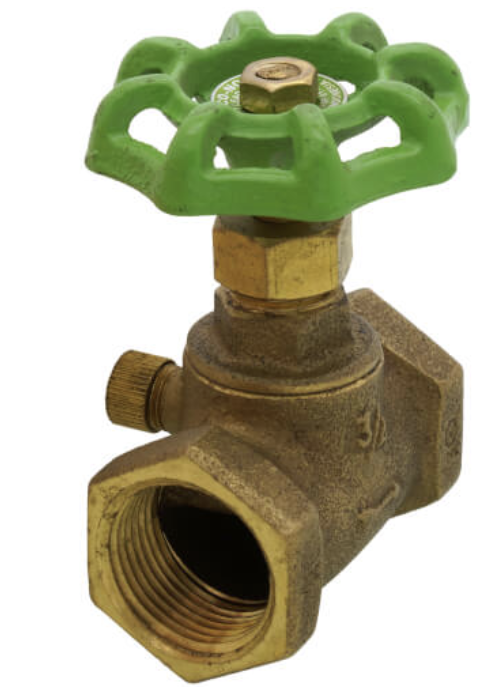
In any case the valve that looks like this is not to be considered a good mixing valve.
Edward Young Retired
After you make that expensive repair and you still have the same problem, What will you check next?
1 -
Yes. You are correct. A thermostatic mixing valve is also required by code in many areas now. A tempering valve, I'm not too sure if they are code compliant for domestic hot water. I just completed a newly renovated apartment complex that required proper hot water thermostatic mixing valves.
1 -
If the installer, service technician, or plumber fully understood how a tankless coil operates under the many changing conditions that occur throughout the year, they would never install or service one without a properly functioning tempering or mixing valve.
The water leaving a tankless coil can range from more than 200°F to as low as approximately 110°F, depending on where the boiler happens to be in its operating cycle. That is why a proper mixing valve is essential. It adds cold water to the hot water leaving the boiler’s tankless coil before that water reaches anyone’s hands or other parts of the body.
Unfortunately, some installers do not fully appreciate the danger until a customer is injured and a lawsuit follows.
Edward Young Retired
After you make that expensive repair and you still have the same problem, What will you check next?
1 -
Agreed . I think there is a play on words that gets mixed up at times, too. Often, a tempering valve will be called a mixing valve and vice versa. I get confused, as do some of the ads I see online for these items.
The watts 70 model top pictured had to be trapped below the coil it served as mentioned in their directions. The thermostatic mixing valves do not need to be trapped and can be installed in almost any configuration.
The Watts 70 is older technology and was used most often on domestic hot water coils back when thermstatic mix was not yet available in residential use.
0 -
Yeah I probably called it the wrong name. But it was neither tempering nor mixing. It was attached at the boiler in yes a typical bypass way, but some part of it failed.
NJ Steam Homeowner.
See my sight glass boiler videos: https://bit.ly/3sZW1el0 -
Just got back from a great vacation in CO, NM, AZ. We followed the Santa Fe trail and learned about 1800's mining, railways, etc.
I got home, flipped the boiler power switch, and it ran for a while. All is well. Hot water works. Glad I learned how to do this.
As for the tankless debate, I'm not spending $10k to save $100/mo. or whatever at $0.31/kWh. And in the winter, the warm boiler heats the basement and living room floors, LOL
Thanks guys!
0 -
That's sort of the problem.
Your boiler is also heating the basement and livingroom floors in the summer too and you're not only paying to create that heat, but you're paying to remove it too if you're using AC.
Right now my only dislike about @EdTheHeaterMan is that he just said I was alive for the turn of the century.
He's right……….but I never thought of it like that before.
Single pipe 392sqft system with an EG-40 rated for 325sqft and it's silent and balanced at all times.

 3
3 -
I had a customer that did the off for the vacation. He flipped the switch on when he go back and a boiler section started to leak. Yup!
0 -
you two are at it again! lets have a big group hug. And pass around some good whisky, for those who partake <3
2 -
As far as a tankless coil boiler "running all summer" for hot water. Everything runs all summer for hot water weather it is an indirect a gas or oil-fired water heater or a HP water heater. An oil-fired boiler makes noise but an electric HWH or gas fired HWH are relatively silent. The oil boilers fire and the HO hears it and thinks "I'm burning oil" not so with gas or electric
I know my cousin (1 person in the house, My GFs daughter (2 people) in the house and My brother in law (2 people) run oil boilers with tankless coils. For low usage they probably are not that bad with a modern boiler if you can keep the boiler at 160-170. Is it the best? No.
Back when I did oil service in the 70s people had old boilers oversized that were the size of battleships. You would go in the cellar in the summer on a hot day and you couldn't breathe with the boilers maintaining 180-degree water yeah that is a waste.
0 -
I moved onto this palace in 1981. I had a Delco DC-4 steam boiler with a domestic hot water coil in it. I had lived with same boiler for l0 years at my apartment so I was familiar with them and how they ran in the summer. The first thing I did was ro have a 30 gallon gas hot water yank installed. That was back when oil was about a dollar a gallon, that was up some from the $0.139 cents a gallon of oiI cost back in 1970 when I got home from that mountain in Korea.
I've replaced that tank several times and never moved to a tankless model because I only use 4-5 ccf of gas each month in the summer - only one shower a day.
Bob
Smith G8-3 with EZ Gas @ 90,000 BTU, Single pipe steam
Vaporstat with a 12oz cut-out and 4oz cut-in
3PSI gauge0 -
I think you are dramatically overstating the cost of installing a water heater but it's your house, enjoy!
NJ Steam Homeowner.
See my sight glass boiler videos: https://bit.ly/3sZW1el0 -
If everyone just got used to taking cold showers you'd all be saving money and there wouldn't be this here spat!
Save extra money by moving to Florida!
1 -
$10k easily to cover the cost of removing walls, reconfiguring pipes, messing with existing boiler piping, bypass original hot water pipes, electrician, permits, wire from panel, etc. Adding a water tank seems like a Major job.
0 -
I replaced the hot water coil on my oil steam boiler in 1981 and i've had to replace that tnl a couple of times. I'm alone in the house and my summer use is 5CCF of gas a month and that includes my gas stove. i can use that gas stove in a pinch if we lose power to keep pipes from freeziing and have done so on a couple of occasions.
Explain why I should have left the hot water coil in place and used it again?
Smith G8-3 with EZ Gas @ 90,000 BTU, Single pipe steam
Vaporstat with a 12oz cut-out and 4oz cut-in
3PSI gauge0 -
I had a coil in the old steam boiler when we moved in.
It's gpm was bad if you wanted a shower and to do laundry at the same time and it kept the basement 85f all summer.
Single pipe 392sqft system with an EG-40 rated for 325sqft and it's silent and balanced at all times.
0 -
I'm thinking @CoachBoilermaker is not doing the work himself.
National - U.S. Gas Boiler 45+ Years Old
Steam 300 SQ. FT. - EDR 347
One Pipe System0




Categories
- All Categories
- 87.8K THE MAIN WALL
- 3.3K A-C, Heat Pumps & Refrigeration
- 59 Biomass
- 430 Carbon Monoxide Awareness
- 133 Chimneys & Flues
- 2.2K Domestic Hot Water
- 6K Gas Heating
- 124 Geothermal
- 170 Indoor-Air Quality
- 3.8K Oil Heating
- 79 Pipe Deterioration
- 1.1K Plumbing
- 6.7K Radiant Heating
- 396 Solar
- 16.1K Strictly Steam
- 3.5K Thermostats and Controls
- 56 Water Quality
- 51 Industry Classes
- 51 Job Opportunities
- 18 Recall Announcements