Old Home full remodel in Zone 5A — need advice on new ductwork design, Manual J/D, attic ducts

Hey everyone, I’m looking for advice before HVAC contractors come out to quote new ductwork.
We are remodeling an old historic house in Climate Zone 5A in Michigan. The house is being opened up during the remodel, so I want to make sure the HVAC/ductwork is designed correctly while access is available.
I’m doing the electrical and plumbing work myself, but I have not done ductwork before. I’m not necessarily trying to DIY the entire HVAC system, but I want to understand what a proper design should look like so I can ask the right questions and avoid bad ductwork.
House info
- Old home, built around the 1880s
- Full remodel
- Climate Zone 5A
- Main floor: about 1,250 sq ft
- Second floor: about 1,250 sq ft
- Sunroom: about 180 sq ft
- Breezeway: about 180 sq ft
- Basement: about 1,000 sq ft
- Main floor ceiling height: about 8 ft 8 in
- Upstairs ceiling height: about 8 ft
- Basement ceiling height is low — approximately [insert height here]
- We would like the sunroom and breezeway to become conditioned spaces
- Windows are about 20 years old
Current equipment
- Furnace is located roughly in the center of the basement
- Current furnace: Rheem RGRK-10EZAJS, around 20 years old, still working
- Furnace is a 90+ condensing gas furnace, approx. 105k BTU input / 92% AFUE, two-stage
- Current AC: 4-ton Goodman GSX140481KD
- There is a large old chimney running from the basement up through the house
- The chimney is currently being used for the water heater venting
Basement / ductwork challenges
The basement framing makes duct routing tricky.
The joists run north to south, but because it is a very old home, the joists are notched and tied into three large beamsspaced evenly across the basement.
Because of those beams, it seems like ductwork may not be able to stay neatly inside the joist cavities. To cross the beams, ductwork may need to drop down and go around them, outside of the joist cavity, which could be an issue because the basement ceiling height is already low.
I’m trying to understand the best way to design ductwork around these beams without creating a bad system with high static pressure, poor airflow, or a low basement ceiling full of duct drops.
Upstairs duct idea
One thing I’m considering is running ductwork up to the attic and then dropping supplies down into the upstairs bedrooms from above.
I’m not sure if this is a good idea in Zone 5A, especially with attic insulation planned. I’m wondering whether attic ducts are acceptable if done correctly, or if they should be avoided unless they are inside conditioned space or buried/encapsulated properly.
Planned insulation / air sealing
- Attic: about R-50 blown cellulose
- Exterior walls: about R-23
- Basement walls: likely insulated with foam board
- Because the house will be much tighter than before, I’m also trying to understand whether we should add an HRV or ERV for fresh air.
What I’m trying to figure out
- Should I insist on a room-by-room Manual J before any ductwork design?
- Should I also ask for Manual S equipment selection and Manual D duct design?
- Is my current 105k BTU Rheem furnace likely oversized after the insulation work?
- Is the current 4-ton Goodman AC likely oversized after the insulation work?
- Should the ductwork be designed around the current furnace/AC, or around possible future replacement equipment?
- For a two-story old house, would you recommend one system or two systems?
- What is the best way to handle the upstairs: basement-to-second-floor ducts, attic ducts dropping down, high-velocity system, mini-splits, or something else?
- If using attic ducts in Zone 5A, what is the right way to do it?
- How should returns be handled upstairs and in bedrooms?
- Should every bedroom have a return, or are transfer grilles/jump ducts acceptable?
- What should I look for in terms of supply trunk sizing, return sizing, filter sizing, static pressure, and balancing?
- What are the common ductwork mistakes I should watch out for when getting quotes?
- For a tighter renovated house in Zone 5A, would you recommend HRV or ERV?
- Are there any concerns with the old chimney only venting the water heater if the furnace is already PVC vented?
- What questions should I ask contractors before hiring one?
My main goal is comfort and doing this right while the house is open. I don’t want loud ducts, high static pressure, weak upstairs airflow, poor return air, short cycling, poor humidity control, or an oversized system.
I’m not looking for a rule-of-thumb furnace or AC size. I’m trying to understand what a proper design should include and what numbers I should ask for before choosing a contractor.
Any advice on duct layout, upstairs strategy, Manual J/S/D, attic ducts, returns, HRV/ERV, or contractor red flags would be appreciated.
Comments
-
-
It's pretty impossible to see any duct layout issues without being on site. Unfortunately, most installers will undersize the duct. High static won't be an issue if they size the duct right. You want all the ductwork sealed and either insulated or lined.
Running the 2d floor supplies to the attic and coming down will work for AC not great for heat and in your location, I would not do that.
If they quote flex duct it is ok but is restrictive. If it is sized with the restriction in mind it should still be limited in length.
When I was installing flex were told to take a 25' (flex is sold in 25' pieces) section and cut it into pieces not exceeding 8'. less is better.
1 -
Where in Michigan? It gets pretty cold in the UP……….
1 -
I'm not going to comment on the ductwork — not my field at all — except to say that you are going to have a dickens of a time getting comfortable heating… A/C maybe yes, but heating? Were it mine, I'd go with hot water heat and baseboards or panel radiators, or maybe even radiant floors. But that's me
What I will comment on is a structural issue. Whatever you do, do NOT notch, drill through, or cut into those "three large beams" The technical term for them is summer beams (no, I don't know why) and they are critical pieces of the whole structure. Worse, though old wood is much stronger than new, summer beams of that sort are actually very highly stressed, and can almost be guaranteed to break if they are notched, drilled through, or otherwise messed with — and they won't do it right away.
Old timber joists can be drilled through, but only in the middle third of their vertical and the hole most not be more than one sixth of the depth of the joist, nor may holes be spaced closer than twice the depth of the joist. Never cut or notch either the top of bottom.
Br. Jamie, osb
Building superintendent/caretaker, 7200 sq. ft. historic house museum with dependencies in New England1 -
The way I have avoided head bangers in low basements is by running the trunk along the outside wall. You can even run the trunk on edge so it takes up less space and frame it into the basement walls. In your case with pocketed beams, I would put the air handler in one of the corners and run a trunk on either side of the basement. From there you can do short takeoffs to registers.
General rule of thumb, put a register under every window and by outside walls if they are long.
There is absolutely no reason to run ducting in the attic, it just complicates your life and a pretty big energy penalty. Generally you run a bulkhead along the ceiling of the main floor (usually above built in cabinetry so you don't see it) and run the takeoffs from there to feed the rooms on the 2nd floor.
Important bit for good cooling comfort is a large return on the 2nd floor near the ceiling. This will take up space and you need to find a spot for it. There are many places you can hide it with careful design up front.
Generally a sunroom has very different load profile from a house. Usually those are best served by a dedicated minisplit.
The comfort issue @Jamie Hall mentions comes from bad design and oversized single speed units. With a decent envelope, good ducting design, proper load calculation and modern modulating units, the heat is so even you don't even notice.
Do a man J and a rough draft of the duct layout and post it. We can help you dial it in from there.
1 -
2 stories 2 systems!
Basements need very little heat but a lot of dehumidification.
A whole house dehumidifier with outside air hook-up maintaining a slight positive pressure. Today's tight homes need a complete change of air every 3 or 4 hours during nonwind days.
1 -
"Today's tight homes" … yeah right. Good luck with that on a house originally built in 1880! Those houses were meant to breathe. If they are allowed to breathe, they will last for centuries. If you tighten them up to modern standards… there is quite an interesting varieties of evils which will happen.
Br. Jamie, osb
Building superintendent/caretaker, 7200 sq. ft. historic house museum with dependencies in New England 2
2 -
with all the insulation the op is saying that’s going to be fairly tight.
1 -
My grandmother’s home was built in the 1930s and was heated with hot water radiators. There were beautiful radiator covers over them in most rooms. In the 1950s, air conditioning was added, and that was completed with high-velocity 2" ductwork. I know this because of this story:
In your situation, I would take a serious look at using a high-velocity system for your ductwork. I also like @Jamie Hall's suggestion of considering a boiler for heating . You have so many possibilities: fan coils for the high-velocity system, radiant floor heat for the bathrooms or even for the entire home, panel radiators, or even selecting some beautiful cast iron radiators sourced from places like eBay or Craigslist for that special period look in your home (if that is what you are going for). You could even melt the snow from your entry walkway with a boiler.
Here is a 2-ton high-velocity system duct design where the main trunk is 8" in diameter with 1" insulation (10" outside diameter) and 20 or so 2" outlets in all the first-floor rooms. A load calculation may find that you only need 1.5 tons for the first floor. This solves the problem of those 3 main beams by using the perimeter Trunk Duct idea that @Kaos referred to.
I would separate the sunroom, with all that glass, with a mini-split system for cooling and heating. If needed, on cloudy days near design temperature, a hydronic radiator of some sort might be appropriate and can be added later if you find that the mini-split HP is insufficient. Just rough in some 3/4" oxy barrior tubing inside the wall where you might like to set that (those) radiator(s)
For the second floor, I would use 1½" insulation on the trunk duct and place all the outlets in the ceiling. The turbulent airflow from high-velocity systems will cause the room air to mix from top to bottom, eliminating stratification in the heated space even though the heat is entering from the ceiling. That is one of the benefits of high-velocity systems.
Just be sure your installing contractor uses sound-attenuating ductwork for the last 4 to 5 feet of the supply runs. here is why: a new customer with big bucks has a noise problem in Cape May NJ. He didn't know he had the problem until i did a test:
Edward Young Retired
After you make that expensive repair and you still have the same problem, What will you check next?
1 -
This is a project that screams for high velocity air. Use an air-handler in an insulated enclosure in the attic for the upstairs. A second unit in the basement. Install a boiler for hydronic air and hot water. Maybe some radiators for the nostalgic look. Panel radiator in sunroom with sleeved ac if needed. The new inverter ac are a far cry from the old window shakers. Nice cast iron radiator for the breezeway. No mini splits. You have an old house, don't make it look like it is being attacked by a giant squid.
1 -
@Jamie Hall That is a very common often reported myth. People need to breath, houses don't, they need to be able to dry (a lot of house heat leaking through the walls is defiantly a good way to dry them). Old houses sometimes do come with some ugly issues but those can be fixed during a gut job.
@EdTheHeaterMan High velocity is great for retrofit where it is easy to fish the smaller pipe through existing walls. They are pretty spendy to buy and not cheap to run (that high velocity takes a lot of blower power). With the place open, you can put in regular ducting and avoid all those costs. Ducting inside the conditioned envelope also does not need to be insulated.
Before even talking about any heating and cooling equipment, one needs a good man J.
From there, sometimes the answer is hydronic heat, sometimes regular ducts. Sometimes adding a couple of extra inches of insulation can save the cost of fancy equipment.
The answer is never an air hander in the attic though.
 2
2 -
I agree with @pecmsg & @Jon_blaney
That with two floors in a house that size it would be a big mistake not to put in two systems
1 -
Not a myth. If — and only if — you can make the structure so tight, and locate the insulation and vapour barriers in such a way that you never get condensation in the walls or roof structure, you'll be fine, granted.
The problem isn't air movement — draughts — the problem is moisture. Or let me put it a little differently. Wood which is kept underwater — soaked — will rot very slowly, if at all. Wood which is kept with a moisture content below around 20% — that is never in contact with liquid water — will simply not rot at all. If wood is allowed to come into contact with liquid water, as will occur in a wall or roof structure which allows — for whatever reason — the temperature of the wood to drop below the local dewpoint (this may be a result of excess humidity or cold exterior temperature or some combination) it WILL rot and it WILL grow mould.
Not that this can't be managed; it can, with a genuinely tight interior vapour barrier, and this, of course, can be done in a gut rehab — although the level of craftsmanship required is often not there.
The worst combination is an exterior vapour barrier or "house wrap" and heavy, but not vapour tight, insulation.
Br. Jamie, osb
Building superintendent/caretaker, 7200 sq. ft. historic house museum with dependencies in New England1 -
How tight the home is or will be is ALL speculation until a blower door test is performed.
1 -
I could write paragraphs on my experiences with buildings — tight or otherwise. Ranging from genuinely airtight houses (reliant on HRVs or ERVs for maintaining carbon dioxide and oxygen levels, never mind odours and VOCs and the like) to Cedric's home — built between 1780 and 1893, in stages. Along the way I've encountered efforts at tightening up pre World War II houses — which have invariably been dismal failures, either for succeeding too well with air quality, or rot and mould and structural failure from dampness to spending a lot of money with no real decrease in air exchange rates.
Obvious stuff — insulation where it's feasible, but always open cell or breathable. Good storm windows. On newer structures with poured concrete foundations, draught stopping at the sills. That sort of thing. o it, and worth the money (not on concrete block foundations, never mind stone!).
Blower door tests, where they are feasible — they aren't, always — are useful in determining infiltration rates. They are NOT useful to saying "too much draught".
Br. Jamie, osb
Building superintendent/caretaker, 7200 sq. ft. historic house museum with dependencies in New England1 -
@Kaos mentioned that an attic is never a great place to put an air handler and ductwork . I agree. I even had the opportunity to change a customer's mind about doing just that.
It was a one-story home that had been flooded during Hurricane Sandy and was ultimately raised above the new FEMA flood-level standards. This created a 12-foot-high "crawl space" beneath the home, since the area below the flood level could not be counted as a basement. As a result, there was approximately 3 feet of usable space below the floor joists that remained above the flood level.
Relocating the air handler and ductwork from the attic to this space changed the cooling load calculation from 3½ tons to 3 tons. Simply moving the equipment and ductwork out of the attic reduced the required cooling capacity by 6,000 BTUs.
On a two story home, he challenge is often finding a suitable location for the equipment and determining whether the customer is willing to make the necessary sacrifices to have a better-performing system. Too often, the competition advocates for an attic installation because it avoids the need for soffits or a mechanical room and preserves valuable living space. After all, there is a perfectly good attic available to hide all that equipment. With high-velocity systems, that hot attic is less of a factor in equipment sizing. One reason is that the air does not remain in the ductwork as long as it does in a conventional duct system. It is moving much faster and therefore loses less energy to the hot attic.
Another benefit is that if the attic is insulated with R-50 blown-in cellulose, most, if not all, of the ductwork will be buried within the insulation. This further reduces heat gain from the attic.
Perhaps a small closet could be used to house the air handler so that service can be performed without having to enter the attic. I believe this is a better idea, even with the additional equipment and installation costs for this type of home.
However, with a renovation that is so comprehensive, I believe two zones and separate duct systems are easier to install and allow for larger trunk ducts and other options. Since the basement's low headroom was mentioned, I believe the basement headroom has to be included in the design, with perimeter trunk ducts used to keep the headroom from becoming a factor. I like the idea if an insulated room in the attic for the AHU by @Jon_blaney
Edward Young Retired
After you make that expensive repair and you still have the same problem, What will you check next?
1 -
Ed,
Around me, ducting is always inside conditioned space. Even builders put it there, that means it is the lowest cost option. This makes sense as all the ducting can now be bare pipe, no need to insulate air handlers or deal with drainage in the attic. You are also not working on your hands and knees in 140F attic but like a human in a comfortable basement when installing.
It amazes me to see all this attic ducting south of the 49th parallel. I can see why it would be common in places where slab on grade construction is the norm, but it makes zero sense elsewhere.
The big energy issue with attic installs is not the lack of insulation but air leaks.
Any air that leaks out of the ducts/air handler/registers goes to heating the attic so it is 100% lost. This lost air now needs to be supplied up by de-pressurizing the house sucking in more outside air through all the leaks in the building envelope. Basically a double whammy of energy penalty. Typical number is about 25% penalty.
Like I said earlier, for major reno or new build, air handler or ducting in the attic is always the wrong answer. Somebody is trying to tell you otherwise, they are wasting your dollars both for the install and as well as operating cost down the road. Also ask them what they will charge to go and service that unit in that 140F attic down the road.
1 -
These open ended threads with only one post by the OP always make me think we’re being farmed by the AI gods
0 -
I am real, just been very busy with work that I have not been able to reply yet. I greatly appreciate everyones feedback and will be posting a longer reply shortly
 2
2 -
@Jamie Hall thanks for the advice. I have considered adding in radiant heating but I thought if we need to run all the ductwork for AC then we might as well use it for heating and cooling.
I completely agree, in no way will we notch or do anything to those "summer beams." I had no plans to do anything to alter them, but thank you for confirming that.0 -
@MichaelT said "I have considered adding in radiant heating but I thought if we need to run all the ductwork for AC then we might as well use it for heating and cooling. "
Don't fall into that trap. Typically, in northern states the cooling load is much less than the heating load. If you try to combine everything into one ducted system it will be wrong for at least half the year.
Up your way I'd do steam for heating, since it would be far less prone to freezing damage if the power or fuel supply were interrupted in the winter.
 2
2 -
@Steamhead @EdTheHeaterMan @Kaos @Jamie Hall @pecmsg @Jon_blaney
Thank you from the bottom of my heart to everyone who commented! I immensely appreciate everyone’s input and help more than I can say. I'm just trying to make sure everything is right the first time.
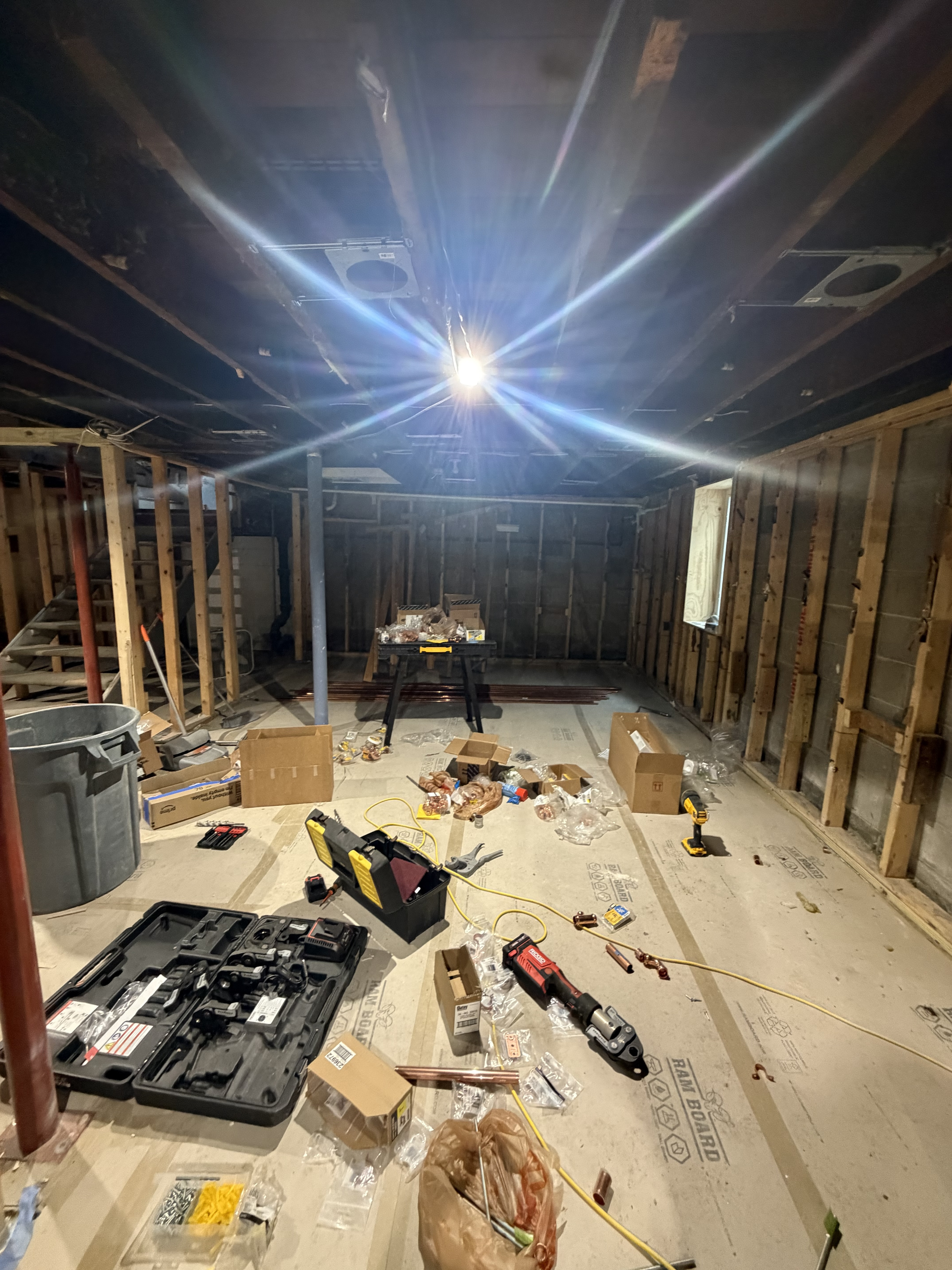
A little more info on the project: I'm in the southern half of Michigan. We bought the house from someone we know for a really great price, and it is completely gutted. We've removed all the old knob-and-tube wiring. I've rewired almost the entire house myself so far, and I will be doing all the copper/PEX plumbing layouts too. I just haven't done much ductwork. We are working on a fairly tight budget, but I understand that this is a massive project and it must be done correctly.
Because it's down to the studs, we are doing the insulation the right way to get it decently airtight. Our plan is a hybrid flash-and-batt system (spray foam paired with cellulose) in our true 2x6 exterior walls, plus thick blown-in cellulose in the attic floor.
I’ve now had three local contractors out to look at everything. Two of them told me a Manual J isn't needed because "they just know how to size it."
Here is what the two contractors proposed:
- Contractor 1: Didn't mention an ERV/HRV at all. He suggested reusing my existing basement furnace, running one massive main trunk all the way up from the basement into the unconditioned attic, and branching off from there to feed the second floor.
- Contractor 2 (Recommended by a local builder): He seemed much more knowledgeable and suggested a true two-system approach. A furnace in the basement for the main floor, and a separate, smaller furnace upstairs. He wants to frame a small, sealed, insulated mechanical room in the attic for the upstairs unit. He also suggested spray-foaming the entire attic roof deck to bring the attic into the conditioned space, but that's a can of worms I really don't want to open right now. He was very friendly and actually open to showing me a few things.
Contractor 3 (large local union company):
This contractor came out today and thought it may be possible to avoid the attic altogether. He thought ductwork could be run from the basement up through the main floor and into joist bays/chases using round or oval duct. He did not think two separate systems were necessary. His recommendation was one basement system with two zones: one for the main floor and one for the upstairs.
He also strongly recommended using Arzel zoning dampers instead of traditional motorized dampers. He said this would avoid needing twice as much ductwork or four separate trunks, and instead we could have two main trunks with the Arzel dampers controlling the zones. He said it would be quicker and easier to install.
I’m trying to understand whether this is a good design approach or just a simpler install for the contractor.
A few responses to things mentioned:
- I don’t lean toward radiant floors because we’re trying to refinish and keep the original hardwood flooring.
- I agree that two zones/systems may make more sense than trying to force everything through one system.
- I was originally leaning toward one large system with two zones, but the one contractor who saw the house in person suggested one system in the basement for the main floor/basement and a separate furnace/air handler in the attic for the second floor.
- Is the claim that Arzel would avoid needing “four trunks” and allow two trunks instead actually a good design reason, or is that oversimplifying things?
Here are the main things I’m trying to figure out:
- Would you strongly avoid an attic furnace/air handler in Michigan even if I build a sealed and insulated mechanical room around it?
I just don't yet see a good way to route ducts all the way upstairs without it yet. - For a gutted old two-story house, would you prefer two separate systems or one system with zoning?
Is one approach usually more forgiving for comfort and duct design? - If I do one basement system for the main floor and one separate upstairs system, would you use a furnace + AC, a heat pump + backup, or something else?
- For the upstairs bedrooms, would you place supplies in the ceiling/high wall and returns high as well?
- If ductwork can be routed from the basement to the upstairs using round/oval ducts through chases and joist bays, would you strongly prefer that over any attic equipment or attic ductwork?
- For an old gutted two-story house, would one properly designed basement system with two zones be reasonable, or would you still prefer two separate systems?
- Does Arzel zoning work well when designed correctly?
I understand it uses pneumatic/air-driven dampers instead of motors at each damper. I’m not against it, but I want to know if there are drawbacks I should be aware of.
- Is the claim that Arzel would avoid needing “four trunks” and allow two trunks instead actually a good design reason, or is that oversimplifying things?
- Since we are doing a hybrid spray foam/cellulose split in true 2x6 walls, the house is going to be tight. How should I look at incorporating an ERV or HRV into a single-system zoned layout to keep the air fresh?


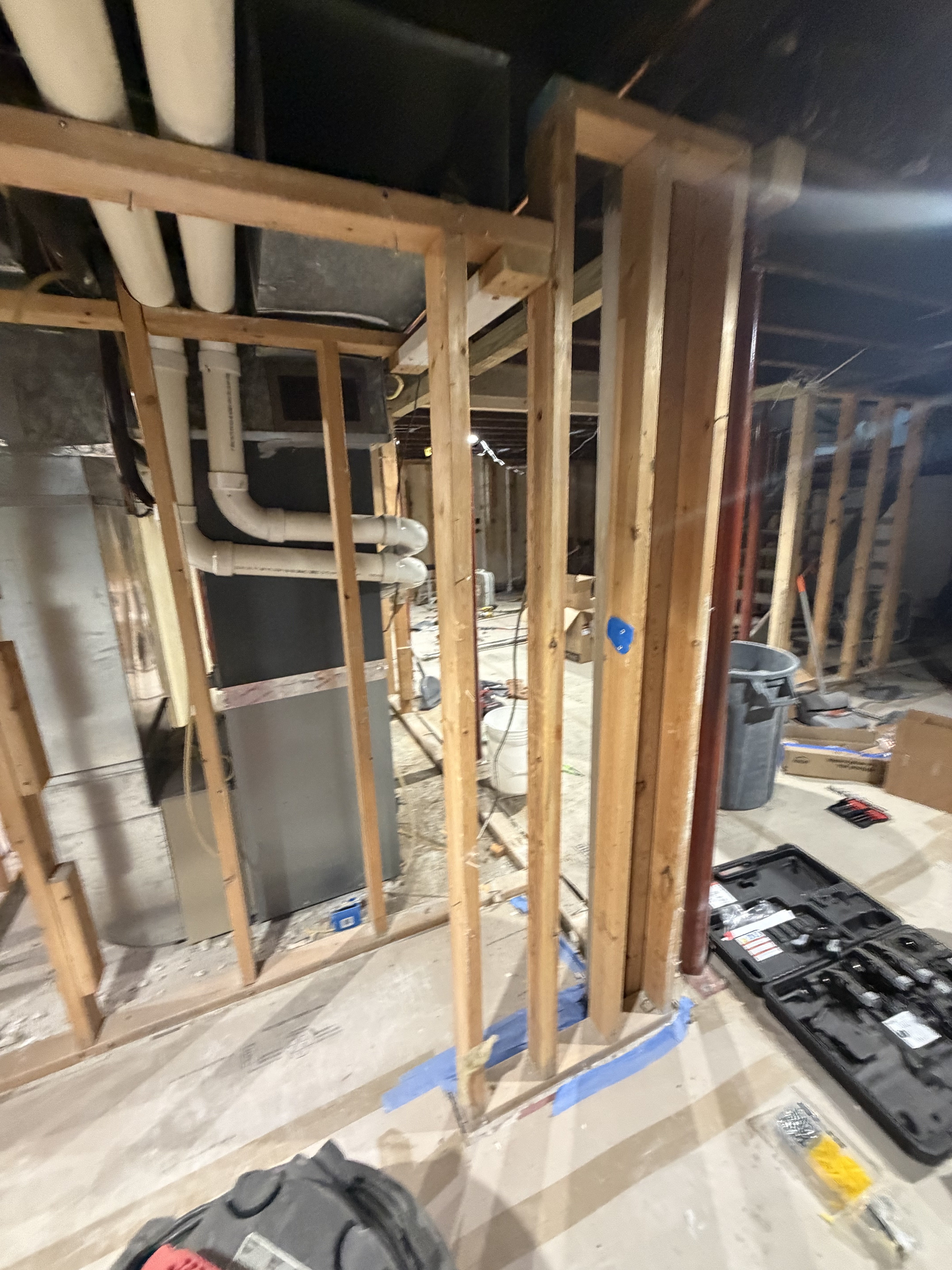
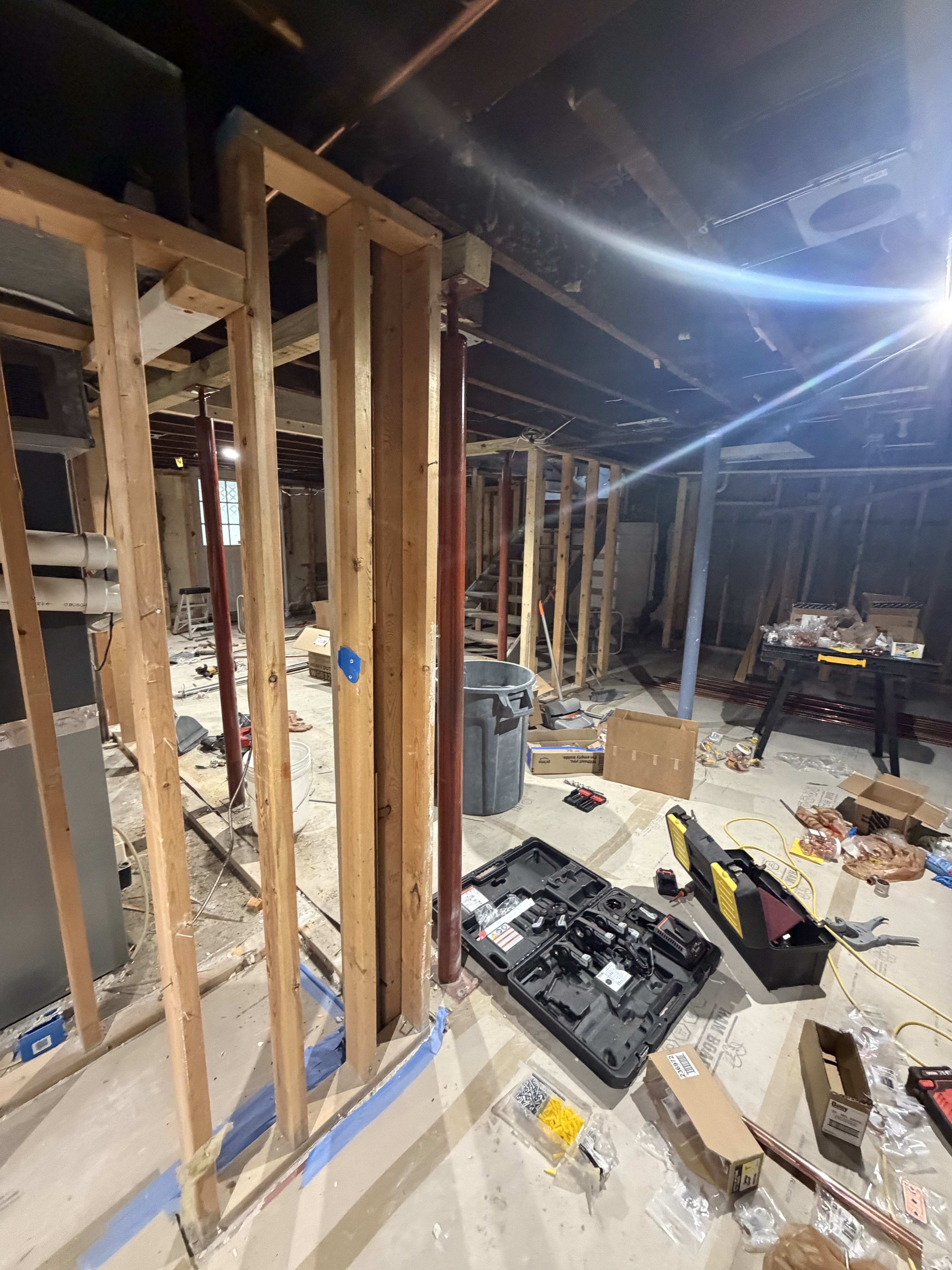
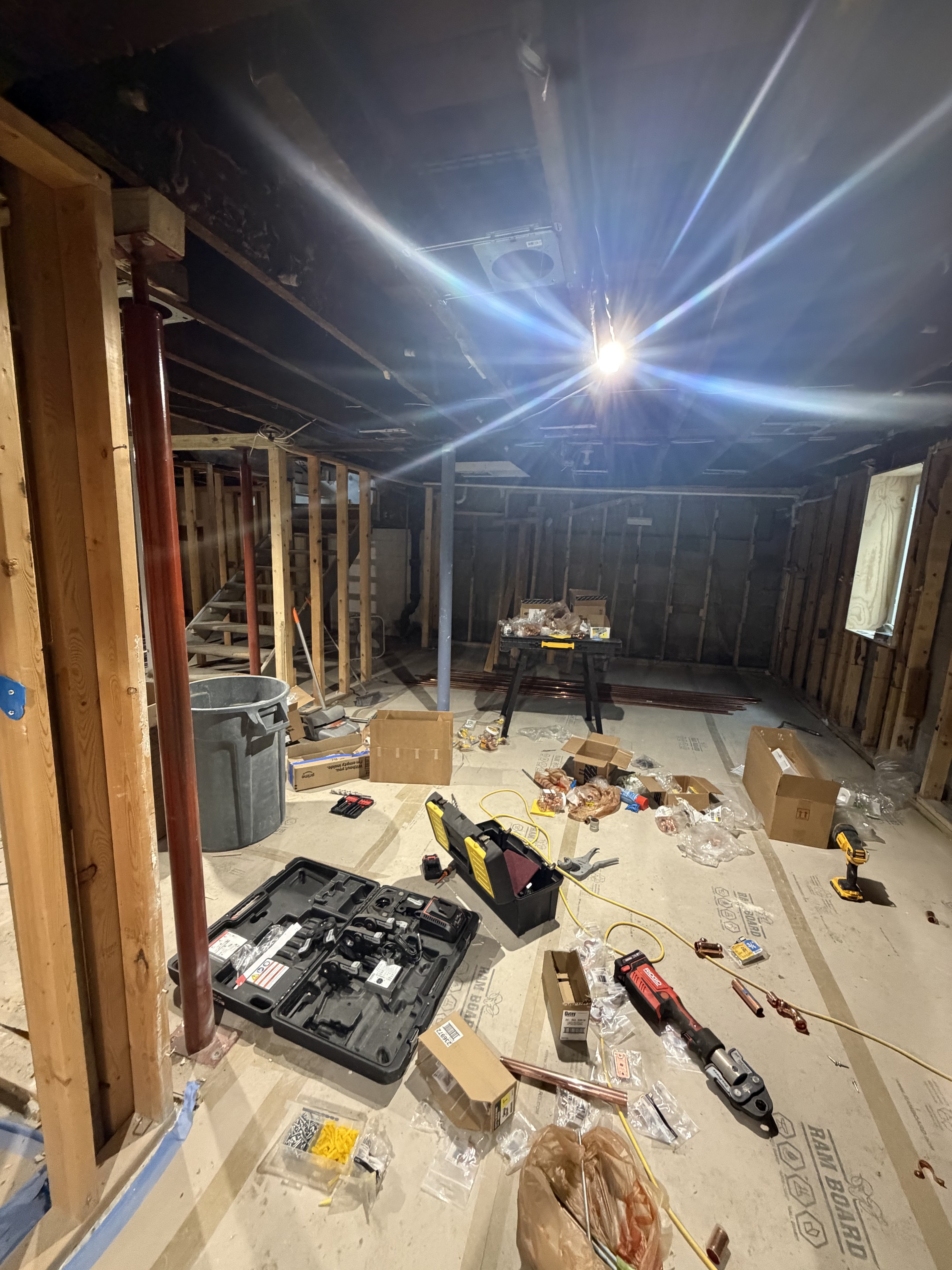


 0
0 -
avoid zoning. Straight ducting is hard enough zoning makes it even more difficult.
2stories 2systems. Both Heat pumps.
I prefer oversized HW coils in each for extreme weather with a mod con condensing boiler. As far as the 2nd floor the coil can be installed in the return duct reducing freeze up issues. 2
2 -
Post floor plans showing windows, joist direction and where there are pocketed beams in the way.
Rough hand sketch is good enough.
The smallest common fuel burner you can get is 60kBTU which is already oversized for your overall heat load based on my rough guess. Now add in two units, and it is WAY oversized.
Contractor 3 is the closest to what you actually need. I'm in the land of 2.5 story houses with basements, most have a single air handler for the whole place.
First step is get a man J. Not that hard to do yourself, make sure to select tight for air leakage.
This is a pretty accurate tool that is free:
I was helping someone a while back that was doing similar gut job, two story with basement. Got silly quotes for duct work and zero design (basically what the useless contractor said, we just know). Had them run Man J and did a rough layout. He never did any ducting before, showed him how to put pieces together and he ducted the rest of his house. Took a couple of days and was about 1/10 the quoted price. New setup works WAY better than the original oversized furnace with sketchy ducting. Takes up less space, way quiter and even temps.
Zone dampers work well but you need to oversize the ducting so when the upstairs zones are closed, the reset of the house can handle the flow. Lot of times you also don't need to fully close zone dampers, something that modulates say 25% to 100% flow rate will get you local control without effecting the overall system too much.
1 -
From what I see here, your top-floor ceiling has not been removed, so installing attic ductwork will require cutting the register openings through the sheetrock and deciding which way you want the system to gravitate. You can choose a duct design that works better for cooling or a duct design that works better for heating. Once you select one of them, the other will not perform as well.
However, with the newer inverter systems, you have the option of constant operation at lower speeds and capacities when the weather is mild, while ramping up to full speed when conditions are more extreme. This tends to minimize the duct design compromise because the constant airflow helps combat temperature stratification, resulting in more even temperatures throughout the home.
This brings me to my next point. I have often thought about zoning with single-stage and two-stage systems, and they always seemed to me to be little more than a band-aid on the issue. The thermostat would control the change from stage one to stage two regardless of how many zones were actually open or calling. I often thought that someone should invent an out-of-the-box zone control that understood that when only one zone is calling, there is no need for stage two and the higher airflow that comes with it.
After looking at the Arzel system information, I really like the concept. It is almost as if they were reading my mind back in the 1980s and 1990s and actually built the system I had envisioned. If I were still installing systems, I would definitely try this equipment in my own home first just to see how easy it is to install and set up.
The videos seem to support the concept of a single supply trunk and a single return trunk. One system can serve two zones—or more—simply by closing off the first-floor branch runs when the second floor needs cooling, or closing off the second-floor branch runs when all you need is heat on the first floor.
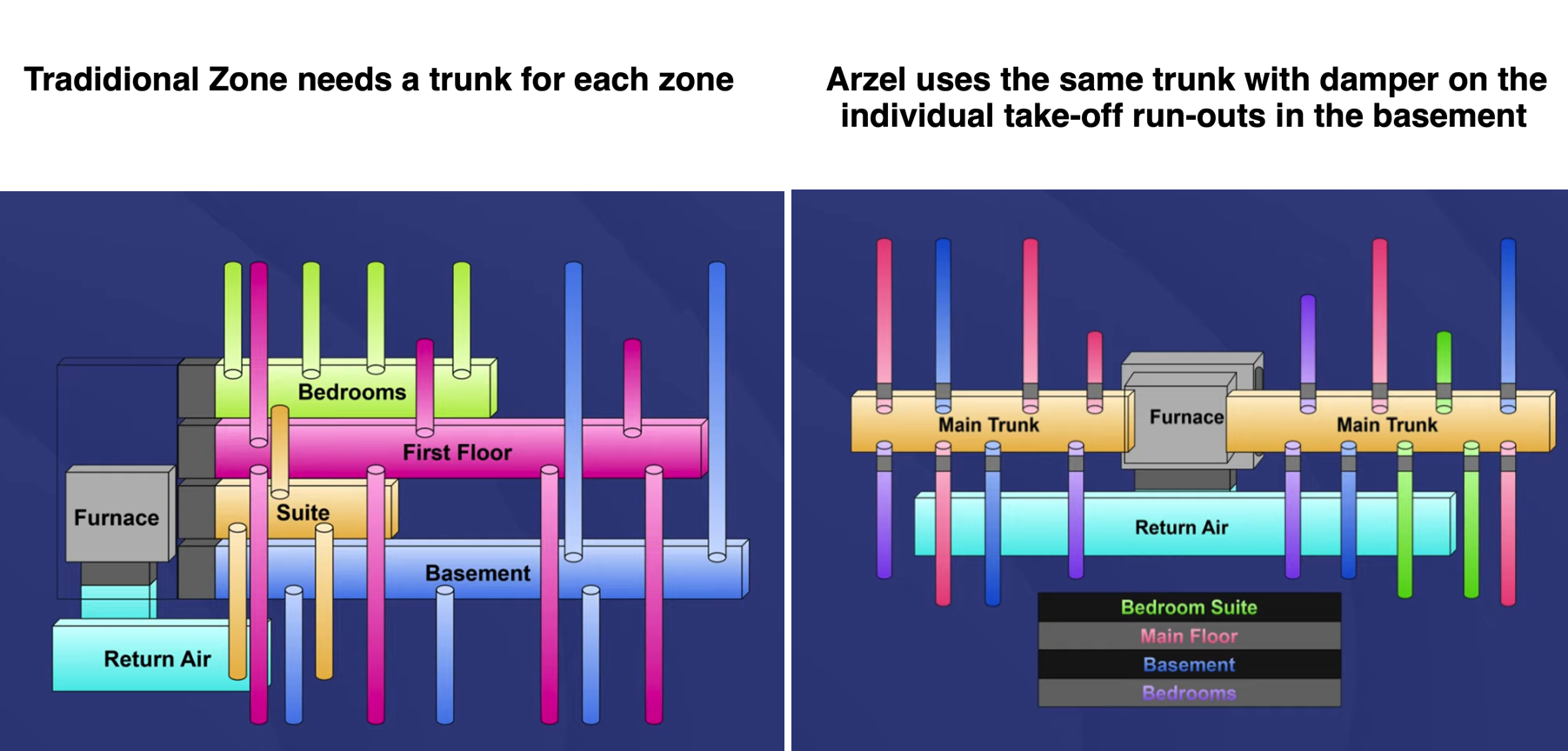
I have installed systems with as many as four zones on a single furnace or air handler and used a duct temperature sensor along with a barometric bypass damper with some success. However, I believe that the combination of today's inverter-driven systems, variable-capacity compressors, and ECM blower motors that can ramp up and down based on inputs from the Arzel panel is truly a game changer.
I wish something like this had been available years ago at what appears to be such an affordable price and with the ease of installation that Arzel seems to offer.I would still look at the price of the two-system high-velocity option and compare it to the price of a variable-speed (or at least two-stage) system with zoning. In other words, compare the cost of two smaller, more expensive systems to one larger system that is capable of staging and equipped with multiple zone dampers. You may find that both approaches cost about the same.
Rest assured that either approach will solve your temperature stratification problems.
Just don't go cheap while the house is in this condition. If you can get basement ducts to the second floor while the walls are open like this, you can have an excellent system with only one set of equipment.
On the other hand, if you decide on the high-velocity system with all the ductwork buried in the attic insulation and an insulated mechanical room in the attic for the air handler, that is also a very good option. Pairing it with a modulating-condensing boiler opens up additional possibilities. The boiler can provide space heating, domestic hot water, snow melting for the walkway, and perhaps even radiant floor heating for the bathroom.
There are many good choices available today. The important thing is to take advantage of the access you have while the house is open and invest in a system that will provide comfort and flexibility for decades to come.
Edward Young Retired
After you make that expensive repair and you still have the same problem, What will you check next?
1 -
Do a proper Manual J/S/D before ductwork so sizing, returns and static pressure are correct for a tightened Zone 5A remodel with attic or basement routing. I checked is american home shield a good company covers home systems like HVAC, appliances and repairs; I’ve seen it used to manage breakdowns and keep heating and cooling systems maintained during remodel projects.
1 -
Thanks for sending that website @Kaos I have been playing around with it. Yes I am starting to understand that more, that we need more than enough air flow going to the second floor if we do dampers. I have been looking into the ones that you can set at 20-25% closed when they are shut to still allow some airflow.
@pecmsg I'm not as familiar with heat pumps but that is a solid idea. Some people that have seen that house have mentioned two separate systems as well and to stay away from the zoning.@EdTheHeaterMan that seems to be what i'm learning, I have to sorta choose if I want it better for heating or cooling. I'm leaning towards making it better for cooling. With that fact that heat rises I think i'll be okay upstairs in the winter. But cooling the upstairs in the summer is a challenge.
So I have had some more people out and everyone has different ideas. The guy today said that my equipment (100k btu furnace and 4 ton AC) are totally undersized. He said I need a 5 ton AC and two 70k btu furnaces. He said we should do two systems, one for the upstairs and one for the main floor/basement. This guy also said he hates two stage furnaces and only likes simple single stage furnaces.
Another contractor over the weekend said he could help with the project. He is a family friend that has done mostly commercial work. He isn't as familiar with zoning and damper controls. He thought to try and get 8 supplies upstairs with coming from the basement and possibly 8 supplies on the first floor. That would leave about 4 for the basement. 80 CM per supply roughly. He thought 2 14x12's or 16x10 trunk lines with one heading each direction off the plenum. Would be about 800 CFM per trunk line. And then 10 6 inch takes off from each trunk. That was his thinking after seeing everything.A few things i'm kicking around based on what i've heard from contractors.
Option 1: Do two separate zones, one for upstairs and one for the mainfloor. Install honeywell controller and belimo dampers. Some problems are my AC is a 4 ton single stage. So when only the upstairs calls for air it could freeze the coils. We can run the main floor dampers at 20% closed though to still allow enough airflow. Would have supplies on the upstairs floor beneath windows. Returns high on the interior walls upstairs. This would take up a lot of the basement headroom.
Option 2: Install a furnace/AC for the upstairs, trying to put it in a upstairs closet so we can have a high efficiency furnace and then do flex ductwork in attic, well insulated and try to bury the ducts in the blown in cellulose insulation too. Would have supplies in the ceiling on the upstairs then. Returns high on the interior walls upstairs. Would probably be easier to run in alot of ways.
Option 3: Run two separate systems, but all directly from the basement to stay out of the attic. This again would take a lot of the basement headroom.
Not sure yet if a heat pump is best? My furnace is 20 year old 2 stage and the 4 ton AC is 6 years old. I'd like to try to maybe keep the AC but think replacing the furnace would be worth it due to all the work we are doing.
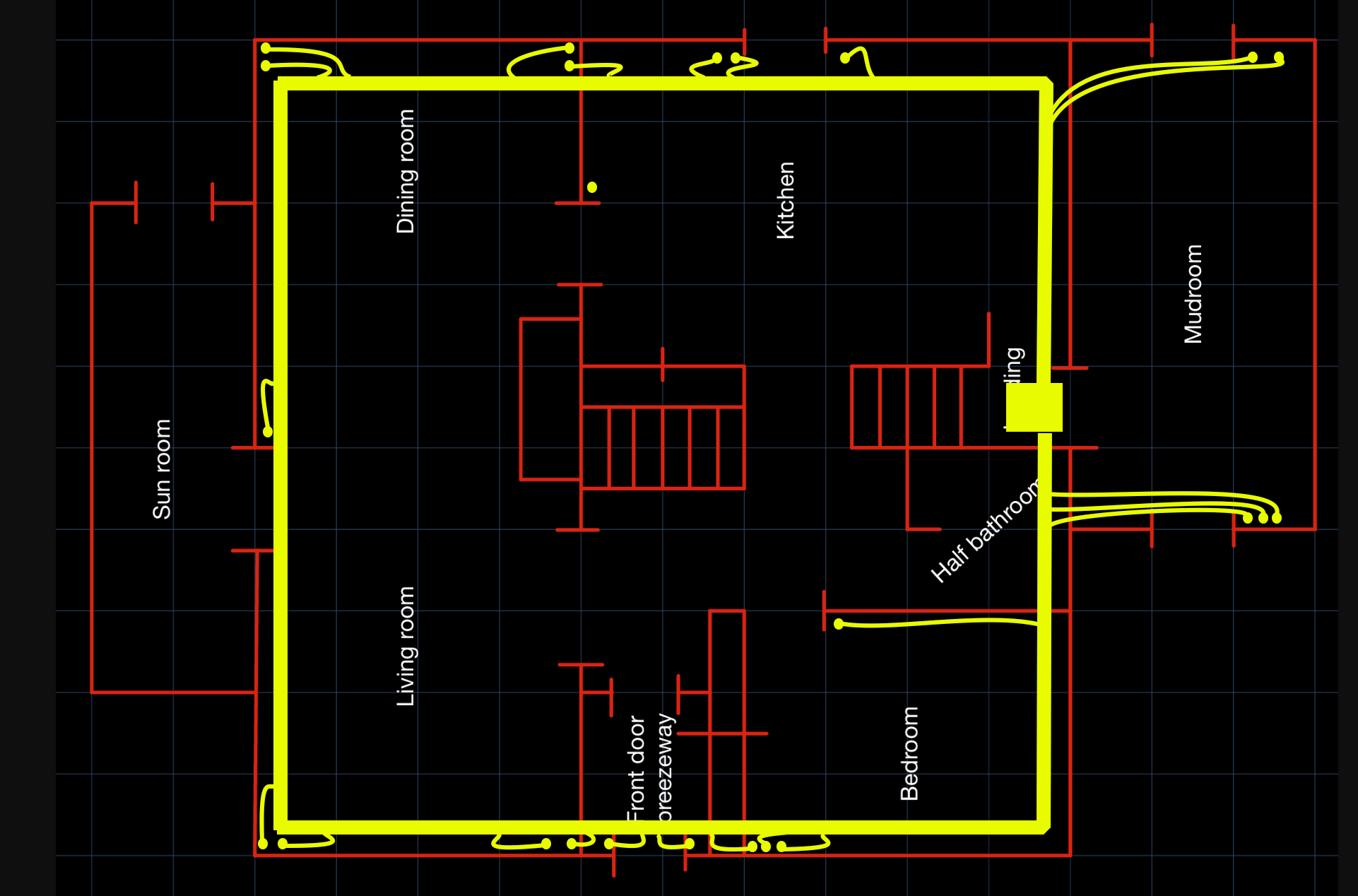
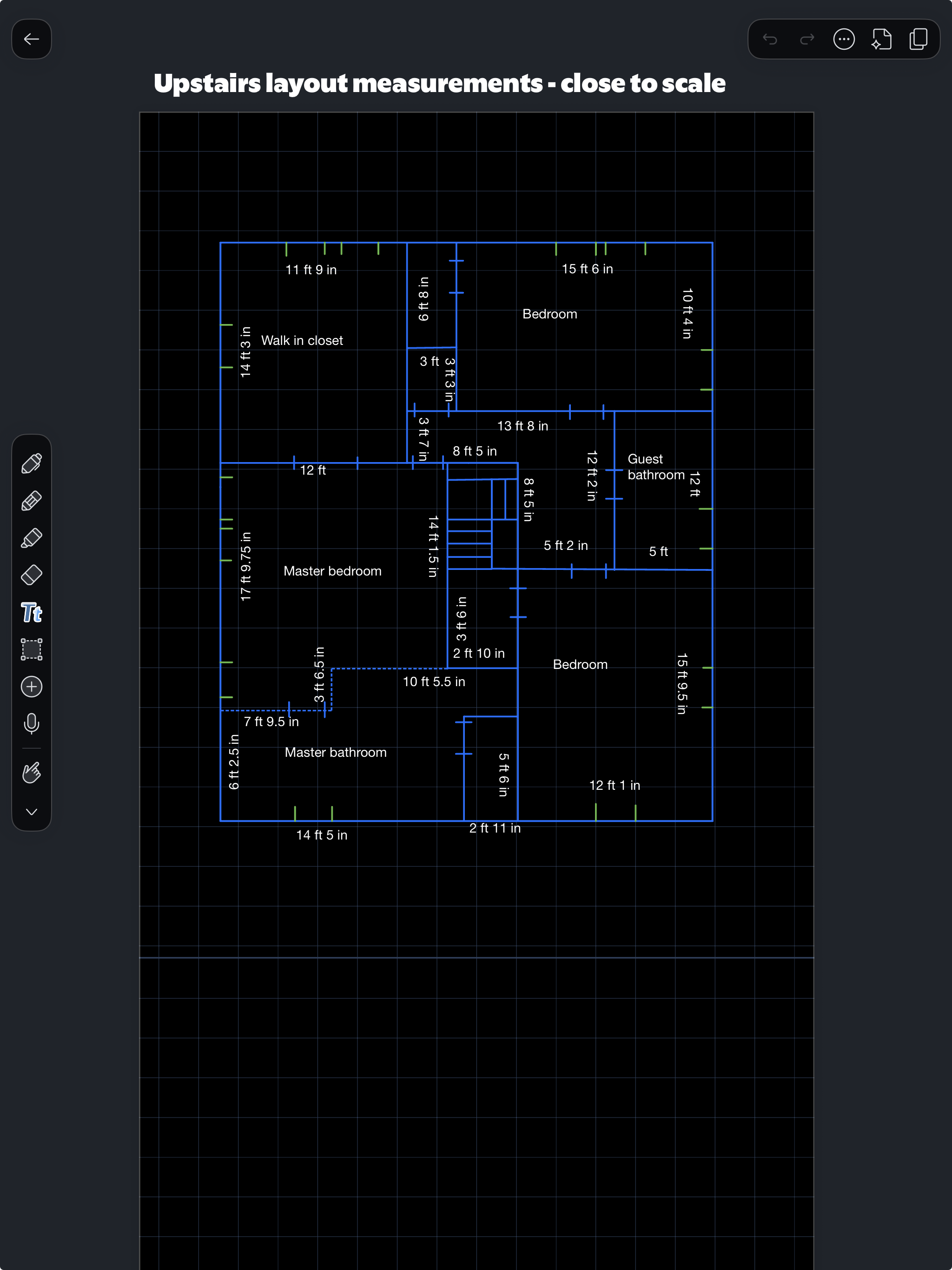
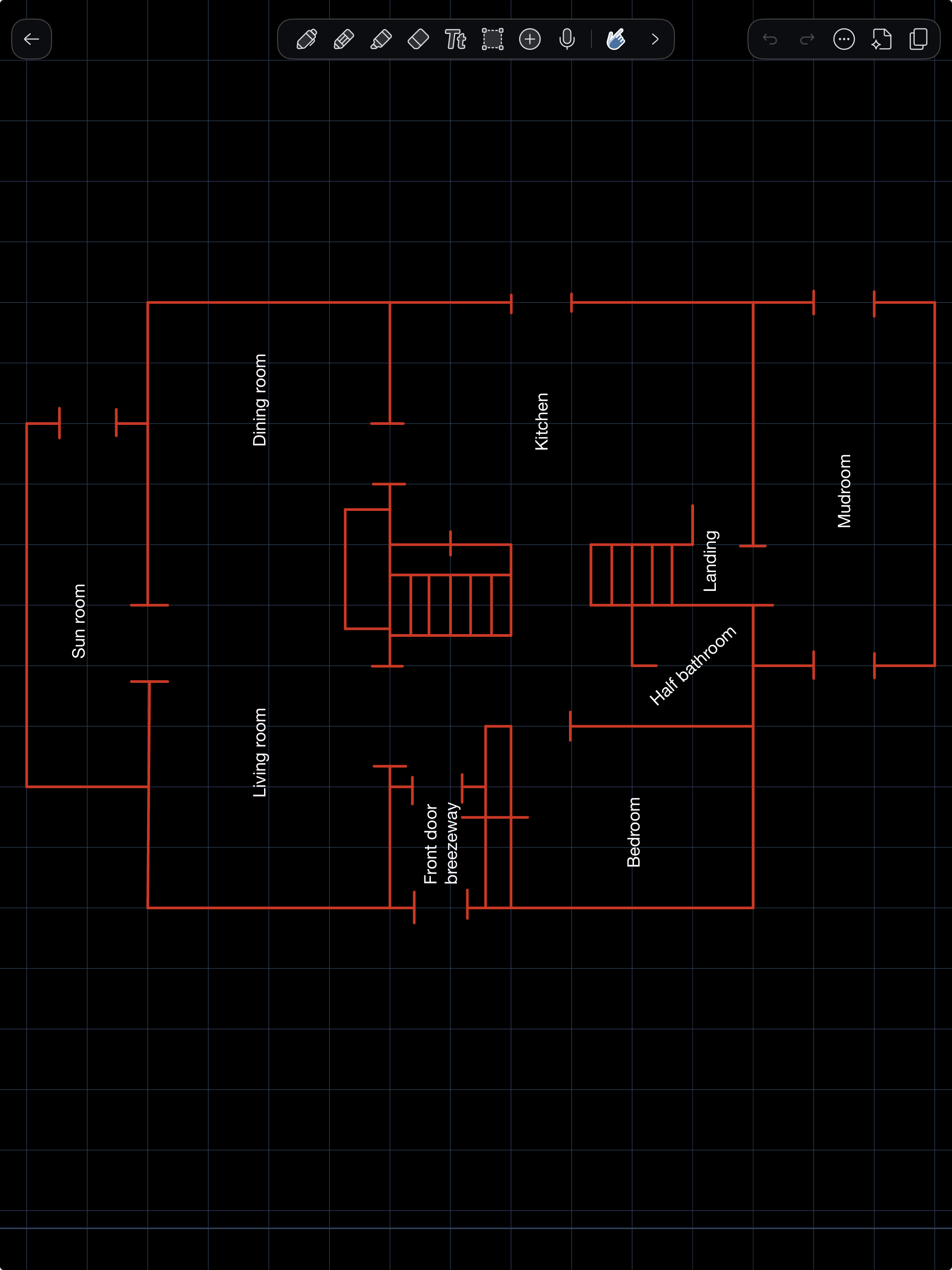
These are the floor layouts for the upstairs, main floor, and basement. Each layout has the top facing the North. The green markings on the outside walls are where windows and doors are placed. The long green marks on basement layout are the beams holding up the floor. The furnace is currently located in the center of the basement near the red X.
The joists are all running North to South, so top to bottom of all the layouts.
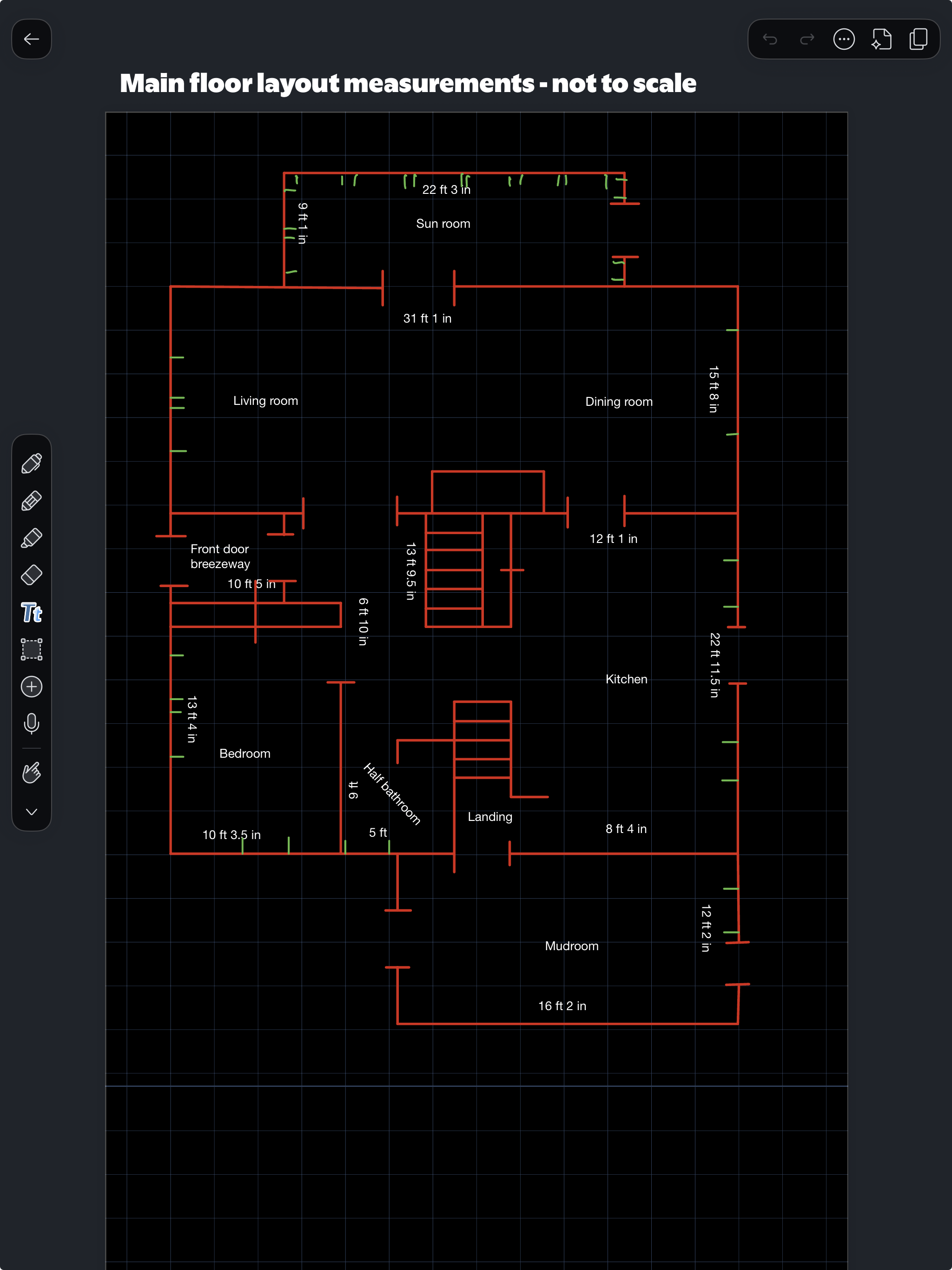
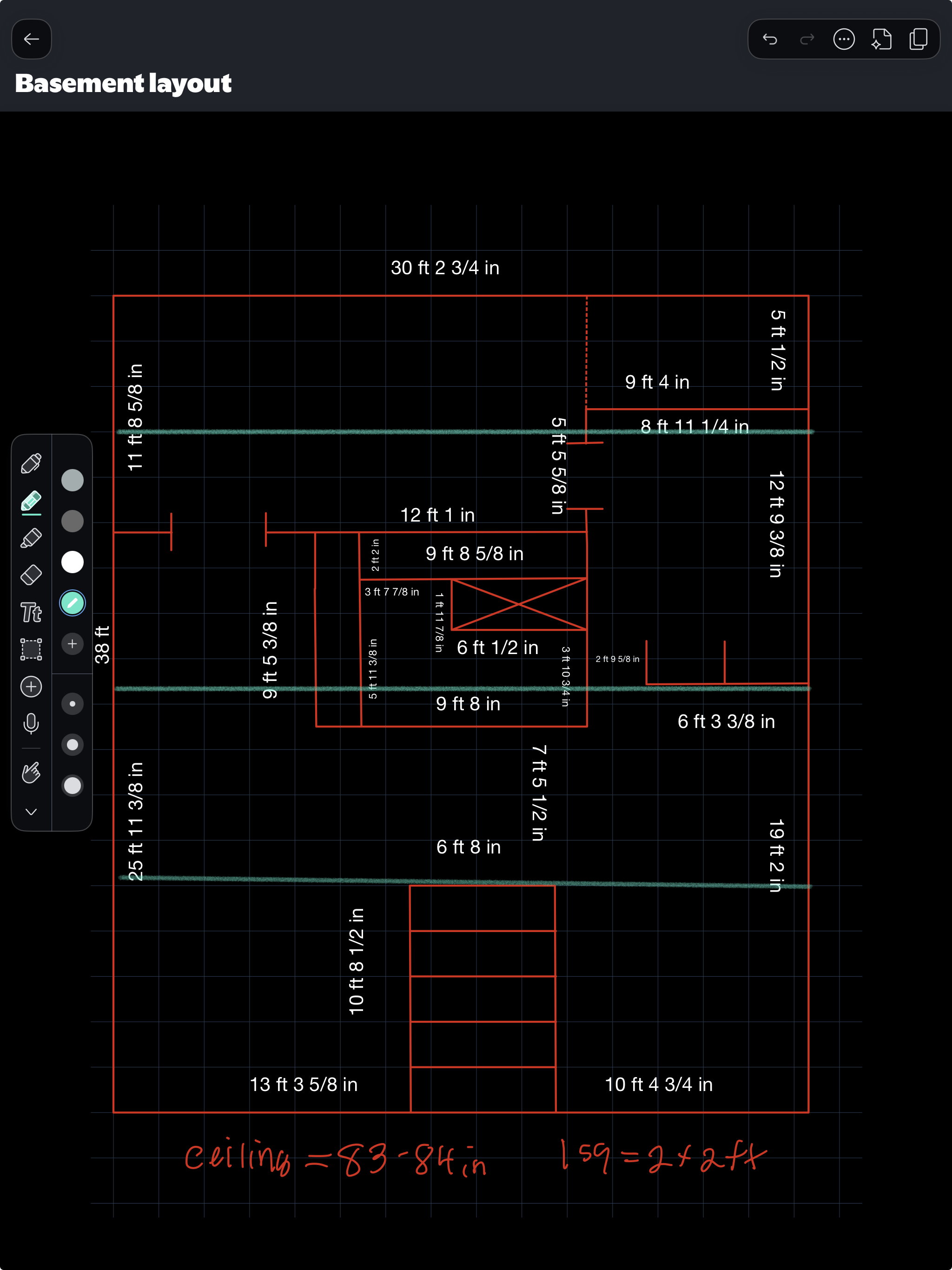 0
0 -
I have a question about your basement.
Have you ever been in that basement in the middle of the summer when the first and second floors were unbearably hot on a 95°+ day? I'm sure you have. Now think about the temperature in that basement without central air conditioning. Was it ever so hot down there that you needed to leave? I'll bet you remember that the basement was the coolest part of the house on those dog days of summer, even without central AC.
Now think about adding four supply ducts to the basement and making that basement drop to 60° when you set the first-floor thermostat to 72°. You have now paid for four additional supply runs that eventually need to be closed off. The dampers on supply registers never achieve a 100% seal, so now you have a whistling noise coming from those closed-off registers, with perhaps 10% of the air still leaking into the basement. That additional noisy conditioned air will cause the basement to remain at about 65°, even with the registers "closed."
Next, you decide to remove those openings, seal the cutouts, and mastic everything so there is no leakage. Then you reinstall the duct insulation. Now you have paid to have those four supply registers removed. After spending all that extra money, your basement is now 68° or 69°.
And to think, you could have had that same result if you had never installed those four supply runs in the basement in the first place.
Ask me how I know this!
EDIT
follow up: if the basement is too hot after you have central airconditioning installed in the first floor, you can always add a duct or two. But I guarantee you that 4 is way too many. Start out with zero and see what happens. You will be pleasantly surprised.
Edward Young Retired
After you make that expensive repair and you still have the same problem, What will you check next?
0 -
You need to decide if the head room is more important in the basement or the lower price single zone standard basement duct system is better. If you use the High Velocity in the basement You can save head room.
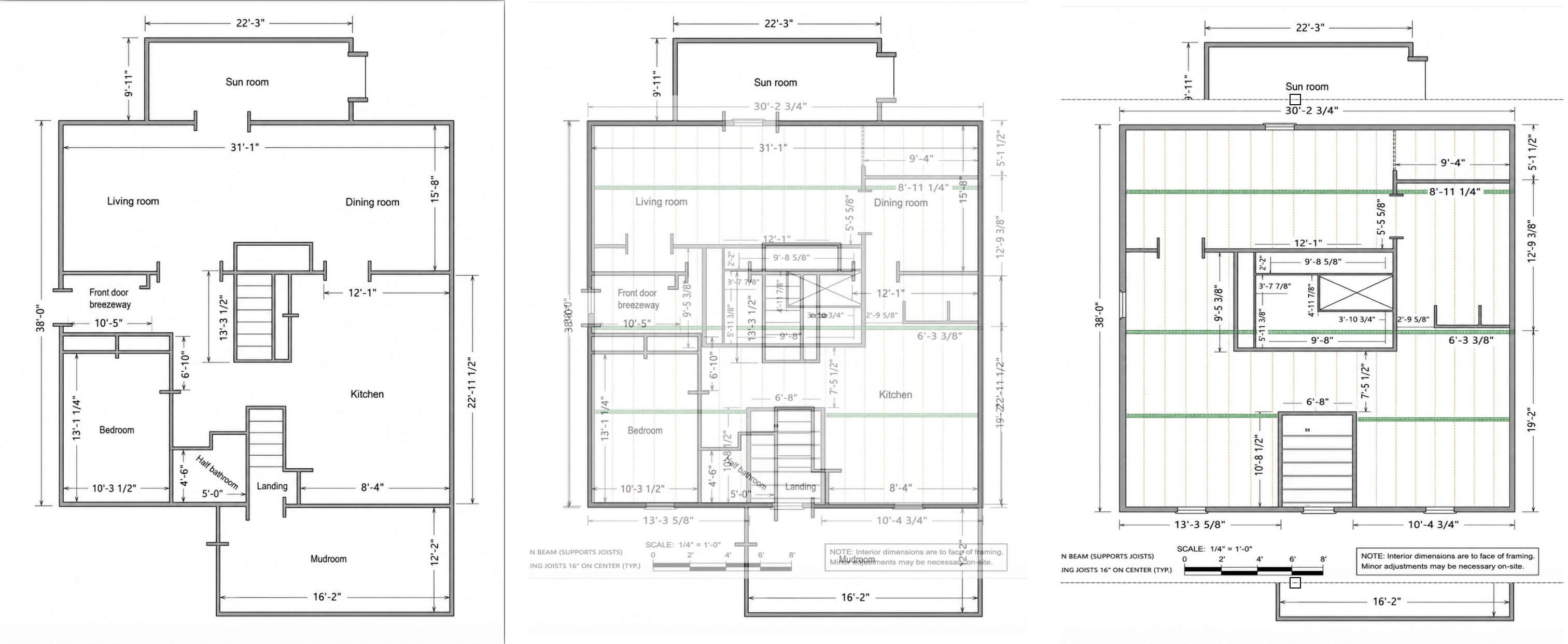
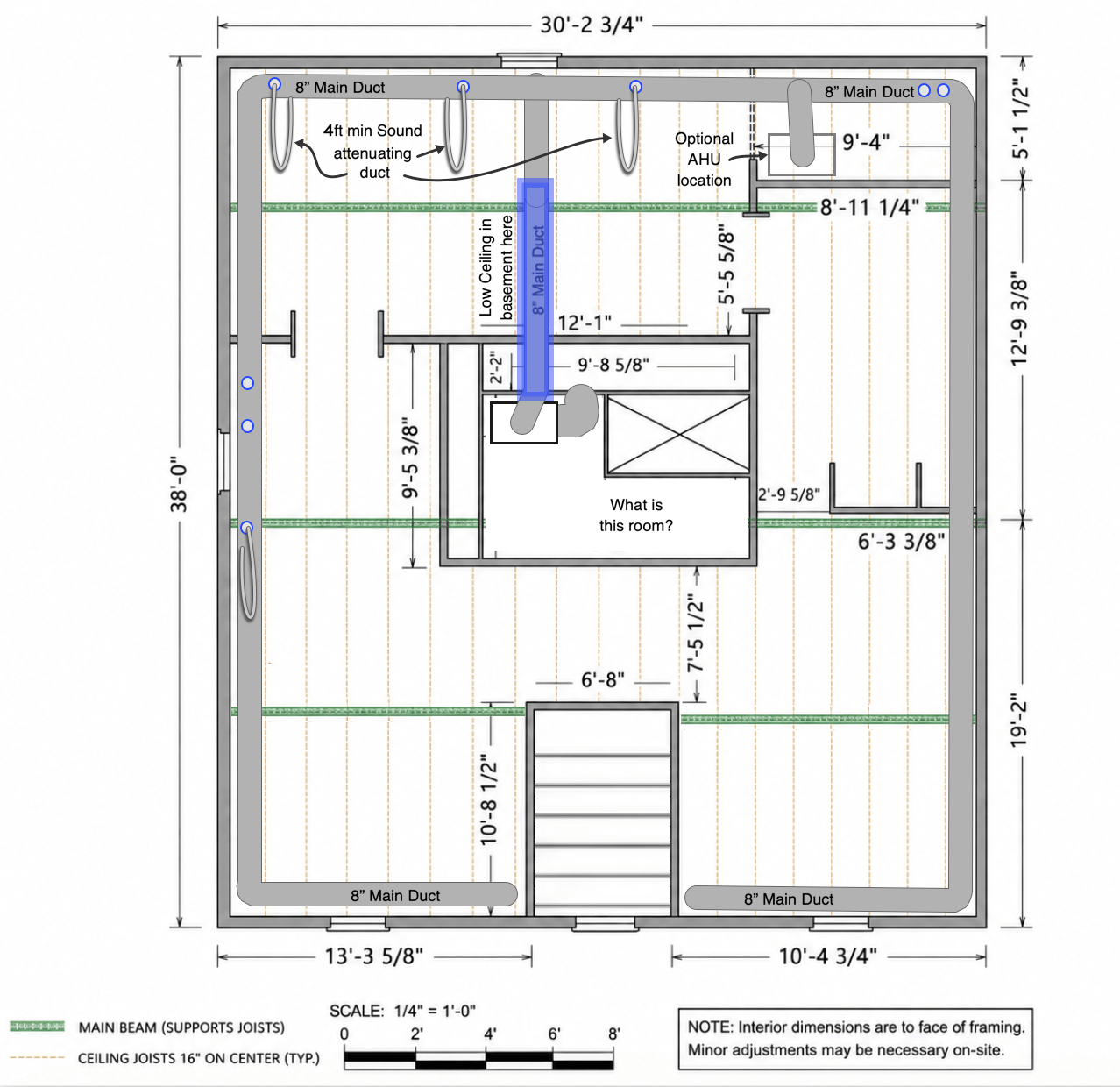
Based on the dimensions on your drawings, the stairways do not line up and the chimney location for the furnace does not line up from the first floor to the basement. But this is the best I can come up with (above). In the next illustration for 8" insulated round plenum for high velocity cooling and heating you can see one area where the headroom in the basement is reduced to accommodate the 8" plenum from the utility area near the center of the basement. If you place the AHU on the north wall in what appears to be a closet in the basement, then you eliminate the head knocker but you are restricted on the return duct location fro the first floor to the AHU. In this illustration with only 4 typical supply runs shown you loose head room all around the edge of the basement, leaving the center of the room open without head knockers.
Of course it you decide that having less head room to accommodate the additional duct needed for zoning or two systems, then you can use the lower cost system.
Have you priced a High Velocity system for the first floor and a standard system for the second floor from anyone yet?
Edward Young Retired
After you make that expensive repair and you still have the same problem, What will you check next?
0 -
@EdTheHeaterMan
Thanks for speaking some sense into me about the basement. Sounds like you have went down that path before! My thought for the basement is more on the heating side than cooling. I've been in basements in michigan that never get very warm in the winter. And if we someday finish the space I would like to have it be fairly comfortable down there.
And yes we did our drawings the best we could but some of it wasn't to scale perfectly.
This is a really neat idea, I have not priced a high velocity system yet, but I have started to get some prices for a standard system. It seems like not many people in my area install them.I've been meeting with more contractors are researching everything extensively.
My current plan I'm leaning towards is two fully separate systems. A furnace and AC for the mainfloor/basement. And a heat pump/air handler installed in a closet upstairs. Running a 12x14 insulated trunk in the middle of the attic and flex lines off of that. These are the supply sizes i'm thinking to use.
I believe a 2 ton heat pump will be enough for this, as i'm more worried about cooling. I think with the heat rising from the main floor furnace, it will still be comfortable in the winter. But gas in my area is a good deal cheaper than electric.
2 in the master bedroom (6 inches)2 in the southeast bedroom (6 inches)
2 in the northeast bedroom (6 inches)
1 in the guest bathroom (4 or 5 inch)
2 in the walk in closet (5 inches)
1 in the master bathroom (one 7 inch supply )
0 -
When designing a small duct system, there is a lot of room for error. When you use Manual D to determine the required duct sizes, it is based on the most difficult run to move the air to or through. There are more stringent duct design criteria for larger systems with zoning dampers and the like, but that does not apply to your situation. Manual D is sufficient for this application, and it may not actually be necessary.
I have used a 0.10" static pressure on a duct sizing wheel for systems of 3 tons or less and have been very successful. With flex duct, I deduct 10% from the supply CFM and 20% from the return CFM, since the return is under negative pressure, causing the duct diameter to actually shrink when the blower is operating. I also like to keep the airflow velocity in the supply ducts under 900 FPM and less than 700 FPM in the returns to keep airflow noise to a minimum.
I actually had one builder tell me that a system I installed was not going to work because he could not hear the airflow when the furnace or air conditioner came on. In his mind, with no noise, there couldn't be any heat. That told me that his HVAC contractor was using smaller ducts and fewer runs than were needed to get the jobs. Why not? He didn't need to live in that home.
The final step with the 0.10" static pressure rule of thumb is that every takeoff should have a balancing damper. This way, the hardest room or rooms to heat or cool will receive the full amount of airflow, and any room that is too hot in the winter or too cold in the summer can have the damper partially closed where it takes off from the main trunk line.
You don't want to make that adjustment with the supply register grille. That would create excessive noise and is subject to tampering by the homeowner over time.
Regarding your duct sizes, you have 1,050 CFM with all-metal duct and about 915 CFM if flex duct is involved. In either case, you have a large enough duct system to handle 2 tons of cooling with no problem.
I agree that the heat pump will be used less for heating, since the normal tendency of warm air to rise will mean that heat from the gas furnace will eventually end up on the second floor. Likewise, cool air from the second-floor system will naturally migrate to the first floor and even into the basement.
So size the first-floor cooling system smaller and the second-floor heating system smaller—but not too small.
For example, if the first-floor cooling load calls for a 20,000 BTU cooling system, you might select a 1.5-ton unit for the first floor and a 2-ton unit for the second floor. You will receive some cooling benefit on the first floor from the second-floor system.
One more thing...
When sizing the return, keep in mind that warm air, because it is less dense, occupies more volume than cooler air—which is one of the reasons warm air rises. Therefore, the return duct for cooling should be larger than the supply duct. The conditioned air leaving the evaporator coil is colder and denser, so the supply duct can be sized for the lower-temperature air.
The return air, however, will be 20°F or more warmer and will occupy more space per pound of air, so you need a larger return duct to keep the air velocity and noise down.
So, if you believe that a 12-inch round return is large enough, think again. For a 2-ton system, I would recommend a 14-inch round metal return duct or a 16-inch flex duct.
This should all be known by the HVAC contractor you select. They use terms like "Size As Needed" in the duct work specifications. You want them to use actual numbers like "16" flex duct for the central return" or what ever design you select get the numbers specified not the "As Needed" spec.
EDIT: I would not dismiss the Arzel Zone guy too soon. Get his price with one system using zone dampers. That is interesting to me and he is correct about using one trunk duct with all the branches using individual dampers per takeoff. Could save in the long run.
Edward Young Retired
After you make that expensive repair and you still have the same problem, What will you check next?
0 -
There is no easy solution here. With that low ceiling height you don't want any trunks across the basement.
Here is the rough stab at one option.
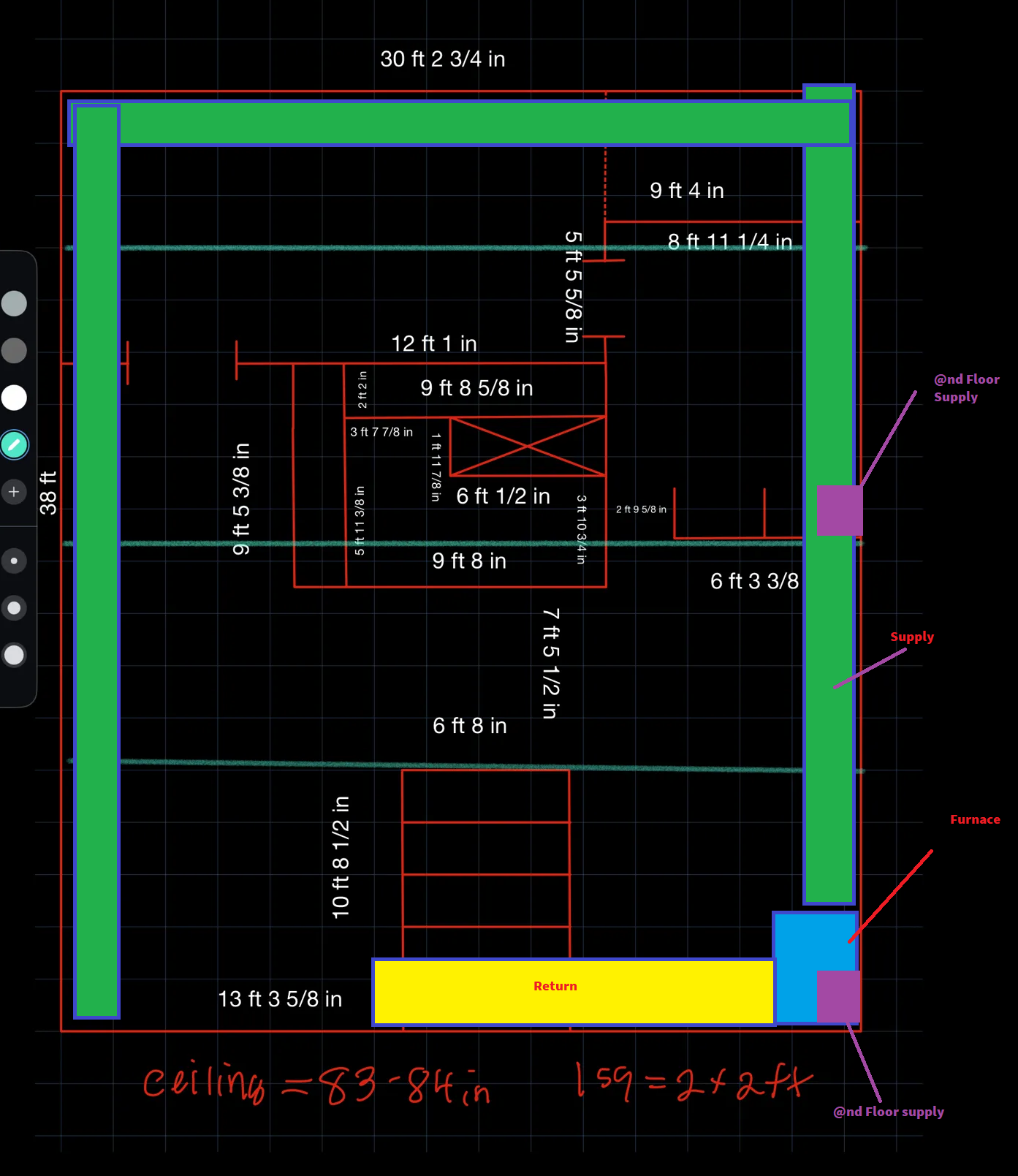
Because of the dropped beam, you would loop the supply trunk around the outside of the basement. These can be either on the ceiling but will block the windows slightly or you can run them on flat bellow the windows and then build it into the walls. The return can run under the basement stairs and go up inside the walls of the main floor powder room to the 2nd floor.
From there takeoffs and floor register at the windows and feeds to the mud room and sun room.
On the main floor, the two supply trunks come up in the corners of the kitchen cabinets which are useless space anyways and run mostly across the top of the cabinets.
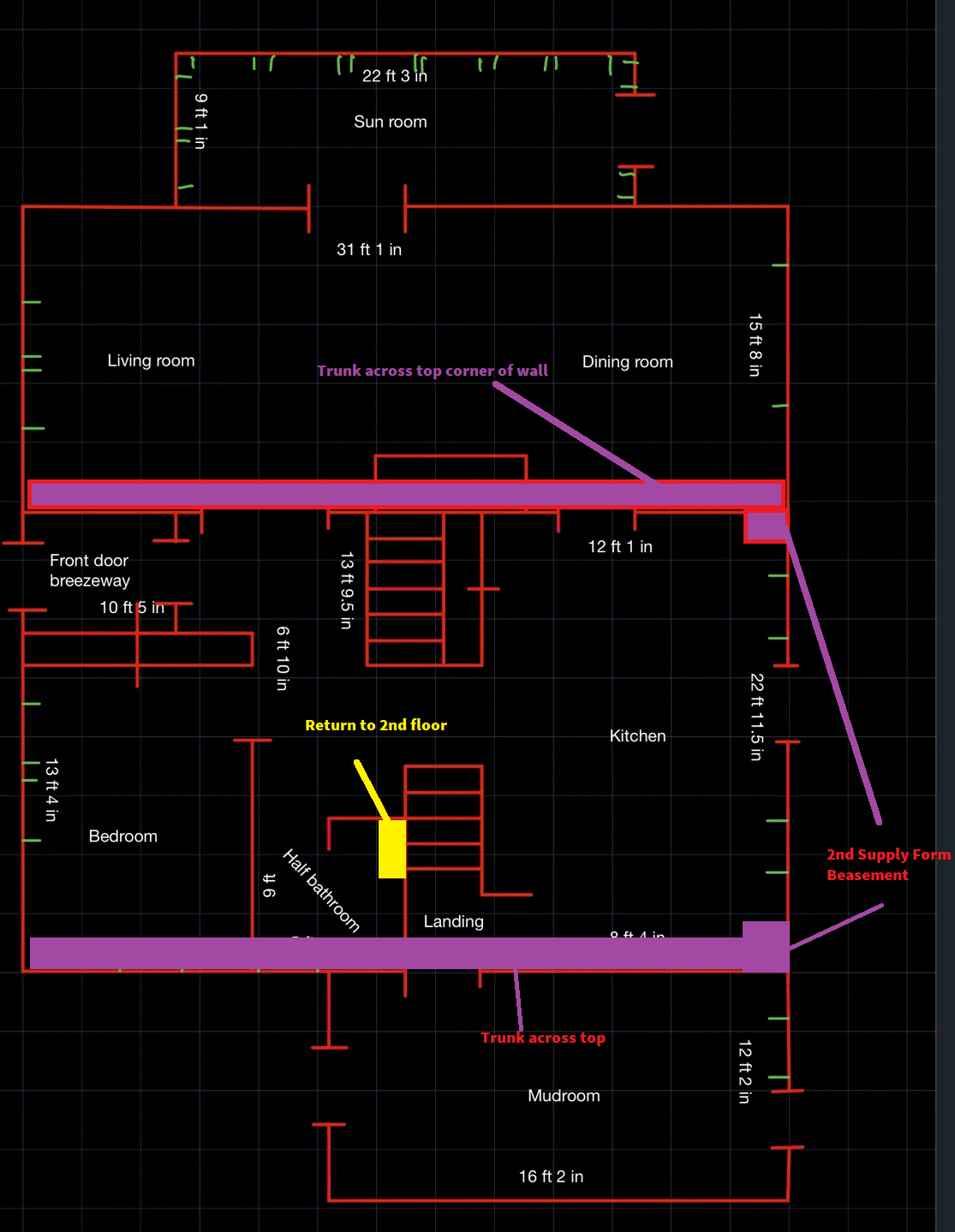
Top takeoffs from these two trunks through the 2nd floor joist bays to floor registers as needed in the 2nd floor.
@EdTheHeaterMan The 8" high velocity trunk is 10" OD so it takes up more space than a regular 8" rectangular hard pipe. HV also about doubles the BOM cost and the blower uses about 2x the power of a regular blower.
@MichaelT As for duct sizing, start from ManJ. Once you have the heat load for each room you can look at the BTU/CFM your air handler delivers and size from there.
BTU/sqft is a terrible measure, but assuming you do a decent job with air sealing, the newly insulated structure will be somewhere about 10-15 BTU/sqft. Assuming 2500sqft above grade plus a 1000 bellow, I would guess your place should come in somewhere around 40k to 50k heat load. The cooling load somewhere around 2.5 tons. The guy saying the existing 100k furnace is undersized is out to lunch. Again, run a Man J to check.
One option is to keep the existing equipment if in decent shape, running it till it dies tends to be the cheapest option. You will then have a couple of heating seasons of data and you can then install the right sized equipment. The one issue is the big furnace will need bigger ducts, so it will be harder to run.
0 -
@EdTheHeaterMan That makes sense on deducting 10% from supply and 20% from return CFM with flex duct - with the flex duct being under negative pressure with the return. That’s a funny story with that builder! Also I tremendously appreciate all your advice!!
Great point - I had actually wrote that down on my system to use manual dampers on all takeoffs but you just confirmed it.
Thanks for confirming the system idea.
So you would likely just use a heat pump for this? My only worry is that with bedroom doors closed, will the heat pump have to run a lot in the winter and spike my electric bill. Like I said, gas is definitely a deal cheaper in my area still. My upstairs is 1200 square feet, the main floor is 1600 square feet including the sunroom, and the basement is another 1200 square feet.
I was thinking towards a 70-80k btu furnace with a 2.5 AC for the main floor/basement. Maybe I could get away with a 2 ton AC.
Thanks for explaining the return air density and how that relates to the return duct sizing. No one has ever explained that to me, that makes total sense.@Kaos
I’m almost set on the two systems now just because of how the old house is set up. I think we will be far happier in the long run.
And I have been really wanting to keep my old equipment, but the more I think about it, a 22 year old furnace that wasn't serviced much won't be lasting much longer. I'm now thinking to start anew even though I'm in sticker shock.0 -
Two air handlers is definitely the nicer setup.
In heating climate you want the registers on the floor, attic ducting is not the best here. I have tried to make it work but hard to get enough throw to mix at ground level even with 8' ceilings. Having high levels of insulation and good windows can help.
Most multi-position heat pump air handlers can be configured for downflow orientation. You can run a trunk across the house on the top of the main floor fed from a down-flow air handler in the closet on the 2nd floor. From there takeoffs with supply runs inside the 2nd floor joists. Simple return on the top of the air handler to a filter grill on the top of the closet for a high mounted intake.
This gets your ducting out of unconditioned space and puts the registers on the floor level.
1200sqft, unless you have a wall of glass, will not need a 2.5ton AC. Do an accurate manual J for proper sizing, don't guess.
1 -
There is one way to run ductwork from the basement to the second floor that is in common use around these parts; however, the math does not actually work out.
You take an 8" round duct and transition in the basement to 8" oval duct so it will fit inside a 4" wall cavity. Then, when you reach the second floor, you transition back to round duct in order to run a lateral, horizontal duct between the floor/ceiling joists to the register boot location.
It might look something like this:
8" round duct in the basement
to 8" oval duct inside the wall cavity
back to round duct above the ceiling
then over to the second-floor register boot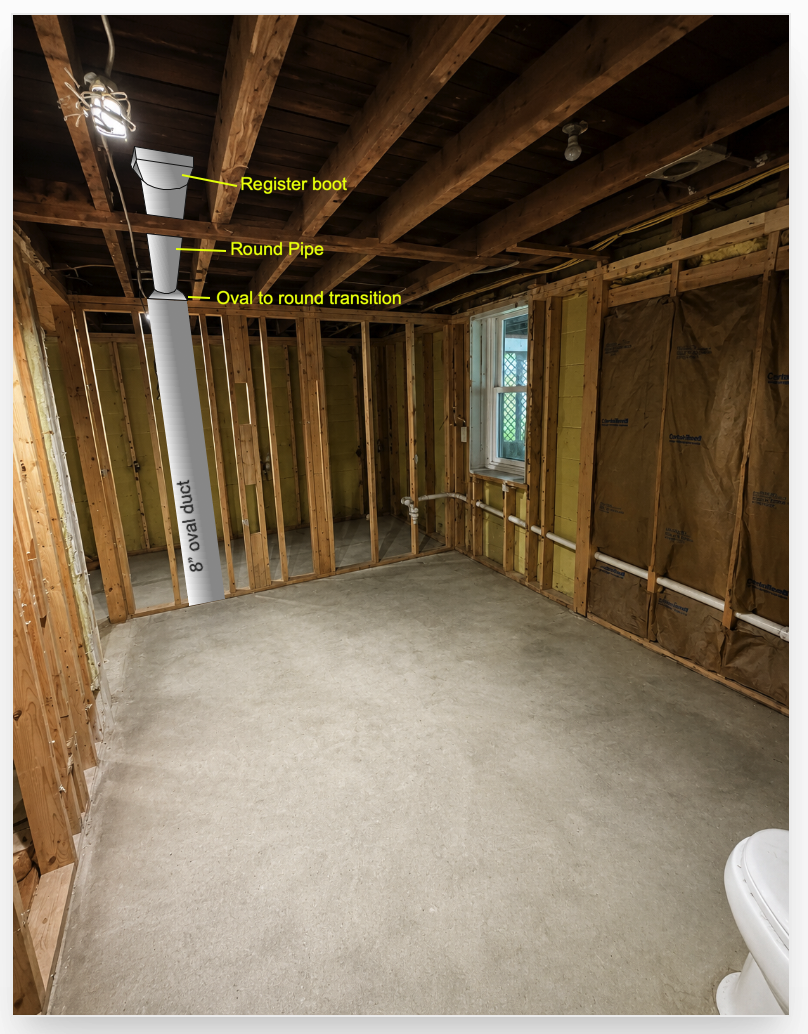
The math does not work out because the cross-section of an 8" oval duct actually measures about 4" x 10.25", with a cross-sectional area of about 37.7 sq. in., while a 7" round duct has a similar cross-sectional area of 38.5 sq. in.
But no one has a 7" round-to-8" oval transition fitting. So we see a lot of 6" round duct to 6" oval duct and 7" round duct to 7" oval duct installed in walls that are too small by design.
For some reason, the people who specify oval duct somehow believe that 6" round and 6" oval move the same amount of airflow, and that is not the case.
Don’t fall into that trap when it comes to switching from round to oval duct.
Edward Young Retired
After you make that expensive repair and you still have the same problem, What will you check next?
1 -
I've been lurking on this thread since my comment on structures… mostly because you have your heart set on ducts and blowing things around and so on.
OK. I'm a grumpy old man. BUT. That's the wrong heating solution for a house of that age and layout. It's Just Plain Wrong. You could either go steam, which is simple and reliable — but no one out your way knows how to work on it — or hot water with baseboards. So it's hot water with baseboards and a nice mod//con boiler to power it.
Oh well…
Br. Jamie, osb
Building superintendent/caretaker, 7200 sq. ft. historic house museum with dependencies in New England0 -
@Jamie Hall Once you need AC, you need ducting. If your load is low enough, that same ducting can supply your heat. Adding in a boiler adds a 2nd redundant system that doubles the cost. With a decent envelope and good windows, the comfort benefit of radiant go away so all you are left with is twice the install and maintaince cost.
There are lot of old myths like, scorched air or blowing dust around with air handlers and somehow radiant is dust free. Most dust in houses is generated by people, not by equipment (assuming your air handler is not in the attic). I have a radiant home and it is not dust free at all, I have to run a stand alone filter fan to clean up this dust. A forced air house would circulate the house air through the air handler to do this job for free.
As for the scorched air, that comes for wildly oversized equipment (usually mixed in with undersized ducts) such as some of the options proposed to the OP. With those, you get short burst of super heat followed by long delays of no heat. A right sized modulating unit delivers even heat most of the time to the point you don't even notice the air handler is running.
 1
1 -
Well now… if you need AC, I suppose… but I'm not going there. "Need" is a very slippery concept. But you don't want a sermon (wrote one a while back) on the distinction between "need" and "nice to have".
Br. Jamie, osb
Building superintendent/caretaker, 7200 sq. ft. historic house museum with dependencies in New England1 -
Isn't turning "nice to haves" to "needs" part of living the American dream?
 2
2 -
i'm going to continue in a separate post as I now have some more so final questions. I can't thank you enough for all your help @Kaos and @EdTheHeaterMan
0





Categories
- All Categories
- 87.8K THE MAIN WALL
- 3.3K A-C, Heat Pumps & Refrigeration
- 60 Biomass
- 430 Carbon Monoxide Awareness
- 133 Chimneys & Flues
- 2.2K Domestic Hot Water
- 6K Gas Heating
- 124 Geothermal
- 170 Indoor-Air Quality
- 3.9K Oil Heating
- 79 Pipe Deterioration
- 1.1K Plumbing
- 6.7K Radiant Heating
- 397 Solar
- 16.1K Strictly Steam
- 3.5K Thermostats and Controls
- 56 Water Quality
- 51 Industry Classes
- 51 Job Opportunities
- 18 Recall Announcements