New Gas Boiler "short cycling"
Comments
-
one zone?
take the check out,
known to beat dead horses0 -
@nelic why open the system up and introduce more air. just shut the supply off and purge thru the boiler drain. Simple
0 -
good point
known to beat dead horses0 -
-
How are you taking the temperature readings? If it is a non-contact thermometer (IR), they can be a bit tricky — and they are very sensitive to variations in the surface they are "looking at". Are the surfaces all the same? Are you very close to the pipes?
Reason I ask is that those temperature measurements if they are correct suggest that the flow through the boiler may be backwards…
Br. Jamie, osb
Building superintendent/caretaker, 7200 sq. ft. historic house museum with dependencies in New England0 -
Doh!!
known to beat dead horses0 -
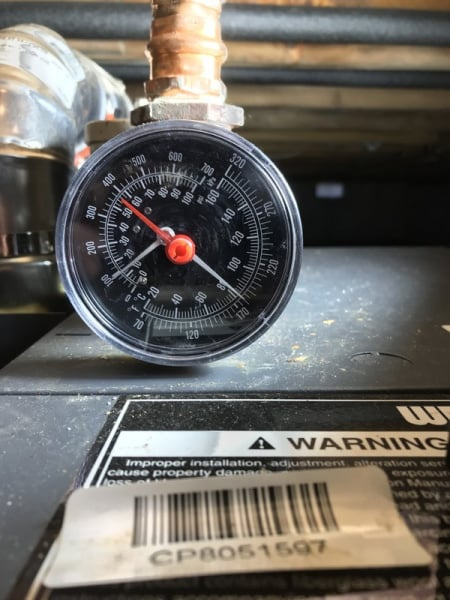
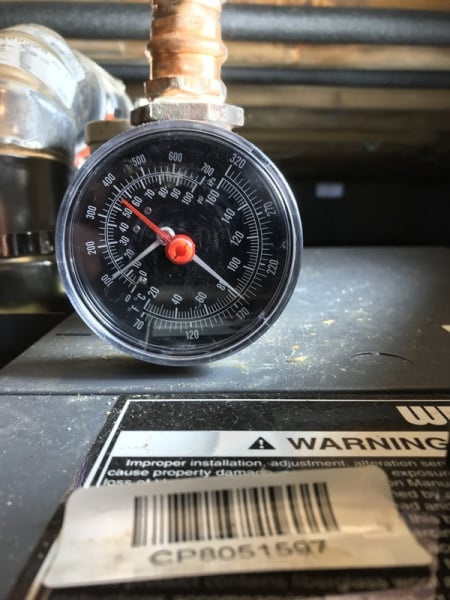
looks to me like that’s the tee & tridicator gauge that comes on WM boilers
0 -
-
I swear I saw ventilation holes on the back of some weird azz motor,
Doh !!
known to beat dead horses0 -
Correct. That is a pressure (and temperature) gauge. A gauge. In one single place. What is happening to the pressure elsewhere?
Br. Jamie, osb
Building superintendent/caretaker, 7200 sq. ft. historic house museum with dependencies in New England0 -
If those temps are correct, then it wasnt purged properly, or there is a valve somewhere stopping circulation, or the new circ is a dud, or there is a ghost. If the circ was in the right place, with the feed and exp tank in the right place, we could probably eliminate the purging as a possibility. If its a ghost…good luck.
0 -
This problem is quite common in vacation homes. The homeowner is not there during the coldest part of the winter, so they don’t know that this problem may have existed for 30 years, since they are never there on design-temperature days. They also know that on the few cool days when they visit the home, it gets comfortable for the most part.
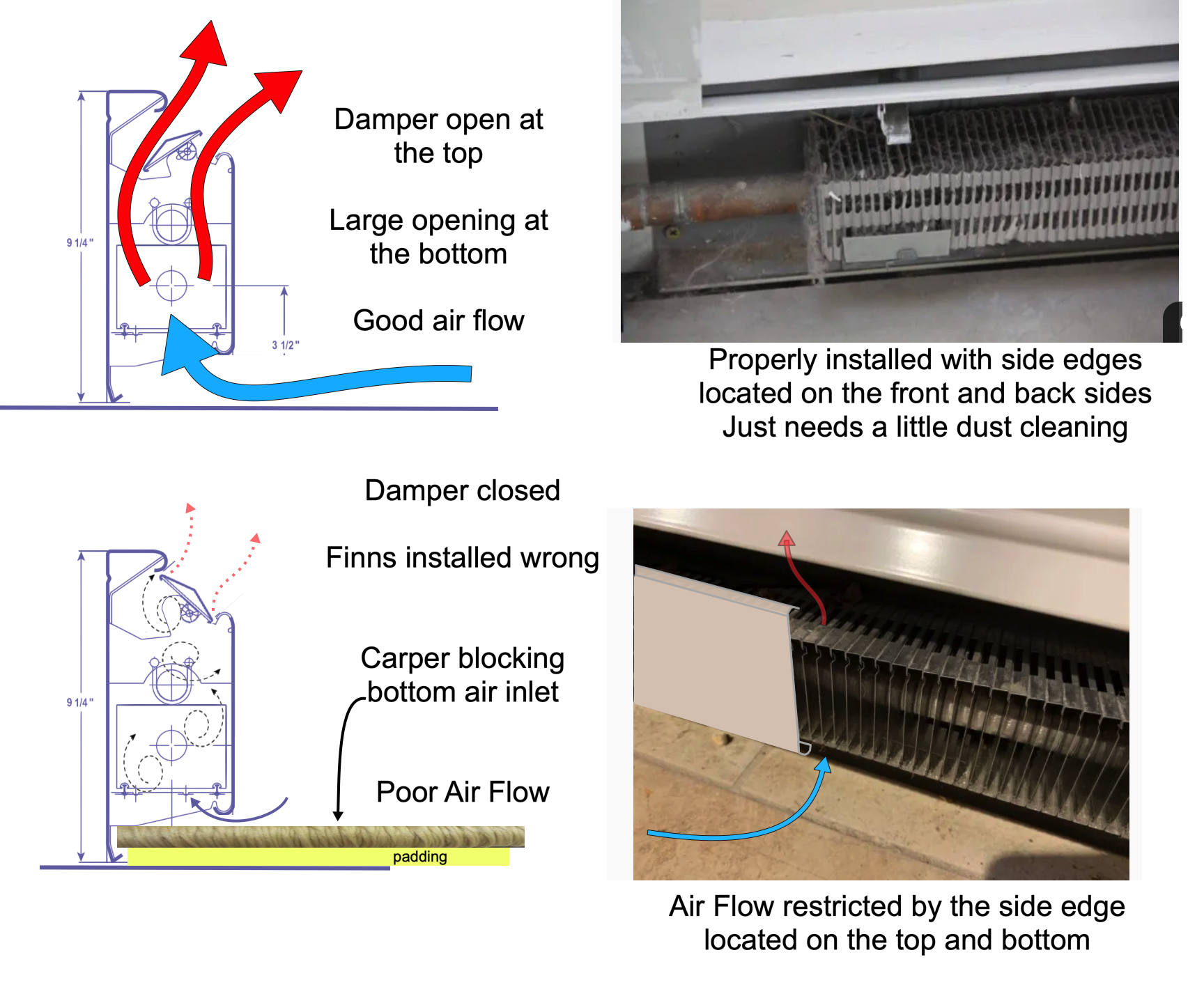
So let’s look at the whole system.
- What do the radiators look like? Can we get a picture of some of the radiators? Are there any installation errors, such as placing the fin in the wrong orientation? Are there wall-to-wall carpets blocking the underside of the air intake at the bottom of the enclosure? Is there a kink in a piece of copper pipe that is restricting the flow?
- Also look at the near-boiler piping for a blockage. I once had a Spirovent get clogged with debris in the system that we could not find for years. When we finally removed it for another reason, we discovered the problem that had haunted us all that time. Once I saw that screen all gummed up, I realized that all the strange moaning noises and circulation problems were the result of that clogged air vent not allowing proper water flow through the system.
- After ruling out water-flow restrictions and air-flow restrictions through the radiators, then we can look at all the other things that were discussed here.
Edward Young Retired
After you make that expensive repair and you still have the same problem, What will you check next?
0 -
There are no carpets, just hardwood floors. I am not at the house now but will check for proper fins installation.
As others have mentioned, the system has been purged of air two times.
From what has been mentioned here, this boiler seems to need more than 57 feet of fins to operate properly. Could this be the problem? Adding more fins wouldn't be difficult.
0 -
More radiation would help once the system is working correctly. With those temperatures measured it seems like there is a flow issue, or a measurement issue. I would think this issue should be understood before spending time and money modifying the system.
National - U.S. Gas Boiler 45+ Years Old
Steam 300 SQ. FT. - EDR 347
One Pipe System 1
1 -
I agree the temperature measurements look odd. I'll try a different meter next time I am at the house.
The boiler states a "heating capacity of 77,000 BTU's". It appears that would require about 128 ft of baseboard fins.
The plumbing is easily accessible and I could add four 10 ft baseboard fins. When added to the existing baseboard I'd end up with 97 ft.
0 -
Sorry for the delay, still trying to resolve the problem.
I had another heating company check it out. The tech did nothing at all, no tests or measurements, took a lot of pictures and said they would get back to me. They didn't. When I finally contacted the company they said they wouldn't be able to help me. I am in the process of trying to get an invoice and any info/findings on the techs visit. There are a lot of Heating Companies here on Cape Cod, I need to find the one willing to troubleshoot and actually do some tests of some sort.
Any techs on this board know a company on Cape Cod that would be willing to put the troubleshooting work in? I am in the process of a 3rd company coming in but fear nothing will be done.
Trying to learn but it seems a heating company would do a load/loss calculation to determine if a boiler was over sized? I ordered a temp meter to check the supply/temp lines and see if anything looks odd. Could be a supply/return balance issue?
I have been told elsewhere that the supply/return should be close in temp but in searches ideal is a delta of 20F, so confused at this point. And the Flow Rate, a search said a 76,000 BTU should have a flow rate of 7.6 GPM which would require a Delta of 20F.
I also am having a energy assessment done on July 1 to see what improvements can be done in regard to insulation etc.
When people ask me what I am doing in retirement, I answer, learning about boilers.
0 -
Return should be 20° less then supply minimum.
0 -
Not sure what supply minimum means. If the supply is 190F, the return should be 170F?
0 -
I also contacted Weil McLain. They said a tech should call them during a visit, that there are tests that can be done. And they also said they have received no tech calls for help on my boiler at all despite 4 visits using two companies.
0 -
at a minimum.
0 -
Ok, thanks.
0 -
the return temperature will vary, throughout the boiler cycle.
Under a heavy heat load, or coming out of setback expect to see a wide delta between S&R
The delta will close as the system distribution warms, the room load gets satisfied. It could drop to 10, even 5 as the thermostat satisfies.
Low mass fin tube will see that delta closing quickly. High mass, large volume radiators will slow the change.
A 20 delta is just a design number. Under a full load, non stop firing it may or may not run a 20 delta. It is a very arbitrary number, That 20 delta.
A 77,000 btu boiler wants to have bout 154’ of fin tube connected. To move that many btu at a 20 delta would require 7.6 gpm, which isn’t likely if it is 3/4 fin tube and piping.
154 X 500/ft=77,000/ft
But the fin tube should be sized to the actual heat load.
You mentioned 80’ of fin, is that accurate? If so, you have the ability to move about 40,000 btu/ hr. That is doable with 3/4 fin and tubing. Ideally a heat load number would bring all the answers.So you probably have too much boiler, maybe too little fin tube. If the home heats adequately on the coldest day, then you have enough fin tube, but still too much boiler.
This is the cause of the short cycles, the fin tube connected will dictate the boilers operating condition (temperatures) at any given time and load
Regardless of all the numbers ddi g up, the heat load at 40,000, a properly sized boiler, the correct amount of fin tube, on mild low load days the boiler is still going to cycle more. It only knows one speed, full speed.
Bob "hot rod" Rohr
trainer for Caleffi NA
Living the hydronic dream1 -
Thanks for the info.
I currently have 57 ft of fins. I wasn't sure if adding more fins would help with short cycling. I could add about 40 more feet of fins.
0 -
@Ismellelephant , here is a list of some contractors who advertise here. Not being familiar with MA geography, I don't know who is close to you, but it's a good place to start:
It sounds to me like a circulation issue, but the travel time from Baltimore to Cape Cod would be a bit much…………
0 -
Thanks steamhead.
None of those contractors are on the Cape unfortunately.
If a circulation issue, is this some I could detect by measuring the supply/return temps?
0 -
If the old boiler worked as you would expect, not short cycling, and
heating the home as expected. And the new one is short cycling and NOT
heating the home as expected. The question is what significantly
changed. Assuming the new boiler is not significantly oversized.Do you know the size of the old boiler ?
National - U.S. Gas Boiler 45+ Years Old
Steam 300 SQ. FT. - EDR 347
One Pipe System0 -
The old boiler is the same as the new, a Weil McLain CGi-4-PIN. The older one was called Gold Series? The new one is gray colored. The BTU/hr is different though, the old boiler was 85,000, the new boiler is 77,000 BTU/hr. And old boiler was 100,000 BTU input, and the new, 90,000 BTU input.
This is a family home that was not used much in the cold weather, so I can't say for certain that the old boiler heated the home as expected. But I am certain the old boiler did not short cycle like the new boiler.
So being retired I have used the home in the winter and the boiler couldn't reach thermostat temp.
Overnight, with thermostat set it to 70F, it would 67F in the morning. And the boiler would be cycling off and on, in under two minutes, all night long.
0 -
57’ fin tube X 500 btu/ ft = 28,500 btu: hr that it can transfer into the space
So your 77,000 output boiler is more than twice the size of the attached fin tube probably twice what the heat load would calculate at
Being a very low mass heat emitter and under partial load 80% of the heating season , it is going to cycle, a lot
The boiler should have been sized to the fin tube. A 50,000 input boiler should have been installed
Bob "hot rod" Rohr
trainer for Caleffi NA
Living the hydronic dream0 -
And I think you may be right hotrod, but the installers claim the boiler isn't over sized and the boiler is functioning properly. To confuse the situation, the older boiler was slightly more BTU/hr and didn't have a short cycling issue.
Earlier in the thread it was mentioned the expansion tank is plumbed in the wrong place. I know it is in a different place in the circuit from the previous boiler. Could this have anything to do with short cycling?
0 -
@Ismellelephant I have not read the entire thread, but what are the low, high and differential control settings on the boiler's aquastat? Can you post a photo of it with the cover off?
You certainly have enough boiler capacity and the radiators are the same ones that heated the house adequately with the old boiler. Logically you have either a water circulation problem or a water temperature problem, which the control settings will affect.
—
Bburd0 -
I do tend to agree that this sounds like a circulation problem, rather than a boiler problem. — but the problem may be a combination of two factors: circulation, but mostly simply not enough radiation too absorb the heat output of the boiler. Adding more fin tube in parallel with the old — don't just daisy chain them! — will help. That 40 more feet will soak up another 20,000 BTUh for a total of 50,000 BTUh — which is probably more like what the house needs anyway. And is closer to the boiler output, which will help with the cycling.
The piping is important. Ideally you need to arrange the piping so that each run of fin tube is fed directly from a manifold from the boiler, and returns directly to another manifold which, in turn returns to the boiler.
Neither of our real "go to" contractors service the Cape, so far as I know — and that's no wonder. Just GETTING to the Cape from anywhere is a nightmare…
Br. Jamie, osb
Building superintendent/caretaker, 7200 sq. ft. historic house museum with dependencies in New England0 -
Right now the differential is set to 190/170F. The differential is always 20F no matter the settings. Tried 180/160F same short cycling.
0 -
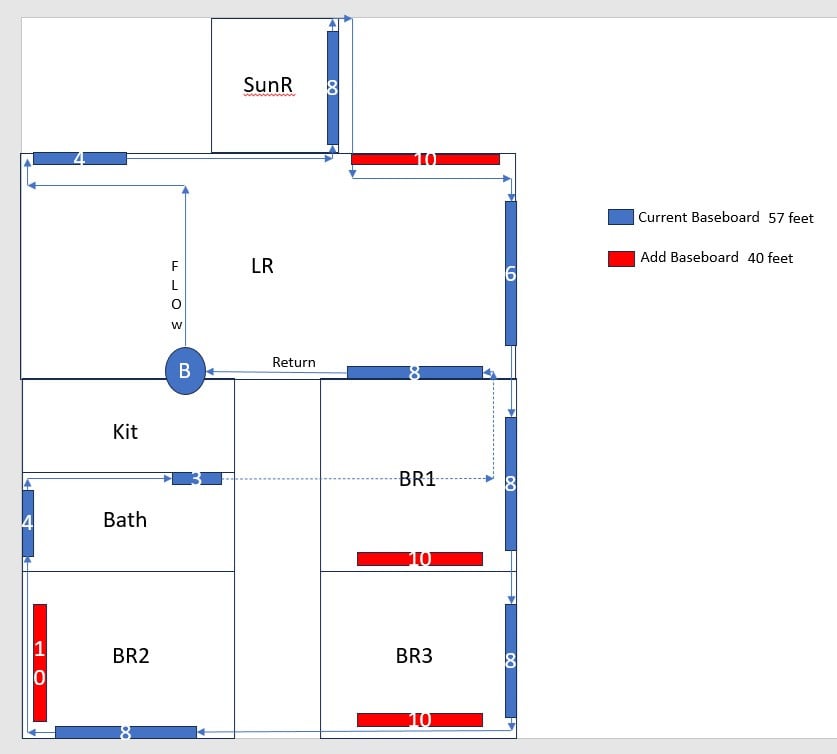
I thought I could add more fins, the system is one series loop, one zone. I have this diagram of how i thought it could be done. But parallel to the old and from a manifold seems beyond my understanding and skills.
Blue is the current setup. Red is what could possibly be added.
 0
0 -
adding more fin tube will just have the boiler reach the thermostat setting faster, I doubt this solves the cycling?
Your bottleneck then becomes the 3/4 tubing capacity, in that series loop, about 4 gpm. You’ll be hard pressed to move 77,000 through 3/4 copper tube. Splitting the loop into 2 section would allow more gpm, but your boiler is still twice what you need!
However more fin tube would allow you to run the boiler at a lower temperature, which reduces fuel consumption.
That boiler on fin tube could maybe run a 150- 130 delta. Still warm enough return to prevent the boiler from running too cold.
Bottom line, you need a smaller boiler. Or leave some windows open and increase the load, not recommend 🤓
Not knowing the actual heat load leads to a lot of speculation. But I think you indicated the home previously stayed warm in the coldest day? I suspect, based on the info you provided, the old boiler cycled also. How could it not if it was oversized?
Some more fin tube is throwing good money after bad.
Bob "hot rod" Rohr
trainer for Caleffi NA
Living the hydronic dream1 -
To me, if the old boiler cycled less and it was bigger (BTUs), I say the easy answer is there is air in the system. I know you said it was purged, but maybe they did not get all the air out and it is causing a flow issue.
National - U.S. Gas Boiler 45+ Years Old
Steam 300 SQ. FT. - EDR 347
One Pipe System0 -
I am so screwed, lol.
One thing certain, the original boiler did not short cycle.
When the new boiler was installed, the short cycling was noticed immediately, because the original boiler ran for long times, 8 to 15 minutes or so. So that part of the situation is confusing.
And air in the system is also noticeable, noises etc. It is one loop, purged 3 times by the installers. I could do it a 4th time but I don't think there is air in the system.
Paying $9,000 again to install a correctly sized boiler isn't an option at this point. Can a year old boiler be sold?
0 -
The system has a good air purger, pump is not in the ideal place on boiler return, but it should become air free within hours, a day with that purger? If any flow at all is moving, which you do hear?
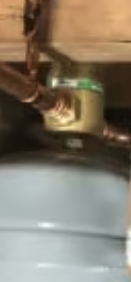
Do you ever hear air coming out of the purger? Or see any water trickling down from the top?
Could be it is plugged or defective. We have seen them sludge up also, reducing flow.
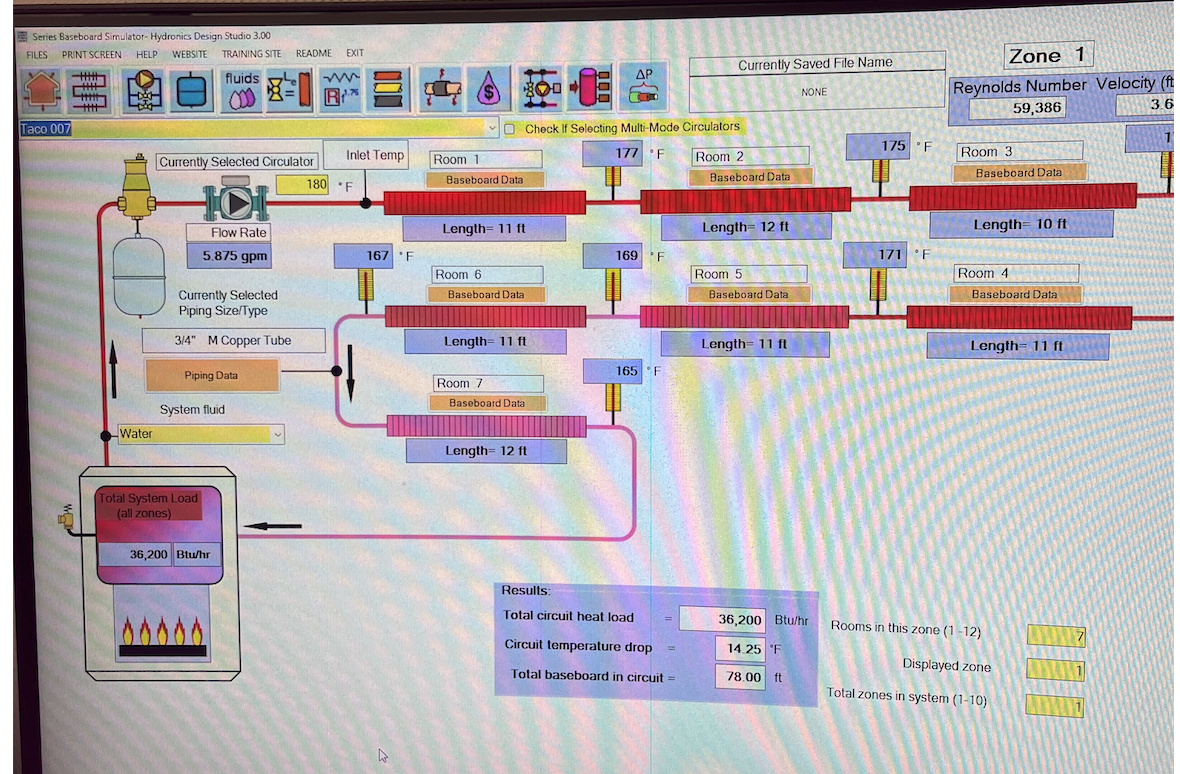
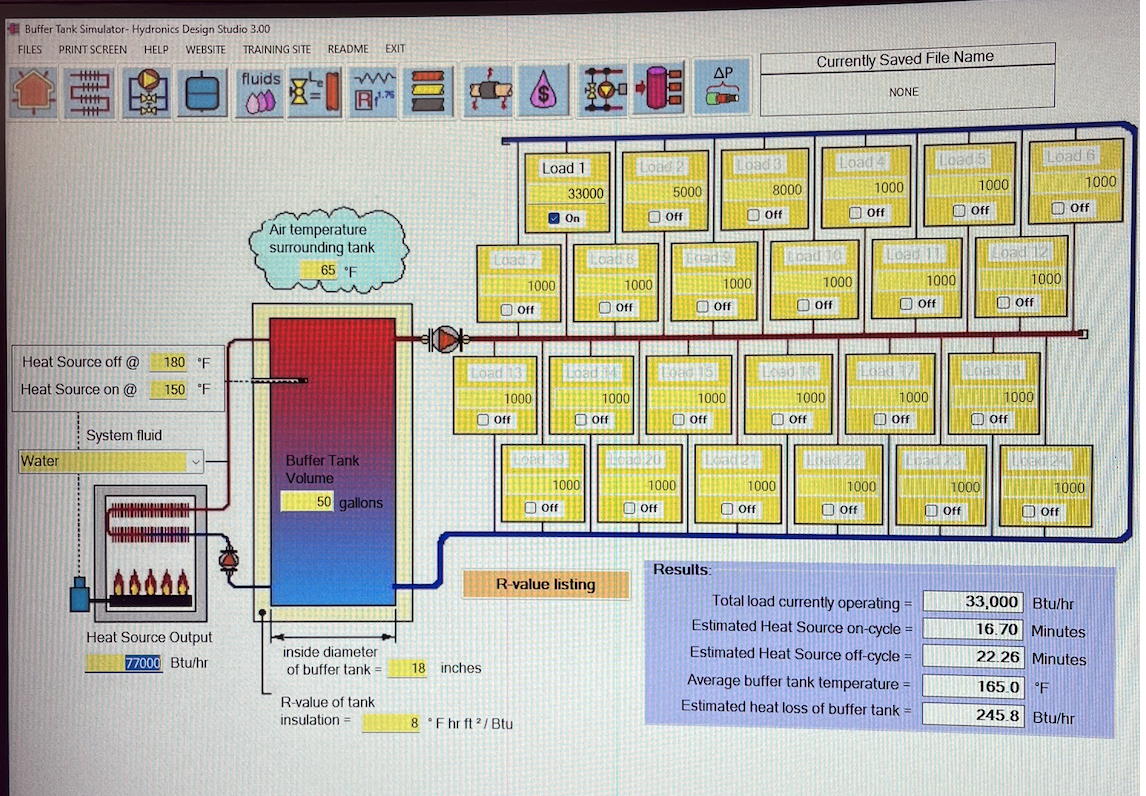
This simulation shows 78' of typical 3/4 fin tube, a Taco 007 circulator.
I used a total 100' of 3/4 copper including the fin tube, 20/4' elbows. If this is close you should be moving 36,200 btu/hr
Without adding some more gauges to confirm actual flow rate I would
remove pump from body and check for impeller condition, plugged, broken
Remove the top of the air separator and see if it is plugged or the float stuck.
BUT if you are seeing that 15- 20 temperature difference, some flow is moving. Temperature and flow move heat. Something is not adding up if just a like sized boiler was swapped, nothing else changed?
As for the cycling, right sizing the boiler is preferred, a buffer than could be added to give the system more volume to work with
If you adjusted the control to run the boiler at 180-150 a 30∆, and added a 50 gallon tank, you would get a 16 minute run time with a 33,000- load on a 77,000 boiler.
I think the installer needs to step up here and at least do some investigating.
If you or someone performed an accurate heat load calculation, I thing the oversizing would be documentable. An on site analysis of the system actually running then would confirm that.
 Bob "hot rod" Rohr
trainer for Caleffi NA
Living the hydronic dream0 -
looks like a power vented boiler, that is the inducer fan.
Bob "hot rod" Rohr
trainer for Caleffi NA
Living the hydronic dream0 -
Thanks for the info. I am heading to the home today.
I agree, the installer needs to step up. On their last visit, when all of a sudden, he now claimed the boiler was performing as it should, I told him I would contact him again in the winter when the boiler can't reach the thermostat set temp.
I am treading lightly here and looking to keep things friendly with the installer. Not sure if the installer is just trying to kick the can down the road but how can a boiler be operating properly when it never runs more than 1 to 2 minutes when there is a call for heat.
I was focused on this being an oversized boiler problem but the slightly larger previous boiler didn't short cycle. Very puzzling.
The circulator was replaced with the new boiler. I may have the old circulator and can check if it was a different size, model or flow rate or something. I will be measuring supply/return temps today. Not sure if that will reveal anything but in previous tests, with an infrared meter I don't believe I saw any temps above 90- to 100F on the supply/return lines. The new meter is a thermocouple with pipe clamps.
0 -
What bothers me with this situation.
- The old larger boiler worked good, no short cycling.
- The new smaller boiler short cycles with the burner apparently shutting down on high limit and the thermostat is not satisfied in a timely manor.
- The temperatures on this diagram. I would expect the supply pipe would be warmer than the return, which also seems odd. Seems like the heat can't get out of the boiler so the burner just shuts down on high limit.
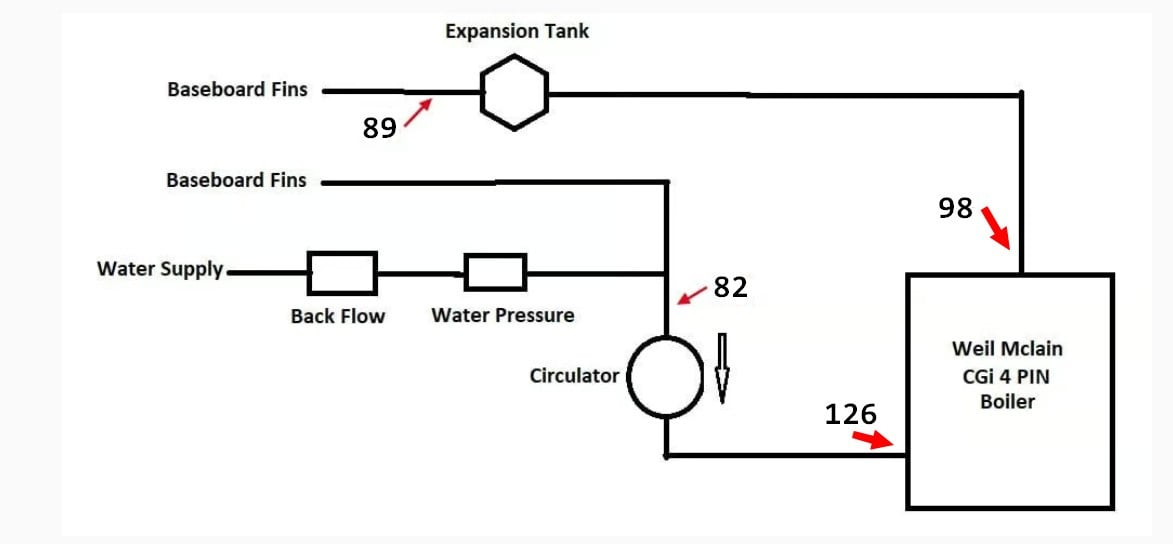
Could the installer have stuffed a rag in a pipe and failed to remove it or something else that is restricting the water flow ?
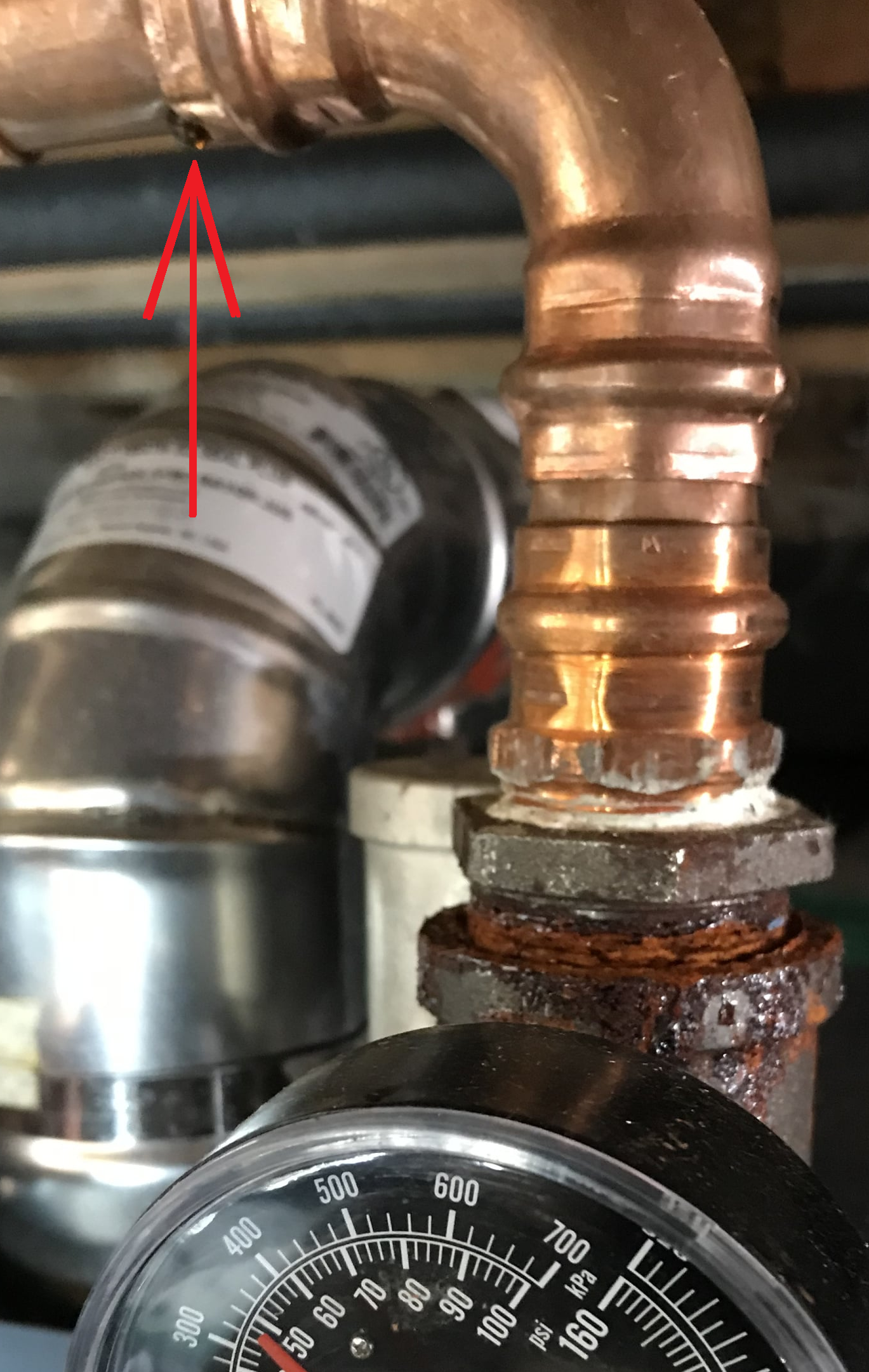
Is this a leak?
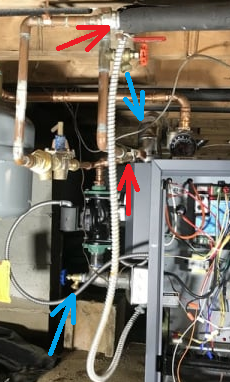
If I'm seeing it all correctly I'd take some hoses and a bucket and verify flow through the boiler and the system. Close the valves at the Red arrows, water feed and the one circulator isolation valve. Feed water from a hose into the drain valve and verify good water flow out the purge valve. Blue arrows represent the water flow, in the drain out the purge valve.
 National - U.S. Gas Boiler 45+ Years Old
Steam 300 SQ. FT. - EDR 347
One Pipe System0










Categories
- All Categories
- 87.8K THE MAIN WALL
- 3.3K A-C, Heat Pumps & Refrigeration
- 60 Biomass
- 430 Carbon Monoxide Awareness
- 133 Chimneys & Flues
- 2.2K Domestic Hot Water
- 6K Gas Heating
- 124 Geothermal
- 170 Indoor-Air Quality
- 3.9K Oil Heating
- 79 Pipe Deterioration
- 1.1K Plumbing
- 6.7K Radiant Heating
- 397 Solar
- 16.1K Strictly Steam
- 3.5K Thermostats and Controls
- 56 Water Quality
- 51 Industry Classes
- 51 Job Opportunities
- 18 Recall Announcements