Can Heat Pumps heat Hot Water Cast Iron Radiators for Radiant Heat?

i’m new to this form but was referred here. Yesterday got notice from our oil company when they were servicing our oil furnace that after we’ve been in our house for 24 years and the furnace was here when we bought it that it’s time to get a new furnace. So I’m looking at all sorts of options. We have hot water radiators cast-iron radiators in this old house was built in 1900 in New England. We could just get a new oil furnace or even propane gas furnace, but my mind was going, “Could you even a heat pump work to heat enough water to a needed temperature to heat water for these radiators. Currently we have two zones using radiators in our house. We have a heat pump hot water heater that works great for domestic hot water. But looking at efficiency cost Savings and effectiveness at new sources of radiant, hot water heat in these radiators that we have. Any thoughts? Thanks.
Comments
-
Maybe, especially if the home has had energy upgrades.
I've run cast radiators on 120 supply and they still give some heat.
So you need a room by room heat load. Then determine the existing radiator output at lower temperatures. See if they can meet the heatload at 120 supply water temperature.
Some ideas and options here.
Bob "hot rod" Rohr
trainer for Caleffi NA
Living the hydronic dream 1
1 -
I’d say probably not, even in my neck of the woods unless you’re willing to layer up with sweaters when it gets cold. You will probably still need a backup boiler.
And what do you pay for a heat pump install these days? Not cheap.
8.33 lbs./gal. x 60 min./hr. x 20°ΔT = 10,000 BTU's/hour
Two btu per sq ft for degree difference for a slab0 -
Unfortunately, unless your older home has had very significant envelope upgrades like full insulation and draft sealing, the answer is: probably not.
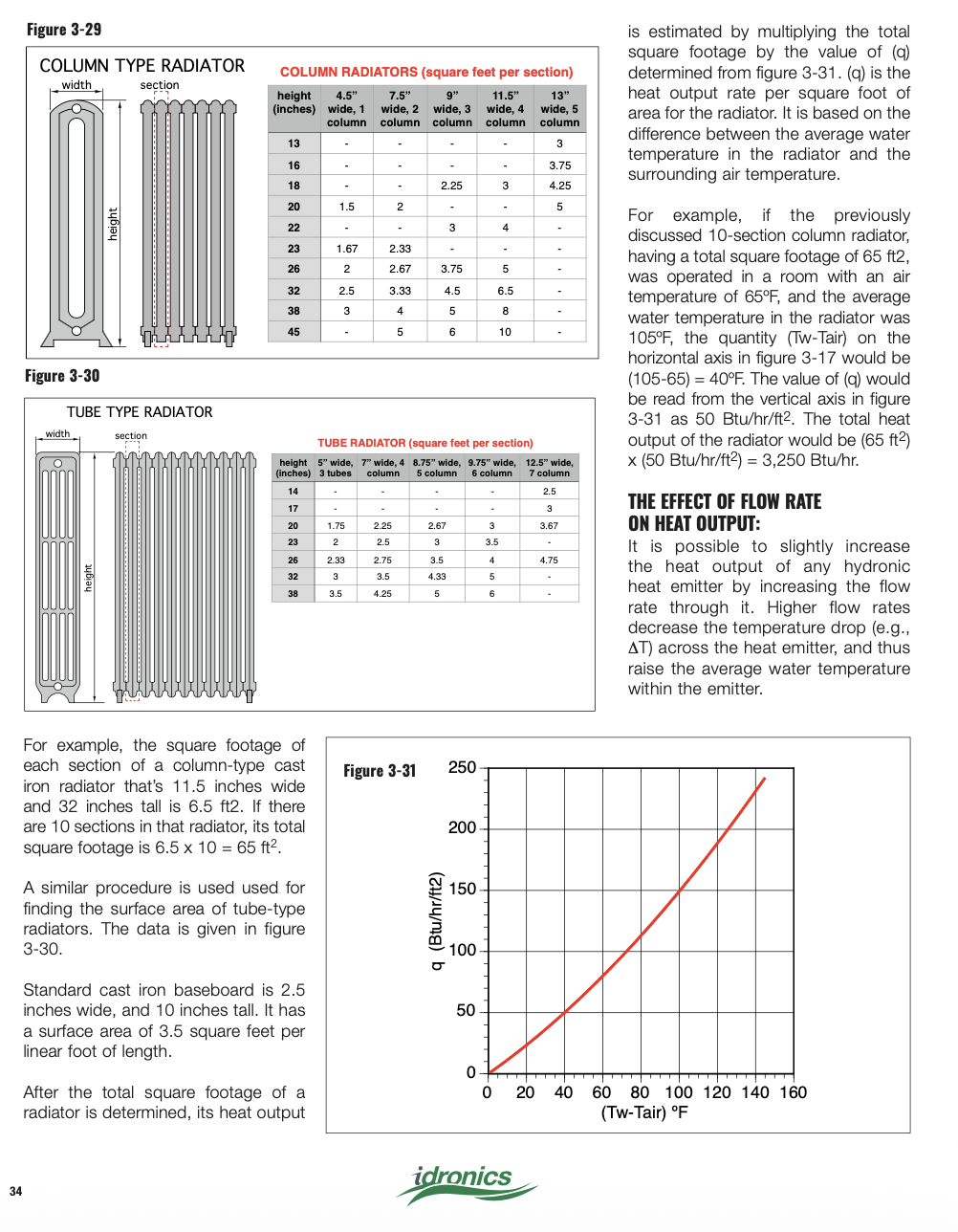
Your existing radiators were probably sized for an average water temperature of 170°F on a design (very cold) day. An air to water heat pump can produce 120°F supply water, which means the average will be closer to 110 to 115°F. Conversion charts show the heat output of cast-iron radiators at various water temperatures; in this case you would get about 40% of the original design heat output.
You can survey your radiators using charts that show the square footage of heating surface per section for the various types and sizes. At 170° average water temperature the heat output is 150 Btuh per square foot. Then apply the correction factor for the lower water temperature, which will tell you how much heat you will get with an air to water heat pump.
Compare that to a Manual J or other heat loss calculation of the heating load for the house as it now exists. This can also be estimated from your fuel consumption over several years.
—
Bburd0 -
A blower door and infrared scan is a good idea with any heat design. It will show where improvements can be made.
All the numbers are obtainable if you take the time top do some research. What the home requires, and what your radiators are able to provide.
I think Steelrad has a derate sheet on their site also.
A hybrid option, keep the boiler for the boost days, determine the boilers age, there could be 20 more years of life in the boiler..
 Bob "hot rod" Rohr
trainer for Caleffi NA
Living the hydronic dream 1
1 -
@woofenme , what reason did they give for replacing it? What make and model is it? Post some pics if you can……………..
 2
2 -
what’s wrong with it?
1 -
That would be my first question. 25 years old isn't necessarily a problem — many boilers, if they haven't been too badly abused, can last a good deal longer than that.
Get around that question first. Salesmen do like to sell things…
Then, I'd say that it is somewhat unlikely that an air to water heat pump will do much for you in colder weather — so you wll need a boiler (and do your sums: LP is not usually much, if any, cheaper than oil!) anyway to keep from being very chilly on colder days…
Br. Jamie, osb
Building superintendent/caretaker, 7200 sq. ft. historic house museum with dependencies in New England0 -
Check out these two issues of Idronics:
Trying to keep Bernie burning!
0 -
I heat a 1928 3200 sft house with water that maxs out at 115F. I can do that because the house is over radiated and well insulated. It was common for houses built in the 1920's after the flu pandemic to have enough capacity to heat home with the windows open (fresh air movement).
The new sections added in 2020 are 2x6 with foam (800sft) plus original walls full 4” have dense pack rock wool. Exterior is 2” stucco on original so very tight.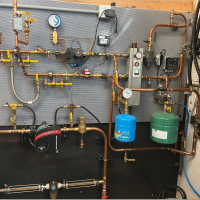

 3
3 -
You can do a proper heat loss and add radiation if and where necessary, as well as building envelope upgrades.
0 -
Maybe. Old houses often had heating systems that were oversized by a factor of two to three.
This article explains how to estimate your actual heating load based on past fuel usage:
https://www.greenbuildingadvisor.com/article/replacing-a-furnace-or-boiler
Once you have your heating load, you need to figure out if your current radiators can meet the heating load with water at the temperature a heat pump produces, which would be about 110F.
As a rough guide, the amount of heat produced by a radiator is proportional to the difference between the water temperature and the room temperature. Most oil systems are set to go on at 160F and off at 180F, so the average water temperature is 170F, with the room at 70F you have a difference of 100F. With a heat pump producing water at 110F you'd have a difference of 40F, so you'd expect about 40% of the output.
If your radiators are oversized, that may be enough. If not the next step would be to figure out if you can add more emitting capacity through more radiators or convectors.
0 -
the exact formula given in one of the recent idronics issues is: radiator output = 0.3748 * EDR * (avg water temp - room temp)^1.3, so it’s not quite linear in produced water temps.
0 -
This is a common comment. Don't bet on it. I doubt very much that it's true more than half the time — at least in my area it isn't.
Br. Jamie, osb
Building superintendent/caretaker, 7200 sq. ft. historic house museum with dependencies in New England0 -
That Quote was based on steam systems…not hot water systems.
Totally different animal.
 1
1 -
Back to the original question
Can Heat Pumps heat Hot Water Cast Iron Radiators for Radiant Heat?Yes, BUT a lot of work needs to be done before deciding to attempt it.
1st an accurate Manual "J" room by room to determine the exact heat load loss.
2nd Getting an accurate heat output of the existing radiators.
3rd you said you're tightening up the envelope………. This WILL change the Manual "J"
A blower door test needs to be done to locate how the heat is escaping before and after tightening the envelope.
After all that's done then you can begin deciding what equipment and fuel is best for your situation.
3 -
A very common radiator around me is the BaseRay cast iron baseboard. The manufacturer's data sheet is at: https://s3-us-west-2.amazonaws.com/catsy.782/Baseboard+and+Radiators+Product+Data+Sheet.pdf
On page 2 there is an output vs temperature chart. I took the numbers from it and put in the graph below, it's a straight line:

If you look closely you can see a dotted line, that's the actual straight line. But the values are rounded to the nearest 10 BTU/hr.
0 -
Another popular radiator is the Slantfin. Their datasheet is at:
Output information is on page 3. Here's the chart;

Again, it's a straight line.
0 -
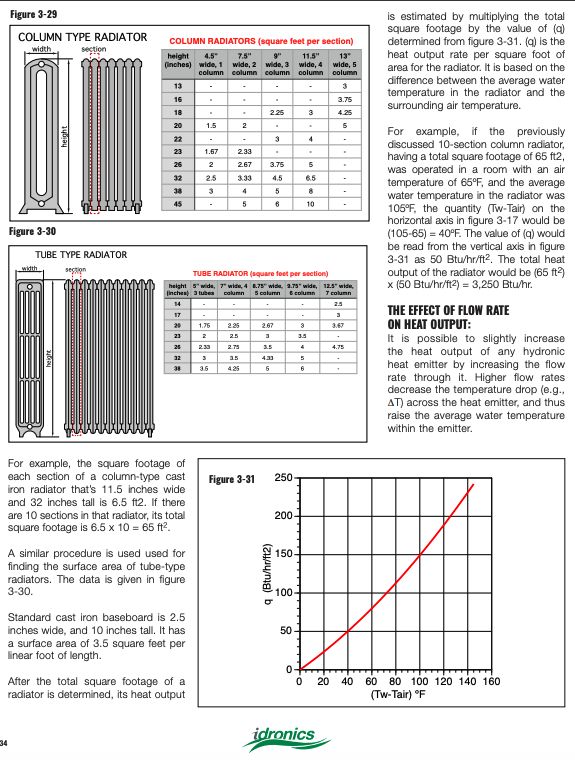
The output when simulated shows a slight curve, but not that it changes the answer that much. Fairly linear would be a good description.
The SIM adds some operating condition, the ambient air temperature, to the equation. The ∆ between the radiator temperature and surrounding ambient is what determines output. As the air warms, ∆ changes, output changes.
Increasing flow causes the entire radiator to warm which can get a slight output increase also.
This math assumes a CI baseboard 2.5" wide, 10" tall for 3.5 sq ft per lineal foot.
That manufacturers output graph may have been developed from the older IBR lab testing and certification.
 Bob "hot rod" Rohr
trainer for Caleffi NA
Living the hydronic dream0 -
And so was my reply. It is quite true that in some areas at some periods (perhaps 1918 to 1925) both steam and hot water systems were oversized to allow for fresh air. But to assume that ANY old house has an oversized system is just wrong. Sorry about that, but it is.
It's in the same category of frankly bone-headed short cut as assuming that the old boiler was the right size — or oversize. Sometimes quite true. Sometimes most certainly not.
Br. Jamie, osb
Building superintendent/caretaker, 7200 sq. ft. historic house museum with dependencies in New England0 -
Most things in hydronics, including steam can be diagnosed, designed, improved with a few basic measuring tools
A tape measure, temperature gauges and a calculator.
With computer programs, no need to guess or assume, number crunching, data acquisition has never been easier.
However with existing structures there will always be some assumptions. Blower door test, infrared scans can tighten up some of the assumptions, as to insulation and infiltration.
Bob "hot rod" Rohr
trainer for Caleffi NA
Living the hydronic dream0 -
I'm in colder climate, north edge of Zone 5, and heat a house that is 2/3 100 year old uninsulated construction without issues with an air to water heat pump.
As others have said, you have to see where your heat loss is (fuel use is the most accurate for this) and do an audit of all your rads.
Two things help to make it possible in my case. I had to replace lot of the original windows and went with triple panes and did a fair bit of air sealing to reduce leakage. The old rads were oversized even for the original house so with the reduced loss, I can run with 112F water on design day.
 2
2 -
I have an idea that dates back to the early days of boiler installation, long before Manual J heat-loss calculations became common.
Try heating your home to 120°F using 125°F boiler water overnight when the outdoor temperature is around 60°F. That would create a ΔT of approximately 60°F and provide a representative test of how the cast-iron radiators might perform when it is 0°F outside.
"You have to sweat for your money" was a phrase I heard from old-timers when I first started in the trade. The story went: that if you installed a boiler during the summer, you had to heat the house to 120°F to prove that the boiler could maintain 70°F indoors when it was 0°F outside. I'm not sure how accurate the story really was, but it made sense to me at the time.
So, if your oil boiler is still capable of producing 120°F water for the radiators, try leaving it on overnight and see whether the house can maintain 120°F by the time the outdoor temperature reaches its overnight low. If it can, then you may have oversized radiators that are large enough to do the job at lower water temperatures.
One technical note: the old "120°F house" test is more heating folklore than engineering. The concept is interesting, but actual radiator output does not scale perfectly with temperature difference, so I'd describe it as a rough field test rather than a scientific proof. but you can try it and see how close you get.
Edward Young Retired
After you make that expensive repair and you still have the same problem, What will you check next?
0 -
Send any pets to the neighbors overnight if you try the 120 indoor temperature test, maybe stay and keep them company😉
Bob "hot rod" Rohr
trainer for Caleffi NA
Living the hydronic dream0 -
You're not going to be able to get the interior to 120F using 125F water because the temperature difference is too small.
Let's say you have a system that is capable of maintaining 70F with 125F water when it's 15F outside. The temperature difference between the inside and the outside is 55F, and the difference between the water temperature and the inside is also 55F. As a first approximation, the heat flow between both the radiator and room, and room and outside is proportional to temperature difference. Running that system full out with the same 125F water when it's 60F outside you'd expect the temperature differences to remain equal. The difference between interior and water is 65F, so you'd expect the interior to stabilize between them, 32.5F away from each, at 92.5F.
This is basically the same game as using old fuel bills to estimate the heating load. You could measure the existing boiler's run time during cold weather to estimate how much heat the radiators are actually putting out.
0 -
Here is a graph of that formula. The dotted line is a straight-line trendline:

X-axis is temperature in F, Y axis is BTU/hr per square foot. As you can see, in the temperature range that radiators normally operate it is very close to a straight line.
0 -
Thanks everyone for sharing real data from the radiator manufacturers, and for checking my math. My point was specifically in regards to the statement that @DCContrarian made, about getting 40% of the output from 110F AWT compared to 170F AWT earlier in this thread. I think the actual number is 30% right? (110-70)/(170-70) = 0.400, but (110-70)^1.3/(170-70)^1.3 = 0.304. I agree that seems small, but if you took the 40% number seriously you'd only get 76% of the BTUs you thought you would get.
0 -
(110-70)/(170-70) = 0.400
(110-70)^1.3/(170-70)^1.3 = 0.304
If your wedge (^) symbol means multiply (and even if it doesn't), these two calculations should both yield the same quotient, no, as the 1.3 cancels out?
8.33 lbs./gal. x 60 min./hr. x 20°ΔT = 10,000 BTU's/hour
Two btu per sq ft for degree difference for a slab0 -
@Alan (California Radiant) Forbes I am using the "^" symbol to exponentiate. I think the simplification you might be thinking of is (110-70)^1.3/(170-70)^1.3 = ((110-70)/(170-70))^1.3 = (40/100)^1.3, which is still 0.304.
 2
2



Categories
- All Categories
- 87.8K THE MAIN WALL
- 3.3K A-C, Heat Pumps & Refrigeration
- 60 Biomass
- 430 Carbon Monoxide Awareness
- 133 Chimneys & Flues
- 2.2K Domestic Hot Water
- 6K Gas Heating
- 124 Geothermal
- 170 Indoor-Air Quality
- 3.9K Oil Heating
- 79 Pipe Deterioration
- 1.1K Plumbing
- 6.7K Radiant Heating
- 397 Solar
- 16.1K Strictly Steam
- 3.5K Thermostats and Controls
- 56 Water Quality
- 51 Industry Classes
- 51 Job Opportunities
- 18 Recall Announcements