Steam piping, change in elevation solution.

Once in a great while, among the insanity of running a business and dealing with the whole getting old thing, there are still times I find I'm actually proud of myself. So, here I am today. This worked out better than I could've anticipated.
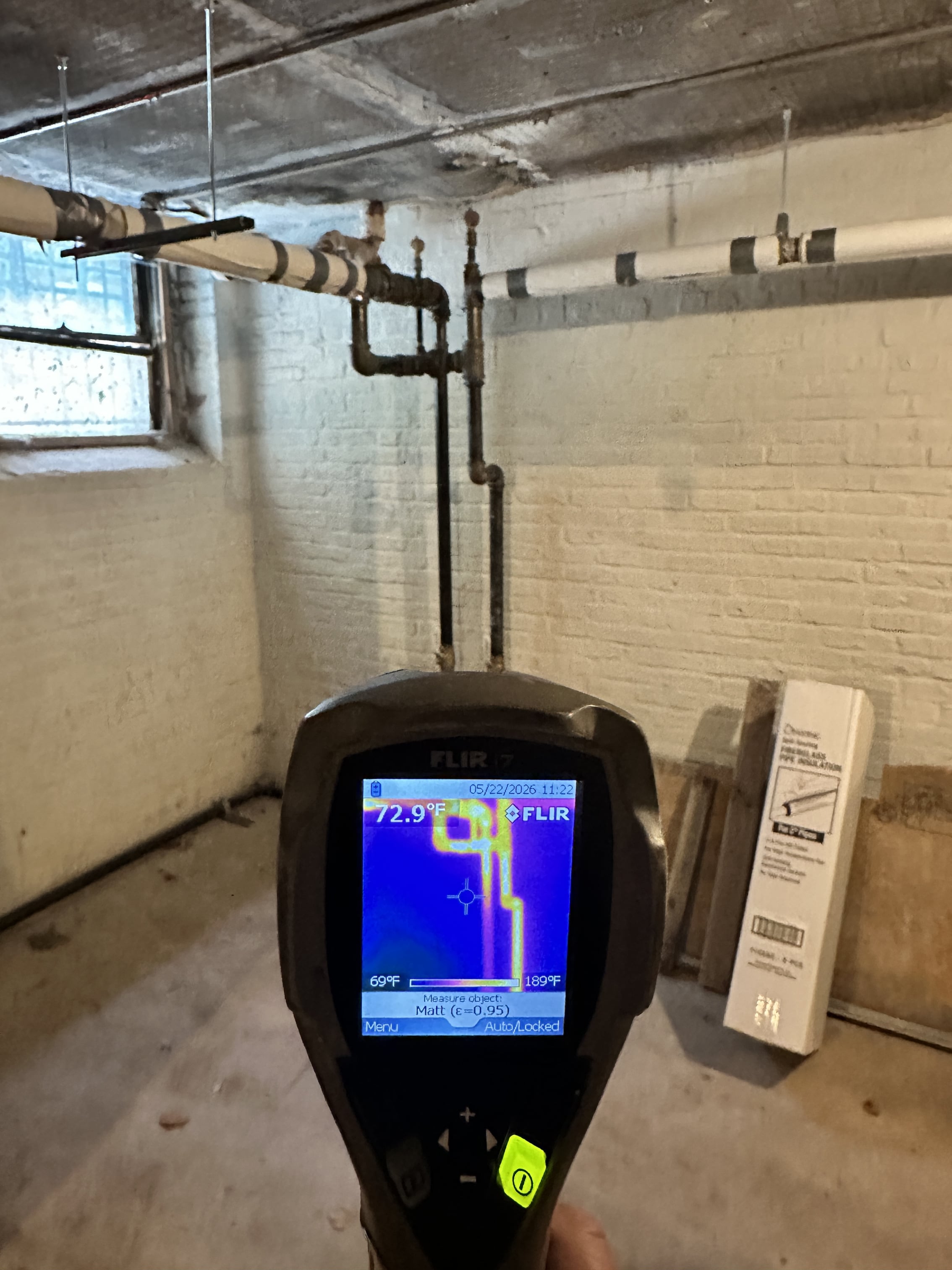
We had a situation where a steam main was moved to accommodate the addition of some storage lockers in a Brooklyn multi-family basement. No one in the building remembers when the work was done but the current residents all said the heating system had "always made a ton of noise" during the heating season, especially on colder days when the system ran longer cycles. Half the main had been moved and back-pitched so there was good original parallel flow in one part of the building and then counterflow in the other. Both sides shared a return that was rendered undersized by the old piping alterations.
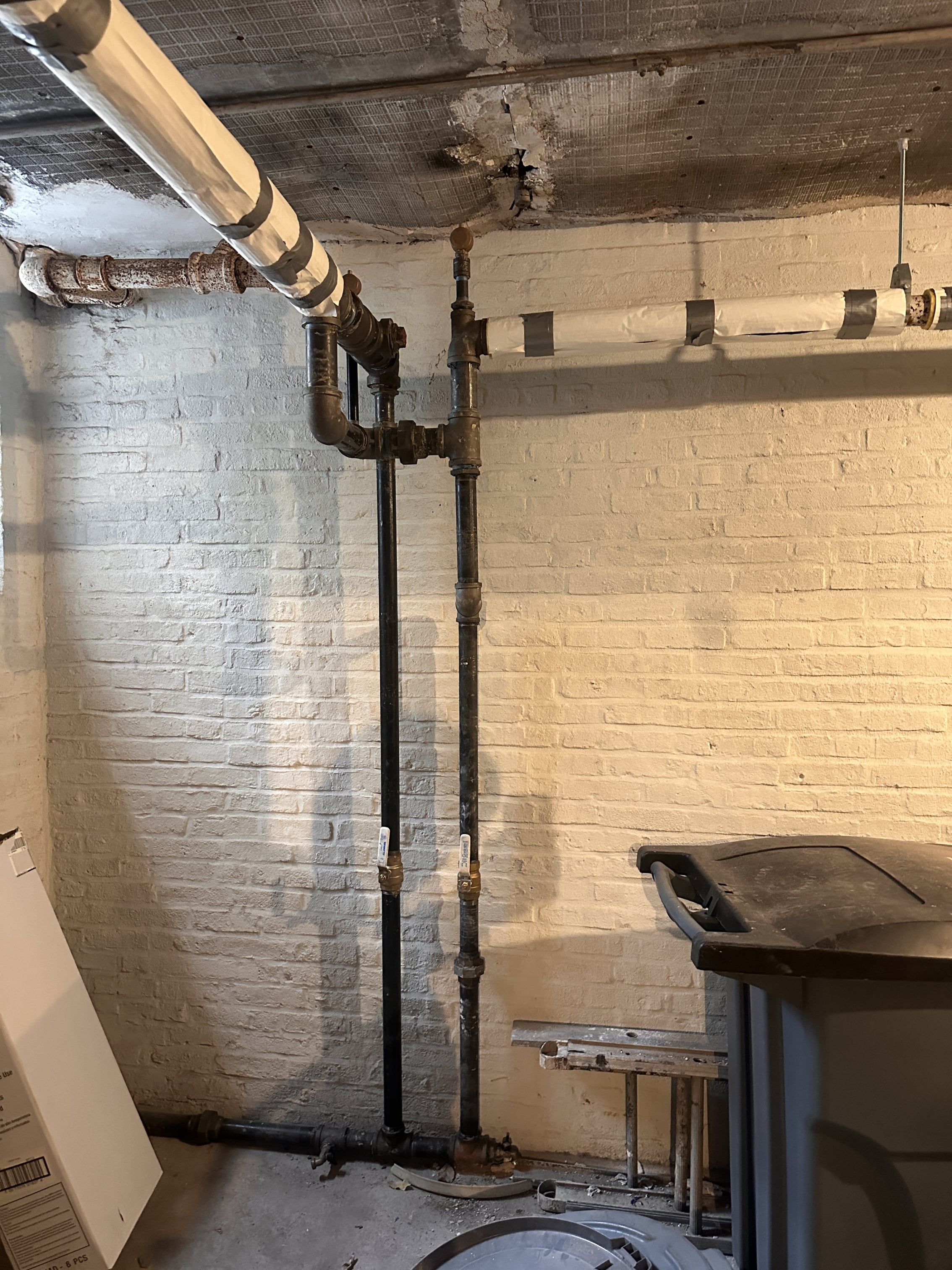
It's difficult to photograph but here was my solution. The left side comes from the boiler and the right side is a back-pitched main serving about half the building. There is no practical way to move the right side main, or at least, moving it would incur tremendous costs.
It now works silently and heat distribution is normalized.
Consulting & Troubleshooting
Heating in NYC or NJ.
Classes


Comments
-
-
it really isn't that hard if yo think like steam. you need to keep the steam from going where it shouldn't and give the condensate somewhere to go.
 1
1 -
the drips and wet return are all new, right?
0 -
nice!
Br. Jamie, osb
Building superintendent/caretaker, 7200 sq. ft. historic house museum with dependencies in New England0 -
Can you explain what you did so I can understand?
8.33 lbs./gal. x 60 min./hr. x 20°ΔT = 10,000 BTU's/hour
Two btu per sq ft for degree difference for a slab1 -
i would also like to know. i suspect some of it has to do with what was already there.
0 -
That's the ticket!!!
I might have done it different but what do I know?
I probably would have teed up from the boiler main and up from the counterflow main and tied that together for the steam. Then dripped both mains the same way you did connecting them below the water line. That way the steam isn't fighting the condensate in the short riser.
But all that doesn't matter you fixed it and it works!!!
Something so simple with a few pieces of pipe that nothing can go wrong with.
0 -
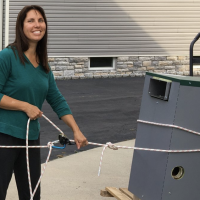
First of all, not to mislead anyone, I didn't touch it. I just had my 5th knee surgery (2nd partial replacement) and my wrench swinging days are over. My guys (Nyel, pictured, is excellent) installed what I drew.
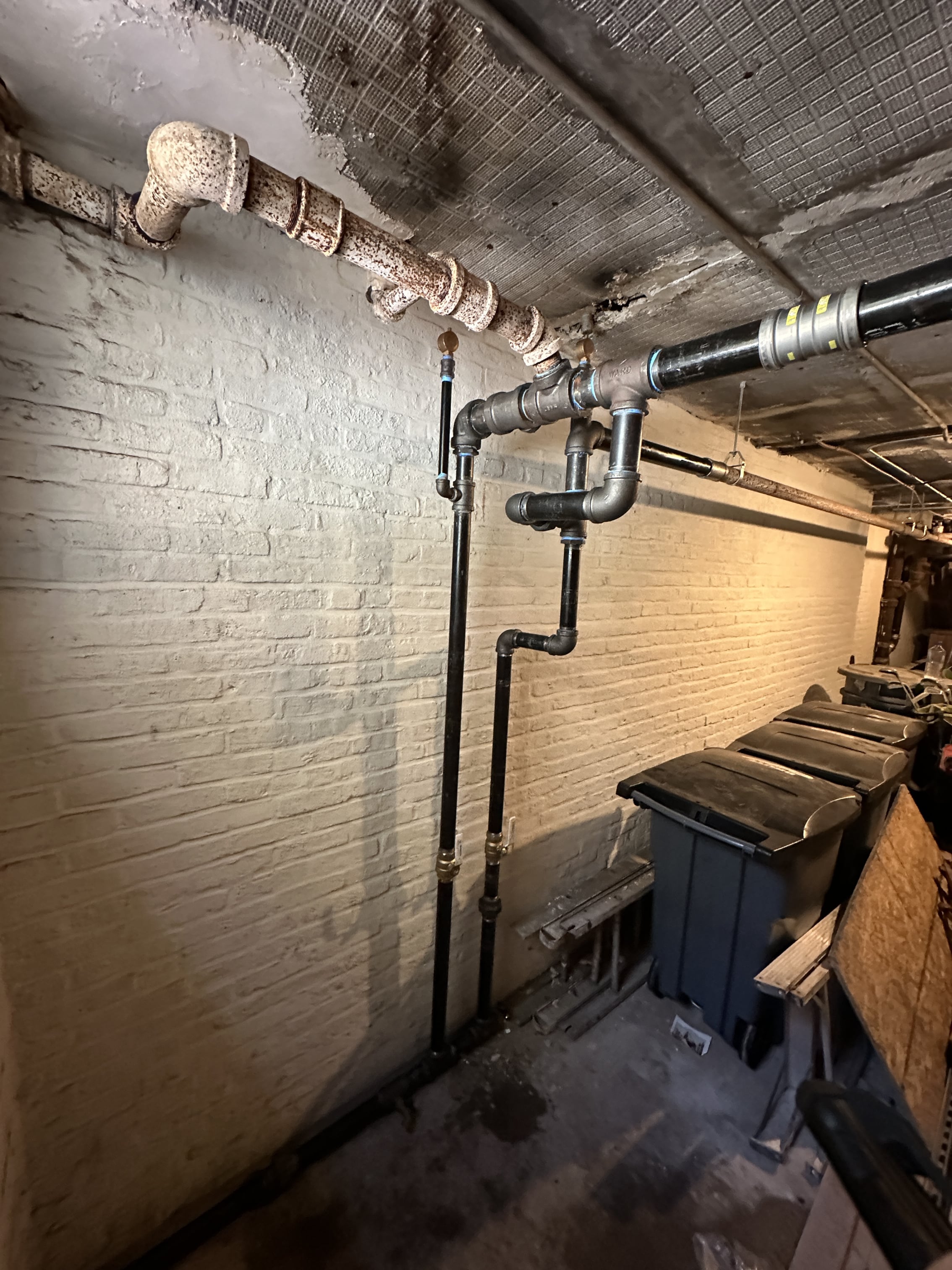
We created a little downfeed system by dropping down off the main and bull-fed a tee (!!!) creating both a short upfeed riser to the right-side main and also a drip line to the wet return. @EBEBRATT-Ed I thought about coming up off the left side main but I was afraid there wouldn't be enough height for the 2" fittings to go up and over to the right side. I felt like adding the vent on that right side would have more effect.
The picture below more clearly shows a 2" riser in the corner of the building. That one's got a lot of EDR attached to it and it makes a lot of condensate so I didn't want the new drip line crossing or interfering with it.
I hope I'm explaining this clearly. Certainly there were options here but we chose this way, achieved our goals, and got paid. It's fun to be able to get mechanically creative some times.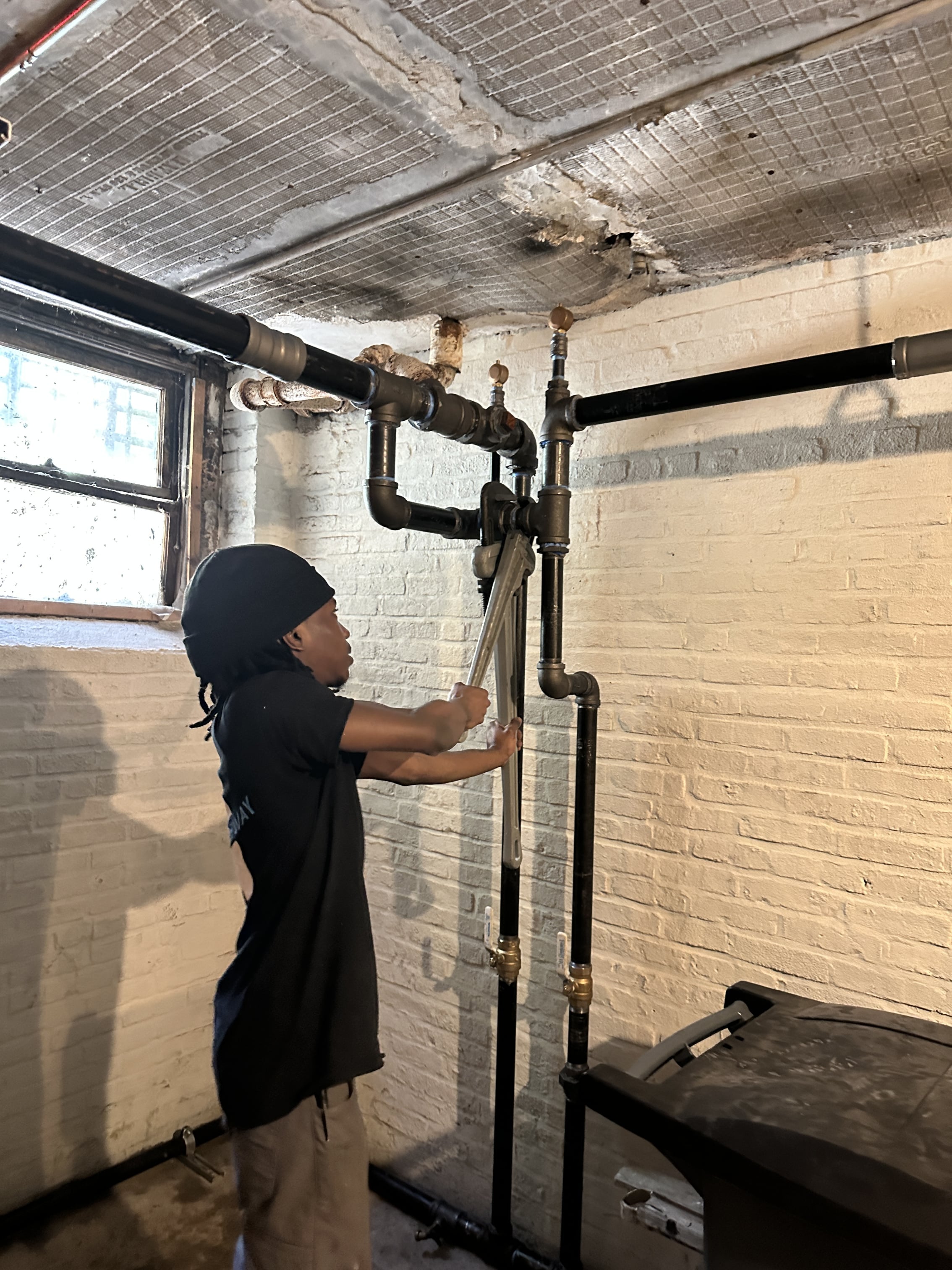
 Contact John "JohnNY" Cataneo, NYC Master Plumber, Lic 1784
Consulting & Troubleshooting
Heating in NYC or NJ.
Classes

 7
7 -
it makes more sense seeing what is happening in the corner. tall buildings with 1 pipe steam are unusual outside of nyc or chicago
1 -
It works which is the only thing that matters.
I fixed something similar in a very old building, but I got sidetracked. The building had a few one pipe radiators but was mostly two pipe with steam traps. They were losing steam out of the condensate pump vent.
I rebuilt all the traps which fixed most of the issues, but they had some of the one pipe rads spitting water from the vents but only occasionally. Everything looked ok to me. pipe pitch and steam pressure were ok.
After a few trips and doing some other non-heating work I walked through the basement and realized that the end of main 3/4" trap was not just dripping the main but had to handle the condensate from all the 1 pipe radiators……It wasn't big enough.
DUH. I should have spotted this earlier. We had just started working in this building so it had been wrong for years.
It was a Friday afternoon and nowhere to get an 1 1/2" trap quickly. So I picked up some pipe and fittings and took the old trap off and made a 1 1/2" loop seal. Problem fixed and for less $$$ than a trap.
Just one of the times I couldn't see the forest through the trees.
4 -
@Alan (California Radiant) Forbes and @mattmia2 I can only guess what piping was there before but I believe that one side (B) was a counterflow as a result of a repiping job long ago, and the other side (A) was a parallel flow and there was insufficient return so the condensate didn't get out fast enough. By adding a second return drop (D) and adding a drop from the riser into the second return (C) pipe there is more condensate going to return (D) and less going to return (F) so the problem of insufficient return for the condensate from Pipe (E) and (A) was eliminated.
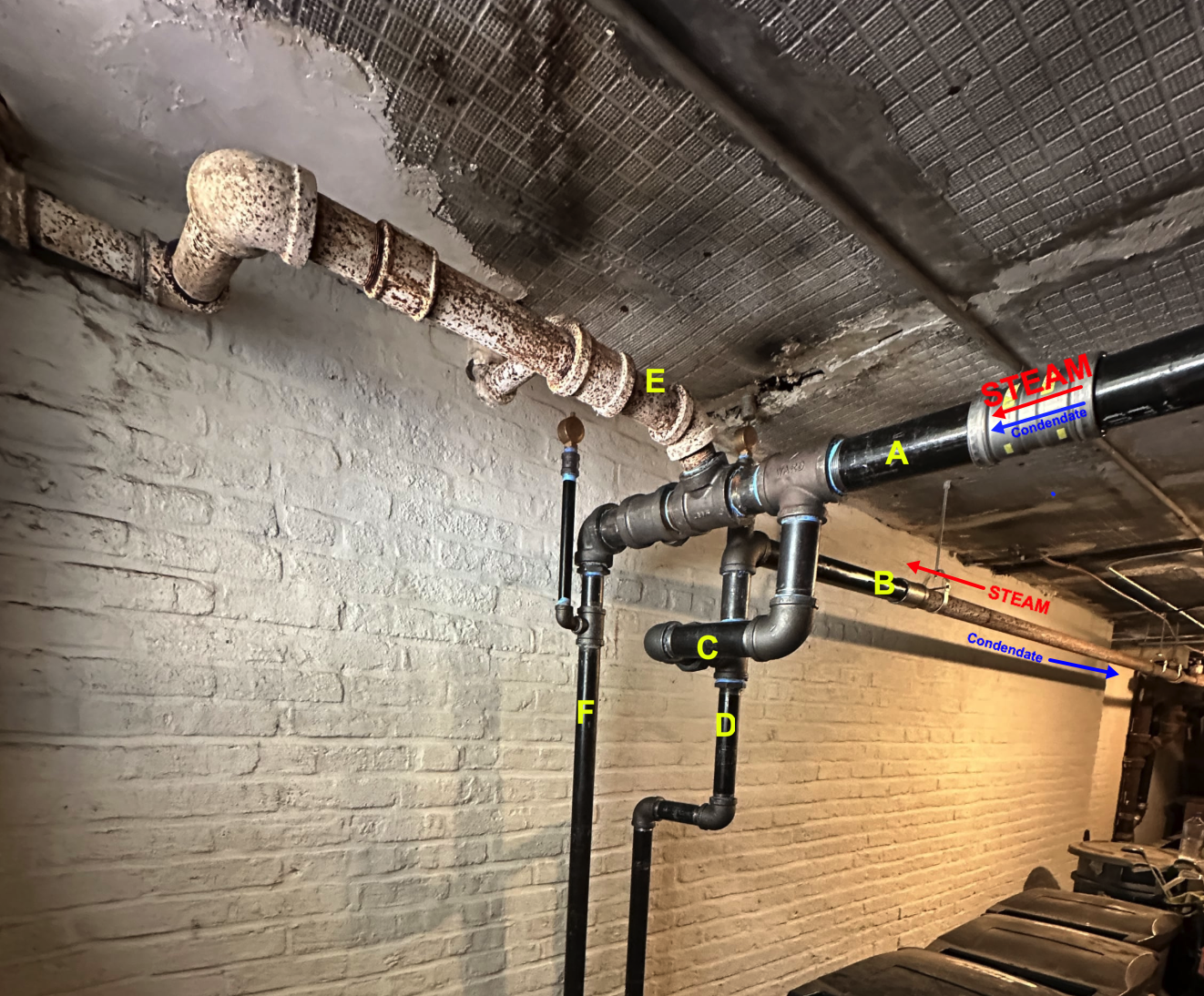
I think that is how I understood this fix. but it is only a guess. Great Job!
Edward Young Retired
After you make that expensive repair and you still have the same problem, What will you check next?
1 -
"Bull-fed a tee? Wow, nice work, nice fix.
0 -
With all the bolloxed-up boilers we see it is nice to see a solution with just pipe and fittings. No traps, fancy valves or other stuff. Just some brainpower and imagination
3 -
@EdTheHeaterMan You got it right except that B gets its steam from A. So, you'd have to reverse your arrows on the B line. B still gets steam from A but it takes it from the 2" downfeed/drip-line C. As noted, my C line would probably have been better taken from the top of the A line but I didn't have the room for the fittings and an air vent which I felt would be critical in breaking any vacuum on the counterflow B line.
Contact John "JohnNY" Cataneo, NYC Master Plumber, Lic 1784
Consulting & Troubleshooting
Heating in NYC or NJ.
Classes 2
2 -
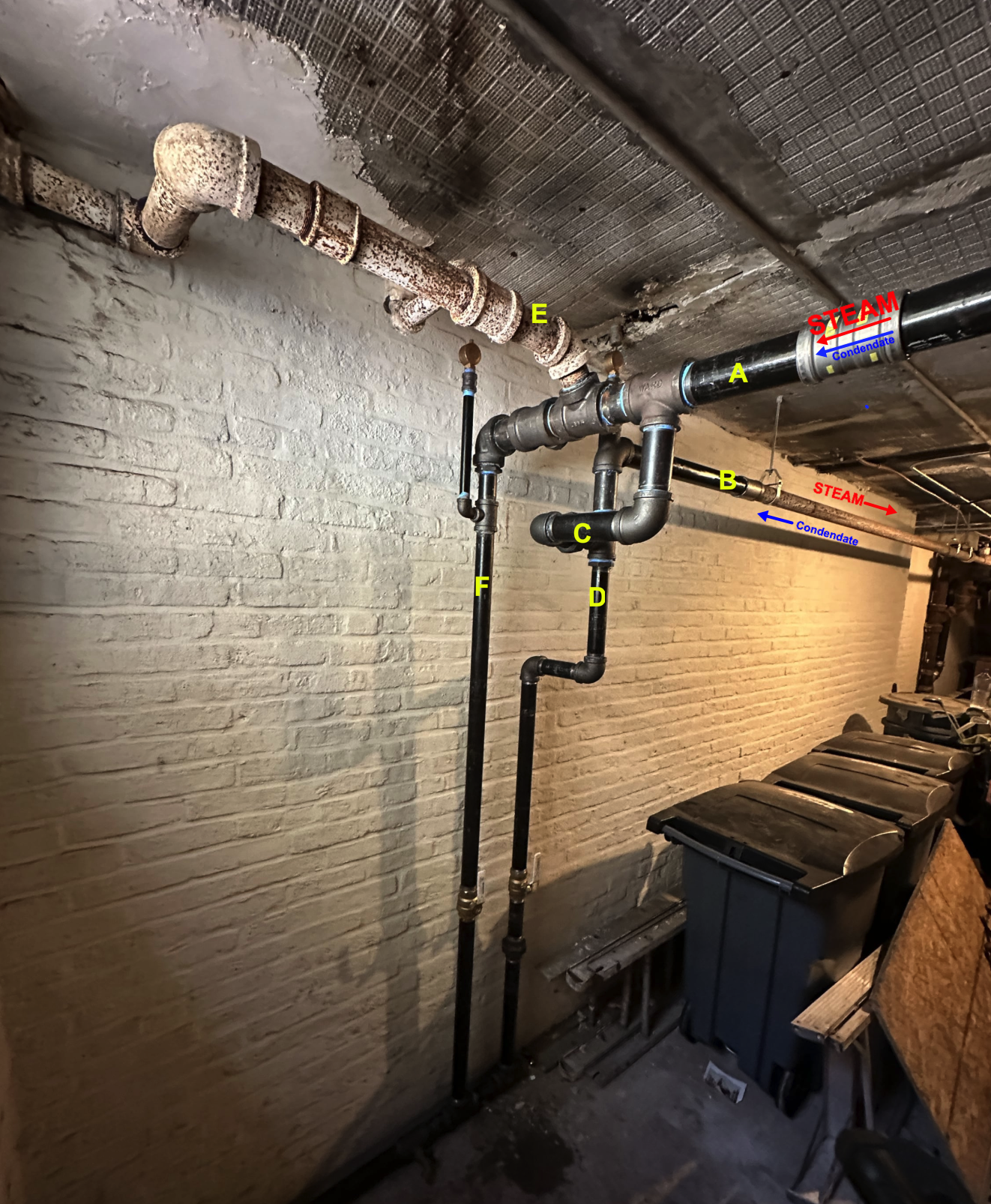
So that makes more sense. The two mains don't start at the boiler and meet at this return location. B is a continuation of A and that is why there was so much noise after B was relocated for the storage lockers so many years ago. Where there is a will …
…There is a dead person.
Edward Young Retired
After you make that expensive repair and you still have the same problem, What will you check next?
1 -
Nyel looks like a good man to have around. Kudos to you and him to make a tough job look easy.
And the only unions you needed were those MegaPress couplings which saved you from threading old pipe. Nicely done! A perfect and suitable time to say, "there are still times I find I'm actually proud of myself."
8.33 lbs./gal. x 60 min./hr. x 20°ΔT = 10,000 BTU's/hour
Two btu per sq ft for degree difference for a slab1 -
with all due respect I’d rather thread that old pipe then 90% of today’s crap!
 2
2 -
-
Those large megapress are impressive.
0 -
megapress. propress for steel/"black iron"
1 -
-
I know ProPress is approved for steam below 5psi. Same with MegaPress?
8.33 lbs./gal. x 60 min./hr. x 20°ΔT = 10,000 BTU's/hour
Two btu per sq ft for degree difference for a slab0 -
I thought both PP and MP were rated for 15psi steam but I could be wrong.
0 -
@RayWohlfarth (insert eye roll here) Haha. Hope you're well.
That's an interesting question! I'm going to find out what the threshold is on the mega press. I spent over $10,000 on ½" to 4" jaws so after the fact seems like the perfect time to look into it.
Contact John "JohnNY" Cataneo, NYC Master Plumber, Lic 1784
Consulting & Troubleshooting
Heating in NYC or NJ.
Classes 6
6 -
low pressure steam is 15psi or less. They are not going to approve it for 5psi. How do you guarantee a system stays below 5psi when safety valves are 15psi? not happening. The answer is the correct gasket. They use different gaskets for over 5psi.
see attached
1 -
-
The chart shows that ProPress and MegaPress fittings with EPDM o-rings (green dot) are rated at 250°F which is ~30psi steam.
8.33 lbs./gal. x 60 min./hr. x 20°ΔT = 10,000 BTU's/hour
Two btu per sq ft for degree difference for a slab1 -
What Ed said above
0 -
The tech sheet is very detailed.
0 -
@Alan (California Radiant) Forbes
The gasket may be rated for 250 degrees but the fittings are only rated for 15psi steam.
The Vitaulic gaskets for the different couplings were rated at different temps and they would not last if you ran them at the rated temp.
Had many Vic systems that had been overheated. They wouldn't leak a drop when hot. Shut them down and its like your in a shower.
Any rubber gasket vic, propress etc will fail
1 -
If your supplying steam from the C pipe to the B pipe then that is where you are going to have banging. You are going to have all that steam supplying from below trying to fight the steam condensate falling on top of the steam. It's definitely not the preferred way. I would have rolled the tee up at a 45 degree angle off of the "A" pipe and supplied the "B" pipe from the top so it won't have to fight the condensate coming back horizontally and fighting the return condensate from the "B " pipe.
also you create a lower "A" dimension at the "C" pipe. The horizontal also could be a cause of banging.
0 -
What you say may be true but it works and apparently is quiet.
Just like a lot of steam jobs we see.
Some jobs look like they will never work but they do.
Sometimes you don't get to pipe things the way you want.
1 -
i'm pretty sure that is set up more like a boiler header where different parts have pitch in different directions to make steam go one way and the condensate the other. a drip right at the bottom of the riser would be better but would also be more rework. the way it is now it dumps the condensate in to the wet return as soon as the existing runout to the riser ends.
1 -
There's always more than one way to "skin a cat." Textbook installations aren't always practical due to space and budget constraints. The ideal and perfect fittings aren't always available either. Looks fine and it worked? That rules the day. You got excited about the job and caught a little thrill thinking through the design? PRICELESS! I always like to see the service valves which you didn't have to install either, but we know how much they help when flushing wet returns. You schooled young Nyel on how to think not just copy. Once you've mastered your trade, unorthodoxy is part of artistic choice that we have earned. I commend that fully. Mad Dog
 4
4 -


Categories
- All Categories
- 87.8K THE MAIN WALL
- 3.3K A-C, Heat Pumps & Refrigeration
- 60 Biomass
- 430 Carbon Monoxide Awareness
- 133 Chimneys & Flues
- 2.2K Domestic Hot Water
- 6K Gas Heating
- 124 Geothermal
- 170 Indoor-Air Quality
- 3.9K Oil Heating
- 79 Pipe Deterioration
- 1.1K Plumbing
- 6.7K Radiant Heating
- 397 Solar
- 16.1K Strictly Steam
- 3.5K Thermostats and Controls
- 56 Water Quality
- 51 Industry Classes
- 51 Job Opportunities
- 18 Recall Announcements