Indirect vs Electric water heater

We recently replaced our old oil boiler with a Weil Mclain gv90+5 gas boiler over fall of last year. The plan was to eventually install an indirect tank with the boiler, but I am trying to decide which will be better/lower cost in the long run.
We currently run out of hot water (my wife does in her 30+ minute showers) with our current electric water heater which was installed in 2020. We moved into the house last year.
When I converted from oil to gas I was hoping to save a good amount of money over the winter, but didn't realize how much gas we would be using for our boiler. Our bills were $240 each month just for gas. I guess it's better than the $3000 the previous owners spent filling oil up throughout the year.
Which is typically the better option between the two?
We are with Peco so our KWH is .102 and our gas is .681 CCF
Comments
-
-
you have asked about cost but then you mention your issue with running out of hot water.
a heat pump water heater is the cheapest.
But the indirect should recover faster. Of course you’ll be paying to heat up your boiler all summer which I find to be insane.
Get your wife a low flow shower head and an 80 gallon tank
NJ Steam Homeowner.
See my sight glass boiler videos: https://bit.ly/3sZW1el0 -
In my experience Indirect tanks last a lot longer on average than electric water heaters. Many indirect water heaters are stainless steel or plastic lined and do not have an anode to replace. Electric water heaters can last a long time too if attention is paid to maintenance but most people tend to ignore the required maintenance. The heat pump water heaters have their advantages but they tend to be a throw away appliance when they develop a refrigerant leak or any other problems develop with the refrigeration system.

 2
2 -
if you can identify the DHW load, then size the tank to that. A 30 minute shower with a 1.5 gpm shower head?
40-50 gallon Indirects cover most households, you can run them at 140 and add a mix valve to extend the drawdown capacity. Your boiler output has a lot to do with recovery time.
If you had an 80 gallon tank would your wife take a 45 minute shower?
For endless hw, a tankless is an option.
Bob "hot rod" Rohr
trainer for Caleffi NA
Living the hydronic dream0 -
interesting, never thought about adding a mixing valve and running a higher temp.
I think running out of hot water is the only reason she gets out!
 2
2 -
Hi, Can you tell us the size of the tank, and using a bucket and stopwatch, measure the actual gpm of the shower… then let us know that number as well. I'm pretty sure those numbers will help us give you some solid ideas. 😊
Yours, Larry
0 -
That is often the case, people tend to use what is available, be it 30 or 80 gallons :)
Bob "hot rod" Rohr
trainer for Caleffi NA
Living the hydronic dream0 -
At $.102/kWh, the energy used to create the same amount of hot water as the boiler/indirect would cost approximately $2.69 compared to $.68 for NG. Using an electric WH with prices like that is insane, in my opinion. An example of 100 gallons per day with a 70 degree temp rise would be a difference of roughly $39 per month. 5 years your indirect is paid for and you're saving $468/yr after that.
0 -
I think you must be referring to resistive electric, and not heat pump water heaters.
Just so I can follow along, you said .102 per kWh for the electric…how much is the natural gas in your example?
NJ Steam Homeowner.
See my sight glass boiler videos: https://bit.ly/3sZW1el0 -
A comment on heat pump water heaters. Wonderful gadgets. Expensive to buy and maintain, but wonderful on energy.
With a problem. Their recovery rate is abysmal. Unless you engage the resistance element (which some, but not all, have) it will take, quite literally, hours for them to reheat the tank (the resistance elements are, of course, quicker — but then you might as well have a straight electric…). What this means, in practice, is that what you have for hot water in the morning or the evening is what there is in the tank, and no more.
Now if you are a two person household and go for Navy style showers with a piddly 1.5 gpm shower head, this may work for you. Otherwise, maybe not so much.
Br. Jamie, osb
Building superintendent/caretaker, 7200 sq. ft. historic house museum with dependencies in New England

 4
4 -
Consider reading the OP, where it was very clearly stated that they are using an electric water heater and both rates were shared. Or my comment that you responded to where the both rates were also stated.
1 -
Important note: please remove the contractor quoted price from your original post. we don't publish that info on this site: It is in the rules …about the 4th one down.
you can use the EDIT function to remove that price: and substitute $$$$ in it's place.
@ethicalpaul will always direct you away from an indirect even if the number don't add up. I did a comparison for a heatinghelp.com member just last month.
They were in a similar situation. They already owned the indirect and wanted to purchase something else because they were getting a heat pump to use for 10 months out of the year (Cooling and the start and end of the winter). the two coldest months were going to be covered by the existing hot water boiler using the baseboards. The HH member was going to shut the switch to the boiler off for the 10 months that he didn't need the gas boiler, so there would be no heat for hot water fof the indirect. I understood the logic and still found that the indirect was the best option.
I said it then and I said it in 2024.
If you click on the link to the chart you will see this chart:

This is what an accountant might call a cost-of-ownership calculation.
- The first column lists the number of years you plan on owning your home (this example goes to 30 years).
- The second column shows the lowest-cost water heater at $1,200.
- The third column is the estimated annual fuel usage (not accounting for inflation).
- The fourth column represents a high-efficiency water heater.
- The fifth column is the annual operating cost for that unit (not accounting for inflation).
- The sixth column is for an indirect water heater (not vented), assuming you already own a high-efficiency boiler.
- The seventh column is the annual operating cost for the indirect (not accounting for inflation).
This assumes only the additional cost to produce domestic hot water—fuel used for space heating is not included, as it would not be considered for the other two water heaters.
Let’s analyze the numbers:
On average, a standard tank-type water heater lasts about 10 years, so you could expect to buy three over a 30-year period for both the lowest-cost model and the more efficient model. That comes to $3,600.
The same is true for the second option, for a total of $5,400.
Many indirect tanks come with a lifetime warranty. Since there is no flame inside the tank to contribute to corrosion on the dry side, they tend to last much longer. That brings the total to about $2,400, since you would likely only need one tank over the 30 years you own the home.
Now, take the annual fuel cost over 30 years and add it to each total. You’ll see that the most expensive choice upfront—the $2,400 tank—actually costs less over time.
What choices are you thinking about? I will make up a chart for you using real time data and the estimates you have in hand to help you decide.
Edward Young Retired
After you make that expensive repair and you still have the same problem, What will you check next?
 1
1 -
@Ghynes440 said: We are with PECO, so our kWh rate is $0.102 and our gas rate is $0.681 per CCF.
Those are not your total costs—that’s just the price of the fuel or energy. It does not include transmission, distribution (delivery), riders, fees, or taxes. when comparing to fuel delivered by truck to your home like Fuel oil you need to use the total cost because the fuel delivery per gallon includes the transportation and taxes and all the other fees, without itemization. That is how the utilities get you confused
If you look at your bill and divide the total amount charged by the kWh or CCF you actually used, you’ll find that you’re really paying about $0.21 per kWh (not $0.102) and about $1.75 per CCF (not $0.681). That may be why you’re not saving as much as you expected after replacing your oil boiler with a WM GV90+. It may be a bit more efficient, but not enough to justify the cost of the replacement.
Water under the bridge—now let’s look at the hot water situation with that $0.21/kWh electric rate and see if the indirect is a good idea.
Calculation to follow:
Since we can’t discuss pricing here, I have a national range from angi.com for three different water heaters: a heat pump water heater is $1,600 to $5,800, and I believe they are actually higher in your area. The federal tax credit of $2000 is gone for now and there is only a $350.00 rebate from PECO. Another option would be a standalone water heater that uses gas and is power vented, with an EF of 0.65, and that has a price range of about $400 higher than the HPWH after rebates. Then there is the indirect tank connected to your GV90+. Using an .65 EF for the power vent water heater and a COP of 3 for the HPWH and an AFUE of 91.0% for the boiler here is how crunching the numbers using what you really pay for electricity and gas, this is what I have come up with:
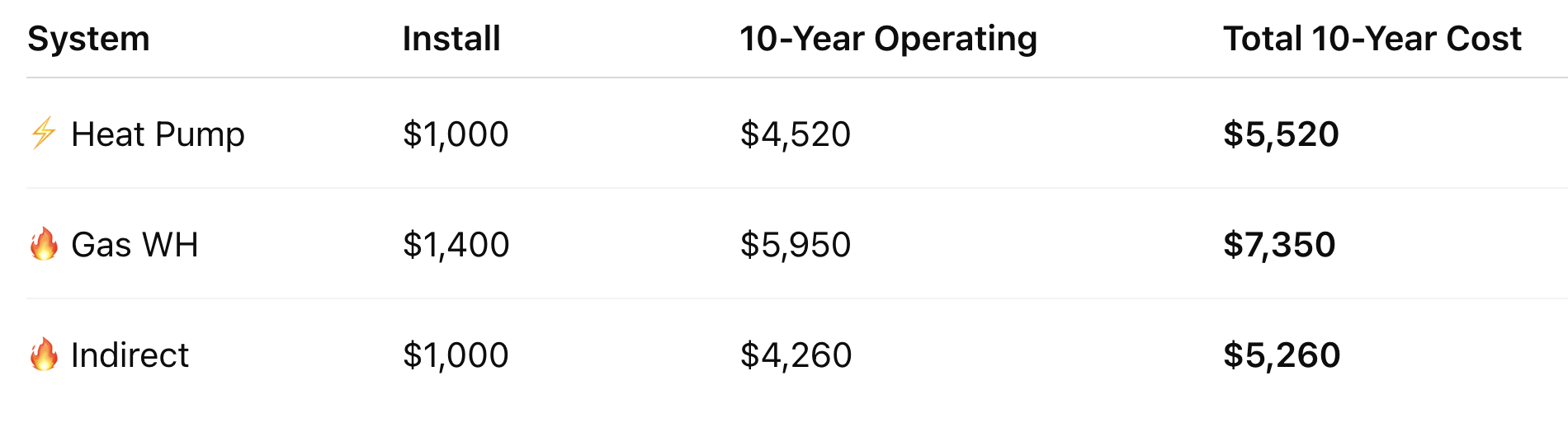
This chart does not account for energy cost inflation over ten years. It only uses the actual cost to produce hot water using three different heat sources: a GV90+ at 91.0% AFUE, a standalone power-vented water heater with an energy factor of 0.65, and a heat pump water heater with an average COP of 3.
The installed price will be higher and will depend on the water heater you select. There are more efficient standalone HPWH and gas power-vented water heaters available, so in most cases, the more you pay for the equipment, the lower your operating cost will be.
Other factors that are not considered:
- A HPWH operating in your basement will lower the basement temperature by as much as 3° while operating, averaging about a 0.6° impact over time. That may cause you to use a little more gas to heat your home, but not enough to actually measure.
- A standalone 120°F gas water heater is always connected to an exhaust vent that leads to the outside, even on the coldest days of the year. Imagine that temperature difference and the amount of heat that may be lost during standby (off) cycles.
- The indirect is not connected to a vent, but the boiler it relies on is connected to the exhaust system and may actually go cold to room temperature in the summer if there is no hot water use for several hours. so there is no standby loss up the chimney or out the vent when that happens.
I hope this helps.
Sorry Paul. Your HPWH is the better choice in your case because of the rebates and incentives, and the steam boiler can’t get anywhere close to 91% efficiency. You made the right choice for you—but it is not the right solution for everybody.
Edward Young Retired
After you make that expensive repair and you still have the same problem, What will you check next?
0 -
Get a boiler with a tankless coil and pipe the domestic through the coil and into an electric water heater. I’ve done it a couple times. Not my finest moments. Never heard back from those clients though so I assume it worked out.
Contact John "JohnNY" Cataneo, NYC Master Plumber, Lic 1784
Consulting & Troubleshooting
Heating in NYC or NJ.
Classes0 -
Here is Maine's nice chart with your numbers, @EdTheHeaterMan
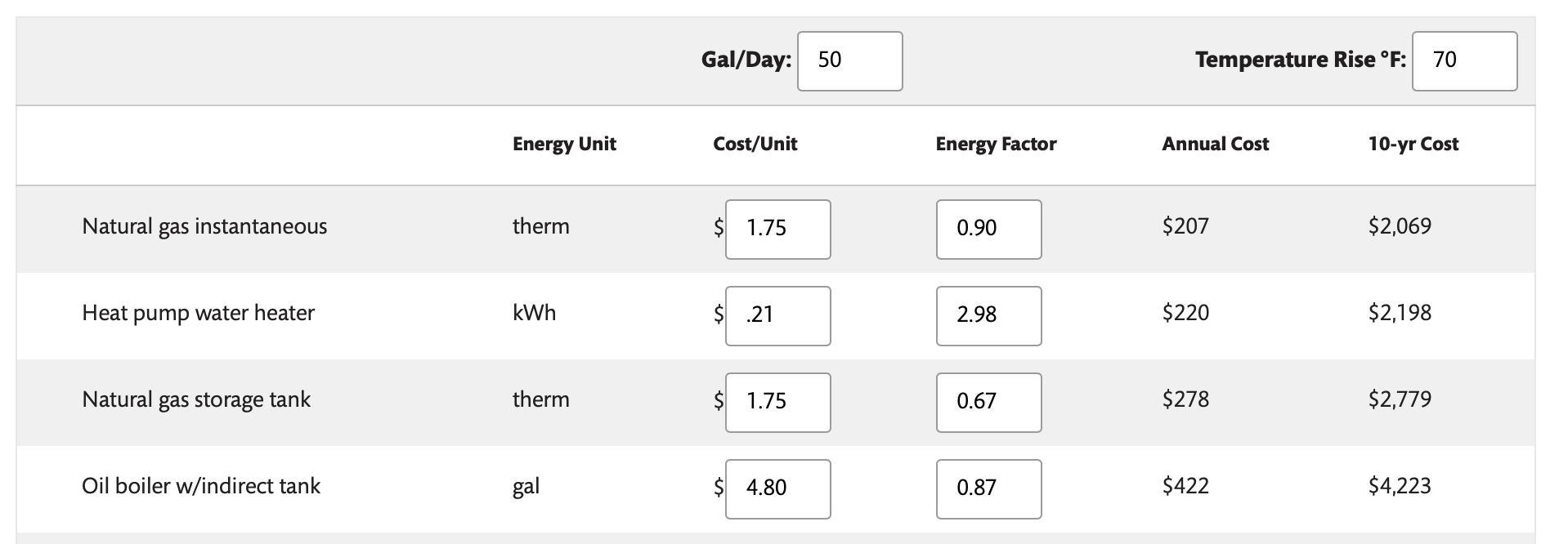
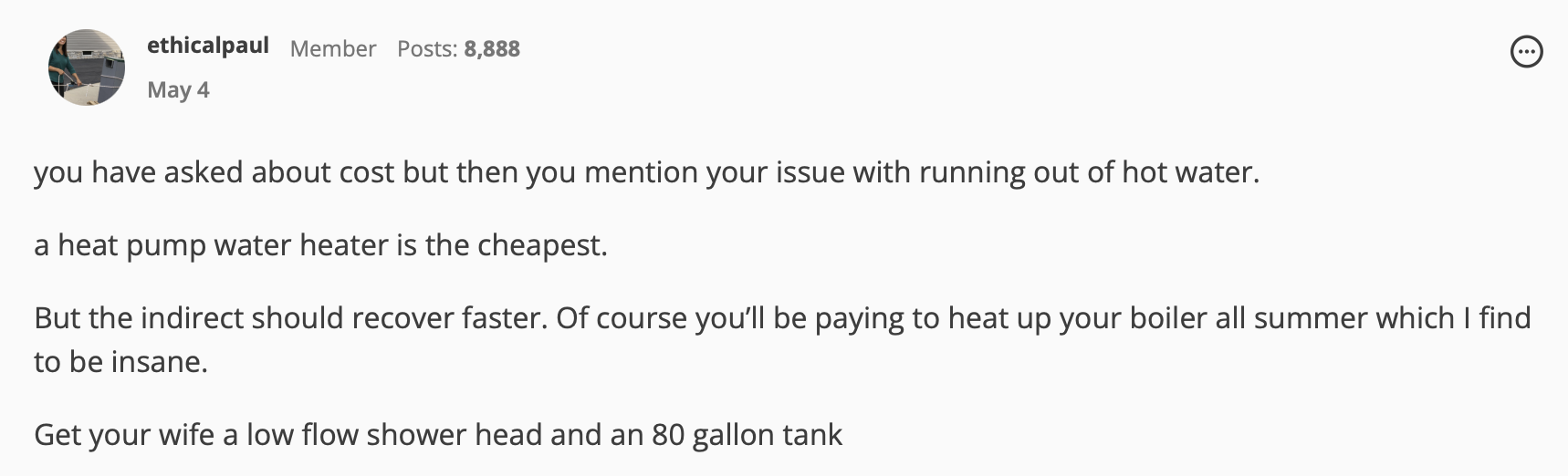
And just to repeat what I first said, no, I don't think a HPWH is for everyone…I spoke to this in my first reply. But everyone keeps misquoting me. Whatever.
NJ Steam Homeowner.
See my sight glass boiler videos: https://bit.ly/3sZW1el0 -
@ethicalpaul I believe this says what you believe:

That word “insane” was my clue to your opinion about using a boiler to heat water in the summer. You’ve made your position clear on this topic every chance you get. I don’t think it’s a misquote—you don’t believe a boiler should be used for DHW.
Your heat pump water heater stays hot all summer long. My boiler does not stay hot all summer long. Those facts aren’t really in dispute. When I use that large boiler—big enough to heat my entire house in New Jersey on the coldest day of the year—it still has to fire up just to make a small amount of hot water for my indirect tank. Even so, it ends up costing a little less or about the same as what you might pay to make that same hot water with your heat pump.
I guess I’ve had too many bad experiences with heat pumps that didn’t perform well for heating homes in New Jersey. After dealing with customer complaints about no heat in January—and being outside trying to add refrigerant in below-freezing weather—it’s made me less enthusiastic about heat pumps.
You were the first one to reply to this discussion and you said "HeatPump Water Heater"
And the OP switched from oil to gas and didn't get the savings they expected. How do you account for that?
What does your chart say about this option? Fill in the AFUE of the WM GV90+ at 91.0% got the EF number in your chart.
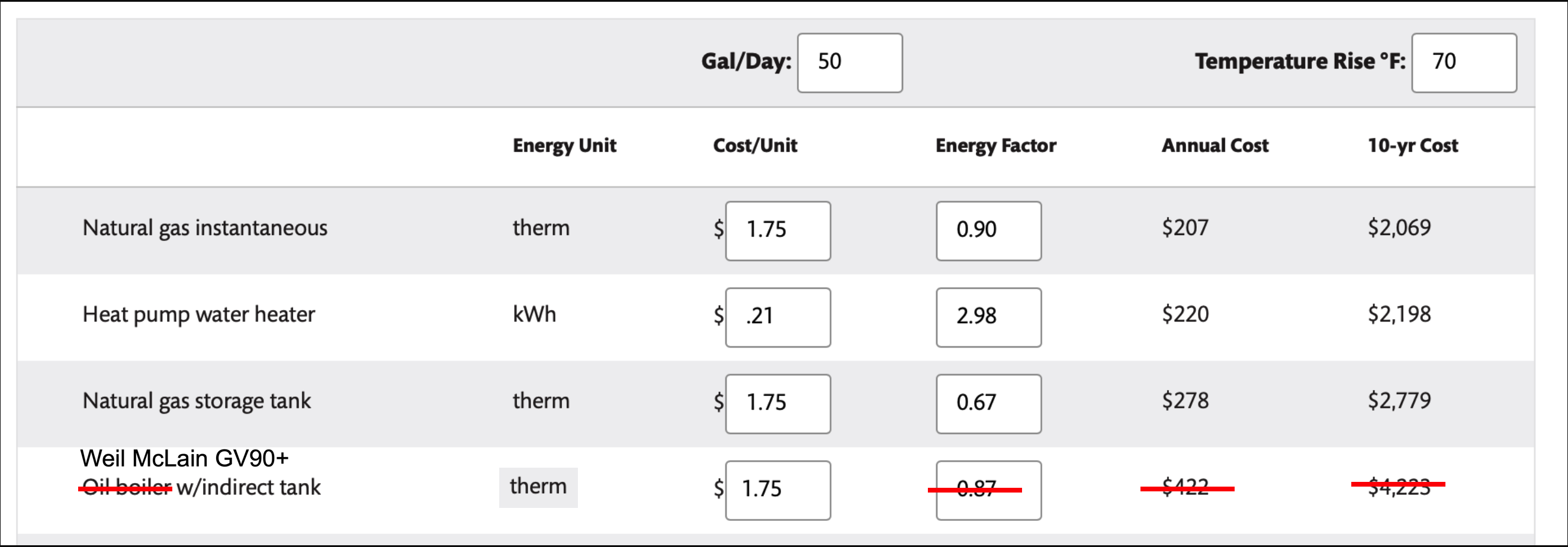
This represents the question originally asked.
Edward Young Retired
After you make that expensive repair and you still have the same problem, What will you check next?
0 -
I mentioned heat pump water heater because the OP expressed a concern about cost. And since heat pump water heaters cost less to operate than any other kind, I mentioned it. And if you think HPWH are expensive to install (they aren't), wait till you get the install bill for an indirect.
But he also expressed a concern about how much hot water was available, and so I also mentioned that an indirect would provide more hot water (even though it makes you heat up your boiler all summer long and yes I do think that is insane.).
NJ Steam Homeowner.
See my sight glass boiler videos: https://bit.ly/3sZW1el0 -
I've tried hard to find the amount of power a HPWH puts out, and I've come up with almost nothing.
ASSUMING it's 4,000 btu/h which seems very possible, that results in a 6 hour recovery time after I take a shower vs my NG tank heater that takes roughly 30 minutes. This is assuming a 50f to 140f rise of 25 gallons. That's also assuming I did the math correctly.A 6 hour recovery will work for some, and won't work for others.
If anyone actually has info on how many btu/h these typical residential HPWH are, I'm curious. Input wattage for the compressor would be a good starting point.
Single pipe 392sqft system with an EG-40 rated for 325sqft and it's silent and balanced at all times.
0 -
I still have to do my experiment where I drain x gallons and see how long it takes to recover.
NJ Steam Homeowner.
See my sight glass boiler videos: https://bit.ly/3sZW1el 1
1 -
Seems to me the only really valid conclusion is this: every single situation is different, and thus it would be dubious to say that this one or that one is best because it seems to work for this particular situation.
What we can do — and are trying to do — is to point out various factors which should be taken into consideration in making a choice. Just two examples from my own experience. First, someone up there said that there boiler only runs two moths out of the year. Don't I wish. Cedric — which only does heat, supplementing two mini-split heat pumps — runs 9 months out of the year (in fact, he is running as I type on a sunny May morning!). And we need all the capacity of the oil fired water heater. One of the houses I care for is owned by a moderately wealthy individual. She installed a heat pump water heater (she had had oil). It worked well — so long as the only person there was herself. When she had guests, it didn't, so she went back to the oil fired one. Should I have told her and her guests to take short low flow showers and skip more or less daily clean linens? Ah… no, if I wanted to keep my job.
So — in those two particular situations, a heat pump water heater didn't work. But — in other situations it would have worked splendidly, though with New England electric rates it wouldn't save any money. There is, for example, an island resort (summer only) I know which uses a bank of heat pump water heaters. They have ample solar panels, and can control when guests can use the hot water — and getting oil to the island is insanely expensive. The heat pumps do the job well, and were much the best choice for the application.
So. Every situation is different. How do you — or your client — actually use water? How much does energy cost? Even installation questions? Do your sums — and then pick the best solution.
Br. Jamie, osb
Building superintendent/caretaker, 7200 sq. ft. historic house museum with dependencies in New England0 -
It depends on the specific model. The versions that operate on a 20a 120v service will be the slowest. If you have a 240 on a 30a service, it could kick in a resistance element to speed up recovery, selectable on some models.
I had an 80 gallon 120v unit that I experimented with. Filled with 52 f water it ran 12 hours to reach 120f, no load at the time. Running in my 65f shop, Exhausting about 43f air temperature
Probably in actual operation it would not be pulled down to 50f or even ambient room temperature.
Especially if you are in the shower😳
Bob "hot rod" Rohr
trainer for Caleffi NA
Living the hydronic dream1 -
That comes out to roughly 5000 btu/h.
Do the larger ones have larger heat pumps on them too or just resistive heating added?
I used 50f but I also only did 25 gallons out of 50. I did this because the incoming water can easily be 50 especially in the winter.
Single pipe 392sqft system with an EG-40 rated for 325sqft and it's silent and balanced at all times.
0 -
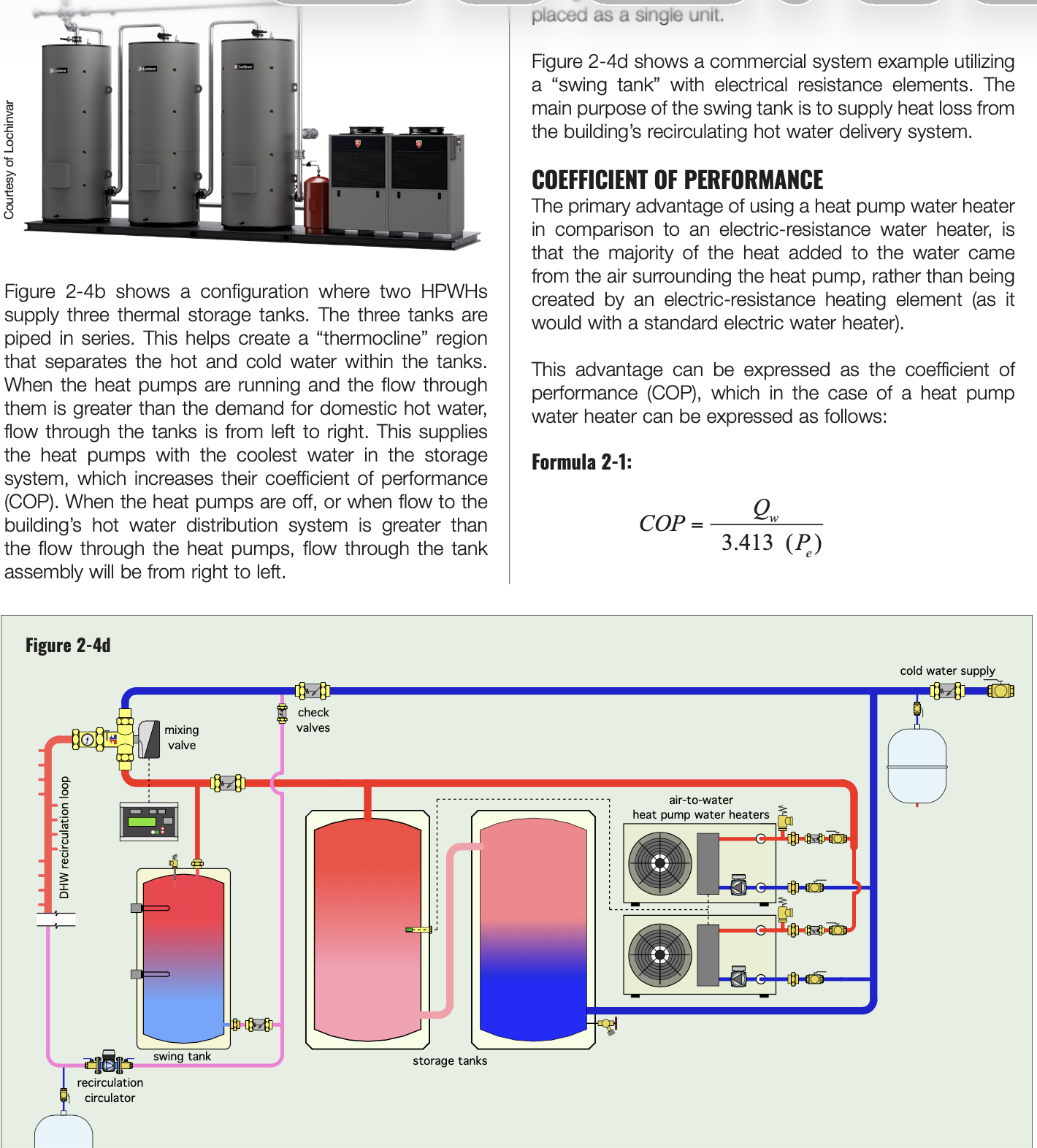
Here is a good read on HPWH fundamentals.
This slide shows how proper piping is critical when storage tanks are used. Series piping helps maintain the HP efficiencies.
The swing tank covers the recirculation loop heat requirements, avoiding busting up the thermocline in the storage tanks..
 Bob "hot rod" Rohr
trainer for Caleffi NA
Living the hydronic dream 1
1 -
… and used the word "Insane"
He also mentioned the cost of installing the indirect water heater which was very reasonable in my opinion. (before he edited it out after I mentioned the rules about that type of thing)
You paid for a HPWH and got the federal rebate (which is no longer available as of right now) and I cant believe the tank that costs more from the wholesaler than an indirect water heater, would be less expensive to install than the indirect. But we have different perspectives and experience on this topic. When you were looking for a water heater I guess you looked as more than just HPWH. I might guess that you got a price for an indirect for your steamer (not recommended) and for a tankless on demand and perhaps a chimney vented. then you DYI your steamer and perhaps the HPWH after you discovered the rebates and tax incentves. You selected the best one for your situation. I believe it truly is the best for you.
Also What was the ten year cost for the indirect with the GV 90+ at 91.0% AFUE?
Edward Young Retired
After you make that expensive repair and you still have the same problem, What will you check next?
0 -
Tankless WH for the win. Gives you plenty of hot water… almost cant run out. No standby losses.
0 -
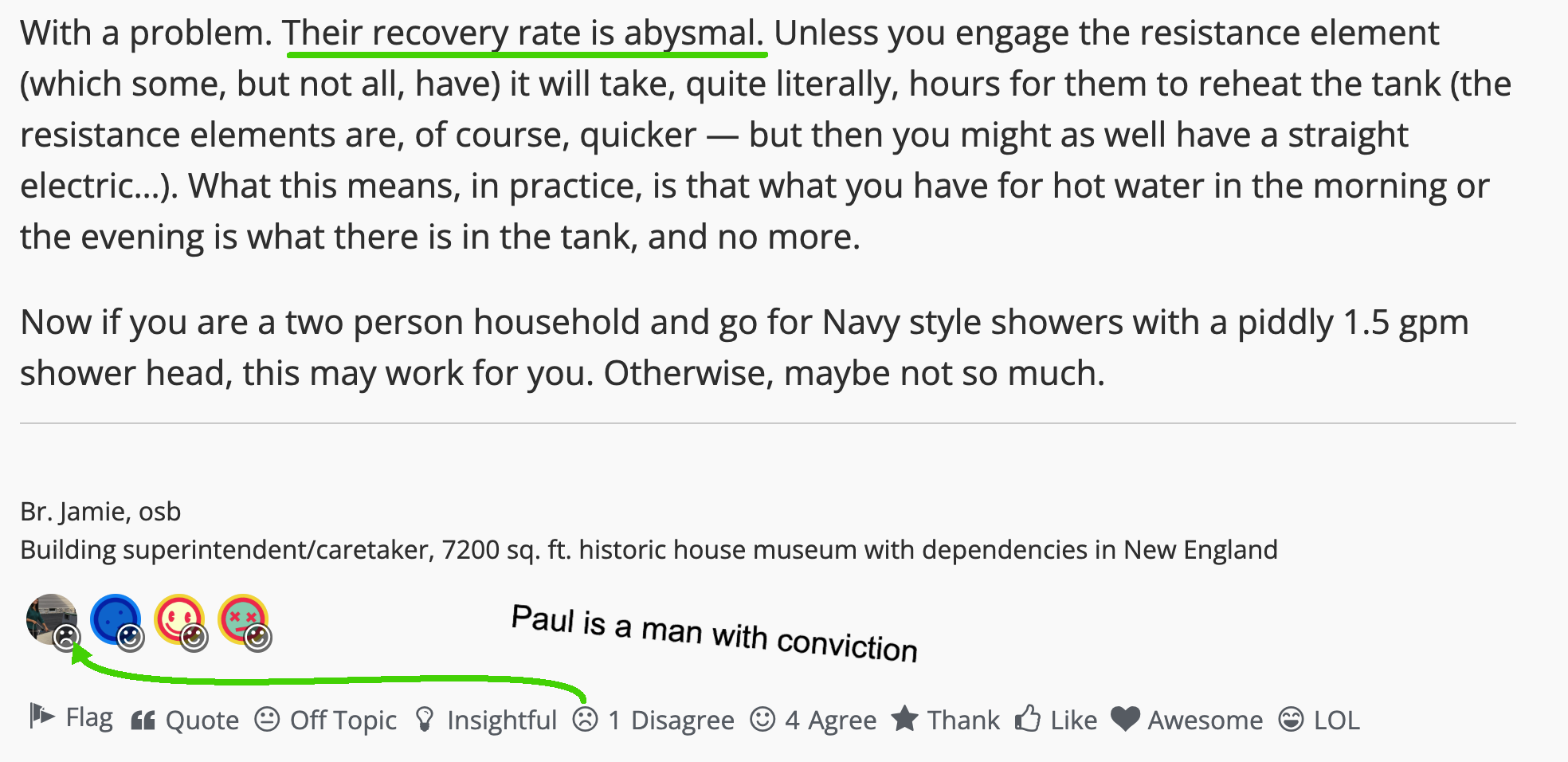
Hay @ethicalpaul I did some research on a Rheem GEN 4. The “Recovery (GPH)” shown in the specification chart is NOT heat-pump-only. That number is based on hybrid operation (compressor + elements). You mentioned that you set yours to heat pump only. I did some math and the compressor will rase the temperature of water to 130° from say 40° incoming city water at a rate of about 5.6 GPH. If you have the 80 gallon tank and don't use any hot water after filling the tank with cold city water, then start your compressor, at a rate of 5.6 GPH it should take only 14.2 hours. That is not ever a full day!
I believe that might not work for our friend who is complaining about running out of hot water. What would you recommend in this case? More tanks?
Edward Young Retired
After you make that expensive repair and you still have the same problem, What will you check next?
1 -
I can assure you it doesn't take that long. But yes I'm aware their recovery rate is based on partial electric element use. That's why I have to do my own test.
I said in my very first response, which I already posted to remind you, but now I have to remind you AGAIN that I told him he should consider an indirect if his primary concern was amount of water, and he should consider a HPWH if his primary concern was cost, since he mentioned both concerns in his original message.
He has the option of a 50 or 80 gallon tank, and 80 gallons of 130 degree water is quite a bit.
NJ Steam Homeowner.
See my sight glass boiler videos: https://bit.ly/3sZW1el1 -
Then you have the smaller tank. If you have the 40 gallon model it will only take a little over 7 hours. But then, you have only 40 gallons of hot water to use.

I wouldn’t want to be on the other side of that argument with this one.
She looks like a force to be reckoned with.
As far as I'm concerned she can have as much hot water as she wants!
I like it when she is smiling like that
Edward Young Retired
After you make that expensive repair and you still have the same problem, What will you check next?
1 -
@hot_rod Thank you for posting the link and diagram of the storage tanks in series: figure 2-4D. I have to admit, it looks wrong to me. «Clearly, it is not wrong.» But piping the hottest water out of the heat source into the top of a storage tank just goes against conventional wisdom. I look forward to reading the Caleffi literature on the subject.
Contact John "JohnNY" Cataneo, NYC Master Plumber, Lic 1784
Consulting & Troubleshooting
Heating in NYC or NJ.
Classes0 -
Id expect it's because it's just going to float up there on its own anyway and mix everything. This way you're filling the tank with hot water from the top down and pulling the cold out of the bottom, not really mixing anything.
The colder the water is the better the heat pump does.
Single pipe 392sqft system with an EG-40 rated for 325sqft and it's silent and balanced at all times.
0 -
Since moving into our house in 2009 we have produced DHW 3 different ways.
- Indirect water heater with an oil boiler (250k btu/hr).
- 50 gallon electric water heater
- 50 gallon heat pump / electric water heater.
The indirect water heater and oil boiler produced nearly unlimited amounts of DHW. It was also the most expensive to operate, easily using 1 gallon of heating oil per day in the non-heating months. When the 30+ year old indirect started leaking, I calculated that an electric water heater would be less expensive to operate (oil was high at the time, electric was still reasonable), so I installed a regular 50 gallon electric water heater. This met our needs fine - it was quiet, and the cost to operate was reasonable…then our electric rates started going up, and up, and up…
Last June I decided to swap out the electric water heater for a HPWH. Between the rebate from our utility and the tax credits, my out of pocket expense was relatively small. This was for a 50 gallon Rheem unit, which I set at 140F and use a mixing valve to temper the water to 120F.
Since it has now been about 1 year since the swap, here is my experience with the HPWH:
The good: The HPWH only uses about 100 kwh per month for our family of 4. This is less than half of what the old resistance electric WH used. My basement dehumidifier runs less in the summer, so there is some electric savings with that also (not sure how much).
The bad: If 4 people shower back-to-back, the electric resistance elements have to kick on to assist with recovery. If the 4 of us try to shower in half the time by using two showers at the same time, the second pair better be quick or they will get a cold shower. This is a rare event and was also an issue with our previous electric water heater. If either of these scenarios were common, it would greatly reduce the electric savings. In our house the kids tend to shower in the evening and the adults in the morning, so it hasn't been a deal breaker for us.
The unknown: Time will tell how long this HPWH will last. There is a lot that can go wrong with it and not many people that can fix it. If it dies just outside of warranty that will probably sour me on the whole thing and I will go back to something I can fix myself.

 3
3 -
A nice honest first hand experience, thanks!
Bob "hot rod" Rohr
trainer for Caleffi NA
Living the hydronic dream0 -
much better than my dishonest first hand experience, definitely!!
NJ Steam Homeowner.
See my sight glass boiler videos: https://bit.ly/3sZW1el0 -
Yeah,
I'm not sure why that was any different than your comments on the subject. You've given many reviews etc.
Some could argue yours is second hand experience though……….
Single pipe 392sqft system with an EG-40 rated for 325sqft and it's silent and balanced at all times.
0 -
I was speaking of my dishonest first hand experience of owning a HPWH
NJ Steam Homeowner.
See my sight glass boiler videos: https://bit.ly/3sZW1el1 -
Why so sensitive? We all enjoy your related experiences.
@Robert_25 with 575 posts is just a fresh voice on the question.
Bob "hot rod" Rohr
trainer for Caleffi NA
Living the hydronic dream1 -
On the difference between energy cost and total consumer cost - most of the add-on costs are dependent on usage, but some may be a fixed. Looking at my most recent gas bill the $20 fixed fee is bit less than 10% this time of year but will be 20% come mid-summer. Electricity usage is fairly steady through the year so the $18 in fixed costs are fairly consistent at 8%. Not recognizing the fixed costs can skew comparisons.
For me, electric resistance can't compete with gas costs. I chose an indirect for several reasons over a combi, on-demand, or stand-alone gas-fired. My incoming water is about 38 degrees year-round which made me leery of a combi properly sized for the heating load for a fairly well insulated house. The indirect operating at 140 degrees with a tempering valve gives me all the water I want for even a long shower. With the indirect I only have two flame sources in the house - the clothes dryer and the direct vented boiler which gets its combustion air from outside and exhausts directly without additional flue losses or having to draw cold air into the rest of the house. I also love having the DHW return loop which gives me nearly instant hot water for my shower in the morning. That wouldn't be practical with on-demand.
As was said above, there is no one-size-fits-all, but for my particular circumstances I am very happy with my choices.
 1
1


Categories
- All Categories
- 87.8K THE MAIN WALL
- 3.3K A-C, Heat Pumps & Refrigeration
- 60 Biomass
- 430 Carbon Monoxide Awareness
- 133 Chimneys & Flues
- 2.2K Domestic Hot Water
- 6K Gas Heating
- 124 Geothermal
- 170 Indoor-Air Quality
- 3.9K Oil Heating
- 79 Pipe Deterioration
- 1.1K Plumbing
- 6.7K Radiant Heating
- 397 Solar
- 16.1K Strictly Steam
- 3.5K Thermostats and Controls
- 56 Water Quality
- 51 Industry Classes
- 51 Job Opportunities
- 18 Recall Announcements