Exterior insulation on foundation wall
Comments
-
I can appreciate needing to dial in the answer and this is definitely something you want to get right. Guidelines vary according to which climate zone you are in so that is why you are seeing different configurations. However, Allison Bales III with Energy Vanguard in Atlanta follows similar guidelines to what we do here in Upstate NY.
A search on his blog might help. https://www.energyvanguard.com/blog/
0 -
Look at ICF manufacturers instructions, some sell the stucco coating specifically for this purpose.
Another option is PVC trim board or composite deck facia board if the height is not too much.
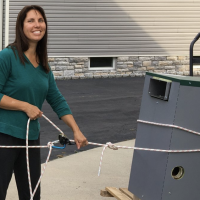 1
1 -
Exterior basement insulation is required in MA unless the floor is insulated. There are insulated panels available for the exposed portion. They are comprised of xps board with 1/2” of glass reinforced cement bonded to the front and have t&g vertical edges. They are clipped to the wall with SS clips so no exposed fasteners. Can’t remember the name but something like ez panels or quick panels
0 -
Hi, I'll add that I prefer exterior insulation, as it adds the thermal mass of the concrete to the home. This is a plus for moderating temperature swings. I know a guy in Colorado who would insulate four feet down into the ground under his exterior building walls. This tempered mass had a huge effect in keeping the buildings from getting too cold.
Yours, Larry
0 -
Using ICFs presents the same problem. I used 24 gauge galvalume roofing metal to cover the above-grade foam. The ICF foam also had a waterproofing membrane and dimple mat which the metal extended far enough below grade to cover. There is a detail showing the use of metal and other suggestions on the Fine Homebuilding web site:
https://www.finehomebuilding.com/2017/11/27/protecting-foundation-insulation
Hardie board is not rated for ground contact but there is a similar product from Finex that can be used. It looks great (see pic below) but was quite expensive when I looked into it.
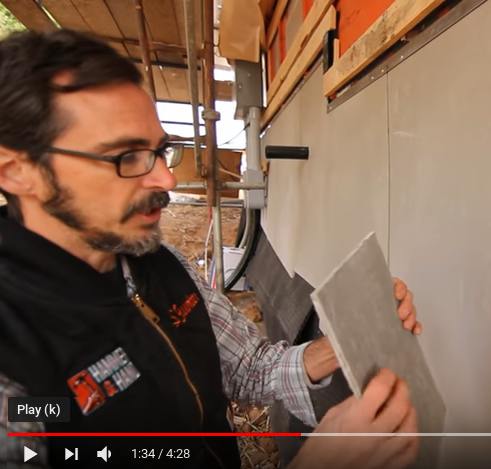
You could also use something like Nudo Ground Breaker, a fiberglas reinforced plastic product.
To minimize possible damage from bugs, the ICF foam was sprayed with Boracare before it was covered. You can also get pre-treated rigid foam.
1 -
Hey Paul,
It is always a challenge to insulate on the outside and protect the insulation from damage where it is exposed at grade.
You might consider this option for insulating the inside:
1.Shoot fiberglass insulation stick pins into the inside of the concrete wall.
2.Apply vapor barrier to the dirt floor and adhere it to the wall up about 12"
3. Apply 2"-3" of closed-cell spray foam that extends from the crawl space floor to the bottom of floor sheathing. This completely seals the notorious air gap at the rim/foundation connection.
4. Apply R-19 encapsulated fiberglass batt blankets over the spray secured by the stick pins
This gives you a super-tight building envelope insulated to ~R-34
Carl
"If you can't explain it simply, you don't understand it well enough"
Albert Einstein1 -
I covered our foam with flashing that matched the color to the vinyl siding, as per the recommendation from our architect. The heat load of the addition is hardly anything compared to the original house.
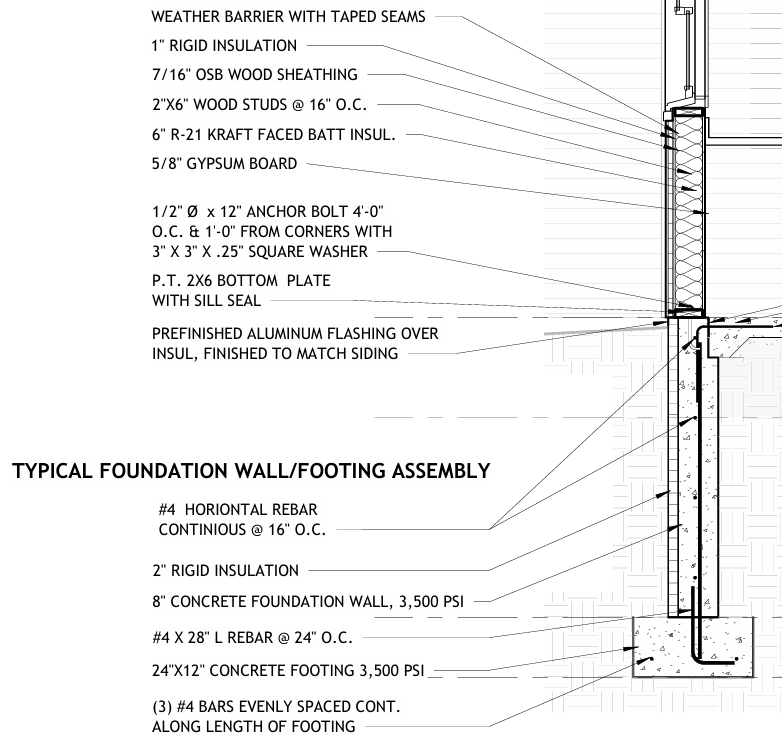 1
1 -
any professional stucco company will know how to handle this. Mine has waterproofing layers between the sheathing and the foam; primer over the foam with mesh embedded to protect the foam from damage ; then top color coat.
You can see the scrap of yellow mesh lying in foreground of the second picture I posted; it’s embedded in the brown base coat.
1 -
Exterior insulation is something that needs to be discussed before a building starts. Provisions need to be made for the added thickness — especially if you are taking it all the way up to the roof. Typical poured or block walls will have the framing all within the foundation — there is no place for the foam unless you have a ledge. Who wants that ? I have learned the hard way — in two ways. KISS is a thing and getting people (professionals/ trades) to do things not KISS — can be a problem.
As for Building Science — if you have been around long enough you see how things change. In the pursuit of perfection, other bad things can happen. I will leave it at that. If you look hard enough you will find a few different details of the so called "best practices" of external insulation over the years. Same with some of the crazy walls they have proposed — Fine Homebuilding as well.
Let me say this — there are all kinds of "problems" placing foam on the outside of a foundation. Where does the water management go for one (you have already placed stucco). How do you attach the foam is always a big one and does that negatively impact the water management.
IMO. NJ is not cold enough to to worry about the tiny potential thermal savings of the exterior foam on the foundation VS inside — if there is any. Why not do it inside ? Properly seal the top plate and properly insulate the floor structure above the foundation. Spend your money where you get a real return.
1 -
Thanks for your input, there is logic in your points.
However there is also error. I think northern jersey has adopted the 2021 efficiency code which basically mandates an exterior insulation all the way up.
But my understanding is that today many architects, contractors and even inspectors are choosing to pretend it’s not a thing.
Meanwhile people moan about rising energy costs rather than spending once up front like I’m trying to do
NJ Steam Homeowner.
See my sight glass boiler videos: https://bit.ly/3sZW1el 1
1 -
Showed that FH article to a structural engineer when I was doing my church project — about 5 years ago now while COVID was going on. We both questioned the "second" wall out over the foam. The first problem with anhything odd is getting someone to design it and the next is finding someone to build it. Or agree to built it and then actually be able to get the crew to do it. And at what aditional cost ?
My parents built a ICF building. It was a beach house designed to take a hurricane. I built a ISP building years ago because it seemed like a good Idea at the time for the project and I had an idea of buying an old barn timber frame in the near future and constructing an ISP around it. Both thoses projects had reasons for doing something out of the norm and both were even possible because there were contractors around at the time doing that type of construction. My parents never really liked the house and the ISP has been a problem since day one.
 1
1 -
NJ also had the runny egg law back in 1992 that everyone ignored…..
Single pipe 392sqft system with an EG-40 rated for 325sqft and it's silent and balanced at all times.
0 -
The intent was to show the metal flashing detail, not the double wall. The transition from 2" of exterior foam to a wall flush with the concrete basement wall will be less than ideal.
Our new home (still not finished) is ICF from the footing to the roof. The roof is SIPs (same as ISP?) The north and east sides of the main floor are earth bermed. The thermal performance is great but if I knew then what I know now I'd have done a lot of things differently… and I'd have been done a long time ago.
0 -
The intent was to show the metal flashing detail, not the double wall. The transition from 2" of exterior foam to a wall flush with the concrete basement wall will be less than ideal.
I want to run 2" foam from the basement all the way to the roof so that transition is not a concern I think.
NJ Steam Homeowner.
See my sight glass boiler videos: https://bit.ly/3sZW1el0 -
What do you do with the windows with the 2" addition on the 2x6" walls?
Single pipe 392sqft system with an EG-40 rated for 325sqft and it's silent and balanced at all times.
0 -
We have extra thickness in our exterior walls and used extension jams on the inside.
The window flange was set on the outside wall surface as usual and then the extension jam was simply a site built oak box frame that was put inside against the window itself. Trim out as usual.
This gives us a nearly 6" window sill to sit "stuff" on.
 2
2 -
Yeah basically all new construction is going to have these really thick walls with a strange new appearance that us old people will have to get used to. Kids won't know the difference.
NJ Steam Homeowner.
See my sight glass boiler videos: https://bit.ly/3sZW1el0 -
From what I recall my dad's windows were setup for 2x6's walls from the factory and didn't look any different, at least nothing obvious.
Single pipe 392sqft system with an EG-40 rated for 325sqft and it's silent and balanced at all times.
0 -
Yes but code here in NJ is now calling for a continuous layer like the one I want to add so that is another 2" at least. At least that's how I read it.
NJ Steam Homeowner.
See my sight glass boiler videos: https://bit.ly/3sZW1el0 -
NJ wants 2" of foam on top of the sheathing of every house?
Single pipe 392sqft system with an EG-40 rated for 325sqft and it's silent and balanced at all times.
0 -
Anderson casement windows have the nailing flange that puts the glazing almost flush with the siding. Extensions jams are an extra charge (as are the window screens, which are another surprise$$$).
Jams are available for standard 2 x 4 or 2 x 6 walls. But they are just clear pine.
Every house here has the custom oak jam extensions.
Our walls are 7.5" thick.
FWIW
0 -
Is there a termite shield?
0 -
every new house. Continuous insulation over bay inserted
NJ Steam Homeowner.
See my sight glass boiler videos: https://bit.ly/3sZW1el0 -
yes which is funny because there’s not on the rest of my 100 year old house
NJ Steam Homeowner.
See my sight glass boiler videos: https://bit.ly/3sZW1el0 -
Mine is framed from red cedar. The sill of course is cedar as well. Are you sure at least the stuff touching your foundation isn't cedar?
Single pipe 392sqft system with an EG-40 rated for 325sqft and it's silent and balanced at all times.
0 -
Yet.
0 -
Not quite. There's lots of ways you can do it. For wood frame walls, the code offers three prescriptive alternatives:
R20 between the studs and R5 continuous
R13 between the studs and R10 continuous
R20 continuous
R20 is fiberglass in a 2x6 wall. R13 is a 2x4 wall. R5 is generally construed to mean 1" of XPS foam, R10 is 2".
Continuous insulation can be either exterior or interior.
You can also meet the code with an overall R-value of R22 (U factor of 0.045). A 2x8 wall with fiberglass insulation meets that.
0 -
If insulating below grade makes basement warmer in winter then won't it make basement warmer in summer as well? Without A/C a cool basement in summer can be a feature.
0 -
"If insulating below grade makes basement warmer in winter then won't it make basement warmer in summer as well? Without A/C a cool basement in summer can be a feature."
Hi, I'll suggest that insulation below grade slows heat loss rather than warming the basement… so it doesn't get as cold. In summer, it will slow heat gain. In both cases, exterior insulation makes the thermal mass of the foundation walls part of what tempers the basement, helping to prevent highs and lows. For a basement to heat up in summer, some big internal gain would have to be present. Seems 🤔
Yours, Larry
 1
1 -
no, I meant no barrier
NJ Steam Homeowner.
See my sight glass boiler videos: https://bit.ly/3sZW1el0 -
Yes the basement should be warmer during the summer with insulation. But I don’t mind it being warmer than an uninsulated one because the relative humidity will be lower and mold/fungus growth should be reduced. At least that’s how I’m thinking about it
NJ Steam Homeowner.
See my sight glass boiler videos: https://bit.ly/3sZW1el0






Categories
- All Categories
- 87.6K THE MAIN WALL
- 3.3K A-C, Heat Pumps & Refrigeration
- 59 Biomass
- 430 Carbon Monoxide Awareness
- 124 Chimneys & Flues
- 2.2K Domestic Hot Water
- 5.9K Gas Heating
- 120 Geothermal
- 168 Indoor-Air Quality
- 3.8K Oil Heating
- 78 Pipe Deterioration
- 1K Plumbing
- 6.6K Radiant Heating
- 396 Solar
- 16K Strictly Steam
- 3.5K Thermostats and Controls
- 56 Water Quality
- 51 Industry Classes
- 51 Job Opportunities
- 18 Recall Announcements