Commercial Boiler replacement

I got a call from a customer that owns an apartment building and is asking for a quote to replace the boiler. He tells me it is a 1 million btu hot water boiler system (natural gas) that is about 40 years old.
I don't know much else about it, since I haven't seen the job. All I know is what he has told me. I assume it's gotta be zoned in some way for the apartments, but I have no idea yet.
I've done hundreds of smaller residential boilers in my 29 years of experience, but never replaced one of this size. But I'm certainly willing to go look at it and come up with a quote.
So can anyone give me any advice on things to look for, and things that may be different with a boiler this size?
Comments
-
Also,, I know that we don't usually discuss pricing here, and I know there's a lot of variables to figure out a job like this.
But what is a typical round-about "ballpark" cost to replace a boiler like this?
0 -
More than $10K, but less than $250K. That doesn't help you at all, does it. No pricing means just that.
We would need to know more about the job in order to tell you what to watch out for. Take plenty of pictures of the old boiler, piping and any zone valves; expansion tank, indirect water heater?, etc. And ask lots of questions, like what's wrong with the existing boiler.
Radiators or radiant? You may need boiler protection if it's radiant. Plenty of make-up air? Is the exhaust in good shape? Correct size gas pipe? Do you have to drain the whole system to replace the boiler. Purging air problems?
Scaling up for a big job if you're used to smaller work means new tools to handle bigger pipe. Lots of things to consider, no?
8.33 lbs./gal. x 60 min./hr. x 20°ΔT = 10,000 BTU's/hour
Two btu per sq ft for degree difference for a slab 2
2 -
And don't forget to do a heat-loss calculation on the building. If the present boiler is oversized (many are) you might be able to go to a smaller boiler that will use less gas, saving the customer's money two ways.
0 -
I can imagine the owner and the tenants not wanting you rummaging through the apartments to do a heat loss.
A radiation survey would get you close. I agree with @Steamhead the boiler should be the right size but in an apartment building is difficult without cooperation.
0 -
Agree with all the points made so far but would like to add one. Never assume anything. Why would make you assume that the building is zoned? i can show you hundreds of older buildings that are not zoned in the greater boston area. I even have old converted gravity down feed systems that are not zoned. They are radiators. You can have direct return system. You need to really look over the building.
Plus find out the codes for your jurisdiction. In my state unless your a licensed pipefitter you will not be allowed to install a boiler of that size. Anything over 699,000 requires a pipe fitters license.
0 -
Wouldn't it be nice if there was an easy formula for pricing boilers, Like $1.23 per BTU, but it doesn't work out that way as I recall. Where are you located and what does does the competition bid on a job like this? You should be able to just call them and ask, right? That doesn't usually work either. Have you asked AI for that info? I just asked Alexa and she said "it depends". She is smarter that you think. She doesn't want to get in trouble for giving you bad info.
Hope this helps!
And one more thought! how do you know that the 40 year old boiler was the correct size for the building. back then a lot of mechanical engineers went with the Bigger is Better sizing guide so they didn't get a law suit for undersizing the boiler. Besides they didn't have to pay the fuel bill of being inefficient, and they DID get paid for making the system oversized.
Edward Young Retired
After you make that expensive repair and you still have the same problem, What will you check next?
0 -
In the old days they used to say take the price of the boiler and double it=installed cost.
That never worked IMHO.
I found at one time if you took the cost of all the material including the boiler and doubled it that was in the ballpark.
But that was long ago.
With today's labor and material cost its anybody's guess


 3
3 -
I remember that pricing system @EBEBRATT-Ed when I started to price jobs. That was a ballpark price not one that I would bank on though. I got burnt on a job pricing that way.
Actually got burnt by trying to work on some smoke pipe to cut in a barometric while the burner was still running. LOL 🤪
Edward Young Retired
After you make that expensive repair and you still have the same problem, What will you check next?
0 -
Tony Kiter (RIP), an Old Timer from Mineola and Licensed Master Plumber gave me a very simple Rule of Thumb when I was putting out my Shingle that I have found rings true in 2026:
"If you want every job, Double the cost of materials (1/1 ratio)."
If you wanna be "competitive," go two times the material cost (2/1 ratio)."
If you wanna make $$$, go three times the materials cost (3/1 ratio)."
You'll find YOUR breakeven and profit margin somewhere in there. Mad Dog
 2
2 -
I was told ions ago all equipment and materials x 3 and you will be able to do the job properly and possibly pay yourself a little . On a side note being a low baller will help no one when you did not make any money you usually do not return being you have a bitter taste like working for nothing . Which none of us like to do . As of lately that x 3 rules means nothing being the public utilities are charging way more but got to remember zero financing which leaves little guy like me outta the picture .
In these times x3 really isn't being greedy if your doing everything on the up an up unless ya skip a couple of steps you should be able to eat and lets not forget your business expenses and all the cost that your customers pay ya just ta get ya there . All that being said maybe ya like to make no money and work for free it certainly ain t me thats for sure .
clammy
R.A. Calmbacher L.L.C. HVAC
NJ Master HVAC Lic.
Mahwah, NJ
Specializing in steam and hydronic heating1 -
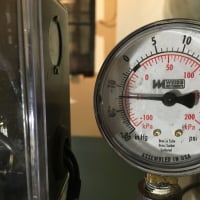
I suggest considering installing 2 or 3 smaller boilers to match the load at design conditions.
Be prepared for extra wiring costs for lead/ lag, cascade, outdoor reset, constant circulation, and other control and piping strategies including combustion air requirements.
Hire a shoring / rigging company for boiler removal and getting the new equipment in place.
I've done several change outs this way and the heat loss has always resulted in a lower btu requirement.
 2
2 -
Yes, I was thinking about this as well. I doubt that I would be able to go thru every single apartment, all at once, to do this.
But I also don't know what type of emitters are there yet, nor do I know how much radiation is in the entire building for boiler sizing. Again, I was told it's about 40 years old. So I would likely guess it is probably over-sized.
0 -
Yes I know.. Was just asking as a starting point.
0 -
I'm sure the leases for those apartments specify that management has to have access for maintenance and repair work. Normally they have to give a certain amount of notice for this. Check with management and local laws.
0 -
I always installed multiple boilers for large loads. The boilers would be controlled by a boiler computer, allowing staging and redundancy. I use a spreadsheet to determine the pricing, which has been refined over the years. Never guess the heat loss or the true cost of materials and labor.
0 -
You can probably do a block HL from outside the building and get close enough.
0 -
Find out what the relief valve pressure is set to and what the cold static fill pressure of the system is.
Is the expansion tank a bladder/diaphragm style or compression style? is the new tank you plan to install a bladder/diaphragm or a compression style? if changing you may need to add air separation does the new tank need to be ASME?
Is the old system fluid in good condition? or has the boiler had tons of leaks and hooked to an open fill valve? You may need to fix leaks, and/or flush out sludge
Is the existing flue adequate for the boiler you plan to install? do you need to route new vent pipe for a higher efficient boiler? if keeping an existing chimney is it going to pass inspection if required?
What actually fires the boiler? (thermostats? outdoor temp? etc etc)
are there any existing issues with the system or tenant comfort that need to be addressed?
Does the building owner have any desire to add multiple boilers? and if so can you vent multiple boilers?
Are there existing site conditions in the mechanical space that need to be addressed before work commences?
If its just a swap out, are all the required components there and already installed?
How will you get the new boiler into the space? will you need to bring it all in knocked down? if high efficient can you fit the new one through a service door?
0 -
I went to look at this job and it is simply a water boiler (700,000btu) and one single zone for the whole building.. Supply and return main piping is 2 1/2 " black iron piping. Ball valves and drain valves already existing on returns for system purging. Two large compression style expansion tanks existing.
There are a total of 18 apartments, approx 300 sq ft each, with old cast iron standing radiators. Don't know exact size of radiators or how many in total. There is a main thermostat in mechanical room controlled by remote sensors in the hallway of each floor (3 floors) and an outdoor reset control. The boiler mech room is on ground level right off of driveway, and boiler is right inside doorway from outside. So it would be easy to remove and install new. (I could use my skid-loader for this.)
But the owner is leaning towards replacement with 3 smaller boilers instead, and I think I agree. That way I could set things up a little different. And also there would likely always be heat available in case one of them fails to operate.
Does anyone agree or disagree with this ?? Any other thoughts or suggestions ??
1 -
18 apartments, 300 sq ft each, fed by a 700k boiler. Yeah, that is massively oversized, actually its comically oversized by about 5 times, rough estimate.
You have a total of 5400 sq ft which would work out to about 125 btu's per sq ft. Unless your trying to heat the outdoors on the north pole, that's way way too much. I agree a couple smaller boilers would be good, but you need to drastically reduce the size overall.
To give an idea we just had a dual boiler system replaced in an historic mansion (built 1913) that is 15,000 sq ft. We had 2 boiler put in each rated for 240k btu's (480k total). Just finished this winter with them and it performed flawlessly.
I think you need to crunch some numbers.
 1
1 -
Speaking as home owner that has had a steel compression tank for the last eleven years that has performed flawlessly to maintain the point of no pressure change on a single loop heating system they work very well.
If the each of the 18 apartments are 300 square feet they must be single rooms?
Is the boiler leaking? when was the boiler serviced last and the burners cleaned?
Does the single circulator have isolation flanges to prevent water loss in the event of a circulator failure. If it has isolation flanges do these isolation flanges have gauge ports for pressure and vacuum gauges?
Does the existing boiler have an immersed low water cut switch or pair of immersed low water cut off switches to comply with plumbing code?
Do not remove the steel compression tanks, the steel compression tanks have been sized for your both boilers volume and the heating systems total volume and they have been doing their job silently for 40 years.
If anything adding one or two more of these identical or larger steel compression tanks will only help the building owner as the amount of thermal mass will increase and aid in heating the building more efficiently in my opinion. Bell & Gossett describes how 4 or more steel compression tanks can be plumbed successfully if there is less head room above the boiler.
Replacing the existing boiler with three boilers will only complicate matters for the owner and you and require more plumbing to complete the installation.
If the steel compression tanks have been properly plumbed there is a single Internal Air separator that is feeding an upward sloped feeder pipe to the two steel compression tanks which have a Tee connected to the first steel compression tank that is either connected to the base of the first tank with an airtrol fitting an elbow that allows the system to be vented while it is being filled with a drain-o-tank valve and also allows any air bubbles in the system to be trapped in the air blanket in the upper third of the compression tank.
The second steel compression tank will terminate in an elbow and a riser to the rear of the tank where it has an airtrol fitting or an elbow and a drain-o-tank fitting in the base of the tank to drain excess water out of the steel compression tank to create the correct amount of pressure change for the system to operate properly.
If there is more room in the mechanical room adding a buffer tank would be even more advantageous as it would add much more thermal mass to the system and would allow the boiler to tun less as the cool water would return to the buffer tank and the boiler would run less often as the feed water to the boiler sump would be warmer and require less heat energy to bring it up to temperature.
Speaking again as a homeowner adding a smaller second boiler and a buffer tank as a backup boiler with additional hot water storage and 2 or more steel compression tanks would be the better option as it would allow the small boiler to work by the larger boiler with separate valving and piping if the other boiler is leaking and must be replaced.
0 -
Not a heating pro, just a homeowner/mechanical engineer. But we have a somewhat similar situation in a 4-unit condo building with two boilers that we would like to eventually tie together in a primary/secondary arrangement to heat the entire building (vs current split where one boiler heats one half of the building).
You don't say how far north you are or how old the building is, but here in the Boston area, a typical 100-year-old multi-family would need maybe 20 BTU/hr/sq ft. Let's add some hallway space to your habitable square footage and say 7000 sq ft total. 7000 x 20 BTU/sq ft = 140,000 BTU/hr. Or worst case with leaky windows, 30 BTU/hr/sq ft = 210,000 BTU/hr.
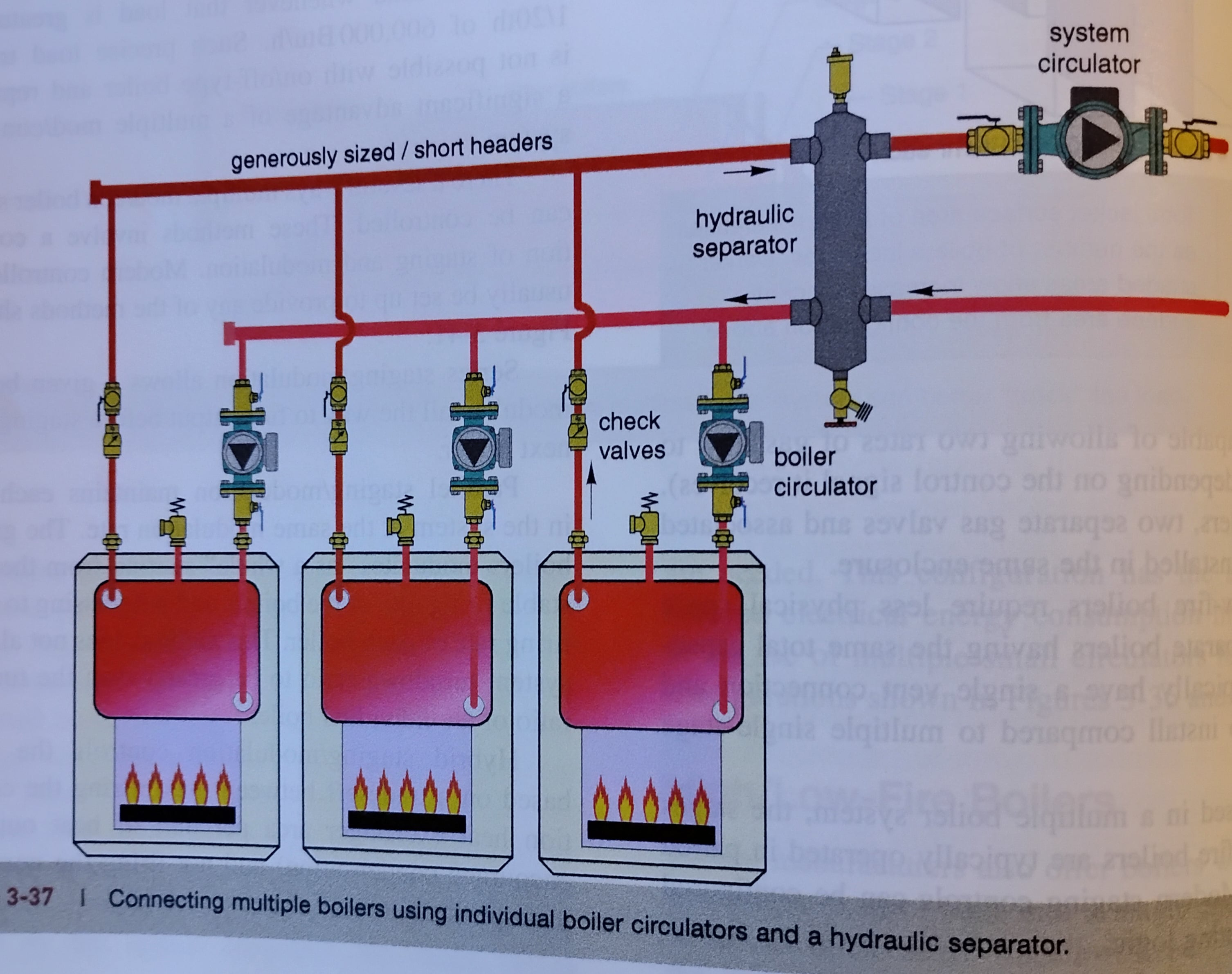
So (depending on your exact heat loss) you could maybe do 2 x 100MBH boilers piped primary/secondary with staging control. Most of the time you'll probably be running only one boiler.
Here's one way to pipe it, from John Siegenthaler's Modern Hydronics, using a hydraulic separator. This shows 3 boilers, but as others have said, you probably only need two. This is how I'm hoping to re-pipe our two WGO-5 boilers.
 0
0 -
Oops,, Sorry. Each apartment is approx 600 sq ft… I mis-typed . The 3 is right below the 6 on the keyboard. My fault🙄
0 -
And yes, I agree this current boiler is likely over-sized just by square footage alone. This is in the Pittsburgh PA area.
And if I were to do multiple boilers, I would also agree to pipe them primary / secondary and stage them in some way to operate only as needed.
0 -
OK, so an older apartment building in Pittsburgh area, maybe 14,000 sq ft with hallways/lobbies added in? Could be under 20 BTU/hr/sq ft if not terribly leaky. So 280MBH total?
Still doable with 2 x 150MBH output boilers, or 3 x 100MBH output. You will get somewhat better overall efficiency with 3 smaller boilers vs 2 larger. If the owner is willing to pay for 3 smaller, that may be the way to go.
If you go with a cast iron boiler you'll also need return water temp protection/bypass with that high water volume system to prevent flue gas condensation. The single zone for a large building means you will be flooding a relatively small boiler with a massive volume of cold water on cold starts.
0 -
You can go with mod/cons and have them cascaded. New commercial mod/cons are up to 10-1 turndown ratios and with radiators for emitters you'll be maximizing the condensing mode. No BMS to worry about as the master will control the output. Just daisy chain any number of boilers together. The boilers will pretty much load match with multiple boilers. No combustion air dampers to worry or chimney lining either. Considering its a commercial boiler the added PM is a non issue as the fuel savings will more than make up for it.
1 -
Does the existing boiler also provide domestic hot water?
Do you have any idea how much gas the boiler burns per season?
0 -
You could try calling CS&E in Pittsburgh, Pa. 412-821-8900 and see if they can help. Ask for Tim Fugh (few),or someone in the service dept.
0 -
That diagram makes more sense to me than the ones I remember from the seventies.
0 -
two mod cons get you 20-1 turndown, could run 90% efficiency for some of the season, eliminate the large combustion air grill that boiler must have?
There may be some incentive $ available from the utility, state or feds for efficiency upgrades
Check here
Bob "hot rod" Rohr
trainer for Caleffi NA
Living the hydronic dream0 -
FYI Lochinvar Crest is up to 15-1 turndown. only problem is smallest size is 750K
0 -
Ok here I am again. This job is going to proceed and I have a couple more questions… all in regards to inspections / requirements.
I'm not extremely familiar with commercial boiler room codes and want to make sure I get everything done properly. I actually tried calling a local boiler inspector twice with no response. And I tried the PA Dept of Labor boiler division also with no good information.
So I'm asking here if anyone is in Pennsylvania and is familiar with the required codes for commercial boiler inspections. The job is actually in southwest Pa, Washington County.
I just need to know what the specific requirements are for the boilers and boiler room to pass inspections.
I already know I need an electric shut-off at each entrance (doorway) to the boiler room. I know I need back-flow preventers on water supply. I know I need proper amount of combustion air intake (already existing). I know that the chimney needs inspected/confirmed for proper draft…
Does anyone know what other things are REQUIRED in Washington County Pennsylvania ?
0 -
If you are unsure just travel to the local building codes office, walk in, and ask for help.
Code requires at least one and or 2 low water cut off switches(for steam) wired as the first electric controls that will shut the power off to the boiler in the event of a water loss.
The Bell & Gossett RB-122-E Low Water Cut Off Switch is a direct immersion LWCO switch that allows it to be mounted in several ways including the insertion of the probe in the steam chest of the boiler or in the pressure flow of the hot water or the return flow from what I remember of it.
I have had one on my boiler threaded into a steam chest tapping for the last 11 years and I sleep very well at night. It has a test switch that cuts off the power to the boiler controls. The RB122-E LWCO switch =also has a spinning probe cleaner that cleans the sensor as well.
0 -
I did not read the entire thread, but here are some "general rules" that I believe are not just for NJ, but for the entire United States. We deal with NJ state boiler inspectors AND insurance companies that are at least nationwide if not international too.
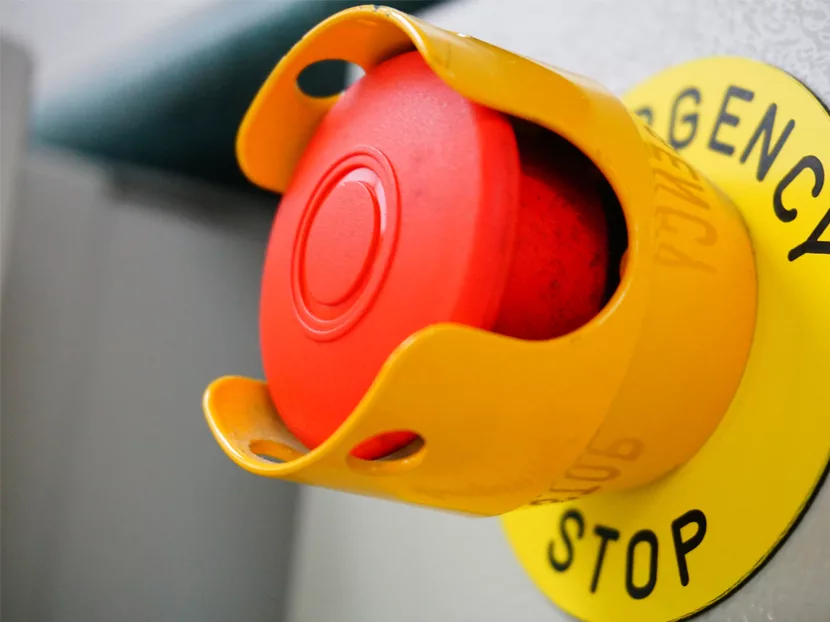
- Each commercial boiler shall have a locking emergency switch. This could be as fused disconnect, a non-fused disconnect or as simple as a 1900 box, toggle switch with an emergency switch cover and a simple plastic locking device. Generally speaking the larger the boiler the larger the switch,
- Each commercial boiler must have a automatic limit for temperature (hot water) or pressure (steam).
- Each commercial boiler must have a manual reset limit for temperature (hw) or pressure (steam).
- Each commercial boiler must have a manual reset low water cutoff (we and the inspectors much prefer the 120 volt models).
- Each commercial steam boiler must have an operating low water cutoff.
- Each commercial water boiler must have isolation valves on the supply and return.
- Feedwater to steam and water boilers is a little tricky in NJ (I assume PA is the same). The state requires a check valve on the cold water feed to the boiler. The local plumbing code requires a backflow prevention device. Depending on the job, the backflow device might be as simple as a Watts 9D or you might need a RPZ type device. Is there city water? Is there going to be water treatment in the system? Is there anti-freeze in the system? I always struggled with needing a backflow preventer, and pressure reducing valve and a check valve on the city water feed. Seems a little redundant, but many inspectors have demanded it on our jobs so we must comply.
0 -
What @ScottSecor mentioned is pretty much standard everywhere I think.
I am in MA and the emergency switches here do not have to be locking AFAIK.
Commercial boilers usually fall under the ASME code which I think most if not all states adopt.
Maybe you can PM @RayWohlfarth he is in PA. for advice.
0 -
commercial is kinda vague
Apartment, manufacturing, industrial. This might make a difference
0 -
CSD-1 is the standard to look up.
Found this article written by @Steve Minnich in 2020. AFAIK most states adopt this and may modify it by adding additional requirements.
Since everything has gone up in price a PDF copy of the CSD-1 is now like $150 to download which is part of the issue.
States that adopt CSD-1 will probably be on the hook for copyright laws if they print this so they can't print it for contractors. Anyone doing commercial boiler should probably get the download.
Massachusetts got in trouble for this as they used to copy NFPA 54 & 58 for gas piping and hand it out as the MA plumbing and gas code. They got caught.
"
Commercial Boilers and CSD-1
We’re required to follow these rules so boilers don’t blow up and people don’t die; the AHJ is both the check and balance in that equation.
August 10, 2020 Stephen Minnich
The opening paragraphs of any commercial boiler installation manual will inundate you with acronyms, standards, codes and multiple mentions of the authority having jurisdiction (AHJ). This one is courtesy of Dunkirk Boiler. Sound familiar? I hope so:
“Your commercial boiler is furnished with combustion side water or steam controls to meet our interpretation of the American Society of Mechanical Engineers (ASME) Safety Code for Controls and Safety Devices for Automatically Fired Boilers, No. CSD-1.
“Installation shall conform to the requirements of the authority having jurisdiction, or, in the absence of such requirements, to the National Fuel Gas Code, ANSI-Z223.1/NFPA-54 (latest revision). Where required by the authority having jurisdiction, the installation shall conform to the American Society of Mechanical Engineers (ASME) Safety Code for Controls and Safety Devices for Automatically Fired Boilers, No. CSD-1.
“CSD-1 controls and this installation may be subject to approval by local inspectors. Additional parts or equipment may be required. Consult local authorities having jurisdiction before the installation of the boiler.
“CSD-1 controls furnished with commercial boilers are applicable to boilers with inputs above 400,000 BTU/hr. (Models 500-1500)
“Additional parts required by CSD-1 Standards may be necessary to make this boiler compliant. This supplemental instruction manual should be used in conjunction with the installation, operation and maintenance anual for your specific boiler.” (emphasis added)
The AHJ is typically an inspector from the municipality’s building department. Other times, it’s the local fire marshal.
If you haven’t taken the time to read the CSD-1 Standard, you’re going to run into some trouble come inspection time. We’re required to follow these rules so boilers don’t blow up and people don’t die; the inspector is both the check and balance in that equation. The way I see it, understand it and have done it for years goes like this:
• I read the boiler manufacturer’s instructions.
• I review the CSD-1 Standard.
• I consider the city I’m working in, and what it typically requires.
And then I move forward. By the way, you can buy a pdf copy of CSD-1, Controls and Safety Devices for Automatically Fired Boilers, online for about a hundred bucks. Inspectors are human, too, so if they nail you on something you don’t agree with, you’ll be able to have an intelligent conversation with them by being familiar with the document. My goal is to go over some of the highlights as it relates to hot water boilers.
Low-water cutoff, temperature limit controls
The CSD-1 Standard applies to boilers more than 400,000 BTU/hr. and caps at 12,500,000 BTU/hr. At that 12.5 MBH mark, a new standard applies — NFPA 85, Boiler and Combustion Systems Hazard Code.
In my experience, these are the things the authority having jurisdiction looks for immediately. The first observation happens before the AHJ even steps foot in the boiler room. Under CE-110(a) of CSD-1, it states, “A manually operated shutdown switch or circuit breaker shall be located just outside the boiler room and marked for easy identification.”
One guy tried to fail me on this. He was looking for an emergency, red-button-type switch. I had clearly identified the circuit breaker right outside the boiler room entry as “Boiler” and showed him what was referenced in the document. He wasn’t happy about conceding, but he did. Being prepared in that situation paid off for me. I like emergency switches, but it would have been redundant in this case.
Once inside the boiler room, the AHJ’s eagle eyes scan the quality or lack thereof, the cleanliness of the room, serviceability of the boiler and evidence of specific controls required. He likely knows within the 10 seconds whether you will get his exalted blessing or incur his wrath.
Most of the inspectors I’ve dealt with went in search of the manual reset high-limit control (CW-410) and the manual reset low-water cutoff (CW-130) right away. My supply houses made that easy for me because they always included each in their quotes for the boilers. Invariably they would add a Taco LFM0243S-1 for the low-water cutoff control and a Honeywell L4006E1000 for the temperature limit control.
It’s important to note that the manual reset temperature limit is to be used in conjunction with the automatic reset limit control that comes with the boiler. It is set five to 10 degrees higher to prevent nuisance tripping of the manual reset limit.
Also noteworthy, and something the AHJs will catch every time, is to make sure there is no isolation valve installed between the LWCO and the boiler (CW-130c). You don’t want the control sensing the presence of water when the boiler might not have any.
Best practices for all boiler installs
On the visual inspection, the inspector is going to take mental and physical notes on some things that we should be doing on all boiler installations, no matter what the BTU/hr.
A gas piping sediment trap is required and must be at least 3 inches long and at the bottom of the vertical drop, out the bottom run of the tee. A manually operated gas shut-off valve is required and must work freely without the use of your hammer, channel locks or 14-inch steel pipe wrench. It also must be exercised regularly to ensure easy operation by hand.
The pressure relief valve on any hot water boilers shall “conform to ASME Section I or IV, as applicable,” and be installed on a vertical plane.
I’ve seen these valves installed backward, on a horizontal plane, plugged or with threads on the bottom of the discharge pipe. The threads on the bottom of the pipe are just an invitation for some unknowing individual to spin a cap on them to stop a dripping valve while creating a potential bomb. I like to use black iron pipe cut raw, sometimes on an angle; anything to deter the unknowing from doing the unthinkable.
Once the near boiler piping and controls are evaluated, the inspector is then likely to take a close look at how the room is getting its combustion air. I’d say 85 percent of the commercial boiler rooms I’ve been in have gotten their combustion air from a fixed louver that is now covered by plywood or cardboard and duct tape. This is why there are inspectors and fire marshals. They will hold building owners, building engineers and contractors accountable if they’re unable to do so by themselves.
I prefer using a motorized damper with an integral end switch under the combustion air requirements of NFPA 54/ANSIZ223.1 in the National Fuel Code. This way, I don’t need to worry about someone blocking the oxygen necessary for complete combustion. If the damper doesn’t open, the burner circuit is never energized. If the burner doesn’t fire up, the contractor’s phone rings and the problem gets solved the right way. Nobody gets hurt. It’s almost a bullet-proof method of attack.
The end of the CSD-1 Standard provides various illustrations of acceptable gas trains with provisions for valve leakage tests (Figure 1). I wouldn’t expect gas valves leaking to be a common thing, but the provision is there for a reason.
1 -
I had to cut the bottom off the above post as it was to lengthy to post
0 -
if you don't go to the web page of/download the code book ad read it you're going to have a bad day.
0 -
you should be able to look at/download the state's adopted version for free. it was decided recently that you can't copyright the public record.
0 -
Thanks for the replies so far.
To confirm, this is not steam. It is a single zone hot water system in an apartment building.
And the plan is to remove the old large boiler and install 3 Weil McLain 133,000 btu boilers instead. Obviously these will all be located in the same "boiler room".
But do all the same rules apply since they are smaller btu capacity ?
0





Categories
- All Categories
- 87.9K THE MAIN WALL
- 3.3K A-C, Heat Pumps & Refrigeration
- 60 Biomass
- 430 Carbon Monoxide Awareness
- 133 Chimneys & Flues
- 2.2K Domestic Hot Water
- 6K Gas Heating
- 124 Geothermal
- 170 Indoor-Air Quality
- 3.9K Oil Heating
- 80 Pipe Deterioration
- 1.1K Plumbing
- 6.7K Radiant Heating
- 397 Solar
- 16.1K Strictly Steam
- 3.5K Thermostats and Controls
- 56 Water Quality
- 51 Industry Classes
- 51 Job Opportunities
- 18 Recall Announcements