Restoring One Pipe -- finally
Comments
-
Flush the vent out- some dirt might have gotten into it.
All Steamed Up, Inc.
Towson, MD, USA
Steam, Vapor & Hot-Water Heating Specialists
Oil & Gas Burner Service
Consulting0 -
After testing the near boiler piping, I test the main:
I did this by capping the risers, or whatever was required to seal the system.
I currently have 2 radiators at 65 EDR; 2 radiators at 40 EDR; 1 radiator at 44 EDR and one at 12 EDR on line. the rest are shut off. total of 266 edr. plus uninsulated piping.
Ambient temperature: -12F. temperature in lobby" 75 after four hours.
I turned the vaporstat down to 1.5 psi. Ambient temperature: 36F. lobby temperature 73 after ten hours.
This is without the thermostat being attached.
The thermostat that came with the house is a seven day programable, heating, cooling, fan, etc digital controller.
I wish I could find the old mercury thermostats. on, off, don't worry about the current. just set it and walk away thermostat.
I love the feel.
it warms the face as I sit fifteen feet away. like the sun on a warm spring day.
my temporary heaters have cycled off.
0 -
Wiring the thermostats in was an all day event.
50' of 18/5. I used all of it.
I removed the fancy t-stat. After all, all I am looking for is a simple on or off, not, heat or cool, very the temperature depending on the time of day or which day it is in the month. and no, there is not a duel heat. Well, I have been running on a temporary backup. but that is different.
Two t-stats. one to turn on the entire system when the house starts to get cool in the fall, and the other to control the temperature.
While running the boiler without a t-stat for control, I noticed that the pressure made a difference. After all, the secondary burner shuts off when I reach pressure. I lowered the pressure to 1.5 psig. The house temperature leveled off at 74 — 75 after 24 hours.
Now, the small burner should stay on, but when the house temp is satisfied, the larger burner will turn off. controlling the house temp by btu in over time. not cycling the system.
Stay tuned. I will know by this time tomorrow.
Also. I do not think i am using water, however, leaky valves fill radiators until the system i turned off. then some seeps back. I open the valves to speed the process.
The water at the bottom, (blowdown) is black and brackish, i assume this will eventually, clear up. The house smells like boiler water. Again, I assume this is temporary. after all, this is the first time it has been run in over eight years.
0 -
While the thermostat on the wall in the center of the house reads 70 degrees, and stays there indefinitely, we feel cold because the unit does not cycle on.
I am going to break convention and move the t-stat. probably next to a radiator on an outside wall. It appears that I might be able to control the temperature of the radiator. maybe keep them at 100 degrees or so.
Of course the other part of the problem is that while I am trying to balance the system, my wife goes behind me and turns on the temporary heat and I do not discover this for eight hours. life is grand.
We used to have this problem at work. The girls would bring in little space heaters and place them under their desks to keep warm. Then the air conditioner would kick in and they would turn the heat up by their feet and complain they were cold. only after we took away all the space heaters could we make them comfortable.
0 -
Is the boiler cycling on the t-stat or pressure?
0 -
Success
I installed a t-stat two foot above the 14 column radiator by the front door. set it at 85 degrees,
The secondary turned on long enough to heat the radiator, then took an hour to cycle. That should work.
The problem is that the primary burner designed to heat the house down to thirty degrees. both burners are on during startup. when the t-stat is satisfied, the secondary turns off. The primary continues, but the house slowly looses heat and the radiators cool. The house feels cold even though the t-stat is satisfied. even at 74 degrees. the heat would never cycle on because the primary still supplied enough energy that that the t-stat would never drop that half a degree to cycle the secondary back on.
and the radiators grew cold.
my wife complained.
now, I have added a cycle that keeps the radiators warm.
0 -
I think I have run headlong into an age old problem: how to control one-pipe steam heat.
when I run without a t-stat, I am at 75 degrees.
when I use a t-stat, it stays at a constant temperature, but the cycle is hours and feels cold even though I am at 70. like when the sun goes down after a warm day. the temperature is there, but there is no longer energy entering the system.
I added a sensor to monitor the radiator, but even that has an hour cycle.
I am ordering a timer to control the cycle.
At present, the ambient temperature is hovering between 25 to 30 degrees all week.
0 -
Don't associate comfort with a number. If you are cold with the thermostat set at 70°, turn the thermostat up until you aren't cold.

 2
2 -
Yesterday, I moved the controlling t-stat to six inches above the end column of the 13 column, 75EDR, radiator.
Evidently, this works.
I got up in the middle of the night, the t-stat read 70, the room felt warm, and the radiator was warm to the touch. I checked three times, all three times same result.
I wonder what would happen if I turn the t-stat down a degree. probably need to turn of the entire system off to reset to a different temperature.
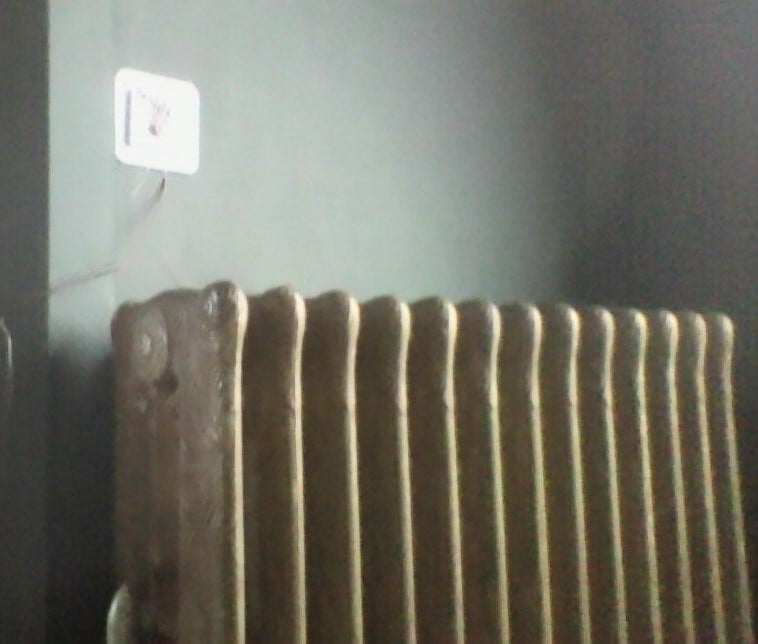
So I have one t-stat to turn the entire system on. (Primary and secondary)
one (Digital) to set the room. but this one does not move. it is too far from the radiators. It will allow me to turn the heat up, I do not know about down. With the primary producing 75k input, output should be 62k with 82 EFU. The radiators currently running, at design temp of -40, I have 68k, or 227 EDR. The basement, before I turned on the boiler was 41 degrees. now, about 68. lots of heat escaping from the pipes. the point is that I am supplying slightly less than what the house is using when only the primary is running.
The third t-stat, pictured here, simply tells the secondary, 200k to turn on for a few minutes. it is connected in parallel to the second t-stat
I will give it a few more weeks, but so far, 24 hours, it seems to work.

 2
2 -
I am having fun, now, chasing details of the one pipe steam heat.
One radiator gurgled. I leveled it.
Boiler Water level fluxuates. I suppose that the radiators valved off, store water as steam leaks by. then returns the water then the system cycles off. This is a problem. I add water, then I am overfull. I have a condensate tank I could install near the Hartford loop to store a few gallons.
Today is minus 25 degrees outside. The boiler is struggling. I intentionally undersized the burners as the first floor is not yet insulated. At -25 the first floor is seventy, second is 65, and the unheated third is 60. The boiler pressure is maybe 4 oz at best.
I bought a second digital thermostat and discovered that the first does not agree with it. Might be my control problem.
so far so good
0 -
That is wonderful news to hear cgutha. We are having our own batch of cold weather here in the east.
We have no wind as of 9AM and powder snow so that is good in a way as it easier to clear.
0 -
I see some comments that I had missed:
Steamhead: how do I flush the vents?
pecmsg: both. At -25 mostly t-stat. at 30, pressure depending on where the t-stat is set.. the burners are undersized, I have not completed insulating the first floor, nor have I rebuilt the widows. I sized the burners according to the completion of the remodel.
I changed the gauge to a 5psi gauge because the 30 did not register. much of the time, the five psi does not register. sometimes I see it go up to 6 oz. Again, I know that I am undersized on the burner size, this was intentional.
yellowdog: I now believe that the t-stat is faulty and will not read below 70. this may be the entire problem I have with comfort.
leonz: now I turn my attention to the LP tank. comfort comes at a cost.
I changed the range of the burners to 25 - 225k btuh when the outside temperature was hoovering between 10 and 30. then the weather dropped to -25. closer to design temperature. we turned on one of the supplemental heaters, so both are running in the uninsulated lobby. This is acceptable for a number of reasons: I removed one radiator, (actually it is still there, it is not connected. It did not match the other radiators in the building, so I assume it is an add on— although I am told that it was needed when the weather turned cold. The Lobby also leads to the open staircase, A big chimney leading to the unheated third floor. although we try to block this with a cloth barrier, convection heat is such that heating the lobby is heating the whole building. That is, the lobby opens to the stairway, the stairway opens to the hallways on the second and third floors, and heat rises. thus, heating the lobby heats the whole building.
Back to the burner size: 270k btuh is roughly three gallons of LP an hour. that is going to hurt. But, every room in the house is comfortable. (the unheated rooms and floor is above 60) so, I am heating four times the building at (only) twice the fuel usage. is that a win? we are no longer huddled into three rooms. we now have the whole building.
Now, to work out the fine details …
0 -
Hello and good morning CGutha,
This is wonderful news, but the propain is a big OUCH. Perhaps you should look into TRV's for the unused rooms to keep them at 60 degrees to ride herd on the unused rooms?
0 -
Take the vent off and immerse it in water, then swish it around.
All Steamed Up, Inc.
Towson, MD, USA
Steam, Vapor & Hot-Water Heating Specialists
Oil & Gas Burner Service
Consulting0 -
leonz: TRVs are a possibility, I have looked into them in the past. However, at this time, there are no radiators in those rooms, only the heat from the first floor is heating them.
0 -
I swapped the new thermostat with the old. The old now is an on-off switch for the system, and the new controls the secondary burners . The old t-stat did not seam to go beneath 90 degrees. leading me to believe that my control problem is in the t-stat.
The new t-stat works well, giving me a one degree variation over the hour and a half cycle.
However, when I worked in building maintenance, we had sensors that would detect 0.1 degrees. not that I want to install that kind of complicated computer controlled system.
Is there a t-stat that would give me a tighter control than one degree? I think a half degree would be good enough.
0


Categories
- All Categories
- 87.6K THE MAIN WALL
- 3.3K A-C, Heat Pumps & Refrigeration
- 59 Biomass
- 429 Carbon Monoxide Awareness
- 124 Chimneys & Flues
- 2.2K Domestic Hot Water
- 5.9K Gas Heating
- 119 Geothermal
- 168 Indoor-Air Quality
- 3.8K Oil Heating
- 78 Pipe Deterioration
- 1K Plumbing
- 6.6K Radiant Heating
- 394 Solar
- 16K Strictly Steam
- 3.5K Thermostats and Controls
- 56 Water Quality
- 50 Industry Classes
- 50 Job Opportunities
- 18 Recall Announcements