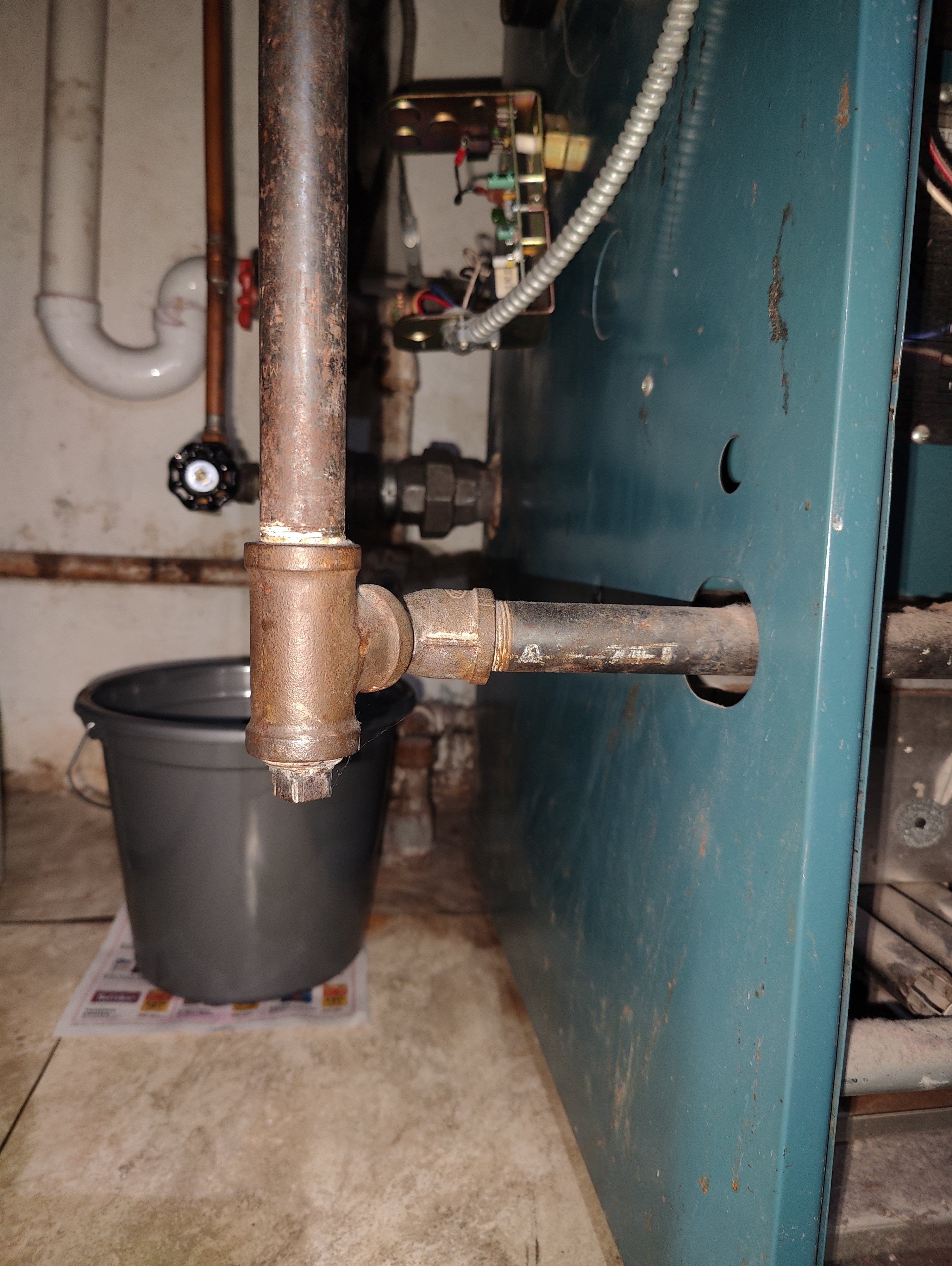
Burnham boiler question
Comments
-
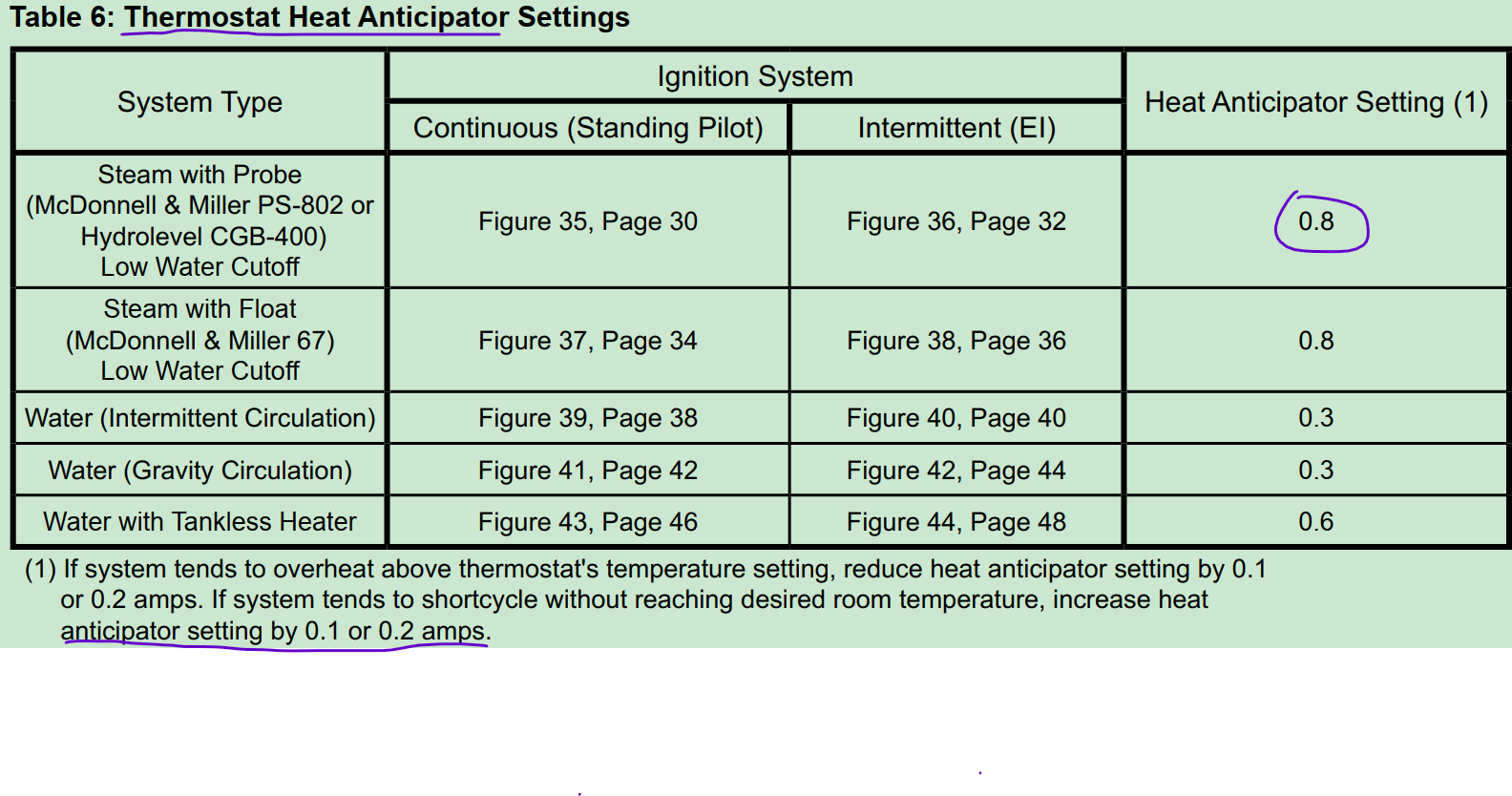
the manual says to increase the tstat setting by ~0.1 amp to avoid short cycling. how many F degrees on the tstat is equivalent to 0.1 amp in this table?
0 -
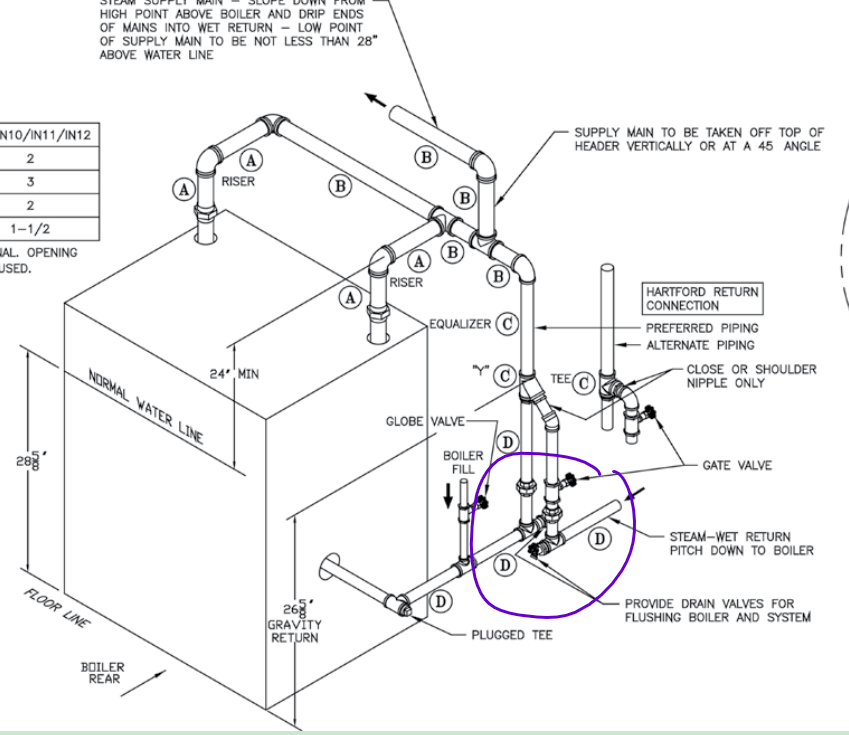
Really???? You are looking at a commercial boiler that will never be anything like it in your home and asking about the type of pipes I illustrated to show you what type of tee fitting you asked about that you will never use and that is the reason you made a post asking about it?
If I knew that you look at everything so literally that I need to be very careful to be precise to the exact detail in order to make a point without you getting side tracked on something that you have no need to know.
I personally like to understand the reason why someone says something or prints something in an instruction manual. But you are taking this to an extreme that is farther than I have ever needed to go. This illustration was a concept drawing not a precise engineering detail for you to follow (that you would not need to ever follow on your steam boiler). The point I made when I posted this particular illustration was to answer your query about the type of tee you might use in order to prevent bridging. I also said that this does not apply to you because you will not be using a tee fitting at all in your situation.
In the future I will try to make my drawings more accurate for you so there is no question about what piping material you might want to use on your next commercial boiler installation.
Here is something that you may need to see for that next commercial boiler you install in your home:
Does this answer your query about the type of piping you will use on the commercial boiler you will be installing? It has iron pipes and I used actual pictures from the catalogue of pipe fittings and pipe nipples I did not use the LWCO photo because I would hope that you understand that the LWCO location would be on the Tee Branch like I illustrated in my concept drawing.
Edward Young Retired
After you make that expensive repair and you still have the same problem, What will you check next?
1 -
Thanks.
I was not concerning the pipe materials.
I was asking weather the joints of he pipes with elbows, and the pipes with the T (in that U shape assembly) are lead hubbed or tapped threaded. it's all hubbed, or at least hubbed where the two elbows tie to the two horizontal pipes (the other 5 connections can be threaded), right?
I have had some experience with diesel fuel system, I'm just curious about the domestic water plumbing where things are different.
0 -
You asked "I was asking weather the joints of he pipes with elbows, and the pipes with the T (in that U shape assembly) are lead hubbed or tapped threaded. it's all hubbed, or at least hubbed where the two elbows tie to the two horizontal pipes (the other 5 connections can be threaded), right?" WRONG
What does it matter? You are not using any of this on your boiler. I would forget the stuff that does not matter and concentrate on the stuff that does matter. Have you read the book yet? Do you know more about the steam boiler that you have?
I was wondering about the water in the pipes, Did you get it all out? When is the gas company going to be ready to turn on your gas? Have you had time to do the maintenance that is recommended since the boiler is now empty of water? did you check the condition of the probe? Is the pigtail that connects the pressure control to the boiler clear? What lkind of pipe joint compound are you going to use to connect the pipes and fittings you remove to do the service work when you put it back together? by the way does the door bell work? Do you even have a door bell? What color is your mail box? Are there any letters in the mail box? Are they all junk mail?
Just wanted to continue with the unrelated questions about the new home.
Edward Young Retired
After you make that expensive repair and you still have the same problem, What will you check next?
1 -
Thanks for the reminder. I should blow all water out asap. I thought to place some temp sensors and keep monitoring the inside temp. The gas servicer has not filed the working permit yet. I complained to the city, hopefully Nationalgrid will call me about a timeline next week. I visit my new place every weekend. The plan regarding the steam boiler is to measure the probe this weekend, and bring my wrenches there in the following visit, I will also take a photos.
i'm going to use rectorseal 5 when reassembling.
when you say wrong, do you mean all 7 connections (each elbow has 2, T has 3) can be tapped threads?
0 -
@paulga queried: "when you say wrong, do you mean all 7 connections (each elbow has 2, T has 3) can be tapped threads?"
Actually there are 11, you need a union to put that all together, and every pipe has 2 ends that are threaded. Two pipe to boiler, four pipe to elbow, two pipe to union and three pipe to tee. (I can nitpick too LOL)
Every pipe on a steam boiler is threaded using NPT standard fittings an pipe nipples. I don't know of any better way to do that. Copper, sweat, ProPress, mega Press, hub, compression, flare and just about any other pipe connection is a sign that the installer/pipe fitter is not an experienced steam fitter.
I have seen copper on wet returns and I find that acceptable, but anywhere there is steam, it should be steel or iron pipe and fittings.
Does your steam boiler have copper tubing and fittings anywhere past the water feed system? All steam pipes should be steel or iron pipe/fittings.
Edward Young Retired
After you make that expensive repair and you still have the same problem, What will you check next?
1 -
i remember the system supply steam pipes are all 2" or 3" cast iron ones, on my steamer.
now that you highlighted it, i recall the manual has a paragraph that disapproves using cooper for steam piping, mainly due to high thermal expansion and heat loss.
0 -
-
-
Vacation mode = set thermostat lower.
It is that simple
Your boiler will short cycle regardless of the temperature you set at the thermostat. It all has to do with oversizing. The funny thing about steam is that the steam does not follow the heat loss of the home. The steam follows the connected radiation. If you have 500 sq feet of radiation and the boiler is oversized by say 500 Sq feet for a total Net output of 1000 sq feet, then once the boiler fills with steam and the mains fill with steam and all the radiators fill with steam, the pressure will increase. If the pressure goes above the cut out pressure the burner will stop. Once the pressure drops to the cut in pressure the burner will start. This cycle will continue until the thermostat is satisfied.
What does follow the heat loss of the building is the heat that leaves the radiators. If the thermostat is set 40° above the outdoor temperature then the heat from the radiators will take a given amount of time to make the home reach that temperature. That means that if it is 30° outside and you set the thermostat to 70° your boiler will operate the same as if the outdoor temperature was 10° and you set the thermostat for 50° The short cycle will be identical in both cases. Where you get the energy savings is having only a 20° temperature difference when it is 30° outside and the thermostat is set for 50° The call for heat will happen less often.
I am not sure that your boiler is actually oversized by 100%, it could be oversized by 150% or more. It may also be oversized by only 50% or less. How the boiler operates will depend on what piping and radiators it is connected to. If you want to solve short cycling for low thermostat settings you will also be solving it for normal settings.
This is over simplified but the concept is still there… Don't just solve for low thermostat settings, solve for all the time.
Edward Young Retired
After you make that expensive repair and you still have the same problem, What will you check next?
1 -
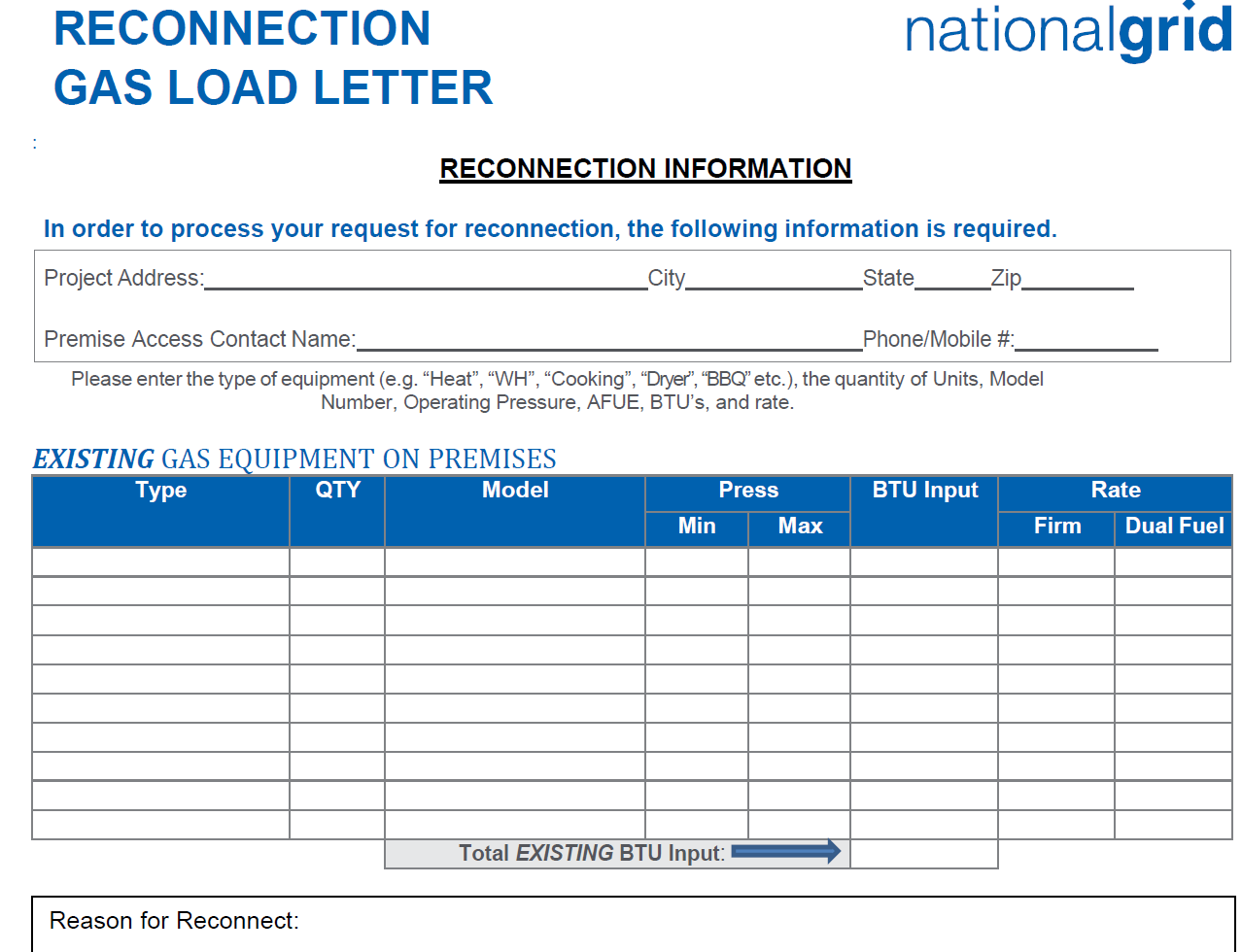
I thought the gas company just need to restore the gas line to its original condition before it was capped, but the company's clerk just emailed me a gas load form that I have to fill and sign.
in its "terms and conditions" part, it says -
"In the event that the equipment identified on the front of this agreement (i.e. the table attached) is not installed and in use within three months (Existing Homes) or six months (New Construction) of the date of installation of the service line, the Applicant agrees to pay National Grid the actual cost of installing and disconnecting the gas service line plus the actual cost of any required main work minus any payments already received "
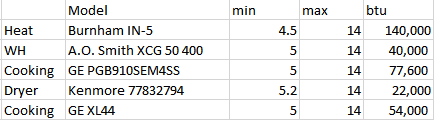
the gas equipment include the steam boiler, hot water heater, gas dryer, range/oven. How to find the min and max inlet pressure, and BTU input for each? what does Firm/Duel Fuel Rate mean?
0 -
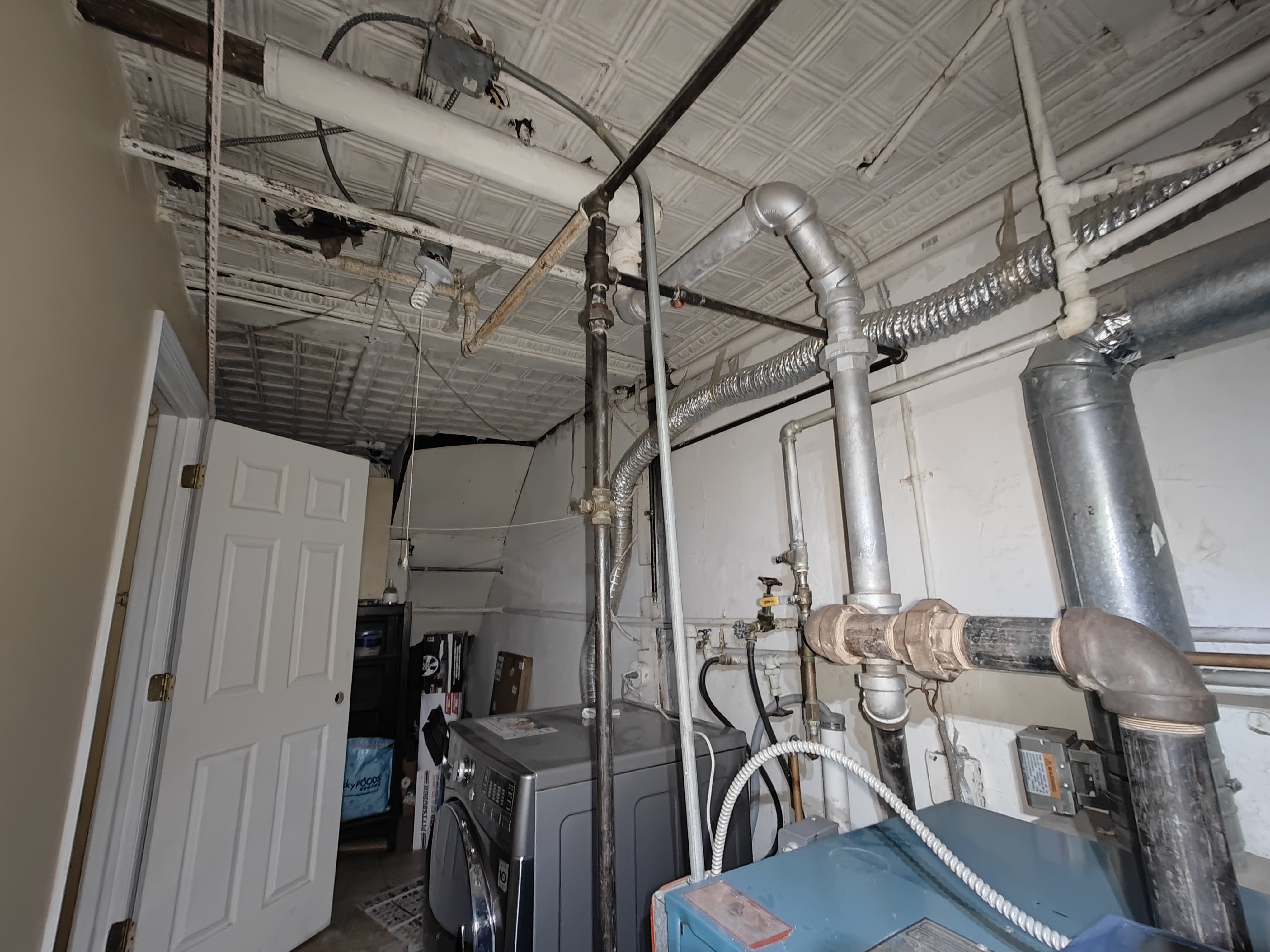
I followed the supply main but didn't see any air vents or plugged T like said in the book.
Could those vents be located in those sections above the ceiling or behind the drywall?
0 -
"I followed the supply main but didn't see any air vents or plugged T like said in the book. Could those vents be located in those sections above the ceiling or behind the drywall?"
Yes, that is very likely. When handymen and builders finish off basements they have no idea that there are things that might need normal maintenance like steam vents that you need to have access to. In many cases those things are covered up and forgotten about. Before you start tearing out ceilings and walls, you will want to try out your system to see how it works. Breaking into dry wall or plaster walls and ceilings to find nothing wrong, might fall into the category of: "if it ain't broke don't fix it"
As far as the gas company application is concerned, just sign it, you will start using it for hot water as soon as the gas is turned on. That wording is to deter folks from applying for gas and after all the work is completed and the new gas main is next to your home, you decide to use Oil Heat or Heat Pump and all that work to provide you with gas, will never provide any revenue. Don't worry about it because you will be using it.
See you reacted just as they wanted you to. Now you are thinking about whether or not you want gas heat…. And You Do!
Edward Young Retired
After you make that expensive repair and you still have the same problem, What will you check next?
0 -
I signed the forms back but the clerk replied that the table need to be filled up, because they are missing that info on their end. May be their policy is being enhanced.
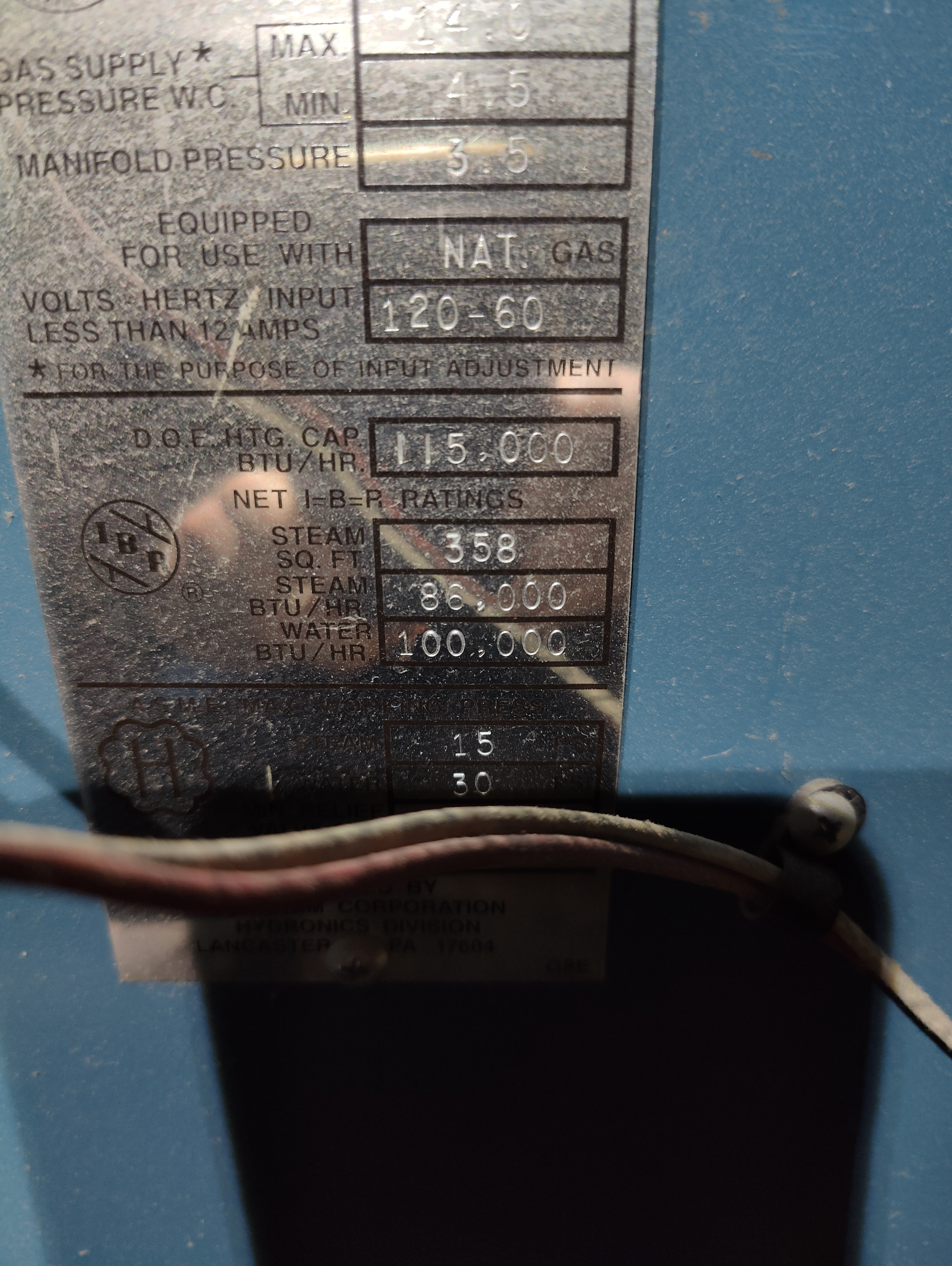
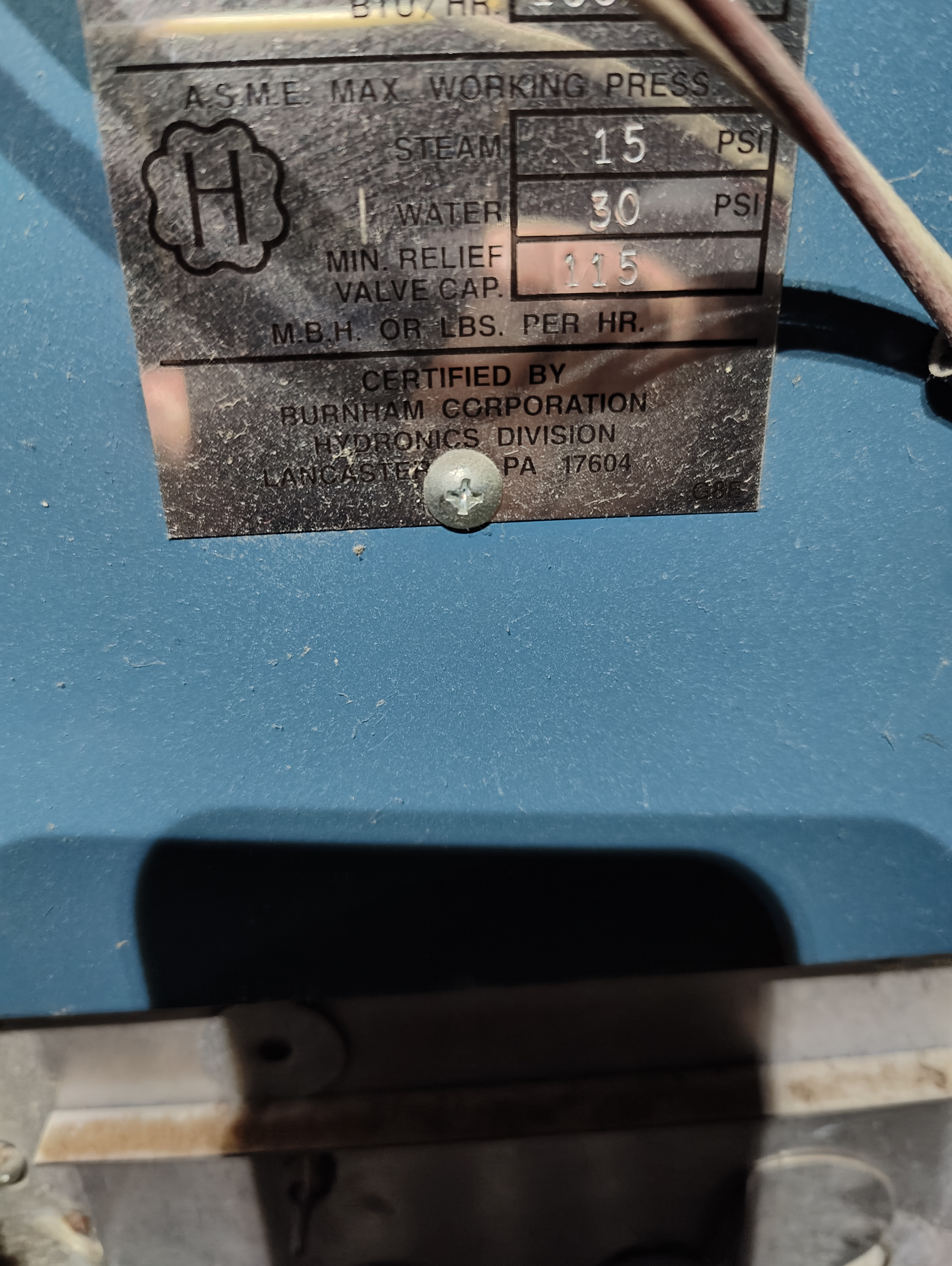
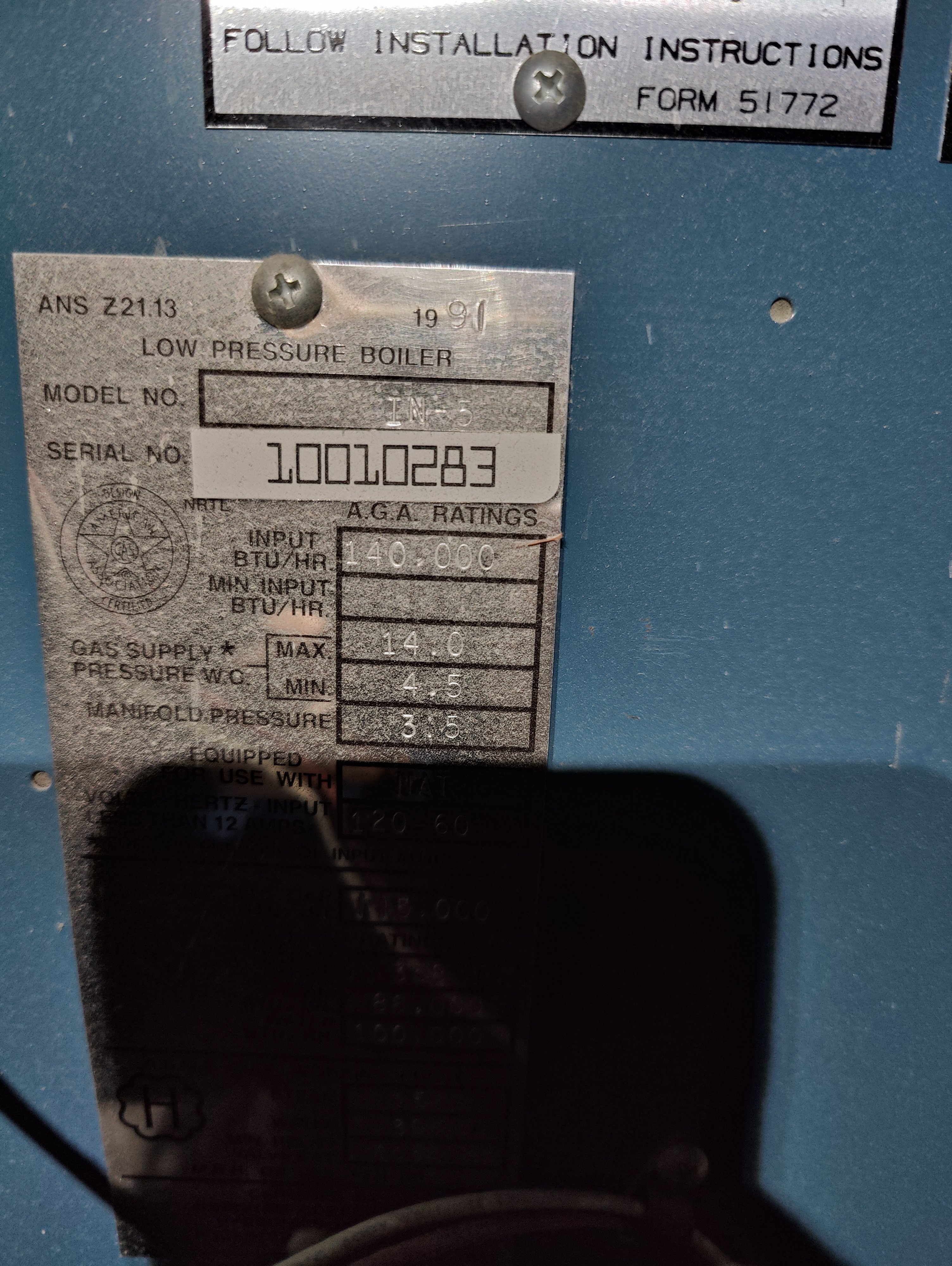
The steam boiler rating label has more than one btuh, which number should be included in that table?
0 -
@paulga , clearly you need a pro. Where are you located? We might know someone whop can help you………
All Steamed Up, Inc.
Towson, MD, USA
Steam, Vapor & Hot-Water Heating Specialists
Oil & Gas Burner Service
Consulting1 -
Brooklyn, New York. that said I'd prefer doing the form myself, rather than having a plumber bill just for the clerk nonsense.
0 -
TheGas co. is interested in the BTU input of all the appliances. That is because that is how much gas they need to provide that appliance per hour. Standard clothes dryer might be 20,000 to 25,000 BTU/h. A water heater will have a rating plate or sticker but if you can't find it, they are about 40,000 BTUh. A standard cooking range for your kitchen might be about 45,000 BTUh. If you have a gas log in the fireplace they can range from 10,000 to 30,000 BTUh. The new Tankless water heaters may be 199,000 BTUh.
Unless you have unusually high amounts of gas appliances with large BTU Capacity, their standard 1" or 3/4" standard residential gas service will be enough to handle your needs. If you have a swimming pool heater that is extra large, along with some extra large appliances, you may need a larger gas service line. outside of that, just fill in the form and sign it so they can move the process on further.
Edward Young Retired
After you make that expensive repair and you still have the same problem, What will you check next?
1 -
Thanks. So the column btuh is for input btuh, then the column "rate" must be the output btuh.
The supply steam piping directly from the boiler shown in my earlier post, and the vertical riser in the living room as shown below, are not insulated.
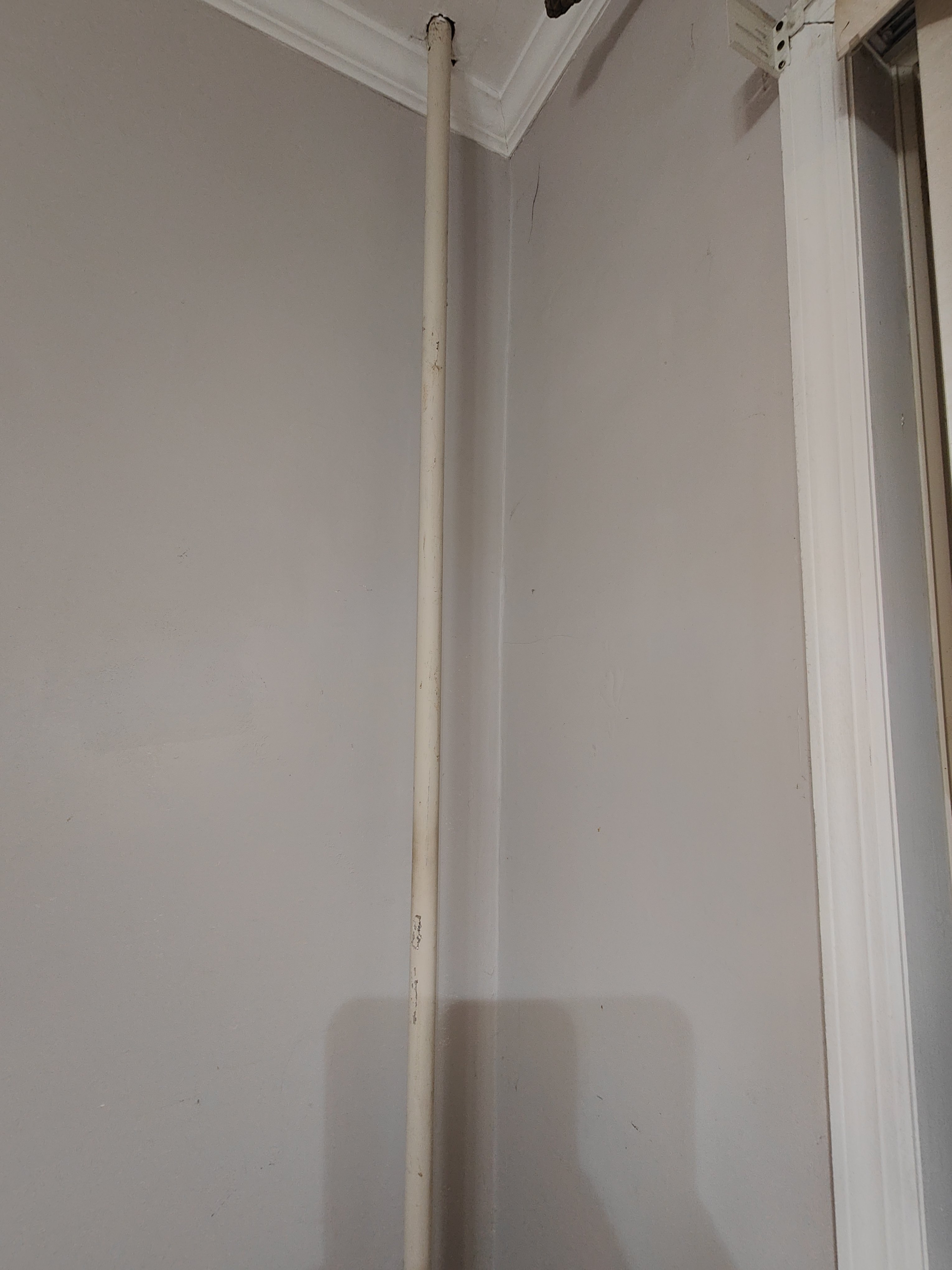
Should I wrap these exposed pipings with say 3" batten insulation and aluminum foil tape?
0 -
"Should I wrap these exposed pipings with say 3" batten insulation and aluminum foil tape?"
That will look like $#1T in my opinion. But you can do that. I would do a more professional job using this product
Edward Young Retired
After you make that expensive repair and you still have the same problem, What will you check next?
2 -
"Thanks. So the column btuh is for input btuh, then the column "rate" must be the output btuh."
Leave RATE blank. That is not for residential use. All they need is the INPUT from each appliance in order to select the proper size pipe from the gas main in the street to your home The model numbers are not as important as the BTU numbers. Also, this is not "rocket surgery". They need to know that you are not running a Commercial Bakery or melting Iron Ore with the 3/4" gas service they usually put in residential homes. The Mattress Police will not be knocking down your door with an arrest warrant for getting BTU calculation wrong.
Edward Young Retired
After you make that expensive repair and you still have the same problem, What will you check next?
0 -
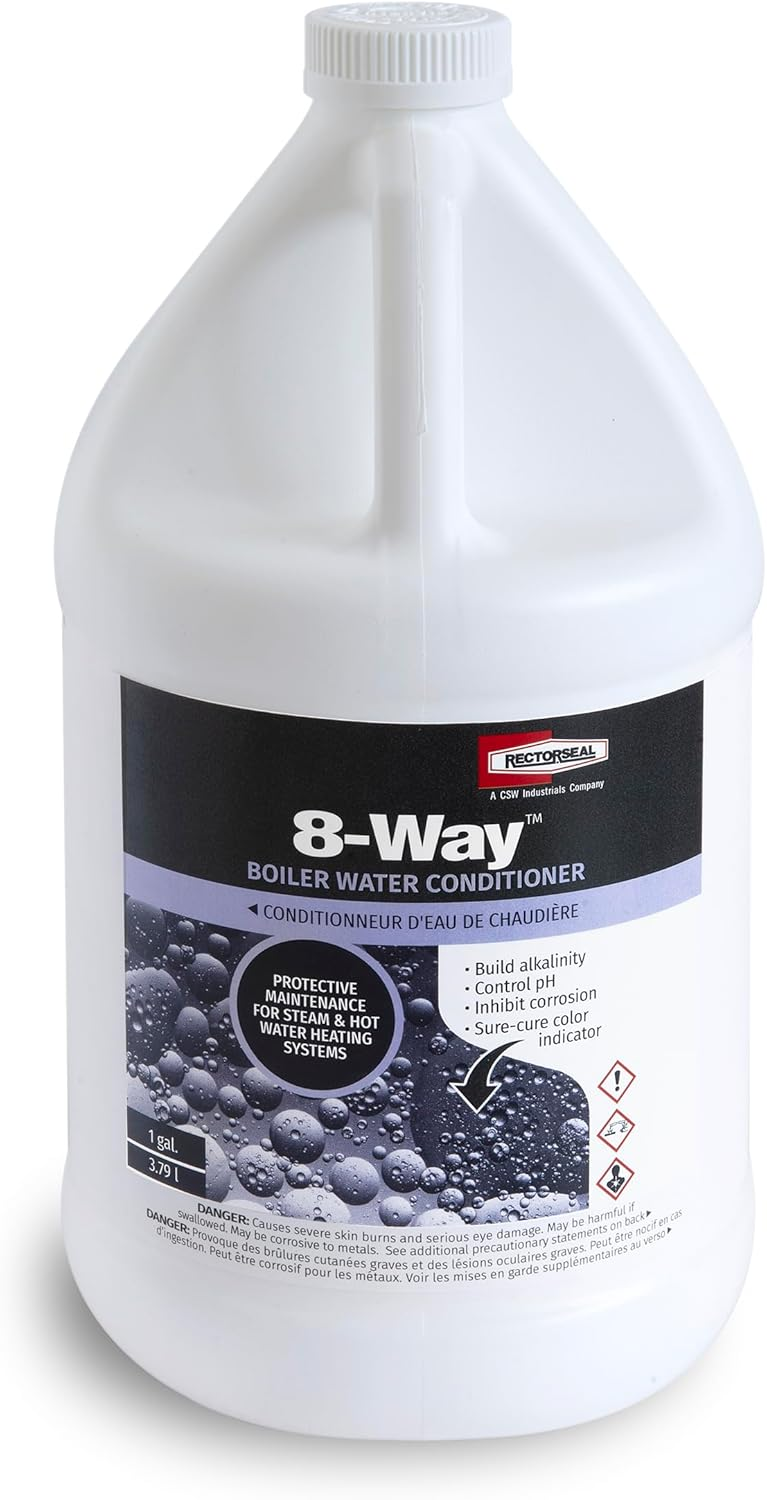
I found this stuff on Amazon. Where do you add it?
When the lwco is removed, I can transfer some in from the tapping. But after the water is filled up, there is not a port for adding this cleaner.
0 -
the numbers match the rating labels. I have filled the table and sent to the clerk.
0 -
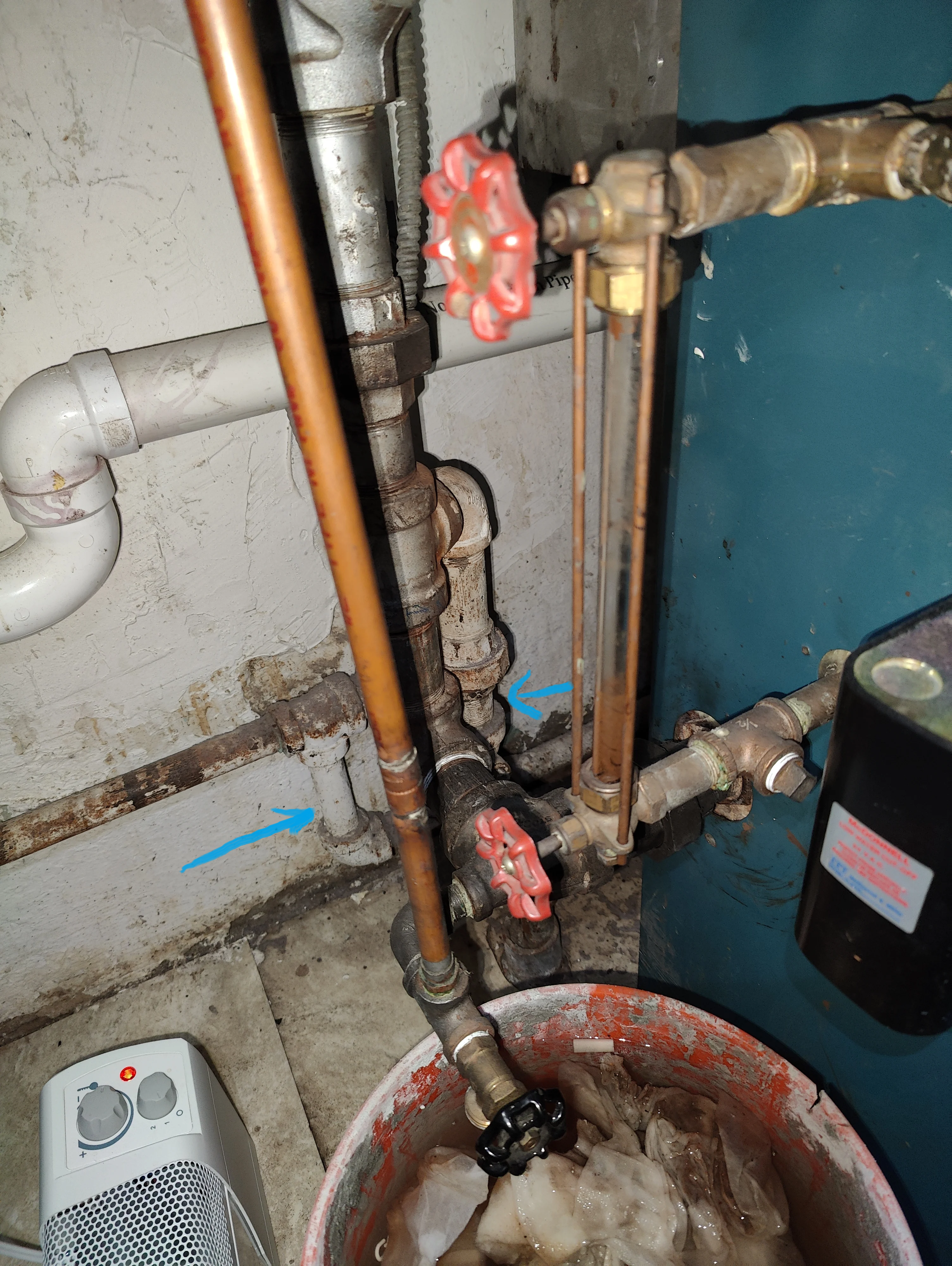
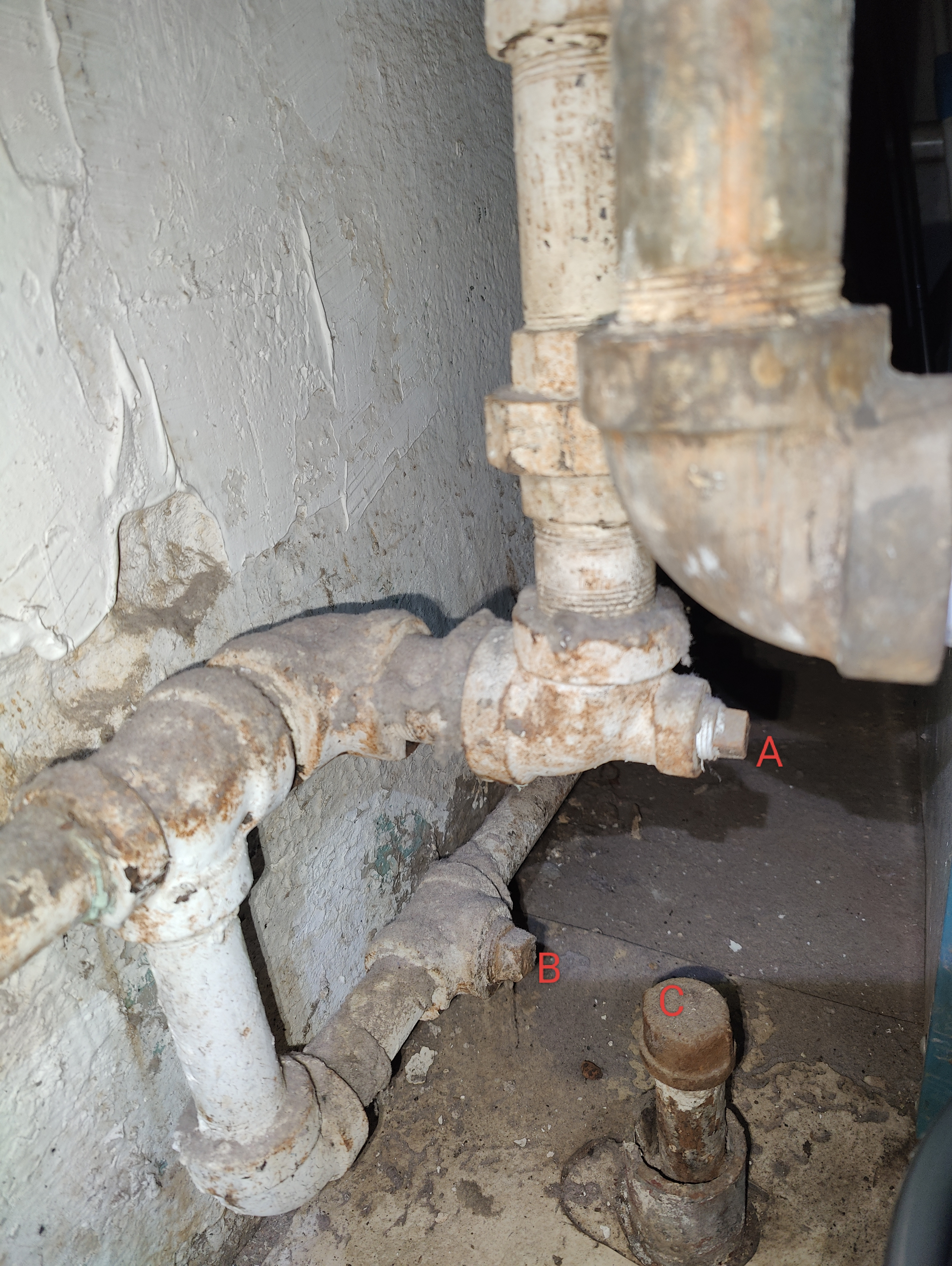
This is the return piping ends where the rust flakes and crud settle. Other than the plugs A and B, I haven't found any shut off valves that isolate the return sections for pressure cleaning. How to clean out the crud from the inside of the return piping?
0 -
It is tough to reference where those pipes are in fererence top your sntire system whan the photo is that close.. you need to step back so we can have some point of reference to how those popes connect to the system… in which direction are the radiators? In which direction is the boiler?
Here is an example of what I'm talking about.
I keep trying to put air in my tire but I don't think this tire valve is letting air in. The tire is not inflating . Am I doing something wrong?
but a picture from farther back tells a different story why the tire won't hold air.
Can you take a photo of those plugs from a little farther back?
Edward Young Retired
After you make that expensive repair and you still have the same problem, What will you check next?
3 -
they are the steam return piping at the back of the boiler
roughly this area
0 -
The plug marked B in your photo is the lowest point of the wet return. It will be very difficult ot remove that plug. You can try spraying is with penetrating oil afor a week or two before trying to get a wrench on it, but I have had mixed success with fittings of that nature. Perhaps a high temperature torch with Mapp gas on that plug unyil it glows cherry red. but that may not happen since there is most likely water behind that plug. If you do get that plug out, I would install a ball valve and a cap for future service in the opening.
If you do get that to open, you can connect a garden hose fitting to that opening and force clean water in, then let the dirty water drain out. do this several times to clear up the mud in the piping.
If you can't open that one up, then use the one above it (A) and do the same thing. It appears that one (A) has been opened more recently and may come apart easier. Full port ball valves are a better valve than the hose bib you might try to use. Add a female hose connection at the ball valve to make it easy to connect a hose for pressure flushing. 3/4 FPT x 3/4 F Hose Fitting
Edward Young Retired
After you make that expensive repair and you still have the same problem, What will you check next?
0 -
Thanks. Is there corrosion concern in coupling a brass valve to a steel fitting? My search returns a "dielectric nipple", is this often used in the trades?
0 -
Brass valves are often used with steel pipe nipples. As a matter of fact if that was a brass plug in the steel tee fitting there would be a much better chance of removing it. Dielectric nipples and unions are used on water heaters, Not so much on steam boilers. The plastic parts of those dielectric fittings don't stand up to the higher temperatures associated with steam boilers.
Edward Young Retired
After you make that expensive repair and you still have the same problem, What will you check next?
1 -
Thanks for confirming.
Right under the so called hardford loop there is also a stand pipe cut short and capped that I labeled as C. What was this piping used for?
0 -
"Right under the so called hardford loop there is also a stand pipe cut short and capped that I labeled as C. What was this piping used for?"
that may be an old wet return from the original boiler. It is buried under the concrete so impossible to repair without tearing up the basement floor. It was most likely abandoned years ago and capped off to keep ground water from getting into the basement from the rusted away pipe that is still under the floor.
Edward Young Retired
After you make that expensive repair and you still have the same problem, What will you check next?
0 -
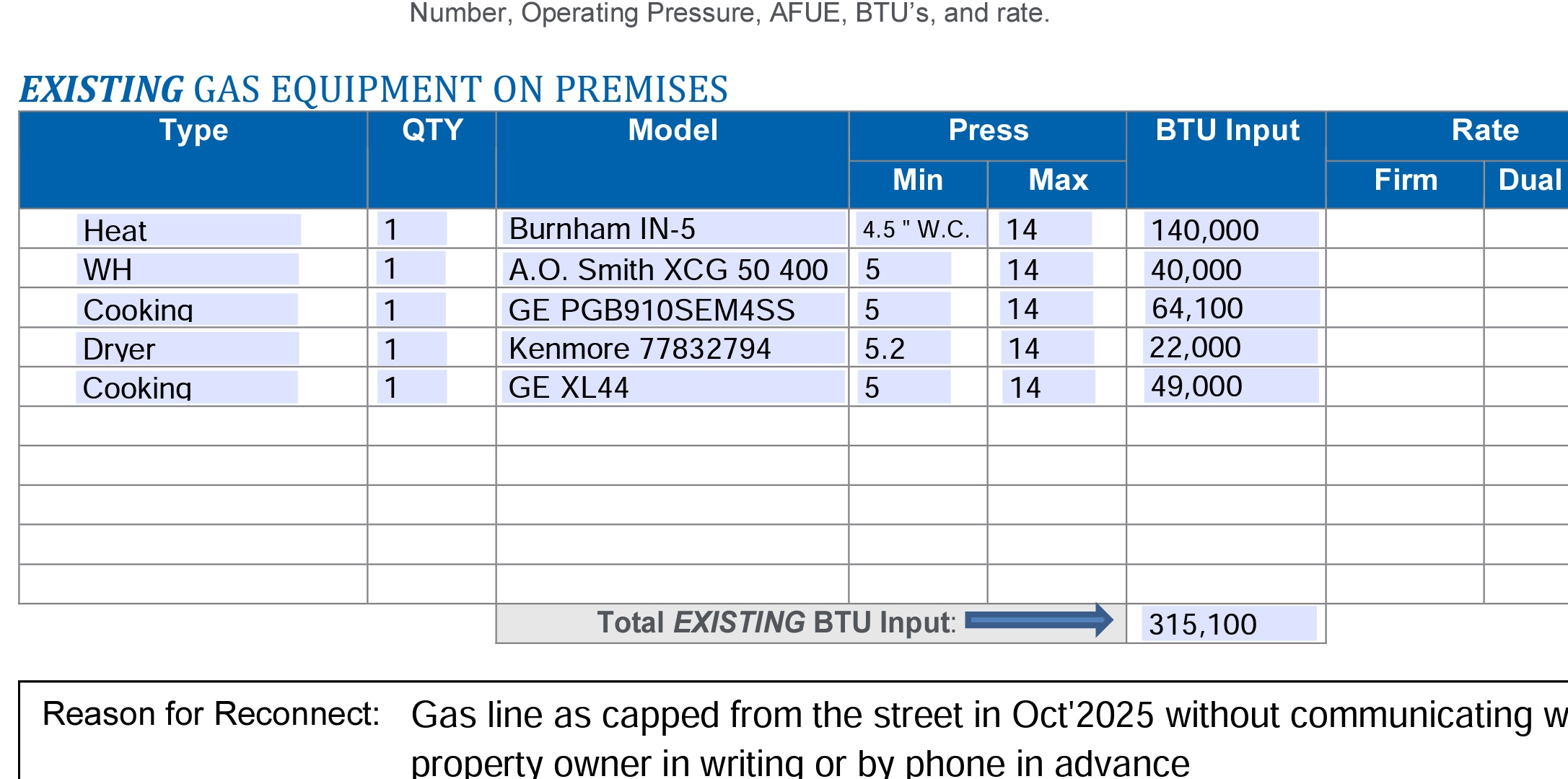
This is the form I sent to the clerk. She told me today -
"After reviewing the load letter, the BTU load amounts are too large for the existing pipe to carry, which means a new service will be required"
The existing pipe as I heard on the phone is 1". Is 315,100 btuh really too large for 1" pipe to handle, or did I fill wrong information?
0 -
Do you actually have 2 cooking appliances? You did not give the incorrect information. I believe that you will just need to wait until the new gas service line is installed. If you have a 1" high pressure gas service then that is more than enough for 315,100 BTU. If you have an older low pressure gas service, then you may not have a large enough service. But I wouldn't be surprised if the new service will be a high pressure service line and probably be 1".
Edward Young Retired
After you make that expensive repair and you still have the same problem, What will you check next?
0 -
How far is the gas main in the street from your house? a 10 foot 1" pipe can handle about 600,000 BTU. but a 100 foot 1" pipe can only handle about 200,000 BTU on a standard high pressure main.
Edward Young Retired
After you make that expensive repair and you still have the same problem, What will you check next?
0 -
The home has two stoves. There is a gas stove in the basement kitchen area that is not connected to gas. I thought to include all equipment.
they opened the pavement just outside of front door when they capped the gas line two months ago. so the gas main goes along the street under the pavement, and the distance to my gas meter is about 10ft?
if the gas main provides outmoded low pressure gas, that's the only choice. what do they need to do to deliver high pressure gas?
0 -
If the gas main is low pressure, you size your pipes to deliver the right amount of gas at that pressure. Simple.
All Steamed Up, Inc.
Towson, MD, USA
Steam, Vapor & Hot-Water Heating Specialists
Oil & Gas Burner Service
Consulting0 -
The front yard is concrete paved 10 years ago. Do they need to dig it all up to upsize the pipe?
They didn't ask one thing when they capped the line. Now they have so many questions for reconnection while the actual gas pipe and equipment have remained the same.
0 -
You dont get a choice on what gas main you get connected to. if all thay offer is a low pressure gas main then you get connected to it. no other option. If the gas company is upgrading to a newer high pressure gas main and eventually abandoning the older low pressure gas main, you don't get a choice there either. they will connect you to the high pressure gas main. That is so they don't need to "redo" your gas service in the future.
Besides, the gas company knows what they are doing when it comes to supplying gas to your home, "until they don't"
Edward Young Retired
After you make that expensive repair and you still have the same problem, What will you check next?
0 -
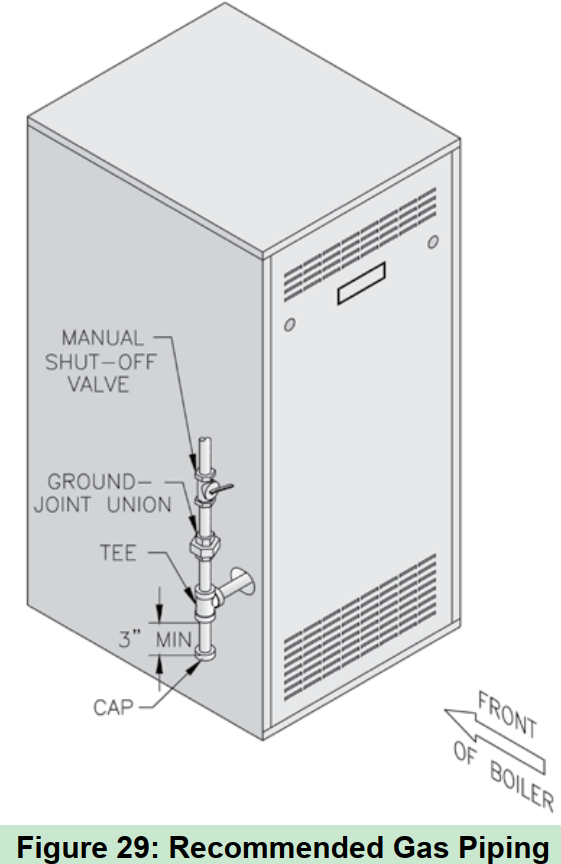
the 3" minimum sediment trap as required on the manual is missing on the inlet piping. is this important to have this trap?
It is present in the hot water heater gas inlet.
0 -
I would not worry about that.
Edward Young Retired
After you make that expensive repair and you still have the same problem, What will you check next?
0 -
But it is easy to add. Do you own a 12" pipe wrench?
Edward Young Retired
After you make that expensive repair and you still have the same problem, What will you check next?
0
Categories
- All Categories
- 87.4K THE MAIN WALL
- 3.2K A-C, Heat Pumps & Refrigeration
- 61 Biomass
- 429 Carbon Monoxide Awareness
- 120 Chimneys & Flues
- 2.1K Domestic Hot Water
- 5.8K Gas Heating
- 115 Geothermal
- 168 Indoor-Air Quality
- 3.7K Oil Heating
- 77 Pipe Deterioration
- 1K Plumbing
- 6.5K Radiant Heating
- 395 Solar
- 15.7K Strictly Steam
- 3.4K Thermostats and Controls
- 56 Water Quality
- 51 Industry Classes
- 50 Job Opportunities
- 18 Recall Announcements