Back-up/supplemental heat

I have come to discover after many years and help here from the forum, that the BTU capabilities of my heating system are undersized for the part of my house that has a cathedral ceiling and lots of glass. We built the house when I was younger, 20+ years ago, it seemed more tolerable. I have just retired and spending more time in the house I have become less and less tolerant of the cool temperatures in the house when the outside temperatures drop below 20° F and where we live in northwestern Pennsylvania that happens way too frequently in the winter. The other part of the story is we are hoping to spend a couple of months of the winter in warmer climates. Both of these issues have me more than a little anxious.
Our current heating system is radiant floor heat which works perfectly when temperatures are above 20–25°, I do not want to replace it, I just want to add some more BTUs to the room that struggles the most. The other part is I would like to have the additional BTU’s come from a device that could possibly act as a back up for when we’re away, if our main heat source were to quit while we’re away and have it automatically kick on, if that were to happen.
Here’s some of the further details.
Propane is our fuel source
We currently have Fujitsu Mini Splits “ 3 heads” that we primarily use for air conditioning that unfortunately stop producing heat when temps go much below 30
I would like the devices to be as unobtrusive as possible and Be automatic/thermostat control
The two things I’ve kicked around are, upgrading the mini splits to Mitsubishi low seer units that I understand produce heat below zero. The thing that makes my head hurt about doing that is, the Fujitsu are only 8 years old and work great for air, but…….. I hate throwing money away on something that is functioning but…
The other thing that I looked at today was 30k BTU ventless gas wall heaters, but uncertain if they can be run on a stat, plus not the most attractive addition to the house walls.
Any help in directing me toward a solution is greatly appreciated.
Comments
-
does the boiler run non stop on the coldest days? If not it may have some addition capacity to add a hydronic heater.
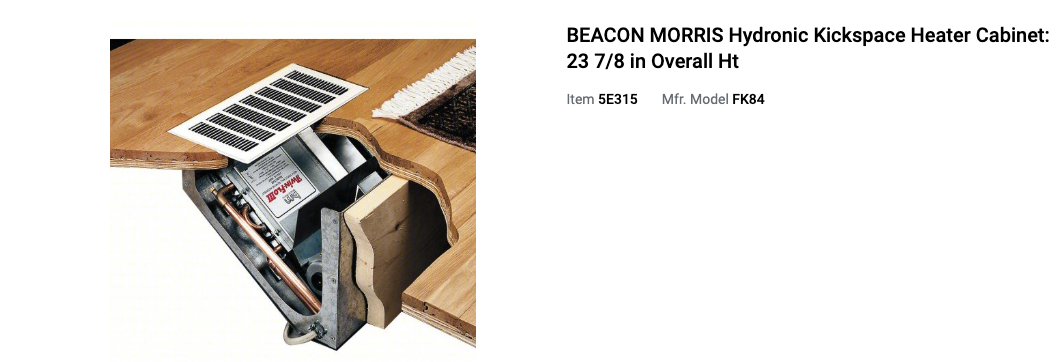
Can you get under the glass wall section of the home? You could cut in a few kickspace heaters to blow warm air across the glass. They may work at the same radiant temperature, they need about 115°F or more to kick out much heat.
The go into the floor like this. Since it is a forced air convector you get a lot of BTU/hr output compared to fin tube or panel radiators.
 Bob "hot rod" Rohr
trainer for Caleffi NA
Living the hydronic dream0 -
Do NOT consider ventless heaters. Just don't do it.
Now having said that… @hot_rod 'ssuggestion is a very good one, if you can get access to under the floor to install them. Another possibility, but somewhat more complex, would be panel radiators in that specific room. They, however, need hotter water than your radiant system, which adds the complexity of generating that hotter water (your boiler can do that) but then mixing it down for the floor — which is also easy enough to do, but adds some valves and at least one more pump.
The other complication is wanting something which will act as a backup when you are away. How independent do you want that backup to be? Are you looking for something which will take over if the boiler or some other part of the radiant system fails? Are you looking for something which will manage a power failure? That affects the choices…
Br. Jamie, osb
Building superintendent/caretaker, 7200 sq. ft. historic house museum with dependencies in New England0 -
you could add a vented wall furnace or console heater if you want it to be a separate system. there are versions that can vent out the sidewall.
electric heat could make sense, it will cost more to operate but the lower installation cost might offset that.
a small mod con boiler and panel radiators is another option.
if you pick the right wall furnace or console heater you could get a model that will run off a thermopile or built in hydraulic thermostat and will run in a power outage.
0 -
I know you said you wanted something unobtrusive. This is understandable if the heating unit is not something you want to look at. But if you have the floor space, a small Jotul (or equivalent) direct-vented stove can be a nice addition that gives some ambiance in addition to heat. We have one in our sun porch, and it really doesn't take up much floor space. I cut the through-hole in the wall and installed the 2-foot horizontal B-vent myself, to code of course, and had a plumber run the gas line. The only other bit was a millivolt thermostat that I wired to the wall, and voila. Dirt simple install, really, and the millivolt thermostat works fine. It's a lovely place to sit and read in the winter.
1 -
I'm with @hot _rod on this one. I have seen a project where the floor heat was sufficient for the home where there was average (35% of the walls are windows) glass, but the "solarium" with 18ft ceilings and 18ft floor to ceiling glass wall would not get enough heat after the outdoor temperature dropped below 40°. That same boiler would produce 180° water to run through Runtle® radiant panel baseboard radiators that wrapped around the perimeter of the glass walled room. That was able to heat the room when the temperature dropped to 15°. But when the outdoor temperature reached below that, the warm air duct system would operate to take up the slack.
Since you are using minispit systems for your cooling, that eliminates the duct coil option. So perhaps the kickspace heaters as the third line of defense is the best idea. That can all be operated from the same boiler that most likely has extra capacity that the floor heat as a heat emitter can't use.
As far as the minisplit heat pump is concerned, I don't see how that will be of any benefit. In understanding the concept of a heat pump you need to think of how it works. Picture a window air conditioner installed in a window backwards. The hot air blows inside while the cold air blows outside. That is a great concept in the right climate zone. If the outdoor temperature is high enough the compressor can take the outside air and remove some heat from it, compress it into a hot gas in the refrigerant and let that heated gas into the indoor coil so heat can blow into your home.
So the heat from outside is compressed and sent inside. As the outdoor temperature gets lower, there is less heat to compress so the compressor is doing the same amount of work and producing less and less heat as the temperature gets colder and colder. Those low temperature heat pumps are just larger heat pumps that have more capacity so it will work at a little lower outdoor temperature. You can't make more heat from air that is -20° by just saying it is a low temperature heat pump. You need to use larger coils and compressors to do more work to make enough heat from that colder outdoor air. I also find them to be less reliable than standard heating equipment as the temperature drops.
If the heater you have has additional capacity, why spend more $$$ on another heat source? Just use better heat emitters to get that heat into the room(s).
Edward Young Retired
After you make that expensive repair and you still have the same problem, What will you check next?
0 -
a conversion to rankine will show you there is plenty of heat, the problems are with ice and finding a refrigerant that can deal with the differing temperatures.
0 -
Thanks for the reply. The boiler does not run continually and cycles on and off even in the coldest weather. The Zone that is BTU deficient has one 3/4” supply and a 3/4” return with two separate loops within the zone on it own dedicated circulator. Can the in the floor convectors be added to the current zone plumbing, or do they need a new dedicated supply, return and circulator? My current boiler temp is 130*f
This option sounds like it would take care of adding BTU’s but not solve the back-up heat source issue.
0 -
I would really like to have a completely separate back-up heating source, separate from the current main heat. I have a few/too many issues for my home while away for extended periods in the winter. They are a driveway from hell, 500’ of uphill curve in a pretty rural area. It’s difficult to keep open when I am home, let alone when away. So the backup heat would be only for when the heat goes down, not do to power outage.
This will be our first ever time away from the house in the winter, so still trying to figure it all out. I plan on adding a cellular based temperature alarm system to start and hoping to get a Neighboro Freind to plow and respond to an alarm
0 -
In answer to"
“Can the in the floor convectors be added to the current zone plumbing, or do they need a new dedicated supply, return and circulator? My current boiler temp is 130*f”
By all standard rule of thumb calculations and some of the more specific actual engineering calculations, a 3/4" pipe can deliver 40,000 BTUh when there is a 20° temperature difference and a flow rate of 4 gallons per minute. So the question you need to answer is "does the problem space require more than 40,000 BTU of heat per hour?" To be entirely sure, I might put the kick space heater(s) on a separate higher temperature circuit in order to get the maximum heating output from them.
As far as an auxiliary separate heat source is concerned, Electric heat as a backup is the most reliable since there are very few moving parts involved. Set the thermostat at 55° on the standard heating system when you are away, set the electric heat at 50° all the time. When you are away, if the boiler heat fails, the electric will keep the place from freezing up.
Edward Young Retired
After you make that expensive repair and you still have the same problem, What will you check next?
2 -
The vented wall furnace seems like it may hit both needs. What would you suggest as the “right” wall furnace? When I search I come up with a brand “Rinnai”
0 -
The adding additional emitters does not address the back-up heat source I desire. My boiler “Laars Combi” has gone down twice in the 7- 8 years of service, once, internal air intake screen plugged with bugs and one control board. I feel very insecure on the dependability of the Laars while away for two month of winter and really want a back-up source. The mini split seems like a good solution from a stand-alone true back-up. The problem for me lies in already having them…
0 -
Does there exist a correct refrigerant for what my situation requires?
0 -
@ColdHouse : "I would really like to have a completely separate back-up heating source, separate from the current main heat."
What do you really mean by "completely separate"? What contingency are you guarding against? Mechanical failure? Water leak? Propane leak? Running out of propane? Losing electricity for a prolonged period? What about if a storm blows a branch off of a tree into a house and it breaks a window? What if a burglar breaks in?
You can always think of a situation where the heat fails. There is no technology where a house can be left completely unattended in the winter with 100% certainty that it will remain heated.
1 -
Redundancy of another complete system also brings more electro-mechanical components that will at some point fail.
I agree an electric baseboard would be the simplest, least prone to failure, other than power outages.
Even a gas or LP appliance that doesn't require power can lose it's pilot flame and fail when most needed.
Redundant systems, alarms, neighbors, it depends on how many layers you want to add for piece of mind?
Bob "hot rod" Rohr
trainer for Caleffi NA
Living the hydronic dream1 -
It’s a kill two birds with one stone problem for me. I have the need for additional BTU’s in the most used space in my house. I also would also like a backup heating source for the times we are away for a month or more in the winter. the direct vent wall furnace with separate stat looks like a good option for me.
In the 23 years since will built the house, the heats gone down 5 times, that a failure once every 4.5 years. In those 23 years a tree branch has never busted a window.
0 -
Have you tried to increase the radiant loop temperature? I don't believe that you mentioned the temperature of the radiant loop?
the problem with trying to heat with forced air is the amount of heat that is going to rise in that cathedral ceiling. While it is a good idea I think something like free standing Runtal radiators might be a more efficient way to add a little heat. might look ok in front of the glass and might prevent the heat sink from between your body and the glass. depends on the room layout
0 -
I am running at 130* and it can run up to 140*. Last winter I went over all of this with the forum and tried higher temperatures, with little improvement.
The Runtal are nice looking in comparison to other options. I wonder what the thermostat options for them, I will look
0 -
as a side question, one post said to not consider ventless propane heaters. I assume that is due to the burnt gas residuals?
0 -
Yup. Also they are illegal in some places because of this.
All Steamed Up, Inc.
Towson, MD, USA
Steam, Vapor & Hot-Water Heating Specialists
Oil & Gas Burner Service
Consulting0 -
I have been reading up on the Mitsubishi Hyper heat mini splits and saw a post saying they will run at 100% capacity to +5* and 93% down to -13*. We rarely see temps below -13* and when we do its a overnight low and normally will recover to 0* or above for daytime highs
0 -
@ColdHouse replied: "I feel very insecure on the dependability of the Laars while away for two month of winter and really want a back-up source. The mini split seems like a good solution from a stand-alone true back-up."
In my subsequent post I wrote: "As far as an auxiliary separate heat source is concerned, Electric heat as a backup is the most reliable since there are very few moving parts involved. Set the thermostat at 55° on the standard heating system when you are away, set the electric heat at 50° all the time. When you are away, if the boiler heat fails, the electric will keep the place from freezing up. "
You can also be selective on where the electric heat is installed. You only need to put them in locations where there are water pipes. I realise that you have heatig pipes full of water in every room, but PEX tubing will not burst like metal pipes when frozen. So you can probably put electric heat in the bathrooms and kitchen and leave the rooms without plumbing pipes without electric heat.
Edward Young Retired
After you make that expensive repair and you still have the same problem, What will you check next?
2 -
@EdTheHeaterMan : "I realise that you have heatig pipes full of water in every room, but PEX tubing will not burst like metal pipes when frozen. So you can probably put electric heat in the bathrooms and kitchen and leave the rooms without plumbing pipes without electric heat."
The problem with that kind of thinking is what happens if you're wrong? Yes, the PEX piping itself can expand as much as the ice does, but what about the things it's attached to? Often what you see when PEX freezes is the pipe is fine but the fittings start leaking. Do you really want a pipe leaking for two months? Do you want the boiler dry firing when it manages to start again and there's no water left?
There's no substitute for having a real person monitoring things. Close second would be electronic monitoring with a real person on call if something comes up.
1 -
I plan on having a cellular temperature alarm in place and a neighbor to respond if needed while away this winter, but I want to have a automatic backup heat source in place before next winter.
The other key to the equation is that I need extra BTU’s during normal winter heating conditions. If I decided to add electric baseboard heaters, I would need many to act as a backup source and what makes me lean towards mini splits or a direct vent wall heaters.0 -
you have to do the math on the load for the bacxkup too. say the design temp is 0f. 0f to 50f to prevent a feezeup is a delta of 50 vs 0f to 70f is a delta of 70 that's almost 1/3 less load and if the design temp is higher then the capacity to prevent freezup is even less. even designing to 50f is probably a little conservative because you really just need above 32 f at the edges vs the whole space to be 50 f.
1 -
You will need to check the breaker box capacity if you start adding any resistance heat.
Bob "hot rod" Rohr
trainer for Caleffi NA
Living the hydronic dream 2
2 -
I was under the impression that the PEX was in the floor. The electric heat needs to be where the manifolds and fittings are, but a bedroom with only PEX in the floor does not need to be heated to 50° in the event the Laars fails during a sub zero event. I would never suggest that you leave a manifold, or the copper pipes the manifolds are connected to, be unprotected. I was just suggesting that the entire home does not need to have electric heaters everywhere. Electric heat is the least expensive backup heat to install. Usually the most expensive to operate but the least expensive to install.
Edward Young Retired
After you make that expensive repair and you still have the same problem, What will you check next?
 3
3 -
You need something for back up heat. You also need something to boost the heat in one room.
IMHO any HP is not the solution. Trying to heat with a HP in the room with a cathedral ceiling will be a disaster. The HP solves your issues for back up but
On heating they will not be comfortable
The lower the outdoor air temp the more they defrost. The lower the outdoor air temp the less heat you get.
I like the hydronic kick space heaters @hot_rod but you may not like the noise. Those would be an option but panel radiators would be better. Beacon Morris has many sizes and there are others. Either of those would make the problem room much more comfortable. While the house is occupied.
To me electric is the best back up and as @mattmia2 mentioned you only need to get to 50 or 55 degrees.
Depending on you heat loss I would buy some of those oil filled portable electric radiators. Nothing to maintain. Each one puts out 1500 watts so 5,130 btu/hour. It woud not take too many to keep the house warm enough. And you don't have to look at them, you push them into a closet when you come home
Any type of gas heater is more maintenance. Each of the electric radiators will draw 12.5 amps. You can set them up and set the thermostats lower than the temp you keep the house at. If your regular system fails they come on automatically. Just don't put more than one on a 15 or 20 amp circuit and when your away your circuits are not loaded anyhow,
If you don't like the radiator idea then go with some type of vented wall heater or furnace. Rinnai makes goo equipment but you going to have to look at it.
Unreliable low output heat pumps that need service would be my last choice.
1 -
If you go with space heaters, you must pay particular attention to the plug connections. They will get warm when the heater is operating, the longer the on time the warmer they get. As long as they're just warm, it's ok, but if the connection isn't good, they'll get hot. Once they get hot, the connection gets worse. As the connection gets worse, they get hotter.
Check the plugs carefully for signs of overheating or corrosion. If there are any signs, both the cord and the recptacle must be repaired. If the recptacle isn't repaired (replaced), it'll just burn up the next plug.
 2
2 -
@EBEBRATT-Ed Depending on you heat loss I would buy some of those oil filled portable electric radiators. Nothing to maintain. Each one puts out 1500 watts so 5,130 btu/hour. It woud not take too many to keep the house warm enough. And you don't have to look at them, you push them into a closet when you come home
The concept of off the shelf plug in electric radiator has peaked my interest, knowing they can produce 5,130 BTU’s each. I wired the house myself and I’m pretty certain I have no less than ten separate 20amp receptacle circuits on the main floor of the house. 6 x 5,130 is nearly 31,000 BTU’s. Would 6 or 8 electric heaters set below main heating system set point of say 55* while away be capable of keeping the house above freezing in normal conditions?
we built the house in 2002, 2x6 exterior walls and well insulated with Anderson windows. The only space in the house with heat issues is the cathedraled great room with loads of glass. The basement is preformed, completely insulated “Superior”concrete walls.
the 1st floor is approximately 1400 sq’
0 -
I may have not fully understood the BTU hour rating ………
0 -
This is a good replacement polarized 2-prong plug:
If you've ever cut apart an OEM molded-on plug, you'll see why they overheat: The wires are just crimped onto the prongs. They work loose and get hot. But they're enough to get through the warranty period.
The above plug has heavy prongs and heavy screws to capture the wires. I've used these on radiator-type heaters with 100% success.
All Steamed Up, Inc.
Towson, MD, USA
Steam, Vapor & Hot-Water Heating Specialists
Oil & Gas Burner Service
Consulting2 -
@ColdHouse Most of the heater I have seen are rated 1500 watts.
1500/120volts=12.5 amps.
1 watt will produce 3.42 BTUs so 1500 x 3.42=5130btus.
Not the most elegant solution but if you have the room to store them fairly easily it may be a good solution
1 -
is there a general formula for BTU’s needed per square footages? I think I saw one here that was broke down by regions of the country. More to the point is how can I figure out how many BTU’s I would need to maintain my home above freezing while away if main heat went down?
0 -
for how long?
0 -
meaning, how long of a need for the backup to be keeping the house warm?
I would think a maximum of 2-3 days
0 -
There are no rules of thumb that are useful.
Houses are individually built, there is a tremendous amount of variation in the way they're built. Two houses the same age in the same place could have heating loads that vary by a factor of five or more, depending on how well they're insulated and sealed. And for the most part insulation is hidden from view so it's hard to know by looking.
This article:
https://www.greenbuildingadvisor.com/article/replacing-a-furnace-or-boiler
gives a method for calculating the heating load on a house based on its past fuel usage. It won't work for houses with heat pumps because the efficiency of a heat pump depends upon the temperature.
Once you have the heating load you could in theory calculate the heat input needed to keep the house at 50F, or any temperature. But here's the problem: what you really care about is keeping the pipes from freezing. That's not about keeping the whole house at a certain temperature, that's about keeping the spot where the pipes are above the freezing point. There's no guaranteed setpoint where that happens. I've seen poorly insulated houses with frozen pipes when the thermostat was at 70F.
Which gets back to the question of risk vs reward. The risks of leaving a house unattended during sub-freezing weather are significant.
1 -
you just do the heat loss calculation using 50f or so for the indoor temp
1 -
it isn't usually "poor insulation" that freezes a pipe under normal heating conditions, it is usually a combination of poor placement of a pipe and a draft near that pipe combined with colder outdoor temps and it being windy. it usually happens more on a windy 10 degree day rather than a -20 degree day.
 2
2 -
With the thousands if not millions of Northern US & Canadians snow birds, I can’t be the first to mull over such issues. Maybe most don’t worry about it and rely on insurance ?
if I were to go the way of permanent mount electric base board heat, is there a good way to control them when they would be on separate circuits or do they each have a thermostat built in0 -
Ask your snowbird neighbors what they do.
Also, ask your insurance agent what is covered when the house is vacant. He might be the best source of information.
0





Categories
- All Categories
- 87.6K THE MAIN WALL
- 3.3K A-C, Heat Pumps & Refrigeration
- 59 Biomass
- 429 Carbon Monoxide Awareness
- 124 Chimneys & Flues
- 2.2K Domestic Hot Water
- 5.9K Gas Heating
- 119 Geothermal
- 168 Indoor-Air Quality
- 3.8K Oil Heating
- 78 Pipe Deterioration
- 1K Plumbing
- 6.6K Radiant Heating
- 394 Solar
- 16K Strictly Steam
- 3.5K Thermostats and Controls
- 56 Water Quality
- 50 Industry Classes
- 50 Job Opportunities
- 18 Recall Announcements