Munchkin Diagnosis and Replacement Size Check

Hi All,
I'm a homeowner with an old Munchkin that I've been nursing along. It recently started dripping off the bottom of the condensate drain tube. As far as I can tell, this is only happening when it's condensing (pressure steady w/ auto-fill valve closed, puddle bigger in the morning).
I opened it up to take a look and didn't want to disturb all the fiberglass without knowing what was going on. So I called my plumber… who also didn't want to disturb the fiberglass and just gave me a quote to replace.
So my first question here is about the drip: Any advice on tracking it down? Or is it, indeed, time to finally replace?
Second question: My current boiler is 140k BTUs and I strongly suspected it was waaay oversized (which I told my plumber). He gave me a quote for a Burnham ModCon that was something like 195k BTUs and said:
- it is only a few hundred dollars of price difference
- it doesn't matter because it has a 10-stage step down and will always be able to fire at the appropriate level
- which just sounds nuts: why would they make smaller models if that was the case?
Are these statements accurate?
My ChatGPT-assisted estimate of our heating needs (via a few cold months of gas use, degree days, and some math) is about 60k. I want to sanity-check that with a local retired plumber I know and probably redo the math and post it here. But I can't see a reason to get a boiler that's 3.3x larger than I need it to be. And I can see some reasons not to.
Edited to add:
I need to rerun the calculations (which I did; chat gpt just gave me the formula), but it was:
((BTUs used * efficiency) / (degree days x 24) ) x (target indoor temp - design temp)
I'm somewhat familiar with manual Js, having done my best to do it myself when we bought the house. This Munchkin had been running @ 180 for 15 yrs or so (due to a truly terrible install job; my plumber finds something new wrong with it every time he looks closer). I ended up using a Taco ZVC to work around the piping issues to be able to use the outdoor reset (see post history for more info).
And please don't forget my first question: Can I track down this condensate leak? If so, how? (or should I just replace?)
Thanks
Comments
-
Lots of reasons not to go with a boiler which is too big. And the idea of replacing a 140K unit with a 195K unit, when you know (I presume) that the 140K unit is plenty big enough — yo do stay warm don't you? — is just nuts.
In fact yu may be able to go smaller — but to determine that you need to know at least vaguely how big a boiler you really do need. There are several ways to do that. There are estimators which aren't goo bad which can give you a good number from your previous fuel usage and where you are located. It is possible to calculate the heat loss of a structure — this is often called a Manual J calculation. In any case you don't need a boiler bigger than what your radiation can handle, usually taken as being around 500 BTUh per foot of baseboard, for fin tube baseboard. For standard radiators, there's another approach.
So find someone who will at least take a pass at actually estimating what size is needed and go from there.
Br. Jamie, osb
Building superintendent/caretaker, 7200 sq. ft. historic house museum with dependencies in New England0 -
Definitely don’t get an boiler. I heat a large house with a 80 K modulating condensing boiler, which often runs at its lowest level.
I wouldn’t be comfortable using ChatGPT based heat loss without verifying the calculations.
What’s the average usage on your gas bills for coldest month for last three years? This give you a ballpark estimate of minimum size but would need to confirm with heat loss report. In my area, temperatures can vary 30 degrees F between night and day / week to week so averaging can be off significantly.
0 -
@PC7060 I edited my original post to include the formula that ChatGPT gave me to use. It all made about enough sense to me. The major questions I had were:
- what efficiency I should use: I used 90%, which is tiny bit under what my boiler was spec'd at from the factory. I think it read that on last fall's servicing report. But maybe I should lower to 88% and rerun
- the "Base Temperature" setting on the degreedays.net report. I left it at default (65)
This year was the coldest winter I can remember; I used the two coldest months (I did match degree days to billing dates), but thanks for the reminder that I should check historical data.
How do you know what level your boiler is running at?
 1
1 -
You don't size for last winter. That was extreme. ASHRAE or any local weather station will have your local design conditions.
0 -
If the boiler is leaking from underneath check that the trap. It is either plugged or cracked. it's just a molded rubber trap. no need to change your boiler of a stupid trap. its not easy to get too but if thats it you'll save a little money
You said that you are running at 180 degrees all the time. Sounds like the outdoor reset sensor was not installed. Install the outdoor reset so you can lower the boiler supply temperature. When Munchkins first came out the didn't supply the ODR sensor with the boiler.
 2
2 -
i reread your question and i couldn't understand what fiberglass you were talking about and then it dawned on me that its most likely the heat exchanger wrap. If that is the case then don't be afraid to move it. i would move it out of need and check the supply and return sensors plus the pressure sensor. they are leak points in that boiler and a lot of MOD/CONS that use a water tube heat exchanger.
I had the misfortune of having a corroded supply sensor blow off and destroy the inducer and flood the finished basement. ruined the 925 control. its really the only thing that i have had go wrong with that boiler.
0 -
@pedmec Thanks. It was running at 180 when I bought it (due to incorrect piping), but I installed an ODR and use a hacky setup with a TAco ZVC to run at 140 for design temp.
I'm quite concerned about flooding… now you've got me ancy. Thanks for the tips.0 -
No problem. I don't want to happen to anybody else what happened to me (in reality my ex-wife has the house but i always get the call to fix. The issue is i don't live there anymore so when the crap hits the fan i get the call. Because i don't live there anymore it turns into a major fiasco).
Its a shame you bought the Taco ZVC with the Taco PC700. You could have just bought the 10k sensor and wired it into the 925. It's just a 2 conductor. I think this is one of the things that HTP failed on when they introduced the Munchkin on the market, was not supplying the sensor with the boiler. Once you connected it to the 925 all you had to do was adjust the parameters in the 925
0 -
Size the boiler close to the actual calculated heat load. But oversizing a bit with a mod con is not as big as an issue as a fixed output boiler. 10 or 11-1 is a common turndown, so possibly a 120 or even 80K would be adequate. About the lowest turndown you will find is 8,000 btu/hr on a 50 or 80,000 mod con.
I think all the mod cons have ODR onboard now. Most companies have a basic model and a more $$ version with more control options, possibly a different heat exchanger design.
What size home are you heating? That can give you a ballpark number to start with.
Bob "hot rod" Rohr
trainer for Caleffi NA
Living the hydronic dream0 -
@pedmec The Taco ZVC was because it was piped with only 1 circ. Vision 1 requires 2 circulators, so the TACO is used to control the single circ and passes the HW and CH calls to the boiler. Pretty hacky, and can have some issues, but it works.
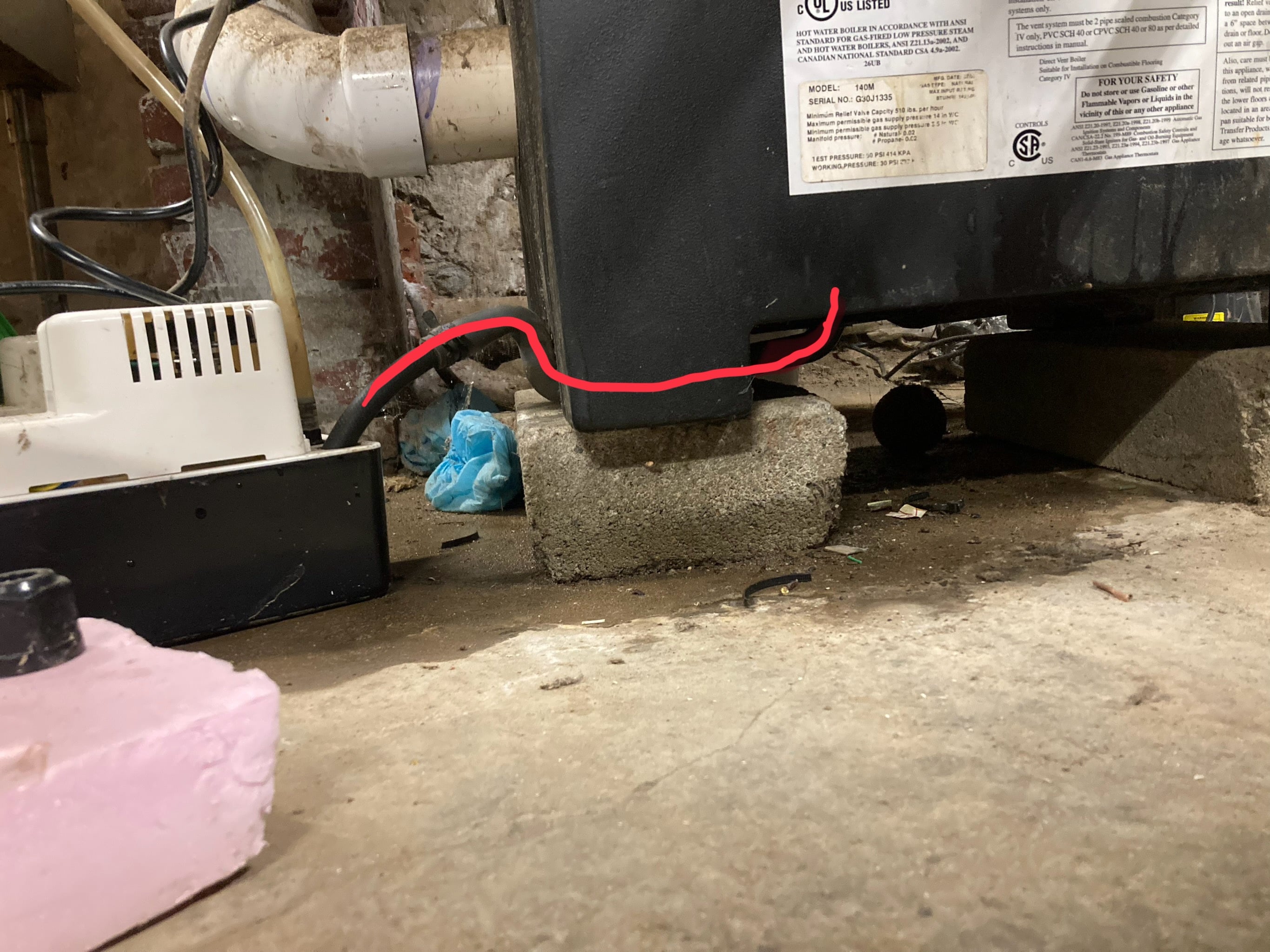
I tried getting a view of the internal side of the drain line with my endoscope; it looked a little bit rusty, but the view was not good. If I'm understanding this correctly, I'll need to disconnect the exhaust and tear out the insulation to get to the internal trap (which seems like a fair amount of work for annual servicing… am I misunderstanding something? Where is the trap and vent that the installation manual says to routinely check? I didn't want to learn this, which is why I called my plumber… but here I am anyway). I don't want to take apart the exhaust on a Sunday on the off-chance that some parts have deteriorated and I won't be able to get replacement parts today.
@hot_rod 3 floor Victorian twin (1895) with roof insulation and a mix of modern and original+storm windows. 2800sq ft. My retired plumber friend said that the 60k sounds very low, so maybe I did the math wrong. Design temp 14 degrees.
Edit: Ok, so this drain line seems to have its own trap? Should I just cut off the riser?
 0
0 -
Fuel use based load calcuations are the most accurate method for heat loss for older structures unless you have something like an MCM house with walls of glass. It makes sense, the fuel the you use is burned for heat, that heat is needed to make up for the heat loss from the house.
It doesn't matter if you use a very cold month even if bellow seasonable. The math normalizes based on HDD and design temp, so the result is about the same. The only thing that would change is the efficiency of the a modcon which decreases slightly with ODR when it gets colder.
A house at 20btu/sqft is actually on the high side for older house, there is probably a lot of low hanging fruit in terms of efficiency improvement.
0 -
The UFT-80 control menu has an option to view operating %. May be one available on the Munchkin.
0 -
Of course you need (2) circulators because that's why you are required to pipe it in a primary/secondary piping method. So you need to a primary circulator to ensure proper flow thru the boiler and a secondary circulator for the heat loop(s). If its piped with just one circulator it ain't installed correctly but obviously getting enough flow to prevent flashing and hi-limit trips. Not the recommended approach for mod/cons.
And yes the red line is the trap location. it's a preformed rubber trap
0 -
Certainly the case with high head boilers. Converted gravity systems with FireTube low head heat exchanger work fine with single pump.
0 -
I am not here to bad mouth plumbers but a lot of plumbers know 0 about heating. There is no heating questions on a plumbing test.
And a lot of installers (plumbers or not) just don't want to bother with working on a MOD CON.
You best bet might be to post your location and check "find a contractor" on this site.
A lot of installers will not bother with a heat loss they see no value in it. It is early summer, so you have time on your side to look for the right installer and the right boiler.
0 -
the color of the PVC says the exhaust is at the upper temperature limit if not beyond.
0 -
The drain spud on the bottom of the boiler sometimes leak. Is the boiler level?
Using the guesstimate of 20btu/ ft the load is 56,000
At 25 btu/ ft, 72,000
Well within an 80,000 boiler size
Bob "hot rod" Rohr
trainer for Caleffi NA
Living the hydronic dream0 -
@pecmsg Thanks for noticing that one!
@EBEBRATT-Ed Last time I checked for contractors, no one was anywhere nearby, and the closest one wasn't licensed to operate in the city.
@pedmec Yes, I know it's supposed to have two circulators; it's one of the many things wrong with this install. It's almost like every time you look at it, you find something new. Just from this picture, pecmsg caught what seems to be an exhaust PVC issue, and I found that the condensate drain line bumps up and creates a second trap (see photo), which I've been told is not how it's supposed to be. The pressure relief valve also had an iron drain pipe (which my plumber said created risk due to rust particles)
As much as I'd rather have the money in the bank, I'm waiting for this thing to go bad just so that I can get a decent install.
0 -
is this for a combo boiler(heat & domestic hot water) or a stand alone boiler? Cause Burnham Alta comes in a 150k so there isn’t a reason to use the 180.
Unless you’re putting a Combi in and it’s being sized based on your domestic hot water needs0 -
The boiler always sizes to the largest load, in some cases that is the DHW load. If you go with a combi, then the boiler needs to size to the DHW gpm you desire at the temperature rise typical for your area. In some cases a 120,000 can get you 2 gpm or so DHW.
A 199,000 if you want 4 gpm or more.
Bob "hot rod" Rohr
trainer for Caleffi NA
Living the hydronic dream 1
1 -
I came here to say that, if you make dhw with the boiler it may need to be bigger to accommodate that, ori ideally you'd size the boiler to the heating load and get the dhw required with a bigger indirect tank. Keeping the indirect cooler also lets you keep the mod con in the higher efficiency range. If you are running fin tube for heating near 180f you likely will get mid to upper 80% efficiency out of the modcon, not the 90%+ you can get with lower temp emitters.
0 -
First, the Munchkin manual does give a diagram using one pump. However, not, did I say not, the preferred installation. Secondly, it should be on outdoor reset.
If the leak is under the cabinet, then there is a failure of the silicone tubing or I guess the red tubing from the heat exchanger to the disposal drain. I have replace several of these drain hoses. Not a simple (easy) job if the unit is sitting close to the ground or support stand. The hose can be purchased at Jupiter Heating ( Part #7250P-7724). It is an after market adaptation as the original rubber hose is out of stock. You could make one.
The heat exchanger should be cleaned, not more than 3 yr intervals. I schedule cleaning at 3 yrs.
You don't have to take it all apart, disconnecting everything (Gasp). No removing the HX from the insulation. Just go under the cabinet and look for the stainless nipple that protrudes under the rear of the cabinet that the drain tube is connected to. Remove the clamp and take the existing hose off. Install the new hose assembly, WALLA, so simple any moron could do it, which is probably why I excel at it.
If you clean your Munchkin, your Munchkin will take care of you.
0 -
The original munchkin piping diagram does not show one circulator. I have the original installation manual when i installed it and it does not show one circulator. they always wanted to ensure proper flow thru the boiler. i would like to see a piping diagram for a munchkin that shows one circulator.
0 -
Average DHW use is about 2000BTU, so if you have an 80k burner, that takes about 1/2h to recover. You do loose space heat during that time but no house would notice that dropout.
The time you need to add extra burner capacity for DHW is when you have a combi.
0 -
agree, I’ve got that extent configuration. With the 40 gal indirect tank @135F/mixed to 115F, the boiler can fill a tub and keep up with two showers for 20 minutes before temp stays to roll off. I’d probably gone with a 100k if installing another for bit faster tub fill recovery.
0 -
@pedmec, I stand corrected. I went thru all the installation manuals up to Vision 3 and they were all primary/secondary with 2 pumps for ZV zoning.
Now you have me wondering. A homeowner who installed his own Munchkin and zoned with ZVs that I serviced had only one fixed speed pump. I told him that the Munchkin was piped incorrectly, that he needed 2 pumps. He showed me his installation booklet and it showed one pump as I recall. I was surprised.
Now, I can't sleep and have to double check my assumption. I know the fellow.
0 -
cast iron rads, for the curious. tenants on the third floor, and current setup is a slightly undersized tank with a (broken) mixing valve. does alright as-is, but HW runs way more often than makes sense to me (but I also need to replace a sometimes-dripping hw bath spigot. but i don’t think that’s loosing more than a gallon a day or so)
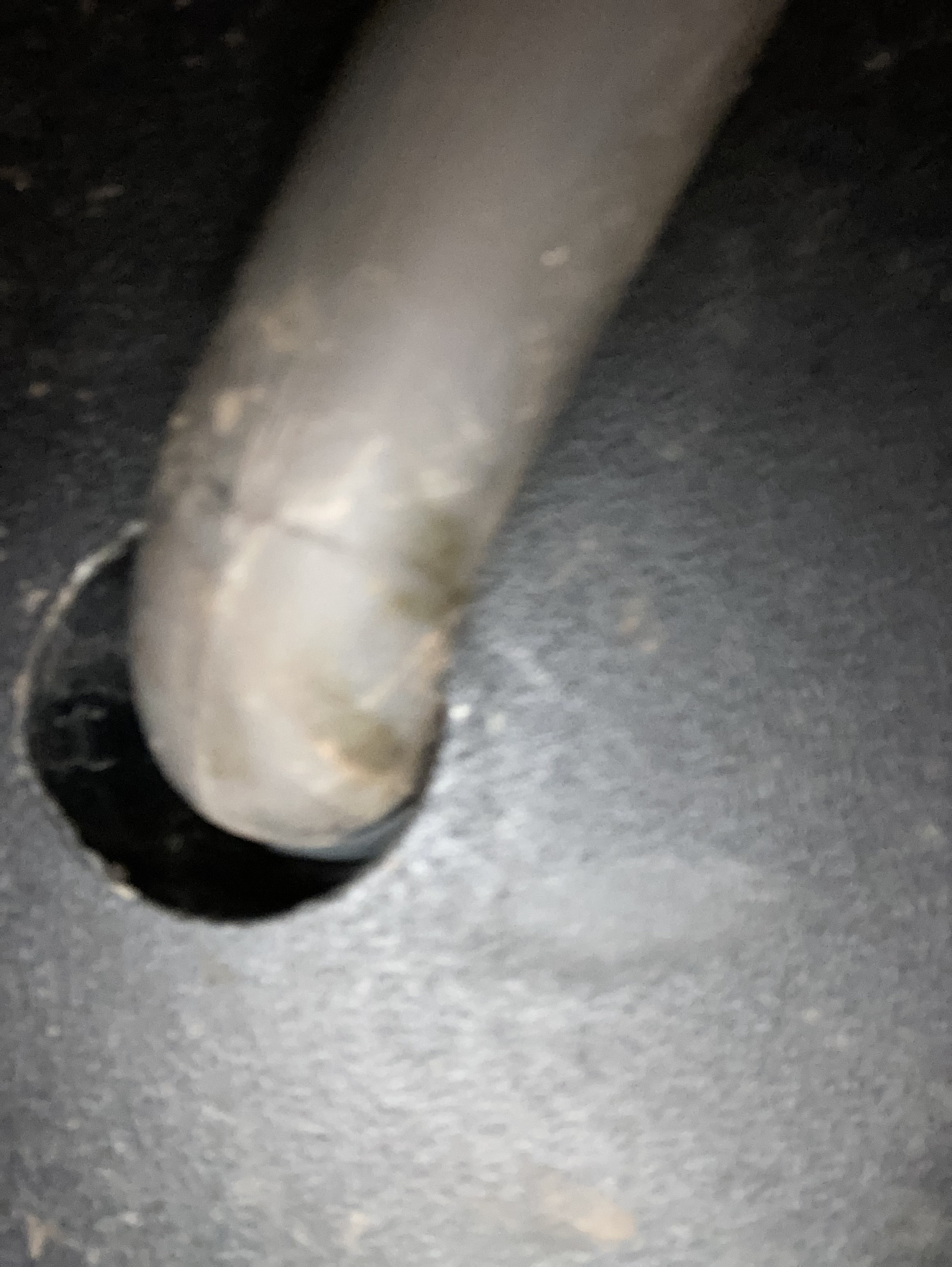
@HomerJSmith sounds like a job I’m qualified for… but under my boiler doesn’t look like I’d expect it to given your explanation. Here’s a shot from under the cabinet looking into the join of the drain to the hose. No clamp (maybe there’s one partially visible just inside the cabinet?)
. I think I might’ve seen a clamp when i tried to shove my endoscope in between the heat exchanger and the insulation… hard to say. Let me know if this is installed incorrectly, because it will add to my tally of “every time you look at it, you see something else wrong with the installation.”
also @pedmec (and homer) I just took a look at the vision 1 and munchkin install diagrams and it looks to me like they all have two circs.
 0
0 -
I service a 2006 Munchkin 199 that has only one pump.
The I&O manual had a piping diagram showing only one pump.
The pump the supplier sent was an Astro 50.
The original installer handed this boiler service off to me a few years ago.
It was cycling on high limit, I lowered the operating temp.
Other than waterlogged exp tank there has been no failures or problems.
Not even coffee grounds, original target wall. New spark and flame rod.
20 years out of a Munchkin…..🤔…..any day now.
0 -
regardless of what the piping diagrams show it is a flow dependent boiler and so must be piped in a way to have the correct flow through the heat exchanger, most replacement jobs it would be pretty hard to guarantee that without P/S piping. If you know the flow requirements for the system you can figure the required pump easy enough to direct pipe most water tube boilers. I've run into issues with direct pipe applications on occasion and the installer or owner will typically show me the diagram showing direct pipe as though that means the boiler will work in any direct pipe application. Not always the case but if it works, it works!
0 -
@GGross Exactly, best way of putting it. a flow dependent boiler. Much like all water tube boilers. I have had discussions with HTP back in the day and if you weren't piped primary secondary they wouldn't even talk to you until the piping was corrected.
For some reason in my area a lot were installed like you would a cast iron boiler. They were sold thru the Portland Group which is down the street from me and you would hear guys bitching about the munchkin because they were all problems. Nobody bothered to open the installation manual. Remember this was the early days of the Mod/Con and you just couldn't explain to the old timers that these boilers are different.
1 -
Munchkins serving low mass, high temperature systems tend to age better than high mass, low temperature systems. Makes sense since you will probably get little or no condensing with high temperatures. No acidic condensate to eat away the stainless steel HX.
I wouldn't be surprised if you get 25 years out of that Munchkin.
8.33 lbs./gal. x 60 min./hr. x 20°ΔT = 10,000 BTU's/hour
Two btu per sq ft for degree difference for a slab0 -
That's pretty much my experience as well. and despite so many install issues so many of them are still up and running! 20 years, piped wrong, under pumped, probably never cleaned, combustion never checked, still runs can still get most parts lol. it sucks when you have to replace them because nearly all of them in my area got a little table built under them so even if they were piped right we'd have to re-pipe them.
1 -
@JUGHNE Post the pic because i would like to see it. I have a 2005 and its not in my manual. single pump set just a few years ago got introduced by lochinvar on their FTXL boiler. If you have the ftxl you can have an external VFD communicate with the add on device to load match the circulator with the demand and maintain a fix delta T
0 -
The boiler and book are 10 miles away.
If possible I will get the book.
It has been cleaned, and as I stated has no coffee grounds, original target wall.
I did change spark and flame rod.
0 -
SENorthEast1895er, thanks for the pic. I have never seen that. The stainless nipple has always protruded below the case. Perhaps, the boiler was installed in an incorrect position. Removing that silicone tube is problematic as the clamp is out of reach. I wouldn't be looking forward to replacing that.
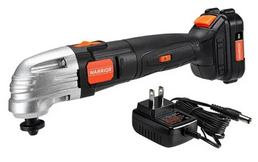
If I had to do it, if I couldn't shift the HX, I would use a multi-purpose tool with the blade at 90 deg and cut the case around the tube, about 3" square to access the clamp.
0 -
Oh, @HomerJSmith , you're a genius. I think I'll give that a try. As promised, the closer you look at it, the more you find wrong with this install.
Regarding the old and incorrect Munchkin installs: My boiler was running at high temps (and high mass: cast iron) until about 2-3 yrs ago (when we bought the house) when I used the ZVC to bypass the dual-circ limitation on running the ODR. Probably got its first service then, too (certainly first since the previous owner of 7 yrs).I've been getting it serviced annually and it's been looking good so far.
Correct me if I'm wrong; doesn't this thing just get Cast-Iron levels of efficiency if not condensing? And, if so, you've just wasted a ton of money on a short-lived 88% efficiency boiler, no?
0 -
it is a little bit more efficient than a ci boiler but not a lot at high temps. it can run lower temps on high temp emitters some of the time with odr in most cases so it gets a bit more efficiency that way. the efficiency bump is from condensing the moisture in the products of combustion and recovering the latent heat of vaporization. you can usually get some of that some of the time. the other advantage is that it can run fewer and longer cycles. there are some losses in the heat in the system when it shuts down that doesn't make it to the conditioned spaces and that has to be replaced when it starts up again. those are less in a mod con because of the lower mass. those can be somewhat significant in a ci boiler especially if it doesn't have a vent damper where it will pull much of that heat up the vent.
so it is more efficient but probably not enough so to pay for the increased costs of maintenance and shorter lifespan. of course if you can avoid dealing with a failing chimney by installing a modcon it can be a lot less costly.
0 -
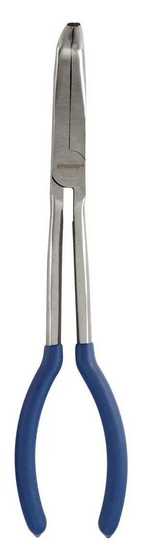
SENorthEast1895er, I have two muli purpose tools that I bought at Harbor Freight. A great price. I would also use 90 deg Offset Long Reach Pliers to grab the clamp.
I think that the condensation thingy is a bugaboo. "… the efficiency bump is from condensing the moisture in the products of combustion and recovering the latent heat of vaporization." That's the conventional wisdom. But I have my doubts.
0 -
In the winter my mod/con produces 5 gal of condensate in 3 days and in the off season it produces 5 gal in one month, hmmm. What's going on? Ya, it's working harder in winter, but… What causes condensation? Is it when the temperature falls below the dew point? Is that what happens in combustion? The temp of combustion drops? Is it because the cold water in the HX cause the combustion temp to drop, hmmm. What else causes the combustion temp to drop? There are so many BTUs in a cubic foot of NG, not a penny more. Hopefully they all go to heat the water in the HX, but, do they? Where else do those sneaky BTUs go? Why do we say that all boilers condense at some point in their heating cycle?
Homer, you're becoming un-glued.
0 -
Al, boilers are condensing boilers!
At least until they get up above the fuels dewpoint.
I think it was gentleman Jim from Burnham that started his seminars with that statement.
Efficiency gain with condensing would depend on how long it is running in condensing mode. On mild heating days it could run its entire cycle in condensing mode. The modulation function is a big plus on zoned systems. Cast boilers cycle a lot with multi zoned applications.
Some of the nicer mod cons data log that run time at various conditions to give you an idea.
I suspect many cast boilers run below, far below the 86% efficiency depending on zoning, sizing and actual temperature conditions in the area.
Bob "hot rod" Rohr
trainer for Caleffi NA
Living the hydronic dream3





Categories
- All Categories
- 87.8K THE MAIN WALL
- 3.3K A-C, Heat Pumps & Refrigeration
- 59 Biomass
- 430 Carbon Monoxide Awareness
- 132 Chimneys & Flues
- 2.2K Domestic Hot Water
- 6K Gas Heating
- 124 Geothermal
- 170 Indoor-Air Quality
- 3.8K Oil Heating
- 79 Pipe Deterioration
- 1.1K Plumbing
- 6.7K Radiant Heating
- 396 Solar
- 16.1K Strictly Steam
- 3.5K Thermostats and Controls
- 56 Water Quality
- 51 Industry Classes
- 51 Job Opportunities
- 18 Recall Announcements