Munchkin Diagnosis and Replacement Size Check
Comments
-
in a cast iron boiler, any heat you gained by condensing water out of the products of combustion you hopefully lose later when you reevaporate the water as the system comes yup to temp. you will lose it unless your system never gets up to a temp that is safe for the hx.
the latent heat of vaporization is significant, if you design the system to give you low enough return water temps to condense most of the water produced from burning the hydrogen in the fuel it is at least another 5% of heat. where you don't get the efficiency is if you designed the system wrong. steam systems work almost entirely off of the energy in that phase transition.
0 -
We installed two mod cons years ago to heat a 300000 gallon outdoor storage tank for sprinkler water. We maintained the tank at 50 degrees and the return water to the boilers was 85 degrees maintained by a 3 way valve.
The condensation just poured out of the boilers. They save so much money in the first year it paid for the job. 3 200,000 btu mod cons replaced an 1,500,000 gas fired atmospheric that was way oversized.
 1
1 -
What I am trying to get at, is. Mod/Con boilers are category 4 boilers. That is, they draw their combustion gases from outside the building and expel their combusted gases outside the building.
We can agree that condensation occurs when the temp drops below the dew point, and also, heat energy travels in a straight line to what ever is coldest, relativity speaking. Mother Nature seeking equilibrium. The effects of Heat Energy as measured in BTUs.
On a blistering cold day in the depths of winter, -5 deg day is not uncommon in my area. No, I don't live in Minnesota where the people. when the temperature get up to 45 degs, they put on their shorts and go out for a picnic.
That -5 deg air is coming into the combustion chamber where some of the BTUs are going to the HX and the bulk going to heat the incoming air (how is that economical)? Reminds me when I was a kid, at dinner, the older brothers got first choice and I was left with the scraps. Better if it all goes to the HX.
So, I think, it isn't condensation providing the economic benefits of a condensing Mod/Con, but the turn down ratio (ramping) and ODR. Of course, the modest water capacity of a Mod/Con as compared to CI helps.
0 -
it isn't like heating the air in the house if you use that for combustion air is free. the boiler had to heat that air too one way or another.
0 -
Weather a boiler takes inside air or outside air it makes no difference. The air leaving through the flue is replace by outside air either leaking in the house or intentionally brought in. That goes for any boiler.
A mod con runs at a lower flue temp than a CI boiler so it is putting less heat into the flue gas than a CI boiler so it has to be more efficient.

 2
2 -
With atmospheric boilers, we jumped through hoops to prevent them from condensing. With mod cons, I’ll do everything possible to make them condense like grossly oversize the radiators, run tubing at a tighter spacing than necessary and of course, outdoor reset.
But the boiler’s HX has to put up with the acidic condensate and should get regular cleaning. And choosing a boiler manufacturer that uses a robust HX is prudent. The current fire tube HX’s fit the bill.
“In the winter my mod/con produces 5 gal of condensate in 3 days and in the off season it produces 5 gal in one month, hmmm.”
I would check your settings if you’re running radiant. A 100,000 BTU boiler will produce a gallon of condensate per hour.
8.33 lbs./gal. x 60 min./hr. x 20°ΔT = 10,000 BTU's/hour
Two btu per sq ft for degree difference for a slab0 -
mattmia2, says, "…air is free." "The air, the air, is everywhere…", from the play, "The Dawning of Aquarius". The ultimate lesson on Supply and Demand. The demand is unlimited, but the supply is unlimited which is why it's free. If the air comes from outside or from in the house, regardless, it's going to be heated. If your supply temp is set at 120 degs, would it take more heat energy to bring that water to 120 degs if the combustion air is -5 degs or more heat energy if the combustion air was at household temp of 70 degs or the same?
EBEBRATT-Ed, where the combustion air comes from does make a difference in economy of operation which is what I'm saying. Why does a Mod/Con run at a lower flue temp than a CI given the same rating?
Alan (California Radiant) Forbes, why do you do everything possible to make them condense? There is a limit to heat emitters before you run out of heat energy. It's like the train analogy, a train pulls into a station and a bunch of BTUs get on board. The train get to the next station and a bunch of BTUs get off. It get to the next heat emitter and a bunch more get off. It gets near the end and no BTUs get off. There are still BTUs on the train that want to get off, but they don't. Why not? Maybe because the loading dock is so crowded with BTUs that there isn't any room on the dock for the ones left on the train to exit. It's called stasis. The room is the same temperature as the train. Temperature is the motor that moves BTUs from one point to another. But you know all that. I have fin tube baseboards with an indirect.
0 -
@HomerJSmith Interesting supposition. If you have outdoor reset driving your system and if properly set up, you should never reach stasis, even at warm weather shutdown (WWSD) as long as the room temperature is colder than the water temperature.
If you haven't sized your supply and return piping correctly, the convectors or tubing will be starved of heat. Heat transfer is a function of temperature differential between the emitters and the air temperature. So, in your example, if the loading dock is the same temperature as the water on the train, the BTU's will not jump off.
If I've sized my emitters properly and have chosen the correct heating curve and the thermostat is calling for heat, there is plenty of room on the loading dock for the BTU's to jump off and warm the room. And if my radiators are larger than they need to be or if tube spacing is tight, I can heat the room at low water temperatures, allowing the boiler to condense.
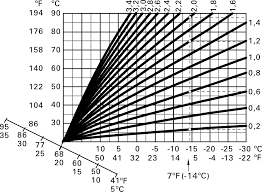 8.33 lbs./gal. x 60 min./hr. x 20°ΔT = 10,000 BTU's/hour
Two btu per sq ft for degree difference for a slab1 -
The same boiler heats the combustion air weather it is through the combustion process taking in cold outside air or taking the air from inside the building using indoor air.
Mod cons have a heat exchanger designed to lower the flue gas temp so moisture in the flue gas will condense. its designed for that purpose.
2 -
in no world is the bulk of the burner heat going to heat the combustion air (at least no more than any other heating system which is by design technically heating the outside air via structural heat loss), those boilers would be terribly inefficient if that were the case. you can choose not to believe the hundreds of papers and thousands of hours of research if you want but it won't change reality. welcome to stop by my house on a -20 f day and clock the meter, measure flue temps and see for yourself. the bulk of the burner energy goes to the heating system, 3-8% out the flue depending on how much I am condensing.
No matter the boiler, when you are expelling air from a house, which is what a flue does, there is makeup air coming in to that house. if you have no other heat source then the boiler the boiler is always heating that air. direct venting just means you can control exactly where that makeup air is coming from.
2 -
The concept of a condensing boiler is it has a secondary heat exchanger that the flue gases pass through extracting the additional heat so your flue gas runs around 10° or so of the boiler operating condition.
A conventional boiler 400° or so flue gas temperature.
I too have seen a fair share of direct connected Munchkins, other brands also. Properly pumped, assuring proper flow and temperature ∆ across the HX they will work fine.
I recall Dave Davis of HTP had a direct piped Munchkin heating his swimming pool, back in the early wild west days of condensing boilers.
Bob "hot rod" Rohr
trainer for Caleffi NA
Living the hydronic dream1 -
Reading the discussions of condensing boilers, I saw no mention of the term "phase change".
Phase change has been a property of heat transfer for a long time.
Starting with steam systems, the boiler (evaporator) turning liquid water into steam (vapor) by absorbing heat from the fire, then the steam goes to the radiators (condensers) to change back to the liquid water giving up heat to the room.
And in this process gives up more BTU's in the form of latent heat as condensation occurs. (And we know this has nothing to do with burner efficiency)
Jumping to cooling (or heat pumps), we get the same process as with a steam boiler. Different hardware but the same principle of phase change. Condenser outside giving up heat and evaporator inside absorbing heat. (reverse coils for heat pumps).
It is just at the other limits of temperature/pressure, but the same principles.
One of the first 90% furnaces I installed had the condensate being temporally collected in a bucket. One man saw this and wanted this design of furnace in his basement because it looked like a good dehumidifier. I tried to explain to him that that water did not come out of the air, but rather the furnace was making water. He gave me that "you're crazy" look.
Many people think the water dripping out of the car tailpipe on cold start up is cheap gas with water in it…..no it is being made by the engine combustion process until it is warmed up.
The point of all my rant/rambling here is that the extra 10-15% efficiency of condensing appliances comes from the phase change of gases to liquid.
This bell went off in my head about 40 years ago and helped me start to understand HVAC and steam…..still working on it though.


 5
5 -
i mean i did, i just said latent heat of vaporization.
0 -
Matt, your right……I see it now.
0 -
When condensing or evaporation is said, that's another way of saying phase change and phase change is all about latent heat.
8.33 lbs./gal. x 60 min./hr. x 20°ΔT = 10,000 BTU's/hour
Two btu per sq ft for degree difference for a slab0 -
@HomerJSmith Yea, I have a multitool already, but no 90 degree blade. But, given my complete ignorance of how much clearance I have on the internals, I was thinking of trying to avoid powertools and get a handle for a jigsaw blase or similar.
Was thinking about getting a pliers as you suggested, too, so good to know I'm not too far off base.
0 -
@HomerJSmith yea, I have a multitool and was considering the angled pliers. Was thinking about 3d printing a handle for a jigsaw blade to cut the case by hand. I have no clue how much clearance I have inside there, and the worst-case scenario with a powertool is pretty bad.
0 -
@HomerJSmith yea, I'm going to run out to HF to get some angled pliers tomorrow. Might try to 3d print a handle for a jig saw blade and cut it open by hand. I don't have the faintest clue of where things are inside there, or how much clearance I have. Makes me hesitate to use any powertool.
EDIT: didn't realize this got onto a second page.
0 -
you can buy a handle that clamps on hacksaw blades or reciprocating saw blades
0 -
@mattmia2 yeah, I know. I've got one for hacksaw blades, but not enough clearance to use it effectively. Hence the jigsaw.
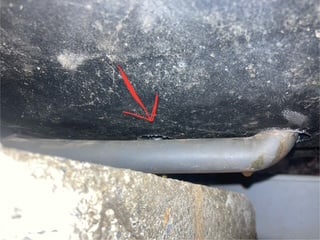
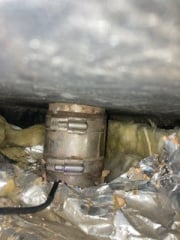
Started going at this this am and didn't get far before I wanted to post on here with more info (to see if I'm barking up the wrong tree, before I put too much effort in.)The insulation seemed dampest below the exhaust coupling (to PVC, see photo). It was wet on it's top side, leading me to suspect that the exhaust coupling is leaking or the leak is so bad it's puddling inside the housing. But there are two holes for it to drain out of (photo below), so I really doubt it's puddling enough to get the top side wet.
The second hole is immediately under the exhaust coupling. There is evidence of dripping from both holes, and I'm considering the possibility that the "unused" hole was dripping first, but slower and much less noticeable due to placement (and that the leak has progressed to the point where the second hole is also dripping off the bottom of the pipe). There is a light brown discoloration (mineral deposits? dirt?) on the cinder block directly under that hole. You can see it in the photo; it's the light brown streak running down the side of the cinderblock.
I'm guessing that the condensate pipe is supposed to go through the "unused" hole, which would then join up directly with the exhaust. I anxiously await someone telling me more about how this is installed incorrectly.
I've turned off CH for the past few days, so only using the boiler for HW (not a problem, it's that time of year anyway). Water is still collecting on the bottom of the condensate line, though not enough dripping to keep the floor damp (obviously b/c I'm not condensing except at startup). Of note: the drip is now clearly a dark brown. I do not remember there being any obvious coloration prior to turning off the CH.
 0
0




Categories
- All Categories
- 87.8K THE MAIN WALL
- 3.3K A-C, Heat Pumps & Refrigeration
- 59 Biomass
- 430 Carbon Monoxide Awareness
- 132 Chimneys & Flues
- 2.2K Domestic Hot Water
- 6K Gas Heating
- 124 Geothermal
- 170 Indoor-Air Quality
- 3.8K Oil Heating
- 79 Pipe Deterioration
- 1.1K Plumbing
- 6.7K Radiant Heating
- 396 Solar
- 16.1K Strictly Steam
- 3.5K Thermostats and Controls
- 56 Water Quality
- 51 Industry Classes
- 51 Job Opportunities
- 18 Recall Announcements