Welcome! Here are the website rules, as well as some tips for using this forum.
Click here to Find a Contractor in your area.
If our community has helped you, please consider making a contribution to support this website. Thanks!
2 pipe vapor style. Slow return issues

I have a historic mansion I’m working on. Basically a full on heritage restoration. The owner loves antiques and is fully on board with doing everything necessary to return this heating system to the way it operated during the Truman administration.
2 pipe radiators. Supply main and dry return run parallel to the far end of the basement. Traveling away from the boiler. Hangers got messed up during abatement procedures and I have since re supported them properly. End of mains have crossover traps which I’ve replaced. Supply main drip connection passes through an f&t and then drops into the wet return. Dry return has end of main b&j big mouth and then drops into independently into the wet return. With the mains running parallel to the far end of the basement, that setup yields a long wet return. It’s 11/2” copper and I have flushed it. It’s all exposed and I’d guess was installed in the 80s/90s. I have a 35 1/2” a dimension (at least from static cold water line)
while steaming water leaves the boiler faster than it returns. People have been battling this for years as evidenced by a bunch of different attempts. One guy even installed a solenoid valve on the wet return and a timer to dump condensate to waste periodically. Which I couldn’t make sense of and have removed that atrocity.
All the radiator traps have been replaced and all the main vents have been replaced. As well as crossover traps, and ft traps.
I don’t believe this system was intended to have the ft traps originally. I think its a vapor system that has been bastardized through the decades. No Dunham 1a or the like exists.
There are check valves at the base of the drip connection and my theory is that…they are preventing water from stacking up the drip connection while steaming and as such not building enough head to shove water in the boiler. Also compounded by the long and likely undersized wet return. It’s about 100’ or so maybe more. Thanks in advance for your thoughts
THINK

Comments
-
also I installed a vaporstat and am trying to get the system psi as low as possible. After installing the vaporstat I found the original on a shelf in the basement full of old parts. The cut out and diff were maxed out and when that didn’t work they switched to a pressurtrol
THINK
 2
2 -
I would think that it's not really an issue of slow return but rather the pressures the boiler is reaching are pushing water out the bottom of the boiler into the wet return. What pressures are you seeing during long calls for heat?
I'll be interested to see what @Jamie Hall and others have to say.
NJ Steam Homeowner.
See my sight glass boiler videos: https://bit.ly/3sZW1el0 -
I saw the same behavior from original settings on pressurtrol (1-2) and on vaporstat operating at 2 oz. The equalizer should keep water from pushing out the boiler. That being said the near boiler piping is incorrect. Not the worst I’ve ever seen. I’ll be repiping it in the next few days. Probably done by Monday/tuesday
THINK
0 -
The equalizer should keep water from pushing out the boiler.
I'm sorry to let you know it doesn't do that. I know you've read differently. But if there is 1-2 psi in the boiler (for a 2-pipe system only) you will push water out the back. It depends on the details of the system.
I wouldn't trust the vaporstat and definitely not a pressuretrol to be operating where it says it is, you need a low-pressure gauge to verify.
NJ Steam Homeowner.
See my sight glass boiler videos: https://bit.ly/3sZW1el0 -
It’s a catalog town we’re in and I’m waiting for my wholesaler to get the low pressure gauge. Should be here tomorrow. For today it’s good old fashioned Kentucky windage.👍🏻I will consider what you have said and appreciate the input
THINK
 1
1 -
My low pressure gauge is $14 from Amazon, I'm in a catalog town too I guess 😀
NJ Steam Homeowner.
See my sight glass boiler videos: https://bit.ly/3sZW1el0 -
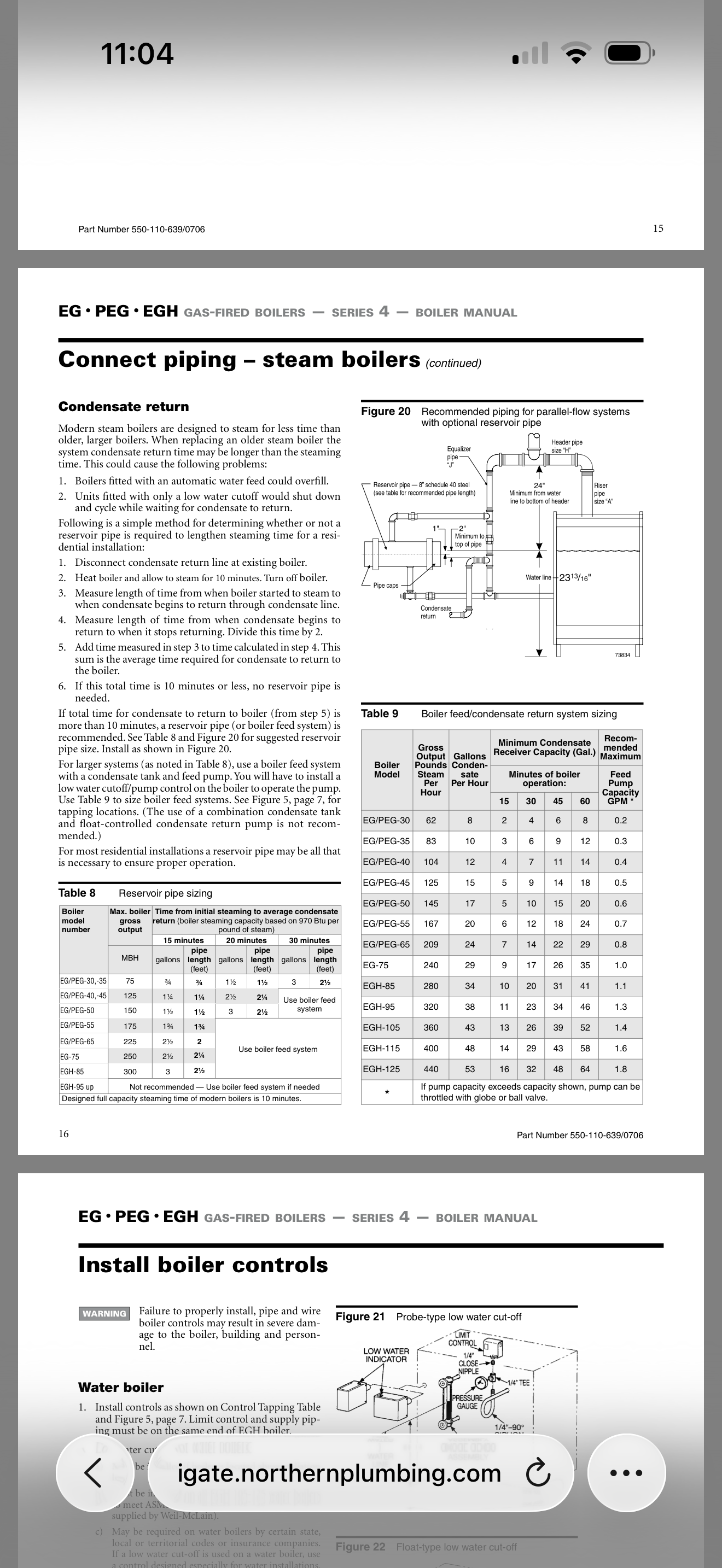
Any thoughts on the reservoir pipe? I’d really like to get this right without a boiler feed unit
THINK
0 -
How large is the system in sq ft of steam?
My general feeling is that 99% of the time such things aren't necessary at all…after all for large systems you buy a larger boiler that has a larger water reservoir.
I'm not saying there are zero cases where such a thing would be necessary, but I am saying that many many times I think people think their systems don't have enough water in them mistakenly.
NJ Steam Homeowner.
See my sight glass boiler videos: https://bit.ly/3sZW1el0 -
I haven’t measure the radiator yet.I'm getting there though. 26 pieces of equipment. Most are cast iron rads but there’s ~6 copper tube convectors. 500k btu boiler that I’m sure is oversized.
THINK
1 -
what kind of valves are on the radiators? a vapor system should have vapor valves although the traps on the radiators will mitigate that to some extent.
don't think the f&t trap or the check valves belong there. there will need to be enough condensate stacking up behind the check valve to open it and allow it to return. could also maybe cause some issues with air not being able to get behind the water to let it drain in to the return while the trap is closed.
if whatever device is keeping the differential between the mains and returns within the design of the system is working and still there (the vaporstat can do it on its own if the device is missing)and the water line is where the wet returns were designed to have it and it really is a vapor system it shouldn't need the f&t trap
the original race to the bottom with pressure likely had to do with bad traps and return vents because if the air can't get out if you crank the pressure up enough it compresses that air that cant get out and you get a little bit of heat
0 -
Oh dear. Well, lose the F&Ts. Drop straight down, and let gravity do the work. Also lose the check valves.
I hope your vapourstat is the 0 to 16 ounce variety. Try setting it to cutout at 8 ounces and a differential of 4 ounces.
Now. Water level in the boiler and "slow" returns. This is not at all uncommon a problem — in fact, my own Cedric does this. My own theory is that what we are really seeing is a mismatch between the original, probably SUV size boiler and a modern boiler, rather than a real slow return problem. What needs to happen is that you need to watch the boiler when it is steaming. There are two possibilities. The hopeful one is that what will happen is that as the boiler starts to steam and fill the system the water level will drop but, once it is steaming merrily — say 5 to 10 minutes — the water level will not drop further, but sit there, probably bouncing gently, but just sit there. Then when the boiler stops, the water level will gradually return (may well take 10 or more minutes) to where it was in the beginning. Now if that is the case, take a really close squint at the sight glass and see if it possible to set the cold static level high enough — perhaps even only an inch or two down from the top — so that when it is finally steaming along the water level is just above the marked line on the boiler. The key here is that that marked line is the intended steady state steaming water level — not necessarily the cold fill level..
Now it may be that there isn't enough headroom in the boiler to do that — that if you set the static cold level just below the top of the sight glass it drops too far when running, but is stable. That's not a slow return — that simply a modern boiler with a small water volume arguing with a heating system with a large volume. The solution to that is simple enough: add a water reservoir tank to the system set with the centre of the tank at the boiler water level, connected to the wet return and equalized. No pumps, no valves, no switches — just a tank and a couple of pipes. How big? Probably a 20 gallon tank, half full…
The last possibility is that you genuinely do have slow returns, but that strikes me as somewhat unlikely. Inch and a half sounds small, but really isn't. Even a really big residential boiler — say 300,000 BTUh — produces less than a gallon per minute of condensate.
Br. Jamie, osb
Building superintendent/caretaker, 7200 sq. ft. historic house museum with dependencies in New England 3
3 -
I’m mopping what you’re spilling. Basically exactly what Weil McClain points out in their manual about the reservoir tank right Jamie. I posted a screenshot above. As to the ft traps…this all started as a quick no heat call. They actually have a delay timer interrupting power to the gas valve to help this issue that a weary serviceman installed ages ago. It’s been there ever since. One day it went bad and I was dispatched to this house. I thought “well that’s queer, what else is going on it this building?” Got digging and found the ft traps and they were packed full of mud. Not knowing the system the way I do now, I cleaned and then replaced.
My question is..if they’re not hurting anything can I just leave them? I can’t return them. Check valves are coming out now
THINK
0 -
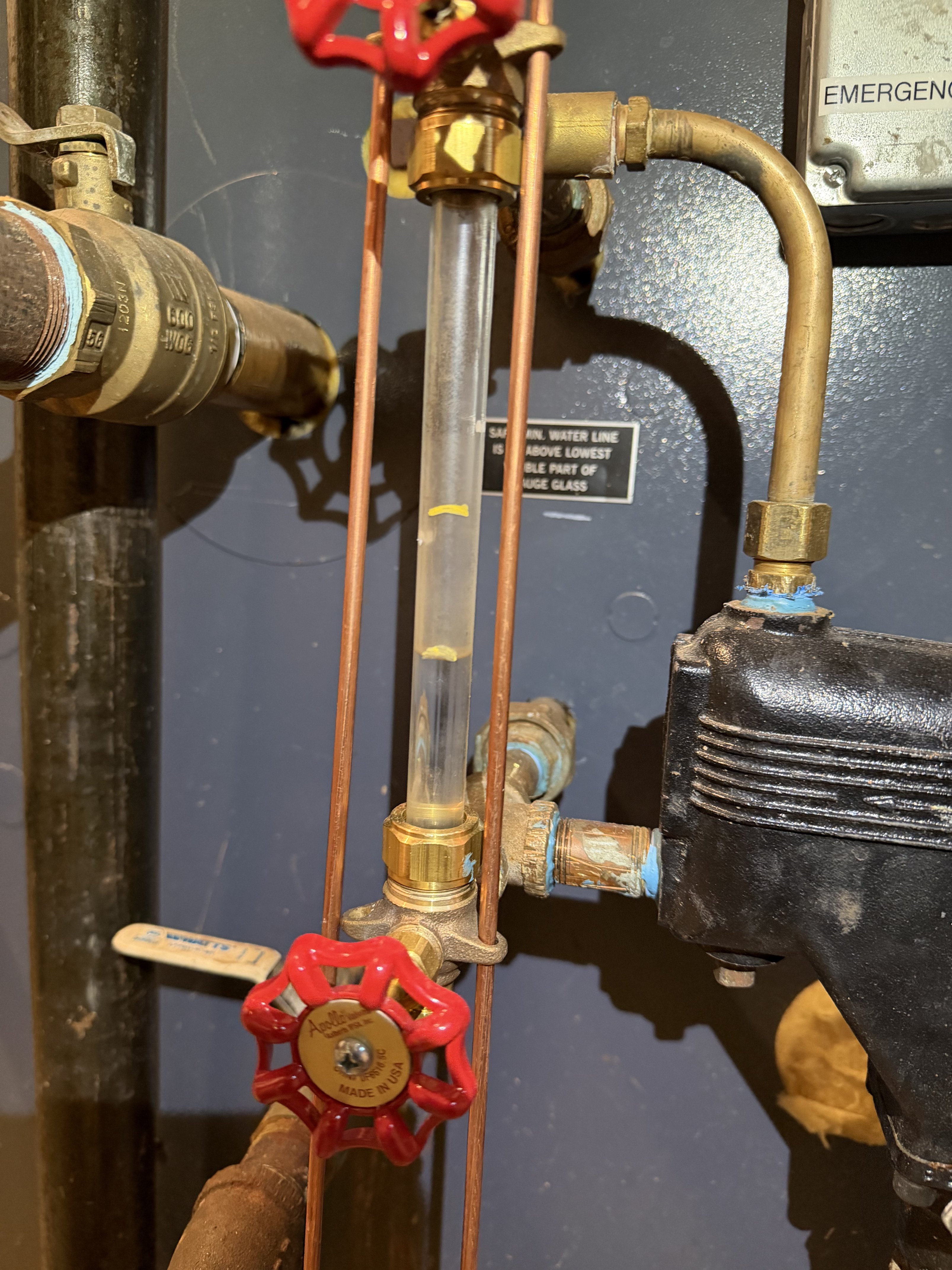
Also you’re spot on with condensing time taking a long while to get back home. After the burner stops it takes a good 20 minutes to get back. And the system seems to hold water as well. For instance. If you fill the system cold to the water line which is 24” as specified in the manual(23 13/16”) from the floor. Let it steam for long enough to get all the rad hot. And shut it off overnight. It’s not back to the original water line. The two yellow paint marks in the picture show that
THINK
0 -
Have you considered it's not slow, that it's leaking somewhere very bad? That last description you gave would indicate a leak to me. If it was holding water anywhere, you'd see that behavior once, as that volume would just continually be out in the system. If you are consistently seeing it lower the next day, that's a leak, or a bunch of small leaks. If those 2 lines are from one day of usage, I'd say a fairly major leak or leaks.
0 -
Sorry I need to clarify. You’re absolutely right to say so. I was hunting for leaks the first day, certain I would find one. Nothing yet…returns are all above the floor now.
THINK
0 -
@KC_Jones has a very definite point. If I looked at the situation with your picture and the two yellow lines — a leak. If you have to add more than a couple of gallons of water per week, you have a leak — possibly in the boiler above the water line.. More research is needed here.
And on the F&Ts — yes you can keep them, so long as you are sure they are open to condensate flow and stay that way, and that they are closed to steam…
Br. Jamie, osb
Building superintendent/caretaker, 7200 sq. ft. historic house museum with dependencies in New England0 -
you could be leaking steam somewhere or in many small somwheres. there also may be stuff that needs to fill up from condensate that will not fill from the wet return so it may not be unusual for it to not all come back for the first several cycles after something has been drained.
0 -
agreed more information is necessary
There is one short section of under slab wet return that is under asbestos tile. I did some shop vac investigating at each side of it if you know what I mean. It passed the sniff test, but I recognize that as a half measure.
interesting about steaming out the flue. In the draft hood I don’t see anything obvious. I’m gonna pull the jacket and look into that further. I was more leaning to what Mattmia said about condensate setting out there for the first few cycles.How do you guys feel about press fittings on steam jobs? I’ve never done one, only ever used screw pipe.
THINK
0 -
megapress can be used on steam but it is very pricey
the test for a leak above the water line in the boiler is to flood it (fill it up to the steam riser out of the top of the boiler) and wait to see if water drips out somewhere. The leak in the wet return would be diagnosed by filling it above the hartford loop (assuming no false water line) and see if it falls overnight or so
I would highly suggest you get and read "The Lost Art of Steam Heating".
0 -
thanks Mattmia. When I say press, I of course mean mega press. It’s just…idk. I like traditional. I still sweat all new installs as long as it’s not a time crunch and has to be on in one day. Call me old fashioned. I haven’t flooded the boiler yet but did pull the jacket and flue collector. Nothing telling while inspecting the castings. It definitely doesn’t have a false water line. I have all of Dans work besides “we got steam heat” A month or so ago, I installed a water meter in the make up line. It fed 3 gallons but I think that was the caretakers doing. I really don’t think it’s leaking anywhere at this time. I was surprised to come to this conclusion early on in troubleshooting. I was certain I would find a leak after watching it steaming.
One other thing to note. There is the original 10 section Spencer coal boiler still piped into the near boiler piping and it is valved off from the system.
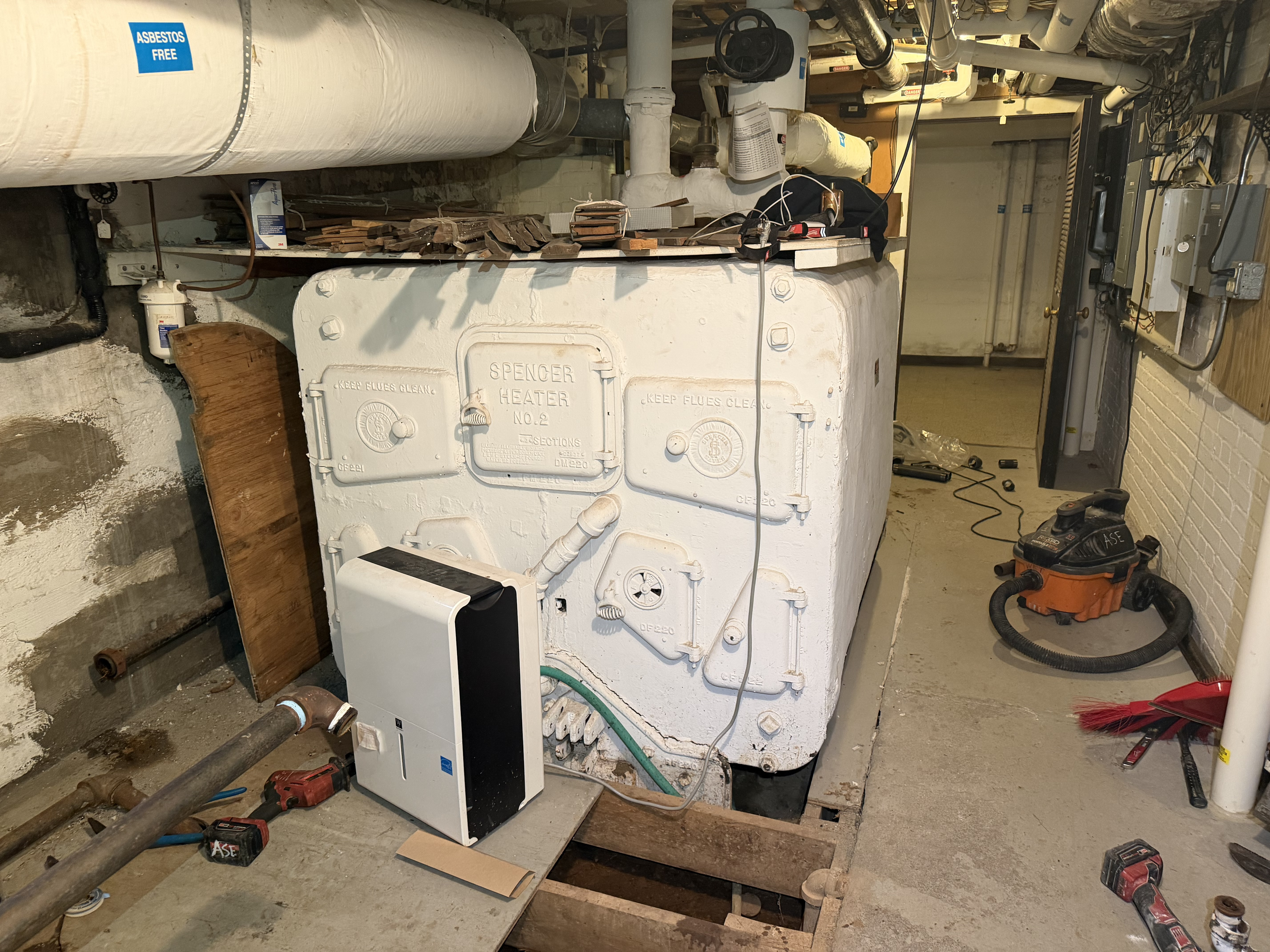
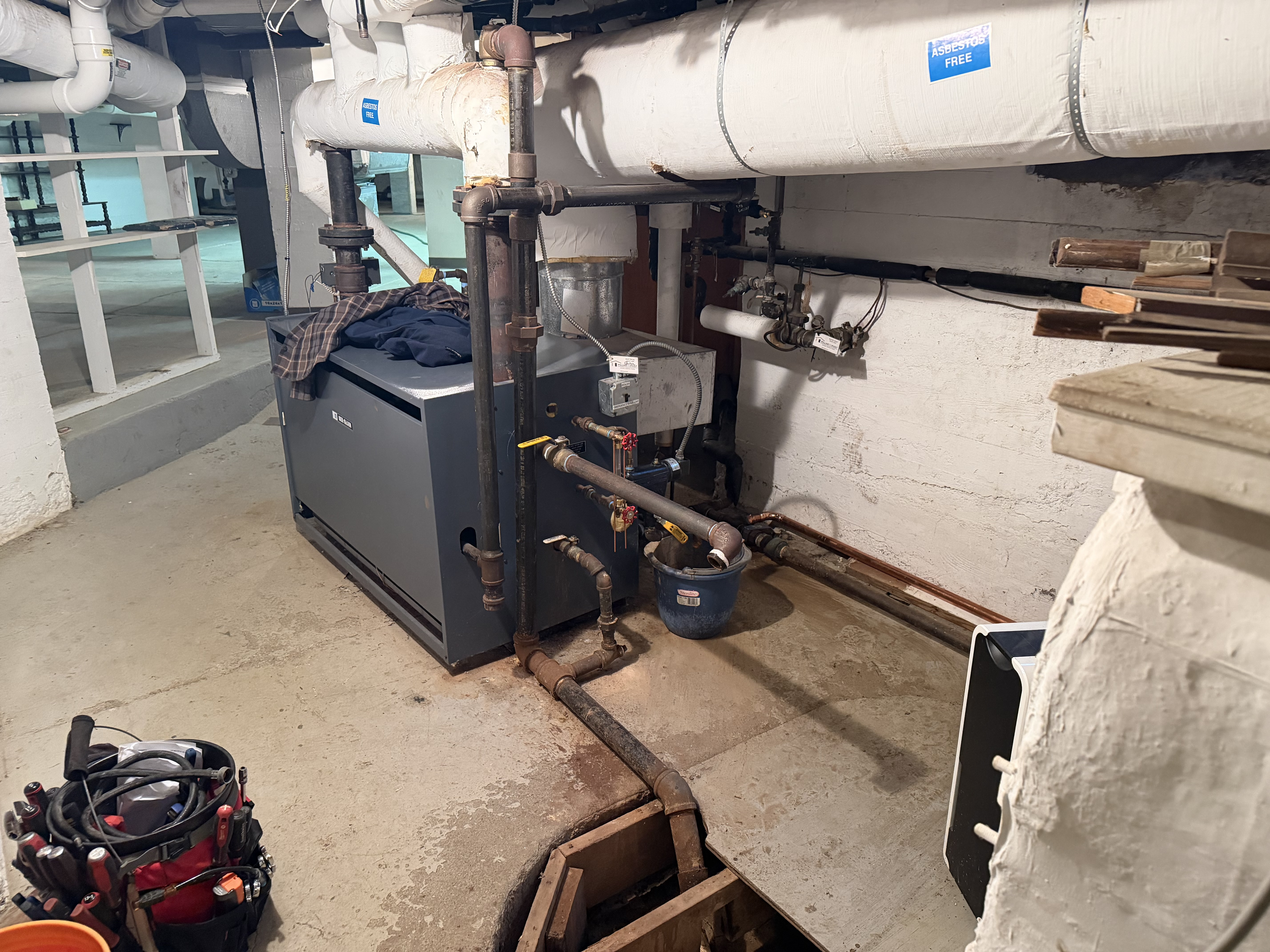
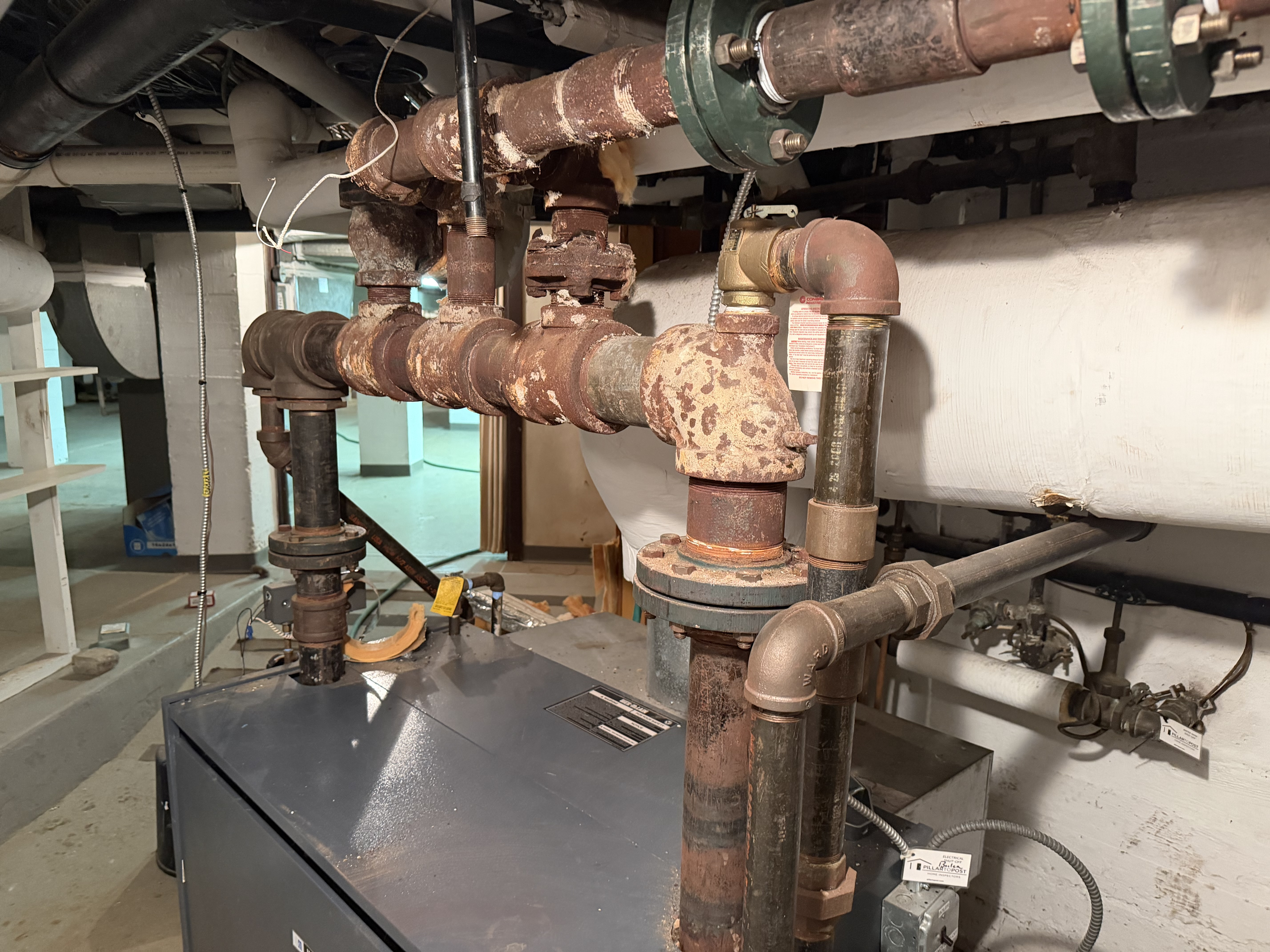
have you ever seen a boiler that easy to skim? It’s got a built in personal drain pit. I never have that kind of luck
THINK
0 -
I'm wondering if it is carrying over with those bulheaded tees between the two takeoffs.
0 -
the relief valve is supposed to daylight someplace where you would see it discharging, it shouldn't be piped directly in to the pit.
make sure the old boiler really is completely isolated, it would be really easy for condensate to end up collecting in there. i wonder if that boiler really needs to be that big, given the different technologies it seems bigger than the old boiler.
1 -
I’m repiping it in the coming days and will disconnect it completely. We will get her all fixed up. I’m certain the Weil McClain is oversized. How oversized I can’t say yet. I’m considering talking to Weil McLain and possibly replacing orifices or downfiring the boiler to make it “smaller” anyone ver do that before?
THINK
0 -
@AndythePlumber , every Vapor system manufacturer had its own set of quirks. Have you found any original equipment such as traps or radiator valves, that would tell us who designed it?
1 -
I’m glad you asked Frank. Always with informed questions you are. These are some of the artifacts I was able to salvage
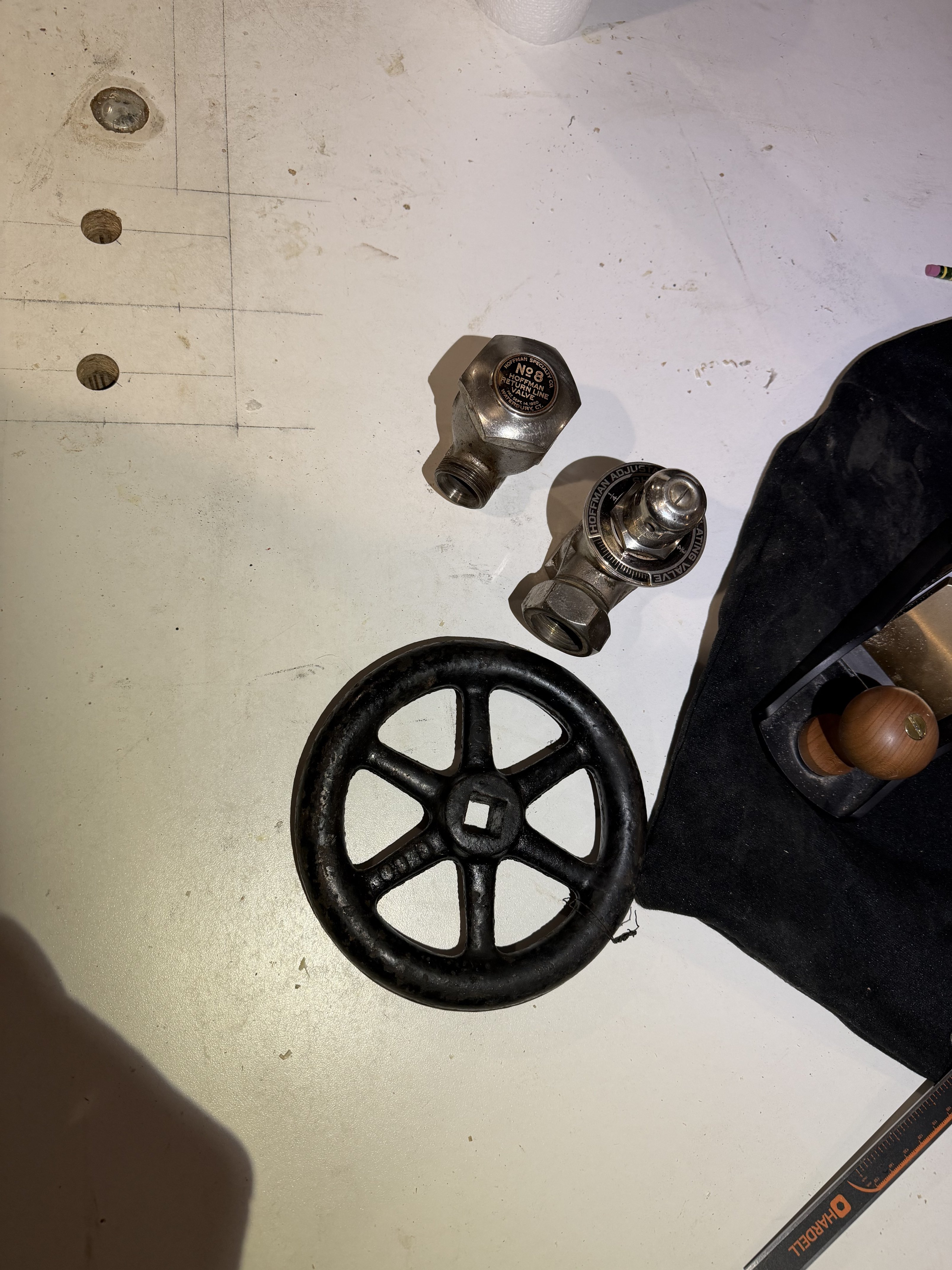
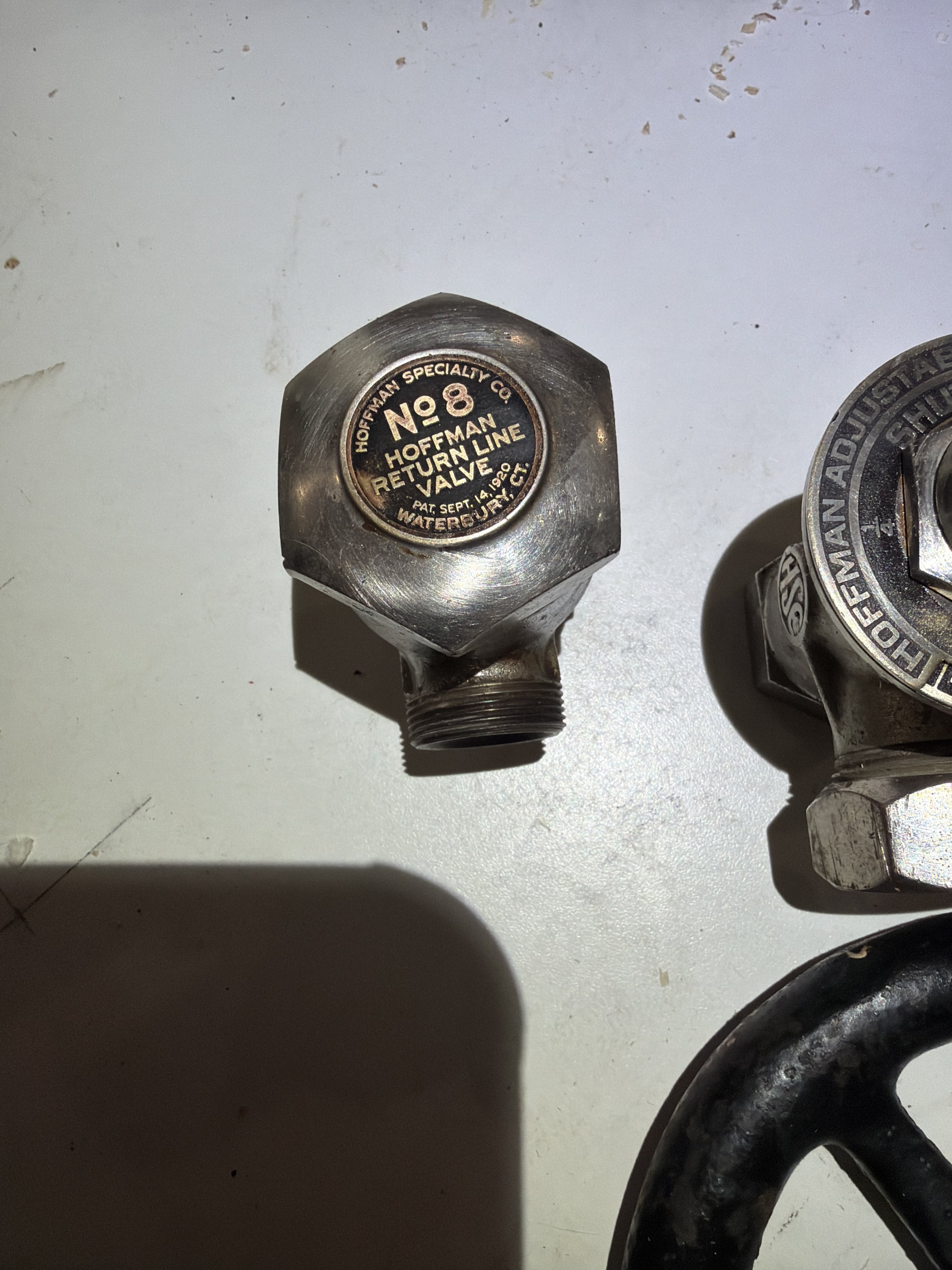
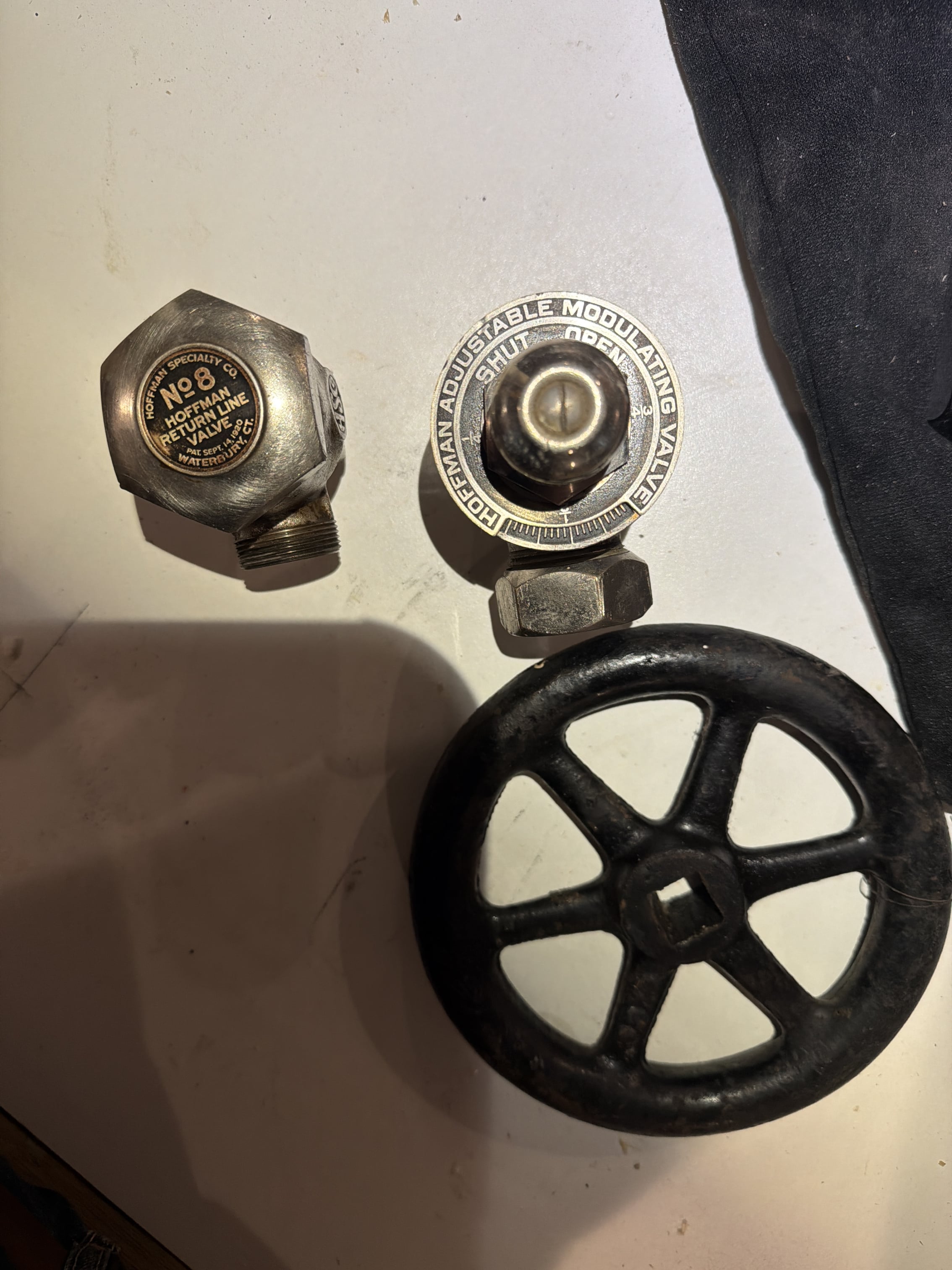
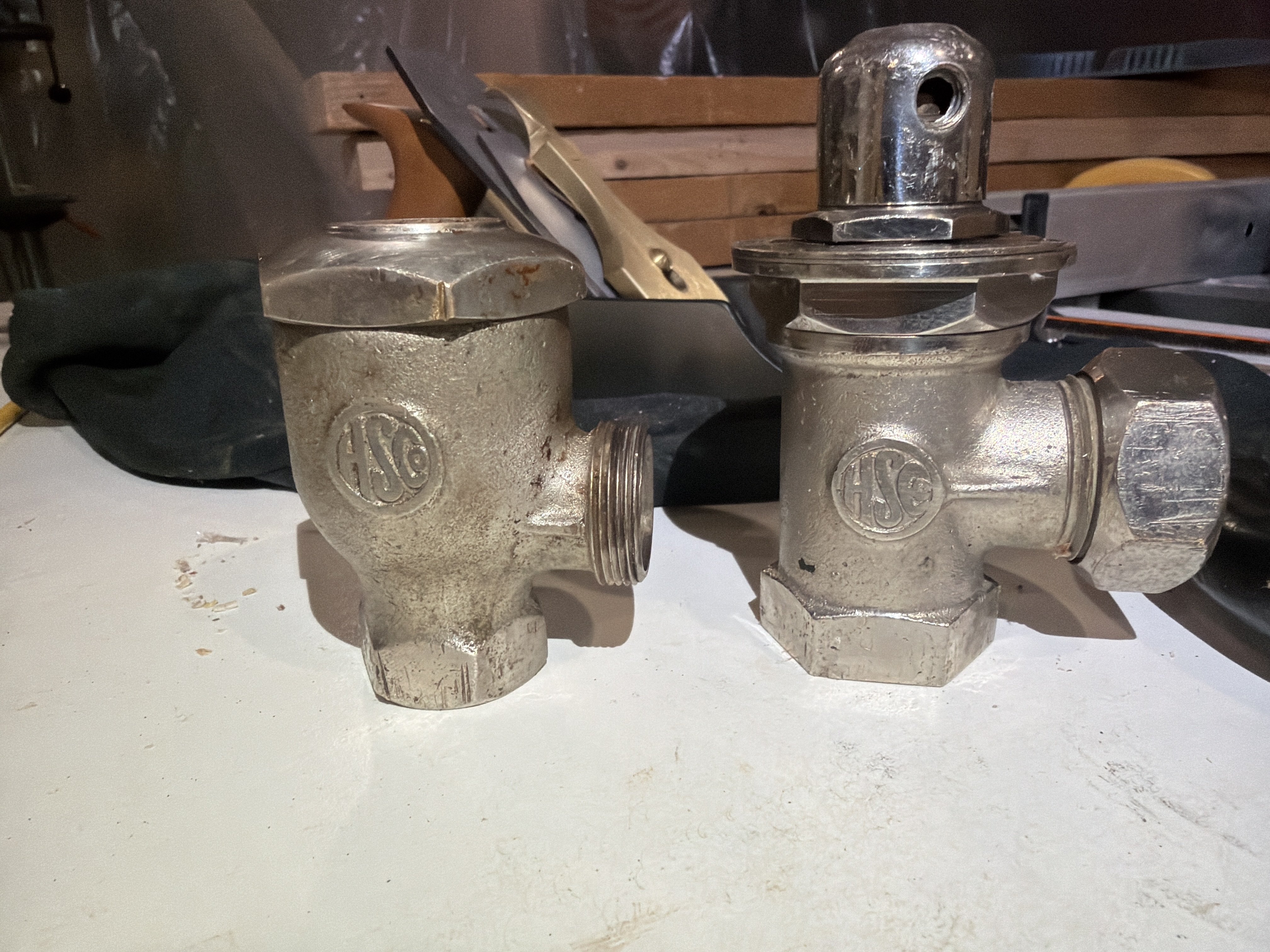
aren’t they gorgeous. Taking them out was like killing a unicorn
THINK
0 -
I see no need for an F &T when it drips into a wet return.
1 -
That is a Hoffman system. Did/does it have a Differential Loop near the boiler? Check around the old Spencer to see if there are any unusual devices in the piping there.
0 -
so it is a hoffman vapor system
0 -
Hoffman Equipped. Any sign of the Differential Loop? Bet it was taken out when the new boiler was installed. "I don't know what this piece of junk does"…
Those radiator inlet valves were usually calibrated for the radiator they were used on. ut
That system will run best with the cutout set to 6 ounces per square inch, 4 ounce differential.
Br. Jamie, osb
Building superintendent/caretaker, 7200 sq. ft. historic house museum with dependencies in New England2 -
the differential loop is probably somewhere around the old boiler that is still there.
1 -
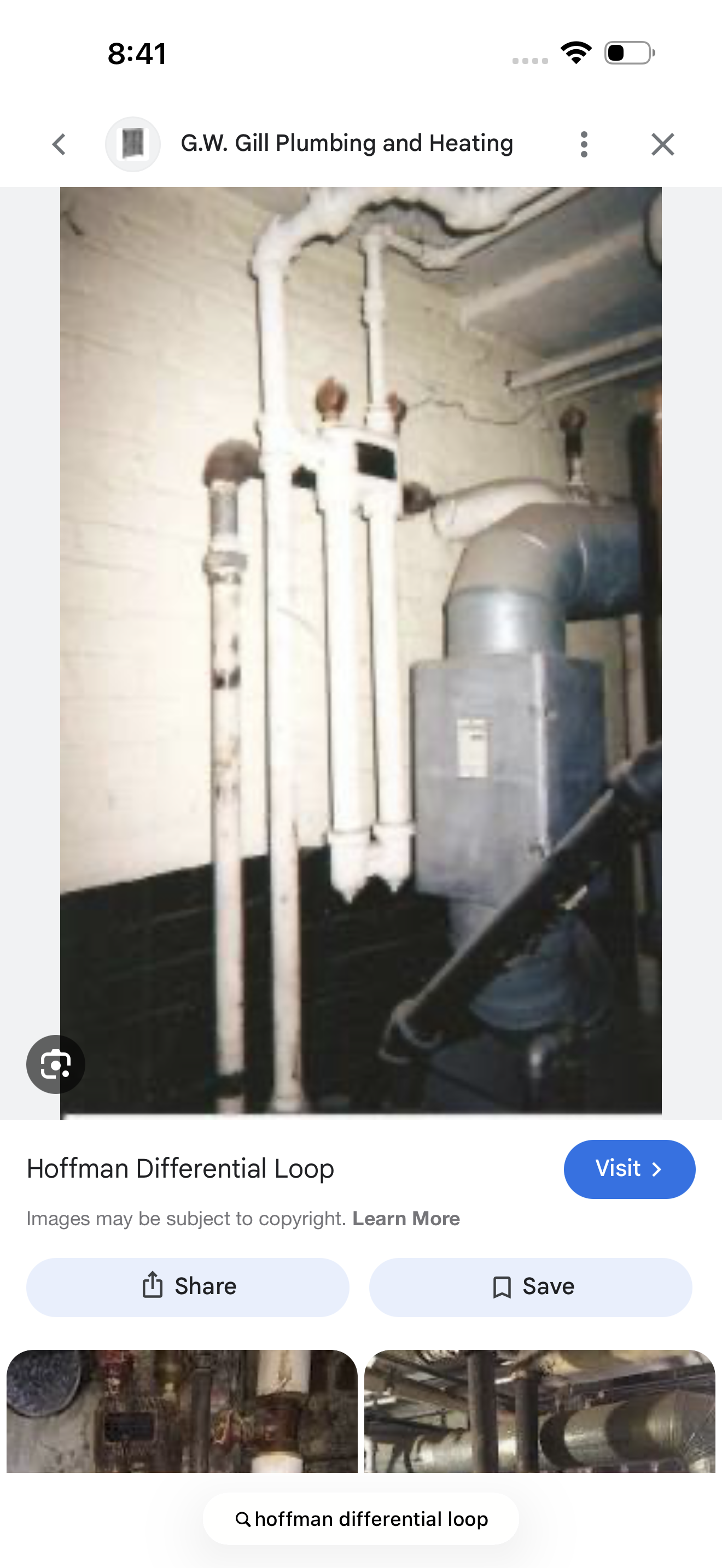
I am unfamiliar with this diff loop. Save me some reading tonight please.
THINK
0 -
@AndythePlumber , if you have @DanHolohan 's book "The Lost Art of Steam Heating", it's in chapter 15.
The earliest version was called the Equalizing Loop, and @StevePajek found the patent on it:
Some other articles are here:
0 -
-
OK- some Hoffmans used return traps, but the Loop was most common. When you go back, take plenty of pics of any devices in the piping around both boilers.
0 -
@Steamhead you reckon I should build that sob? I can bring my mig down there and fab it up. The owner just wants it legit. He doesn’t care what it takes
THINK
0 -
if the vaporstat keeps the pressure down it doesn't need it. its job is to let steam past the water loop in to the return to keep the differential between the mains and the returns under the height of that water loop to allow the water to be able to return to the boiler and to keep the water seals in the drips to the wet return working properly. the only vent in the system is supposed to be at the differential loop so that steam passing through the loop closes that vent and allows the return to build pressure. with a functional differential loop and vents in other places, those other vents can result in steam in the returns.
0 -
Probably don't need to go that far. They didn't have Vaporstats in those days, so the Loop's function kept the water returning if the boiler pressure got too high.
What you're looking for is piping issues. I think the present boiler's water line is well below the Spencer's, so there may be one or more pipes that had water standing in them with the Spencer, but are now dry. This can cause all kinds of problems. Look at the drips coming from the various steam mains and dry returns.
And don't forget to take plenty of pics of any devices in the piping around both boilers. We may find more interesting stuff there.
BTW, where is this job located?
1 -
@Steamhead you know Cornell university? Ithaca NY. Right in the heart of it, Cayuga heights. Gorgeous place. Copper gutters, slate roof, a marble fireplace in every room, manicured ivy all over. It’s the real McCoy.
More pics coming tomorrow, not sure if there is much left to see. It’s really been cut up over the years, and I know the house pretty well by this point. It’s an intimate process iykyk
THINK
1 -
NO! You may be extraordinarily skilled, but i dont think you would be able to find the specs on the internals. I had to reassemble one after an employee got over zealous with a sawzall. It was not a good day.
0 -
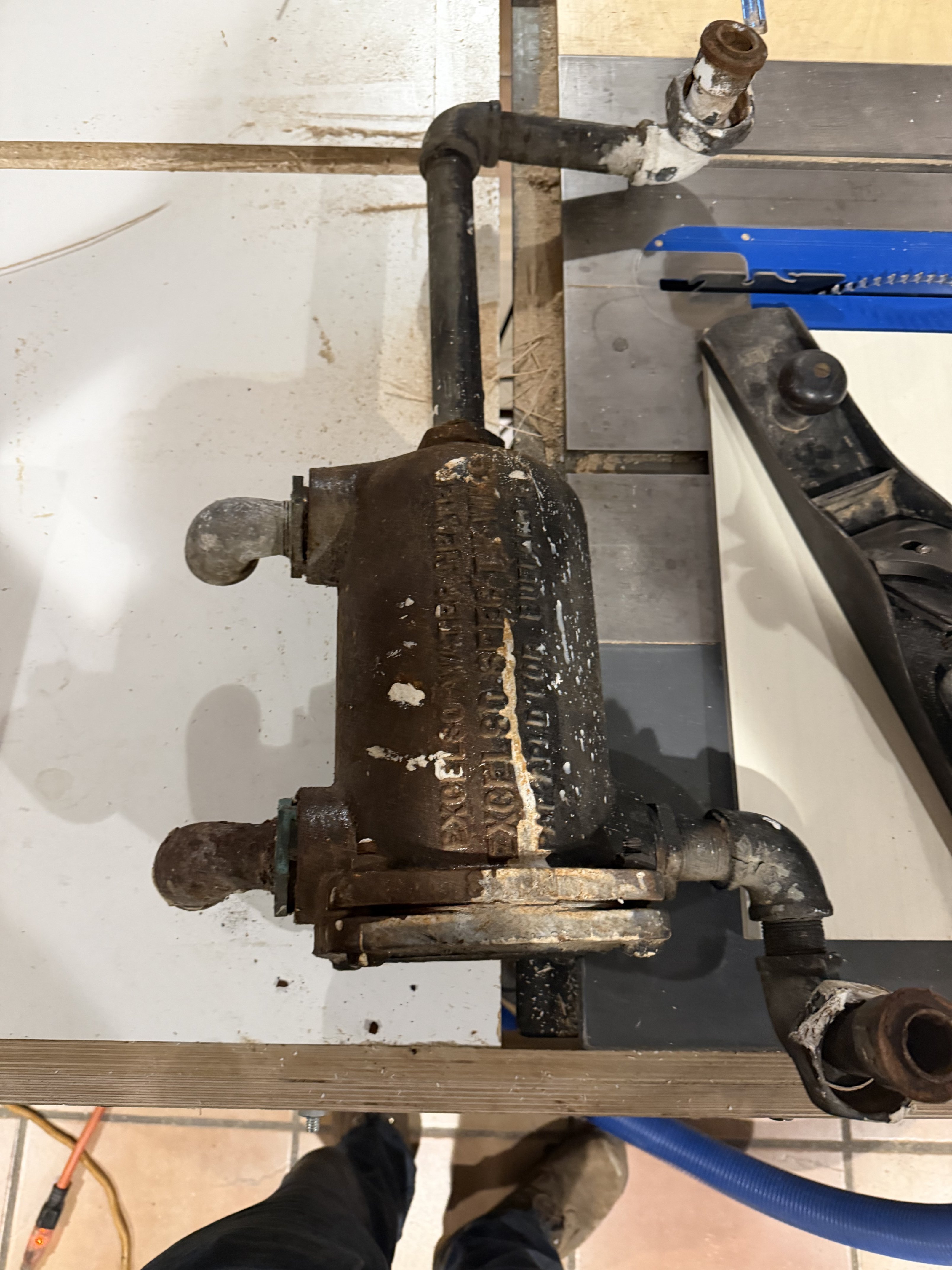
I did cut this mf off the Spencer. It was restricting my access to some wet return I was repairing and I couldn’t sneak past it…plus a man can’t have too many heat exchangers
THINK
0



Categories
- All Categories
- 87.8K THE MAIN WALL
- 3.3K A-C, Heat Pumps & Refrigeration
- 60 Biomass
- 430 Carbon Monoxide Awareness
- 133 Chimneys & Flues
- 2.2K Domestic Hot Water
- 6K Gas Heating
- 124 Geothermal
- 170 Indoor-Air Quality
- 3.9K Oil Heating
- 79 Pipe Deterioration
- 1.1K Plumbing
- 6.7K Radiant Heating
- 397 Solar
- 16.1K Strictly Steam
- 3.5K Thermostats and Controls
- 56 Water Quality
- 51 Industry Classes
- 51 Job Opportunities
- 18 Recall Announcements