Welcome! Here are the website rules, as well as some tips for using this forum.
Click here to Find a Contractor in your area.
If our community has helped you, please consider making a contribution to support this website. Thanks!
Boiler Surge Protector Issue: Light goes off when power is turned on

Howdy folks:
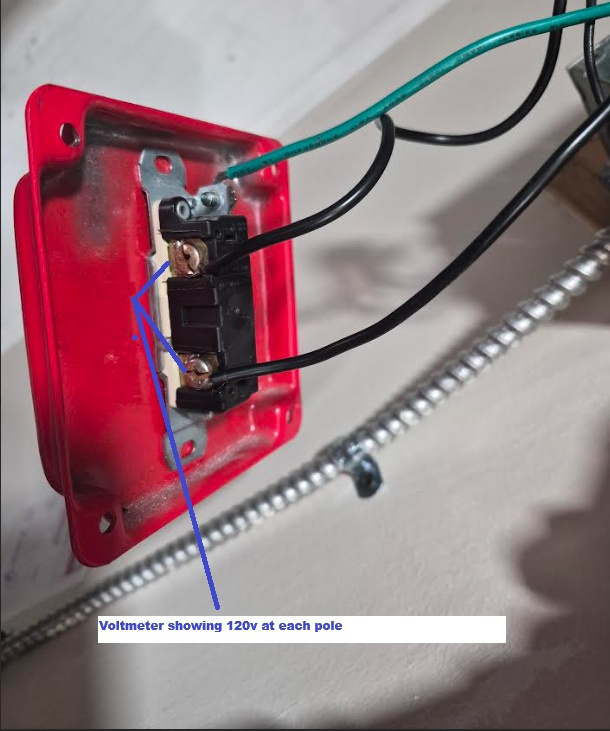
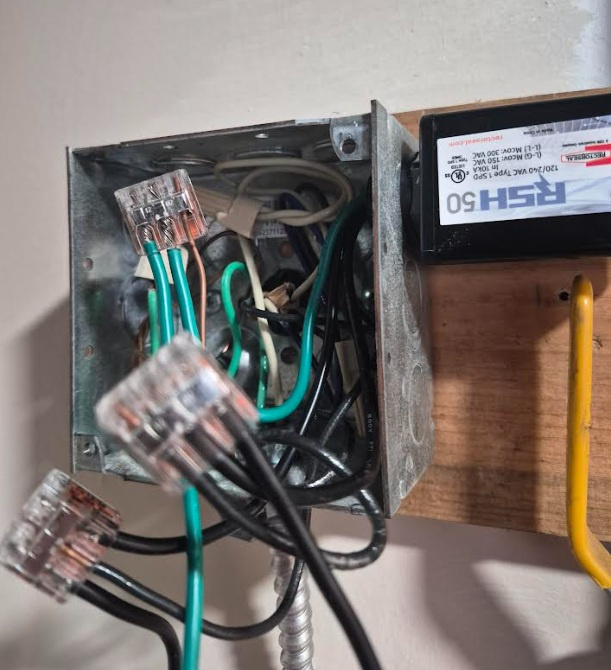
Strange wiring situation here and feedback would be appreciated. 09/2025, I had a Weil Mclain Eco Tec 80 installed. It's been running perfectly. A few videos popped up that strongly recommended installation of a surge protector or else the main board on the Eco Tec could get fried. No problem, I bought a Rectorseal RSH-50 and went to install it. Here's where the fun starts: I installed the RSH50 on the emergency switch located right next to the boiler. The switch has two hot wires and one ground with the white neutral being capped off. There is a second emergency cutoff switch upstairs. I hooked up the RSH50 using Wago connectors and when power is turned on at the main breaker, the RSH50 displays a green light. When I turn on the emergency switch, the green light goes out. The boiler runs fine with the light out, however, that seems to indicate that the surge protector is no longer protecting the boiler. Here are some photos of the safety switch and the wiring. PS, voltmeter showing 120v at each pole of the switch. I'm stumped and feedback would be appreciated. Thanks!
PS: maybe move the surge protector to the dedicated breaker in the main panel?
Comments
-
You — or a licensed electrician — are going to have to go all the way back to the circuit breaker panel and verify and quite possibly redo the wiring.
Off hand I couldn't say what is wrong with it — but there are a number of possibilities, none of which are good.
Br. Jamie, osb
Building superintendent/caretaker, 7200 sq. ft. historic house museum with dependencies in New England0 -
I called the electrician who wired the boiler. This is above my pay grade and I don't want to blow up a new boiler over a $110.00 surge protector.
0 -
my guess would be high impedance in the ground.
1 -
There's a good chance the two switches are not wired in series. But a bad ground is another option.
Br. Jamie, osb
Building superintendent/caretaker, 7200 sq. ft. historic house museum with dependencies in New England1 -
Interesting as the ground for the boiler loop is 14 gauge. I put a 12 gauge lead from the 14 gauge n the emergency box to the Wago but that won't matter if the entire circuit wiring was done in 14 gauge. The electrician said his preference would be to install a whole-house surge protector which I agree with.
0 -
I'm sensing a cashectomy here. Yikes.
0 -
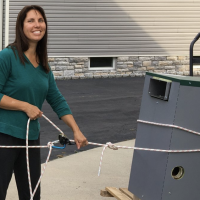
You should have 2 switches,1 at the boiler 1 at the top of the stairs. Both switches should be 3-way SPDT. What you posted is a SPST.

 1
1 -
Electrician says we can get around the switch issue with a whole-house surge protector. I'd rather spend money on that than try and get a surge protector to work on a single circuit.
0 -
How does he "Get Around" the wrong switch?
0 -
That may be code in NY but some areas do not require two switches.
As far as I recall in NJ you do not need a remote switch on a gas appliance, but do on oil. Unless we know the OP's location, we have no idea what their code is.
I've always seen SPST used for these, including the remote. If either is off, the circuit is dead. I'd think a "3 way" would cause confusion?
Single pipe 392sqft system with an EG-40 rated for 325sqft and it's silent and balanced at all times.
 2
2 -
You said you installed the protector on the switch.
Do you mean from the two screws on the switch? That's why it's going out when you turn the switch on. It needs to be connected to the switch either wire, and a neutral. If it's wired across the switch it's not doing anything other than lighting up when the switch is off.
Single pipe 392sqft system with an EG-40 rated for 325sqft and it's silent and balanced at all times.
1 -
Probably. But that doesn't fix the problem that in some obscure way that thing is wired incorrectly — and is probably quite unsafe.
And no, @pecmsg — both switches must be SPST and wired in series. The idea is that either one being off should kill the whole circuit. Both the neutral and the ground must carry through, unswitched.
I am not in favour of whole house surge protectors as a rule. If they truly have the capacity to protect the whole house, they are very pricey indeed — and, depending on how the house is wired, may not actually protect sensitive equipment Much better to have the surge protector as close to the device being protected as possible.
Br. Jamie, osb
Building superintendent/caretaker, 7200 sq. ft. historic house museum with dependencies in New England2 -
I did a Square D HEPD80 80,000a protector at my panel. I also installed a stainless plate behind it as a heat shield incase something goes really bad with it.
But, those protectors do not clamp until fairly high voltages…. so they probably will never protect anything sensitive. I think the HEPD80 doesn't do anything at all until you exceed 150V RMS per phase.
Single pipe 392sqft system with an EG-40 rated for 325sqft and it's silent and balanced at all times.
0 -
Really sensitive stuff use a voltage range monitor like the one rectorseal makes (has one of those surge protectors built in also) for boilers I have typically used power conditioners, basically just a more expensive power strip. After watching my own fancy boiler take all kinds of brown outs and surges during last years ice storm without missing a beat I am fairly confident anything extra would be overkill for it. I do have a VRM on my mini split and the electrician put a surge protector in the panel when I got my panel re-done, not putting much faith in that protecting my equipment though.
0 -
Not only would 3 way switches cause confusion, they would make it impossible to know if you have disconnected the equipment or not.
Surge suppressors usually clamp at something more like 1000 v, much less than that and you are trying to conduct huge currents that result from the normal reactance of the system and if your power supply isn't designed to tolerate that then issue is with your power supply design and it isn't going to last long.
#14 wouldn't be high impedance as long as the connections back to the neutral bond at the service are good.
0 -
That does look like what is happening in the picture, that the protector is connected to both sides of the switch and is nto connected to the neutral.
0 -
The specified MCOV on the one I'm using is 150V RMS. That's the only thing I could find quickly.
Single pipe 392sqft system with an EG-40 rated for 325sqft and it's silent and balanced at all times.
0 -
Which really, is good news for the OP because it's an easy fix.
Single pipe 392sqft system with an EG-40 rated for 325sqft and it's silent and balanced at all times.
0 -
the whole house surge protector is not for protecting an individual piece of equipment, the whole house protector protects mostly from things outside the house. there are things that can happen near the equipment in question that the whole house protector can't mitigate because of the impedance of the wiring between the pane and the equipment, to protect an individual piece of equipment the surge suppressor should be near that piece of equipment.
you have a salesperson, not an electrician. if i think what is wrong is what is wrong it should be a 5 minute fix for an electrician.
0 -
@ChrisJ this is the datasheet for your surge suppressor
mcov is the maximum operating voltage
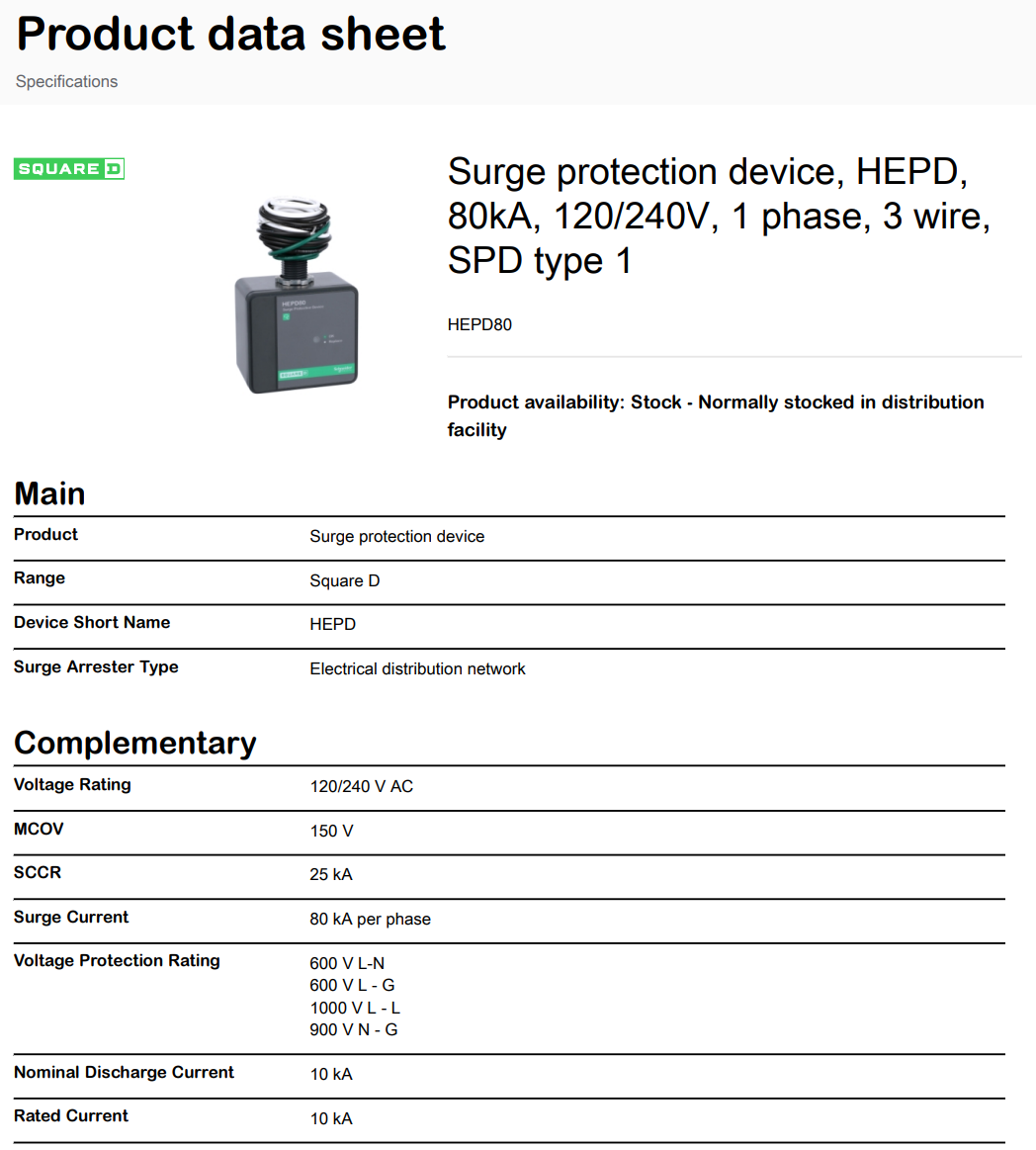
the voltage protection ratings are presumably some point on the conduction curve of the mov where the conduction becomes significant. at some point the current will be enough to trip the breaker that the suppressor is connected to. probably be nicer to have a remote trip main that would trip from the suppressor if the primary voltage appeared on the secondary instead of just opening the breaker to the suppressor but remote trip breakers are expensive and quadrupally so in main breaker type of currents.
0 -
Sorry, I wasn't clear in my post. There are two emergency shutoff switches, one next to the boiler and one in the upstairs hallway.
0 -
I took the advice of some folks here. One hot lead was pigtailed with the surge protector and connected to the upper lug of the emergency switch. The second hot lead was directly connected to the bottom lug of the emergency switch. The second black wire of the surge protector was pigtailed to a capped-off neutral in the box. Boiler works fine and surge protector displays green light when power is turned on at the breaker.
1 -
Does the boiler turn off when either switch is off? When both switches are off? Not talking about the surge protector. The boiler.
If it doesn't turn off when either switch alone is off, it's wired wrong.
Br. Jamie, osb
Building superintendent/caretaker, 7200 sq. ft. historic house museum with dependencies in New England0 -
i looked at the instructions for that "surge protector". it is sold as for 120v, 240, or 208 v applications so it has 2 black wires which is confusing to someone who doesn't understand electricity.
1 -
I think that maybe this needs to go back to square one. Something isn't wired properly.
We have a circuit breaker in a breaker panel. We have two emergency switches, let's call them 1 and 2. And we have a boiler.
Now. We need a black wire (probably 12 gauge, although if the breaker is 15 amp it could be 14) which goes from the circuit breaker to one terminal of switch 1. Then there is a same size black wire from the other terminal of switch 1 to one terminal of switch 2. Then there is another same size black wire from the other terminal of switch 2 to the hot power terminal of the boiler controller.
We also need a white wire of the same gauge as the black wire which goes, unbroken, from the neutral bus in in the breaker panel to the neutral terminal of the boiler controller. If it runs in the same conduit or jacket as the black wires, it can be tapped at one of the switch boxes if a neutral is needed at that box — for instance, if the surge protector is located at a switch box rather than the boiler.
We also need a ground (usually green) wire which runs from the ground bus in the breaker panel to the ground connection of the boiler. It must be tapped at each metallic box to ground that box.
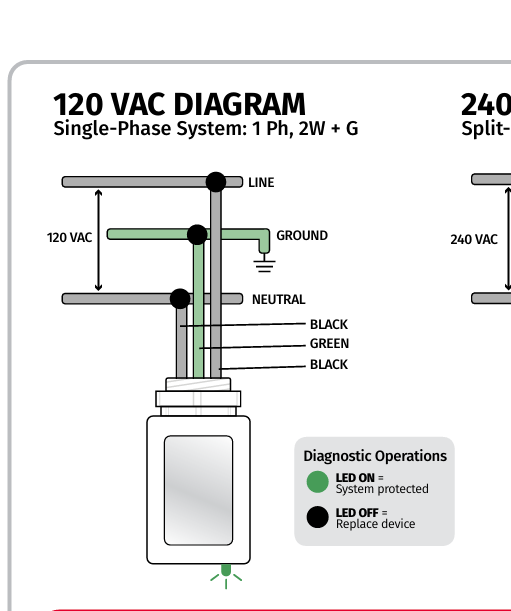
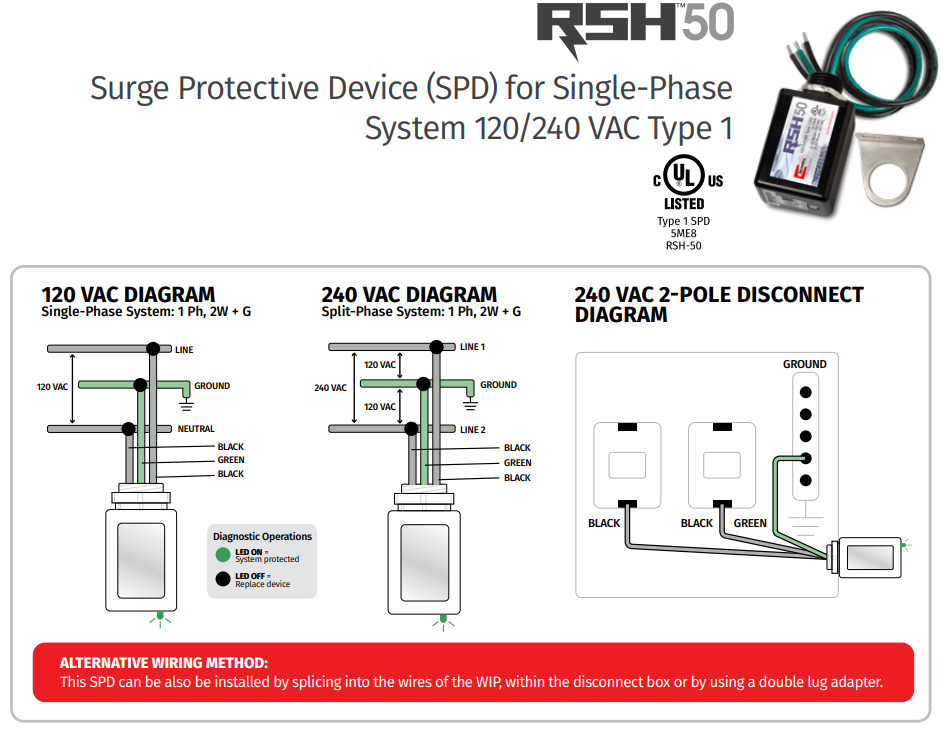
That surge protector — RSH50, Rectorseal, can be wired for a 120 VAC circuit, which I presume you have. The instructions are very clear: one black wire goes to the hot (black) side of the circuit. The other black wire on the device goes to the neutral (white) side of the circuit. The green wire goes to the ground (green) side of the cirucit.
Even if the switches are wired correctly — which is possible, but must be verified — the RSH50 isn't.
FIX IT!
Br. Jamie, osb
Building superintendent/caretaker, 7200 sq. ft. historic house museum with dependencies in New England0 -
they had the surge supressor wired across the switch instead of between hot and neutral because of the afformentioned 2 black wires and ensuing confusion.
0 -
It sounds like it's wired fine Jamie.
The only mistake was he wired the surge protector across the switch by the boiler rather than from Hot to neutral. You're over complicating it.
Single pipe 392sqft system with an EG-40 rated for 325sqft and it's silent and balanced at all times.
1 -
The surge protector works on 120 VAC by shorting the hot to the neutral in the event of a surge. It works on a 120/240 volt circuit by shorting the two hots (opposite sides) together.
If you connect the two black leads of the surge protector to the same side of a 120 VAC circuit, it will accomplish exactly nothing at all. That is the configuration which I seem to see in this particular application.
Whatever.
Br. Jamie, osb
Building superintendent/caretaker, 7200 sq. ft. historic house museum with dependencies in New England0 -
That's why we had the OP move one of the black leads to the neutral.
Why "whatever" ?
Single pipe 392sqft system with an EG-40 rated for 325sqft and it's silent and balanced at all times.
2 -
Without being there to pull things apart, that is my guess as well. Surge protector is installed across the switch in a switch loop of some sort. When the switch is open, the surge protector is happily protecting the switch from surges (not really needed) and when the switch is closed the surge protector is happily doing nothing with its input wire shorted together.
0 -
Not really protecting anything.
It's more like isolating the equipment from mains voltage, except there's enough current draw to light up the green LED, similar to the neon lights in old lighted light switches.
Lighted light switch……..that types weird.
Actually yeah I guess you're sort of correct, about it "protecting the switch". I mis-read that.
Single pipe 392sqft system with an EG-40 rated for 325sqft and it's silent and balanced at all times.
1 -
it only works on 120v loads or 240v loads, it doesn't work on 120/240 v loads because it doesn't have the etra MOVs to "protect" 3 power wires.
0 -
Actually.
Why wouldn't the OP's orignal wiring mostly work?
Since it does both 120 and 240, wouldn't that suggest the MOVs go from hot to ground, so really the hot should have been protected. Just the light was out.
Single pipe 392sqft system with an EG-40 rated for 325sqft and it's silent and balanced at all times.
0 -
Oy. If it actually passes the surge from hot to ground, that I REALLY don't like. The resistance of the ground isn't zero — it isn't meant to be — so the surge, or at least a sizable chunk of it, will appear on the ground bus in the breaker box. And therefore on all the other "grounded" objects in the house.
Wonderful.
I might add here that if it actually does function by shorting to ground rather than to neutral or opposite side, I don't want it anywhere near my house. But then, I'm a bit flaky about ground being ground and such oddities as correct bonding and so on…
I sincerely hope that it has been rewired as intended… and the rest of the circuit tested and verified to function as intended…
Br. Jamie, osb
Building superintendent/caretaker, 7200 sq. ft. historic house museum with dependencies in New England0 -
Ground is bonded to neutral at the main panel as per NEC.
The ground bus in most residential panels is literally the same as the neutral bus. Obviously sub panels there's the added resistance of the ground between that and the main panel…
The Square D one I installed has two hots, a neutral and a ground. The Rectorseal RSH-50 the OP has appears to only have two hots and a ground.
Single pipe 392sqft system with an EG-40 rated for 325sqft and it's silent and balanced at all times.
1 -
The Rectorseal instructions are quite specific. If the unit is installed on a 120 VAC circuit, one of the black wires goes to hot. The other black wire to neutral. Ground to ground. What could be simpler?
Br. Jamie, osb
Building superintendent/caretaker, 7200 sq. ft. historic house museum with dependencies in New England 1
1 -
To expand on Jamie's comments, below is the actual diagram.
 0
0 -
Its very simple.
Except how can it function on both 120v and 240v without any changes to the circuit? And how can it function at all on 240VAC? It shorts phase to phase?
Also, a bit confused why this is being explained to me when that's literally what I told the OP to do with it many many responses up?
Single pipe 392sqft system with an EG-40 rated for 325sqft and it's silent and balanced at all times.
0 -
From Eaton: https://www.eaton.com/content/dam/eaton/services/eess/eess-documents/sa01005003e.pdf
How does an SPD work? The design goal is to divert as much of the transient disturbance away from the load as possible. This is accomplished by shunting the energy to ground through a low-impedance path (i.e., the surge suppressor).MOVs are the most reliable and proven technology to reduce transient voltages. Under normal conditions, the MOV isa high-impedance component. When subjected to a voltage surge (i.e., voltage is over125% of the nominal system voltage), the MOV will quickly become a low-impedance path to divert surges away from loads. The MOV reaction time is nano seconds—1000 times faster than the incoming surge.
I agree that it was not installed correct the first time, but should be doing what it's supposed to now that it's connected L-N.
Installing the SPD at the switch will surely offer more protection than not having an SPD at all, but I would caution that SPD's become less effective as the distance from the ground bar (inside your panel) increases… If you have legitimate concerns about transients, a two stage cascaded approach is ideal (but is otherwise often just an exercise in spending money to get a warm and fuzzy feeling with little actual effect). This would be a "whole house" surge protector in combination with surge protectors at sensitive equipment.
0 -
Ah ha! We have the answer from @Erin3 ! Thank you!
It does shunt to ground. Not real happy about that, but if the building grounds are all done right it will certainly protect the equipment — which is, after all, the purpose of the exercise.
Then we could get into the niceties of bonding and acceptable grounds… but let's not! The odds of someone holding onto a bonded/electrically grounded object and standing on a true earth ground are pretty slim…
Br. Jamie, osb
Building superintendent/caretaker, 7200 sq. ft. historic house museum with dependencies in New England0




Categories
- All Categories
- 87.8K THE MAIN WALL
- 3.3K A-C, Heat Pumps & Refrigeration
- 60 Biomass
- 430 Carbon Monoxide Awareness
- 133 Chimneys & Flues
- 2.2K Domestic Hot Water
- 6K Gas Heating
- 124 Geothermal
- 170 Indoor-Air Quality
- 3.9K Oil Heating
- 79 Pipe Deterioration
- 1.1K Plumbing
- 6.7K Radiant Heating
- 397 Solar
- 16.1K Strictly Steam
- 3.5K Thermostats and Controls
- 56 Water Quality
- 51 Industry Classes
- 51 Job Opportunities
- 18 Recall Announcements