Welcome! Here are the website rules, as well as some tips for using this forum.
Click here to Find a Contractor in your area.
If our community has helped you, please consider making a contribution to support this website. Thanks!
Boiler Surge Protector Issue: Light goes off when power is turned on
Comments
-
The 'shunt to ground' is a tiny misdirection.
The purpose is not to somehow shunt the energy of the surge into the ground rods.
Rather the purpose is to limit the voltage between any two wires, and it does this by conducting current when the voltage gets too high between any two wires. Power = voltage * current. When the surge suppressor 'shunts' a surge, it does so by conducting current and heating up. That is why surge suppressors are rated in joules; the amount of energy from a surge they can absorb/shunt.
When the device limits the voltage between line and ground, then current must flow in the ground connection. But say that the ground connection is very poor. The surge suppressor can still still do its job as long as it limits the voltage between the black and the green wires. Maybe this means that both black and green wires are at some crazy elevated voltage (poor ground connection), but now you have a 'bird on a wire' situation: it doesn't matter that the bird's left leg is at 7200V because it's right leg is also at 7200V.
0 -
The switches may not have 2 black wires. One or both could be wire with Romex or NM cable that has a white and a black. It is possible the surge protector "knows " the voltage being fed.
Also you can't use 3 way switches in that application. You could be working on the boiler and shut off the switch at the boiler and someone else turns it on upstairs.
0 -
Agreed, @winnie . Poor language usage on my part!
And you are quite correct in pointing out that the device protected will — within limits — in fact be protected. The gadget is doing its job. As you say — the "bird on a wire".
You are also, unhappily, quite correct in pointing out that the the voltage on the wires the bird is sitting on may be pretty wild — with respect to something else, such as… other "grounded" objects. Exactly what those other "grounded" objects might be depends entirely on the quality of the circuit from the device ground connection to a ground busbar (which in many circumstances may be very good — but in others, sad to say, somewhere between horrible and non-existent) and then the quality of any bonding from the electrical ground to other metal objects — such as plumbing, the boiler casting, gas piping… and the building ground itself (if any!) and then in the chain the quality of that building ground.
In a modern installation with everything up to code, none of this is probably all that much of a concern — maybe… although it can be used to explain why that surge protector on widget A in the basement didn't prevent (and may even be responsible for) the demise of the TV set in the den. In older installations… well may I assume you are a sparky? If so, I daresay you have seen installations which make your hair curl — or stand on end!
I'm probably a bit paranoid about this sort of thing — as we have large animals (draught horses) and they are absurdly sensitive to electric shock (a shock that would annoy you might easily kill a horse) — with the result that bonding and grounding is a point of real concern.
Bottom lines… keep the surge protector as close to the protected device as possible. Make sure that it is on a really sound ground circuit to the switch gear. Make sure that everything is really bonded. Make sure that the premise ground is really good, and not just 5 feet of copper rod pounded in next the the electric meter!
Br. Jamie, osb
Building superintendent/caretaker, 7200 sq. ft. historic house museum with dependencies in New England0 -
i would contend that the newest of installations are probably far worse than somewhat older installations since new subdivisions usually get plastic water mains and services, a 30+ year old subdivision will usually have a metallic service and cast iron main to bond to. bad neutrals happen quite frequently
0 -
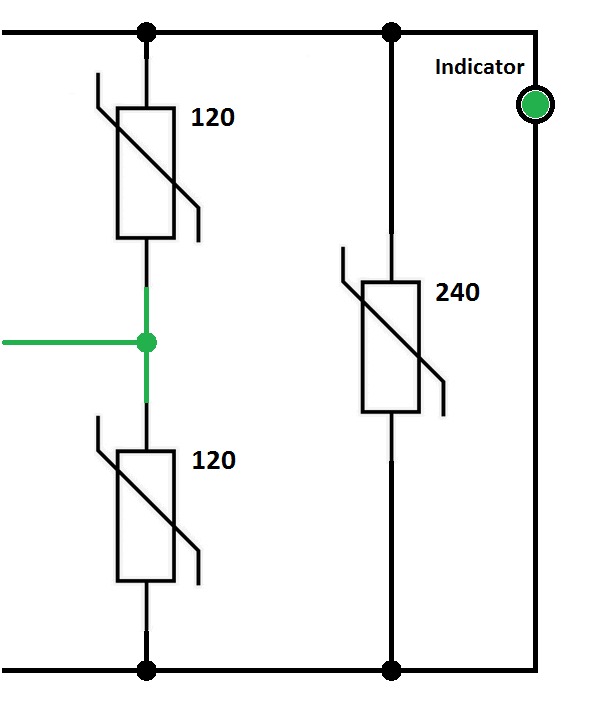
Inside the Surge Device. I suspect there is two 120 Volt MOVs and one 240 Volt MOV. The power indicator is between the two black wires. So when it was connected up wrong the indicator would go out. The indicator is not wired to the ground wire since Neutral current should not be in ground wires.
 National - U.S. Gas Boiler 45+ Years Old
Steam 300 SQ. FT. - EDR 347
One Pipe System0 -
it is very likely all the same mov for all positions. there should be thermal fuses to keep it from turning in to a roman candle if the MOVs short or the line gets connected to a high voltage source somehow.
0 -
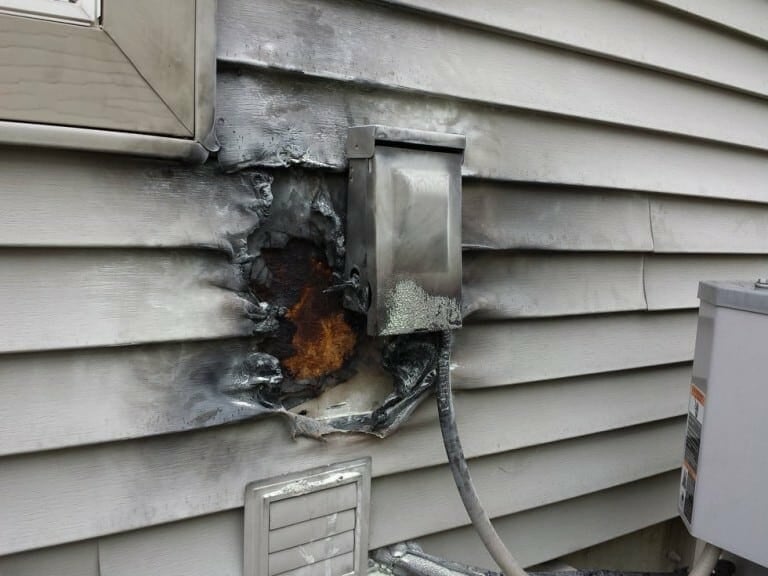
Like this? From what I can tell they rely on the breaker and many have caused serious issues. That's why I put stainless behind mine with short spacers.
Single pipe 392sqft system with an EG-40 rated for 325sqft and it's silent and balanced at all times.
 1
1 -
lots of stuff doesn't have the thermal fuse. i don't know if the ul standard changed or if some stuff is just better than others or different things need to meet different standards. the minimally acceptable stuff has a thermal fuse in seraies with each mov and in contact with the mov so if the mov starts to cook either the heat from the mov blows the thermal fuse or the current heats and blows the thermal fuse.
of course an mov alone is a poor surge supressor but that is a different discussion, you need reactive components to do most of the work.
0 -
@Jamie Hall , I wasn't complaining about your understanding, but rather the common usage the term.
About the risk to four legged beasties, IMHO that is a perfect example of why 'shunt to ground' doesn't work. Animals are almost designed to be sensitive to voltage differences in different patches of soil.
In the electrical equipment world, I encountered a failure caused by having two separate grounding electrodes for two different systems in a building. The phone wires came in on one side of the building, with an old school demarc and surge arrestor with a ground rod. The electrical service came in on the other side of the building with its own grounding electrode system.
With no external evidence of lighting strike I found length of phone wire inside of the building destroyed by an apparent high voltage discharge. Every few inches along the wire there was a scorch mark on the wood behind it, with jagged shards of copper jutting out from the wire at the scorch locations. It seemed pretty clear that an impressive amount of melted copper and physically expelled it from the wire. But everything was 'grounded'. My best guess: lighting hit a nearby transmission line, was conducted to ground, spread out through the soil, entered through one ground rod, and then did damage relative to the other ground rod.
0 -
Most likely, @winnie ! Lightning is weird… but a good example of why one should have one really good ground — and only one.
If possible. It isn't always… House yes. Farms and ranches? Can get interesting…
Br. Jamie, osb
Building superintendent/caretaker, 7200 sq. ft. historic house museum with dependencies in New England0 -
you can get damage like that from a bad neutral in another neighbor's house too, the neutral current follows that telecom wiring to the neutral in your house.
0 -
If we are still referring to phone lines and not coax, there should be no neutral current in phone lines, ever. They are a balanced pair.
National - U.S. Gas Boiler 45+ Years Old
Steam 300 SQ. FT. - EDR 347
One Pipe System0 -
Closing the loop on this folks. One black "hot" from the RSH50 was wired to a capped-off neutral inside the safety switch that is next to the boiler. Green light on the RSH50. I moved some breakers around and installed a Square D HOM250PSPD whole-house surge protector on the panel just below the main breaker. The 250 is not the best whole-house surge protector out there, however, installation of something like a Square D HEPD80 or Eaton 108kA would have presented installation issues. I have a boatload of other projects to tackle and the 250 will have to be good enough for now. It's better than nothing.
0



Categories
- All Categories
- 87.8K THE MAIN WALL
- 3.3K A-C, Heat Pumps & Refrigeration
- 60 Biomass
- 430 Carbon Monoxide Awareness
- 133 Chimneys & Flues
- 2.2K Domestic Hot Water
- 6K Gas Heating
- 124 Geothermal
- 170 Indoor-Air Quality
- 3.9K Oil Heating
- 79 Pipe Deterioration
- 1.1K Plumbing
- 6.7K Radiant Heating
- 397 Solar
- 16.1K Strictly Steam
- 3.5K Thermostats and Controls
- 56 Water Quality
- 51 Industry Classes
- 51 Job Opportunities
- 18 Recall Announcements