Converted to Gas from Oil last year and I REGRET IT BADLY!!
Comments
-
What is your cost per therm according to your statement?
1 -
That's why we always say the installer is more important than the boiler (except for the Burnham independence line). Near boiler piping is a critical aspect of the install and is stressed over and over again by the gentlemen on this site. You mess up the near boiler piping and you will pay the price for it.
 1
1 -
A good simple indicator is how often the boiler cycles on and off. With excessive and short on off cycles, boiler efficiencies go down, fuel usage goes up.
It sounds like gears are in motion, that's the good news.
Bob "hot rod" Rohr
trainer for Caleffi NA
Living the hydronic dream0 -
Stop the check or cancel the credit card transaction, this works to piss people off as it sets them back.
They did not bother to set the steamer on concrete blocks either so that is one more issue with this poor installation.
0 -
You feel trying to piss people off that are in the process of trying to fix their mistake and make things right is a good idea?
I think that's terrible advice.
Blocks are optional and would greatly depend on the situation. I didn't put mine under blocks either.
Single pipe 392sqft system with an EG-40 rated for 325sqft and it's silent and balanced at all times.
0 -
They did not bother to set the steamer on concrete blocks either
It is on a raised slab.
0 -
Sorry, I missed that 😔
0 -
If they did it not follow the boiler builder's instructions for the correct installation I would be pissed off so no worries there. How are they supposed to skim the boiler with that installation? Using the drawing 7.2 that Ed provided it would have made more sense to turn the boiler 90 degrees clockwise to expose it enough to have a skim port.
As far as the boiler mount/placement, I missed the raised slab which is why I commented as the concrete color between the floor slab and the raised slab were identical so that is on me.
0 -
Maybe just one or two people sending a message will be sufficient? It sure seems that just one might have started the ball rolling.
If I were a fan of internet shaming, I'd be more active on some of those other web forums, not HH.
I'm pretty sure that, while I would definitely think about the first msg or two I received about my work being substandard, I would quickly get pissed or worse if they kept coming.
 1
1 -
IDK
when I or my guys make a mistake I what to know.
it happensHow we deal with it separate use from them.
0 -
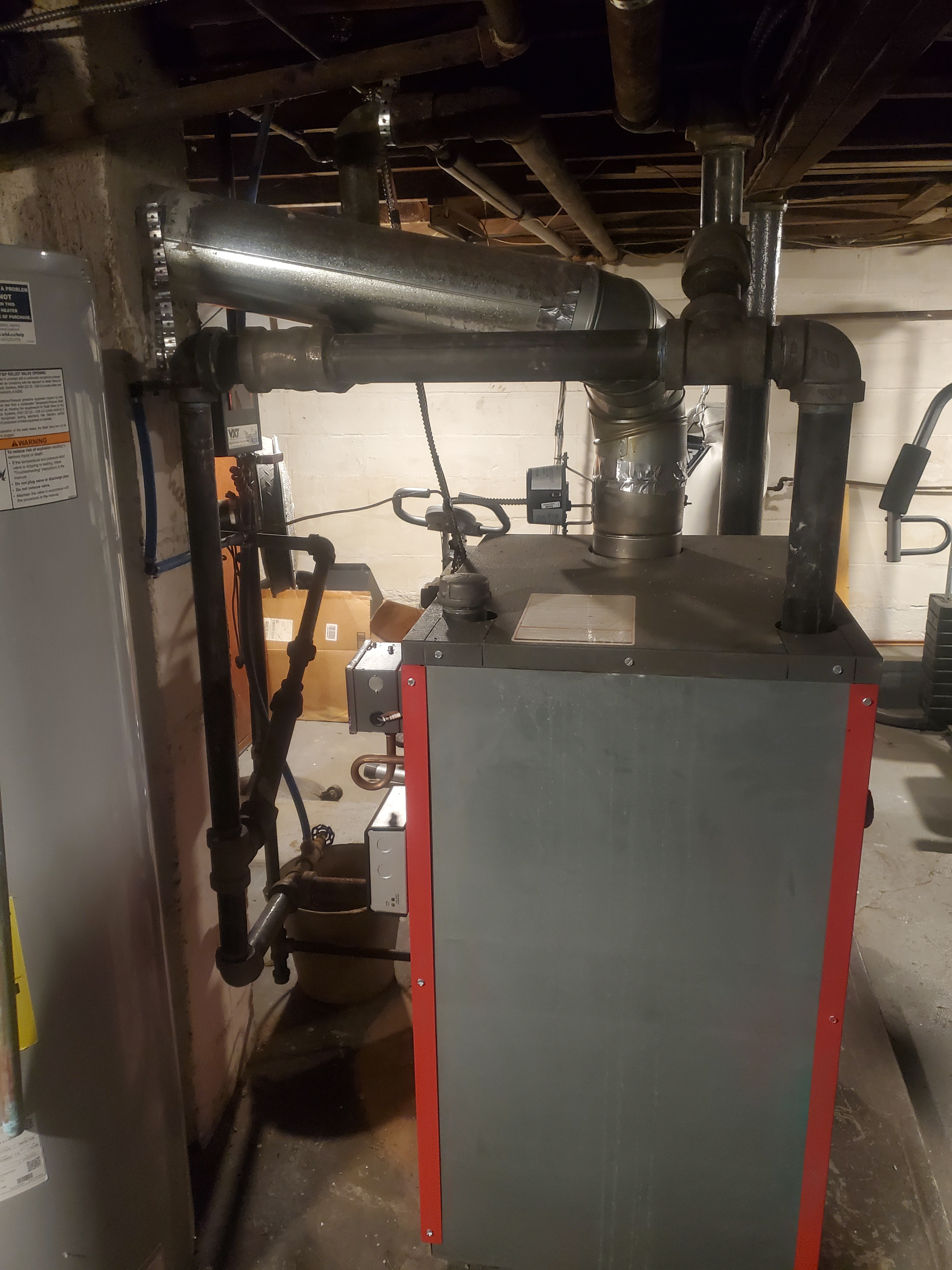
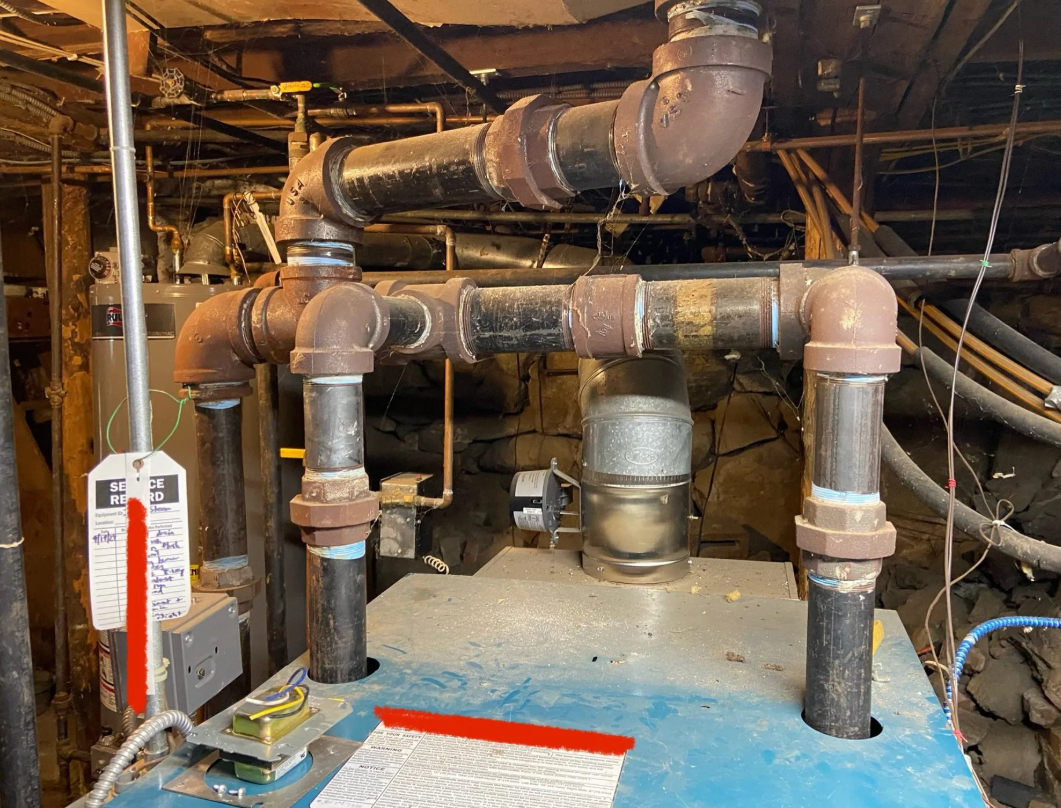
Also, quick update.. Here is the back of the boiler. I only showed the front previously. Looks like I'm missing the connection on the left according to the pic below
 1
1 -
Agreed. I've deleted the post regarding shaming this company as a group. This is not what Heating Help is here for. Thank you.
Forum Moderator


 4
4 -
That is a horrible instal and it’s a shame you paid good money and didn’t get a quality job. I’m a plumber in NYC and can’t say I’ve ever heard of That company. What area of Long Island are you in?
0 -
I'm in West Hempstead. I reached out to these guys about t and I wasn't happy with what he said. Bottom line is, I don't want them touching my equipment again. I'll bite the bullet and reach out to someone mentioned here to straighten this out. Also, someone mentioned the constantly cycling on and off…well fortunately it doesn't do that. I'd say that it holds the heat at between 70 to 72 for almost a good 2 hours before it kicks on again. My downstairs is drafty as **** but it still manages to hold the temp for awhile before the system kicks back on. I'd really like to see the difference with it properly piped. Stay tuned…
1 -
Anyone measure the radiators in that place to check that the boiler's not twice as big as it should be?
 1
1 -
during this cold spell with winds that boiler should be running almost 100% of the time!
1 -
@KeefWeef Hello Keef.
I have read carefully every post here ,and:
I can't/will not believe in the almost middle of New York you got a nice furnace (considering Crown brand) but a bad install… (considering your gas bills 😱 ).
please forgive me ,but I am from Romania. And by comparison ,to spend here $10000 US dollars and not get a good or at least decent install(since by reading what other american dudes wrote here with years of experience, it's not the Crown fault) ,that would mean at least a beating ,tied in basement and you don't go home until you fix the problem!
I too used oil heating for some time but gave up for various reasons.
Done right ,it's best and safest heating.
Although ,around here natural gas G20 and condensing water central heating is the "king" of heating...
I too am very curios how you fixed your gas bill "problem"!
To receive a $1500 gas bill would make me "at least a bit angry"!
Although 500 euros monthly gas bills is common here ,when it's minus 10 Celcius outside and a 40km/h constant wind…
For an apartment. Big houses pass 1000 euros gas bills a month.
At least we're not (YET) buried in snow as in many past winters(2012 was/is to remember).
Cheers
0 -
There's probably very few if any steam systems that run 100% of the time during weather like this.
Not only are the radiators almost always grossly oversized, but we have boilers that are no less than 33% oversized and often 50-100% oversized. On a rare occasion you'll find the radiators properly sized but it's rare.
The last time I did a manual J my system needed -40F to run 100% with a 72F inside temp. Our design temp is +6F.
While what you said is technically correct, it's not reality.
Single pipe 392sqft system with an EG-40 rated for 325sqft and it's silent and balanced at all times.
 1
1 -
Guys,
I reached out to a company listed in this forum and he's coming over next week for a consultation. I explained the boiler size to him and the outrageous gas bill (I got one today for $450) he said he may be able to downfire it with a 2-stage gas valve that can reduce its output from 100, to 60%. It depends on what he finds. I really hope he can resolve this because I'm so ready to give up a kidney and go BACK to oil🤬
0 -
The first step in assessing whether your gas bill is "too high" is having a good understanding of your building's actual heat loss. I grew up on Long Island in a 100+ year old house that burned oil, and I'm having trouble believing that you heated an average-sized (?) house of similar vintage on Long Island with little more than 1 gallon of oil per day (from your statement that you would typically get a delivery of 60-80 gallons every other month, which works out to 30-40 gallons per month, or 1 to 1.3 gallons per day.)
To put that in perspective, I maintain our 4-unit 100-year-old condo building (built just like a house but with 4 units) in the Boston area, so slightly colder than Long Island. We have upgraded windows, 10" of cellulose in the attic, but no insulation in the walls. Even so, our heat loss isn't bad. In a 4800 sq ft building, in the coldest months of January and February, we average just under 300 gallons per month, using 82% combustion efficient Weil McLain WGO-5's. On a design day with outside air temps at zero degrees, we burn on average 0.6 gal/hr, for a gross input rate of about 84,000 BTU/hr, or about 17 BTU/hr/sq ft, which is reasonable for an older house in our zone.
So if you have a similar 100+ year old house on Long Island, we should be in the same ballpark per square foot heat loss. We use just under 300 gal/month for 4800 sq ft, so about 0.06 gal/sq ft in the coldest 2 months. So if your house is, say, 1500 sq ft, for a similar heat loss, you'd be at 0.06 x 1500 = 90 gal/mo. Our oil costs about $3.50/gal, so that would be $315/mo for you in Jan/Feb. That sounds reasonable, and I guarantee you many, and perhaps even most, houses on Long Island are spending more than that in heating costs per month.
But you say you were using less than half that in oil? 30-40/gal/month? In January and February, in a 100+ year old house on Long Island? I could believe that if your house is, say, only 750 square feet, or if your 1500 sq ft house was built 10 years ago with 2x6 double-insulated walls and triple-pane windows. Something isn't adding up, unless your house is much smaller than average or much better insulated and air sealed than the average 100-year-old house on Long Island.
1 -
Let's not forget that snowman that was what, 60% efficient?
That's another part that's very hard to understand.
Single pipe 392sqft system with an EG-40 rated for 325sqft and it's silent and balanced at all times.
 2
2 -
So the snowman boiler at 60% efficiency costs less to operate than the Crown Gas boiler rated at 82%. Your Oil Dealer must have had great service technicians that knew how to make old coal conversions operate as much higher efficiencies. Perhaps it was operating at 75% efficiency and not 60%.
There is a major problem with the way this was specified and installed. I believe that a good professional with steam experience will be able to help you.
Edward Young Retired
After you make that expensive repair and you still have the same problem, What will you check next?
0 -
Even if the snowman was operating at 82% combustion efficiency like our WGO-5's, an oil consumption rate of 1 gal per day for an old house on Long Island heated to 74 F in January is miraculously low…
Put another way, 1 gal/day burned at 100% efficiency would average 5800 BTU/hr, which is about the heat output of one 1500 watt space heater. So the OP has been heating his entire 100-year-old house on Long Island to 74 F in January with the equivalent of one 1500 watt space heater? Hmmm…🧐
1 -
I went back and read the first post:
" I was able to keep my house at a nice 74 degrees all winter and it was extremely comfortable. My oil bill would be maybe $150 - $350 depending on how much oil I wanted to have put in the tank. I would do this maybe every other month. "
So if we use the higher number of $350 and go every other month, he's using less than 2 gallons of heating oil a day. He didn't say how big his house was, but if it's an 800sq foot that was updated with in-wall insulation, attic insulation, and top performing windows and doors, can he get to less than 2 gallons a day? Maybe if he averages his total usage over the course of the entire year, but 2 gallons of day in the winter on that old converted boiler would be impressive indeed.
I use just under 700 gallons of oil a year on a 2800sq foot house, and on very cold days it uses 5-8 gallons. But averaging 700 gallons over the year, it's using an average of just under 2 gallons a day (I also use oil for how water).
1 -
@MaxMercy Yes on the average thing. In our condo building (4800 sq ft) we use 1200 gal/yr. Which turns out to be exactly the same annual rate as you, per sq ft (though we have gas for DHW).
As you say, 2 gal/day for an old house on Long Island in January would be impressively low, but 700 gal/yr is not. So it seems there's some averaging going on in the OP's oil cost numbers, which makes it difficult to say whether a $300 gas bill in January is reasonable or not by comparison.
1 -
@KeefWeef said: "I'd put maybe 60 to 80 gallons in it every other month or fill it up once or twice a year."
OK, so I'm just trying to understand what your total annual consumption was. If you fill up a 275 gallon tank from near-empty once per year (say adding 200 gallons at the start of the season), then add 80 gallons every other month during the heating season, that's 3 x 80 = 240 gallons more, for a total of 440 gallons. That could be reasonable depending on your sq ft. At $3.50 gal, that would cost you $1540/yr. And obviously if you "fill" it from near-empty twice instead of once as I assumed, that's more $$.
I find that we burn about 25% of our annual oil total in the coldest month of the year, which for you would then be 110 gallons. At, say, $3.50/gal, that would cost you $385. Suddenly your $300+ gas bill for December (?) doesn't look so bad.
Again, I'm not doubting your statements, just trying to understand your actual cost basis when you were using oil.
Around here (Boston area), natural gas prices spiked last year, resulting in near-parity in cost per BTU with oil. Long Island could be in a similar situation..
0 -
So my house is 950 sq ft. When I had oil I would never let the tank go below a quarter tank. For example, Let's say in January, I had a quarter tank. I would put enough oil in to bring it to 3/4 tank. I wouldn't have to put anymore oil in until maybe the end of February, when it would be back down to a quarter tank and so on. 74 was the temp I kept the house at. My home isn't that big.
0 -
What was the reason for buying a new boiler and changing over to NG if your bill was affordable previously?
Was the old one leaking?
Single pipe 392sqft system with an EG-40 rated for 325sqft and it's silent and balanced at all times.
0 -
OK, so scaling off us by sq ft, if your heat loss and boiler were the same, you'd be using about 240 gallons per year. But with that old snowman boiler running at low efficiency, you'd need to burn maybe 25% more oil to get the same output as us, which rounds you up to 300 gal/yr. Then 25% of that burned in the coldest months puts you at 75 gal/month for, say, Jan and Feb.
Another way is to take your example of adding 1/2 tank in January, so half of 275 is 138 gal, and maybe that lasted you from mid-Jan, to end of Feb, so 6 weeks. That's a use rate of 23 gal/wk, or 92 gal/mo. And extrapolating to a full season, that's about 370 gal/yr.
With that old boiler, I'm going to guess 92 gal/mo in Jan is more likely than 75 gal/mo, so let's use that. Now you're in a more realistic place of burning 3 gal/day in Jan, not 1 gal/day which would be miraculous as I said earlier. So 92 gallons at $3.50/gal is $322. That's a reasonable cost for heating your house with oil in January.
And for your total annual heating cost with oil, 370 gal x $3.50/gal = $1,295/yr. Again, a reasonable number.
Now for your switch to gas. If you were here in the Boston area, natural gas last year was around $2.30/therm (=100,000 BTU, or about .71 gallons of oil equivalent). So the gas equivalent of 370 gallons oil for a year would have cost you about $1200 for the year, and the gas equivalent of 92 gallons of oil for January would cost you about $300. (You also has a $35/mo gas bill for hot water before the switch, so that's another $420/yr. So maybe $1600 total annual cost for the natural gas equivalent of oil, if you lived here last year.)
But you're on LI, not in Boston, so your rate per therm will be different.
Then check the total number of therms used in January. Based on 92 gal of oil use in January, the gas equivalent would be 129 therms. If you used more gas than that, it could be that your boiler is running inefficiently and your system needs to be adjusted for better efficiency. Your new boiler should be more efficient than the old snowman, so you should probably using less than that in January.
0 -
I was told by those who had Gas heat how much cheaper it would be if I converted and how the conversion wouldn't be that much since I already had a gas line down in the basement. I fell for it.
0 -
That's a lot of math you're doing @jesmed1. Bottom line is, it was much cheaper when I had oil. My house stayed comfortable even during the coldest months because I could crank it up to 76 if I wanted to. My oil gauge stayed between a quarter to 3 quarters. I would also fill it up maybe twice so the oil lasted me for quite some time. I remember tallying all of the money spent during the heating season and it was around $2200. I'm already at almost $1000+ and we're nowhere near the end of the cold weather up here in NYC. I do NOT intend on going through this again next winter. I'm willing to take out a loan to convert BACK to oil. I'll reserve that action until I hear what the HVAC guy says when he gets here next week. If the limiter and the CORRECT piping resolves this and my gas bill becomes reasonable again, and reasonable for me is no more than $80 to $130 per month, then I'll stay with it.
0 -
Even with the cost of NG being cheaper where I am, and a new boiler being more efficient I cannot see the cost savings vs what your oil cost ever being enough to justify a new boiler. Should you have replaced that snowman boiler? YES, but not with the expectation of saving money. It ensures a good safe reliable heating system.
I did $350 divided by 2 to give me the cost per month, times 5 months is $875 a year.
Even if you cut that in half, it's only $437.50 a year savings, and there's no way you're cutting a fuel bill in half except for maybe some good insulation, windows etc. But not by ch
I'm sorry, but if they get it running good it should be a bit cheaper, and you won't need oil burner maintenance etc, but you'll never break even in my opinion.
Now, taking out a loan to have yet another boiler, new oil tank installed is jumping out of the pan into the fire. That certainly won't save you any money. Boilers aren't cheap and good labor certainly isn't.
Single pipe 392sqft system with an EG-40 rated for 325sqft and it's silent and balanced at all times.
0 -
The old tank is still under the front porch as well as the pipe to it that's currently connected to a shut off valve.
0 -
is the fill capped?
1 -
I'm willing to take out a loan to convert BACK to oil.
Keep in mind if your next contractor installs an oil boiler with incorrect steam piping, your heating expenses could be even higher than they are today.
1 -
Your math is still not adding up. You say you spent $2200 on oil last year? At, say, 3.50/gal, that would have been 630 gallons. And in the coldest month you would have burned 25%, or 157 gallons. That's $549 worth of oil.
But let's say the $2200 you spent on "heat" included $350 for boiler servicing, and $400 for gas for DHW. That leaves $1450 for oil. And if your natural gas cost per therm is on a rough BTU parity with oil (as it was here in Boston last year), that's $1450 in gas for heat, plus the $400 for your gas DHW, so $1850.
Even if your new gas cost was only half of what you spent on oil (because of new boiler better efficiency, etc), you'd only be saving half of $1450, or $725 per year.
I agree with @ChrisJ . Get your new boiler working as efficiently as possible, and accept that your heating costs are (relatively speaking) so low as to make further investments in boiler swaps a money-losing endeavor.
1 -
We've also had a few very mild years.
This is the first actually cold winter in quite a while.
Single pipe 392sqft system with an EG-40 rated for 325sqft and it's silent and balanced at all times.
2 -
We're up 11% on oil consumption for the season to date vs. last season, based on total boiler run times.
1 -
So are we…
Br. Jamie, osb
Building superintendent/caretaker, 7200 sq. ft. historic house museum with dependencies in New England1







Categories
- All Categories
- 87.8K THE MAIN WALL
- 3.3K A-C, Heat Pumps & Refrigeration
- 59 Biomass
- 430 Carbon Monoxide Awareness
- 132 Chimneys & Flues
- 2.2K Domestic Hot Water
- 6K Gas Heating
- 124 Geothermal
- 170 Indoor-Air Quality
- 3.8K Oil Heating
- 79 Pipe Deterioration
- 1.1K Plumbing
- 6.7K Radiant Heating
- 396 Solar
- 16.1K Strictly Steam
- 3.5K Thermostats and Controls
- 56 Water Quality
- 51 Industry Classes
- 51 Job Opportunities
- 18 Recall Announcements