Design Review - heat pump water heater with boiler coil redux

Hello All and thanks in advance for any thoughts you might have on the following approach to installing a hybrid heat pump water heater (HPWH/HP) that will hopefully become the main source of domestic hot water for a system that currently relies on an oil-fired boiler coil. I've followed many of the discussions on this general topic here on Heating Help and have hopefully used what I have learned to design a "mongrel" install that addresses the concerns raised when bypassing (but not removing) the coil. First some context: I live in southern Maine, so generally considered a cold climate though things are changing, summer is longer and hotter, winters shorter and cold but less predictably so. Current heating system is a 90's vintage Utica boiler with a Beckett burner and forced hot water baseboard distribution system. It's had fairly light use, runs reliably and still holds consistent temp and pressure, but obviously it doesn't owe me anything and I'm gradually preparing to replace it with an air to water heat pump system when she finally gives up the ghost. I run it at ~180 F on the high end, which still gives the two of us plenty of heat and hot water. We are conservative with resource use and have a wood stove to take the edge off in winter.
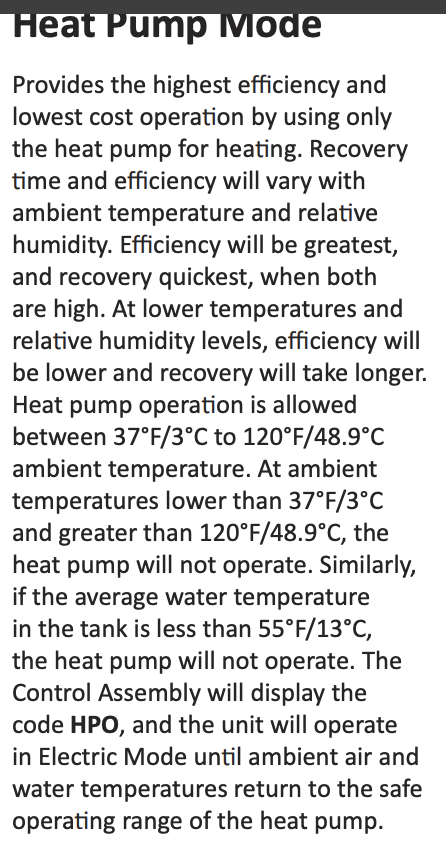
Here's the issue: I purchased a 50 gal. State HPWH, with a generous point of purchase rebate from Efficiency Maine and intended to use that exclusively for DHW. Low and behold, when reviewing the install instructions I discovered that the heat pump mode will not operate if water temperature in the tank is below 59 F. I knew about the HP cut out if the ambient air temperature is below 45 F (not a problem, it's in the basement next to the boiler) but I was unaware of the 59 F cut out for the tank water! In either case, if the temp is lower than the low default, the unit switches to the electric heating mode, which is not a step up in efficiency. We have a drilled well and the water temperature fluctuates from a high of ~52 in summer to a low around 45 F in winter, 7 - 14 degrees below the cut out year round. This is a problem since I purchase the HP to reduce our oil consumption (particular in the summer) and as part of an effort to improve energy efficiency. Though I am uncertain of how long the unit will have to operate only using the electric elements to raise the temp enough for the HP to kick in, time and experience will tell, I've decided to attempt an install that will allow use of either the boiler coil or the HP. The design I am proposing will allow me to isolate, drain and vent the boiler coil when using the HP and vise versa, if it turns out to be necessary to continue using the coil during the coldest months. I would appreciate any comments you might have on the functionality and safety of the proposed design and I will do my best to answer any questions.
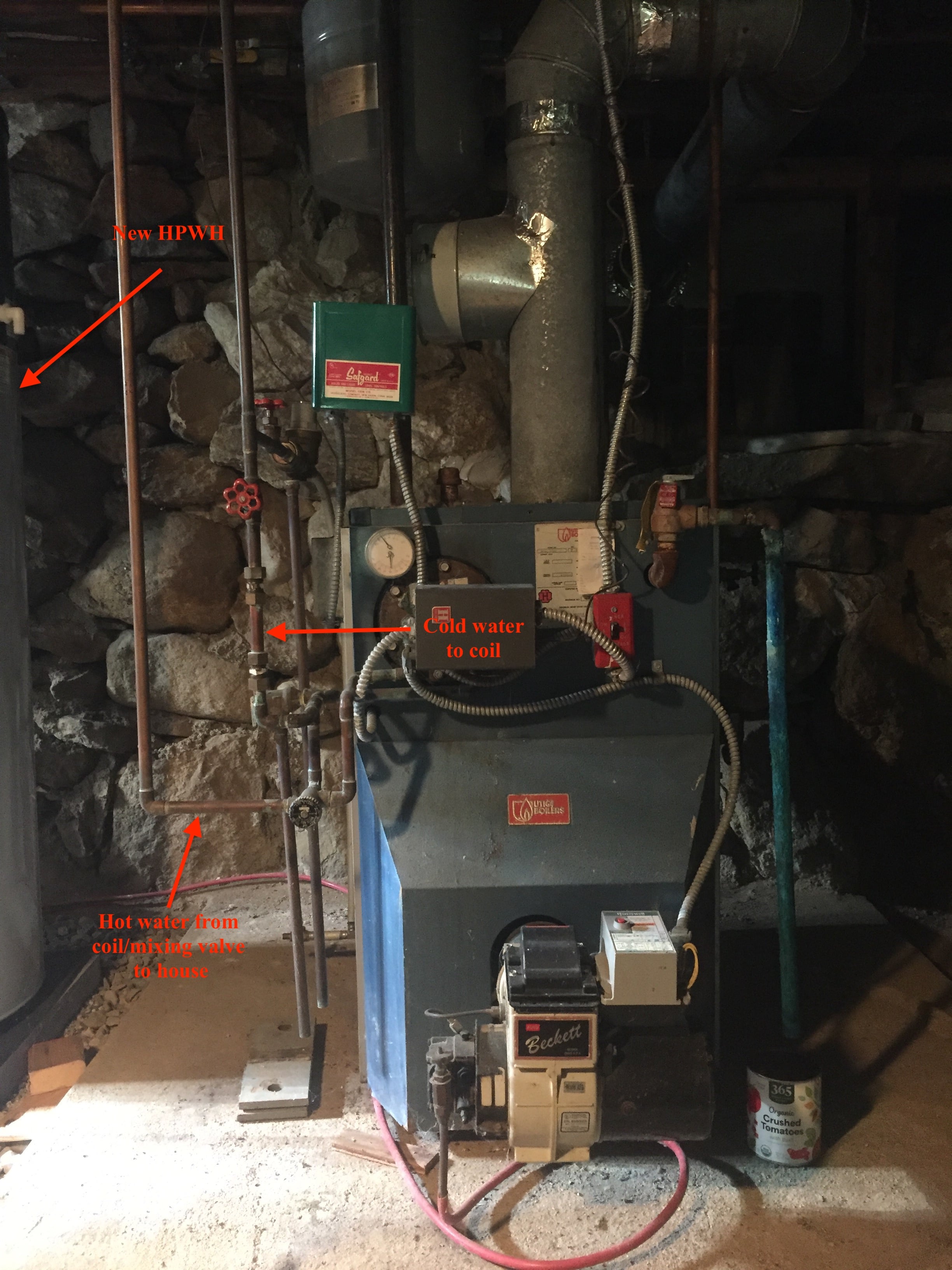
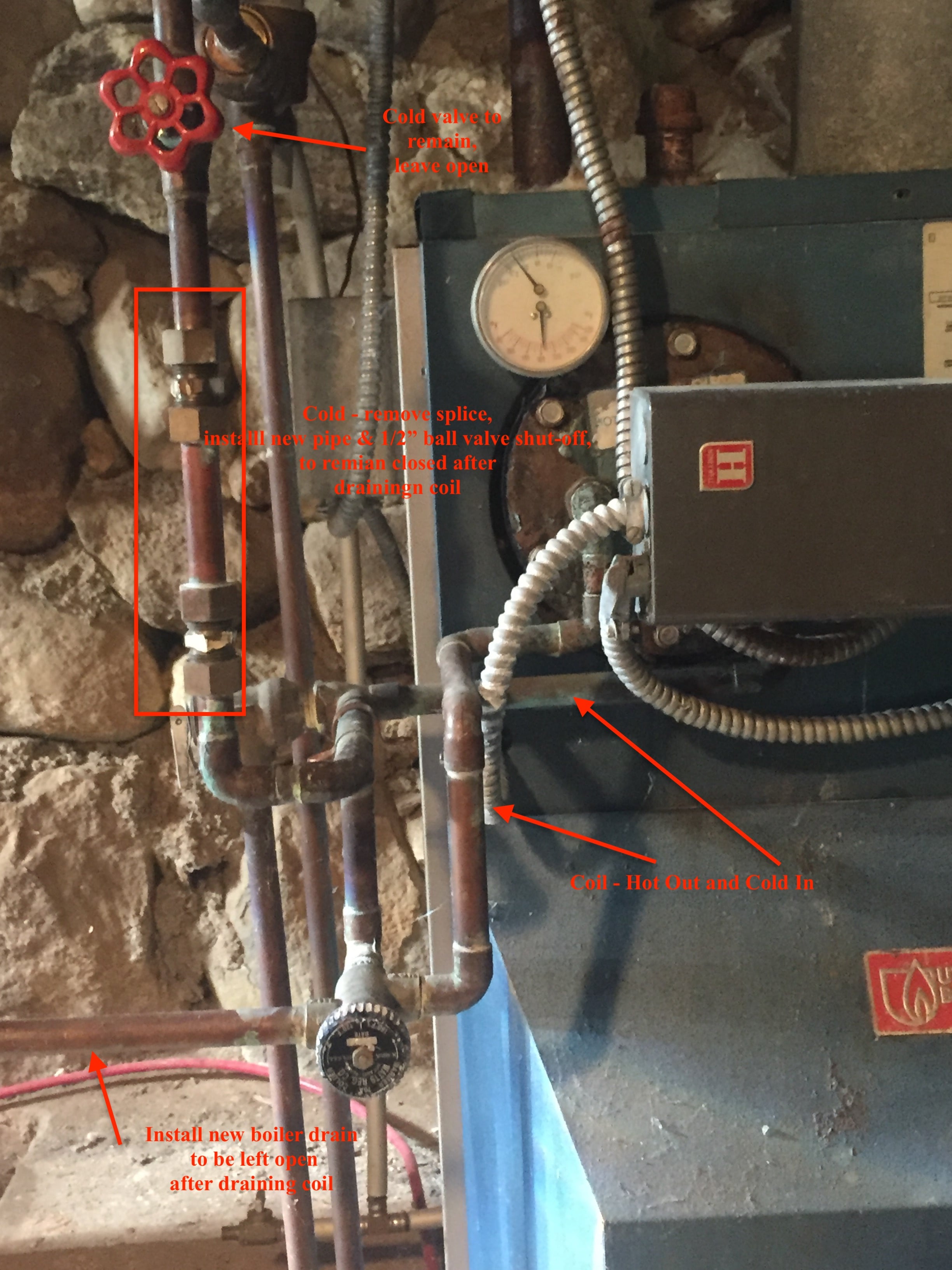
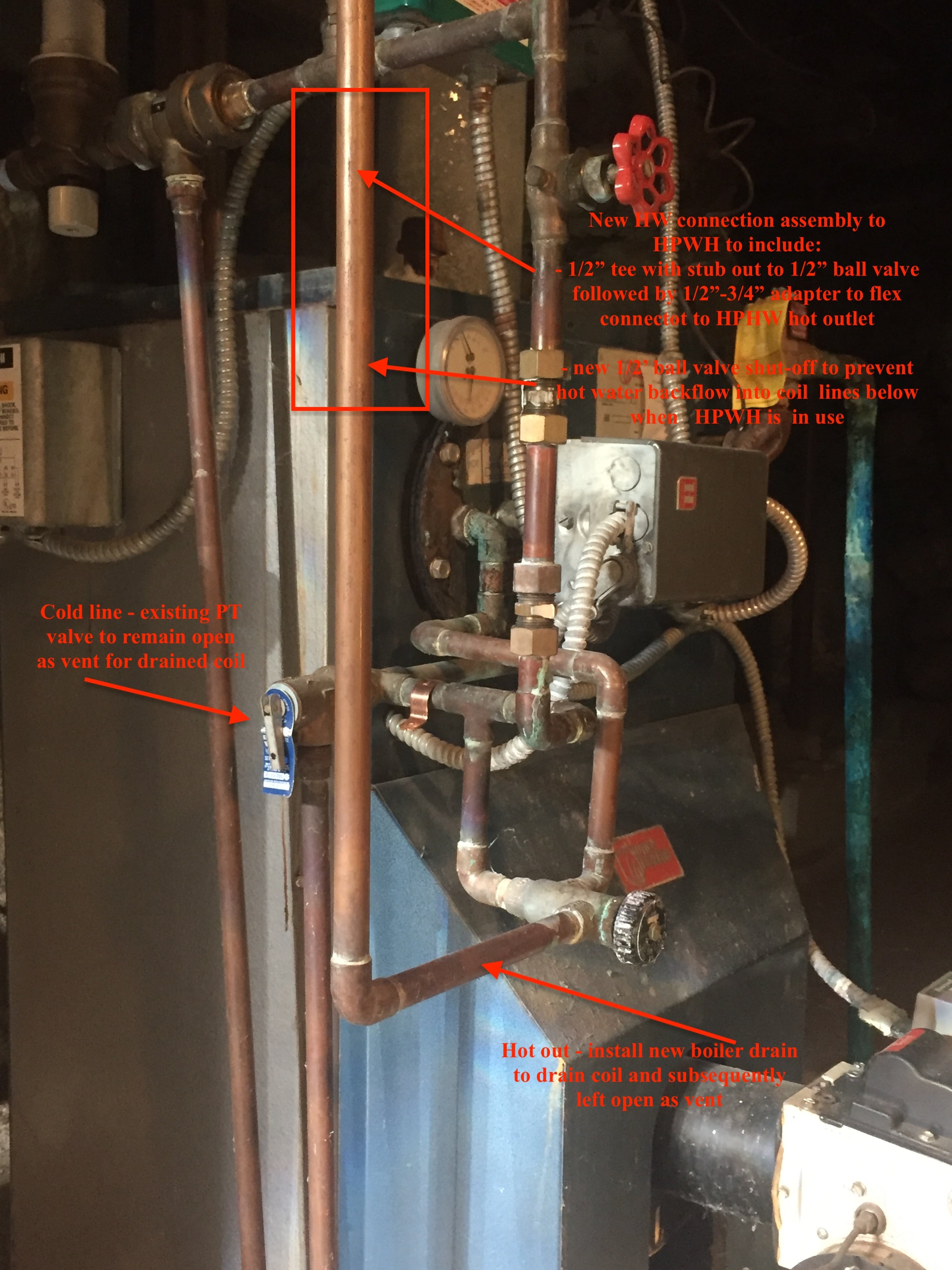
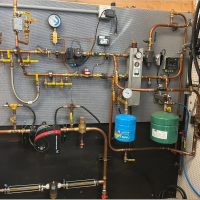
I have attached three photos that hopefully describe the design in sufficient enough detail for reviewers to understand how the installation will work. I'll let them do the rest of the talking.
Thanks for any help,
Rusty
Comments
-
My user name is Rugged, not Rusty. That one was taken. Sorry folks!
 1
-
Generally you do not pull the entire tank down to 55°. It shows average tank temperature, probably reading at mid point in the tank. Why would you be running hot water taps if water is below 55°?
So on first fill, if water is below 55 it will run electric only until it heats above 55° as I understand it. Then it goes to heat pump mode. This may be only on 120V models?
If you did pull the entire tank to 45, electric element warms to 55 then HP takes over.
It takes about 3400 btu to raise the tank from 45- 55°, so about 1.2 Kw. What are you paying for KWh?
Maybe plug it into one of those Kil O Watt meters to track for a month and see what you actually use for electric
You could plumb up either a manual or automatic bypass valve that reverts to tankless until the HP warms on its own. Maybe try it as is before you go to that trouble.
Bob "hot rod" Rohr
trainer for Caleffi NA
Living the hydronic dream 1
-
Depending on the temps of your basement, a holding tank to "prewarm" the well water before it enters hpwh, uninsulated tank, could be an option. Alternatively a basic electric water heater, set to 59F as a preheat tank.
More complex would be Drain water heat recovery system, your house may not be a set up for it.
 1
-
seeing how most basements are 55* anyways that is lityle help.
Small solar collector(s) will help under the right condations.0 -
Thanks for your comments everyone. (btw, can I reply to an individual's comments w/in their comment box so I don't have to scroll up and down to address specific points? Thanks.).
Hot-Rod, from your btu comment it's clear that the cost is not an issue using the the electric elements to raise temp 10 degrees or so for the HP cut in. I wasn't sure how that was going to effect overall efficiency and cost. Electricity supply costs about $0.13/kwh :), the distribution cost averages out at roughly $0.18/kwh so it's not cheap as grid power goes, but the electric mode demand seems like it will be small part of the overall cost to run the HP. I certainly wouldn't expect to get any hot water prior to the tank heating up to its default temp of 120 F. I may notch it up a bit after I see what that does for us. The Watts tempering valve on the boiler is pretty much shot (I've got a replacement for it) but since every faucet has a mixing type fixture, this hasn't been a problem, no kids to worry about.
I've pretty much weighed most of the options prior to posting and was hoping to get some feedback on the proposed configuration for dealing with the coil in a safe manner. Any thoughts about that (see photos) would be much appreciated.
Bjohnhy, I did give some consideration to options for pre-warming the incoming cold, there's some clever ways of going about that and you hit on a couple I've explored. There's a building science discussion group over in Portland that I participate in now and then, it's a lot of fun and some real nerdy discussions emerge from time time. The free food and beer helps folks to think outside of the box! Waste drain heat recovery has come up, mostly in multi ot commercial settings with lots of hot water being waster. Unfortunately, I don't have long enough runs to scavenge enough heat from that approach. But since the HP is located right next to the boiler, the return lines run right above it so if I'm unhappy with performance, I may play around with some type of heat scavenging (pipe conduction) off of those lines. Haven't worked out any of the details on that yet and of course, it's a trade off energy wise so it might not pencil out. Someone who understands the relative heat loss and btu trade-offs might jump in on this but I'm not too worried about it at this point. Going to run with what I have, unless someone see's a problem with the configuration I've presented, and stop, you're going to blow up your boiler.
pecmsg - yes on basement temp, especially in this 200+ year old farmhouse with a dirt floor and stone foundation. Spend a lot ot time doing air sealing. The HP will actually lower the temp a few degrees but it will also dehumidify so it's a fair trade off for this place. I'm a big fan of solar collectors and thought about going that route for the entire DHW system at one point. But winter snow conditions are expected to become more mixed precip (read icy) and that will mean more down time on the panels. Still, I may add a few at some point to give me the extra warming if performance lags. Hard to beat passive sources if you can make them work.
Any thoughts on the proposed configuration? Thanks.
0 -
I hve been doing solar thermal since the 70-'s. I'm still building some thermal panels for my projects. You can buy the copper fins from AET in Florida. Build the box from most any material.
Here is my most recent, 28' long 3' wide drainback panel, aluminum frame, rockwool insulation, tempered window glass. The aluminum tubing was free, about $1500 in copper and glass, that was 3 years ago.
Used thermal panels go through FB marketplace from time to time. In warm weather I get 145° or so, 110- 115 in winter in Salt Lake, cold and snow.
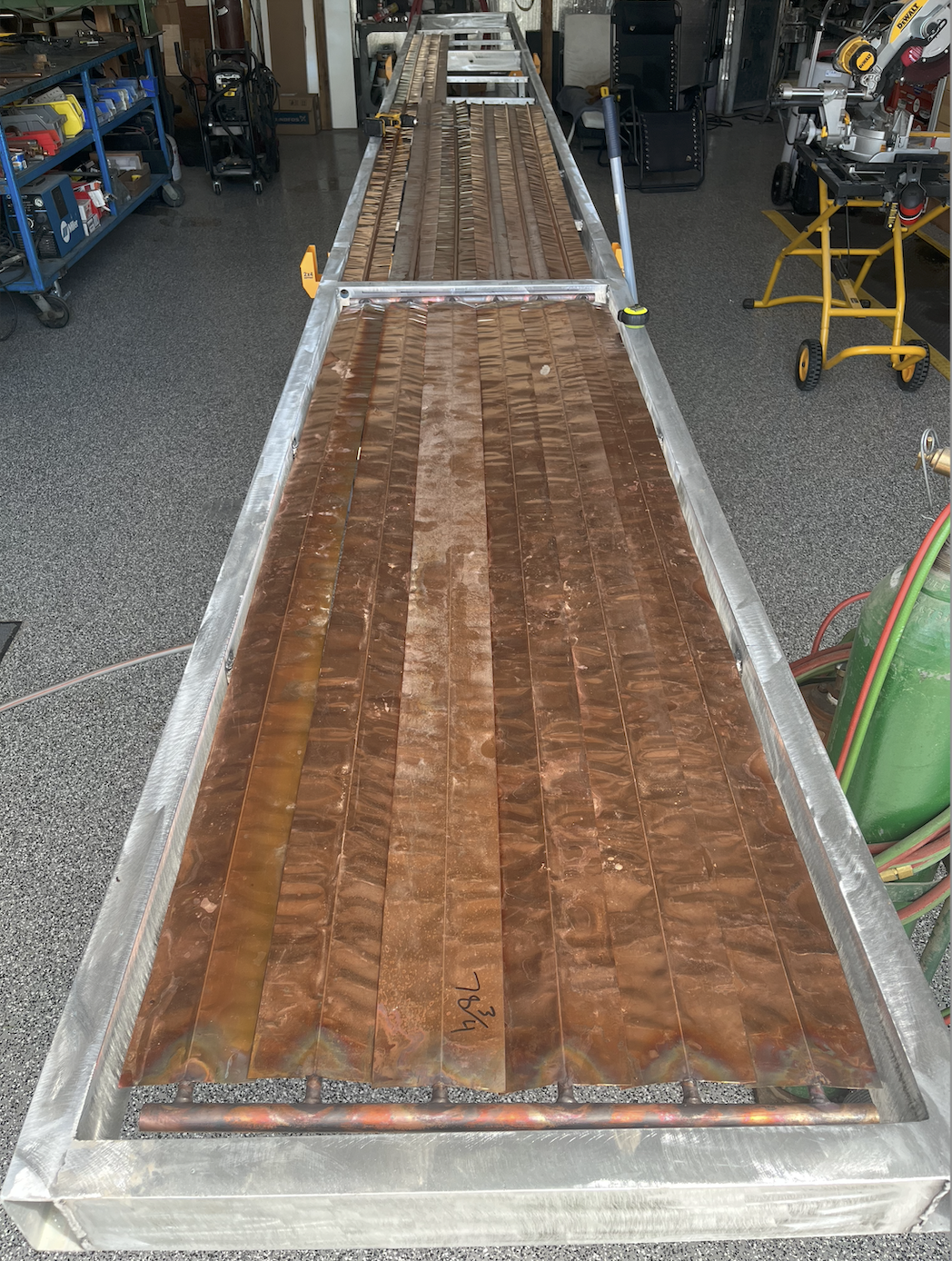
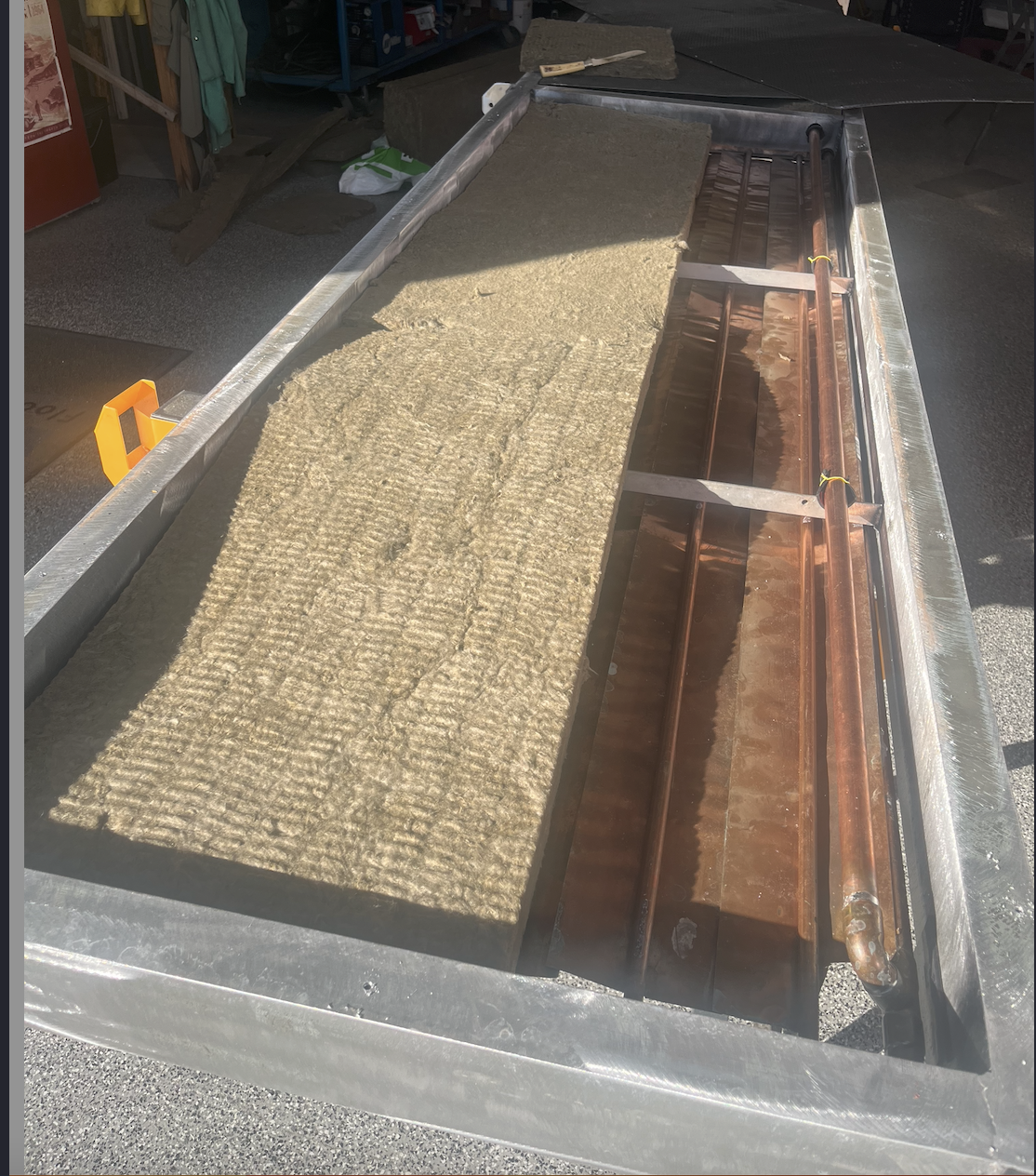
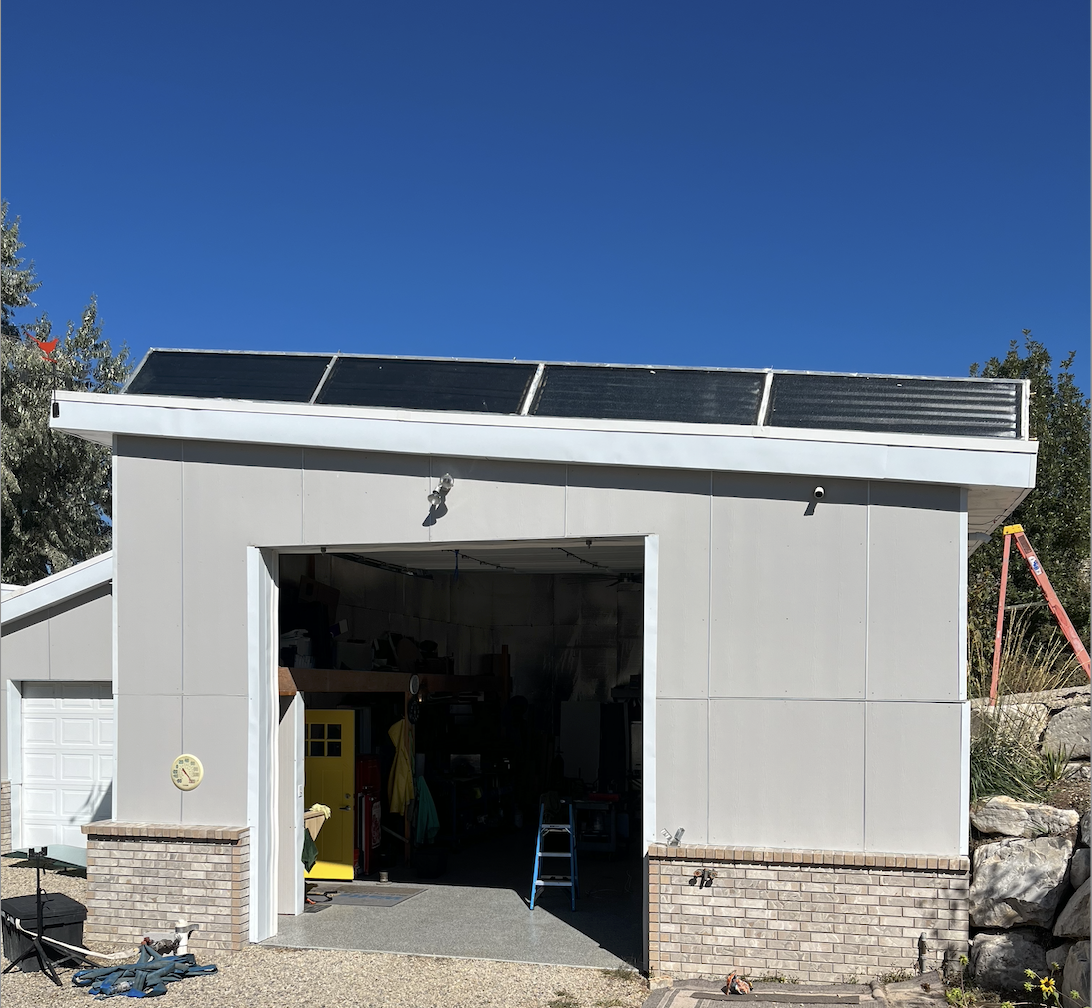
A Harbor Freight compressed air tank for the drainback.
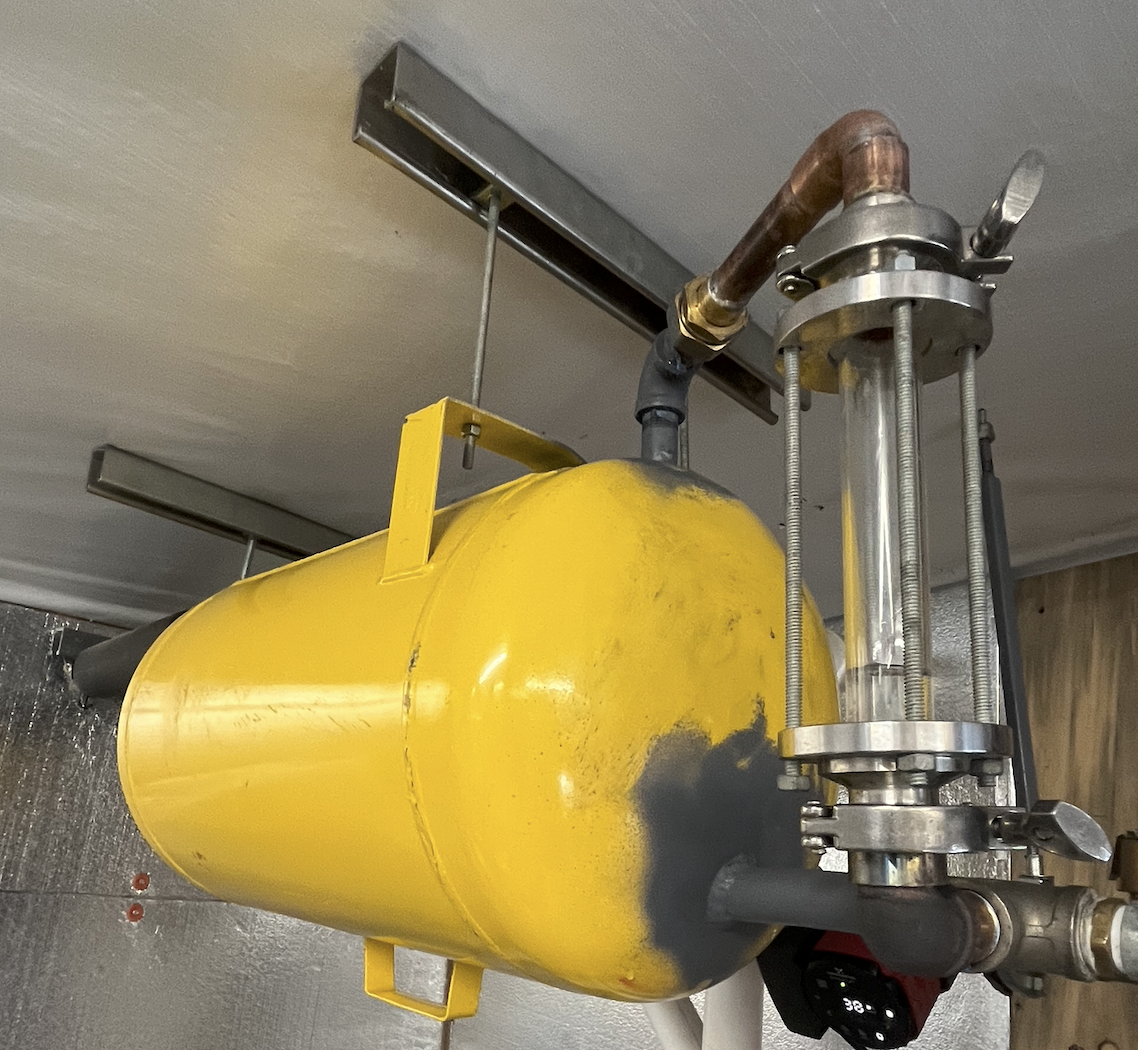
looks like that HP cannot take above 120 pre-heat, so you would need to either temper or use a few thermostatic mix valves as a selector valve.
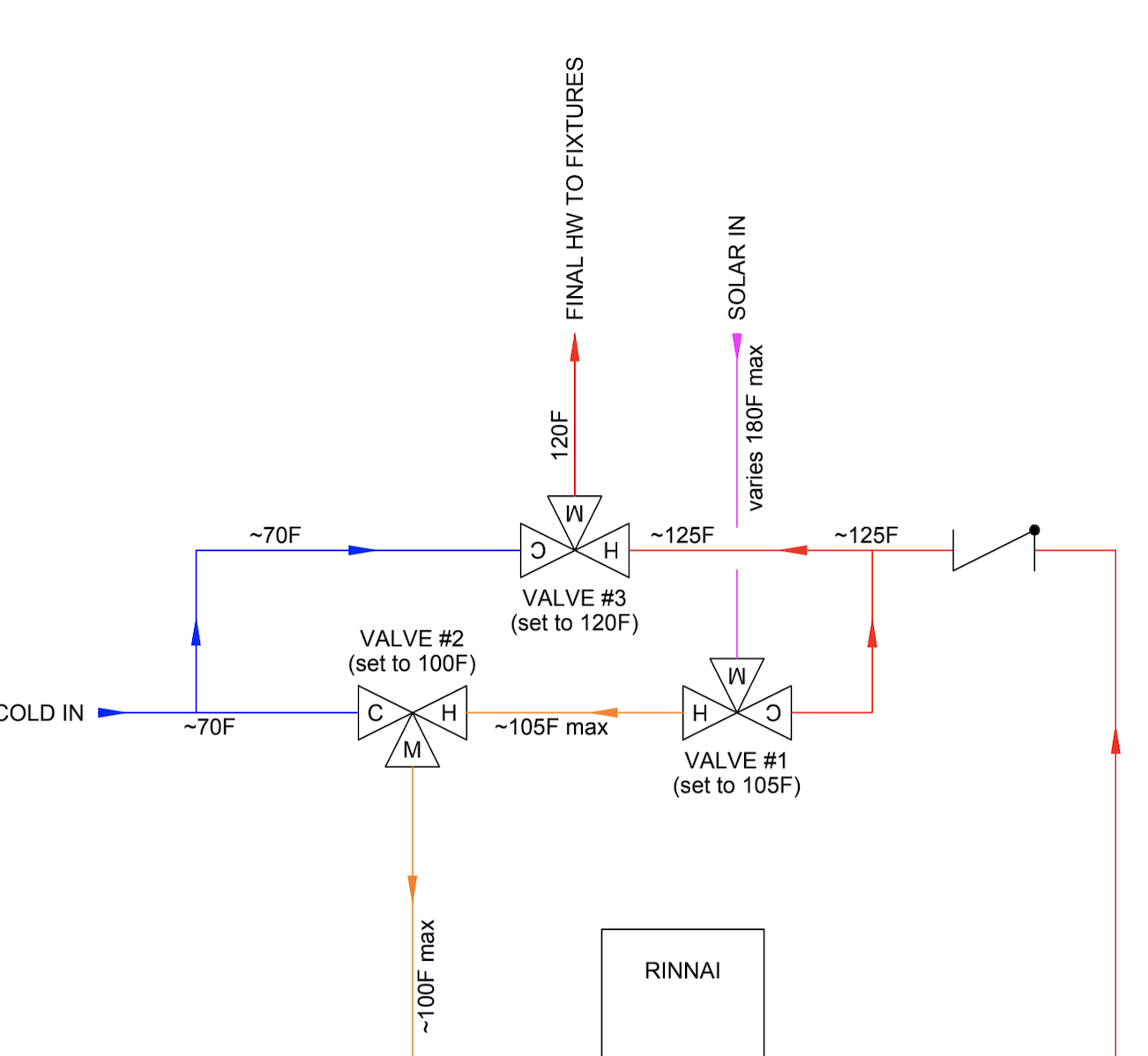
This was a prototype we built foor Rinnai, back in the solar heyday.
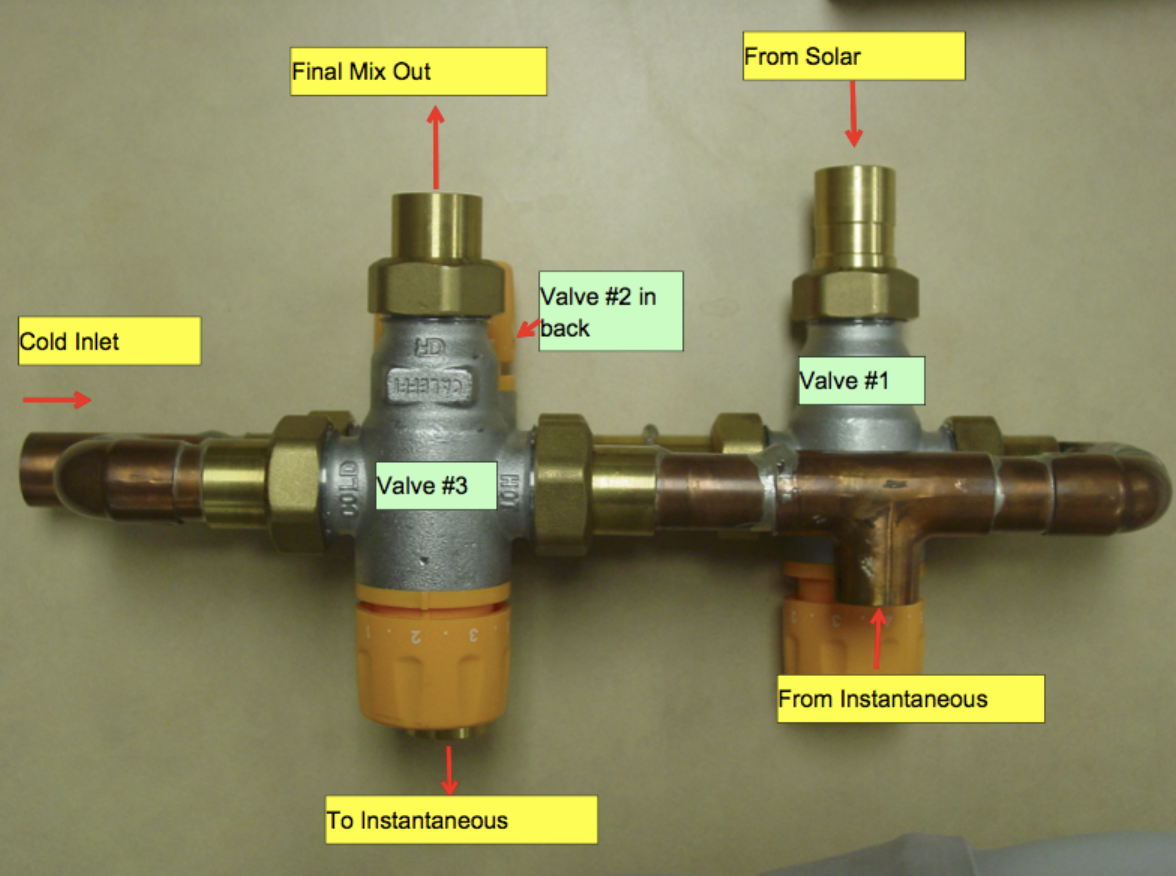 Bob "hot rod" Rohr
trainer for Caleffi NA
Living the hydronic dream1 -
Hi David784, thanks for the comments on the coil configuration. I understand the concerns about leaving a coil full with water, really any water, right, so that's exactly why I have decided to plumb this as an Either/Or setup where I'll be using only one or the other, but never both, at any given time. I'm not attempting to use the coil as a pre-heat, I'll jump off that bridge later if the cold water temp becomes a limiting factor for efficient HP operationI in winter. In the short term (~ 1st year) if the HP turns out to be a de-facto electric hot water heater due to low water temps, I want to have the option to shut it down, drain it and go back to the coil for winter use. I understand this is not something to do with the simple turn of a valve, i.e., don't flood an empty, hot boiler coil with cold water! If it comes to it, I would shut down the boiler, let it drop ambient temp and then slowly let water into the coil. I would use the new boiler drain to purge the air before closing it off to help ensure there was no trapped air in the coil assembly. In addition, the ball valves I'm using also have bleeder caps that will allow me to vent air from the small section of pipe above the boiler drain. Obviously this is a lot of fiddling that I hope I don't have to do but I want to leave the option of going back to the coil if the HP turns out to be less efficient than expected. Given all that, I've configured the plumbing to be able to completely isolate and drain the coil and leave both the cold (using existing PT valve) & hot (new boiler drain) lines open as vents. I'm also installing a new ball valve on the incoming cold line to the coil below the ex.gate valve since it does not completely seal and I don't want any slow leaks into the coil that might build up pressure. (I may end up repacking this valve eventually but I want to avoid it for now (got enough to do) since it is close to the boiler feed line and I don't want to get into that can of worms. I know my limitations, and this job is about as close to a boiler as I want to get.
If there are any problems you see with this approach, anything I missed, I would appreciate hearing about them. Thanks.
Hot_Rod, what can I say, that is an awesome solar panel set-up. Your fabrication is obviously top of the line. The performance speaks for itself, especially in your climate. I have had the good fortune of working with a close friend who owns a solar company in MA (PV and DHW) so over the years have ben involved a quite a few solar hot water installs. He typically used flat plate collectors and rarely plumbed drain back systems, preferring the glycol/heat exchanger approach over drain down systems with additional valves that homeowners never touch and end generating call backs. Not that he begrudged servicing whatever he installed, often at no cost if he thought he could have done something better. At any rate, I'm sure you don't have that problem. Beautiful array.
Any final thoughts you might have on my configuration description above are greatly appreciated.
Happy trails, Rugged
0 -
Hi, Just to share a historical perspective, when electric water heating first appeared, the heating elements were quite small and slow. The manufacturers got around this by having clients install a tempering tank in series before the heater. This approach seems a great and simple way for what you're doing. You only want to raise the temp a little, and a large uninsulated tank could probably do this. Do you know what temps you have in the boiler room?
Yours, Larry
1 -
The main issue with pressurized glycol. The glycol cooks when there is no load, which can destroy the glycol within a few years. Pretty much all summer long, once the tank recovers the glycol is hitting 375- 400°
With ST use it or lose it.
The DB just empties when the job is done.. No expensive glycol, no expansion tank, no over-heat protection needed.
Maybe the only downside is they can be noisy depending where the tank is located. Music to my ears, much like steam heat owners enjoy hearing the system operate :)
Don't confuse draindown with drainback. The plain water stays in a drainback system. A solar indirect tank or plate HX does the exchange.
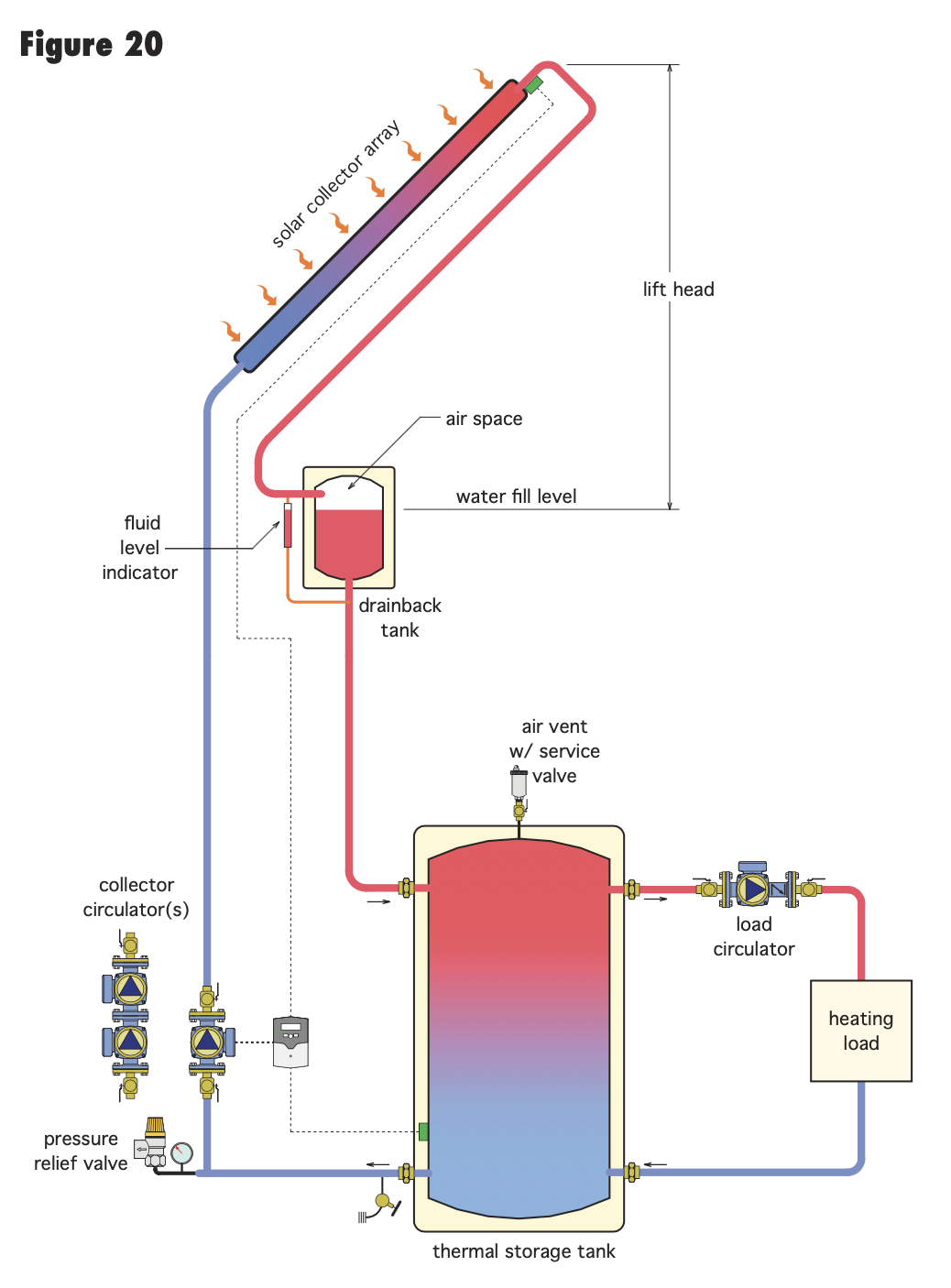 Bob "hot rod" Rohr
trainer for Caleffi NA
Living the hydronic dream0 -
HI ALL, I AM AWAY FOR FEW DAYS AND WILL GET BACK TO YOUR POSTS WHEN I RETURN AND CAN FOCUS ON ANY OUTSTANDING ASPECTS OF THE DESIGN THAT I MIGHT STILL HAVE QUESTIONS ABOUT. Thanks for the help,
Rugged
0 -
I'm back and wondering if anyone notice any problems with the connections I have described/depicted for isolating the coil? I want to complete the HP installation before the heating season gets into full swing.
Thanks again.
0 -
Can you draw a sketch? It's hard to follow exactly where you are putting tees and valves.
I don't thik that 59° incoming water temperature will be a problem. I might try it before you go to the trouble of this bypass work around.
I think if the 59 temperature was really a problem it would be all over the WWW. Especially with the HPWH haters :)
Bob "hot rod" Rohr
trainer for Caleffi NA
Living the hydronic dream1 -
hot_rod said it right in the first reply…when do you think your tank will get down to 59 degrees???
NJ Steam Homeowner.
See my sight glass boiler videos: https://bit.ly/3sZW1el0 -
Hot rod, here's another sketch up photo consolidating everything in one view. I hope this clarifies the install for you, I don't think I could do any better with a drawing program. I think you're right about the tank water temp, my initial concern was that if the sensor was located at or close to the cold water supply intake it would be defaulting to electric every time cold water entered the tank, at least in winter. But most comments indicate that the sensor is likely taking the average temperature in the tank, in which case , the electric elements would likely be triggered far less often. Also, as you mentioned, the btu required to raise the temperature of the tank enough to run on HP mode is quite minimal, so I'm no longer concerned about this issue. ethicalpaul, I think this addresses your point as well, i.e., as long as it's in use, the tank will only ever be at this low temp upon first fill (and any subsequent drain/fills) so it shouldn't be a problem. I will let everyone know how this all works out.
At this point, the only outstanding concern I have is once I have complete the work, will I have to bleed the heating system? All the work I am doing is after/below the tee supplying cold water to the boiler, so that should stay pressurized. There is a shut-off (original gate valve) on this line and another for the coil, both visible in the attached photo. I plan to close both beforehand, along with, of course, shutting down the boiler, well breaker off and draining the affected lines. Logically, that should prevent any water from leaking paste these points when I cut into the cold line, so no air should get into the boiler lines. However there is a slow leak in the lower shut-off valve to the coil (dead center in photo). Collects about a pint per month, so there's a chance that water could slowly drip from here while I'm working. I can't imagine that a slow leak would be capable of allowing air to get into the boiler line unless the gate valve fails completely. This may be why I ended using the compression fittings (see photo) to repair that short section where a flow reducer sprung a leak many years ago. I prefer to sweat everything, but I have shark bite fittings for this if the leak becomes a problem. Any thoughts oin this?
Thanks again!
1


Categories
- All Categories
- 87.8K THE MAIN WALL
- 3.3K A-C, Heat Pumps & Refrigeration
- 60 Biomass
- 430 Carbon Monoxide Awareness
- 133 Chimneys & Flues
- 2.2K Domestic Hot Water
- 6K Gas Heating
- 124 Geothermal
- 170 Indoor-Air Quality
- 3.9K Oil Heating
- 79 Pipe Deterioration
- 1.1K Plumbing
- 6.7K Radiant Heating
- 397 Solar
- 16.1K Strictly Steam
- 3.5K Thermostats and Controls
- 56 Water Quality
- 51 Industry Classes
- 51 Job Opportunities
- 18 Recall Announcements