9% efficiency gain from thermal post-purge of cast iron boilers?

In my ongoing quest to improve the efficiency of our two Weil Mclain WGO-5 boilers, in November 2024 I installed a Resideo L6006 aquastat on each boiler, attached to the supply pipes coming out of the boilers. I wired them to continue supplying power to the circulators after boiler shutdown, until the supply pipe temperature drops to 90 F. Since each WGO-5 weighs over 700 pounds dry, there's quite a bit of residual heat stored in each boiler after shutdown, and my hope was to recapture some of that heat, which otherwise would go up the flue during the typical 2+ hours of idle time after a cycle. (These are cold start boilers that always start cold, run maybe 45 minutes, then shut down and idle until cold again).
I was hoping for maybe 5% efficiency improvement at best, and I was prepared to be disappointed by no measurable improvement. But after crunching the numbers for the first time tonight, after one partial heating season (2024-25) and one full heating season (2025-2026), it appears that the post-purge may be working better than I expected.
I've kept detailed consumption records for the past 7 seasons, and I have heating degree data from our local airport (Norwood MA, weather station KOWD). Taking the ratio of oil consumption per season total HDD for each year, for the two seasons prior to doing post-purge, the ratio was 0.236 gal/HDD for both previous seasons, a remarkably consistent result in consecutive years.
Then in the first partial season with post-purge (beginning late November 2024), that number dropped to 0.228 gal/HDD, a reduction of 3%.
Then last season, the first in which post-purge ran the entire season, that number dropped to 0.215 gal/HDD, a reduction of about 9% from the 0.236 gal/HDD baseline from two prior seasons.
Last season was also the coldest season in my 7-year database, with 6145 HDD's, which is almost 30% more than the two prior "baseline" seasons without post-purge. My understanding is that milder seasons typically result in lower BTU/HDD ratios, because solar heating does more of the "work" in milder seasons, resulting in lower BTU/HDD's. Conversely, colder seasons typically result in higher BTU/HDD ratios because the solar heating factor is relatively smaller. So in the absence of post-purge, I would expect last season's colder climate to have increased our gal/HDD number. But with post-purge running, it came in 9% lower than the two previous "baseline" seasons that had milder weather.
Of course other factors can be involved, but since I manage the building maintenance here I keep a close eye on whether people are leaving windows open, etc, during the winter, and we haven't made any envelope changes (in windows, insulation, etc) that would make any difference in the last several years. The only difference was the addition of post-purge.
I have fooled myself enough in the past to be cautious in how I interpret these numbers, but right now it looks like we got a 3% improvement in gal/HDD during the first partial season running post-purge, and a 9% improvement during the first full season running post purge. Since our annual oil bill runs about $5000, a 9% savings is $450. I think the two aquastats cost me $300 total, so if my math is correct, they've already paid for themselves.






Comments
-
I used to do that with my gas fired boiler in my house. I had a Honeywell strap on aquastat on the return. The system was 1 pipe monoflow. The existing boiler was oversized so it would hit limit often on a call for heat. I kept the aquastat set at 100 but I never did any calculations to see if any fuel was saved.
With me if I was working in the cellar which I often was I would notice the call for heat ended and the boiler and circ shut off with the boiler at 190 deg. I wanted to put that heat upstairs where it belonged. I noticed after doing that that the thermostat would overshoot 1-2 degrees so you might notice a tiny bit more temp swing.
Many have said it doesn't matter "the heat is still in the building" but I would rather have it upstairs than in the basement.
 2
2 -
Thanks for that update. This is good information and one of the reasons that EK smaller mass boilers with thermal purge are more efficient that the Cast Iron monsters that are out there (like your 2 WMs). Amazing that your experienced 9% when you would have been satisfied with 5%. AWESOME !!! Nice work
Edward Young Retired
After you make that expensive repair and you still have the same problem, What will you check next?
 2
2 -
@EBEBRATT-Ed and @EdTheHeaterMan Thank you both for all your help over the past few years. I'm still trying to think of other factors besides the post-purge that may have contributed to the efficiency gain, but I so far I can't.
In looking at the "baseline" data before post-purge, what suprised me was the consistency of the gallons/HDD number in the 4 years before post-purge. Despite variable weather conditions each season (one season might be windier than another, for example), in those 4 prior years, the gallons/HDD stayed within a +/- 2% range, despite HDD totals ranging from 4800 to 5200. So the 9% decrease in gallons/HDD after post-purge does seem "real," and not just random variability.
In looking to the future, I had been hoping to switch to Buderus G115/3's when these boilers needed replacing, but apparently Buderus is discontinuing that line. The Burnham MPO-IQ84 is my next choice as a reliable 3-pass cast iron boiler with a low firing rate of 0.6 gal/hr that would be better matched to our heat loss.
@EdTheHeaterMan I'm still trying to get the other owners to agree to implement the cross-strapping idea you suggested with the existing WGO-5's, but we have a $45k roof replacement coming next year, and no one wants to spend the $$ unless absolutely necessary, so I'll have to wait until one of the boilers needs replacing.
1 -
Great work! And awesome verification method.
1 -
I have a similar situation with my steam boiler…I run a couple hot water loops of under-floor radiant off of the steam boiler. In the winter, these are running during the times when we are likely to be in the house. I don't even bother with an aquastat, I just run the circulator during those hours with the expectation (and experience shows it to be true) that the boiler always has pretty hot water in it due to periodic calls for heat.
This takes the heat from the boiler and puts it into our floors. Just like Ed said, the heat is in the building either way, but we like it better to keep our feet warm than to keep the basement warm.
NJ Steam Homeowner.
See my sight glass boiler videos: https://bit.ly/3sZW1el2 -
Interesting posts and study, @jesmed1 - nice work! I couldn't sit this one out, and apologize in advance for my long windedness…
Important note about thermal purge, not related to this thread: Thermal purge is especially important with domestic hot water, but it is very difficult to purge to a tank with a coil (if the tank is 140°F, you can only purge to about 150°F so minimal gains). With a properly designed plate heat exchanger and storage tank, purging is simple and easy.
A quick estimate of how much energy may be wasted in the boiler off cycle can be found by either A) measuring how long the boiler takes to heat up with no load to 180°F from room temperature and multiplying by the firing rate ( Example: 8 minutes is 8/60 min/hour or 0.133 hours x firing rate for example; 1 GPH would be 138,600 BTU/gal x 0.133 or 18,400 BTUs per warm up cycle); or B) by calculating how many BTU's it takes to heat up the boiler using thermodynamic equations - see example below.
When the boiler's burner shut off at 180°F, this "heat up energy" is roughly how much energy has not been distributed to the building (less the combustion efficiency which went up the stack to start with). A warm boiler/chimney will continue to vent that boiler heat out, and a draft regulator will continue to pull heated air from the building in the off cycle.
Additional energy that can be captured is found in the volume of water and mass of the piping that is not in the conditioned space, combined, both boiler and piping can be recovered with thermal purge (but can also lead to overheating with cast iron as noted in nearby posts).
Low mass is an elegant solution - no fancy controls or operating schemes are needed to work very effectively; if it takes 90 seconds to heat up, you would never think of overheating a zone if the thermostat shut off 90 seconds later.
A return temperature sensor also allows the system to interpret how large the load is - this makes operation very simple and smarter. If the return is cold, it is a large load (start up condition, radiation working hard, etc.); if the return is hot, the burner may not need to run (small zone, radiation in steady state approaching the supply temperature).
In summary, thermal purge will
- Capture the heat you've already paid for that remains in the boiler
- It will capture heat in the piping that was not installed in the conditioned space
- It will improve distribution efficiency by keeping that water moving after the burner turns off so the hydronic water can move more BTU's out of the radiation which is more effective at heating than just piping in the conditioned space, and
- It will reduce off cycle stack losses by cooling the boiler off faster so there is no heat left to vent out the chimney in the off cycle, also reduce room air losses.
The hotter the boiler is, the faster it cools off and loses heat up the chimney, so hot water cycles and operation like a tankless coil boiler accelerate losses; finishing cold with thermal purge savings can be even more pronounced in these cases. Connecting outside combustion air and eliminating the draft regulator (possible with stable combustion) reduces make up air from the building, making it less drafty and more comfortable.
Roger
Thermodynamic equation example:
BTUs = mass x specific heat x ΔT
Add cast iron mass in lbs x 0.11BTU/(lb·°F) x (180°-70°) plus water gallons x 8.3 lb/gal x (180°-70°). Example: A 600 lb boiler with 10 gallons of water would take 600 lb x 0.11 x 110°F + 10 gal x 8.3 lb/gal x 110 or ~16,400 BTUs to heat up. Low mass example with a 160 lb boiler with 2.5 gallons of water is ~4,200 BTUs, with most recovered during thermal purge.
The specific heat of water is ~1.0, so I did not show it in the equation - that also means it takes almost 10x as much energy to change the temperature of 1 pound of water compared to 1 pound of cast iron.
President
Energy Kinetics, Inc.
 4
4 -
@Roger in your equation above, don’t you have to also account for the true efficiency of the burner? IOW that 1 gallon per hour @ 138,000 is actually inputting 138,000 btu’s.
Or am I missing something?
Thanks0 -
The specific heat of water is ~1.0, so I did not show it in the equation - that also means it takes almost 10x as much energy to change the temperature of 1 pound of water compared to 1 pound of cast iron.
I was unaware of this, thanks for sharing that part!
NJ Steam Homeowner.
See my sight glass boiler videos: https://bit.ly/3sZW1el 2
2 -
@Roger Thank you for that excellent summary. Since you talked about how to measure/calculate residual energy stored in the boiler, I'll mention that I did that calculation before setting up the post purge, and I came up with an estimate of roughly 9% of the BTU's from a typical boiler cycle left as residual heat in our boiler's cast iron. (Obviously that percent will vary depending on boiler mass, typical burn time, etc).
It may or may not be coincidental that we seem to have gotten a 9% improvement in efficiency from post-purge. I think it's more likely that some of it is just random variability, and maybe we actually got 5-7% or so improvement from the purge, but I'll take it. It will be interesting to see the results from this coming season and how repeatable the numbers are.
0 -
This is why it's a pet peeve of mine when people use the word "mass" to describe heat capacity.
A 700 pound cast iron boiler has a lot of mass — it weighs a lot — but it only has the heat capacity of about 10 gallons of water.
1 -
Thank you, @HydronicMike - you're correct and that's an important point. I simply noted "this 'heat up energy' is roughly how much energy has not been distributed to the building (less the combustion efficiency which went up the stack to start with)" to address that point. The thermodynamic calculation doesn't need that adjustment, the heat up time could be a bit shorter to estimate the energy (if you measure 8 minutes, and the combustion efficiency is about 85%, that's roughly 6 minutes and 45 seconds of energy heating up the boiler, the other 1 minute and 15 seconds when up the chimney).
You're welcome, @jesmed1 - your engineering analysis approach is always a good way to help frame what might be expected, and then the field testing will give you data so you can theorize and test why it may be different to get a more complete understanding. The Department of Energy did this in The Performance of Integrated Hydronic Heating Systems.
If you think about it, the heat loss without thermal purge will vary with the frequency of the heat and hot water calls (your application is very unique with one cycle and then off for a very long time). In the spring and fall when there are longer off cycles, more energy is wasted each cycle because the boiler has time to cool off, but there are fewer cycles. In the winter, a boiler without thermal purge runs more efficiently because it did not cool off as much before the next heat call, but there are many more calls for heat so the losses add up. There are thousands of heat calls in a typical year of boiler operation, so this is a huge target for savings.
Low mass with thermal purge has almost no off cycle losses, which means it runs at very near the same efficiency from very small to very large loads. In other words, there is virtually no oversizing penalty. This means that a building could be weatherized before or after the low mass boiler is installed and it would not adversely affect the efficiency; the building owner can decide what makes sense to do first for capital costs and expected energy savings to make the best decision for their circumstances.
Roger
President
Energy Kinetics, Inc. 5
5 -
Thank you, @DCContrarian . In general, cast iron boilers also have much more water content than low mass boilers - mass is a proxy for heat energy overall when discussing boilers. We do indeed need to use the proper specific heat for water and cast iron, which are different as you noted. Water also holds a remarkable amount of energy per pound - that 700 lbs of cast iron you mention is the equivalent of about 9.3 gallons (77 pounds) of water and would take 8,500 BTUs of energy to heat from 70°F to 180°F on cold start. If there is 9 gallons of water in that boiler, it doubles to nearly 17,000 BTUs to heat it up.
Roger
President
Energy Kinetics, Inc.0 -
At no little risk of stirring u[ a can of worms… all this is also the principle behind allowing a steam system to drop into a vacuum at the end of a heating cycle. Depending on how deep a vacuum the particular system can maintain, you can — in principle — drop the boiler temperature to somewhere in the 100 F range without that much trouble.
HOWEVER. There is the minor detail of getting a steam system to hold a vacuum at all! Not that it can't be done, it has been — but the problem has to do with venting. Main vents are available, if you have the money, for two pipe vapour systems. Not for one pipe. However, there are other approaches, such as the old Paul system, which work on what looks, at first, like a one pipe system.
You can also add vacuum pumps to a two pipe system.
Things begin to get expensive and complex and maintenance intensive… which steam is NOT normally.
It's a matter of how much money are you willing to spend for the ability to move the heat from point A — the basement and the boiler — to point B — say Aunt Minnie's room up stairs, and how much complexity do you want to add…
Br. Jamie, osb
Building superintendent/caretaker, 7200 sq. ft. historic house museum with dependencies in New England0 -
I would also add that, in the case of our 700+ lb pin-type cast iron boilers, when the boiler stops firing, the gas side of the heat exchanger is at or above flue gas temp (350 F +), while the fluid side is at the water temp (in our case, around 140 F at end of cycle). So in fact, the average temp of the cast iron heat exchanger could be well over 200 F, making the residual BTU number even higher than a more conservative number obtained using only the water temp.
0 -
Very nice that you could document your increases, @jesmed1! I also wired in a similar system in my large, old cast-iron boiler, but I don't have the data to isolate the improvement (because I was also improving the envelope at the same time). Nice work!
Trying to keep Bernie burning!
1 -
This is all very interesting. There are lots of calculations, theories, testing, time, thought power, brain-wave activity, mental gymnastics, intellectual processing, analytical reasoning, careful consideration, contemplation, deliberation, evaluation, examination, investigation, speculation, computation, experimentation, observation, interpretation, deduction, educated guessing, head scratching, pencil chewing, calculator punching, number crunching, staring into space, second-guessing, rethinking, double-checking, triple-checking, checking the checking, thinking about what you just thought about, and an extraordinary amount of otherwise perfectly good brainpower being consumed in the process.
Roger, wouldn't it be just as easy to say "Because I Said So!" and leave it at that?
Edward Young Retired
After you make that expensive repair and you still have the same problem, What will you check next?
1 -
Thank you, @EdTheHeaterMan - bonus points for wrapping up calculations with levity!
President
Energy Kinetics, Inc.3 -
Just an update to correct a mis-statement I made earlier about there being no other system changes than post-purge. In checking my records I see that I also increased the thermostat swing from 1.0 degrees to 1.5 degrees, and started an overnight setback of 3 degrees, at the same time I added the thermal post-purge. So there are two other factors that probably contributed to the 9% measured reduction in BTU's per HDD used, but because I implemented all three simultaneously, it's impossible to say how much savings each factor contributed.
But based on other people's reported experience with changing swing and adding setbacks, it's conceivable that each factor (post purge, increasing swing, and adding setback) could have contributed maybe 3% each to the total 9% reduction. That makes a more credible explanation, as I was having a hard time believing the post purge alone made that much difference.
I should also mention that after implementing post-purge I instrumented the supply and return pipes with recording thermocouples and measured delta T over time during the post-purge operation. I found that most of the residual heat in the boiler was recovered within 5 minutes of purging start and represented about 4,000 BTU's, or about 3%-5% of BTU input for a typical boiler cycle. So it's possible the purge was responsible for 3%-5% of the improvement, with the swing change and setback responsible for the remainder.
0 -
Good analysis, @jesmed1 - I like how you estimated the thermal purge BTU difference compared to the on cycle. As you have a very unique operational condition (always start cold, run maybe 45 minutes, then shut down and idle until cold again, and have a 2+ hour minimum off cycle), the impact of thermal purge will be more limited.
A typical heat and hot water system has thousands of cycles per year, so the impact of low mass and thermal purge is much greater. In the above reference Department of Energy study, you can see how low mass with thermal purge operates at nearly the same efficiency from steady state (100% on condition) down to very small to loads. All the other boilers in the study had a much steeper drop off, which means they run much less efficiently in the shoulder seasons (spring and fall) due to higher idle loss (energy wasted when the boiler is off), and for domestic hot water calls for the reasons I described above.
To properly purge domestic hot water for the the best efficiency (not for @jesmed1's heat only case) , a storage tank that stratifies (heats from the top down) and leaves a reservoir of cold water at the bottom to provide a destination for thermal purge energy is the best strategy. In this post, I explain how it can typically save 5% to 10% on annual fuel consumption (not just hot water).
Best,
Roger
President
Energy Kinetics, Inc. 4
4 -
Just to spitball a bit — that 700 pound boiler has the heat capacity of 77 pounds of water, let's say there's another ten gallons or 83 pounds of water in it, so the equivalent of 160 pounds of water. Presumably it's shutting off because it's hitting the high limit, so it's at 180F and then cooling down to 90F, so a 90F drop. That's 160*90=14,400 BTU that leaves the boiler between when it shuts off and when the purge ends. If you're capturing 4,000 BTU that's 28%.
Increasing the thermostat swing from 1 to 1.5 will increase the time between cycles by 50%, which will cut the number of cycles by a third. So it makes sense that this would be roughly equivalent to the savings from the purge.
1 -
@Roger Thank you, and you're right that we have an unusual setup. Our boilers don't provide domestic hot water and therefore run "only" 2000-3000 cycles per heating season combined (based on annual oil consumption around 1300 gallons, and a typical cycle burning 1/2 gallon). Also, we run relatively low average water temperatures, rarely exceeeding 140 F, meaning there's less residual heat in the boilers than there would be if the water temp was, say, 180 F at shutdown. But I can see how a different setup where a boiler runs shorter, and more frequent, cycles would stand to gain more from purging.
0 -
Thanks for posting all this data, it's a very interesting read for the homeowner!!
Just curious, what kind of improvement is normal to see with a system that closes a damper to the chimney a given time after the combustion has completed? I forget what those are called, but in essence, closing the chimney.
It seems this could be a very good argument for replacing a tankless system with both an indirect and a thermal purge. Allowing the boiler to ride at a much cooler temp between heat calls would be a real plus without even changing the boiler itself.
@Roger, thank you for posting about the cast iron equivalent to water for heat retention, certainly was interesting!
0 -
Thank you. @jesmed1 .
The first question is why you are running two boilers with only 1,300 gallons of oil per year - that's about a 75,000 BTU/hr load. You could shut one boiler off, or install a much smaller boiler and you'd be much better off. 3,000 cycles over they heating season from October to April is about 210 days, so that is 14 cycles per day on average - quite a bit, so thermal purge with a low mass system could deliver very good savings.
But maybe you are referring to 3,000 burner cycles, while the thermostat has a continuous call, not heating cycles where the thermostat turns off? That would make more sense when comparing the heat energy left in the boilers, because if it is burner cycles, the water continues to circulate and the zones continue to heat so the energy left in the boiler is not left unused as is the case when the thermostat turns off.
I originally interpreted your operating conditions as a special condition where the boilers ran once daily, not 2000 to 3000 heating cycles per year. If this was the case the boiler model you mention has 15.9 gallons water content and is likely close to 600 lbs of cast iron, so if you are heating to 140°F from room temperature, the heat energy contained in each boiler at the end of the every heating cycle is about 13,900 BTU (21,800 if operating at 180°F). If both boilers actually cool off to room temperature between cycles as you note, that would be the equivalent about 1,200 gallons of oil per year worth of energy left undistributed in the two boilers at the end of those combined 3000 cycles (1,880 gallons at 180°F); even more if you apply the boiler operating efficiency to heat the boilers back up to that temperature. This is a huge difference compared to your annual usage of 1,300 gallons, so I believe you must be referring to burner cycles, not thermostat calls. This would be considerably less for thermostat cycles (far fewer), and somewhat less because the boilers are probably not cooling off all the way in the colder months where they have more frequent cycles (Dept of Energy charts show boilers as more efficient in the winter than spring and fall), and there is probably some regain if the conditioned space is above or closely adjacent to the boiler room.
President
Energy Kinetics, Inc.1 -
@Roger Thank you for that feedback. This is what I get doing your calculation:
delta T from cold start to 140 F: 140-65=75
Water heat capacity: 15.9 gal x 8.3 lb/gal x 1 BTU/lb-deg = 132 BTU/deg F
Cast iron heat capacity: 600 lbs x 0.11 BTU/lb-deg F = 66 BTU/deg F
Total heat capacity = 132 + 66 = 198 BTU/deg F
Total heat content = 198 BTU/deg F x 75 F = 14,850 BTU per cycle
2500 cycles x 14,580 BTU/cycle = 36,450,000 BTU total
36,450,000 BTU/140,000 BTU per gal=260 gal oil equivalent, or about 20% of annual consumption
Without post-purge, we still have gravity circulation that probably recovers a good portion of this naturally. If gravity circulation recovers, say, half of that, it would be recovering 130 gallons, leaving 130 gallons of flue loss.
Then if post-purge recovers an additional half of that 130 gallons, that's an additional recovery of 65 gallons, or about 5% of our annual consumption, and that seems roughly consistent with the apparent 9% improvement total from post-purge, swing increase, and setback.
To answer your question about the number of thermostat calls for heat vs the number of boiler cycles, these are the same, because even in very cold weather, the boilers typically run 45 minutes, then idle 2+ hours because they're so oversized for the heat loss of the house. So the boilers always cool off to room temperature after a cycle, even in dead of winter.
0 -
Thank you, @jesmed1 .
I see your a 75° temperature difference (dT), so I'll interpret your room temperature as 65°F. Since you said you purge down to 100°F from 140°F (40°F dT), that would account for 40°/75° or 53% of the heat remaining in the boilers being used from thermal purge. You have two boilers, so you would double your calculations to 520 gallons, or is one boiler just backup for redundancy? There's not much of a thermal engine for gravity circulation to drive on or recover if the boilers and piping purge down to 100°F, and both zone valves and zone circulators with check valves would further reduce gravity circulation, so I would discount that as any significant amount. Still wondering if your 2,500 cycles is thermostat or burner cycles as 53% of 520 is 275 gallons or 21% of annual consumption, so I'd expect more from thermal purge if it is thermostat cycles. If it is one boiler, your 9% is pretty close (at 180°F this would be double with an 80°F differential to 100°F vs a 40°F differential, or closer to 20%).
Roger
President
Energy Kinetics, Inc.0 -
@Roger Sorry for the numbers confusion.
Yes, room temperature is 65. And to be exact, our post purge is set to run down to 90 F. So yes, without purge, the boilers would normally cool off from 140 to 65, for a delta T of 75, during 2+ hours of idle time. With purge, the purge will run from 140 F down to 90 F and then stop. That's a delta T of 50. So the purge could in theory recover 50/75 or 67% of the 14,850 residual BTU's, or 9,800 BTU's.
In practice, I've instrumented the supply and return during one shorter cycle (30 minutes) during shoulder season, and looking at my notes from that experiment, the purge recovered about 5,000 BTU during a roughly 30-minute purge following a 30-minute boiler run with a total BTU input of 80,000 BTU, for a recovery of about 6%. I should have posted those numbers earlier, as that's the best hard data I have from a purge.
That agrees reasonably well with theory, because the shorter burn I mentioned above would have ended with a water temp of about 130, so a purge from 130 to 90 would be a delta T of 40, resulting in a potential recovery of 7,920 BTU's. The purge recovered about 5,000 of those, which is 63% recovery efficiency. (My measurement setup was crude, and it's possible I missed another 1500 BTU's or so recovered in the first minute where the BTU flow rate is highest, so it could have been closer to 6,500 BTU's actually recovered, which would bring that up to 82% recovery efficiency).
To answer your questions about boiler cycles, both boilers are set up identically with identical ecobee thermostat settings, and they run identical cycles. I track the run times from the ecobee data, and the total run times at season's end are virtually identical. So because the boilers run identically and split the typical 1200-1300 gallon total consumption evenly, I do my calculations assuming a single boiler burning 1200-1300 gallons total and running 30-45 minute average cycles of 1.2 gph consumption, so 0.6-0.9 gallons per cycle. Dividing that into 1200-1300 gallons yields a range of 1333-2167 total boiler cycles per season (sorry, I misquoted the total number of cycles above). The center of that range is 1750 total cycles, so let's use that for an average season. In reality, those 1750 average season total boiler cycles are shared by two identical boilers, so each boiler in fact runs an average of 857 cycles per season, and each consumes half of the 1200-1300 gallon total.
So in the experiment I quoted above, post-purge from 130 F to 90 F recovered about 6% of the total BTU's consumed in a 30-minute cycle. (Jn theory, it could have recovered about 10%, or 7920 BTU of a total input of 80,000). Again, that seems to agree well with our measured 9% reduction in BTU's per HDD after implementing post purge, along with increased swing and setback.
0 -
Thank you, @jesmed1 .
The much lower cycles per year (857 per boiler vs 2500 for each boiler) combined with 130°F to 140°F operating temperature is indeed very unusual, but helps explains why your thermal purge arrangement did not yield much higher savings than 9%.
If your boilers had a 40°F dT during thermal purge, that would be 7,900 BTU per boiler with straight math ([15.9 gal x 8.3 lb/gal + 600 lb x 0.11BTU/(lb·°F)] x 40°F dT), or 15,800 BTU recovered from the combined two boilers. This should closely agree with the estimate of the BTU that is recovered using thermocouples and the flow rate in the system over a 30 minute period. Since it does not, either the thermocouple reading (insulated properly?) and/or the flow rate is not accurate, so I would look there to find out why the calculation results in the 5,000 BTU instead of the much higher number from the boilers' mass and dT.
Roger
President
Energy Kinetics, Inc.0 -
Roger, thanks for continuing to explore this. I think there may still be some confusion about how our boilers are set up, or maybe I misunderstand what you're saying.
The boilers are piped independently on two separate loops, heating separate but identical halves of the building, and controlled by different thermostats in separate locations. There is no piping connection between boilers. So after a boiler cycle, there isn't a combined recovery from two boilers. There's only recovery from the one boiler that cycled. So there isn't a combined total of 15,800 BTU's available from both boilers available for recovery. There's only 7,900 BTU's available for recovery from the one boiler that ran.
So each boiler runs separately, on separate loops, controlled by separate thermostats in separate halves of the building, with no piping connection. Then each boiler runs, on average, 857 cycles, for a season total of 1750. And after each of those cycles, there's only about 10% residual BTU's available for recovery from purge (in the case I cited, 7,900 BTU after a roughly 80,000 BTU input into the one boiler that was running, over a 30 minute cycle).
So the recovery math is:
857 cycles/boiler x 2 boilers x 7,900 BTU's per cycle available for recovery by purge
or 1750 total cycles x 7,900 BTU's per cycle
And I measured about 5,000 recovered from the one cycle I instrumented.
I had admittedly crude equipment and methodology for measuring the purge BTU's, and one of the unknowns was flow rate, which I calculated two different ways, but which could be off by 25-30% or so. So given the possible errors, it's possible we're actually recovering almost all the 7,900 theoretical BTU's available from a 40-degree purge (from 130 to 90 F). In which case, at best we'd be recovering 7,900/80,000 BTU's, or close to 10% (vs my measured 5,000 BTU recovery which works out to 6% but could admittedly have been off). However, at the bottom line, our measured BTU's per HDD improved 9%, so we know we're getting close to our theoretically possible 10%.
But I understand your point that in other setups with higher water temperatures, there is more residual energy available for recovery by purging, and the effect is magnified if the boiler runs more, and shorter, cycles.
Thanks, and sorry if I misunderstood you.
0 -
-
"Presumably it's shutting off because it's hitting the high limit"
This boiler system with two oversized WGO boilers never gets the the limit setting to shut off. There are too many cast iron radiators and huge pipes in the system. I believe @jesmed1 explains that the hottest the boilers ever get on the coldest days is just over 140° or there abouts. Perhaps the oil burner nozzle has been derated to compensate for the oversizing, perhaps the radiators are also over sized for the building, but for whatever reason, @jesmed1 is doing his best for the other three owners and himself to keep costs down. And I like that he is sharing the results with us.
Edward Young Retired
After you make that expensive repair and you still have the same problem, What will you check next?
2 -
@EdTheHeaterMan Thanks, and now you know our heating system better than I do! I wish you lived next door so you could help re-pipe it on the days you weren't off fishing. 😀
To follow up on what Ed said about the low water temp, he is correct as usual:
-Two WGO-5's with input capacity of 1.45 gph, downfired to 1.2 gph because boilers are 3x oversized. In fact, we could heat the entire building with just one boiler running at 0.7 gph input, vs the combined 2.4 gph capacity we now have.
-Cold start and typical 30-45 minute run time with high water volume gravity conversion system and oversized cast iron radiators means water temp at shutdown corresponds roughly to run time: 30 minutes gives final water temp of 130, 45 minutes gives water temp of 140-145.
-For posterity, I will repeat that these boilers are close to 30 years old and have been running cold start/low temp at shutdown for their entire lives, and yet show no sign of condensation damage on the pins. I keep meaning to invite all the pros on HH over to inspect these boilers, which many have told me should have been destroyed by condensation from cold return water. It's a miracle! Thank you, Weil-McLain.
0 -
I can travel if it is prepaid and meals are included. The accommodations must be wheelchair accessible. I get $75.00 per hour for consulting on site. If I need to actually do any work like sanding the copper for solder or cutting pipes to the proper length as you call out the next size… the price goes up from there.
Edward Young Retired
After you make that expensive repair and you still have the same problem, What will you check next?
1 -
@EdTheHeaterMan I think I owe you at least $2k already. Let me try to take up a collection from the other owners. 😅
1 -
I think Roger wants you to replace those WM - WGO boilers with EK boilers when you are ready.
Edward Young Retired
After you make that expensive repair and you still have the same problem, What will you check next?
4 -
I'd love to get an EK. I just have to convince the other owners.
1 -
of course the pumping power to purge needs to be accounted for
A 78w circ x 3.41 to get 266 btu/ hr
Bob "hot rod" Rohr
trainer for Caleffi NA
Living the hydronic dream0 -
Thank you, @hot_rod . To put that in perspective, a 20 minute run with a 78 W circulator uses the energy found in less than a 1/2 teaspoon of fuel oil. If you use the 7,900 BTU's recovered in a 20 minute thermal purge, that would be a 90x return on investment in units of energy (180x if the boiler is running at 180°F).*
Roger
*Those figures drop to about 30x and 60x if you calculate using the source energy at the power plant to produce the electricity to run the circulator (power plant efficiency less transmission and distribution losses) - still exceptional. But you'd get that back with an ECM circulator that uses about 1/3 the electricity as a standard wet rotor circulator.
President
Energy Kinetics, Inc.0 -
You could start with one that is half the size of one of your WMs and connect it to both sides. Then leave the other old WM as a backup. I bet you never operate the WM again after you get a half-size EK. Then your fuel usage will be cut by at least 20%.
Do the math and see what the other owners think about that. If you form an association that is allowed to take out a loan for the replacement boiler, I bet the amount of money you spend on fuel plus the loan payment will be very close to what you are spending on fuel alone right now.
When I look at a scenario like that, I call it getting a new boiler for free.
$5,000 fuel per year = $416.67 per month
$3,500 fuel per year = $291.67 per month
Plus a loan payment of $125.00 per month = $416.67 per monthEither way, you are paying about the same amount every month. The difference is that one way gets you a new boiler, while the other way leaves you with the old boiler and increasingly higher operating costs as fuel prices rise.
As fuel prices increase, the loan payment stays the same. That means the savings from the new boiler actually become greater as fuel prices go up.
Check with your local EK dealer for available financing options.
Fuel prices, estimated savings, and loan payments shown above are for illustration purposes only. Your actual fuel costs, savings, financing terms, and payments may vary.
Edward Young Retired
After you make that expensive repair and you still have the same problem, What will you check next?
2 -
-
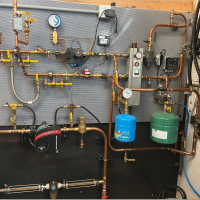
I just ripped out my WTGO-3 from 1996. When I bought the house in 2002, it was one zone, split loop. I did an extension and added zones. In 2003 when I thought I knew what I was doing, I piped it P/S with the boiler circulator wired to low limit to try to combat the micro zoning.

And now I don't need to do math. This boiler does it for me.

Almost done. I still have control wiring and some touch up.
2


Categories
- All Categories
- 87.8K THE MAIN WALL
- 3.3K A-C, Heat Pumps & Refrigeration
- 60 Biomass
- 430 Carbon Monoxide Awareness
- 133 Chimneys & Flues
- 2.2K Domestic Hot Water
- 6K Gas Heating
- 124 Geothermal
- 170 Indoor-Air Quality
- 3.9K Oil Heating
- 79 Pipe Deterioration
- 1.1K Plumbing
- 6.7K Radiant Heating
- 397 Solar
- 16.1K Strictly Steam
- 3.5K Thermostats and Controls
- 56 Water Quality
- 51 Industry Classes
- 51 Job Opportunities
- 18 Recall Announcements