Ac indoor coil sizing.

Looking at the spec sheets for goodman indoor coils they have a CAPTA4230D3 2.5 to 3.5 ton and a CAPTA6030D3 3.5 to 5.0 ton. I am looking to go with a 3.5 ton system. The bigger coil has more surface area, and less static pressure. Is the smaller coil better for dehumidification, or is that old school thinking. They both are by the book. Looking for better dehumidification.
The spec sheets have the suction line at 1 1/8 for 3.5 ton unit. Unit is R32 any real world problem keeping it 7/8 it's only 38 feet long. I know warranties won't apply if it's known it 7/8.
Thanks
Comments
-
Most manufacturers allow you input an equipment configuration along with your site specific parameters to calculate how the setup will function. in addition most manufacturers have refrigerant piping guidelines that call out pipe size reductions, as well as long lineset best practice. I know the brand I sell allows pipe size reduction with no issue on warranty, but it will reduce the capacity depending on length of the line. all of this should be supplied to you by the manufacturer.
for what its worth my manufacturer shows no change in latent capacity whether I use a 2.5ton only coil, or a 4-ton coil assuming i use the correct TXV and all else is the same but your coils may differ slightly
 1
1 -
To dehumidify choose least powerful A/C so that it runs longer. Theoretically the smaller coil will run colder and that enhances dehumidification as well. There's also systems with a downstream subcool/reheat coil.
Most practical & simple is to use a dehumidifier and set A/C for higher temperature.
0 -
probably the bigger thing that will affect dehumidification is to slow down the airflow as much as you can. and turn off any post purge so it doesn't reevaporate the water on the coil at the end of the cycle.
1 -
your increasing the capacity 50% I hope your increasing the duct size as well to Handel the additional CFM requirement's!
I find reducing oversized equipment is a better solution to high RH.
0 -
i don't see what was there before mentioned?
other way to get better humidification would be a multi stage or modulating system.
 2
2 -
my mistake I saw 2 1/2 to 3-tons.
it sounds like he’s guessing at sizing. 1
1 -
Possibly the best point about sizing. If there is an existing system in place, which sounds like there must be since OP is talking about re-using a lineset. How does the current system perform and what size is it?
0 -
Going down a size from 4 ton to 3.5 ton System. Based upon historical energy usage the 4 ton was only running non stop a couple days a year from 12-6 pm. Goodman makes two coils that matches the 3.5 ton system. One is rated from 2.5 to 3.5 ton's and one is rated from 3.5 to 5 ton's. I am thinking the 2.5 to 3.5 coil will have more latent load, because it should be smaller surface area ie colder. But do i have that wrong because the smaller coil will have slightly higher static pressure.
0 -
what is the physical footprint of the coils? usually one fits a different size furnace than the other without adaptation.
0 -
Both the coils have the same foot print and case coil size. I Just looked they both weight the same. Could the coils be the same and they just have a different TXV installed?
They have to have some difference because the static pressure in the chart is not the same for both coils.
0 -
The coil size aside have you considered a two stage outdoor unit as well?
Id use whatever coil matches your current setup the best and has the highest EER for the combination you're using.
If the published specs are essentially the same just go with the one that fits the easiest.
Single pipe 392sqft system with an EG-40 rated for 325sqft and it's silent and balanced at all times.
2 -
The larger coil with more surface area will dehumidify better. The air will be in contact with the coil longer and lower static pressure is better.
0 -
I am thinking you may need to consult directly with Goodmans sizing tools and plug in your exact equipment. When I check with my manufacturer its different depending on exact models. i had checked with some larger size coils on a 2.5t ODU and it made no difference, but when I check our 3.5t model there is some slight increase to the latent when when using a 5t coil (a difference of 300 btuh). my best advice is to do a thorough load calc, this will give you required sensible and latent numbers, then use your manufacturers information to make the best selection. there isn't just a general rule of thumb to this stuff currently as it has all rapidly changed (including testing process) over the last 10 years. each manufacturer is going to be slightly different. One thing that has not changed is that if you want the best designed system it will start with a load calc.
0 -
I think the OP was talking about an inverter system. One model ranges from 2.5 to 3.5 tons. The other 3.5 to 5 tons.
If the manual J comes in at 3.5 tons, then obviously the smaller system.
0 -
i think they are just evaporator coils that can be paired with multiple size condensers.
 3
3 -
From the factory the TXV is different between coils. That's it. They won't advise using the 7/8 line set for 37 feet. I wonder if i replace the first 14 feet from the evap to 1 1/8 then to the last 24 feet of 7/8 burried in the the wall it would work. But then again i am going rouge without support. I would be fine with it if it was just an hit on efficiency . Thanks all for the comments.
0 -
In the past I sized a lot of ac equipment for labs and clean rooms etc. Rooms where the humidity had to be controlled.
For a standard AC "comfort cooling" system" the standard sensible to latent heat ratio is about 80% sensible and 20% latent with a standard package unit. This was using the standard 400-450cfm/ton air flow.
If the room needed something different than 80/20 to get the conditions, you needed it was common to go to a different design and use a split system so you could tinker with the air flow to get what you need. Now, some companies for commercial jobs can design what you need in a package unit. AAon will do this and others probably will now as well but back a few years you would use a split. We didn't have VFDs or variable speed back then
But the physics doesn't change. With a given coil and condensing unit and load lowering the air flow will reduce the sensible capacity and increase the latent capacity.
In all cases where you have a higher-than-normal latent load the coil would need to be a larger and thicker evaporator. With the larger coil the air spends more time in the coil (more rows) and produced more condensation.
When I was doing this I would calculate the heat and humidity loads which gave me the tonnage and CFM I needed.
Then I went to Carrier or Trane etc and they would give me an AHU with the coil and cfm i needed to meet those room conditions.
If you had to force the humidity really low for some process etc you might lower the sensible air temp below what was needed in the room and a reheat coil (steam, HW or electric) was used to bring the air temp up.
But the bottom line in this post is that a larger coil will dehumidify better.
0 -
maybe do the heat gain calculations and see if a smaller condenser that will use the existing line sizes will work. the longer cycles you run the better dehumidification you will get so it could solve both problems if say a 3 ton is actually the right size.
0 -
Look closer at the spec sheet, or look up the long line set info from them.
Chances are you'll lose almost nothing even with a 3/4" line set on 3.5 ton. I just ran a 7/8 on a 5 ton and I think I lost an extra 1 or 2% vs 1 1/8 but I forget the distance.
1-2% isn't worth pulling your hair out over.
Higher velocity also means better oil return. It probably won't matter in your situation but just throwing it out there as a plus.
Single pipe 392sqft system with an EG-40 rated for 325sqft and it's silent and balanced at all times.
0 -
typically you have 3 sizes for txv, the smaller coil is almost definitely a 1.5-3t TXV and would need to be swapped. Where did you find Goodman's refrigerant pipe guidelines? I couldn't find it anywhere. If you are a non-licensed homeowner just asking questions of their customer service they are not giving you accurate info.
0 -
Where did you find Goodman's refrigerant pipe guidelines?
I use this:
1 -
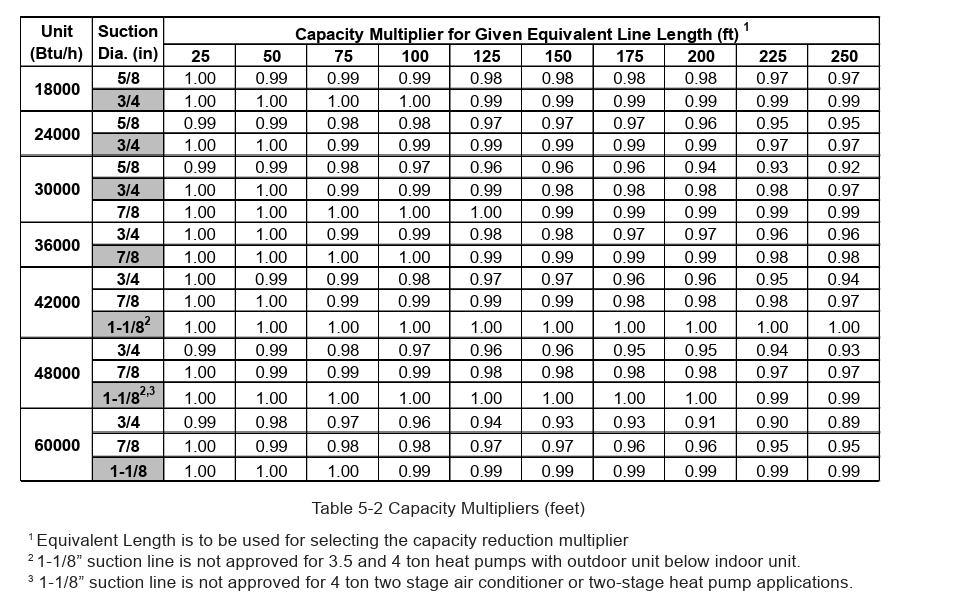
This is from Goodman's long line set application guideline for R32 systems.
I assume the OP got their info from the installation instructions.
Single pipe 392sqft system with an EG-40 rated for 325sqft and it's silent and balanced at all times.
1 -
Chris,
Yes I got the information from installation manual. Then called Tech line and confirmed. They said that the pressures could be off and they couldn't, wouldn't bless anything longer than 25 being smaller than 1 1/8 on 3.5 ton r32 system.
Your chart confirms that it's no problem at all. Don't know why their tech support didn't have that chart. Frustrating that calling the tech support line didn't give this answer, Thank you again for your comment.
0 -
@ChrisJ @pecmsg These look basically identical to what I am used to seeing. thank you!
@heathead If what chris posted is accurate from goodman (it looks exactly like my manufacturers as well) then Goodman would have to bless the size reduction because they approve it directly in their own guidelines. They were blowing you off most likely. Most importantly I wouldnt want you to think you were doing something unconventional, you should be safe to reduce the size , no need to only reduce partially.
1 -
I might add that if you use the smaller of the two coils, there is a good chance you will need to swap the TXV, again not sure with goodman but typically there are 3 sizes of TXV ( for residential), and the multi-rated coils that cross TXV sizes typically have the smaller one equipped.
typically TXVs for resi are rated for these sizes
1.5-3t
3.5-4t
5t only
So I would expect if I had a 2.5-3.5t coil that the TXV would be a 1.5-3t TXV.
the 3.5-5t I would expect a 3.5-4t TXV installed
My manufacturer lists these TXV swap requirements in the unit specification booklet
0 -
I’ll admit, I’ve never worked with R-32. That said, I have never had to use an 1 1/8” suction line on a 3 1/2 ton R22, or R410A system.
I was the lead HVAC tech for Grainger a long time ago. All 19 of us had a considerable amount of field experience. Many places don’t hire tech support staff for their HVAC knowledge. They hire kids who type 300 words a minute, making search attempts with the databases available to them, at a fraction of what we were making. I know this firsthand.
It’s better to do your own homework first. I know there are still many hydronic manufacturers who offer outstanding tech support. I remember, back in the day, tekmar walking me through some control work and they were outstanding.Steve Minnich1



Categories
- All Categories
- 87.8K THE MAIN WALL
- 3.3K A-C, Heat Pumps & Refrigeration
- 59 Biomass
- 430 Carbon Monoxide Awareness
- 133 Chimneys & Flues
- 2.2K Domestic Hot Water
- 6K Gas Heating
- 124 Geothermal
- 170 Indoor-Air Quality
- 3.8K Oil Heating
- 79 Pipe Deterioration
- 1.1K Plumbing
- 6.7K Radiant Heating
- 396 Solar
- 16.1K Strictly Steam
- 3.5K Thermostats and Controls
- 56 Water Quality
- 51 Industry Classes
- 51 Job Opportunities
- 18 Recall Announcements