Looking for a Company to Design & Supply a Coal-Fired Steam Heating System for a 40' × 60' Shop

the early planning stages of a new building and I'm looking for recommendations for a company (or engineer) that specializes in coal-fired steam heating systems.
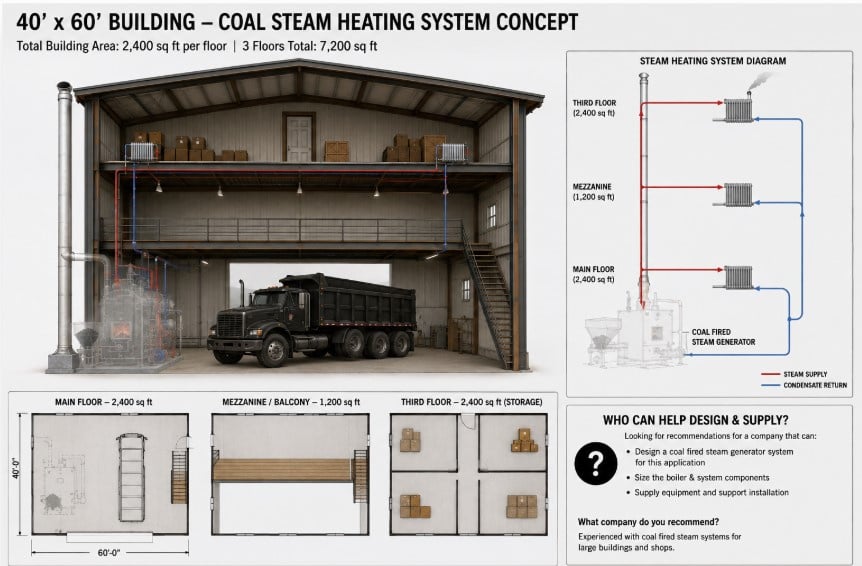
Building concept:
- 40' × 60' footprint
- Approximately 7,200 sq ft total over three levels
- Main floor will be an open equipment/truck shop with a door large enough for a tri-axle dump truck.
- Second floor will have a mezzanine/balcony overlooking the shop.
- Third floor will be primarily storage with four storage rooms.
I'd like to explore low pressure steam using a coal-fired stoker boiler (or other coal-fired steam generator if there is a better option).
I'm looking for recommendations on:
- Companies that Design the complete steam distribution system.
- Size the boiler correctly.
- Recommend the proper chimney, piping, controls, and condensate return system.
- Supply the equipment (or recommend the best manufacturer).
If you've worked with a company you would trust on a project like this, I'd really appreciate the recommendation.
Thanks in advance for any advice.
Comments
-
-
Edited for clarity and error correction 4, August 2026
First things first;
what type of coal do you have access to, Eastern Anthracite Coal, Western Sub Bituminous stoker coal or Eastern Bituminous Coal?
Buying in quantity will save you money, can you store a 22+ ton load of pea or rice stoker coal on your property if a lean with a concrete floor is used to house the stoker boiler and your coal supply?
If you are located in the east and only have access to Bituminous coal it is going to smoke a great deal even with induced or forced draft combustion.
This will not be a problem for a coal stoker steam boiler using Western Sub Bituminous or Eastern Anthracite coal.
Do not expect your insurer or an installer to place your coal stoker boiler it in your shop as you will have flammable materials in it.
You will need to place your stoker boiler in a lean to with your coal supply bin attached to the side orend of the building.
Do you have enough room and solid ground to back a coal truck near a lean to unload it with its elevated dump box or conveyor?
Do you have a skid loader that you can use to pile your coal in a lean too if you purchase your coal in a 22+ ton load?
How many cubic feet is the building interiors size?
How much insulation R value do you intend to have?
Is the building slab going to be a slab on grade construction or will you be installing a perimeter footer?
A slab on grade construction needs to be insulated with reflective foam insulation and reinforcing mesh and rebar. The same goes for a slab and footer foundation whether the footer is to be poured neat or in a concrete form.
If your building is going to have a central exhaust fan you should plan on putting the coal stoker in an attached lean to assure it has enough combustion air as a central exhaust fan can cause a down draft through a chimney if the stoker is in the same area.
For continuous service you need an underfed tuyere burn pot stoker like the EFM DF520 coal stoker boiler to make steam as the Underfed Tuyere/burn pot stoker is the least troublesome to take care of as it has many fewer moving parts than a rolling grate steam stoker.
Using a top fed steam heating system with your proposed design will allow you a great deal of flexibility in radiator placement and by using a double drop header you will be able to create dry steam that will heat your shop and offices quickly by using a single riser to feed dry steam to the entire structure with a single ceiling hung header pipe at one end with crosses and drop pipes to the radiators.
Feeding the dry steam to the central header will not be a problem from an attached lean to.
Now, for the assembly of the double drop header to make dry steam: The riser for the double drop header has to be the same size as the steam chest tapping of an EFM DF520 in the example which is 3 inches.
The riser from the steam chest tapping must be 3 inches and it must be at least 24 inches tall to allow the assembly of the double drop header to work correctly.
The double drop header will have a 3 inch header pipe feeding a 4 inch header pipe that will feed the dry steam to the single riser that creates the top fed steam riser for the building.
The four inch header pipe will have a street ell at one end that feeds the condensate back to the boiler water level.
The dry steam created by the 4 inch header pipe is fed from the end of the 4 inch header to the to the four inch riser that will reach the roof line of the third floor.
The top of the riser at the elbow or T is where you want the first main vent or vents to be located to allow the atmospheric air to be pushed out of the header pipe to allow the dry steam to travel to the end of the header and the crosses feeding dry steam to the drop pipes feeding dry steam to the radiators.
At this point it would be advisable to contact EFM and ask if a change order is possible to allow 2 three inch steam chest tapping's to allow steam to be delivered to the double drop header faster before it enters the double drop header as the wet steam will enter the drop header faster with 2 three inch tapping's connected to the double drop header ad your radiators will more quickly expel the cold atmospheric air and fill with hot dry steam. The radiators will also stay hotter longer between heat calls.
You may very well not require two 3 inch tapping's if you use 3 inch pipe from the riser of the steam chest to feed wet steam to a 3 inch header and then to the 4 inch header in the double drop header feeding the 4 inch riser that reaches the third floor ceiling to feed dry steam to the 4 inch header pipe.
If you have access to or can buy tested and cleaned surplus steam radiators from an architectural salvage company all the better as that will save you a great deal of money and work.
A bottom fed dry steam system will be harder and more expensive to plumb in your shop and offices as there is more pipe, labor and parts.
A top fed overhead steam system will let you run steam lines in a direct drop from the top floor radiator to the bottom floor radiator in a direct line and have wall hung radiators if desired on the bottom floor.
Your system designer will just have to decide how many crosses in the header pipe will be needed to meet the number of radiators needed for the building where the last tee is to be located and how much insulation you will need if the building is to be insulated.
Using the top fed/overhead dry steam delivery method it will allow you to have your main vents located within easy reach if they need to be replaced in time as well.
I have to ask you this; do you really need a mezzanine? Do you have enough square area/land surface to make this building a longer 2 floor building with a lean to the length of the building to store coal and have the coal stoker boiler fed by the EFM auger out of the coal bin and have a sliding barn door to access the boiler to remove ashes every day if desired.
Using a lean to attached to the building will let you place the stoker boiler at one end and the coal bin behind it where the bin could be filled through the wall of the lean to and you could keep the coal ashes dry and out of the weather until you dispose of them.
By putting a coal stoker and coal bin in an attached lean too it will keep the coal ashes and coal handing away from the shop floor and keep the coal dust from entering the shop space and at the same time allow the coal fired steam stoker to have its own air supply for combustion air.
For the EFM DF520 stoker boiler you need a tile lined 8" by 8" by 30 foot block or brick chimney and an adequate foundation for the chimney.
How much insulation and R value do you with to have in the slab, walls and roof?
Will the building slab and entrance aprons be heated or remain cold?
Will you be storing oil, grease and other combustible products in flame resistant safety cabinets?
You only need a steam licensed plumber to install a coal fired coal stoker boiler and an architect to design the double drop header and steam piping layout unless your building supplier has a complete start to finish inhouse design office.
The EFM DF520 only requires 110 volt power to run it and plumbing code requires 2 low water cut off switches and a Hartford Loop.
If the building is not to be insulated:
An old heating method used by the Great Northern Rail Road in its round houses and shops was to use hot water to keep the unused steam engines hot by pushing hot water in the boilers at all times to keep them hot.
You could do the same thing with a simple nurse tank that would be connected to the boiler drain and upper tapping to allow the hot water to continue entering the steam chest at all times.
EFM Sales Company
155 Route 61 South, Schuylkill Haven, Pennsylvania 17972-1000
1-(570)-385-1892
0 -
Where is this to be located?
Br. Jamie, osb
Building superintendent/caretaker, 7200 sq. ft. historic house museum with dependencies in New England 0
0 -
radiant in the slab is a great way to heat a shop like that
Air handlers for the upper allows for AC
Bob "hot rod" Rohr
trainer for Caleffi NA
Living the hydronic dream0 -
I agree radiant is the way to go. Maybe install some AHUs, or hot water unit heaters, buffer tank for a dump zone or to bring the heat up quickly after a setback.
I would probably check on any EPA requirements before doing anything else.
I would suspect that if you contact some of the coal fired boiler mfgs they may be able to point you to a designer.
Google "Alternate Heating" in PA. Tel: 717-229-9546
0 -
Problem with hot-water heat in such a building is that it can freeze if someone leaves the garage door open too long, or if there is a power or fuel failure. If a pipe in the slab bursts from freezing, you have to break up the slab to fix it. Since most of a steam system drains dry when the boiler shuts down, there's much less chance of frozen pipes.
@Subdural , you'll want to have the boiler far enough below the lowest steam-carrying pipe that the condensate can return by gravity. This eliminates the need for a return pump. Also, size the pipes so the system can run on maybe 8 ounces, tops. This will keep your fuel consumption down.
Where is this located? We might know someone who can help…………..
0 -
I have an 1898 Magee Steam boiler that needs rehomed. It's located in Denver Colorado.
I can get a better picture. It was converted to gas, but can be unconverted. It had a section leak, which could be repaired/eliminated and still in the right sizing ballpark.
It served 7 unit/13 bedroom condos.
0 -
With his open floor plan and full access with the overhead door he will need high mounted wall hung radiators or batteries of steam to forced air heaters above the overhead doors to drain back the condensate by gravity.
0 -
Really? As long as the system is designed to never need more than 2 pounds at the boiler on the coldest day of the year, a 28" "A" dimension would be plenty. If the radiators have traps, that would be a "B" dimension of 30" per pound, 2 pounds would equal 60" or 5 feet. Very doable.
0 -
https://forum.heatinghelp.com/discussion/comment/1901306#Comment_1901306
systems like that often have glycol in the radiant tube, to protect against freeze up
You need to he concerned about plumbing pipes freezing during long power outages.
Or a back up generator or power source.
With radiant you could heat with a 90% boiler, or heat pump at 3 COP
Bob "hot rod" Rohr
trainer for Caleffi NA
Living the hydronic dream0 -
to cool the slab below freezing will take a long time. Glycol prevents that.
0 -
The customer wants steam and coal based on the post. Bottom line is we would need to know a location to recommend someone to design it. Anyone that is going to do that will want payment. The entire OP and photo are generated by chatgpt (crazy how you can immediately identify not only that its AI but which AI made it, this stuff is everywhere) so not even sure how serious any of this is. I imagine the average reply here spent more time on it than the poster did.
0 -
There are no problems
There are only solutions!
 1
1 -
Edited for clarity and error correction today 5, August 2026
I agree with you Steamhead, the system needs no more than 2 pounds pressure to heat the building.
What is the water supply going to be for this building, municipal water supply, a drilled well? Delivered water? where will the water storage/pressure tank and water softener be located? What is or would be the water quality before the water softener?
What if anything will be done for roof drainage from rain or snowfall? Will rain gutters be used? If the building does not have adequate drainage away from the building water and snow will pool and enter the building walls if the building is constructed as a slab on grade structure. Ideally, if the building is designed and built as such the building should be at least 2 feet above the surrounding ground to allow for a slope to drain away water from rain gutters and snowpack.
You will need to treat the steam boiler water every year with boiler treatment and blow down the boiler weekly after the boiler has been initially skimmed over several days to remove any residual oil in the boiler from the steel plating used in its construction. A simple floor drain to a stone lined wet well would work for drainage.
As I am a layman and homeowner with hot water baseboard heat, perhaps I am speaking out of turn as we have a severe lack of information about this proposed building with regard to heat loss, exhaust fan or fans, the desired insulation value details about the concrete slab insulation and the apron approach to the building as to whether it will be heated to keep it free of ice and snow?
The chain grate stoker drawn in the building floor plan is much too large for a building of this size and not needed as the steam pressure generated by a chain grate stoker is not needed.
My basic thinking about this was the lean to for the stoker and the coal bin where the double drop header with 4 inch pipe would feed the dry steam through the side wall sloped upward to the header pipe in the ceiling where it would meet a 4 inch elbow and then join the header pipe under the ceiling peak at the closed end of the building.
If the DF520 had two 3" tapping's in the steam chest it would provide plenty of wet steam to push through a 3 inch to 4" inch double drop header and then to the heating load with a 4 inch riser to a 4 inch elbow and then 4 inch pipe joints with 4 inch tees sloped downward to the radiators using bell reducers (concentric reducers or eccentric reducers-preferably with pipe to match the tapping's on the steam to air shop heaters and radiators. The sloped riser pipe would be insulated, the header pipe in the ceiling and the drop pipes to the radiators would also be insulated. If the building is to be insulated to a high R value all the better.
The EFM DF520 when firing at 25 pounds per hour with the stoker feed rate of 10 teeth will have a gross output of 214,690 BTU+ with a net output of 186,690 BTU+ heating 778+ square feet. The ratings depend on the BTU of the Eastern Anthracite Coal or the Wester Sub Bituminous coal used as it can vary.
The design and location of the overhead door lends itself to condensate lines sloped toward the opposite end of the building where they could meet at the left hand corner where it would pass through the wall to the stoker in a lean to attached to the building where the stoker would be located at the end of the building where the riser to the header in the ceiling would rise to the peak.
They would need access for a coal delivery from the overhead door side of the building either through a side window for a coal chute or a poured slab with wooden walls to resist the pressure from a large coal load that could be augered into the building or simply carried by a small loader from the opposite end to where the coal bin wall and auger feeding the coal to the stoker would be located by the left rear corner of the shop.
The EFMDF520 pot stoker is designed and tested for 15 pounds of steam pressure just like the small chain grate stokers.
The EFMDF520 has the flexibility of locating the coal feed auger on one side or the other of the boiler to allow the end user to place it where it would be most advantageous for the user with limited room.
A lean to installation that is lower in elevation than the shop floor would allow the condensate to drain by gravity and the user will have the feed auger and coal bins doghouse facing the opposite end door where the coal is piled and the drop header would be piped so that the entire drop header would be on the right side of the stoker and the riser feeding the dry steam to the header in the ceiling would be secured with stand offs holding it in place up to the elbow or tee of the header.
As the design is wide open and the only opening on the bottom floor is the overhead door it lends itself to having radiators on three walls, the mezzanine and the third floor if the third floor is to remain in the design and perhaps just having two steam to hot air shop fans at the overhead door would be simple to do as the condensate lines would not have to be installed under a door frame affecting and hampering the cooler condensate flow back to the stoker.
If the lean too is built so it is three or four feet below grade concrete walls could be used on both long sides making a long concrete walled coal bin. The stoker boiler would be placed on the far end of the building with the solid end wall. A small overhead door would be placed in the lean to at that end to allow access to the stoker for ash removal and for the needed pipe installation, the needed 110 volt power for the stoker and overhead lighting, several duplex outlets and the water feed line to the stoker.
Anthracite pea or rice coal is about one ton per cubic yard in volume when it is examined for the needed storage volume so a standard 22 ton load of rice anthracite coal would require 22 cubic yards (594 cubic feet) of available bulk storage.
What I find odd with this is the building design in itself as a storage area would normally not be on a top floor but on the ground level. What purpose will the second floor mezzanine in this building? The top floor has a door in the middle, where does it lead?, better yet why is it there? Does it lead to a covered staircase that drops to ground level in three landings or just one long staircase or is it just there as a drawing?
Will the building require a sprinkler system for fire suppression?
=============================================================================================================================================================================================================================================================================
If the user has access to Western Sub Bituminous coal using a rolling grate stoker like the Alternate Heating systems S250 or S500 would work but it will require you to manually load the hopper of the rolling grate stoker much more often unless you have an auger to fill the hopper.
As I mentioned previously the rolling grate stokers require much more maintenance due to their induced draft combustion systems. The induced draft combustion fans are installed in the boiler fire box and require much more work to repair them in comparison to the EFM DF520. The EFM DF520 uses a single electric motor to power the combustion air turbine and the reduction gearing for the coal feed auger drive system which uses a ratchet and pawl drive system.
If I have offended anyone and spoken out of turn I want to apologize.
 1
1 -
why do all the radiators have a nipple on the bottom tapping of the supply side…
0 -
-
Hello mattmia2,
I think it is a generic radiator image.
0 -
ChatGPT drew what it thinks a radiator looks like
 1
1 -
I could easily slide down the bannister. It's getting up the stairs that might be a tight squeeze.
2 -
mighty take like a 50 point turn to get that truck out of there too.
 1
1 -
Check out coalpail.com. . that's where all us backwards coal folk hang out.

 2
2



Categories
- All Categories
- 87.8K THE MAIN WALL
- 3.3K A-C, Heat Pumps & Refrigeration
- 60 Biomass
- 430 Carbon Monoxide Awareness
- 133 Chimneys & Flues
- 2.2K Domestic Hot Water
- 6K Gas Heating
- 124 Geothermal
- 170 Indoor-Air Quality
- 3.9K Oil Heating
- 79 Pipe Deterioration
- 1.1K Plumbing
- 6.7K Radiant Heating
- 397 Solar
- 16.1K Strictly Steam
- 3.5K Thermostats and Controls
- 56 Water Quality
- 51 Industry Classes
- 51 Job Opportunities
- 18 Recall Announcements