Instant water heater exhaust

we have an old 1800’s home that we just switch to a gas boiler. Now we are looking to switch from electric water heater to an instant Rinnai RX199in. I was planning on doing this myself minus the gas hookup part.
my question is, we have an old window that is rotted in the basement and needs to get replaced. Can I just completely seal off this window and then use that for the exhaust exit for pvc? I would have to come out the window to a 90 and go up the wall of the house to get out of the window well and then run it 4’ along the wall to where I end it.
it’s an old basement that will never get finished, I figure this would be easier then drilling through brick with a a 3” bit
Comments
-
If you put a solid panel over the window it would be legal but it would be a hack job. You would also end up sealing in all of the rot with the panel and the vent where it would still get wet and rot more but would be very difficult to take apart and repair properly with a vent running through it. Solid glass block would also be legal although not so much appropriate for a 19th century house.
It is pretty easy with a short handle sledge and a chisel to split and break out a piece of brick to make a penetration. Score it where you want the hole an break out the piece. Could use a demolition hammer or air chisel too. Pack mortar in around the pipes. It should be soft lime mortar but modern mortar in that little piece would probably be ok, just don't start repointing stuff with it or something like that. In fac the chisel I had wasn't long enough and I just used an old piece of galvanized pipe for the part in the middle.
 1
1 -
You can purchase, or rent a carbide drill for coring brick if you don't want to do a chisel hack :)
i keep an assortment of common pipe size in the shop. 2-9/16 for 2" PVC, 3-5/8" for 3"
There may be a wood framed wall behind the brick?
Imported diamond core bits are cheap online, a little harder to keep centered. They are deep enough to reach across the brick.
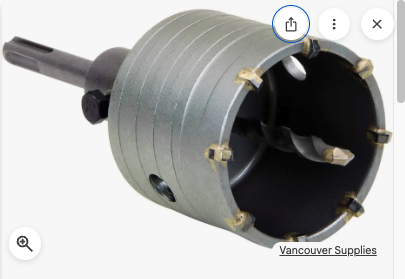
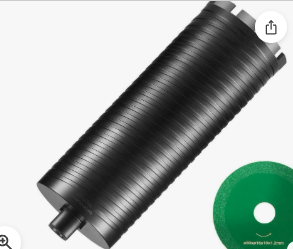 Bob "hot rod" Rohr
trainer for Caleffi NA
Living the hydronic dream0 -
I cannot seem to find a cheap 3 5/8 core bit online.. only 3 1/2
0 -
4" and a tube of grey silicone to seal the 1/4" gap around it. Assuming you are using 3" PVC? If not measure the OD of the material you are using.
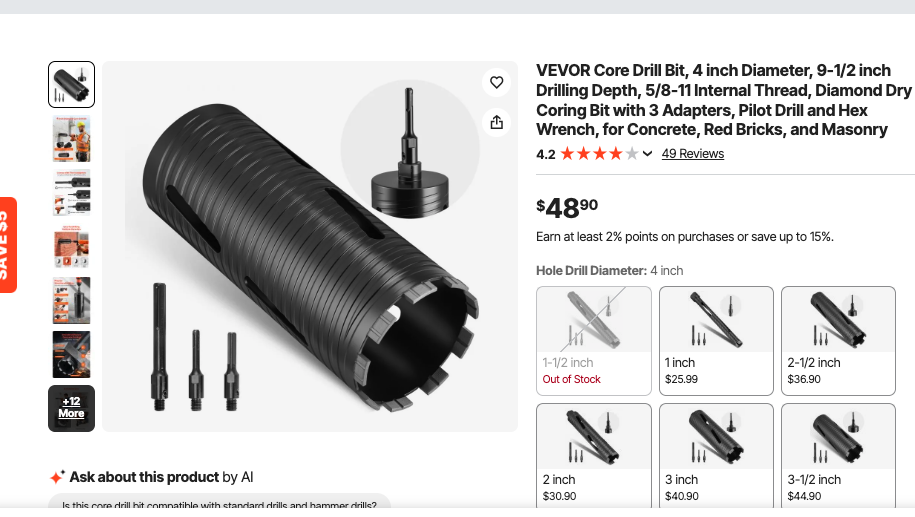 Bob "hot rod" Rohr
trainer for Caleffi NA
Living the hydronic dream0 -
The short answer is yes you can do that. Take out the window and it's frame, though, and fill with new masonry to get a really clean job of it.
The just drill through the brick idea works, too — if it's brick. However, if your foundation is field stone… you can do it, of course. But I wouldn't advise it with a hand held drill — there is no way you can hold it straight when it hits a change in stone at an angle. Further, in some stone you might find that it would take you a while. I have seen folks trying to drill through some field stone foundations and spend all day — literally — to get through them.
Br. Jamie, osb
Building superintendent/caretaker, 7200 sq. ft. historic house museum with dependencies in New England 0
0 -
I had to drill into and bust out some quartz when I dug for my sump pump. It wasn't fun even with small bits.
I believe a lot of my foundation contains it as well.
Single pipe 392sqft system with an EG-40 rated for 325sqft and it's silent and balanced at all times.
0 -
I core drilled a 2 1/2 in hole with core bit in a rotary hammer to run 2" PVC through a granite fieldstone foundation at my uncles' house for a 200-amp service. Took a long time. The rotary hammer was so hot I had to ware gloves. But that was 35 years ago. Today I would rent a core rig to bolt on the wall with a wet core bit……….or better yet sub it out.
The largest hole I ever cored was a 10" through a concrete roof in a hospital for an 8" cooling tower feed.
0 -
go up to 3–3/4 or 4”; diamond if cutting through masonry.
Edit: Predrill the center guide hole. Otherwise edges grab if you get off axis a bit. 1
1 -
You can use a core bit with no centering bit but its tricky. Some have started the core bit on an angle until you get part of a grove cut and then straighten it out.
Better idea is to cut a hole in a piece of 3/4 plywood just 1/4" larger that the core bit and anchor it to the wall and use it as a guide to start the core.


 3
3 -
that is the trick to cut a bigger hole with a hole saw where you can't use the pilot is to drill a hole in a p piece of plywood with the hole saw then clamp or screw the plywood over the hole that is too small and use it to guide the saw
0 -
A further tip… don't ask how I learned… if you are drilling through stone, rather than concrete or block, you may find that the drill wants to wander off the straight and narrow if it hits a stone which is harder or softer. Not really a problem, but… go slow. The bolted down coring rig works, but if you don't have that, just don't force the drill. Slow and easy…
Br. Jamie, osb
Building superintendent/caretaker, 7200 sq. ft. historic house museum with dependencies in New England0 -
I'll be that guy. What is the big deal about removing the window and just re-framing it in with proper materials, just as you would do if it was just a typical wood sided house? Is it just a visual thing there to have the wood clashing with brick or concrete? Seems a lot simpler than drilling out the wall to me.
Rick
0 -
Even on concrete and block, the pilot bit wants to wander. Yes, a light touch to start a good groove.
0 -
I would suggest before jumping at this location that you walk around the place looking at where the water heater is currently vs where you use the most hot water. Don’t perpetuate the mistakes of the original low cost bidder. One of the issues with water heating is time/distance to the faucet, regardless of water heater type. Your instantaneous isn’t. It will make it quickly but you still have to draw the cooler water out of the pipe before you get hot. YOu can do recirculating systems to handle this or place the unit where the load is, which is better. Close to the kitchen is best imho. As to the vent, I have vented these it the corner of the kitchen cabinets behind the lazy susan. A pain to reach, but better than the core drill. A closet on an outside wall? Getting the vent up off the first floor is good also for snow clearance.
 2
2 -
If there was an official engineering drawing of do the pipe thru the window idea, would that make it OK?
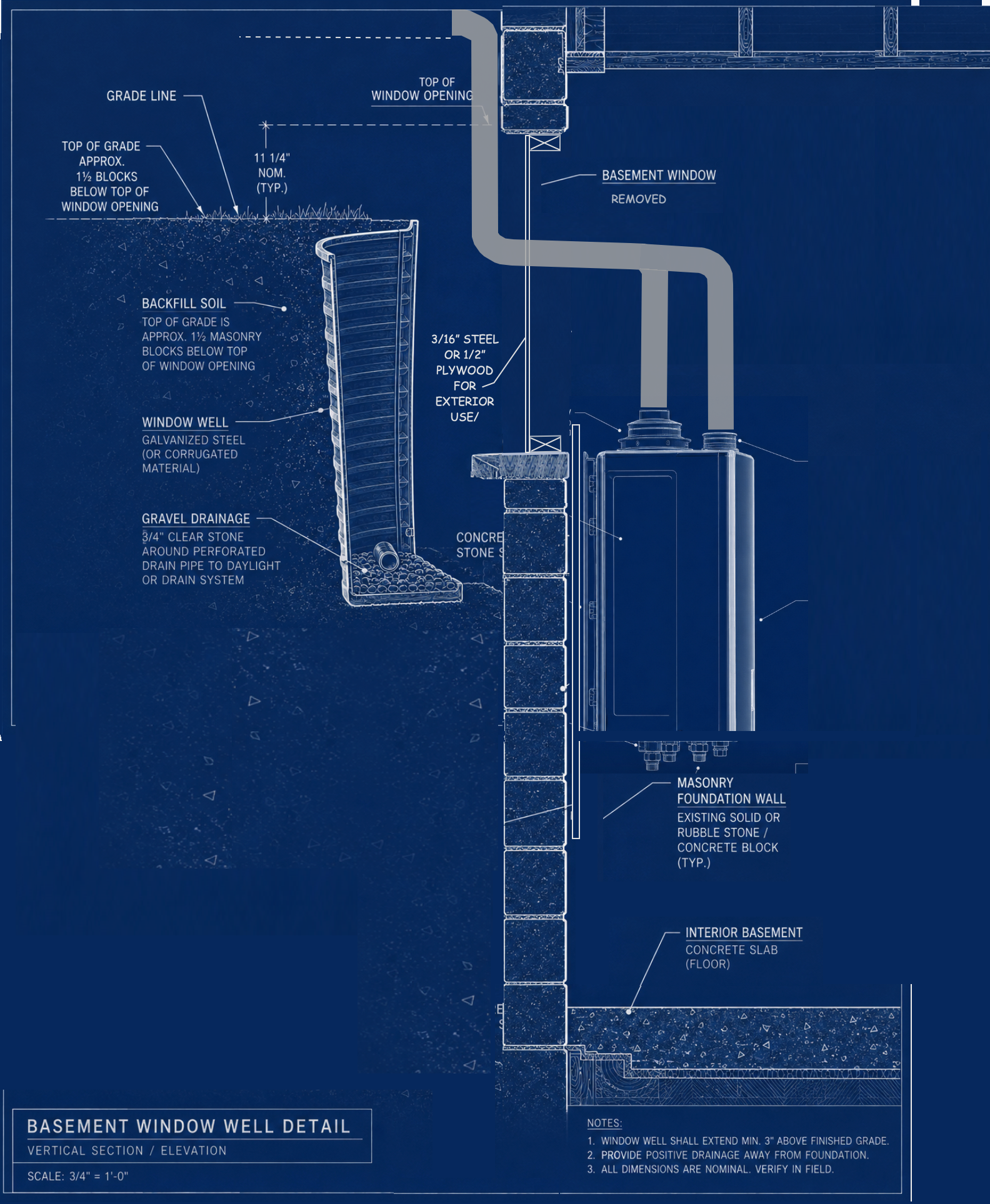
What do you all think?
Edward Young Retired
After you make that expensive repair and you still have the same problem, What will you check next?
1 -
so can you get cyanide poisoning from those?
0 -
-
Psychological
Evaluation
???
😇
1 -
Would that make me that PIA engineer customer no one wants?
Edward Young Retired
After you make that expensive repair and you still have the same problem, What will you check next?
0 -
0
-
I keep them on the other side of my screen. I never touch the blue prints themselves.
Matt… are you somehow digitizing yourself so you can get on the other side of the screen so you can touch the iron compounds and potassium ferricyanide? I didn't think they still did it that way in the cloud.
Does that chemical in the cloud cause it to rain, like seeding clouds with potassium chloride? Does that wash away all your stored data when that happens? I wonder?!?
I learn so much from you guys!
Edward Young Retired
After you make that expensive repair and you still have the same problem, What will you check next?
0 -
using the window opening is more of an aesthetic issue, in my mind.
Why core a hole next to a perfectly good hole, the window.
If you want some light, I suppose part could be window, part sheet metal for the vent. As long as the window is fixed.
Bob "hot rod" Rohr
trainer for Caleffi NA
Living the hydronic dream 1
1






Categories
- All Categories
- 87.8K THE MAIN WALL
- 3.3K A-C, Heat Pumps & Refrigeration
- 59 Biomass
- 430 Carbon Monoxide Awareness
- 133 Chimneys & Flues
- 2.2K Domestic Hot Water
- 6K Gas Heating
- 124 Geothermal
- 170 Indoor-Air Quality
- 3.8K Oil Heating
- 79 Pipe Deterioration
- 1.1K Plumbing
- 6.7K Radiant Heating
- 396 Solar
- 16.1K Strictly Steam
- 3.5K Thermostats and Controls
- 56 Water Quality
- 51 Industry Classes
- 51 Job Opportunities
- 18 Recall Announcements