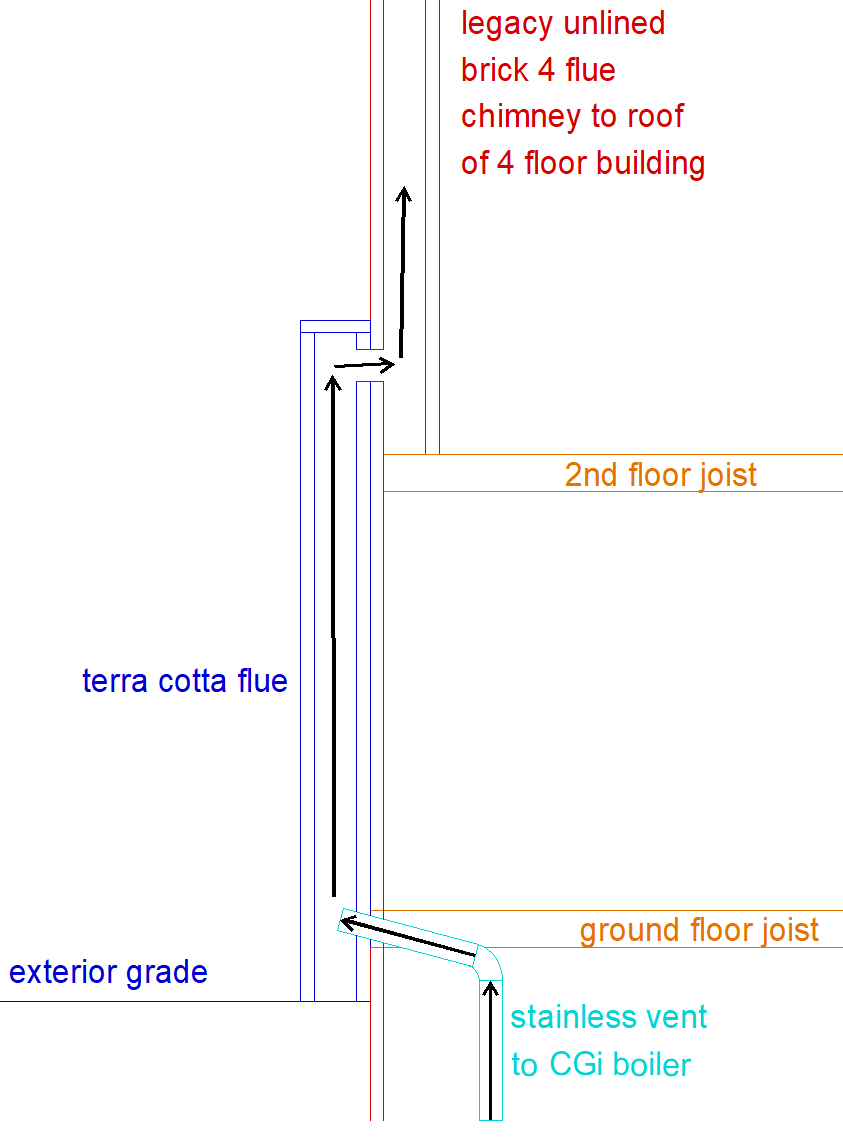
what to do with this odd boiler vent setup redirecting the vent into the old chimney?

This is how it was set up when decades ago we bought this building that was once heated with coal fired stoves and grates. For the boiler in the basement heating the ground floor they built a terra cotta lined cinderblock chimney outside the wall and then connected it to the original 4 flue chimney. Is this legal? Was it ever? No clue. If you're wondering why the chimney doesn't continue down to the 1st floor, I think it was removed in a 1950s renovation.
In recent years there's been condensation on the outside of the chimney causing the cinderblocks to spall. I think it's time to do something else. Do I have options other than a 50' double walled stainless vent pipe up the entire side of the building? Can a liner be fed through this mess?
Comments
-
doesn't seem right to have the old chimney supported on floor joists.
 1
1 -
Well, who's to argue with at least 65 years of success? Sadly, this old place is a teardown when they take me out of here feet first. The lot is worth far more scraped and redeveloped than these funny old weird layout apartments with sagging floors, baseboard heat from a DHW tank and cracking horsehair plaster walls.
 1
1 -
Not the first chimney I've seen supported on floor joists. Not the best idea in the world, but so long as the joists are undamaged and old wood, and have a good connection to the walls, at least it won't fall down. Was it legal? Did anyone check? Probably not on both counts…
Now is it wise to use it for a modern appliance? Is it even possible to line it? It might be possible — but it's going to be a job, and the material costs will be at least comparable to running a nice new double wall flue up the outside of the building, and the labour costs should be less. Which is what I would do.
Br. Jamie, osb
Building superintendent/caretaker, 7200 sq. ft. historic house museum with dependencies in New England 2
2 -
or replace the boiler with a mod con and vent it out the side wall if it is a hot water system and the boiler room isn't half asbestos.
 1
1 -
Did you see that the boiler is in a basement nearly completely below grade? And I don't want a mod-con, I'd never recover the purchase cost and maintenance in efficiency savings. My yearly gas bill is $1500.
1 -
will you recover the cost of building a new vent?
0 -
The new vent will not cost me >$500/year in maintenance. The last time I asked a "Pro" to come in Sept for seasonal maintenance on a steam boiler in another property, he quoted me $$$$. And yes, he's a member here.
1 -
Hi, Dare I say "heat pump"? 🙀
1 -
That CGi (i=Induced Draft) boiler could be sidewall vented bypassing the chimney all together using AL29-4C listed SS vent pipe by Heat-Fab, Fas-N-Seal, Z-Vent or others.
0 -
Please explain how I would cost-effectively replace hydronic heating for my four bedrooms, kitchen, dining room, living room, and basement with a heat pump? And that doesn't even get into the fact that I'd probably have to replace my underpowered electric service.
0 -
I didn't think that was legal to do for anything but a ModCon. Can you explain? Isn't there regulations about how far from windows etc?
0 -
powervented cast iron boilers typically vent through a sidewall with UL listed stainless steel vent pipe, its a normal thing. yeah there will be local codes that regulate where your vent is located but I'm not entirely sure the current situation is entirely "up to code" either?
2 -
I hope this link works. If not, let me know. Yes, there are requirements regarding how close the vent terminal can be from windows, doors, fresh air intakes, etc. It's in the install manual for the boiler that I could send if you need.
1 -
@Karl Reynolds is right .
Sidewall venting the CGI is the way to go. M
anual attached see venting on pg 14
1 -
Hi @Jells , To me it's simply part of the brainstorming process. Might be crazy, but you seem to be running up against problems whichever way you look, so I thought it might be worth looking at the costs of mini splits or some air to water approach to see if it might possibly make sense and give a long term solution.
Yours, Larry
2 -
or put a power venter on your current boiler.
probably don't actually need to clean a mod con every year if you choose the model wisely and apply it correctly.
conversely the safeties on any fuel burning appliance should be tested annually, not that most people do that.
1 -
I said in my OP that I was dubious about legality of the current setup! I have a chimney & vent contractor coming Thursday, hopefully he will give me some good info.
0 -
Thanks, but that PDF was already in my PC! So the issue is how to work within these guidelines.
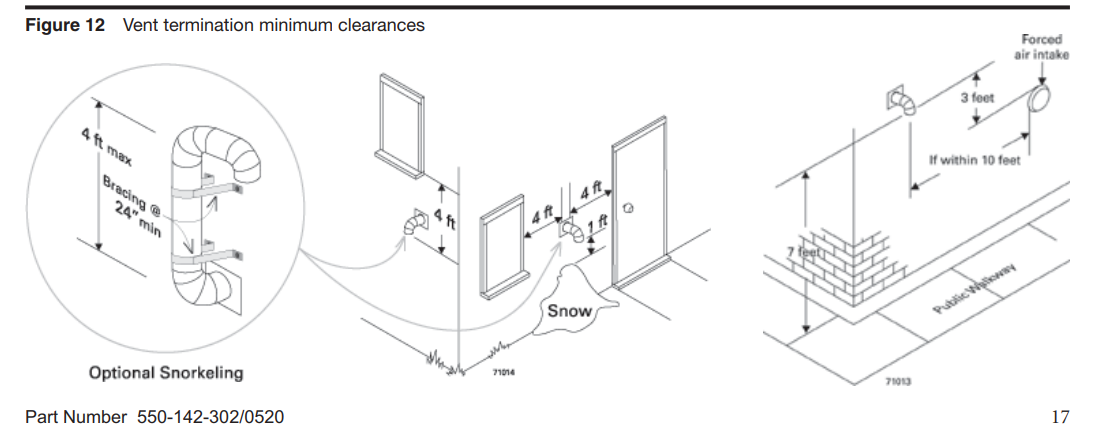
I was hoping to move it off the side of the building where cars park, but the window and door around back do not provide the 4' clearances. I can put it as in the figure on the left where the current masonry flue is. The bottom of the 1st floor joists are 12" above grade. I guess I would also need to install a couple of vertical 3" steel pipes in the ground guarding it from a sloppy parking job! At least my kids are out of the house.
Still seems weird when what I googled about vents previously said they had to run above the roofline. It could be the reason it wasn't done like this to begin with was there was also a DHW on the vent. When I had the CGi replaced like 15 years ago, the vent was blowing out the WH hood! I resolved this by replacing the WH with an indirect tank. I love the nonexistent maintenance on that piece of equipment.
We'll see what the chimney contractor says on Thursday.
0 -
So I finally got a chimney contractor to visit and he was utterly amazed and baffled when I showed him the page from the CGi manual in the previous post with the snorkel option. He wanted to run it 45' up above the roof instead, a hugely more expensive job, especially if he had to use a scaffold instead of a ladder.
He was concerned that the city would not approve the 4' snorkel instead of a full run up, even if it was explicitly an option in the install manual. Do I work with this guy, who came recommended by my regular plumber, or keep looking?
0 -
unless there is some code rule that power vents must be above the roof line, I don't see where it is any different than a direct vent fireplace or console heater or wall furnace or tankless water heater venting out the sidewall.
0 -
That's my take too. For heaven's sake, the config is in the manual! This guy is pretty young, I guess he hasn't seen this before. Is the roofline rule for natural draft appliances where it needs some distance to draw properly?
0 -
it appears the michigan code only requires natural draft vents to terminate above the roof.
0 -
The only usual concerns with sidewall venting is staying away from windows, gas meters or other building openings and snowfall.
1 -
If you decide to keep looking until you find a professional who has looked in the manual, you may be looking for a long time
NJ Steam Homeowner.
See my sight glass boiler videos: https://bit.ly/3sZW1el 1
1 -
Lol, I guess, but you'd think he had seen a direct vent before? Maybe most are done by the heating contractor rather than a chimney guy?
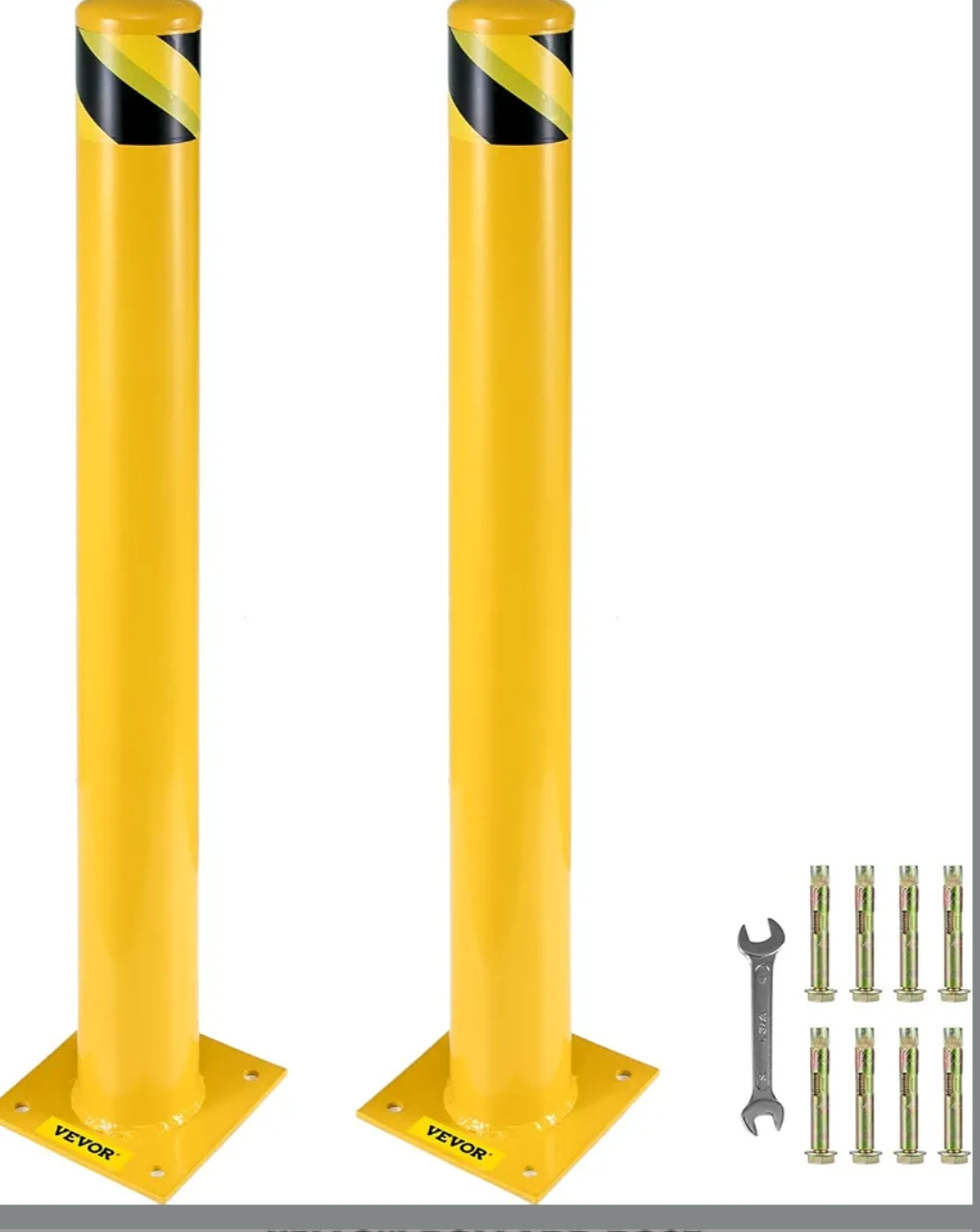
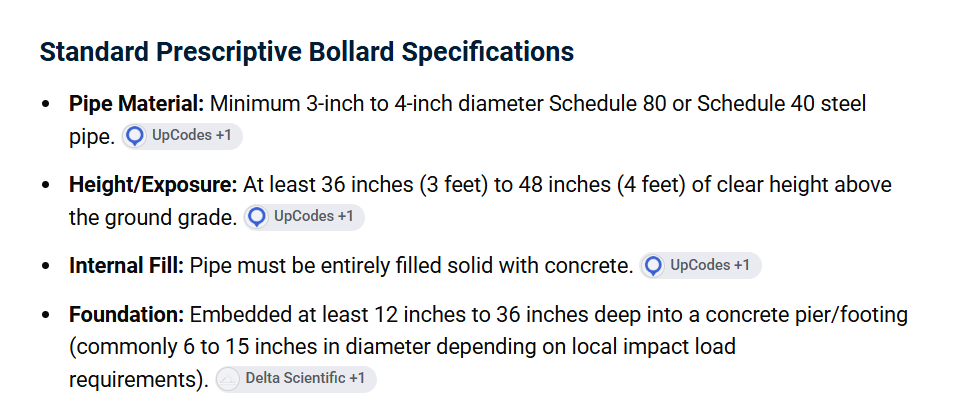
Now I gotta decide whether to try and get a permit from my dysfunctional city, or just do it and ask forgiveness if it gets spotted. "It was an emergency!" I also will need to mount steel poles on either side to protect it from the parking cars. I don't know how heavy those need to be, probably 3.5" pipe.
1 -
i believe there are specs for the bollard protection in the code. it is usually a lally column.
it would concern me that someone is installing a direct vent that is unfamiliar with direct vents. it isn't entirely just following the instructions, you need to understand some things about combustion and vents and draft.
0 -
Fair. It bothered me when he was going on about discharging CO at 5' off the ground. I pointed out that a properly combusting boiler isn't making significant CO! Which is why direct vent is legal to begin with.
I guess I'll have to rummage around to find what the code says about bollards. Great, another project!
0 -
These 48" bolt down 5.5" dia steel bollards from Amazon look like they will do it. A lot easier to use lags than break out a footing from the driveway.
https://a.co/d/0ewaL12y
0 -
i think the code specifies how far it has to be buried in the ground. depending on where it is it could possibly be bolted to the building too. the rules are a lot more lax if it is just the residents vehicles vs public traffic.
0 -
Around here (VA) Boiler exhaust venting isdone by HVAC contractor. The chimney people just repair/certify chimney for “normal” use although some install stainless steel lining as specified by boiler installer.
0 -
I asked 2 HVAC contractors and they both said to call a chimney guy. ¯\_(ツ)_/¯
1 -
Just follow the directions in the boiler manual. I doubt you need bollards. For what? The vent sticks out of the house like a dryer vent. They don't stick out of the house enough to matter.
The distance above snowfall is the thing to worry about.
Any direct vent boiler has the venting instructions and what brands of vent materials they allow.
The codes don't say much about direct vent except to follow the MFG instructions.
0 -
We need bollards because we park a car literally right next to it, and we need to do the snorkeled version. One reason I'm replacing it is shards of stucco off the chimney have been falling on the 14 year old car, and we're getting a new one!
0 -
You need to keep 6" clearance between the direct vent pipe and any combustible materials. You will need a wall thimble for stainless steel when you pass thru your exterior wall. The stainless steel is single wall so it requires clearances.
i would recommend a pro if your going to direct vent this appliance
0 -
I was under the impression from the manual this was done with double wall SS pipe. The wall is masonry. I was not planning to DIY this, but the "pro" chimney guy seemed pretty befuddled by the diagram showing the 4' snorkeled vent, and 2 of my regular heat guys said call a chimney guy! I'm at a loss.
 0
0 -
Read and follow the manual. The pipe also need to be 2" from combustibles not 6" as someone mentioned above. Outside you need to be 1' above the anticipated snowfall.
If you too low that is when the snorkel come in. If your high enough you don't need the snorkle.
- Pick the "brand " of vent material you going to use because you can't mix parts from different brnds
- Measure it out in accordance with the manual and make a list of parts
Just watch the clearances etc
0 -
It's so bizarre, for once I wanted to be the guy who just hires the pro, and I get stymied! FWIW the 4' in the picture is fine. we've never had more than 2' of snow in 30 years. But I'm curious, just say it drifted higher. Wouldn't the exhaust keep it clear by melting the snow?
0 -
That is why they make you put a smoke/co detector near the boiler. At least Massachusetts does. Don't know about other locations.
0 -
NYC and some other municipalities, but We put them on ALL new boiler installations. The piece of mind is priceless. Mad Dog
0




Categories
- All Categories
- 87.8K THE MAIN WALL
- 3.3K A-C, Heat Pumps & Refrigeration
- 60 Biomass
- 430 Carbon Monoxide Awareness
- 133 Chimneys & Flues
- 2.2K Domestic Hot Water
- 6K Gas Heating
- 124 Geothermal
- 170 Indoor-Air Quality
- 3.9K Oil Heating
- 79 Pipe Deterioration
- 1.1K Plumbing
- 6.7K Radiant Heating
- 397 Solar
- 16.1K Strictly Steam
- 3.5K Thermostats and Controls
- 56 Water Quality
- 51 Industry Classes
- 51 Job Opportunities
- 18 Recall Announcements