3/8 pex lines for tiny zones
I haven't done 'new work' in forever, mostly chop-swap. As recall, the 3/8 pex/plastic lines will carry a good amount, 1 gpm under normal circumstances? Up to 10000 btu if we use traditional numbers? I have a guy that want's micro-zones (yes we have a buffer tank)
Thanks for any input.
Comments
-
With 3/8" PEX, you could flow as much as 1.3gpm. At a 20°Δ, that's a max of 13,000 BTU's.
8.33 lbs./gal. x 60 min./hr. x 20°ΔT = 10,000 BTU's/hour
Two btu per sq ft for degree difference for a slab1 -
depends on the loop length.
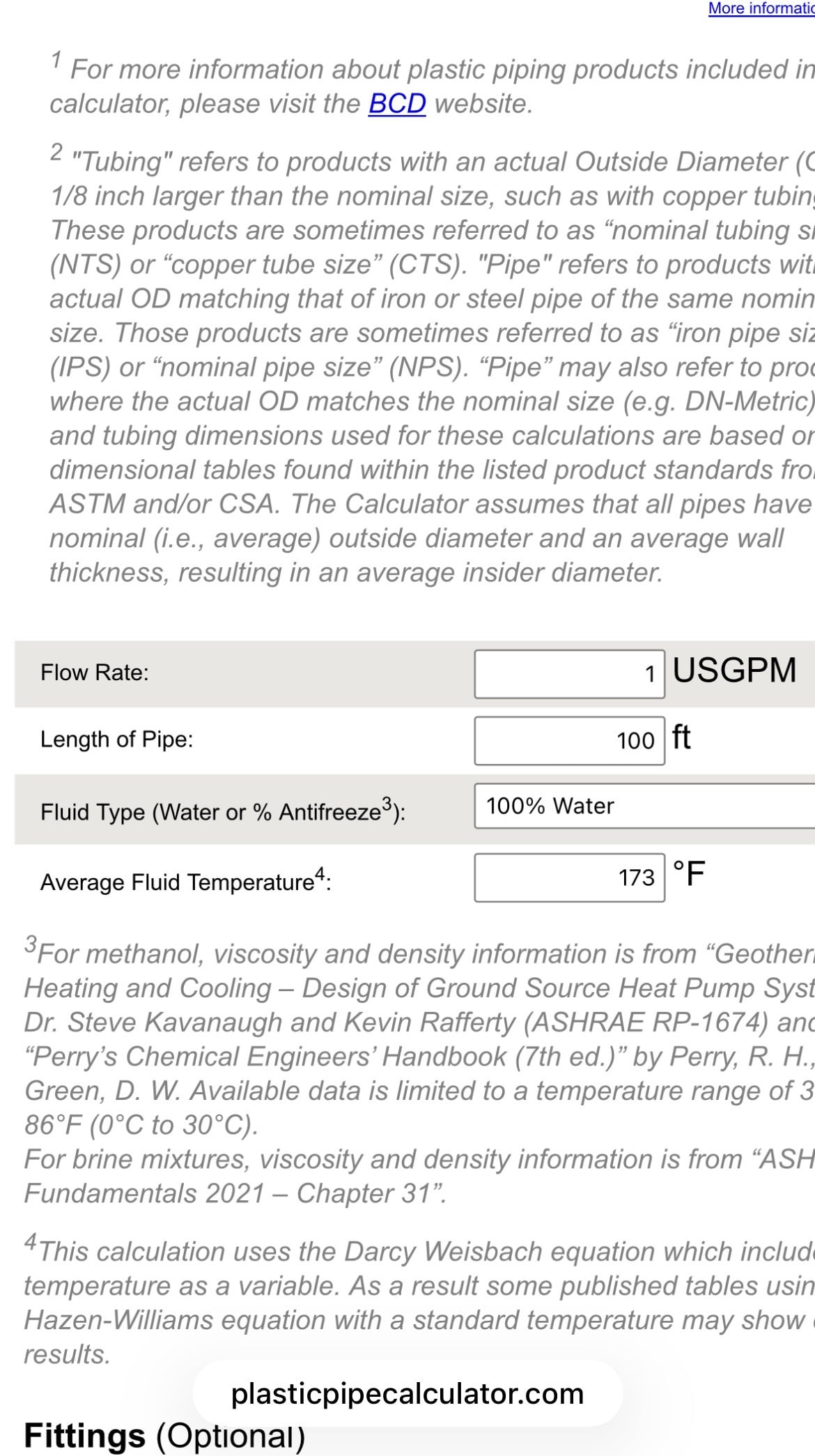
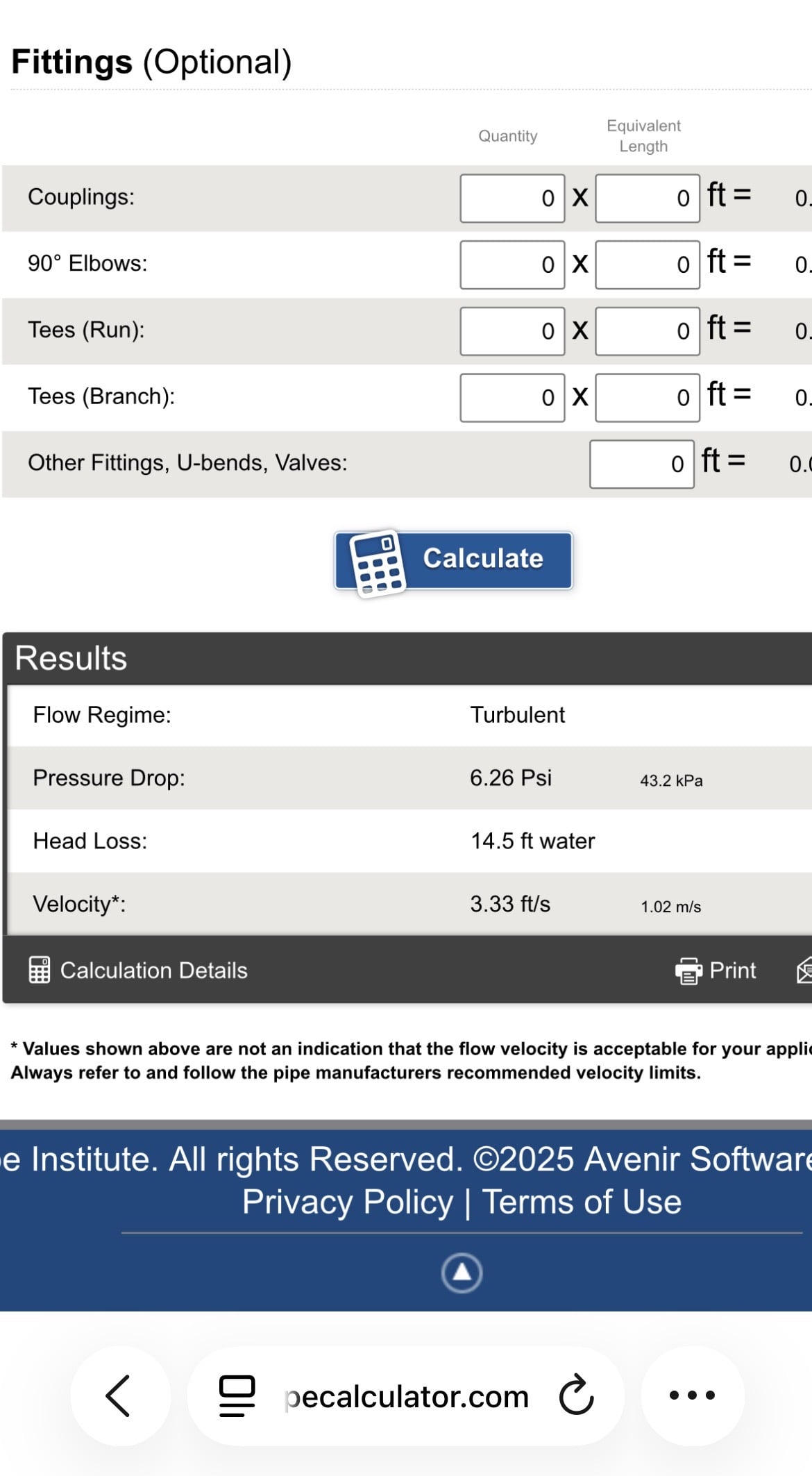
The PPI online calculator is good to run examples
100’ of 3/8 pex at 1 gpm
14, head will take a high head circ
 Bob "hot rod" Rohr
trainer for Caleffi NA
Living the hydronic dream 2
2 -
Just 6600 btu on the largest zone- should be good
0 -
i would figure .5-.75 gpm for 3/8" pex which gives you ~7000 btu/hr at 20f delta t. that is a pretty good sized radiator. if you're trying to do something low temp you might need to think about what flow you need.
1 -
-
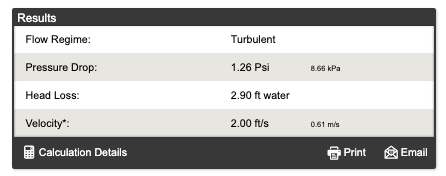
50' of 3/8 with a .6 gpm flow
 Bob "hot rod" Rohr
trainer for Caleffi NA
Living the hydronic dream0 -
Sorry, this is wrong and .6 - 1.1gpm is correct. I was figuring ½” PEX.
8.33 lbs./gal. x 60 min./hr. x 20°ΔT = 10,000 BTU's/hour
Two btu per sq ft for degree difference for a slab 1
1 -
The biggest question is why? What's stopping you from using 1/2" that's available everywhere?

 2
2 -
I would second this, going to 3/8" makes it harder to locate fittings, manifold connections and pipe as there are not that many manufacturers extruding 3/8".
When I do underfloor radiant, i try to always work with 3/8" for ease of install but in tyhis case of supply/return piping to high temp radiation, 1/2" is the way to go
Dave Holdorf
Technical Training Manager - East
Taco, Inc
0 -
Why- there were some tricky routes to weave in and out of the framing.
The HO wanted insulation the whole route(s), and drilling holes to accommodate the OD of the armaflex. I simply wanted to keep the holes to a minimum.
3/8 fittings availability are not an issue
We started this job yesterday. I chickened out and went 1/2”
Yet the sociology is evident- we all mostly oversize to avoid questions.
I remember 20 or 25 years ago this local vendor/heating designer proposed a design to a certain homeowner. I cannot recall specifics, but the gist was there was a little remodel going on the heating area (condominium) was going to double or triple. There was an existing 5/16 inch pex line. I grabbed the 5/16 and created a little manifold and did what I’m guessing was 200 or 300 ft.² of radiant. By human standards, this should not have worked. I recall the guy waiting two or three months to pay me because he didn’t think it would work. I eventually got the check in the mail. The lesson stayed with me, the fact that BTUs can do more work than we generally think they can.
(Those were the old days, business doesn’t work like that anymore)
0

Categories
- All Categories
- 87.7K THE MAIN WALL
- 3.3K A-C, Heat Pumps & Refrigeration
- 59 Biomass
- 430 Carbon Monoxide Awareness
- 129 Chimneys & Flues
- 2.2K Domestic Hot Water
- 5.9K Gas Heating
- 121 Geothermal
- 170 Indoor-Air Quality
- 3.8K Oil Heating
- 79 Pipe Deterioration
- 1.1K Plumbing
- 6.6K Radiant Heating
- 396 Solar
- 16K Strictly Steam
- 3.5K Thermostats and Controls
- 56 Water Quality
- 51 Industry Classes
- 51 Job Opportunities
- 17 Recall Announcements