The Hidden Hydronic Problem Nobody Checks: Water Velocity

This week's video talks about why the speed of the water in a hydronic system matters. Too slow and the air gets trapped. Too fast and you get noise and eventually leaks.
Boiler Lessons


Comments
-
Nice job on this case, Ray. The graphics, length of the presentation all work well.
You left us hanging at the end, :) "ask yourself one simple question, how fast is the water moving"
How about a part 2 how to determine flow velocity in hydronic systems?
Bob "hot rod" Rohr
trainer for Caleffi NA
Living the hydronic dream0 -
I would really appreciate it, Ray, if you would develop an ultrasonic flow meter that wholesales for about $500.
Ever try to buy one of those? They're insanely expensive but I'll bet they answer a lot of questions.
Contact John "JohnNY" Cataneo, NYC Master Plumber, Lic 1784
Consulting & Troubleshooting
Heating in NYC or NJ.
Classes1 -
We had what was thought to be a small case of velocity erosion on a new commercial building. Upon removing the leaking piping, it was discovered that the leak was caused by visible pipe wall erosion. Much like a riverbank looks after a heavy rain. Obvious erosion.
Over a span of a few years, small erosion issues would arise from time to time.
What we did to correct this was to add Variable Frequency Drives (VFD) to the heating systems' circulators, as well as microbubble air separators. This was done some thirty-plus years ago, and the results are still proving successful to this day.
I haven't seen much on velocity issues, but they certainly need to be considered. They are not always obvious and can cause a lot of headaches.
@RayWohlfarth Thanks for this video. It is a very helpful subject.
 2
2 -
HydronicsHandbook from 60+ years ago said 6 fps max as I recall. Decades later plumbing engineers told me that 3 fps is safer. There's a difference between HHW and chilled glycol mix. And between different pipe materials. Ideally one determines system curves (plural intentional) with a variable speed pump and then a fixed speed pump is chosen. Set it and forget it. If you don't want burner to cycle too often then you need some method to maintain minimum flow.
0 -
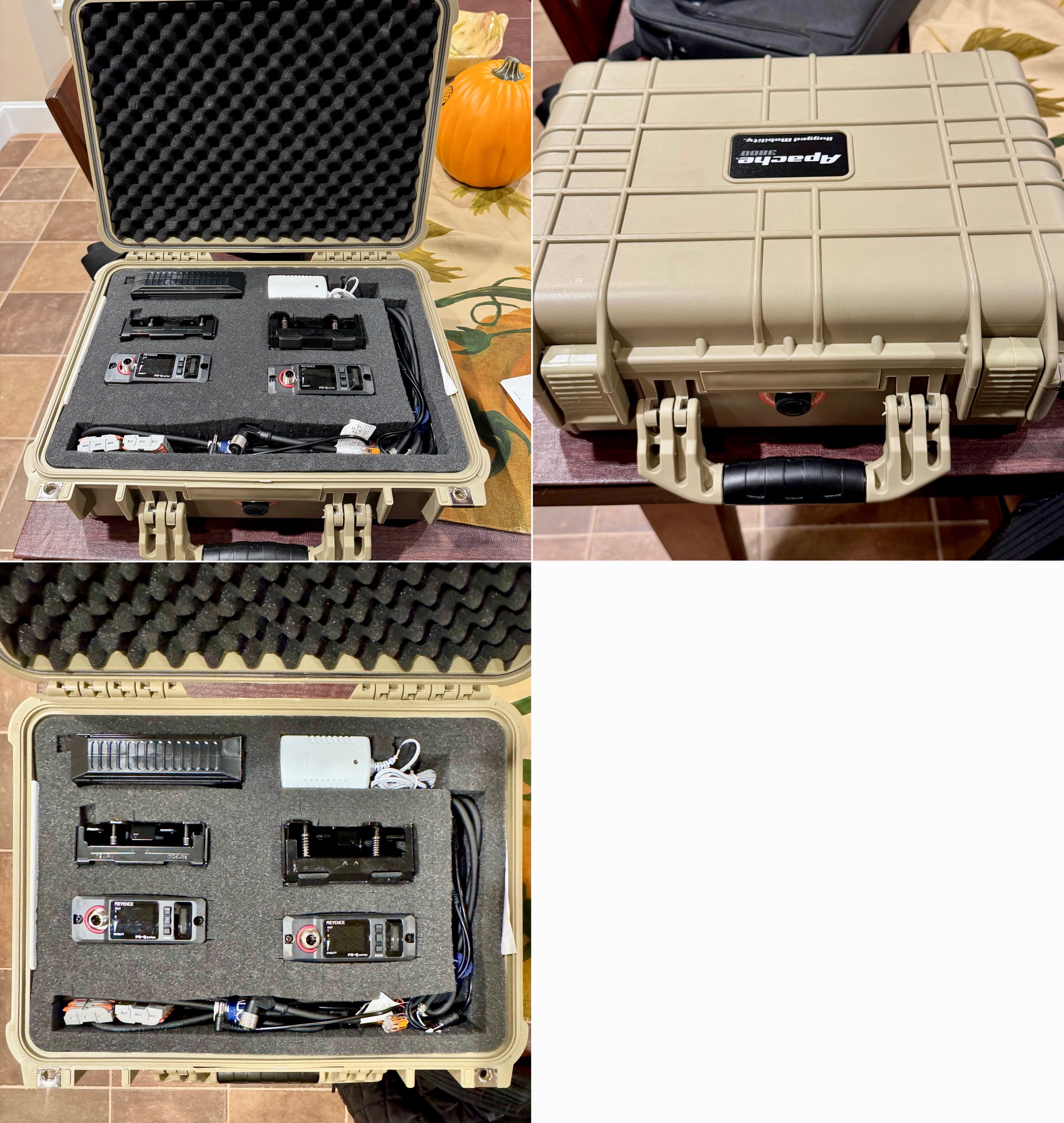
My buddy bought these used on ebay for about $150 each. They are getting harder to find. Covers 1/2"-3/4" and 1"-1 1/4"). He added rechargeable battery pack, some wires/connectors, and a harbor freight case.
 1
1 -
Too much velocity can also be a problem:
1 -
I've seen that claim made, and it never made sense to me. From the article:
"The water was moving through that system so fast it couldn't pick up enough heat from the boiler, or shed it in the radiators."
I just can't see any mechanism where increasing the flow through a radiator decreases the output. Specifically, the output of a radiator is determined by its temperature, I can't see any mechanism where increasing the flow of water causes the temperature of the radiator to drop.
But I don't doubt the writer is experiencing what he's reporting, so I'd like to offer an alternative explanation. If you have a system with multiple radiators, increasing the flow can affect different radiators differently. If the radiators are balance to meet the heating load in different parts of the building, that could cause the balance to be thrown off, which could cause some parts of the building to become uncomfortable.
1 -
I wrote that article.
And it happened just as I wrote.

 3
3 -
I did have an apartment complex with zone valves and the velocity was too high. We were getting a 2 degree delta T when only one zone opened. The open zone apartment was cold. It only heated when I slowed the velocity down
@hot_rod Thanks I will be working on it
@JohnNY I know they are crazy expensive. I borrowed one from a friend who does project management I was sold on it and put it on my Christmas list. So far Santa hasn't brought on.
@HydronicMike Im jealous
Ray Wohlfarth
Boiler Lessons1 -
Mathematicaly,theoretically and pratically it is not possible to increase heat transfer by slowing flow.
All heat emitter output charts indicate this.
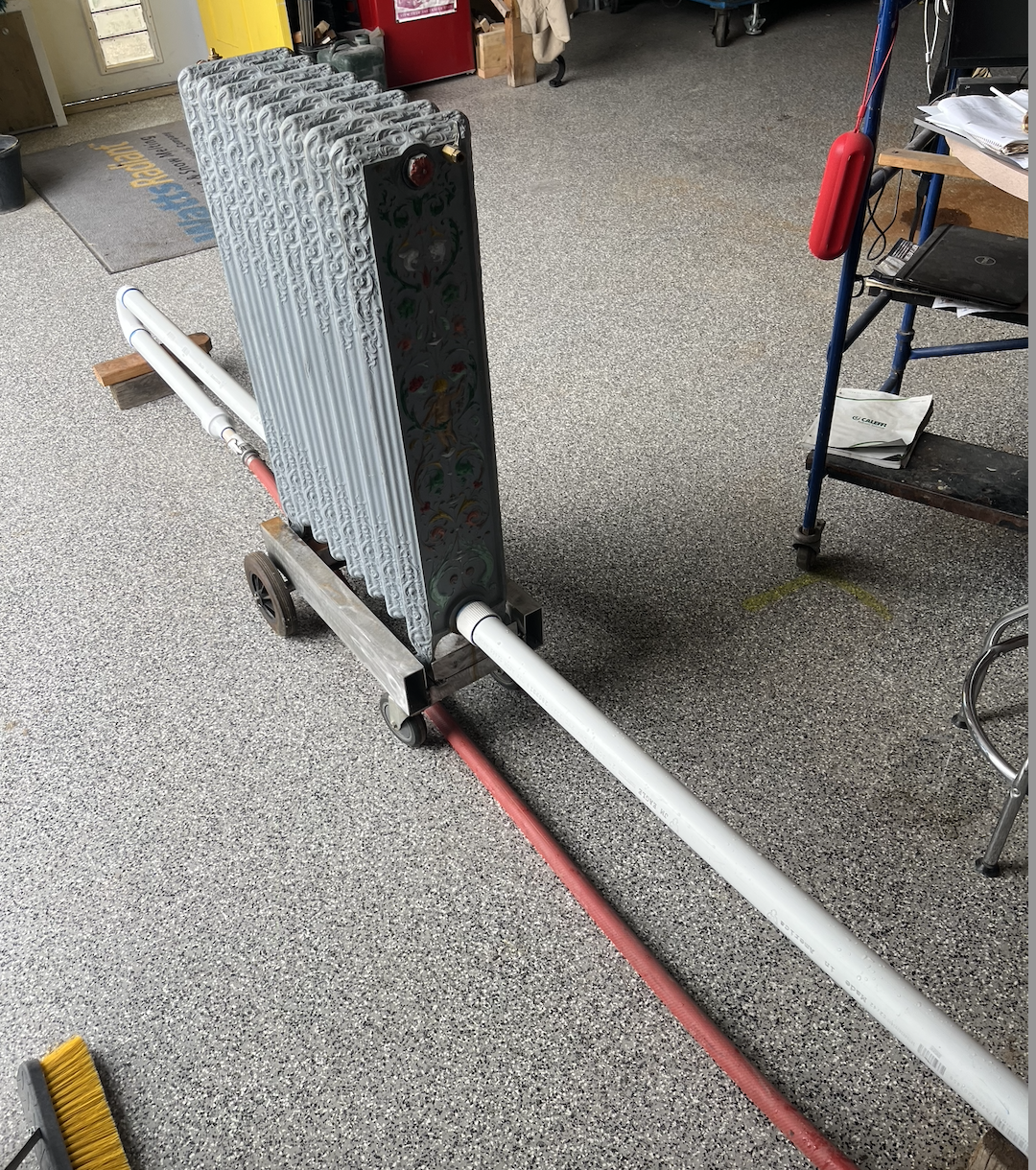
I have tested 4 different cast radiators at various flow rates. Confirmed flow with temperature measurements, flow meters and a calibrated BTU meter.
In every case increasing flow provided faster warm up of the radiator and a higher overall temperature of the radiator.
I've used Steamheads piping suggestions, used 2" pipe to the radiator,tried every variable.
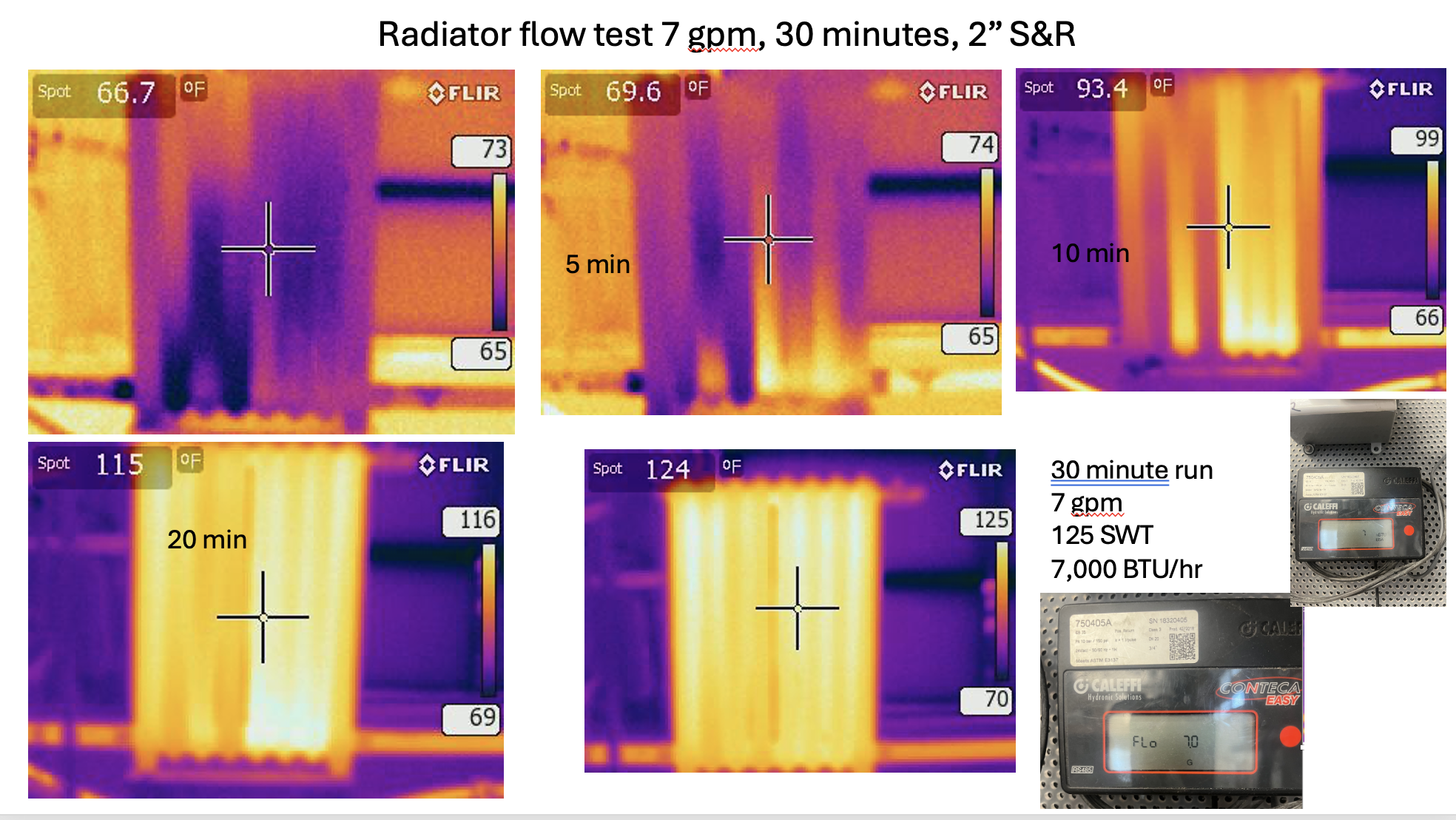
More flow= more temperature at the emitter. More surface vs ambient= more heat transfer.
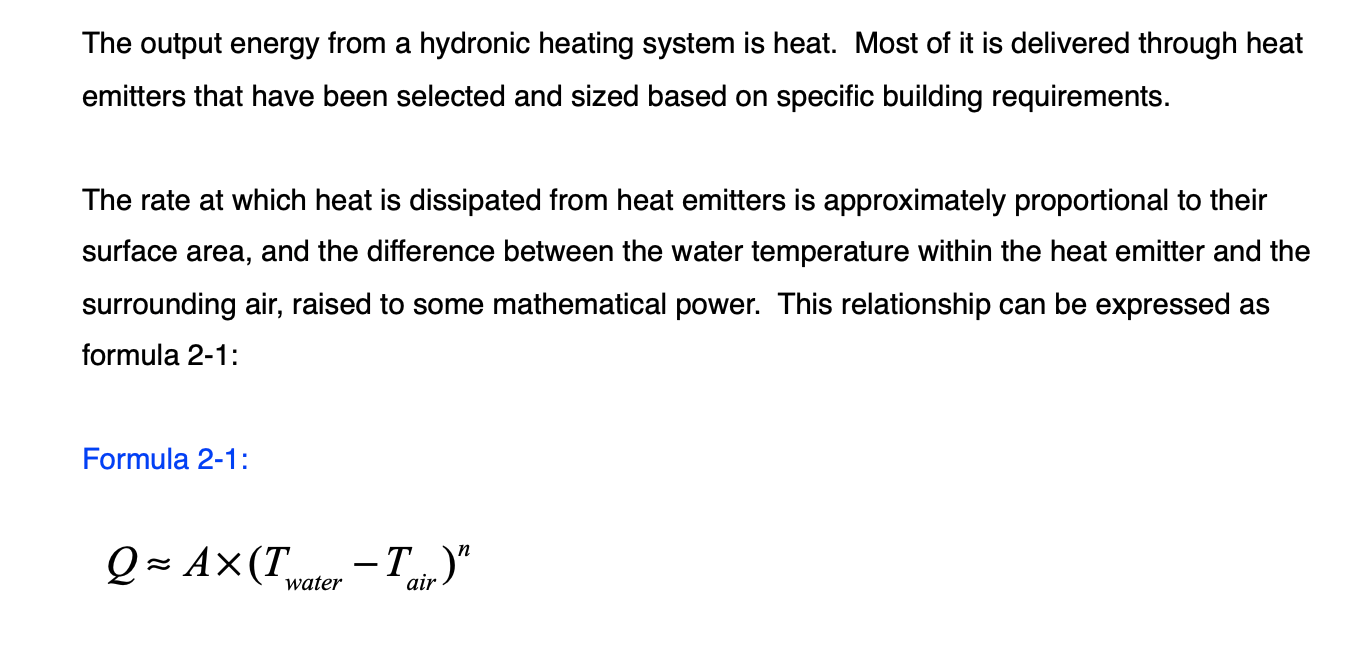
At some point the increase in output slows and the pump size needs to increase. So the juice may not be worth the squeeze.
All the radiators had 1-1/4" connections, I used a pump and 1" pipe capable of 8 gpm as my max. flow.
As for the boiler which is a heat exchanger just as the radiators are. If it runs up to 180° and ∆ of 2, then how does a 178- 180 operating condition cause a boiler to over-heat?
Bob "hot rod" Rohr
trainer for Caleffi NA
Living the hydronic dream0 -
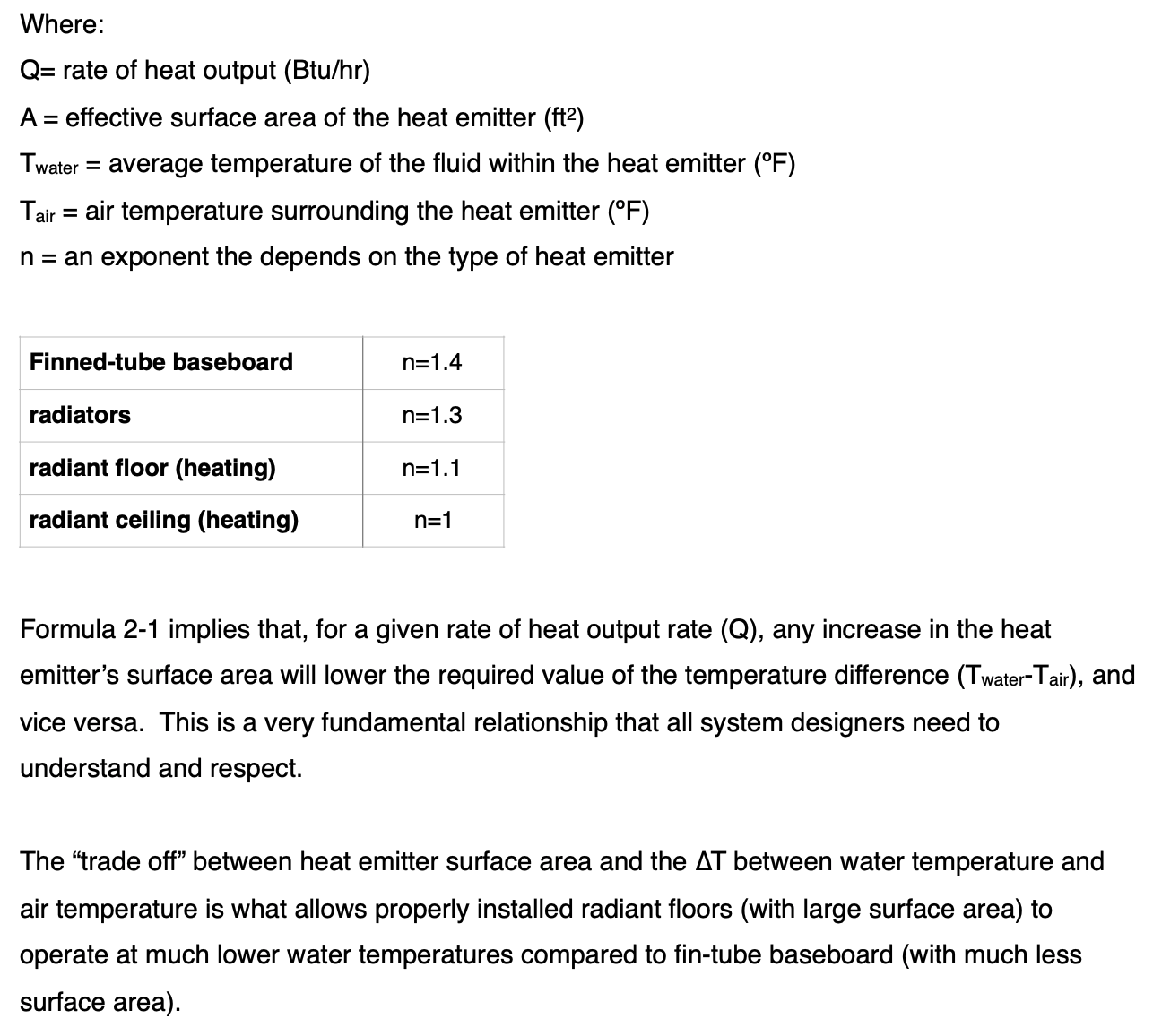
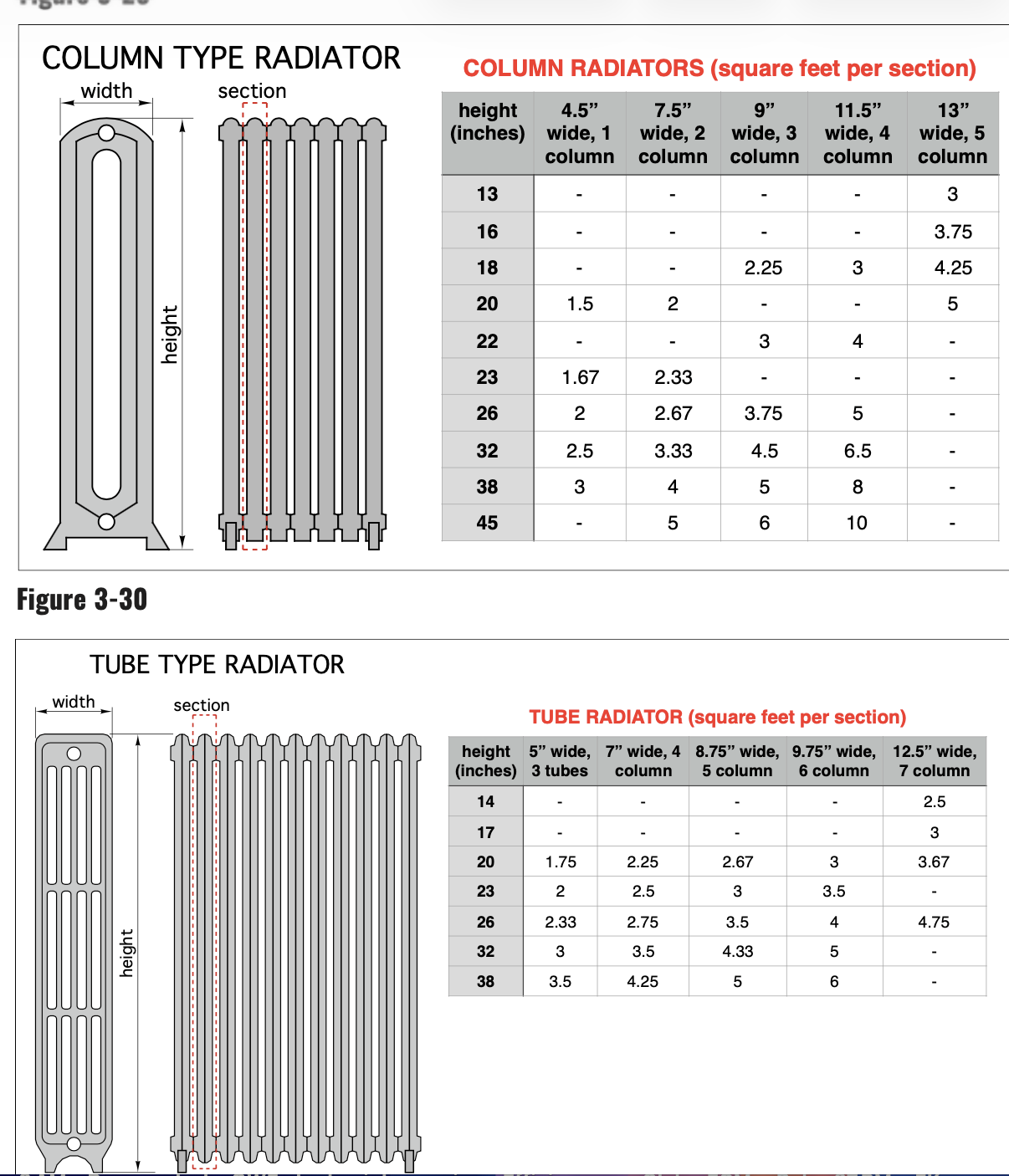
@hot_rod How do you find "A", effective area of a heat emitter?
0 -
Some exmples
If it is a radiant panel, ceilig, wall or floor slab, the sq footage of the heated part is the sq footage
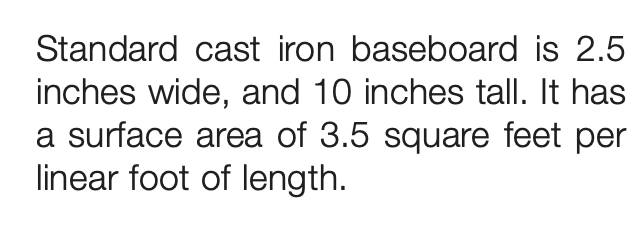
For cast radiators find the data sheet or here is a generic example.
Cast iron baseboard
 Bob "hot rod" Rohr
trainer for Caleffi NA
Living the hydronic dream 1
1 -
@hot_rod: "Mathematicaly,theoretically and pratically it is not possible to increase heat transfer by slowing flow."
Thank you. I agree completely.
I will also say that under certain circumstances, slowing the flow will cause the system to work better. I won't dispute the experience of the people here who solved problems by slowing the flow, I think they're just misinterpreting why it worked.
 1
1 -
Well, bottom line is, it worked. And it's worked other times too. Can't argue with success.
0 -
@hot_rod You may be right I cannot explain it but it worked. By the time I arrived that evening, the owner increased the boiler temperature from 180 to 210 and the apartment would not heat. It had a 2 degree system delta t Once I throttled the valve for that zone, the delta T rose to 20 and the apartment heated quickly
Ray Wohlfarth
Boiler Lessons0 -
so if you are in front of a class of hydronic newbies and they ask how flow effects a hydronic system heat output. What is your answer and explanation?
As an example , a 100,000 system designed for a 20 delta operation.
Hydronic anomalies might be a topic for upcoming an upcoming detective series 😉
Bob "hot rod" Rohr
trainer for Caleffi NA
Living the hydronic dream0 -
I would tell them that since the system in question was originally designed to circulate by gravity, it was designed around very low flow rates. The oversized circulator exceeded the design flow rate by a wide margin, causing the problems cited in the article. The new one, and its associated piping, approximated the original flow rate and the system then worked just as the Dead Men intended.
Both Bell & Gossett and Taco discussed this in their books from that era. My companion article-
takes their info and applies it to modern circulators.
0 -
@Steamhead i find this confusing. The article you wrote emphasizes that gravity conversion systems need more flow than modern systems (for the same sized boiler) right? That’s what I’m inferring from the table in your article, anyway. Is your point that the system in @RayWohlfarth’s original post has gone too far in that direction?
by “very low flow rates” do you mean low rates relative to the piping size, which tend to be quite large in gravity conversion systems?
0 -
Yes. There is more water in a gravity conversion, but it moves very slowly compared to one designed for forced circulation. The large piping kept the friction losses low enough so the water would move easily with the limited motive force inherent in gravity circulation. With such low friction loss, it's way too easy to over-pump these systems.
0 -
At days end if you need to move X amount of BTU out of boiler at a decided ∆, you need X amount of flow.
So 100,000 BTU needs 10 gpm at 20 ∆
Regardless of the pipe size or type of emitters you need to circulate adequate flow to move the btus., or the space will not warm.
Maybe a system requiring 10 gpm that had a 70 gpm circ may have some unique operating conditions. Probably would not need a boiler with the motor heat and friction developed by a circ that size :)
Too low of a flow, somewhere below 2 fps the fluid goes laminar, doesn't transfer heat or move air along with the water.
The Reynolds Number determines if flow is laminar or turbulent. Reynolds below 2300 will be laminar.
Engineers design long, 100- 100 ft runs between buildings for example at laminar conditions to reduce heat loss through the pipe wall.
I think sometimes heat transport and heat dissipation get clouded. You can move heat through the connecting piping at low flow, but the heat emitter itself needs flow to get the entire radiator warmed. If flow is too low I guess the cast mass heat from conduction?
B&G originally
called the cics a booster, intended to fix or make gravity systems with long horizontal runs work. So the gravity induced systems had limitations, and the math was critical
This 1930 pre ASHRAE book, into gravity system design, where's my slide rule, again :) It would feel sacrilegious to do the math with a calculator or AI.
 Bob "hot rod" Rohr
trainer for Caleffi NA
Living the hydronic dream 1
1 -
I can think of five ways that over-pumping can cause system problems. None of them involve radiators having less heat loss at higher flows.
- The higher flow doesn't go to all of the radiators in the system evenly, and the balance is thrown off.
- There are nooks and crannies in the system where air can accumulate, and normally they're not an issue, but under high flow they're scoured and now air is in the system interfering with flow.
The next three all have to do with the fact that in order to get high flow you need a significant pressure differential over the circulator.
3. The lower the pressure, the lower the boiling point of water. The pressure differential is lowering the pressure somewhere in the system low enough that the water is boiling, obstructing the flow.
4. The pressure somewhere in the system is low enough that air is entering through an automatic bleed valve.
5. The pressure is high enough that zone valves are leaking, upsetting the balance of the system.
0 -
@hot_rod I have that Guide.
@DCContrarian it's actually a lot simpler than that. The shortest distance between two points is………… a straight line. The circulator sets up a certain ΔP between the flow and return connections. If the ΔP is too high, the system is over-pumped.
Now picture a typical radiator. If the radiator is connected with flow and return at the bottom on opposite ends, and the system is over-pumped, the water will rocket between the flow and return connections and not much will diffuse in the radiator.
If the pipes are connected with flow at the top and return at the bottom of the same end, and the system is over-pumped, the water will flow downward from the top to the bottom of the first couple sections and not diffuse through the rest of the rad.
In both cases, if the shutoff valve works, you can close it part way and the water will diffuse as it should. Many years ago, one of my customers told me that when she closed the radiator valve part-way in her bedroom, the rad got hotter! This didn't make sense until I realized that system was over-pumped. Installing a smaller circulator solved the problem.
0 -
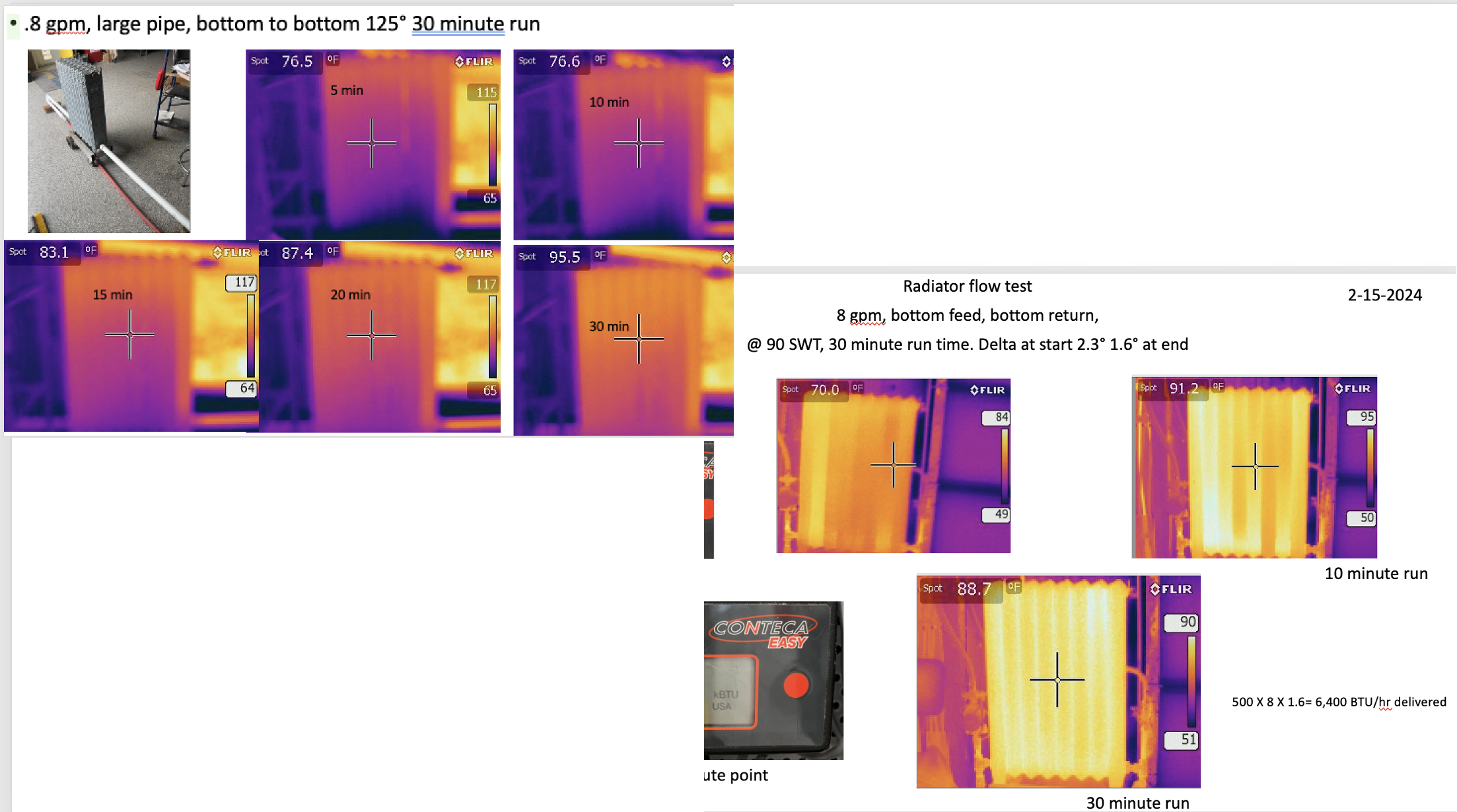
What would you consider excessive flow in this 8 section radiator? It has 2" connections so in theory you could push 40 gpm through it.
I ran this at just under 1 gpm, .8gpm.
Then at 8 gpm, 1.6- 2.3 ∆, and a lower SWT.
The sections still heated bottom to top at the 8 gpm flow rate.
 Bob "hot rod" Rohr
trainer for Caleffi NA
Living the hydronic dream0 -
@hot_rod : Thanks for the pictures, this corresponds with what I would expect and what I have experienced.
As the flow gets higher, the temperature drop gets smaller and smaller, and eventually the whole radiator gets very close to the temperature of the incoming water. At that point increasing the flow results in very little additional heat output because there's just not much room to get the radiator any hotter.
What I can't envision is a scenario where the exterior of the radiator starts to get colder as the flow increases even further.
0 -
@hot_rod @DCContrarian all I can say at this point is, you're missing something. I've seen over-pumped gravity systems way too often and the cure is to slow the flow, every time. Those times I've checked the temperature in the flow and return pipes, I've found the return starts getting warm almost the same time the water enters the rad from the supply, while the rest of the rad stays cool- there's the shortest distance between two points, again. Slowing the flow let the warmer water diffuse through the rad and it heated much better.
I realize the books say it shouldn't work that way, but it does.
0 -
Just know that I am not questioning what you experienced. I would just like to know more about the thermodynamics at play
You mentioned several potential causes which or were all at play? An unsolved hydronic mysteryBob "hot rod" Rohr
trainer for Caleffi NA
Living the hydronic dream0 -
At a delta of 1.6F and 8 GPM that's producing 6400 BTU/hr. In the chart in the article that @Steamhead linked to there's a line for 63.3 MBH of 6.7 GPM "modern" and 10 GPM gravity conversion, which would imply this radiator should have one tenth that, or 0.67 GPM modern and 1.0 GPM gravity conversion. At 8 GPM this radiator would the be 8-12 times over-pumped. The first pictures, at 0.8 GPM, are roughly the indicated range.
Clearly the over-pumped radiator is hotter and more evenly heated.
0 -
-
Same exact concept applies to the boiler, tighter ∆, higher flow hotter overal boiler and SWT. Now
So I come back to Steamheads other possibilities. An oversized pump, pumping at the PONPC could pull sub-atmospheric conditions and flash to steam at high operattating temperatures. So you have vapor pockets preventimg circulation, or adequate circulation.
I did run testa with same side connection, across top and bottom, and bottom to bottor. The oly cgange is how the sections warmed in the OR views, but same result, higher flow regardless of piping allowed the radiator to warm faster.
I'm convinced there is a point of diminishing return. The 8 gpm I used is possible with a typical 87 W circ. Would it be worth using a 200W pump to get a small output increase? Maybe maybe not. If a customer is struggling to get adequate heat, the small power consumption may be a small price to pay to get higher and faster heat output.
If the boiler man. has recommended flow rates through the boiler, adhere to that. Older massive CI boilers could run with a locked circ without issues. The newer smaller sections and thinner castings CI boilers seem to have flow rate minimums.
Bob "hot rod" Rohr
trainer for Caleffi NA
Living the hydronic dream0 -
@hot_rod , I'd think if water was flashing to steam, the system would bang. None of these systems were banging.
Has anyone ever determined the ΔP of a gravity-designed system that is still circulating by gravity?
0 -
At 160F, water has a density of 60.998 lb/ft3. At 180F, it has a density of 60.578 lb/ft3.
Let's say you have two columns of water 20 feet high that are connected by a radiator. One is heated to 180F, in the radiator the water cools to 160F and then falls down the other column. I think that's a fair representation of a gravity system.
The column of 180F water is going to exert a pressure of 20*60.578= 1211.56 pounds per square foot, or 8.41 pounds per square inch. The column of 160F water is going to exert a pressure of 20*60.998= 1219.96 pounds per square foot, or 8.47 PSI. So a difference of 0.06 PSI.
0 -
isn’t it the density difference that causes the movement?
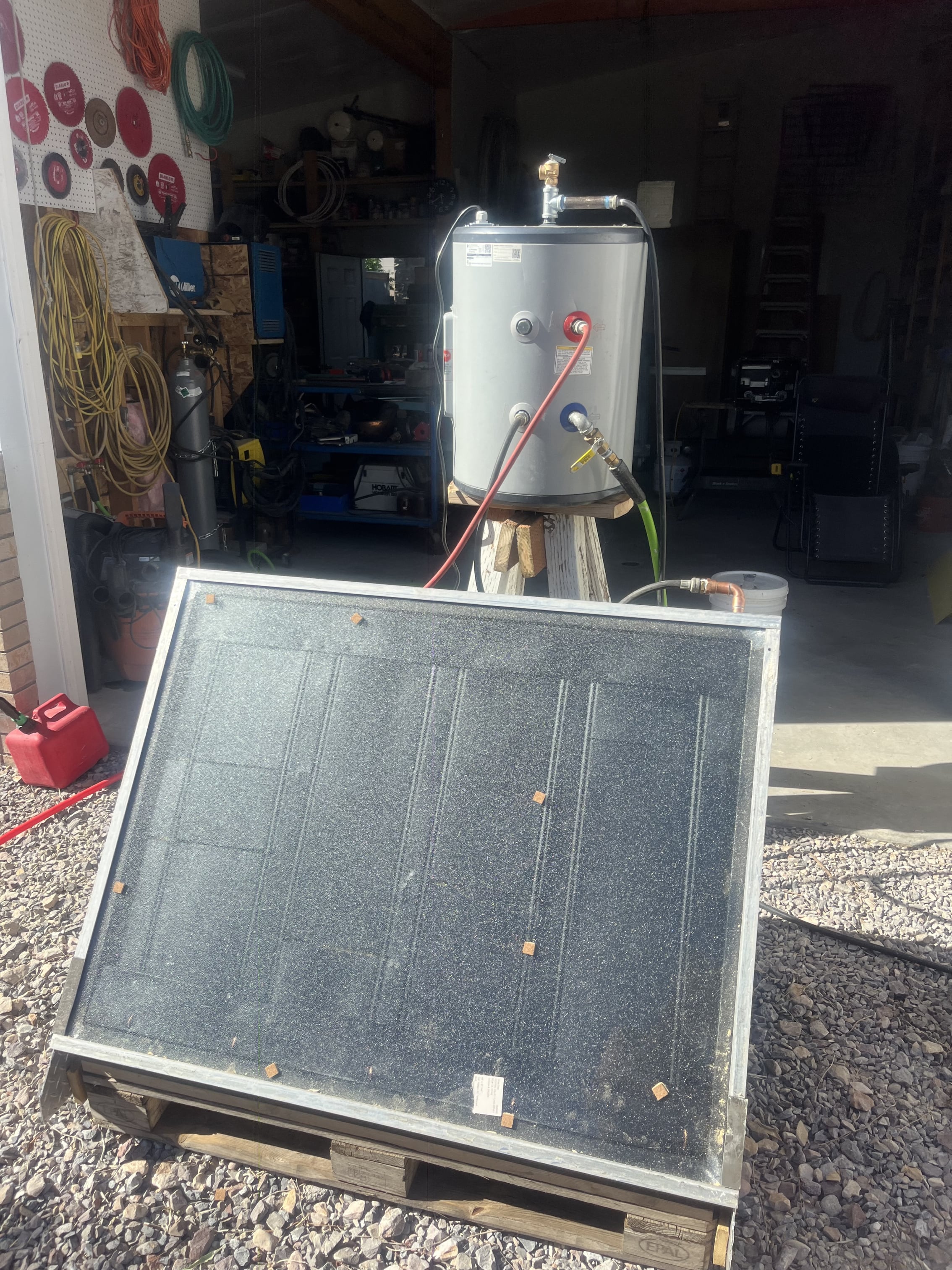
Density .= mass divided by volume that is how solar Thermo siphon systems work,
Here is one I am building currently.It heats 18 gallons from 55- 130 in about 5 hours, 1/2” washer hose for the trial run. 7 square feet of collector
 Bob "hot rod" Rohr
trainer for Caleffi NA
Living the hydronic dream0 -
@DCContrarian said "…… So a difference of 0.06 PSI."
@hot_rod said "isn’t it the density difference that causes the movement?
Density .= mass divided by volume that is how solar Thermo siphon systems work"
Correct. Gravity circulation is basically a thermosiphon.
0 -
@hot_rod : "I'm convinced there is a point of diminishing return. The 8 gpm I used is possible with a typical 87 W circ. Would it be worth using a 200W pump to get a small output increase?"
The amount of heat put out by a radiator is determined by its surface temperature. The average surface temperature is going to be between the input and outlet temperatures of the water, and can never be higher than the inlet temperature. At 8 GPM the delta is only 1.6F, even if you got the delta to virtually zero you'd probably raise the surface temperature of the radiator by less than a degree, and the output of the radiator would hardly change at all.
0 -
I'm thinking the heat output has to do with the surface area of the heat emitter and how well the entire surface is consistently heated.
With a CI radiator, if some of the sections are not being flowed or heated, output would be less. But I found regardless of flow rate or connection orientation, eventually the entire radiator warmed. Maybe some from conduction as much as exact equal flow through each section.
BUT, the faster flows made it happen faster, bottom line in my testing anyway.
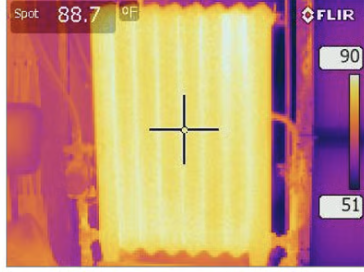
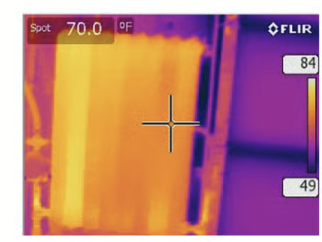
That is why, in addition to ∆ across the radiator I want to "watch" the radiator heat with the IR camera. It clearly shows the entire surface area getting warmed.
It is also possible a 0∆ indicates flow and heat transfer has stopped.
With fin tube a good indicator is AWT not S&R in the section. 180 in 160 out = 170 AWT, use that number in the manufacturers output chart, not the 180 SWT, for actual accurate output
 Bob "hot rod" Rohr
trainer for Caleffi NA
Living the hydronic dream0 -
@hot_rod : "BUT, the faster flows made it happen faster, bottom line in my testing anyway."
I've been thinking about what the theoretical justification would be for having flows be 50% higher in converted gravity systems than in modern systems, and I think you've hit upon it. It's about responsiveness. You want the heat to come on when the thermostat calls and to go off when the thermostat is satisfied.
One of the reasons gravity systems were converted is they were famously unresponsive.
0 -
But, as I've seen, it's way too easy to overdo this.
0 -
What I can't pin down is gpm or flow velocity in the gravity systems. Just because it is gravity driven does't necessarily mean the flow and velocity is super slow.
The stories Dan tell is with tall gravity buildings, the top radiators and floors would get more of the flow and need to be balanced down. So that density difference as well as the weight of the water in taller buildings comes into play.
With a basis two story home, do the calculations change to make it work? Also the temperature difference matters, the density of water at a supply of 180 vs the return at ?? temperature and density. If that ∆ is too wide the final rads don't have as much output. Were the radiators on long horizontals sized larger?
Were the 6th story rads smaller than the first floor. Did pipe sizing matter for the balance?
I suspect not unlike a monoflo piping if changes are made to an original design, removing radiators, reconfiguring piping, it throws off the dynamics?
Were "booster" pump was maybe applied to fix butchered gravity design.
Bob "hot rod" Rohr
trainer for Caleffi NA
Living the hydronic dream0 -
Maybe. I've also seen gravity systems converted to Vapor.
There were several ways to balance gravity piping. One was to make the upper-floor runouts and risers smaller than those feeding the lower floors. Another was to take the upper-floor runout connections from the side of the main, where the water was a bit cooler, and take the ones for the lower floors from the top of the main. I've seen both methods in my travels. The system in my house uses the first method.
0 -
@hot_rod : here's a thought experiment to help visualize the relationship between output and flow.
Imagine you have a radiator that is rated to produce 10,000 BTU/hr when it's provided with 1 GPM of water at 180F in a room that is at 70F. The leaving water temperature is 160F. Further imagine that the average surface temperature of that radiator can be approximated by taking the average of the entering water temperature and the leaving water temperature, and that the heat output of the radiator is directly proportional to the difference between the air temperature and the average surface temperature of the radiator.
What happens if you increase the flow to where the leaving water temperature is 170F? The average temperature is now 175F. The difference between the room and the average temperature is 105F instead of 100F, so the output increases by 5%, to 10,500 BTU/hr. The delta is now 10F, to get 10,500 BTU/hr with a 10F delta the flow needs to be 2.1 GPM. So you've more than doubled the flow but only increased the output by 5%.
Here's a chart of what happens if you take the flow up to ridiculous levels:
In
Out
Average
Output
Delta
Flow
180
170
175
10,500.0
10
2.1
180
175
177.5
10,750.0
5
4.3
180
178
179
10,900.0
2
10.9
180
179
179.5
10,950.0
1
21.9
180
179.5
179.75
10,975.0
0.5
43.9
180
179.9
179.95
10,995.0
0.1
219.9
180
179.99
179.995
10,999.5
0.01
2,199.9
There's drasticly diminishing returns. Even at 2000 GPM you're only seeing slightly less than 10% increase over 1 GPM!
OK, what happens if you slow the flow instead? You get this chart:
In
Out
Average
Output
Delta
Flow
180
160
170
10000
20
1
180
120
150
8000
60
0.27
180
70
125
5500
110
0.1
If you reduce the flow to 0.1 GPM, you reduce the heat output by half. But at that point the outlet of the radiator is at room temperature, reducing the flow even further doesn't reduce the exit temperature or the temperature delta. But it does reduce the heat output, because output is delta times flow.
In
Out
Average
Output
Delta
Flow
180
70
125.0
5500
110
0.1
180
70
97.5
2750
110
0.05
180
70
83.8
1375
110
0.025
180
70
76.9
688
110
0.0125
180
70
73.4
344
110
0.00625
180
70
71.7
172
110
0.003125
180
70
70.9
86
110
0.001563
180
70
70.4
43
110
0.000781
These are microscopic flows, as a practical matter it's impossible to get this level of precision and if you want part-load out of a radiator you're better off putting on a valve that turns it on and off rather than trying to modulate down so low.
Putting all of that in a chart, you get this:
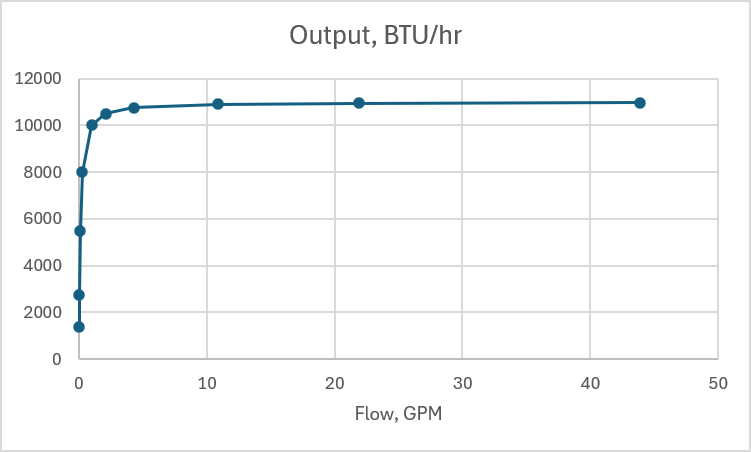
Basically, there's a small area between about 80% to 105% of rated output where the radiator is sensitive to flow. Above that the chart is essentially a horizontal line, and below that it's essentially a vertical line.
0



Categories
- All Categories
- 87.8K THE MAIN WALL
- 3.3K A-C, Heat Pumps & Refrigeration
- 60 Biomass
- 430 Carbon Monoxide Awareness
- 133 Chimneys & Flues
- 2.2K Domestic Hot Water
- 6K Gas Heating
- 124 Geothermal
- 170 Indoor-Air Quality
- 3.9K Oil Heating
- 79 Pipe Deterioration
- 1.1K Plumbing
- 6.7K Radiant Heating
- 397 Solar
- 16.1K Strictly Steam
- 3.5K Thermostats and Controls
- 56 Water Quality
- 51 Industry Classes
- 51 Job Opportunities
- 18 Recall Announcements