Boiler Size and Potential Downsizing

I have a one pipe steam system run by an oil fired WM -SGO7. I did an EDR measurement of my house and came to 336 sq ft(183.25 on the 1st floor and 152.75 on the 2nd floor). If my math is correct, that equates to 80,640 total btus.
My boiler specs sticker shows an IBR capacity of 240,000 btus. I know you don't want to undersize a boiler to the system, but 3 times the necessary size seems crazy. Is my assessment of that correct?
With the price of oil where it is and the fact that my system drinks oil at a substantial rate(1.5-70 nozzle), is it an option for me to replace the main boiler body and jacket to a smaller series rather than replacing the whole boiler? Will I see noticable impacts to my system efficiency and reduced oil consumption being properly sized or would I be spending money/effort for little reward?
Comments
-
"Main boiler body" ?? I think you mean the sectional block. You have two practical choices: 1) Have your oil burner company install the smallest nozzle your particular boiler can safely use and still heat the load. He must be proficient with the Combustion Analyser, pay attention to the key numbers....this is a process. 2) Replace the entire boiler with the proper-sized model.* Removing sections and purchasing a new jacket on a residental boiler like that is not worth it. Mad Dog

 2
2 -
Don't think in terms of BTUh. Think in terms of the EDR. You have measured the EDR or your radiators, now compare that with the EDR rating of the boiler (sometimes shown as square feet of steam — same thing). Conversion into BTUh isn't necessary and gets slightly messy, as their are losses which are hard to figure in going from gross or net BTUh ratings for a boiler to EDR.
Second, you may save a little money with a smaller boiler — but not much.. The amount of fuel you burn is related to the heat loss of the house, not the size of the boiler, within rather broad limits. If you want to reduce your fuel burn, reduce the heat loss of the house. Insulation. Storm windows. Sealing up draughts.
Br. Jamie, osb
Building superintendent/caretaker, 7200 sq. ft. historic house museum with dependencies in New England
 3
3 -
@Brycewvu , there are a lot of other factors that can reduce efficiency, for example, lack of pipe insulation or missing or improper main vents.
Where are you located? We might know someone who can help.
 1
1 -
If the EDR is calculated correctly you then add the piping and PU factor of 1.33 and account for boiler efficiency meaning you correct firing rate for your eDR would be around .9 gallons/hour.
Don't know as suggested above if it can be down fired that much but it probably can be down fired somewhat by a technician that knows what he is doing.
Is it worth replacing the boiler just because it is too large?
No, not unless there are other factors involved. etc. boiler leaking, piping leaking
Sizing a steam boiler correctly is very simple.
Too bad many in the heating business refuse to comply.
1 -
Keeping the heat in the home is definitely the best bet to shorten the total number of cycles per day, however, if the system is too large there may be issues with the number of firings per a single heating cycle, which is inefficient AND will take its toll on the system.
Reviewing the information provided, the NET sq ft value for the SGO-7 is 758 sq. ft. If your calculated EDR is 336 sq ft, that is 2.25 times what is needed. There are a few questions about the system:
- Does the system currently short cycle? How long does it take to produce enough steam to heat the mains and start to heat the radiators? From there, how long are the on-off cycles within a single heating event? This was not mentioned so I wanted to ask if this was occurring.
- What is the cut-out pressure setting on the vaporstat / pressuretrol? The boiler should cut-out 2 psi max.
- Are any of the main or radiator vents hissing or clogged?
- Are the header(s), mains and risers insulated?
If the system is not short cycling, and the vents are in working order and vent quickly / efficiently, it may be worthwhile to review the radiator EDR values. The additional +300 sq ft is being used somewhere.
As for keeping the heat in the home, that is something that most of us are constantly trying to maintain.
0 -
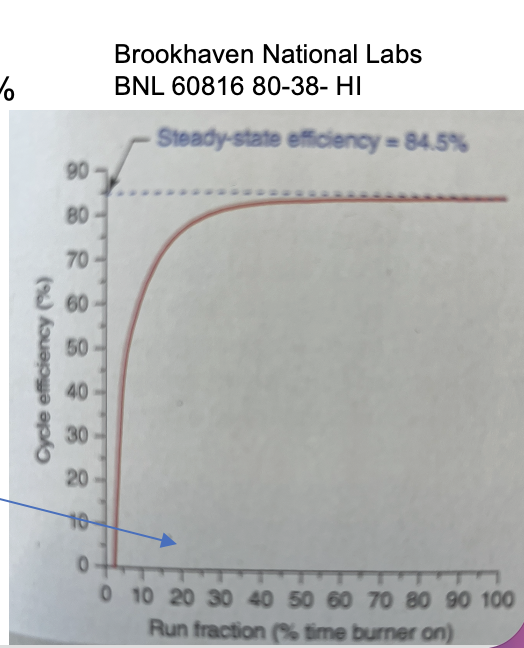
If you time the cycles, how long it runs after firing, then how long it is off before the next run. Then you calculate the Run Fraction.
Suppose an oversized boiler runs just 5 minutes, then shuts down for 20 minutes.5 ÷ (5+20)= .2 or 20%
Enter the bottom of this graph at 20%, run up to the curve to get actual efficiency, running in the 70% range at that Run Fraction, quite a bit less than what a steady state condition would be, at the 84- 85% range
 Bob "hot rod" Rohr
trainer for Caleffi NA
Living the hydronic dream0


Categories
- All Categories
- 87.8K THE MAIN WALL
- 3.3K A-C, Heat Pumps & Refrigeration
- 60 Biomass
- 430 Carbon Monoxide Awareness
- 133 Chimneys & Flues
- 2.2K Domestic Hot Water
- 6K Gas Heating
- 124 Geothermal
- 170 Indoor-Air Quality
- 3.9K Oil Heating
- 79 Pipe Deterioration
- 1.1K Plumbing
- 6.7K Radiant Heating
- 397 Solar
- 16.1K Strictly Steam
- 3.5K Thermostats and Controls
- 56 Water Quality
- 51 Industry Classes
- 51 Job Opportunities
- 18 Recall Announcements