New Boiler & EDR Calculations

Hello. At this time I am planning to replace my old, oil-fired steam boiler with a new gas-fired steam boiler from U.S. Boiler Company. My home was built in the 1930s to '40s and has (8) Burnham tube-type radiators and (1) column-type Fero. The current boiler is oversized so using the sq ft rating from the old unit is not possible. Looking towards getting the correct size boiler, there is a need to calculate the EDR for the home. The Burnham tube radiators range from 4 tubes to 5 tubes and are 19"to 26" in height. Of these, (7) of them have 1-1/2" section spacing and a newer, replacement radiator has 1-3/4". The FERO is a 3-column type that is 31" in height with 2-1/2" section spacing.
Going through the numbers, I am getting around 280 sq. ft. for EDR (rounded-up). The contractor who quoted the installation of the new boiler got around 380 sq. ft. for the EDR. Based on the numbers, I believe the U.S. Boiler Company SteamMax 125 is the right choice and the contractor is insistent on the SteamMax 150. 🤔 The header, mains and risers (where visible) are covered with 1/2 thick fiberglass pipe insulation so I feel the NET values are OK to use with the 1.33 pick-up and a 1.5 value is not needed.
Having lived with an oversized boiler for too long (only now have the $$ for a replacement), I want to make sure that I am not going to live through the same short cycling of a new boiler producing steam faster than the system can handle and turning on and off every 2 to 5 minutes. 😞
Here are the radiator types and sizes that are in my home. I would like to ask if someone can confirm the best charts to use and what would be the best EDR value to use. Bear in mind that the end result I am looking for is to have the right sized boiler based on the EDR needed, not whether or not one calculation is right and another is wrong. 🙂
Rad | Manuf | #-Type | Section Spcng | Height (Flr-Top) | Num of Sections |
|---|---|---|---|---|---|
1 | Burnham | 4-Tube | 1-1/2" | 25" | 14 |
2 | Burnham | 4-Tube | 1-1/2" | 25" | 24 |
3 | Burnham | 5-Tube | 1-1/2" | 20" | 10 |
4 | Burnham | 5-Tube | 1-1/2" | 20" | 14 |
5 | Burnham | 5-Tube | 1-1/2" | 20" | 20 |
6 | Burnham | 5-Tube | 1-1/2" | 26" | 12 |
7 | Burnham | 5-Tube | 1-1/2" | 26" | 24 |
8 | Burnham | 4-Tube | 1-3/4" | 19" | 12 |
9 | FERO | 3-Column | 2-1/2" | 32" | 8 |
Comments
-
I'm getting 295.3 square feet from your chart, so the 125 should be fine. But- are your steam pipes insulated, and do you have proper main vents?
0 -
The header, mains and risers, where visible, are insulated. The mains are well vented by Gorton Air Eliminators following a calculation of the air within the main piping and sizing at 1oz of steam pressure.
0 -
-
I used the Burnham boiler sizing guide and got 411.
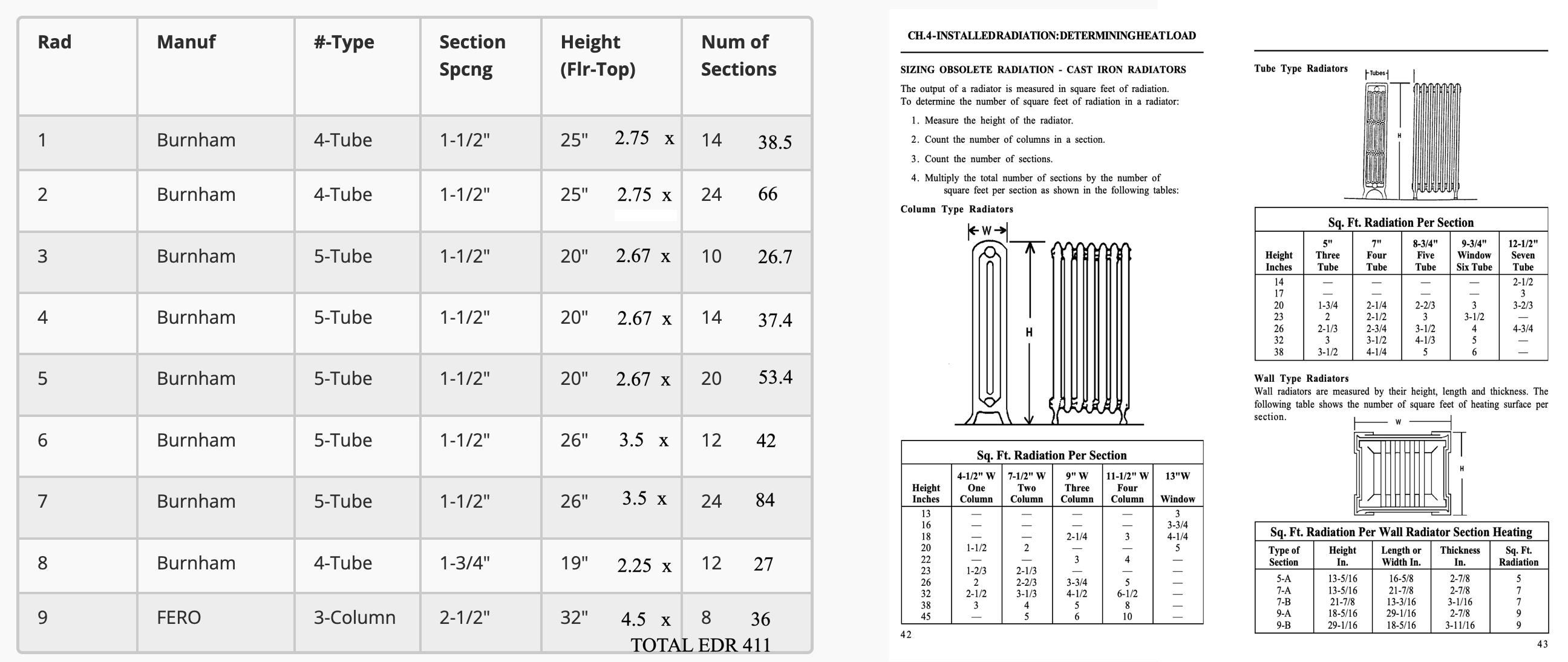
But that book does not have the thin tube listings. I use to use the Weil McLain sizing guide and that listed both the standard tube and the thin tube with dimensions of the sections. Do your 4 tube width sections measure 7" and 5 tube width measure 8-3/4" Like the attached chart? If they are smaller then you may have thin tube and this calculation is not for you.
Edward Young Retired
After you make that expensive repair and you still have the same problem, What will you check next?
0 -
Thank you EdTheHeaterMan for your comments and detail.
I believe that the radiators in my home are the much older, slenderized Burnham radiators. The widths are as follows:
Burnham 4-Tube, 1-1/2" spacing, are about 4-7/16" wide
Burnham 5-Tube, 1-1/2" spacing, are about 5-5/8" wide
Burnham 4-Tube, 1-3/4" spacing is 4-7/16" (new, replacement slenderized)
Fero 3-Column / Tube, 2-1/2" spacing is about 5-1/4" wide
The Burnham Heating Helper is a great resource, but the sizing of the radiators in this reference do not match the sizing of those in my home. I believe that the contractor used the Heating Helper for his original calculation.
0 -
With that additional information and some other steam rating tables to match your dimensions. I was able to get a more accurate EDR of 318. So the Burnham Steam max 125 is spot on!
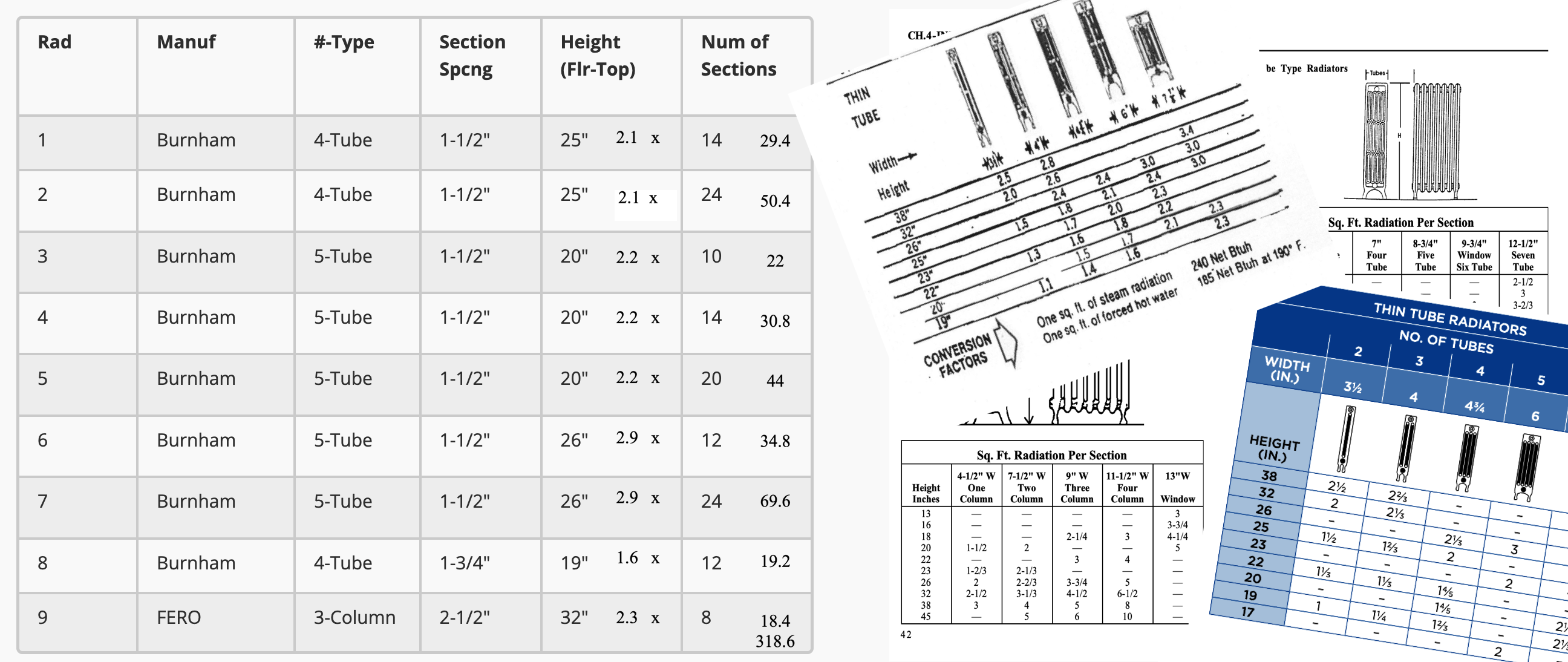
Edward Young Retired
After you make that expensive repair and you still have the same problem, What will you check next?
 1
1 -
Thank you everyone for your posts and for running the EDR calculations. Below are the numbers I was using based on data from US Boiler Company / Burnham as well as the E.D.R. book from Dan Holohan. Both were very helpful and matched my radiators exactly (at least that is what I thought). For the link, click on the Product Data sheet and go to the last page of the brochure. For radiator #8, this is a brand new, replacement Burnham so I am able to use the number right off the page. For those who are interested, the section EDR is 1.6. Using the E.D.R. book, the Burnham pages are about 2/3 of the way and state "Circa 1939". Thank you Dan Holohan!!!!!
Rad
Manuf
#-Type
Section
Spcng
Height
Num
Section
Section
EDR
Rad
EDR
1
B
4-Tube
1-1/2"
25"
14
1.8
25.2
2
B
4-Tube
1-1/2"
25"
24
1.8
43.2
3
B
5-Tube
1-1/2"
20"
10
1.8
18.0
4
B
5-Tube
1-1/2"
20"
14
1.8
25.2
5
B
5-Tube
1-1/2"
20"
20
1.8
36.0
6
B
5-Tube
1-1/2"
26"
12
2.4
28.8
7
B
5-Tube
1-1/2"
26"
24
2.4
57.6
8
B
4-Tube
1-3/4"
19"
12
-
19.2
9
F
3-Col
2-1/2"
32"
8
3.0
24.0
Total
277.2
B = Burnham
F = Fero
The low section rating is due to the size of these slenderized radiators and the small section spacing. These are quite compact and I found it difficult to find charts that have a 1-1/2" spacing.
Thank you all again and I appreciate all of you knowledge and expertise.
OldSteamy
0 -
My pleasure!
Retired and loving it.0 -
Seems your contractor should not refute these calculations when laid in front of him.
0 -
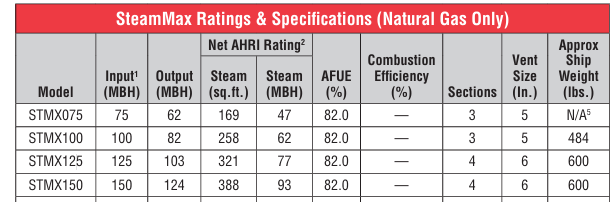
If it had to be a Burnham I'd be going with the STMX100 honestly.
You have 277sqft, so enough radiation to consume 66,480 btu/h. The STMX100 produces 82,000 btu/h output. That's more than 20% over what you need in a perfect world. That's plenty of safety margin and quite a bit more than my own system has.
The 125 is still oversized and it'll be a mistake.
The 150 is ridiculous.
Single pipe 392sqft system with an EG-40 rated for 325sqft and it's silent and balanced at all times.

 3
3 -
I happen to agree with @ChrisJ on this one , but ONLY if you are confident that your numbers are actually 277.2.
You may need to add more insulation to the pipes that are currently uninsulated and cover the fittings with fiberglass insulation as well. So many times I see insulated pipes with the fittings left bare. Even with a really terrible, amateur-looking insulation job, you are still better off having those fittings covered with fiberglass and duct tape than having bare metal exposed.
Whatever you do... DON'T USE THE 150!!!
Edward Young Retired
After you make that expensive repair and you still have the same problem, What will you check next?
1 -
Strongly agree with @ChrisJ the STMX100 still gives you 23% pickup factor. In your case that would be enough to support about 102 FEET of uninsulated 2" main. That boiler will run beautifully on your system.
The 150 is literal insanity and for me shows the incompetence of the contractor. The numbers don't lie.
 2
2 -
I left most of my fittings bare after buying insulation / covers for them.
Primary reason was I was lazy and didn't feel like doing all of them.
Secondary reason became I wanted some heat in those areas, but the fittings don't really dissipate much.
Single pipe 392sqft system with an EG-40 rated for 325sqft and it's silent and balanced at all times.
1 -
Thank you all for your comments and recommendations. With regard to the calculations, I am confident they are close to the correct value of 277 to 300 sq ft. As for the contractor, I actually wrote a 14 page report, showing all of the numbers and referencing the two sources. In addition, there was a page for each radiator with multiple pictures showing the Burnham and Fero markings, the height, section spacing and # of sections. I was thanked for my report and told that they were confident that their numbers were correct. I am not using that contractor at this time.
For my basement, no I did not insulate the elbow and T fittings. The basement has no heat other than the running boiler and the fittings. My home is relatively small, and with the proper venting, the mains heat quickly. However, that is with the current 465 sq ft boiler (NET). This may change as I go to the smaller sized boiler, but I plan to stick with the NET value for sizing as I am purposefully not insulating all of the main and riser piping.
However, based on all of the suggestions, I will certainly run this by my new contractor. Also, we are currently going with the 63-03 Peerless boiler. Based on the recommendations here, we will also look at the 63-03L.
My take away from this experience is to stick to the numbers and let the facts tell the story. If the contractor does not listen, find another one. I tried working with the initial contractor to the point of doing the work for them and was thanked for my effort and told they were sticking with their original recommendation based on many years of experience.
Thank you all for your knowledge and recommendations. It is comforting to know that all of you are out there!
OldSteamy
3 -
Now to the next step
Make sure the installing contractor follows the installation instructions!
TT8139-REV0_63-x-Gas-Steam-Boilers-Piping-Kit-Instructions.pdf
2 -
I have worked with the new contractor before and I feel they are quite meticulous with regard to the work they perform. I had wanted to try a contractor that was closer to where I live and that simply didnot work out. Lesson learned.
0 -
I admire all the work and research you did. Too bad the local contractor didn’t feel the same way. He could have learned a thing or two.
8.33 lbs./gal. x 60 min./hr. x 20°ΔT = 10,000 BTU's/hour
Two btu per sq ft for degree difference for a slab1 -
A lot of contractors are like " I have been doing this for 40 years"
I had a co-worker like that. His favorite saying is "I have been doing it this way for 17 years"
Yup, still doing it wrong.
2




Categories
- All Categories
- 87.8K THE MAIN WALL
- 3.3K A-C, Heat Pumps & Refrigeration
- 60 Biomass
- 430 Carbon Monoxide Awareness
- 133 Chimneys & Flues
- 2.2K Domestic Hot Water
- 6K Gas Heating
- 124 Geothermal
- 170 Indoor-Air Quality
- 3.9K Oil Heating
- 79 Pipe Deterioration
- 1.1K Plumbing
- 6.7K Radiant Heating
- 397 Solar
- 16.1K Strictly Steam
- 3.5K Thermostats and Controls
- 56 Water Quality
- 51 Industry Classes
- 51 Job Opportunities
- 18 Recall Announcements