Help finding contractor for boiler replacement in Midcoast Maine

Hello,
I am located in Midcoast Maine and have a tired 300k BTU Utica oil boiler that is on its last legs, and needs replacing. I was unable to find a contractor in the search for my area. The boiler sections themselves have been patched a few times by the service company so this is somewhat time sensitive. The EDR of the system is just over 700. The system is a mostly original Moline vapor-vaccum architecture, with retrofitted non-adjustable supply shutoff valves, and a Hoffman 76 main vent that I installed to replace another plugged non-original. I need a recommendation for someone who is willing to come 2 hours north of Portland to plan a replacement, as even my local service company who wants to sell me a boiler was unable to diagnose an overfull boiler, or a main vent that was stuck shut.
Comments
-
Difficult.
But to start with, that boiler is roughly twice as big as your system needs, assuming that your EDR number is correct…
And is probably running at much too high a pressure — 8 OUNCES is the maximum it should ever run.
OK. Got that out of the way.
If you can locate a really good plumber — not HVAC service company, probably — who is willing to thread pipe and read directions, we can probably help you and them with figuring out what boiler would suit for the application and get it installed properly. Finding someone who will travel to your area (this is the coast? Down toward Rockland maybe?) is going to be really hard… but it isn't rocket science, just good craftsmanship.
Br. Jamie, osb
Building superintendent/caretaker, 7200 sq. ft. historic house museum with dependencies in New England1 -
The Boiler is definitely a bit oversized, but referencing most of the boiler spec sheets, it seems like I am looking for something in the 260-285 MBH range, and since my local service company stocks Burnham parts and the MegaSteam is well respected, I was thinking that meant the MST758 would be appropriate, however I did end up shutting 1 or 2 radiators totaling 80 or so sq ft of EDR, so perhaps I can get a way with the MST629. I may be wrong though! I am no stranger to DIY, but have no experience threading and fitting iron pipes of these sizes, and have no experience with getting an 800lb boiler down bulkhead stairs safely. The system was previously short cycling at the 3lb cutoff when I bought the place due to a plugged main vent, but now, after replacing the main, the system runs at a few oz of pressure (impossible to tell precisely until I install my new 5PSI gauge) and I have yet to see the main vent get warm enough to close, and the rads all heat up very quickly. The main vent not having to close even bringing the temps up 5 or 6 degrees over 30-40 mins leads me to believe the boiler is likely not GROSSLY oversized, math aside. Once the system begins to cool, the hoffman 76 closes and holds vaccum properly, after fixing a few small leaks around rad valves I observed when the system went into vaccum.
0 -
If I were you, I'd pay Ryan from New England Steamworks to take a ride up from R.I., size and design it for you. You will then take bids. Mad Dog

 2
2 -
I actually tried to call and leave him a message earlier, and I got an AI voice assistant who told me that they do not service my area and that they can't help me. I suppose I could call back and brute force till it lets me leave a message 😆. Taking bids is a fine concept, finding reputable installers who actually know steam in my area is the challenge.
1 -
Not just your area!
0 -
Keep trying @New England SteamWorks - hopefully he will see this.
0 -
@Jamie Hall said: "But to start with, that boiler is roughly twice as big as your system needs, assuming that your EDR number is correct…"
Maybe not twice the size, but it’s likely somewhat oversized. I checked a couple of modern steam boilers, and a unit with about 250,000 BTU input is typically rated for around 646 square feet of steam (AHRI Net). The next size up is usually in the 280,000–300,000 BTU input range and is commonly rated for over 750 square feet of steam.
Whoever installed your 300,000 BTU Utica boiler may have seen that the smaller boiler didn’t quite meet the ~700 sq ft of installed EDR and decided to go up one size. That’s a common decision-making approach, and it’s likely how you ended up with the larger boiler.
However, it’s important to remember that the AHRI Net steam rating already includes a built-in pickup factor (typically 1.33) to account for piping losses and system inefficiencies. Because of that, you generally don’t need to “round up” as aggressively as people often think.
In most cases, it’s better to select the boiler whose AHRI Net rating most closely matches the installed EDR—even if it’s slightly under, assuming the piping is insulated and the system is reasonably tight. If you can, then insulate the near boiler piping and as much of the main piping as you can and end up with a lower operating cost.
For example, if you’re choosing between a boiler rated at 665 sq ft AHRI Net and one rated at 771 sq ft, and your installed EDR is around 700 sq ft, the 665 model is often the better choice. It will typically run longer, more efficient cycles and produce drier steam.
On the other hand, if your installed EDR is closer to 750 sq ft—or if you have significant piping losses (uninsulated mains, long runs, etc.)—then stepping up to the larger boiler would be more appropriate.
I hope you have good luck in finding a steam head in Maine. I was there one winter to pick up this Depot Hack hand made body for my 1923 Ford T. It was from a town called Cape Neddick.
Edward Young Retired
After you make that expensive repair and you still have the same problem, What will you check next?
 2
2 -
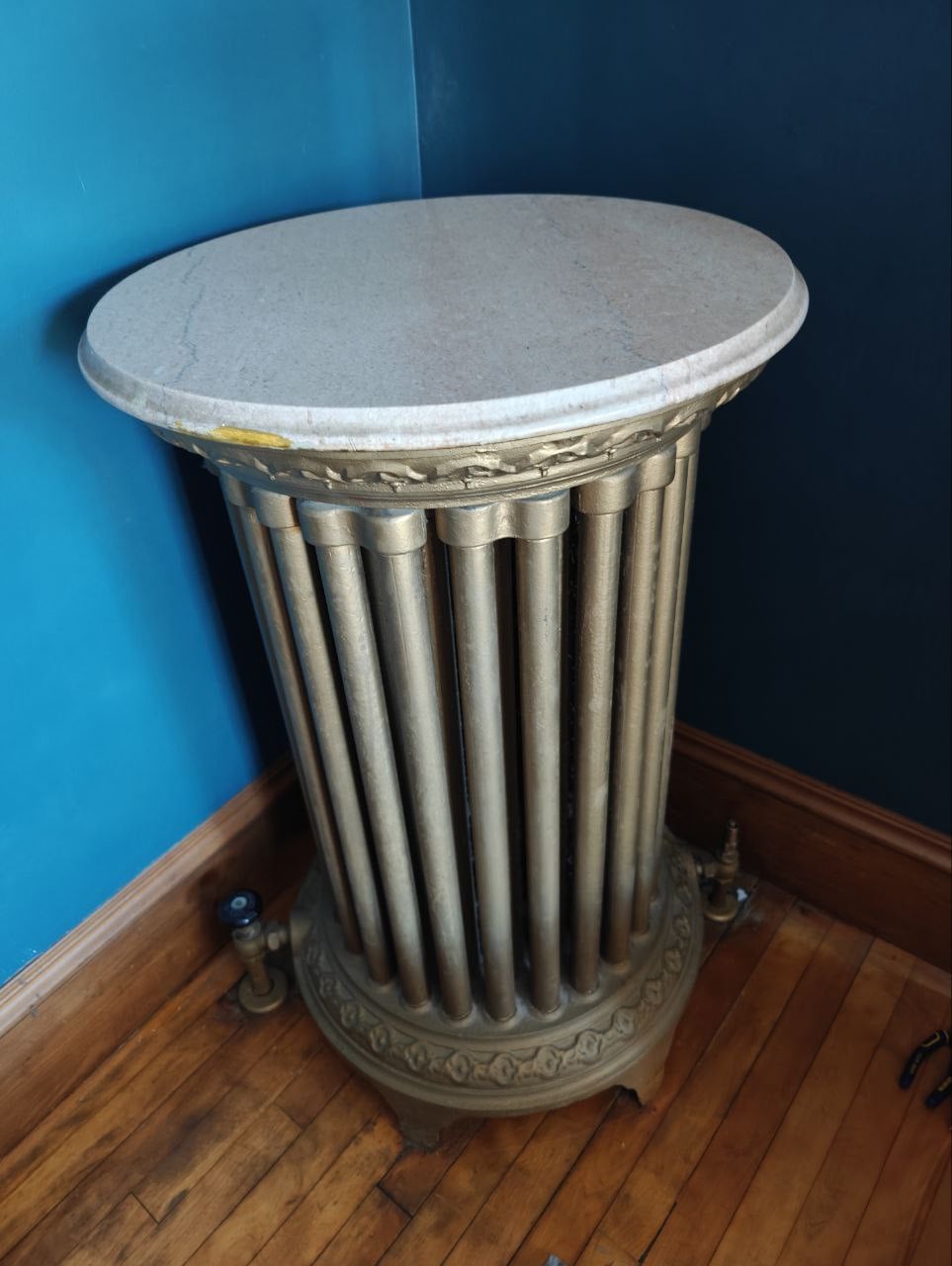
Thanks ED! The house is aprox 4000 sq feet/3 stories, and all steam piping is insulated in the basement, but the risers past the basement are all uninsulated. In many cases this is for aesthetic reasons, since on the first floor they are all painted and designed to blend in with the living space (all outside the walls) but on the 2nd and 3rd floors there are a few places where we could pick up a little insulation where runs are in closets. This beauty alone I estimated to be about 120 sq feet (there are 2 rows behind the first one):

 3
3 -
Uninsulated steam pipes in the living space does not count as lost BTUs in the piping and pickup calculations. That "Lost Heat" from those pipes is actually heating the space you are intending to heat so it's not really lost at all. The fact that all your basement pipes are insulated is a reason to select the smaller boiler when the times comes. Just have the professional double check your EDR numbers to see how far off they are. If they are really far off, then you may need a second opinion. If within 10% then you did a good job with your calculation.
Edward Young Retired
After you make that expensive repair and you still have the same problem, What will you check next?
0 -
That's a beauty! I think it might be a Nason. Is there a name on it?
We have ratings on a lot of very old radiators on the site. The Nason and other similar radiators are here:
Click on the PDF link and scroll to page 2, the Nason circular radiators are there.
0 -
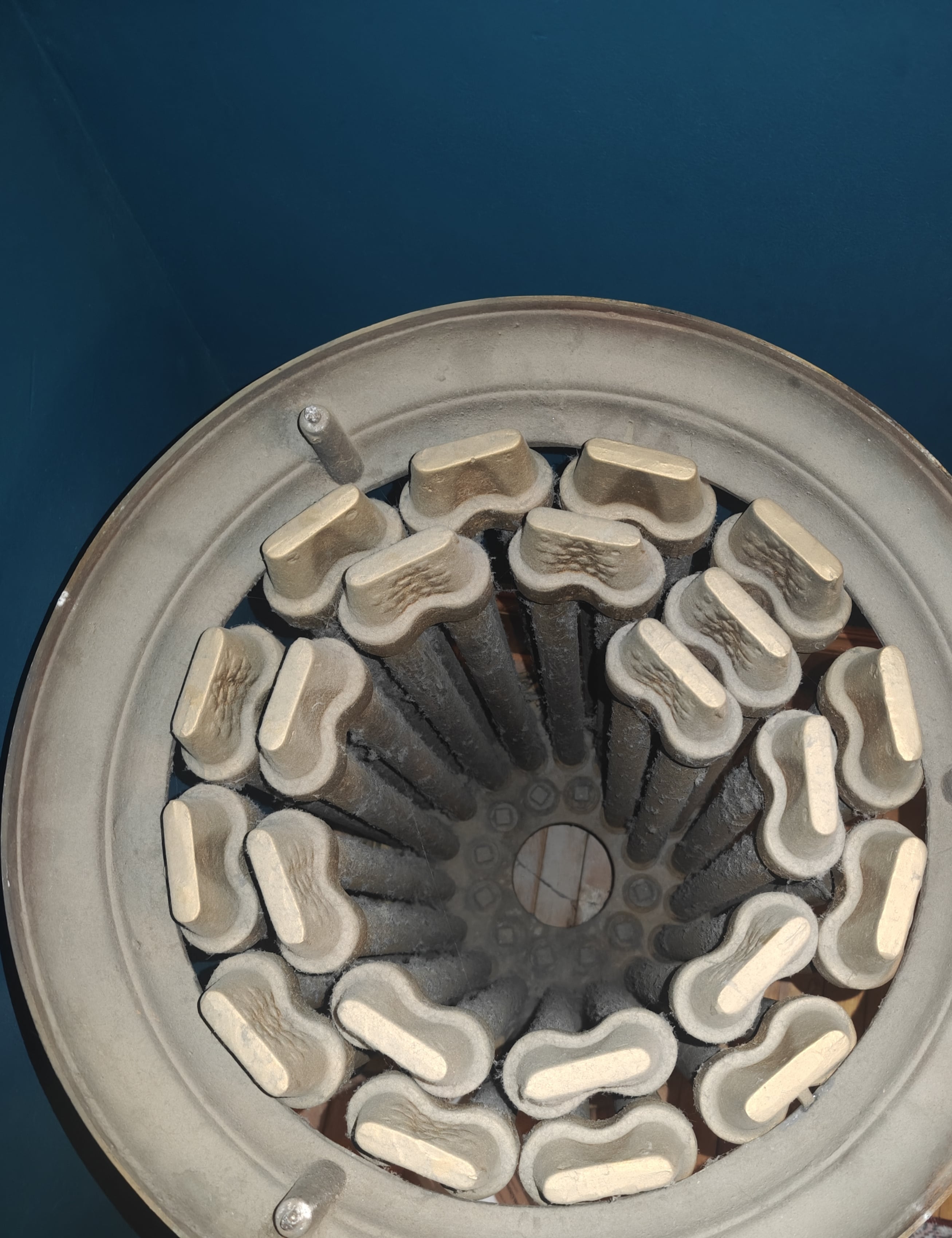
I can't find a name. It looks like its 40 tubes, 1.5in OD, 27 inches long. The surface area is something like 18 square feet of pipe OD so maybe I was way off
 1
1 -
If the overall height of the radiator is roughly 3 feet, each tube is 1 square foot.
AFAIK Nason did not put their name on their radiators. Bundy did, not sure about Gold and Reed.
Are all your radiators of that general type of construction?
0 -
No. The rest are a mostly column style from american radiator CO, and a few tube style. Below is a copy of my notes, based on rough edr per section (from https://www.comfort-calc.com/Steam_Sizing_Radiators.cfm) x number of sections, which comes to 600 without the round guy. So assuming the rest is close maybe its more like 630-640
5x12 = 60
5x8 = 40
3x16 = 48
Whatever the round one is
4x12 = 48
4x7 = 28
5x15 = 75
4x13 = 52
4x6 = 24
4x8 = 32
2.5x9 = 23
4x9 = 36
2.6x17 = 44
2x22 = 44
2.7x16 = 44
0 -
Maybe the trick would be to get someone on this forum to look at the job and select a boiler and write up a package that contractors can bid to.
It takes the guess work out of it for the contractor. Any decent plumber or pipefitter can install a boiler with a drawing and a spec……you would think
We see horror stories on here from people who refuse to open or read a boiler manual.
1 -
Exactly Ed. We do this often for long distance situations. Mad Dog
 1
1 -
-
My research has led me to desire a megasteam. Assuming this isn't too limiting of a constraint, what is needed for someone to bid? On my list I had:
1. Determine boiler size (some of that discussion above)
2. Decide if buying vendor near boiler piping
3. Specify that I want DHW coil
4. I will separately purchase my own low pressure gagues and vaporstat
5. Determine alterations to existing chimney venting since the geometry will change from existing.
6. Do asbestos testing on a few places that have fuzzy bits near the dry return, and if present get that fully removed before installation.
Am I missing anything major?
1 -
Get this book:
This will remove any doubt as to your radiator ratings. If you have something that isn't in there (such as American Corto rads with 2-inch section spacing; we've found a LOT more charts since @DanHolohan published this book) ask us, we probably have it somewhere on the site.
That round rad, by looking at the chart above, works out to 46 square feet.0 -
I will consider getting the book, I have a few others of Dan's.
Either way, it's looking like the MST629 is likely the right choice out of their product line here, that one radiator being exactly 30 vs 40 vs 46 square feet isn't going to change where it fits in the range.
0 -
I am speaking as a homeowner that has had terrible experiences with chinese made digital boiler controls and gauges.
I am willing to tell you that Marsh Instruments gauges are of high quality and made in American, They have a good warrantee length and they offer a gauge rebuilding service. Thier guages are available nation wide through thier distributor network.
I have used the Bell & Gossett RB-122-E low water cut off switch in my hot water coal stoker boiler for 10 years now with no problems.
I can strongly recommend the RB-122-E Low Water Cut Off Switch as a homeowner due to the fact that these excellent low water cut off switches have a spinning cleaning scraper that is used to keep the sensor free of any buildup.
Bell and Gossett recommends that two of these LWCO switches be plumbed as the first electric boiler controls prior to the triple aquastat that submerged in the water in which you will have with a domestic hot water coil.
The second low water cut off acts as a fail safe in case the first one does not detect a low water condition.
One of the distributors of Marsh Instrument gauges in the State of Maine is
Rausch Instrument
41 Bridge Street, Belfast, Maine 04915
1-207-338-3880
0 -
Thank you for the info, I will look into that gear. I have already purchased a beautiful Dwyer 2203 for this build, and may add a second one for reading vaccum just because.
0 -
Like @EdTheHeaterMan said you can undersize the boiler a fair bit with 2 pipe as long as it covers the heat loss. The oil burner might be underfired some.
0 -
OOOOHHHHH!!! I bet the old steamer was a coal fired vacuum boiler.
0 -
Its a moline system that wouls have been installed some time between 1890-1910, and there are a few physical signs of some sort of previous coal installation
0


Categories
- All Categories
- 87.8K THE MAIN WALL
- 3.3K A-C, Heat Pumps & Refrigeration
- 59 Biomass
- 430 Carbon Monoxide Awareness
- 132 Chimneys & Flues
- 2.2K Domestic Hot Water
- 6K Gas Heating
- 124 Geothermal
- 170 Indoor-Air Quality
- 3.8K Oil Heating
- 79 Pipe Deterioration
- 1.1K Plumbing
- 6.7K Radiant Heating
- 396 Solar
- 16.1K Strictly Steam
- 3.5K Thermostats and Controls
- 56 Water Quality
- 51 Industry Classes
- 51 Job Opportunities
- 18 Recall Announcements