Replacing 30 year old Oil Boiler

Looking to get some advice one replacing an old oil fire boiler. I live in an old farmhouse in very northern NY. The house is well insulated for its age, having an energy audit done and sealed fairly well. I initially wanted to get a combi unit but one of the two companies techs that came to look at the setup said that they do not work well for standard baseboard heaters and only really work well for radiant floor setups. Is this true? Below are the two main items on the quote, I like to do research of my own on major items but could not find anything.
Installation of a Cast Iron LP-Gas Chimney Vent Boiler and a 50 gallon Purepro Stainless Steel indirect domestic water heater
Recommended boiler: PurePro Advantage series 117K BTU
Comments
-
Mod cons and combi's are fine but you need someone who knows how to service them.
Standard boilers need service too but are more forgiving.
You can use combi's and mod cons for baseboard heaters but the efficiency will change.
Lets say a standard CI boiler like you were quoted is 84% efficiency.
A mod con or combi used for a snow melt system or radiant floor heat (low temp system) will be say 95%
a mod con or combi used on baseboard will be around 89%
This is because condensing boiler's can't condense at higher boiler water temps. They still modulate and save fuel though.
But we always say the installer is more important than the boiler.
Combis are more $$$ , and don't last as long and need more service (specialized service)
CI boilers are less expensive, easier to find service and last longer but lower efficiency.
 1
1 -
If the energy audit includes a heat load calculation that would give you some useful info.
Next step is to measure how many feet of fin tube
Times 550 btu/ ft. See how it matches the heatload number
In some cases the boiler can run much lower than 180 f.. The lower the operating temperature the more efficient the boiler will operate
With outdoor reset control , much of the season a mod con will modulate down to a lower firing rate. This saves fuel $$ and increases comfort with less boiler cycles.
Plenty of homeowners learn how to service and clean their mid con boilers.
Bob "hot rod" Rohr
trainer for Caleffi NA
Living the hydronic dream1 -
let's clarify that you have fin tube baseboard emitters?
0 -
@jrunks1221 , what boiler do you have now?
0 -
I have water baseboard fin tube heater runs. I have 5 zones, 1 is for the domestic hot water. Zone 1 - 20ft, Zone 2 - 50ft, Zone 3 - 50ft, Zone 80ft All together I have around 200 feet of baseboard fin tube. What's written on my current boiler is below:
Weil-McLain Gold Oil
model - P-WGO-4
Series - 3
Input LT Oil gph 1.2
Htg. Cap.(water), Btu/h 145,000
Water, btu/hr 126,000
MAWP, Water 50 PS1
Max Water Temp 250
Min. Relief Valve Cap 145 LB/HR0 -
Why convert to LP?
Compaire the cost per BTU
0 -
Keep it. If it's working OK, it's just fine — but no harm to starting a find for a new one.
It's about the right size — maybe a bit bigger than it needs to be.
Br. Jamie, osb
Building superintendent/caretaker, 7200 sq. ft. historic house museum with dependencies in New England 1
1 -
It could be a knee-jerk reaction to the current price of oil which is really high. But in the 30 years I owned my home and my commercial building, the oil costs at home were a lot cheaper than my commercial building on NG. Propane in CT is even more expensive than street gas.
I expect the cost of heating oil will be below $3 by fall.
1 -
I agree. That's a good boiler. if it's a bit oversized, it's possible to reduce the firing rate slightly to compensate. This should, however, only be done by someone with a digital combustion analyzer and the know-how to do it right.
And, what @pecmsg said. LP generally costs considerably more per BTU than oil. If you switch you likely won't see any savings.


 4
4 -
Another concern is with 5 zones a buffer tank may be needed.
 1
1 -
@jrunks1221 I like the boiler and water heater choices you mentioned in your original post, provided they are properly sized for your home.
Did the installer measure your home and do a heat loss calculation to size the new unit to fit your home's needs [ properly ]? If not, have that done. Choose your installer wisely. If they do a heat loss calculation, that's a good start.
0 -
We recently purchased the house, the concern is when the boiler fires on, the entire house shakes and we are a family of 4 and cannot all take showers in a single day without the hot water running out, the initial thought for the combi since I had one in my previous house. The installer did not do a heat loss calculation, but the previous owners had an energy audit done around 5 years ago and spray foamed all over. The reason to move to LP from oil is that I am having a backup generator installed and want to use one source of gas for everything, the boiler, our fireplace and the generator.
0 -
How are you making your domestic hot water now? You present boiler would be happy to make domestic hot water through an indirect water heater. You'll like not every run out of hot water and you'll save on fuel, if you're making hot water with an "tankless" water heater causing the boiler to maintain a relatively high temperature.
Miss Hall's School service mechanic, greenhouse teacher, dog walker and designated driver
0 -
There is a 27-gallon tank next to the boiler, noy sure if it's a indirect water heater or what.
0 -
you might just replace the indirect with one sized for your load. it may take a big tank to support that if you are all showering within close proximity. you may have a thermostatic valve that is stuck too.
the house shaking seems like an issue with the burner not being set up right.
a mod con would do better with the many small zones than a ci boiler.
a combi might not be able to make enough hot water depending on your use and the incoming water temp in the winter. municipal supplies can be just above freezing in some systems at some times of year. you may need a big indirect with either a combi or a ci boiler. you need to design the dhw part carefully to make sure you can cover your load.
 1
1 -
The idea of having only one fuel source can make sense—but only if that fuel source is affordable.
You can convert nearly everything in your home to run on electricity. It’s already available, and it can power a wide range of systems. Fireplaces can be replaced with electric units that simulate a flame and provide heat. Cooking, space heating with an electric boiler, and even clothes drying can all be done with electricity. In theory, reducing your home to a single energy source sounds simple and efficient.
However, there’s a major drawback: electricity is typically one of the most expensive ways to produce heat. You may eliminate a $1,000 fuel oil bill, only to find that heating the same space with electricity costs $3,000. That makes it a poor financial decision—especially if you’ve invested five figures in a new electric heating system that ends up costing significantly more to operate over the next 10 to 30 years.
Applying the same logic to LP gas, switching from an existing oil system may not make financial sense either. In many areas, the delivered cost of propane per gallon is equal to—or higher than—the cost of fuel oil. At the same time, propane contains less energy per gallon.
- #2 heating oil: ~138,500–140,000 BTU per gallon
- LP gas (propane): ~91,500 BTU per gallon
So even if the price per gallon is similar, you are getting fewer BTUs per dollar with propane.
As a rough comparison, if fuel oil costs $3.50 per gallon, propane would need to be priced at under about $2.50 per gallon to provide a similar cost per unit of heat, even when accounting for differences in equipment efficiency. Call a few local LP gas companies to find out how much LP is per gallon when you use it fro a generator, fireplace, clothes dryer, cooking, heating and hot water. that should get you their lowest price since you will be a frequent buyer. I bet you it is still going to be higher that your #2 heating oil.
The bottom line: before switching fuel sources, it’s critical to compare both the installation cost and the long-term operating cost. In many cases, keeping a properly functioning oil system may be the more economical choice.
The noisy startup on your oil burner is an easy fix for someone that understands oil burners. Your burner needs a good tune up and it may even use less fuel that you are currently using after proper maintenance. You just need to find the right oil burner tech.
Edward Young Retired
After you make that expensive repair and you still have the same problem, What will you check next?
0 -
You can down fire the WGO-4 to the WGO-3 firing rate. The 3 section actually has a higher water volume than the 4 section. 14.9 gallons in the 3 section vs 13.4 gallons in the 4 section.
Output on 80 ft of fin tube is only about 44K BTU's. If it provided comfy heat this past winter, then you got enough. As long as the aquastat wasn't set to 210°.
0 -
I am very familliar with the Weil McLain P-WGO-4. that means that you DO NOT have a tankless water heater inside the boiler so the tank next to the heater is an indirect.
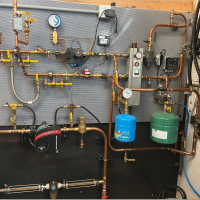
27 Gallons is an odd size tank. I have a feeling that you have a 30 gallon indirect that has 27 potable water capacity with a heat exchanger that holds about 3 gallons of water. Total 30. Can you post a photo of your boiler and your water tank so we can help you better understand your system.
Now there is a possibility that a 30 gallon tank may not keep up with your DHW demand with your family of four. But there also is a possibility that with a very low cost set of adjustments you can have a system that provides more than enough DHW for your needs and you don't need to purchase any new, expensive equipment. Or at the worst case, purchase less than half of the cost of an entire new LP gas heating system and get where you need to be with lower operating costs.
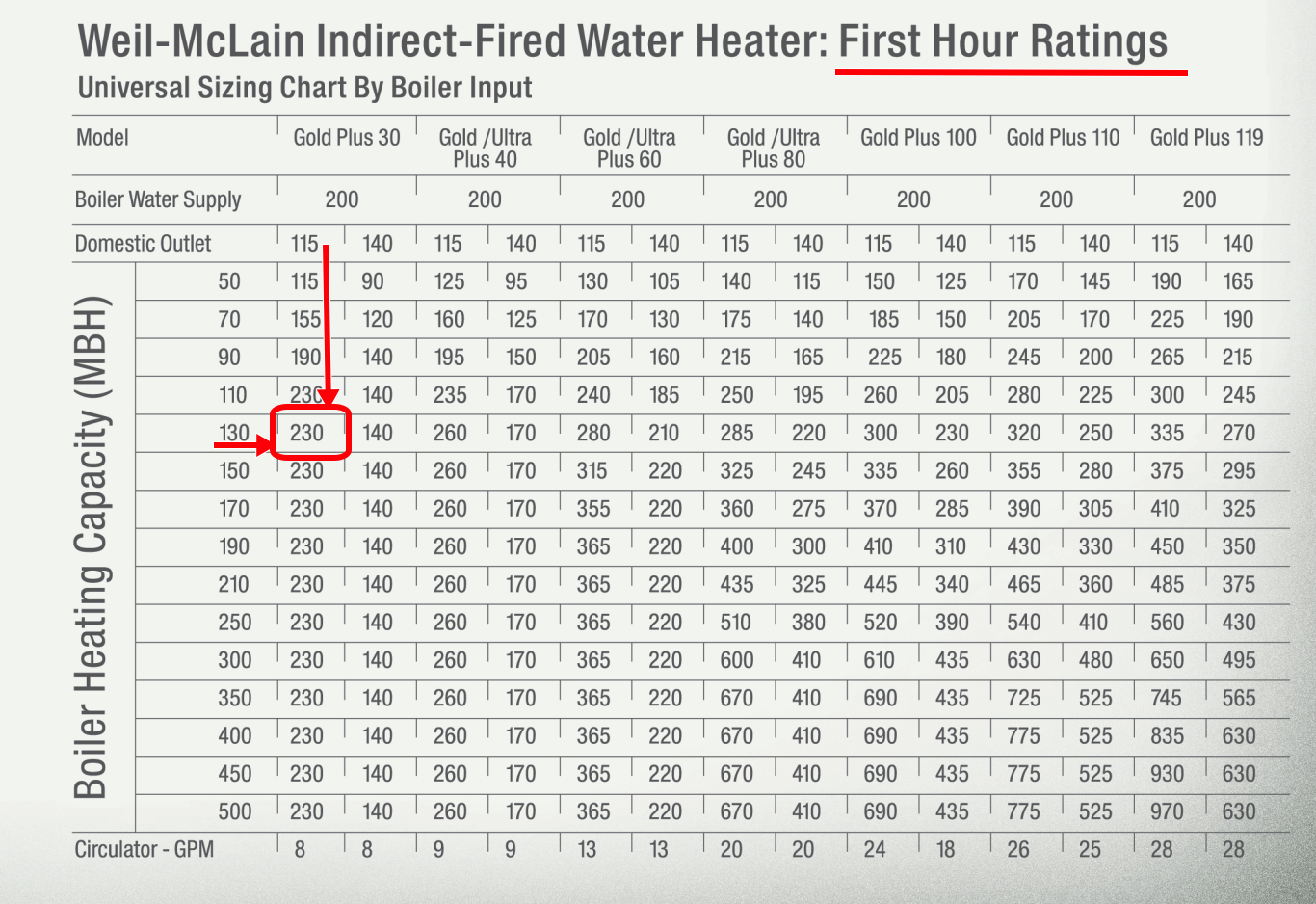
If I were to make an educated guess, that 27-gallon tank and the P-WGO-4 were likely installed at the same time years ago. You most likely have a Weil-McLain PLUS-30 indirect tank, similar to the one illustrated in the first column of the sizing guide.
With proper setup, you can achieve a first-hour rating of up to 230 gallons of hot water.
The first step is to set the P-WGO-4 high limit to 200°F. Next, make sure the water heater zone is set to priority. This means the boiler will temporarily stop space heating whenever there is a call for domestic hot water (DHW), allowing all available heat to be directed to the indirect tank.
Once that is verified, the remaining step is to ensure you are not exceeding approximately 3.8 gallons per minute when taking back-to-back showers. At that flow rate, it is not possible to exceed 230 gallons of hot water within a given hour. The math says so!
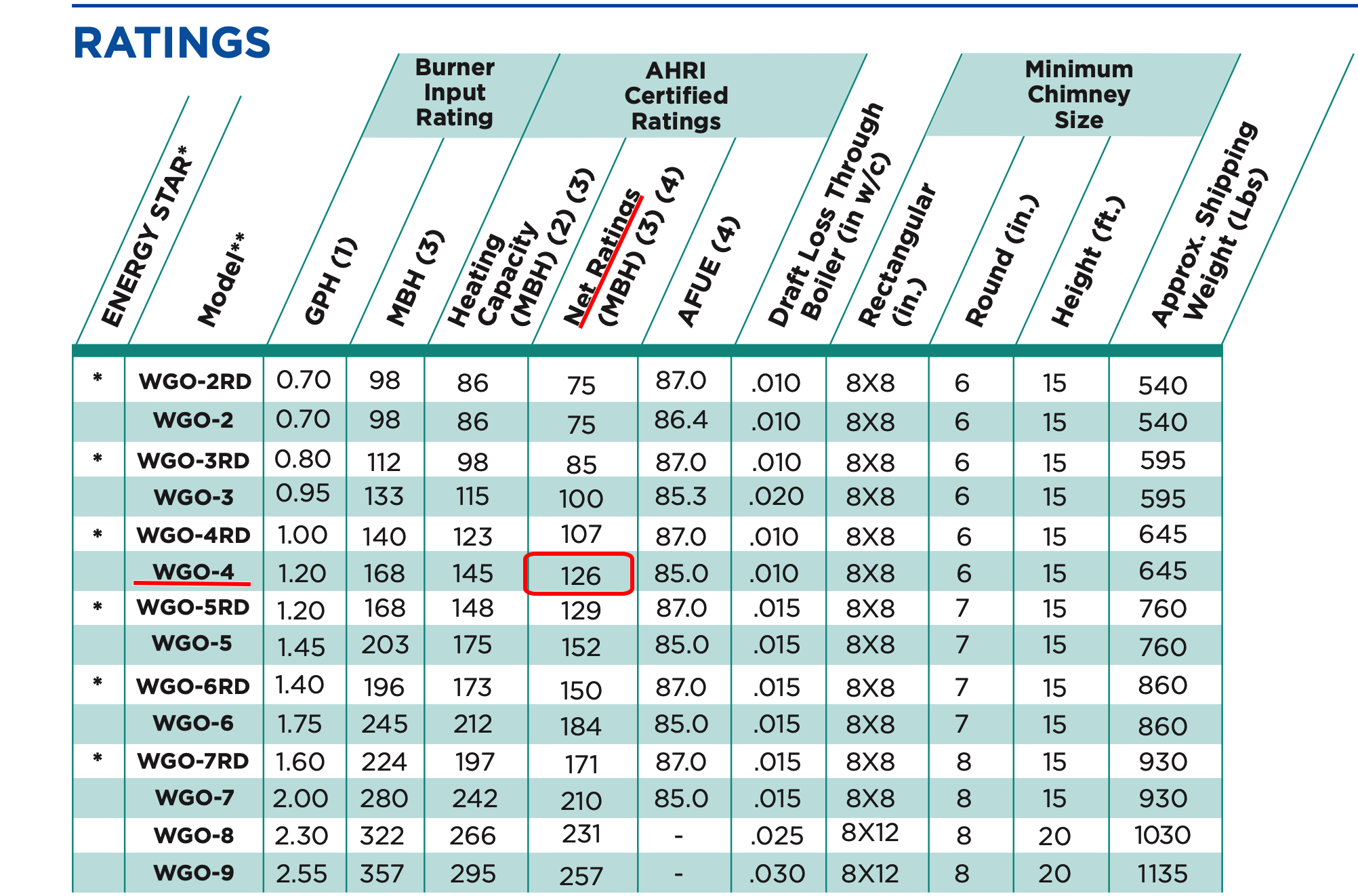
The reason I know this is possible is because the P-WGO-4, when set up for peak performance, can deliver a NET output of approximately 126,000 BTU per hour. This rating already accounts for a 15% piping and pickup factor based on an average heating system.
Since your water heater is located very close to the boiler, the actual piping losses are significantly less than 15%. As a result, you are effectively delivering more than 130,000 BTU from the boiler to the water heater.
The numbers support this. All that’s needed is a properly set up oil burner—one that operates with smooth, quiet starts and clean, soot-free combustion. This requires the use of a combustion analyzer and skilled workmanship to ensure the system is operating at its full potential.
Edward Young Retired
After you make that expensive repair and you still have the same problem, What will you check next?
0 -
-
@jrunks1221 , how about a pic of your hot-water tank?
0 -
Around me propane heat is just a bit cheaper than resistance heat, so you want to get the most efficiency out of the new setup. I would not install a mid efficiency boiler.
A combi is a good way to go assuming your water is not hard and it can support the showers you need. I would get a 5 gallon pail and measure the flow rate at each shower you want to run at the same time.
The idea that a modcon won't work with baseboard is nonsense. All you need is a decent outdoor reset curve and some careful adjustment of emitter flow rates. Neither is hard and something a competent DIY person can adjust down the road. Important bit is make sure the installer puts in the outdoor sensor.
As for exact sizing, if you have previous fuel use, run through the math here to get an accurate heat loss.
https://www.greenbuildingadvisor.com/article/replacing-a-furnace-or-boiler
Fuel used based heat loss is the most accurate method for existing structures.
One challenge you'll probably run into if you go the combi route is you'll need a bit burner to meet your DHW flow needs. Larger units don't modulate down as low as smaller ones, this is generally not an issue if you don't have small zones. If you do have small zones, you would need a buffer tank, at which point a modcon with a separate water heater would be cheaper.
0 -
I believe the smallest BoilerMate was the 41 gallon
Edward Young Retired
After you make that expensive repair and you still have the same problem, What will you check next?
1 -
This assumes that @jrunks1221 has already decided to replace the perfectly operational heating system with a new system that will cost something in the five-figure range , with little savings to show for all that effort and expense. After doing their due diligence, I believe that idea will not be so appealing.
Edward Young Retired
After you make that expensive repair and you still have the same problem, What will you check next?
0



Categories
- All Categories
- 87.8K THE MAIN WALL
- 3.3K A-C, Heat Pumps & Refrigeration
- 60 Biomass
- 430 Carbon Monoxide Awareness
- 133 Chimneys & Flues
- 2.2K Domestic Hot Water
- 6K Gas Heating
- 124 Geothermal
- 170 Indoor-Air Quality
- 3.9K Oil Heating
- 79 Pipe Deterioration
- 1.1K Plumbing
- 6.7K Radiant Heating
- 397 Solar
- 16.1K Strictly Steam
- 3.5K Thermostats and Controls
- 56 Water Quality
- 51 Industry Classes
- 51 Job Opportunities
- 18 Recall Announcements