2 stage vs 1 stage furnace

I am looking at Lennox ML180EK 66,000 BTU and EL280EK 88,000 BTU models.
Is there any reason someone would take a 1 stage model over a 2 stage?
The way I understand it, the Elite would operate at 66,000 in Stage 1 unless it needed more power and only then would kick into stage 2.
I have a basic Google Nest, do I need anything different if I get the 2 stage?
For context, my current furnace is 88,000 but short cycles due to being oversized. I’m looking to downgrade in terms of power, but think it could be worth it to keep extra kick for the really cold days.
Comments
-
Unless the Nest has a W2, second stage kicks in either 7 or 12 minutes into the cycle depending on a Dip switch setting.
To answer your question, if my heat loss was 66K, I wouldn’t install one capable of 88K.
 1
1 -
Do a heat loos calculation and install the correct size furnace. Not sure I would bother with 2 stage with a 60-80K heat loss. More parts to go bad.
 1
1 -
Is there a reason to buy a single stage over a two stage? There sure is, $. Why would you install a two stage unit in an investment property? You don't get the savings. The tenant would. You pay more for a 2 stage unit.
If your unit is oversized your wasting money and ruining the controls by allowing short cycling. The ignition sequence, like everything else, has a life span cycle. The more it cycles the less time it will last. How long do you think your car starter would last if you shut the car off at every red light, and then start it up again.
Also long run cycles allow for the maximum efficiencies. i think you need to define short cycling.
0 -
@2lefthands said:
"For context, my current furnace is 88,000 BTU but short cycles due to being oversized. I’m looking to downgrade in terms of power, but think it could be worth it to keep extra kick for the really cold days."If that is happening on really cold days, then you should consider using the proper size furnace. When you are at design temperature outside (AKA: the coldest day of the year used for heat-loss calculations) and your furnace is still short cycling, then you probably do not need an 88,000 BTU furnace on the coldest days of winter.
You might be better served by the EL280E070, which has a high fire of about 66,000 BTU input and a low fire of about 50,000 BTU input. It can run on the 50,000 BTU stage for most of the winter and only go to 66,000 BTU when you need the extra kick. That should make the cycles longer.
The goal is to reduce short cycles and turn them into longer cycles, and that is done by using a smaller firing rate. Think of it like this: if the 88,000 BTU furnace short cycles on the coldest days, for example 5 minutes on and 5 minutes off, then the burner is only operating 50% of the time. That means it is effectively delivering about 44,000 BTU per hour (88,000 × 0.5). If your short cycles are 6 minutes on and 3 minutes off, the burner is on two-thirds of the time, so the effective output is about 59,000 BTU per hour (88,000 × 0.67).
Both of those numbers are still in the range where a smaller furnace could likely handle the load, especially one with a lower first-stage firing rate.
Not until you get cycles of something like 10 minutes on and 3.5 minutes off (roughly 74% burner runtime) would the effective output approach about 65,000 BTU per hour, which is close to the high stage of the 66,000 BTU furnace. This means that the low stage will operate constantly at 50,000 BTU and only step up the 66,000 BTU for short "kicks" keeping the combustion process on constantly which is a more efficient way to operate a furnace. Not 88,000 on then off then on then off then on then off... A 50,000 always on to keep you comfortable without any off cycles is much better.
Question: So when you experienced the operation of the current 88,000 BTU furnace on the coldest winter days, how long were the on/off cycles?
Edward Young Retired
After you make that expensive repair and you still have the same problem, What will you check next?
0 -
i have an about 75,000 btu/hr 2 stage in an 800 ft^2 house which is probably quire oversized. It has a honewell 2 stage t-stat. It only runs 2nd stage when it is recovering from setback.
the 2 stage makes it run longer cycles on non design day conditions which keeps the temps more even especially if the ductwork is less than ideal.
I would like @EBEBRATT-Ed said do the heat loss and get a furnace about that size but i would do the 2 stage or a modulating and control it with a good 2 stage stat so the second stage doesn't kick on unless it needs it. i don't like the built in second stage runs on a timer.
0 -
not an investment property, my home for at least next 10 years.
Current heat will run for max 5-7 minutes, flames shut off, blower runs for another 2, shuts off, process restarts.
Price diff between these 2 models is negligible - I just want the best unit to handle avg cold days and super cold days.
I’ve also been told by everyone: undersized ducts
0 -
The current 88,000 has short cycled from the time I moved in - 2 years. I recently discovered it has a cracked heat exchanger - that’s why I’m getting a new one.
Cycle: run for 5-7min, flame goes out blower only for another 3min, then everything off, then restarts. Typical heat settings 68 at night and 72 during the day.
0 -
when at “design“ conditions that furnace should run nonstop. Seeing as you’re actually at “design“ conditions less than of the time that furnace is oversized 99% of the time
“Design“ conditions is not the coldest day of record!
0 -
Your short cycling timing indicaters taht you have an effective yield of no more than 66,000 BTUh if that is how your system is operating. With that information, does your home stay at the desired set point temperatures when the outdoor temperature is at its coldest? If you home stays comfortable even when the temperature drops below the normal coldest days, then you do not need an 88,000 BTU heater.
Your existing heated is already working like it is a 66,000 BTU Heater when the 88,000 gas burner can only operate for 7 minutes our of every 10 minutes. You would be better off putting less heat in your duct work if it is undersized. 50,000 BTU would be better for you and the undersized duct work. The only kick you need is the additional 16,000 BTU when it gets really cold.
Edward Young Retired
After you make that expensive repair and you still have the same problem, What will you check next?
0 -
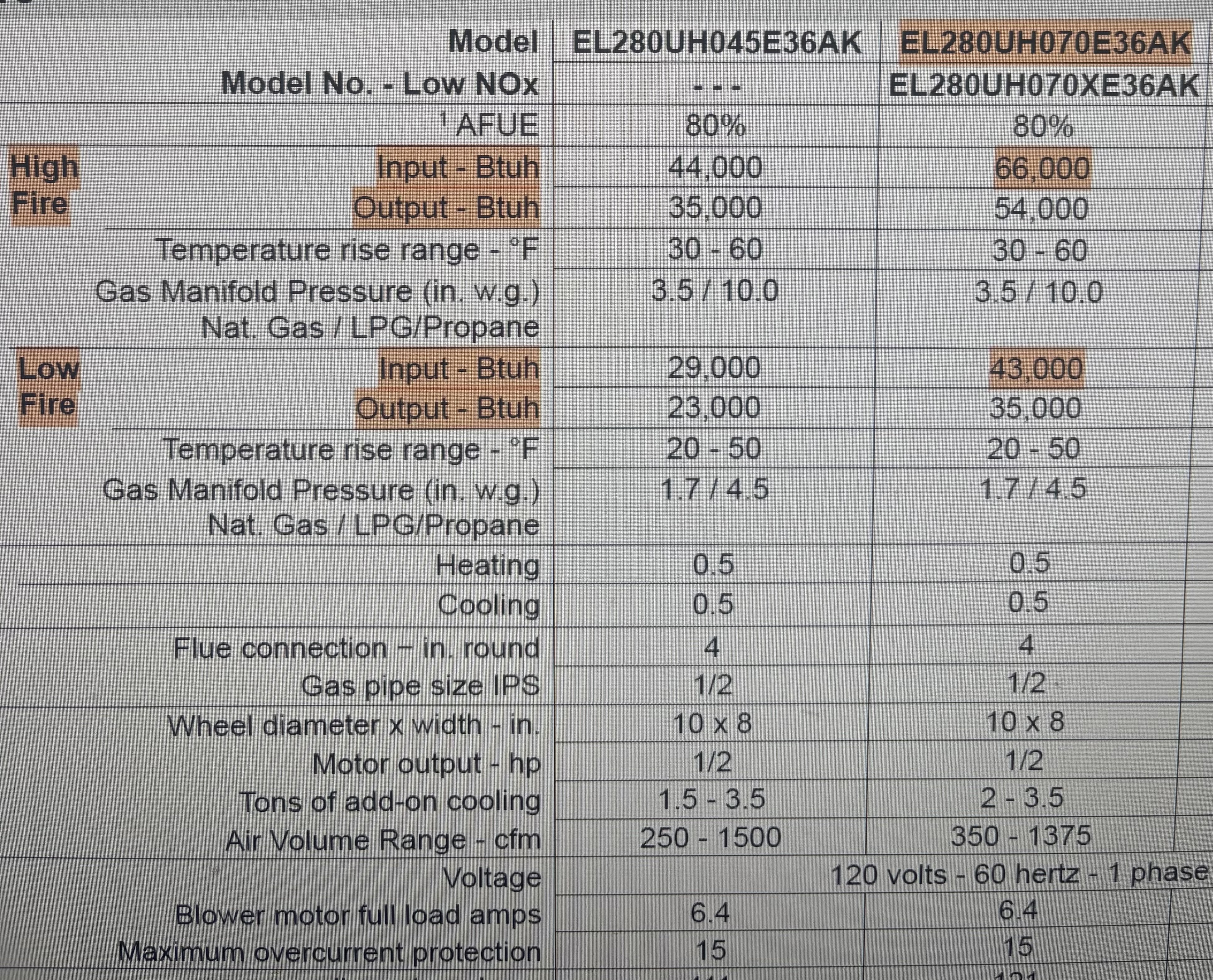
You might be better served by the EL280E070, which has a high fire of about 66,000 BTU input and a low fire of about 50,000 BTU input. It can run on the 50,000 BTU stage for most of the winter and only go to 66,000 BTU when you need the extra kick. That should make the cycles longer.
Low fire on this one looks to be input of 43,000 and output of only 35,000 - that seems insufficient. Unless I’m reading the chart wrong.
 0
0 -
EXACTLY RIGHT: That 43,000 BTU stage is insufficient for a very cold day. If you were in New Jersey, where I used to work, those coldest days could be below 0°F, and keeping the indoor temperature at 72°F was the job of the high fire stage. But we only saw temperatures below 0°F about once every four years or so, not every day of the winter. So to get the home to 72°F when the outdoor temperature is 0°F, you might need 66,000 BTU/h for about three or four hours every three or four years. Other than that, you don’t need 66,000 BTU/h.
The 43,000 BTU burner is not for those extreme days. That burner is for most of the rest of the winter.
For example, when it is 40°F outside, the house might only need about 22,000 BTU/h, and the 43,000 BTU stage is almost double what you need. When it is 30°F outside, you might need about 35,000 BTU/h, which is still less than 43,000 BTU/h.
Now when the temperature gets down to 20°F, that 43,000 BTU stage is too small. But guess what happens? The additional 23,000 BTU burners come on, and suddenly you have a furnace producing about 66,000 BTU/h, even though the house might only need about 48,000 BTU/h. So what happens? the 43,000 burner never shuts off, the most efficient use of fuel, no OFF and ON cycling. The additional 23,000 BTU burner cycles ON to make up the difference then cycles OFF when the temperature at the thermostat gets higher that the set point. The over sized 66,000 BTU burner does not shut off completely, only the 23,000 burner shuts off so the 43,000 burner can keep you comfortable. Much more efficient operation.
Does that make sense?
Edward Young Retired
After you make that expensive repair and you still have the same problem, What will you check next?
0 -
If the Flame goes out and the blower motor stops its because the thermostat is satisfied. That would not be indicative of undersized ducts. That is normal operation. Heat demand, safety check, combustion fan, ignition sequence, flame, heat exchanger warm-up, then blower motor on is the start-up. Shutdown is Thermostat satisfied, gas valve closed flame off, combustion fan off, then after a timed period by dip switch the blower motor will shut off.
If the ductwork was undersized you can test it by measuring the temperature rise over the heat exchanger. There is a low and high temperature that the manufacturer's recommend that you use to help sizing your ductwork. you can see it on the manufacturer's tag. That is how you get a long life out of the heat exchangers.
What i like to do is work backwards. Determine what my ductwork can handle using recommended static for residential installs and then using the sensible heat equation to see the maximum temperature rise over the heat exchanger. Then do a heat load calculation and see if it lines up with the existing ductwork. This will determine whether modifications to the existing ductwork are needed.
Its really kind of critical to size the new furnace to the ductwork correctly if you want your new heat exchanger to last. They really don't make them to last and if you stress it with high temperature rise it's not gonna last. This is an area where they really " don't make them like they used too". It's funny because the competitive models don't handle the the stress like the brand name units but if you stay within the temperature rise area they will last just as long.
0 -
Your cycle description does not state the duration of how long is "everything off"? And is this cycle time typical of the coldest nights or design temps?
Try doing this calculation if you can, make sure it matches with numbers you are considering https://www.greenbuildingadvisor.com/article/replacing-a-furnace-or-boiler
0 -
"…How long do you think your car starter would last if you shut the car off at every red light, and then start it up again…"
In the last two years, between 65% and 72% of new cars sold in the U.S. have been equipped with start-stop systems that do exactly that. 😊
OK, back to heating. 😀
 2
2 -
did it not have a nest at some point, did run longer cycles before the nest was installed or was it already there when yo got it. the short cycling you describe seems to be a control problem although it could also be oversized in addition to the control problem. one common failure point of nests is that their battery doesn't get adequate power and it will die during a heat call causing the heat call to end then the battery charges and starts another heat call.
it could be incorrect anticipator settings/behavior in the thermostat or the thermostat being right at a heat vent too. maybe it could be a safety in the furnace shutting the burner down too.
1 -
it seems that gm is intent on testing that. intentionally over with the models of the past 20 years or so, unintentionally with the models of the late 70's through the 90's
0 -
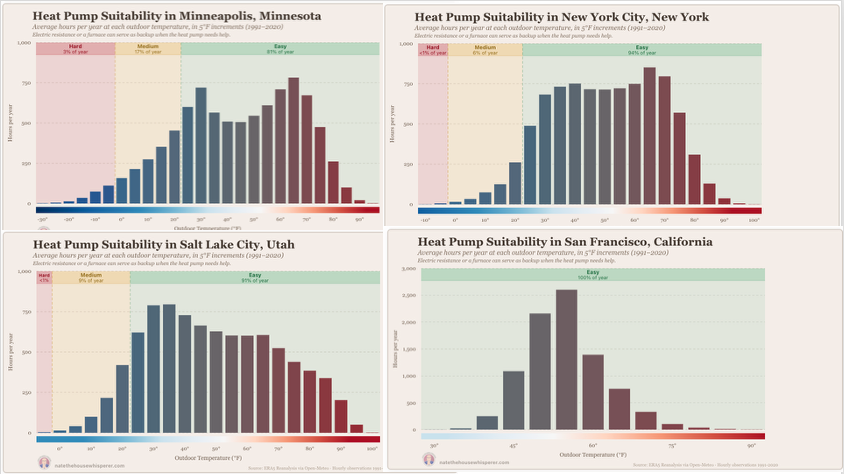
Most homes are at design condition a small % of the year, less than 10%, you can look up temperature info for your location. As such a single stage is mostly oversized. The closer the furnace to the actual load the more efficient and comfortable the home. Below are some examples of temperature data for various cities.
Any air sealing upgrades will lower the load also. A load calc and blower door test can shed a lot of info on your needs. Most furnaces get over-sized.
 Bob "hot rod" Rohr
trainer for Caleffi NA
Living the hydronic dream0 -
thank you for this detailed explanation. What is the largest consequence of utilizing a stage 1 furnace that only works at 66k BTU? I assume I’ll waste more gas unnecessarily, but what are the other consequences?
I ask because I imagine there are more components that can break in the 2 stage model. So maybe effeciency savings are cancelled out by repair costs. Also, I might not mind the “light switch effect” ie on full blast then off vs always on at lower power.
But if the more frequent on/off with a stage 1 66k is gonna cause other issues, those are the risks I want to understand.
p.s I’m in NJ and we had a very cold winter.Northern NJ (e.g., Sussex, Warren, Passaic): Likely 30–50+ days with at least some stations reporting lows below 20°F0 -
These short cycling issues persisted even when the thermostat was disconnected at the furnace and it was basically set to “just work”. Even with the filter box open and empty - it would short cycle.
0 -
aw, no wonder you have cracked heat exchanger.
0


Categories
- All Categories
- 87.6K THE MAIN WALL
- 3.3K A-C, Heat Pumps & Refrigeration
- 59 Biomass
- 430 Carbon Monoxide Awareness
- 124 Chimneys & Flues
- 2.2K Domestic Hot Water
- 5.9K Gas Heating
- 120 Geothermal
- 168 Indoor-Air Quality
- 3.8K Oil Heating
- 78 Pipe Deterioration
- 1K Plumbing
- 6.6K Radiant Heating
- 394 Solar
- 16K Strictly Steam
- 3.5K Thermostats and Controls
- 56 Water Quality
- 51 Industry Classes
- 50 Job Opportunities
- 18 Recall Announcements