Rushing Air Vent, sometimes

I have a 1926 two story house with single pipe steam. Mostly, the system works fine.
Sometimes, one radiator will have a steady heavy stream of air coming out of the vent. This lasts for much of the time the system is active during a heating cycle. If this happens a couple of times, the water level in the boiler is noticeable lower.
This never happens when it is very cold, only when the temperature is warmer, like 40, and the systems doesn't have to turn on only once in 10 hours (I haven't timed this). It doesnt' even happen 100% of the time when then.
Not sure what I should check or try to understand this.
New England steam homeowner
Comments
-
Well, one thought that comes to mind is that a main vent sometimes sticks closed…
Br. Jamie, osb
Building superintendent/caretaker, 7200 sq. ft. historic house museum with dependencies in New England0 -
If the main vent stuck, wouldn't that affect other radiators too? This only happens on one.
New England steam homeowner
0 -
It may be affecting them as well, but they aren't noisy about it.
I'm most interested in the water level issue that you said is related to this…I can't currently think of how that relationship would exist
The thing I would do if I were there would be to start a call for heat and be in the basement from the beginning to the end to see and feel what is happening. I would follow the steam's progress around the main, monitoring the main vent and having someone monitor the problem radiator.
Be sure you aren't hearing the "inhale" that happens at the end of a call for heat from air being pushed back into the system after the steam collapses.
NJ Steam Homeowner.
See my sight glass boiler videos: https://bit.ly/3sZW1el 1
1 -
I have a feeling you're hearing escaping steam, not air. Replace the rad vent. But also check your main vents, at least to see if they're properly sized.
0 -
the radiator is clearly "exhaling", I can feel the air on my hand along with a bit of dampness. So you are right, it is steam. I figure enough air and steam are rushing out that it affects the system water levels. It takes several times before it is obvious in the sight glass (that the water level is down).
What is a good way to monitor the main vent? if the air isn't rushing out it isn't easy to feel it, and there are enough other noises in the basement to not be able to hear. The vents are near the basement ceiling, within a foot of the boiler.
Since this system only started doing this in the last year, maybe that argues against the main vent being the wrong size. But it could be clogged in some way, I guess.
The fact that it does this only under certain conditions is what made me not just replace the radiator vent. I figured if it was that, it would behave the same way every time the heat came on.
New England steam homeowner
0 -
Get a cheap stethoscope to check main vents.
 1
1 -
a bit of dampness could be air. It’s very damp inside a steam system always.
Is the vent too hot to hold onto when this is happening?
You should be able to feel and hear air escaping from a main vent.
NJ Steam Homeowner.
See my sight glass boiler videos: https://bit.ly/3sZW1el0 -
He cant hear he said bc of basement noises. As someone who is deaf in one ear, I often run into this problem.
1 -
thanks, then feeling remains an option too with the stethoscope.
My tinnitus is so bad I didn’t hear him say that about his basement 😞
NJ Steam Homeowner.
See my sight glass boiler videos: https://bit.ly/3sZW1el 1
1 -
I'll have to check on whether it is hot when the air is first coming out. I think not, since I can hold my hand in the stream.
New England steam homeowner
0 -
Which brand/type of valve is the problem one? Are the others the same?
0 -
Right. We don't expect it to typically be hot when it's first coming out. At the start of a call for heat, it's all cool or maybe warm air escaping the main vent. Then when the steam reaches the main vent and heats it to "steam hot" the main vent should close and allow nothing out for the remainder of the call for heat.
This is why I suggested "following the steam" along your main by touch so you can know when it's getting to your main vent(s) and you can see if they are allowing air to pass and then closing to steam like they should.
The same will happen with radiator vents, but often they will not even see steam on a normal call for heat because the thermostat is often satisfied before some or all radiators are completely full of steam with the radiator vents closing.
(I edited this post to add "main" to everywhere I was talking about main vents because I had some confusion at times in your thread about when you were talking about main vents vs radiator vents)
NJ Steam Homeowner.
See my sight glass boiler videos: https://bit.ly/3sZW1el0 -
Finally had a chance to watch things when the heat kicked on with the system completely cold. The bathroom radiator did NOT do the extra rushing air thing, but here is what I observed. Refer to diagram below, black lines are outgoing pipes (about 2.5 inch diameter) and the arrows are pipes going up into the house. The green lines are vertically lower than the black line pipes, and about 1 inch diameter, and wrap back to vents (Vent-Rite 35). The first pipe to get warm was A. After a bit, 1. started to get warm. Eventually, the rest of the pipes got warm, with the returns to the vents taking the longest.
I could not feel air coming out the vents, but they did get hot. No stethoscope yet to listen.
I don't know the exact paths of steam pipes up to the radiators. Pipe marked 1. could go to the second floor bathroom where the air rushes out, not sure.
The problem radiator has a Vent-Rite 11. All the rest have Vent-Rite 1, which is adjustable. They are set to various levels, where i have tried to balance the heat flow as felt .
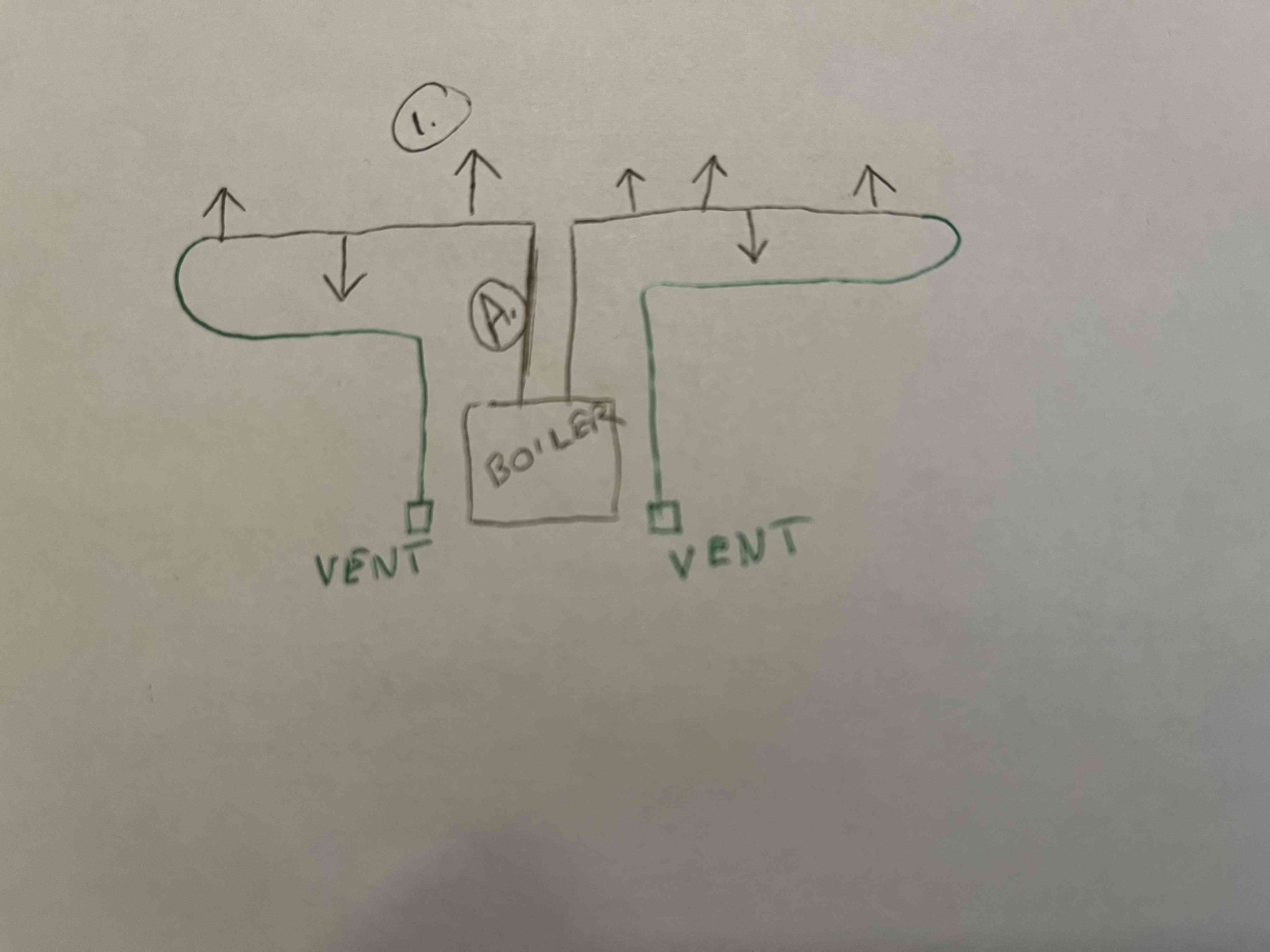
New England steam homeowner
0 -
How long are those mains shown by the black lines?
0 -
Your Ventrite 11 should have about the same venting rate as the 1's when they are set around 6 or 7. The Ventrite 35's are pretty slow vents for main vents but then again all your radiator vents are fairly slow which may make the 35's sufficient. However, if in your observation steam is not reaching the main vents until after you are already getting air rush noise and heating from that bathroom radiator I would definitely increase the main vent sizes. What is the total length and pipe sizes (note whether you are talking actual OD or nominal pipe size) of your mains and returns from boiler to main vents?
0 -
The left side is about 9 feet, the right about 7.5. The run from the boiler is about 6 feet.
New England steam homeowner
0 -
I'd upgrade your Vent-Rite 35s to Gorton #1 vents. This will vent the mains faster and help to balance the system.
0 -
Agree with @Steamhead. You could also get a Ventrite 1 for that bathroom radiator and slow it down a bit but if you are wanting more heat in that bathroom then that wouldn't be desirable.
Seems like a pretty small system. Can I ask what the EDR steam rating is on the boiler (or just the boiler model #)? Have you ever totaled up your radiator EDR's?
0 -
Boiler is a US Boiler Independence 5
Heating Cap: 115 MBH
Steam: 86 MBH
Steam: 358 Sq. Ft.
I haven't calculated the EDR of all radiators. Should that number be less than 358?
The system has heated the house (1200 sq ft, 2 floors) decently for years.
New England steam homeowner
0 -
oh, the diameters I quoted on those pipes was a rough number of the physical outer diameter of the pipe.
New England steam homeowner
0 -
That's what I thought. For the record, iron and steel pipe is designated by its inside diameter. Yours is probably 2".
0 -
Yes your radiators should total roughly equal or slightly less than 358. If you are significantly oversized it can make keeping vents quiet a bit more of a challenge. I'd start by going to Gorton #1's for the main vents, however, I'm still a little confused by the fact that the air rush issue on that bathroom radiator only happens in milder weather and not when it is colder. Usually the difference in warmer weather is that the boiler is coming on less frequently and therefore more often the pipes are quite cold at start of cycle. Under this condition the main vents actually come into play less than they do when the pipes are warm since the steam condenses quite a bit warming the pipes and thus advances more slowly. This can create more condensate so I would check the pitches of all your mains and definitely your return lines. You want to be sure there is no place condensate could pool in a low spot and start blocking air that is trying to escape the main vents at the end of the returns. Do you notice any hammer?
0 -
This can create more condensate so I would check the pitches of all your mains and definitely your return lines.
This is often repeated, but it is false. The amount of condensate is rather constant—the boiler produces the same steam no matter how warm or cold the mains are, and all of that steam becomes condensate.
Yes the condensate manifests earlier in the main when the main is cold compared to when the main is hot, but in the end it's the same amount of liquid.
And I've yet to meet or hear of a main that couldn't handle the condensate from the steam produced by its boiler. If there is one, it will have the same problem regardless of the temperature of the main.
I don't know why people think there's more condensate being produced by a cold system than a warm one. I think it's probably they are hearing water hammer caused by cold condensate lying in a sagging main or something, like you said here:
You want to be sure there is no place condensate could pool in a low spot and start blocking air that is trying to escape the main vents at the end of the returns.
NJ Steam Homeowner.
See my sight glass boiler videos: https://bit.ly/3sZW1el0 -
@ethicalpaul My point was that there is more total condensate produced from the time the boiler starts steaming to when steam first reaches the radiators in a cold system than a warm one due to the boiler running longer to heat those pipes, and he is heating up his entire returns as well.
@klmcc1894I'm seeing a disconnect on the description of the problem here since initially it sounded like the issue only occurred during warmer weather when the boiler might be running only once every 10 hours. Later when monitoring you said it did not occur on a cold cycle . Also, you said the water level drops more when the problem is occurring. I assume this is not a permanent drop resulting in need to add water by hand or feeder since that could only be a leak or steam escaping the system through vents, valves or the boiler itself up the chimney. That would also seem odd to be more of a warm weather issue than a cold weather one. If a temporary drop then more water must be out in the system or the return is slowed somehow.
Just to check again when you hear this air rush noise is the radiator filled (all sections) or not? Is vent hot or cold? Is the boiler still on or has it shut off?
0 -
@dabrakeman Because it is intermittent, it was hard to collect info. I think I have finally triggered it when I was watching.
After turning the heat on, it takes about 10 minutes before heat reaches the bathroom radiator. (I didn't think to time this part, it was somewhere from 8 to 15 minutes)
The radiator is gradually getting hot all the way through. Whatever air is coming out of the vent is quiet, and hard to feel it moving on my hand.
After about another 14 minutes, the radiator is hot all the way through, and what's coming out of the vent gets noisy. It is hot to the touch.
I let the heat stay on for another 15 minutes. Vent continues to be noisy, hot air/steam coming out. It never shuts off.
I turn off the heat, and it takes about a minute and half to slow down so the venting is not noisy.
This radiator heats faster than any other in the house, which I would expect. But shouldn't the vent shut once it gets hot?
New England steam homeowner
0 -
That simplifies things. Your vent on that radiator is shot (stuck open). Get a new vent for it. You have Ventrite #1's everywhere else so that would be a good choice. Should reduce your water loss as well.
0 -
This makes sense. I think I figured out why it mostly happens in warmer weather. When it is colder I have curtains that close off the stairs - otherwise all the heat rises and the upstairs temp is much higher than downstairs where the thermostat is. But when it is warmer I don't do that. So the furnace is actually on for longer when it is on, waiting for the thermostat to get to temp while all the hot air is rising up the stairs.
New England steam homeowner
0


Categories
- All Categories
- 87.8K THE MAIN WALL
- 3.3K A-C, Heat Pumps & Refrigeration
- 60 Biomass
- 430 Carbon Monoxide Awareness
- 133 Chimneys & Flues
- 2.2K Domestic Hot Water
- 6K Gas Heating
- 124 Geothermal
- 170 Indoor-Air Quality
- 3.9K Oil Heating
- 79 Pipe Deterioration
- 1.1K Plumbing
- 6.7K Radiant Heating
- 397 Solar
- 16.1K Strictly Steam
- 3.5K Thermostats and Controls
- 56 Water Quality
- 51 Industry Classes
- 51 Job Opportunities
- 18 Recall Announcements