Lifting up a Radiator

Hi! There are two radiators on our second floor that feed off the same riser. My guess is that the runouts to these two radiators have sagged over the years. Every time the heat comes up, there's a lot of banging in the runouts to the two radiators until the steam reaches the supply valve for each radiator. Once the steam arrives at the supply valves, the banging stops completely.
Once the heating season is over, I would like to hire a plumber to raise these two radiators a little bit (both ends of each radiator) to hopefully give some pitch to the runouts and solve the water hammer that happens each time the heat comes up.
One of the radiators is a 32 EDR six-tube radiator with 8 sections and the other radiator is a much larger 55.5 EDR three-column radiator with 15 sections.
How does it actually work to raise up a radiator? How difficult is it to do this? Is there any potential downside to trying this? Can it break or crack the radiator? I would rather deal with the water hammer than create new, additional problems. How many inches would be good to start with to try this out?
Thank you very much for your help!
Comments
-
You need two strong men and a boy!
Seriously, lifting a radiator with a lever and fulcrum, a little at a time, is not hard to do at all. Have some ¼-inch shims ready. Lift one end ¼ inch, then the other end ¼ inch, then go back to the original end ¼ inch, and then back to the other end ¼ inch. Continue this process until you get the radiator about ¾ inch above the floor, and then try the system out.
The cast-iron parts and fittings should hold up just fine. I have done this several times with good success.
Edward Young Retired
After you make that expensive repair and you still have the same problem, What will you check next?
 3
3 -
A block of wood and a 2x4 make a great lifter. As long as you don't get too medieval on it I think the risk of breaking anything is quite low. But not zero!
NJ Steam Homeowner.
See my sight glass boiler videos: https://bit.ly/3sZW1el 2
2 -
I used a slim car jack, operated with a 3/4” socket wrench, to lift my radiators about 1/2”—raising one end at a time—and slipped 1/2” wood shims underneath to hold them in place. Supporting the back side of the radiators was tricky because there wasn’t enough clearance to slide the shims in, especially on the valve side where the jack had to sit at an angle to fully engage the radiator.
After lifting one of the smaller radiators, I left it perfectly level on @ethicalpaul ’s advice, and that alone reduced the gurgling so much that now I’m the only one who can hear it, and even then just barely.
2 -
I wouldn't go 3/4" at first. If it is one pipe steam keep the pipe end just a bit lower that the other end. First make sure it has a little pitch in the right direction.
If it does raise each end a 1/4" at a time and try that.
2 -
I cut 1-1/2" X12" (or however wide the radiator is) slats out of 1/4. 1/2 and 3/4" plywood). using a 3 ft 2X and a fulcrum I kneel on the long 2X to GENTLY raise an end while slipping a shim under that ends feet. A long radiuator might need a longer 2X and a friend.
You can stain the slats to match your floor. Then I do the other end and check the level to make sure water will flow back to the boiler.
Bob
Smith G8-3 with EZ Gas @ 90,000 BTU, Single pipe steam
Vaporstat with a 12oz cut-out and 4oz cut-in
3PSI gauge 2
2 -
@BobC
Do you disconnect the radiator from the supply valve first?
How bad is it to have a concentric bushing at the radiator instead of going with a larger valve with the reducer under that? Doesn't matter much or is it worthwhile?
1 -
One does NOT disconnect the radiator from the supply. In fact, the whole purpose of the exercise is to raise the supply so it will have more slope back to wherever it is gong!
A concentric bushing really isn't a problem. Yes, it will trap some water — but not enough to be a catastrophe. An eccentric bushing would be better — but this is very much a run what you brung. If there's a concentric in there, live with it.
Br. Jamie, osb
Building superintendent/caretaker, 7200 sq. ft. historic house museum with dependencies in New England 2
2 -
Devils in the details but thanks and I was interested in @BobC method. Case in point.
I have a pair of radiators that I have to jack up at least 3/8". One is on my 1st floor and one on the 2nd. The corner of the L shaped main in the basement needs to come up 3/8" (but I will try for 3/4") for proper pitch purposes and my plan is to jack that main up with a car jack with the radiators disconnected since it needs controlled force. It would be foolish in my case not to disconnect them first and then jack up the radiators to meet the supply valves.
One possible alternative "might" be to disconnect the 1st floor radiator and try to jack up the main in the basement 1/4" at a time, and then the radiator upstairs still connected, and repeat the process until I get the 3/4" and then see if I can pull the valve up to the radiator on the 1st floor after I jack that one up and then reconnect.
0 -
Plastic checkers are another option; and you get a choice of colors.
Retired and loving it.0 -
I have a small system with a very short main. The maim is about 10-12ft long, it circled the chimney and that gives me long leadouts ro the radiators (10-12ft) so there is room for "flex". I have never felt the need to disconnect a radiator. The lever and fulcrum give a good feel for what you are doing.
Bob
Smith G8-3 with EZ Gas @ 90,000 BTU, Single pipe steam
Vaporstat with a 12oz cut-out and 4oz cut-in
3PSI gauge 3
3 -
Thank you for that polite response without talking down. I didn't say but my runouts are less than 2 ft. and not everyone needing to jack up a radiator is doing it because the pitch of their runouts are wrong. Some people need to change the pitch of their main without straining the runouts too much and want to maintain the pitch of their runouts. Also, some people could have soldered copper runouts which can't handle the strain as much as black iron.
0 -
If you are trying to raise your main, can you get a clevis hanger on it? Use a beam hanger if running with the joists in the basement, or a 2×4 between joists with a hole drilled in. Then you can run a nut with a fender washer on top of the 2×4. Lock the clevis with a double nut. Run threaded rod up through second support (beam hanger or 2×4), then wrench threaded rod up 3/4". Everytime you raise it 1/4" run around and see the heights of rads. Sorry that description was a bit convoluted. Its easier with the 2×4, with the beam hanger you need to do a lot of double nut and washer so rod will spin.
1 -
Thanks. I did a hanger already where I am using a piece of 3/8 in. x 2in. x 2 in. steel angle lag screwed to the joist directly over the elbow of the main. There is a 5/16 in. eye bolt that is adjustable for height with a pair of nuts and I got some #8 jack chain that wraps around the elbow. I also plan to put another one a couple joists over from there for additional support. Found a great supplier since you can't get this stuff in hardware stores around me anymore.
PS: I already had 4 of these angle irons made that were to be feet on a router table and I ended up only using two so had two left over and I can always use them with the clevis hardware and threaded rod if the jack chain doesn't turn out to be strong enough but I believe it will be because it probably has a factor of safety of x5 built into the rating.
0 -
Where you are trying to raise and straighten a main, @Captain Who , you are very wise to disconnect the radiators first! I sort of misunderstood what you were up to, an though it was a runout problem. Sorry! Be very careful, though, when you reconnect — as I'm sure you are aware, unions are oddly unforgiving about taking up misalignments.
Also as I'm sure you are aware, if that main is more than say four feet or so long, it needs intermediate supports to keep it straight as well as pitched correctly. You wouldn't think heavy iron pipe could bend enough to create a sag, but…
Br. Jamie, osb
Building superintendent/caretaker, 7200 sq. ft. historic house museum with dependencies in New England0 -
OK all is forgiven and thank you. Misalignments are no good….goes without saying. I am all too aware of having to check the main all over for sags, not just for overall pitch. It's amazing how 100 year old 2 in. steam main is not straight and the fittings and threads were not made with perfect alignment. I have #10 jack chain (I am upgrading that) that was apparently what my dead men used and I will say that it is inadequate, as were the single wood screws driven into the joist. A water level is my go to for checking the piping along with a short magnetic level. If need be I can upgrade what I have planned to the threaded rod and clevis hardware but I like the way the #8 jack chain leaves more room for insulation (ocd yes).
0 -
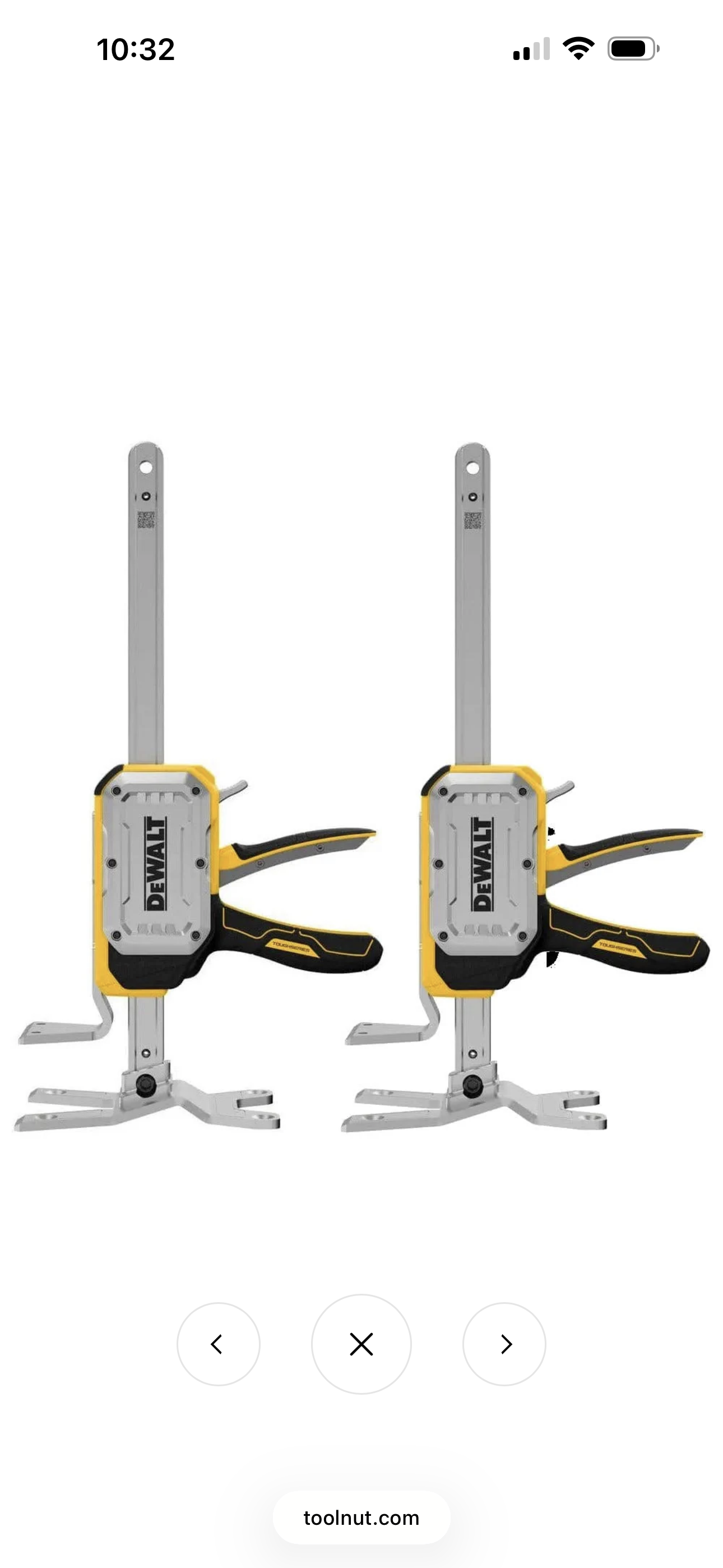
As others said I used to use blocks of wood and fulcrum. That is until I got these Dewalt lifting jacks. On a small radiator that just needs a little shim I can get away with only 1. Otherwise I use a small section of unistrut at an angle under tye radiator and a jack on each end. Quick and easy to lift and shim. I also used them on furnaces, baseboard and water heaters to level equipment.
Owner of Grunaire Climate Solutions. Check us out under the locate a contractor section. Located in Detroit area.
1 -
Those Dewalts can handle the weight? Im shocked and impressed, also buying a set immediately.
0 -
is that a rebranded irwin since if i'm not mistaken stanley owns irwin
0 -
@4GenPlumber the ones I have are rated for 350 lbs each. Usually using 2 plus a section of strut works better. Just angle it between the rad feet and go slow. Makes it quick and much easier on the back.
Owner of Grunaire Climate Solutions. Check us out under the locate a contractor section. Located in Detroit area.
0 -
So the strut goes diagonally and you have a lifter from the front on the valve end and the other lifter is slipped in from the end between the feet rather than the front? Will the lifter fit between the feet?
0 -
The end opposite of the valve at an angle between the feet. This gives you a better base so they don't kick out on you when you lift. You can lift it to shim it up to regain pitch.
Owner of Grunaire Climate Solutions. Check us out under the locate a contractor section. Located in Detroit area.
0 -
Stanley owns DeWalt, Black & Decker, Irwin, Lenox saw blades
0 -
A Burke Bar makes a great lever for lifting radiators…
Homeowner, Entrepreneur, Mechanic, Electrician,
"The toes you step on today are connected to the butt you'll have to kiss tomorrow". ---Vincent "Buddy" Cianci0





Categories
- All Categories
- 87.6K THE MAIN WALL
- 3.3K A-C, Heat Pumps & Refrigeration
- 59 Biomass
- 430 Carbon Monoxide Awareness
- 124 Chimneys & Flues
- 2.2K Domestic Hot Water
- 5.9K Gas Heating
- 120 Geothermal
- 168 Indoor-Air Quality
- 3.8K Oil Heating
- 78 Pipe Deterioration
- 1K Plumbing
- 6.6K Radiant Heating
- 394 Solar
- 16K Strictly Steam
- 3.5K Thermostats and Controls
- 56 Water Quality
- 51 Industry Classes
- 50 Job Opportunities
- 18 Recall Announcements