Thermostat replacement

Thinking of upgrading my really old Honeywell thermostat. Single pipe system, appears to only have 2 of the 3 wires connected at the boiler. I have yet to take the thermostat off the wall to see what it has connected. Thermostat is located on an interior wall of my first floor dining room. There no steam pipes running through that wall to effect its operation. There are 2 radiators about 8 feet away along an exterior wall, they both have MoM with #4s installed. These 2 radiators are at the opposite end of where my boiler is located in my basement.
My system doesn’t appear to have long run times and cycles more than I believe it should. Ptrol is set to .7 with the differential set to 1. Gauge is a 0-5, it’s fairly new and I checked its operation. Pigtail is completely clean. I barely get a reading above half a pound now that the weather has stabilized.
Not looking for anything more than a set and forget style thermostat. Once in a while I might drop the temp 2-3 degrees at night, but I typically set it and leave it alone. Simplicity is ideal, I don’t need to change my home’s temperature while standing in line at the supermarket. I did a search on the subject, but there’s a lot to take in. I see there are ways to change the system cycling and run times (not sure if that’s something that I even need to consider) but I’m not sure which direction I need to go towards. Any assistance is greatly appreciated.
Comments
-
What thermostat do you have?? I guess you could run into trouble with some thermostats that don't play well with steam, which has a system dependent delay to get the steam even to the supply of the radiator. I'm amazed that my White Rodgers Series 90 works as well as it does without anything more than 2 settings; fast and slow. It seems to have learned that it needs to have a certain minimum burner time.
0 -
Before we start to worry about that old Honeywell thermostat — which is likely to be far more reliable than anything you could buy today, by the way — we need to be sure what it is we are trying to do.
The first, and probably most important question, is how is the space comfort in the house? Does the temperature hold fairly constant, or does it go up and down more than you would like? If the space temperature is comfortable, changing the thermostat isn't particularly reasonable — if it aint't broke, don't fix it!
Now on cycles. You mention that the system "cycles more than it should" and has "long run times". These are actually opposite conditions. If the thermostat is what is controlling the cycles and run times, there are ways — even with that old one — to get shorter run times. There are also ways to get fewer cycles. Unhappily, you can't do both. Your house needs a certain amount of heat to stay warm. You can do this either with shorter bursts of heat more often, or longer bursts of heat less often. It's a compromise act — the idea is to get the thermostat set so that the temperature of the space holds reasonably constant, whatever combination of "how often" and "how long" that takes.
Now if it is the boiler that is cycling — the boiler turns on and off usually on pressure — while the thermostat is still calling for heat, that is a very different problem and changing the thermostat isn't going to make a difference at all.
So we sort of need to know if the boiler is turning on and off — but your comment on pressure suggests that it isn't. And, incidentally, NOT seeing pressure while the boiler is running is a good thing, provided the radiators are warm. You don't need much pressure to get nice warm heat from steam!
Br. Jamie, osb
Building superintendent/caretaker, 7200 sq. ft. historic house museum with dependencies in New England0 -
Apologies on any confusion on what I stated………to clarify:
My heat seems to be fine, the house is mostly comfortable. The pressure is typically low, so low that I don’t think the system is ever shutting off from the Ptrol registering significant pressure except when it’s really cold out. It seems to be shutting off by the thermostat. But I’m just wondering if the thermostat is cycling the system too often. The system will run, I’ll get little heat from the 2 closest radiators to the thermostat and then shut down. 5-10 minutes go by and the system cycles again.
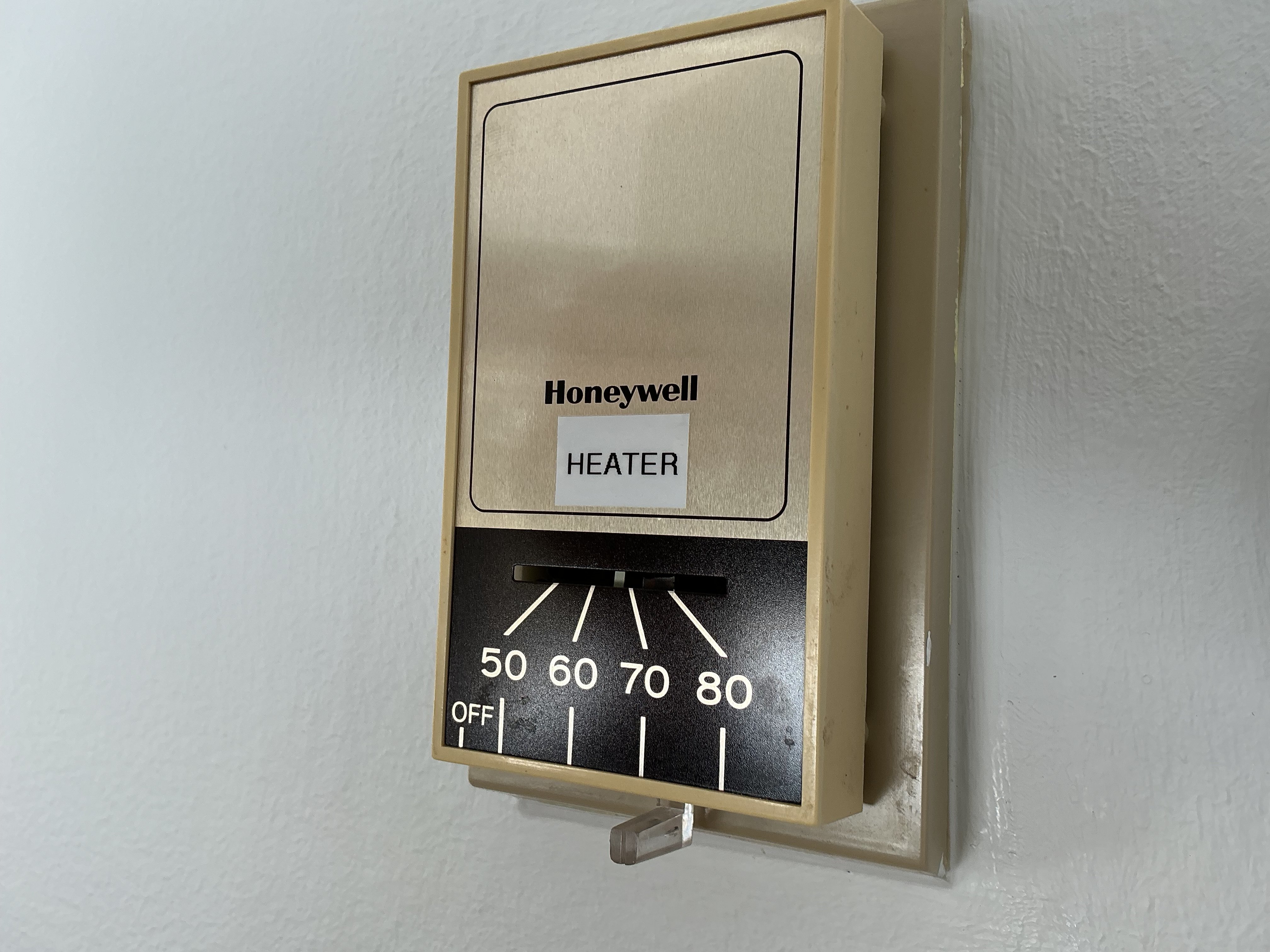
Heres what I currently have………..been here for the 25 years I’ve been in this house. Maybe I’m over reacting and everything is working fine. I just wanted to be sure the cycling of the system was ideal. From what I’ve read here, longer cycles are ideal. Maybe the cycling its running at is normal and I’m just over thinking it.
0 -
Maybe you need to take the cover off and adjust the anticipator setting. Is this a mercury thermostat? IIRC they have a variable resistor heating element near the mercury glass bulb that heats up the bimetallic coil. If that is set to a slower heating setting the burner should run longer.
0 -
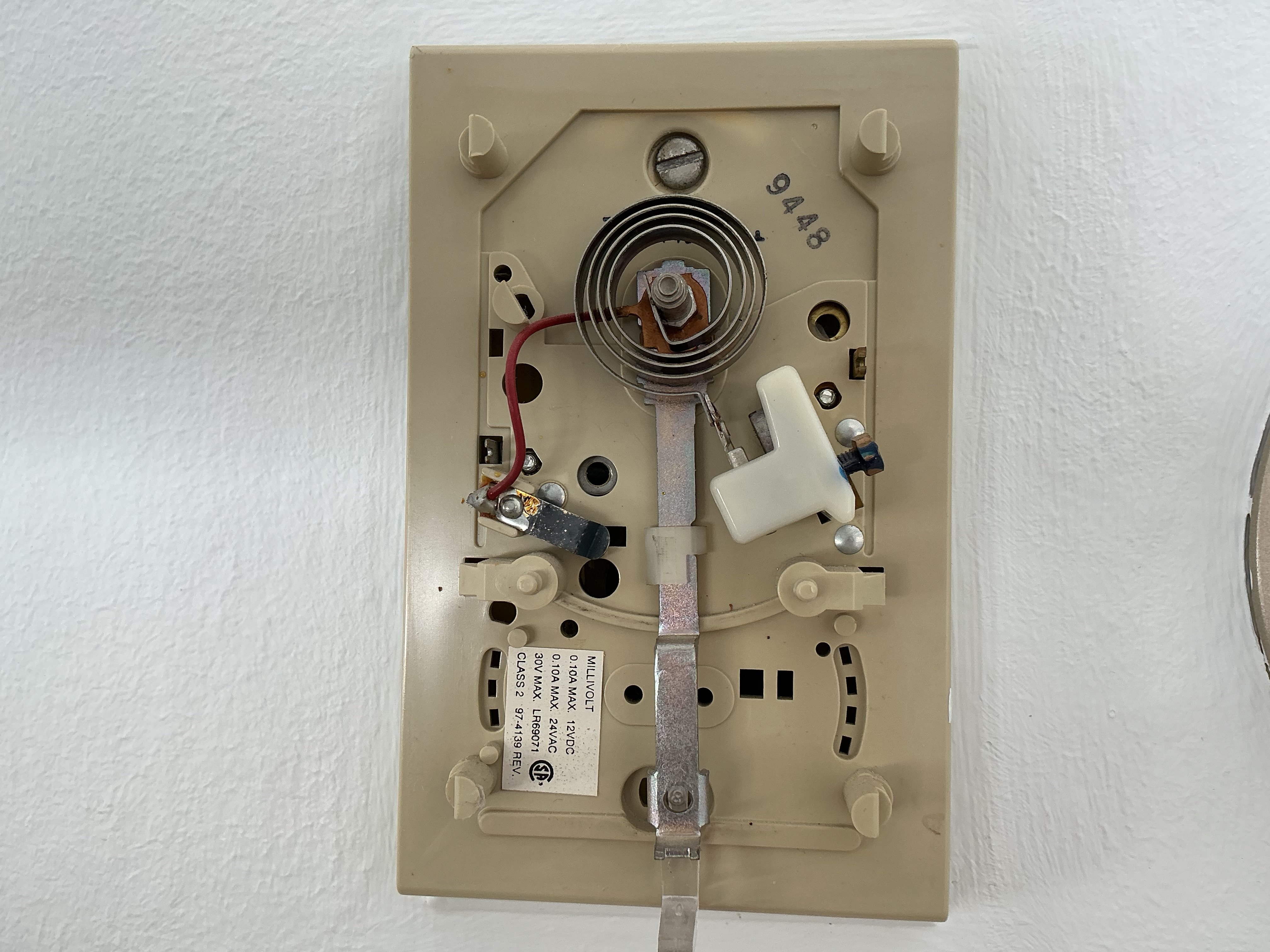
Unless I’m missing something it appears to be an on / off style thermostat. Nothing in the way of additional setting capabilities other than the temperature. Or is the screw on the white L shaped portion it……….i thought that was just a micro adjustment of the metallic spring
 0
0 -
That looks like a snap switch type with no mercury and no anticipator (or at least not an adjustable one). Typical adjustable anticipator heater would draw too much current for a "millivolt" thermostat. This one was designed to be powered by a thermopile only. Date code may be 48th week of 1994.
I think that varnished adjustment screw is just for factory calibration of the switching temperature.
Do you have a millivolt boiler or is there a 24V transformer?
You definitely need a more sophisticated thermostat.
0 -
Hmm. No, that's one of the REALLY simple thermostats! And, in my view anyway, your "on" cycles are a little short for steam — and a little frequent. Again, in my view, you might be well served to replace it with almost any one of the battery powered modern digital ones — they're available Amazon of at the Big Box home stores. It would take the same two wires, but they do need a battery (there are ones which don't — but with just two wires your life will be much simpler with a battery powered one) and is easy enough to hook up.
Something like this
would probably do just fine.
Br. Jamie, osb
Building superintendent/caretaker, 7200 sq. ft. historic house museum with dependencies in New England0 -
Jamie Hall had selected a thermostat that is compatible with a millivolt gas valve system. You should post a photo of the gas valve that operates the burner. If you have a millivolt gas valve operating your steam boiler, you have a power failure proof heating system. You do not need electricity from the grid to operate that boiler.
That said, you must replace that thermostat with one that is compatible with 750 millivolt systems. If you use a 24v. thermostat, there is a possibility that the thermostat contacts will have too much resistance to reliably make the connection on every heating cycle. That could leave you with no heat at times until you cycle the thermostat to reestablish the contacts (off then on)
If, however, you have a different system, and that is the old thermostat from a previous boiler, then that is the wrong thermostat for your system, and that may be the problem with your system cycling problems.
Edward Young Retired
After you make that expensive repair and you still have the same problem, What will you check next?
 1
1 -
@geemalar , you say "The system will run, I’ll get little heat from the 2 closest radiators to the thermostat and then shut down. 5-10 minutes go by and the system cycles again."
If only those first two rads are getting steam, the problem isn't the thermostat. It is the steam distribution in your system.
First thing I'd check is your main vents. If they are missing or inadequate, the radiators further from the boiler will not heat well. Main vents allow the steam leaving the boiler to clear the air from the mains quickly. When the steam reaches them, they close, and now every T joint where a radiator is connected has steam in it. So the steam rises to all the radiators at the same time, and the boiler doesn't have to run as long to get heat to all the radiators. This can save quite a bit of fuel.
Take some pics of your boiler, the ends of your steam mains and one or two radiators, and post them here. Let's have a look at this.
All Steamed Up, Inc.
Towson, MD, USA
Steam, Vapor & Hot-Water Heating Specialists
Oil & Gas Burner Service
Consulting0 -
@Steamhead - I don’t think I explained it properly……what I meant was that all my radiators get heat, but these 2 being the furthest from the boiler in my dining room and they both have MoM 4s on them, I get less heat on these 2 radiators due to the distance and the small vents. I think I have all my vents set up close to what I want, as the house is comfortable throughout when the system is in full operation.
The point I was trying to make was that there doesnt seem to be a significant amount of heat in the thermostat area yet to continuously make it cycle. It’s as if it’s cycling on its own, the heat isn’t sufficient enough to trip the thermostat. But it must be the thermostat as the system hasn’t generated any pressure to trip the Ptrol.
We just had a mild day here where I live. I happened to be in my basement a half hour ago. …..the boiler had not run for at least an hour or more. The boiler came on, ran for 2 minutes, then shut off. There’s absolutely no heat from the 2 radiators close to the thermostat to affect its operation. It’s puzzling to me……..0 -
Puzzling to me, too. Where is the water level on the sight gauge?
Br. Jamie, osb
Building superintendent/caretaker, 7200 sq. ft. historic house museum with dependencies in New England0 -
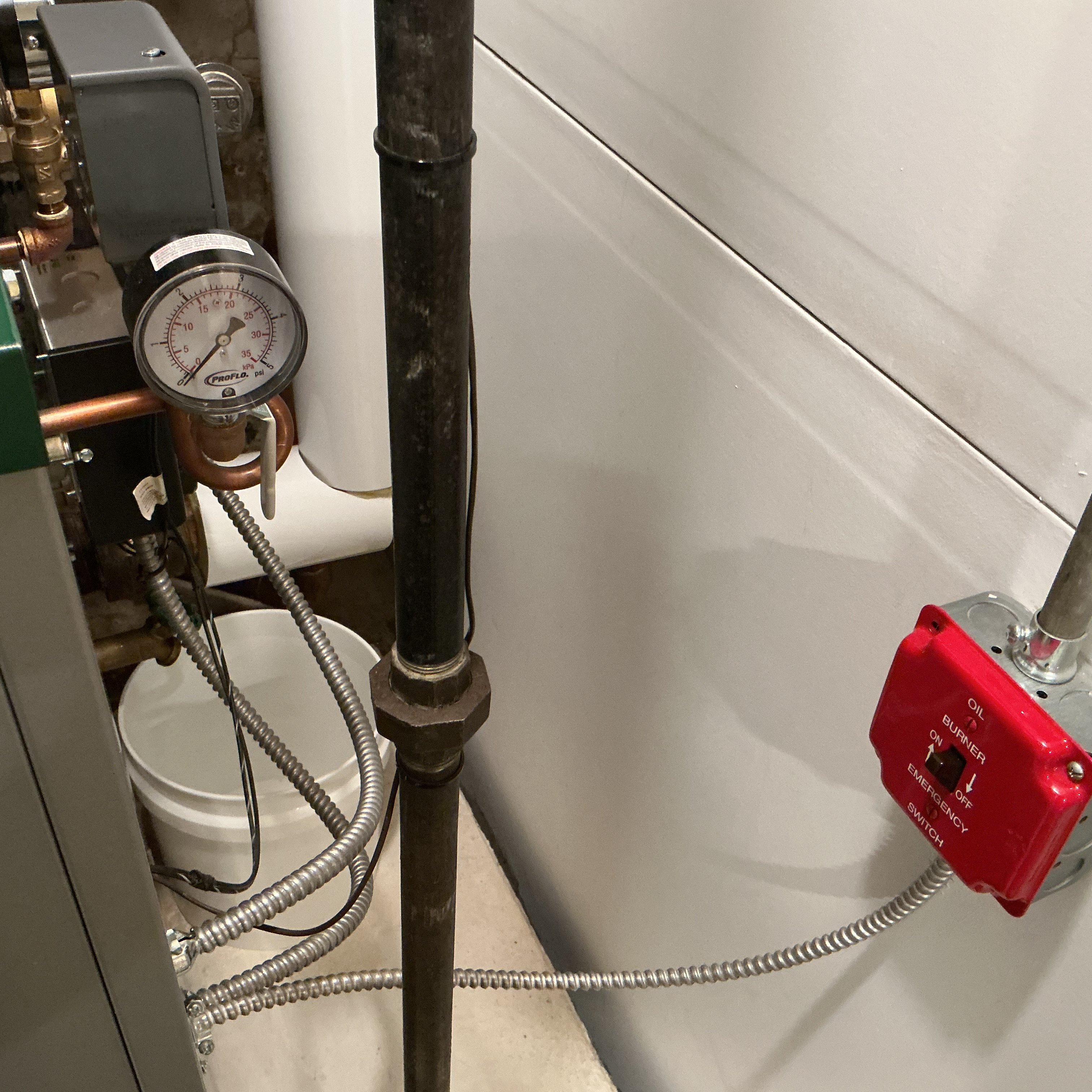
Here’s a picture of the power to the system…..if I need to take a picture of the gas valve that will have to be tomorrow.
 0
0 -
That boiler looks brand new. It couldn't be a millivolt gas valve and you have AC power to the boiler. That thermostat you have has a snap switch in it where the contacts are only rated for 100mA at 24VAC. It is probably in series with controls that are drawing far more than that, unless it is just driving a relay. If it is driving a relay that relay itself may draw more than 100mA.
We would need to see the circuit diagram.
There are so many inexpensive thermostats out there it seems like a no brainer at this point to get one and swap it in.
If you wanted to tinker in the meantime, you could remove the two wires from the thermostat and twist them together and make sure there aren't some defective controls on the boiler causing the early shutdown. Flip that boiler switch off by the boiler before doing that, twist the thermostat wires together and then go down and flip the switch back on and see what's what.
0 -
Some systems have a low water level control that periodically shuts the flame off to do an intermittent test. level check. Here's a link to some info on it. If you have something like this there is are two lights on the top. The green one comes on when the test is performed. But these devices only interrupt the flame for about 2 minutes (see the info)
0 -
@geemalar Said: "It’s as if it’s cycling on its own, the heat isn’t sufficient enough to trip the thermostat. But it must be the thermostat as the system hasn’t generated any pressure to trip the Ptrol."
With the photo of the boiler having a power switch connecting it to the 120v. house power I know exactly what your problem is.
You have the wrong thermostat. that thermostat is from the older boiler that your existing boiler replaced. You can not expect a millivolt thermostat heat anticipator to operate properly when 24 VAC is applied to that thermostat. You need a different thermostat. Just about any thermostat rated at 24 VAC will do what you need without the short cycles you are experiencing with the T822? thermostat you have now.
Replace the thermostat and set it to 1 cycle per hour and see of that solves your problem. This would be a good one to try: https://www.supplyhouse.com/Honeywell-Home-TH1100DV1000-PRO-1000-Non-Programmable-Heat-Only-Vertical-Thermostat
Or you could try the one that @Jamie Hall suggested above.
This has been a problem since the new boiler was installed, Your installer didn't do you any favor by keeping that old thermostat.
Edward Young Retired
After you make that expensive repair and you still have the same problem, What will you check next?
 1
1 -
pretty sure new peerless's usually come with a cyclegard type lwco that stops the burner every x minutes to check the water level. they can be wired 2 ways, one to start the timer when the burner starts firing, and the other is for the timer to continuously run with no information about when the burner is firing. it sounds like yours is wired to do the latter so it might get to its 10 or 15 or 20 minute count 2 minutes after the burner stared.
or it could be a millivolt thermostat with a millivolt anticipator going crazy at 24v ac as @EdTheHeaterMan said. or both.
0 -
@jamiehall - the water level is consistent, it’s just below the normal level mark. It drops slowly about a half inch or less during a full call for heat. There’s no jumping of the water level, it pulses ever so slightly when in operation.
@Edtheheaterman - Thank you for the information. I thought the thermostat was on its way out, sounds as if it was never the correct one with the current system. I’m going to order the TH1100 now, as a heat only vertical thermostat is what I am looking for.
I will report back with the results ………Thanks again all for your assistance in my questions.
 1
1 -
@EdTheHeaterMan For education purposes, can you explain how the installed thermostat creates the long delay time fro turning off the flame to allowing it to reignite?
0 -
I think you are asking how the existing thermostat that is not equipped with a heat anticipator is causing the longer off time as part of the cycle. If I have misread that, I apologize but I will answer that question.
When you do not have a heat anticipator to turn off the burner early, you can get large temperature swing as shown in this graph
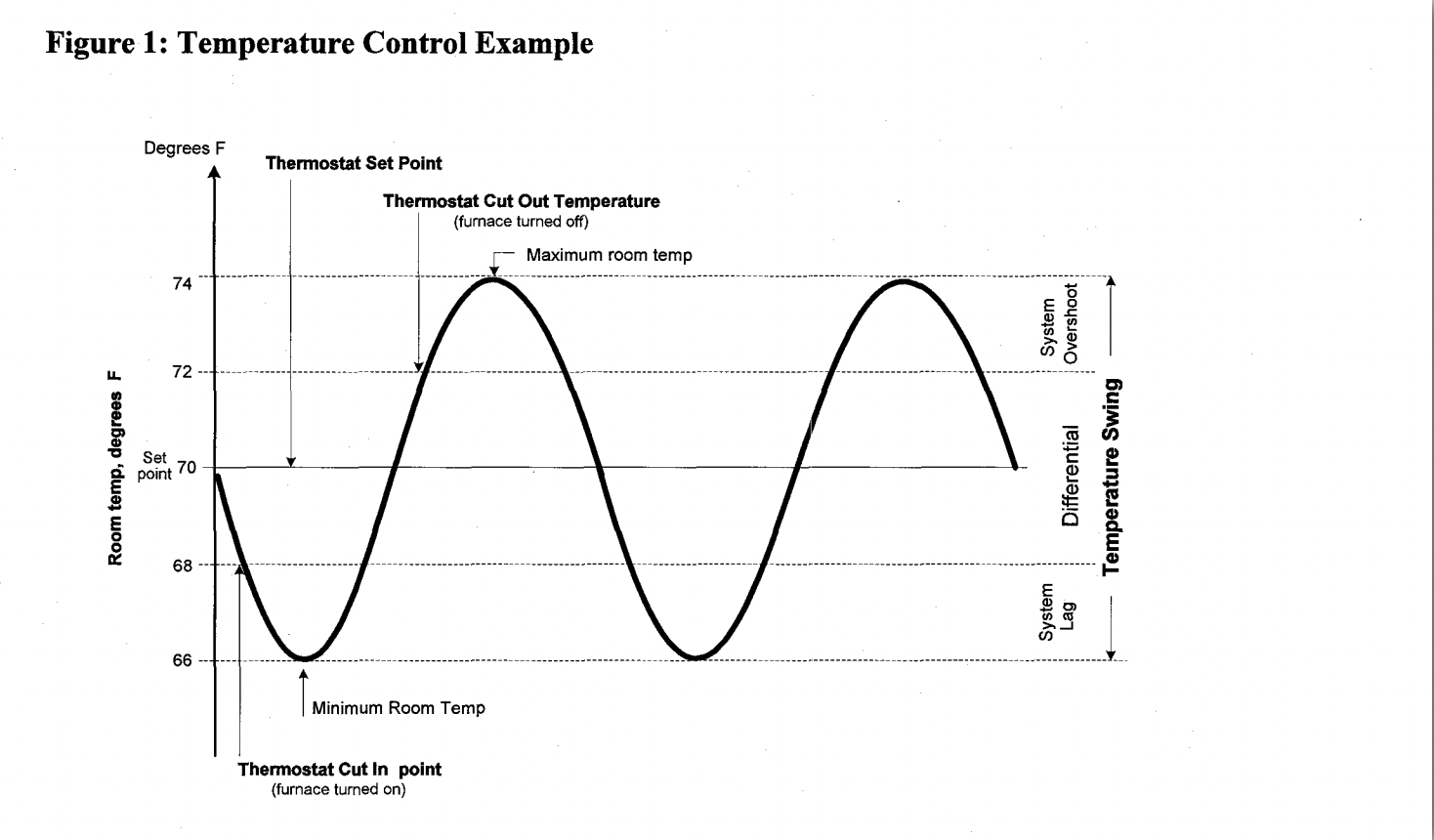
When adding a heat anticipator and tightening up the thermostat differential to about 1.5° to 2° you end up with a room that stays within the comfort zone of the thermostat setting. As shown in this graph overlay in green.
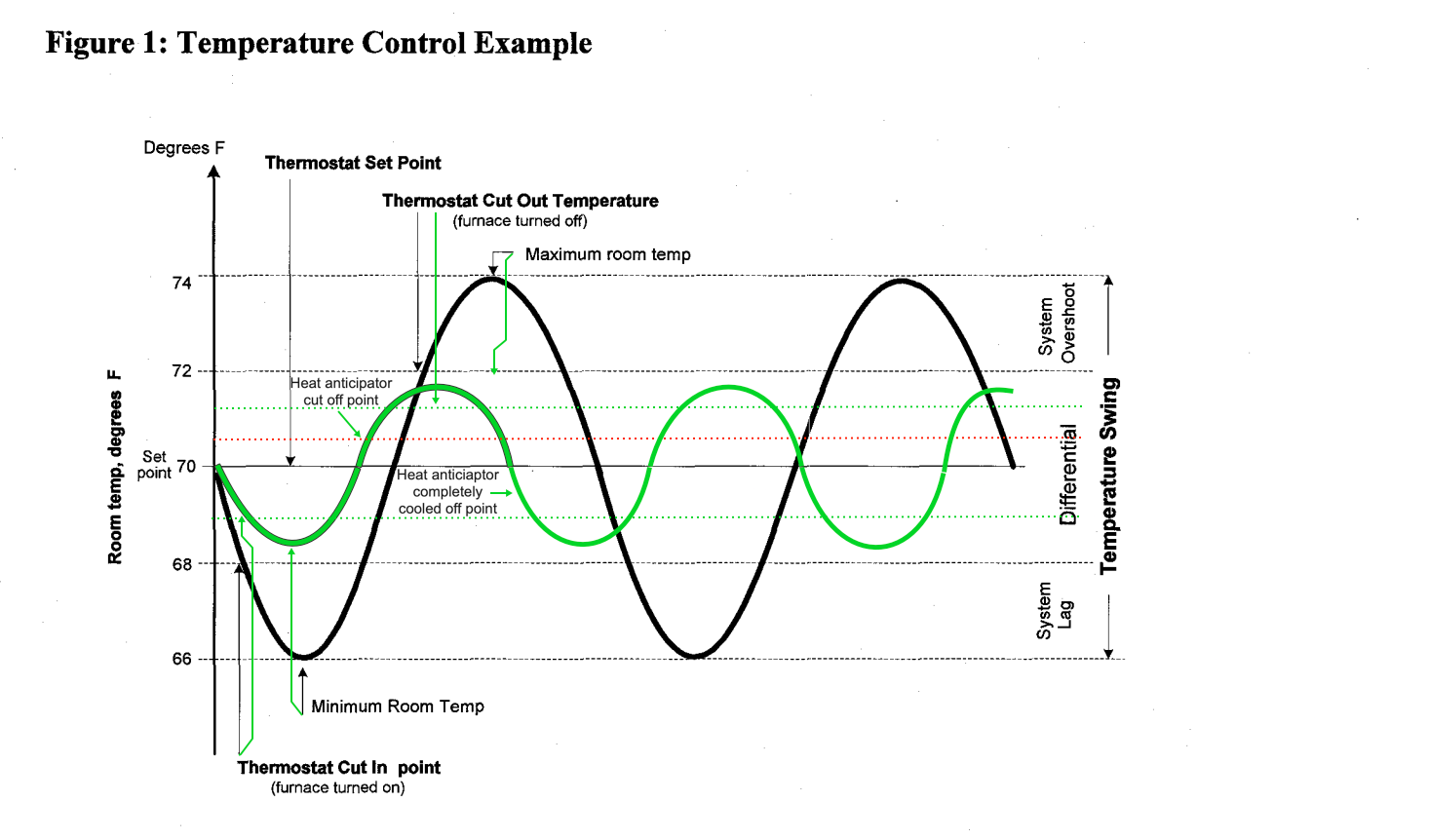
If not properly set to match the controls connected to the thermostat equipped with the heat anticipator, that can happen. In other words if the heat anticipator gets the thermostat too hot too quickly and the call for heat stops too soon, then the room temperature may not get high enough to allow the room temperature to rise above the cut out temperature. This will cause the thermostat to short cycle off of the heat anticipator.
This happens when a thermostat equipped with a heat anticipator is connected to Taco 570 series zone valve. That valve draws a full amp or more of power from the 24v thermostat and overheats the bimetal causing the call for heat to stop before the room gets any heat from a baseboard radiator. Then you find that the zone valve opens and closes about 2 times every 5 minutes and the room never gets enough heat. (ask me how I know this?)
Edward Young Retired
After you make that expensive repair and you still have the same problem, What will you check next?
0 -
I think it is a TS819A (or TS819 with no dual needle/thermometer?) because those didn't have the mercury switch. It probably has a fixed anticipator somewhere that isn't easily seen, just like in the TS822A which was a mercury switch model.
I still wonder why it ran for 2 minutes, switched off for an hour, when obviously it wasn't enough time for the room radiators to even get steam, although if the pipes in the basement are uninsulated that heat could've made it's way into the thermostat room.
I get that this is not to be used with 24VAC and 750mV or less only and 24VAC will heat the anticipator too fast, causing early burner shutdown. It seems like it would normally behave more like he earlier described with lots of cycles close to each other where it didn't shutdown for very long between the short burner on runs.
Maybe since it is only rated for 100mA it is simply drawing so much current that the contacts have become damaged and is acting flaky.
Here's a TS822A with mercury switch where I think the anticipator is visible and attached to the white wire and looks burnt up
0 -
@SteamingatMohawk , under the white piece is the load side contact of the thermostat.
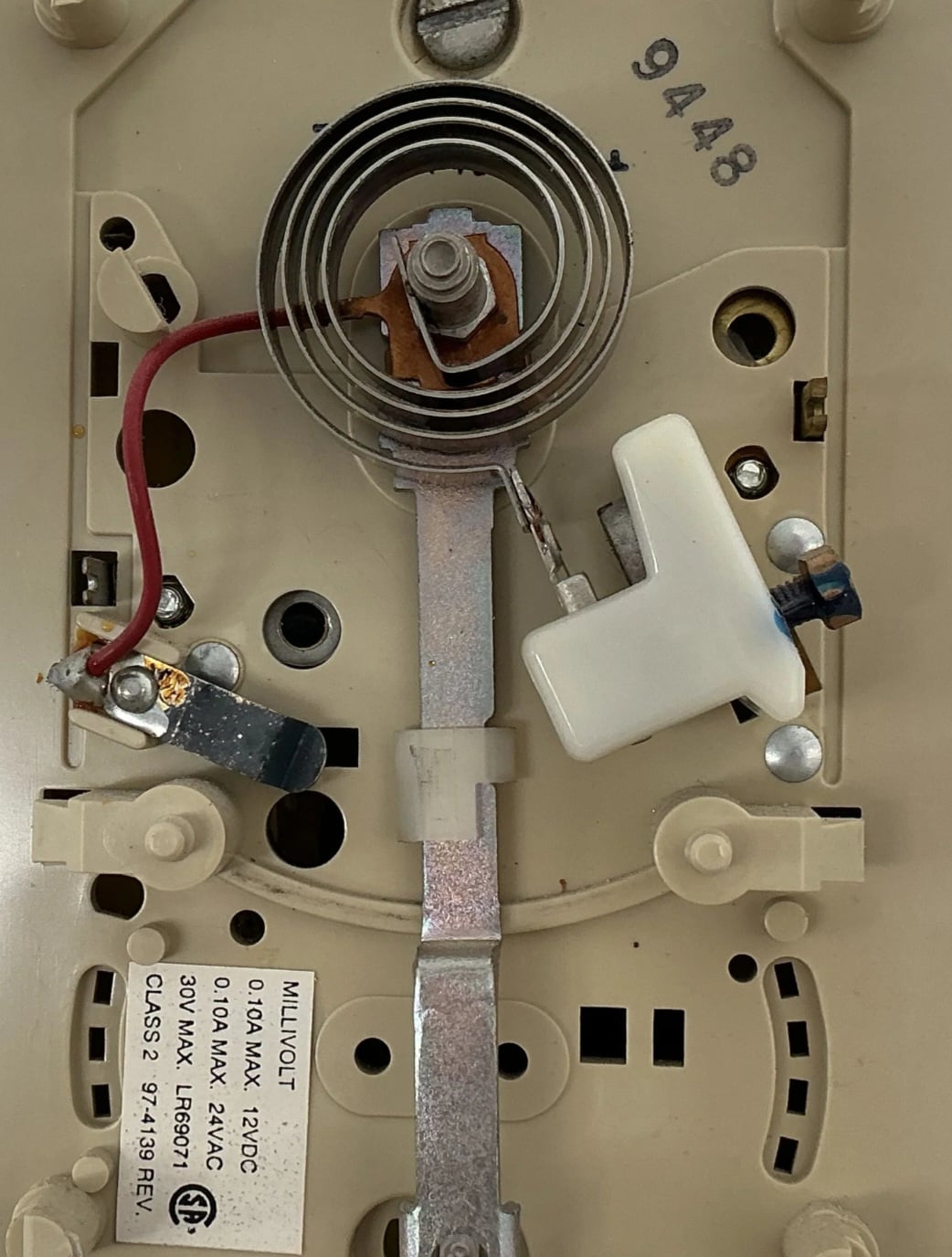
The Red wire connects to the metal coil. The coil expands and contracts with the temperature and moves the White plastic piece to make or break the circuit. The White wire is under it.
The coil design isn't very accurate at keeping even temperatures. Its usually good for at least a 2° swing. That painted screw in the plastic piece looks like some kind of adjustment screw. But I'm not gonna touch it.
0 -
is that anticipator free or does it have an anticipator that works on millivolt or 24vac if the 24vac is under 100 ma? the common fan center they use for isolation of newer boilers has a relay that draws about 375 ma so that would cause the anticipator to end the cycle very early if that is what it has.
0 -
@Captain Who - FWIW the basement main pipes are insulated. I have some main vent upgrades planned this year once there is no longer any call for heat. For now I have 2 Gorton Ds teed off the end of the main. Unfortunately for now the adapter in the main only has a 1/8 inch port. I plan to pull out the adapter and increase the size of the vent size and tubing.
 1
1 -
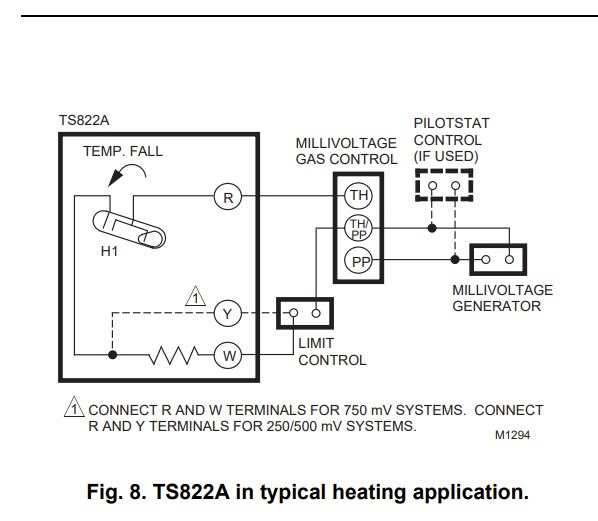
Hard to find info. on the snap switch TS819 but the TS822A mercury switch one was also for millivolt only use and it shows a non adjustable anticipator resistance in this diagram. I'm "assuming" the TS819 had one as well
 0
0 -
Awesome, I didn't expect all the analysis.
Here's my summary at a 5th grade level (LOL). Too much current flow through the anticipator heats it up too much. It shuts off the boiler and takes a long time to cool down and reset so the boiler can run again.
PS: In my working days I was a charts and graphs kind of guy, along with 38 years of working in the nuclear navy business in NY and CT. Learned a lot there and tremendously proud of it. That being said when I bought my rental in 1989, I had a lot to learn about residential steam heat…thanks to all the folks at HH giving me great guidance (Jamie, ChrisJ, Ethicalpaul, and others) and validation of some of the things I did along the way.
Every chance I get, I mention HH to people I deal with in the heating business.
 1
1 -
Except why would the anticipator resistor take a long time to cool down unless the contacts of the snap switch were damaged by too high current for too long and they were allowing a trickle current through but not enough to trip the isolation relay or whatever other circuitry the signal goes through to turn the burner on or keep it on?
0 -
the anticipator is designed to take a long time to cool down or more specifically the thermostat bimetal element which it heated. otherwise it would cool down and flip back on before the anticipated heat arrived from the system. at 3x the rated current it is probably putting about 5x the designed power in to the element.
0 -
The previous behavior observed was short on time followed by short off time and this was repeating enough that the house was fairly comfortable even though the radiators in the thermostat room were not getting steam due to distance from the boiler and smaller venting. Now all of a sudden though it was very short on time followed by a very long off time. Why would all of a sudden an even shorter on time than ever heat the bimetal coil for a longer time than ever? It has to be damaged contacts in the snap switch.
It is hard to tell exactly what is going on without a more concise detail of the on times and off times consecutively over the day.
0 -
i don't think they said that the behavior changed since the new boiler was installed but power is a square of the current so if they are putting 3x-4x the rated current through the anticipator it will get to a much higher temp than it did with the millivolt system. it can only transfer in to the bimetal coil so fast and cause the system to turn off so it likely is putting more energy in to the element than with the millivolt system.
0 -
What makes you think from what I have written in this thread that I don't understand that the anticipator is probably getting more current than it was rated for? Am I not writing clearly? It was an interesting puzzle is all and got my interest and I'm interested in old thermostats.
You don't think the behavior changed. OK well it sounds to me like it did from what I read that @geemalar has written:
"My system doesn’t appear to have long run times and cycles more than I believe it should."
"I’m just wondering if the thermostat is cycling the system too often. The system will run, I’ll get little heat from the 2 closest radiators to the thermostat and then shut down. 5-10 minutes go by and the system cycles again. "
And then most recently there was this which certainly sounds different to me:
"I happened to be in my basement a half hour ago. …..the boiler had not run for at least an hour or more. The boiler came on, ran for 2 minutes, then shut off. There’s absolutely no heat from the 2 radiators close to the thermostat to affect its operation."
0 -
Do you have a Cyclegard or some other low water level control? Maybe there's some kind of magic going on with the water level. Like barely enough for the boiler to start, but not enough to let it keep running once steam leaves the boiler, then a "long" time for it to reset. This is just a wild guess.
1 -
I don't believe it's water level related, as the level in the sight glass only drops 1/4 inch or so, without any significant surging, during any heating cycle. Both sight glass ports are clean and free flowing into the boiler cavity.
The new thermostat shows delivery later on today, I will attempt to install it tomorrow. Once I do I will report back.
0 -
there is either a cyclegard or safgard in the picture, probably a cyclegard since i think that is what peerless provides. i mentioned that about 30 comments ago.
0 -
I believe that is anticipator free
Edward Young Retired
After you make that expensive repair and you still have the same problem, What will you check next?
0 -
@geemalar Don't destroy the evidence; we need to dissect it for science 🤣. With a millohmmeter you could see if you measure any sudden change in resistance when the snap switch goes from open to closed.
0 -
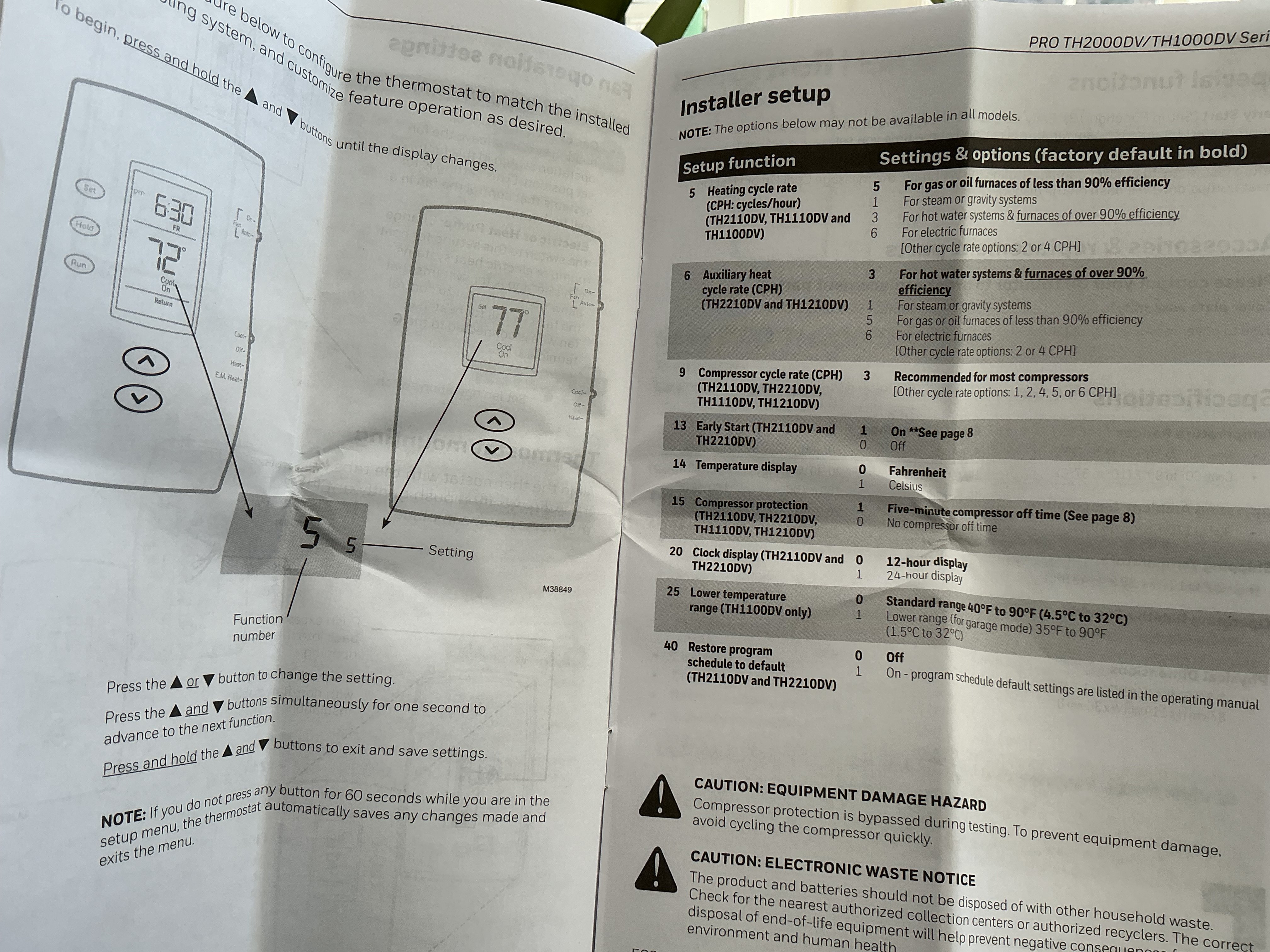
So just wanted to report back on this………installed a Honeywell TH1100 DV non programmable heat only vertical thermostat about an hour ago. Heat appears to run continuously longer than previously. Doesn't appear to short cycle like it did before. I had to eventually shut it off as it's finally warmed up here in northern NJ. I'll keep an eye out on it tonight when it gets back down into the 30's.
There was a previous mention of setting this thermostat to one cycle per hour……I just want to make sure that in setup function #5 I need to have it set to setting number 1 for steam and gravity systems. I just want to make sure it's set correctly.
Thank you to everyone who offered their assistance, and a special thank you to Ed The Heater Man for pinpointing the thermostat as being the issue.
0 -
Yeah use 1 or maybe 2 if that is an option. Try 1 and if it feels cold before it fires again bump it up to 2.
1 -
I find if the system is well vented, 3 works well. Not all thermostats have an option for 2.
All Steamed Up, Inc.
Towson, MD, USA
Steam, Vapor & Hot-Water Heating Specialists
Oil & Gas Burner Service
Consulting2 -
the lower the cph is the slightly more efficient it will be but it isn't much. i wouldn't freeze at one to have an extra $500 when i die if it doesn't have enough mass to keep the heat even at 1.
0 -
Can someone please explain to me the CPH strategy………I currently have the thermostat set to 1. Does that mean the system will only cycle a maximum of one time per hour? Im trying to understand how the CPH functions in relation to the system.
I thought the system runs until either the thermostat setting is achieved, or is shut off once you reach your Ptrol setting.0


Categories
- All Categories
- 87.6K THE MAIN WALL
- 3.3K A-C, Heat Pumps & Refrigeration
- 59 Biomass
- 429 Carbon Monoxide Awareness
- 124 Chimneys & Flues
- 2.2K Domestic Hot Water
- 5.9K Gas Heating
- 119 Geothermal
- 168 Indoor-Air Quality
- 3.8K Oil Heating
- 78 Pipe Deterioration
- 1K Plumbing
- 6.6K Radiant Heating
- 394 Solar
- 16K Strictly Steam
- 3.5K Thermostats and Controls
- 56 Water Quality
- 51 Industry Classes
- 50 Job Opportunities
- 18 Recall Announcements