Heatnglow TownsendII-LP

I've been working with this heatnglow stove and the issue is it will run for 10-30 mins and then the gas valve will shut down completely. I have replaced the pilot assembly and gas valve with the same issue happening. Tech support told me it was a bad thermocouple. I again replaced the thermocouple and used a test adapter allowing me to test the thermocouple in line with the gas valve. It tests in range initially but as the fireplace is on I slowly lose millivolts until there so low the gas valve shuts down. I have verified the venting, verified the pilot is making good contact with the thermocouple, and tried it various ways (logs in, reposition logs, no logs, glass on an off). Curious if anyone has any ideas on what could be the issue.
Comments
-
Some Heat & Glo products are designed for non-vented (vent-free) applications. In those models, the flame input is typically limited — often under 30,000 BTU/hr — because vent-free appliances must meet strict combustion and safety standards.
What model number is your gas log?
If you have a vent-free model, it can generally be installed in a vented fireplace behind glass doors, but it is specifically engineered to operate without a chimney draft. In order to be approved as a vent-free gas appliance, it must include a safety device that shuts down the burner if oxygen levels in the room drop below a safe threshold.
That safety device is called an Oxygen Depletion Sensor (ODS).
The ODS system typically consists of a precisely engineered pilot burner and a carefully calibrated orifice. It works in combination with a thermocouple (or thermopile). As the oxygen level in the room decreases, the pilot flame characteristics change — it becomes smaller and lifts slightly off the burner. When the flame can no longer properly heat the thermocouple, the millivolt signal drops, the gas valve closes, and the appliance shuts down.
It does not wait until all breathable oxygen is consumed. The shutdown occurs well before dangerous oxygen deprivation levels are reached. It is a preventive safety measure.
Given the location of your gas log inside the fireplace — particularly if glass doors are closed or airflow is restricted — is it possible that the oxygen level around the burner is dropping during a 30-minute burn? If so, the ODS may simply be doing exactly what it was designed to do.
Edward Young Retired
After you make that expensive repair and you still have the same problem, What will you check next?
 1
1 -
Thanks for your input but it is not a vent free fireplace. There are no added safety features and has been working in this room with no changes for 30 years.
0 -
It appears the Townsend II has a Thermocouple and a Thermopile.
Just to be clear, so when it acts up
" it will run for 10-30 mins and then the gas valve will shut down completely "
The pilot flame goes out ?

https://manuals.fire-parts.com/aws-assets/heat-n-glo-townsend-ii-townsend_ii-pdf.pdf?inline=true
National - U.S. Gas Boiler 45+ Years Old
Steam 300 SQ. FT. - EDR 347
One Pipe System0 -
Yes pilot goes out. The thermopile tests in proper range but the thermocouple slowly loses millivolts as the burner is on until it drops the gas valve out.
0 -
Can you watch the pilot flame as the milliVolts drop ?
Since you replaced the pilot assembly I wonder if they sent you a pilot assembly that has the Oxygen Depletion Sensors (ODS) built in. And that is not correct for your unit.
Apparently Oxygen Depletion Sensors (ODS) effectively moves the flame away from the thermocouple to cool the thermocouple enough so the gas valve shuts off the pilot flame.
I wonder if this all started with a bad thermocouple then other issues were introduced into the situation by changing other parts causing similar but different problems.
With a good pilot flame sufficiently and consistently heating the thermocouple the milliVolts should not drop.
National - U.S. Gas Boiler 45+ Years Old
Steam 300 SQ. FT. - EDR 347
One Pipe System0 -
I've looked into the ODS you bring up and it doesn't have that. I can see the pilot flame clearly especially when I had the logs removed and it is in full contact with the thermocouple.
0 -
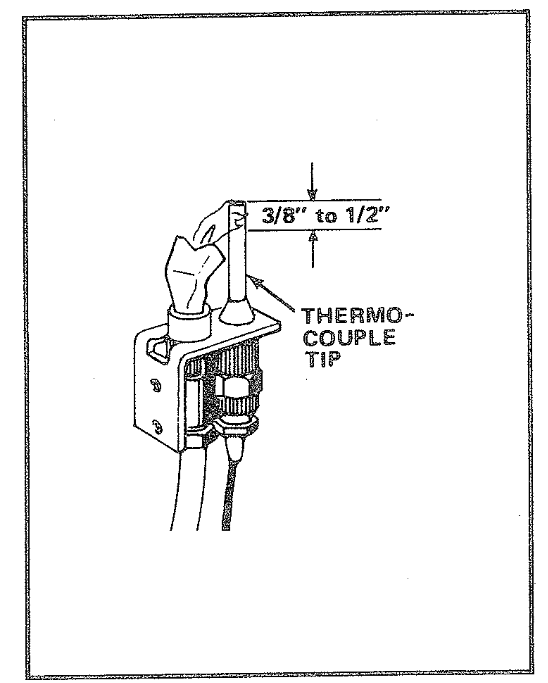
Well if the flame seems consistent and is sufficiently engulfing the end 1/2 inch of the thermocouple until the instant 'it just goes out', I try a different thermocouple, probably the least expensive thing commonly available. No kinks in the thermocouple cable.
Image from an old boiler manual.
 National - U.S. Gas Boiler 45+ Years Old
Steam 300 SQ. FT. - EDR 347
One Pipe System0 -
I've tried multiple thermocouples with the same results. This one really has me stumped.
0 -
I can think of a bunch of independent tests I would do in your situation. However I have many Electrical / Electronic toys to play with.
One thing I think you could do is remove the thermocouple voltage test adapter from the gas valve and monitor the thermocouple voltage while holding the gas valve's pilot push to light control and monitor the thermocouple's voltage with the pilot lit. This effectively removes the load of the gas valve's pilot solenoid. See what the voltage does.
You could also do an independent test with a propane torch heating the thermocouple. You have to be careful to not let any raw propane gas into the living space. Either light the pilot also or shut the gas off the the heater.
With the multiple thermocouples you tried were some from different manufactures ?
National - U.S. Gas Boiler 45+ Years Old
Steam 300 SQ. FT. - EDR 347
One Pipe System0 -
I have tested the thermocouple off the gas valve holding the knob down and it stays consistent between 23-25 millivolts. It only drops millivolts when the burner is on. Yes I've tried various thermocouples all with the same results.
0 -
The reason ODS keeps coming up it's that what you're describing is the expected behavior of an ODS pilot during an oxygen deficiency event. Don't be offended, but you're sure you've got the correct pilot assembly, not an upgraded assembly with ODS?
The next things I'd check are pilot gas pressure, to see if it's dropping due to perhaps an obstruction in the pilot tube or orifice, and power delivered to the valve (voltage and current together) up to pilot failure. Maybe cold & hot resistance (before pilot ignition & immediately after pilot failure) of the gas valve itself, even though it sounds like you already changed it. Two identical failures is very unlikely—but not completely impossible, and would explain the issue.
0 -
Something else just came to mind. You said LP in the subject. Any chance your tank is cold enough that you're fractionating & not getting the right mixture to burn properly with your pilot assembly?
 1
1 -
That is a common misconception among non-professionals. The fact that an appliance is installed in a vented fireplace does not necessarily mean it does not use an ODS (Oxygen Depletion Sensor) pilot assembly.
While a vented appliance cannot be safely operated in a non-vented configuration, a vent-free (non-vented) appliance may be installed in a vented fireplace, provided it is listed and installed according to the manufacturer’s instructions.
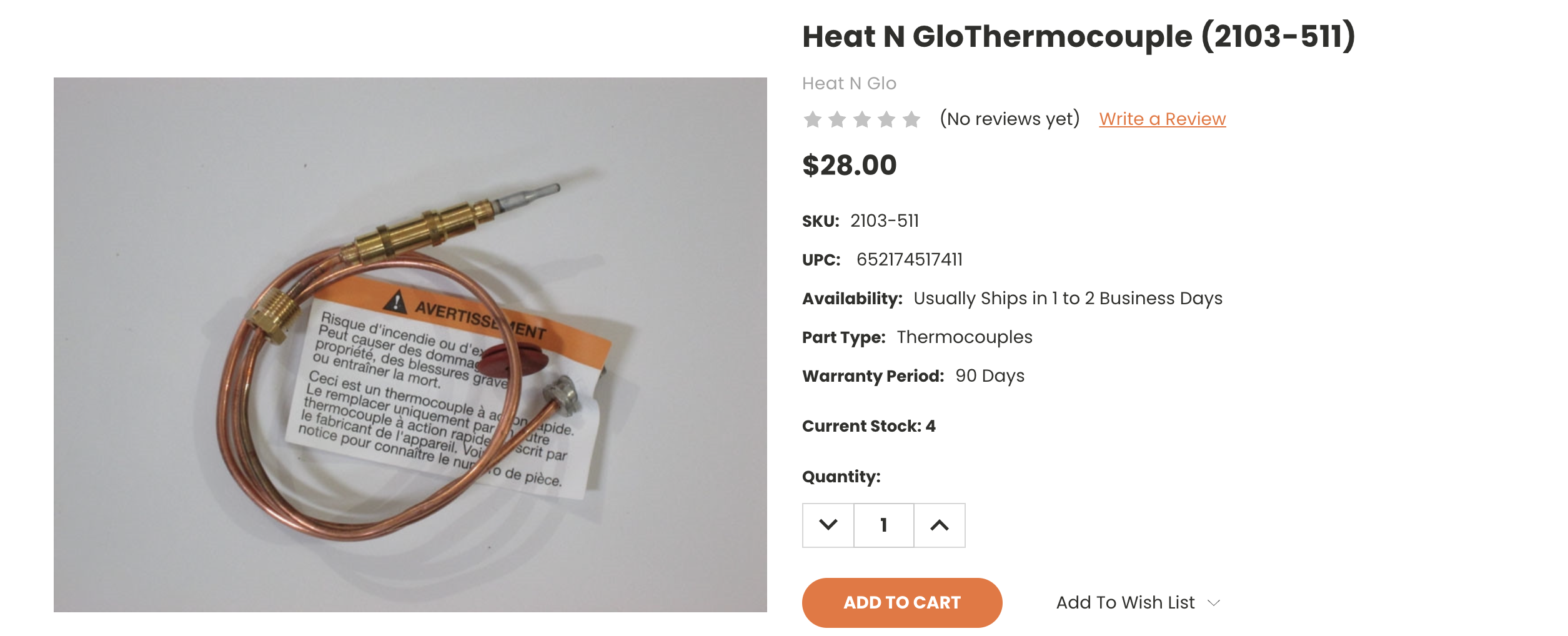
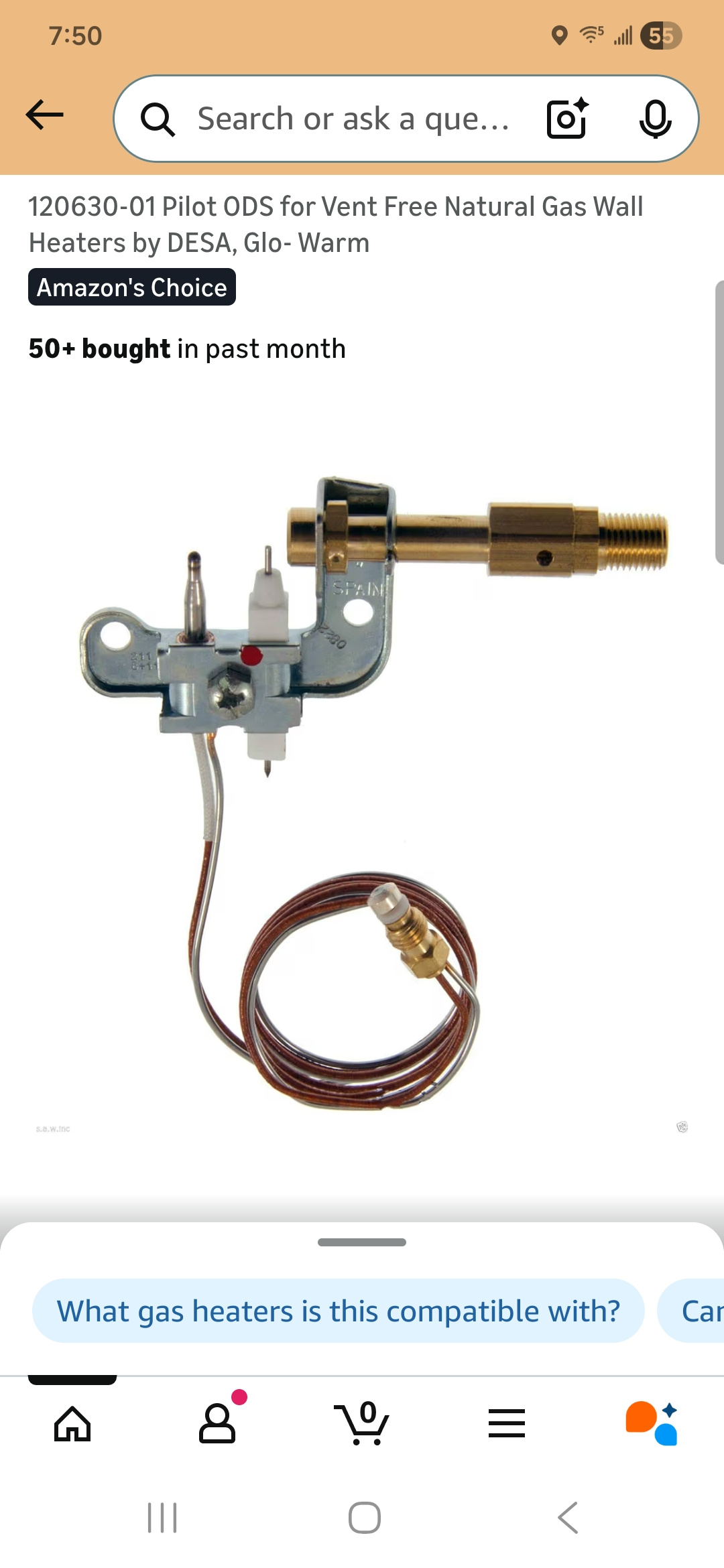
The part number you referenced is, in fact, an ODS pilot thermocouple assembly. There is a distinct design difference between a standard pilot assembly and an ODS pilot. The ODS pilot is specifically engineered with a calibrated air intake and orifice to respond to changes in ambient oxygen levels.
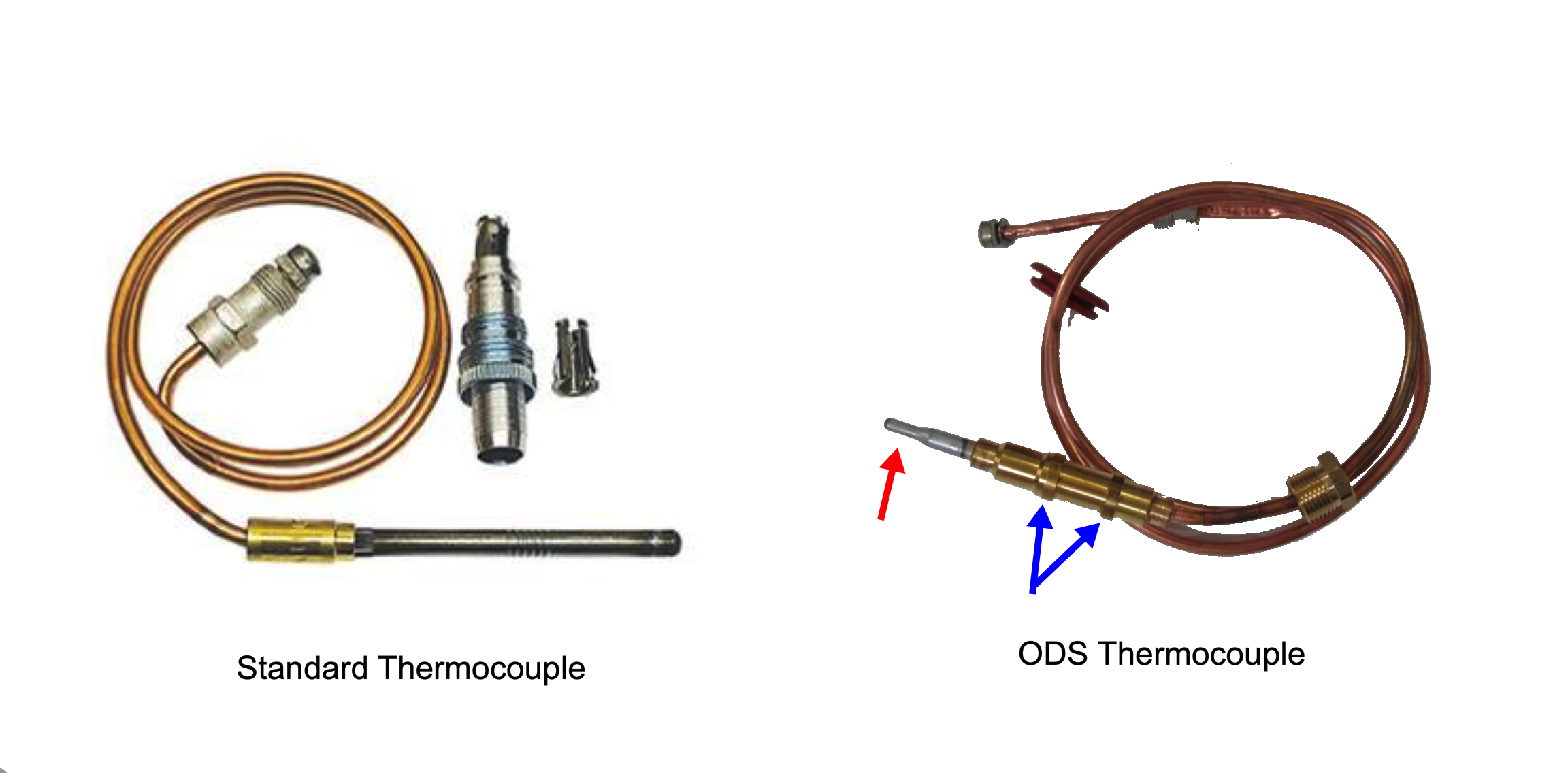
The difference is noticeable: the thermocouple on the left is smooth and allows for adjusting how far the tip can be pushed up into the pilot flame. The one on the right has a precise dimension on the sensing tip (Red Arrow) and two machined ridges (Blue Arrows) to ensure that thermocouple insertion can NOT be adjusted.
Based on the model number you provided, your appliance is equipped with an ODS system. Given the symptoms you are describing, it is very likely that the unit is shutting down due to oxygen depletion or restricted pilot combustion air.
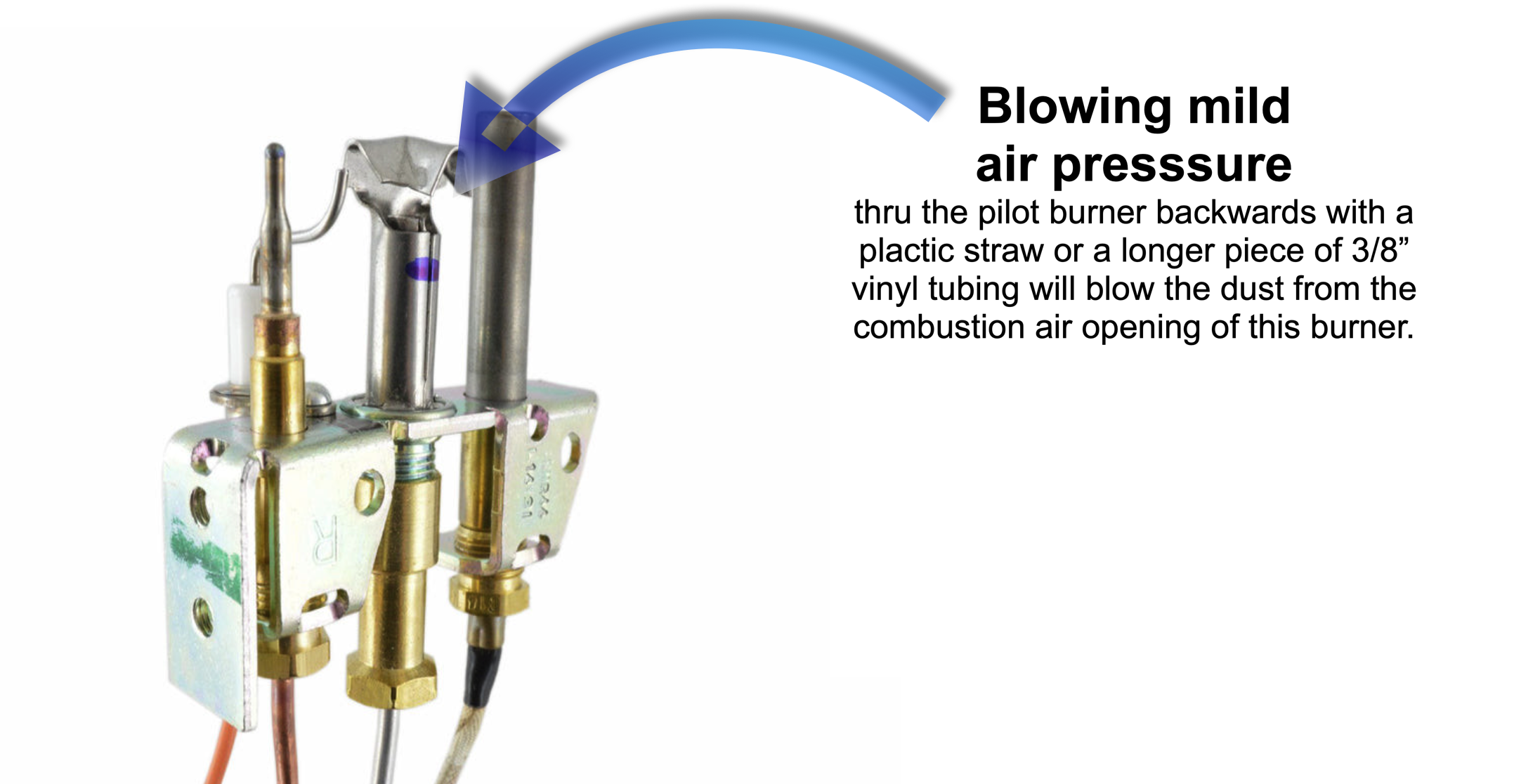
One common cause of this condition is lint or dust accumulation in the pilot air intake opening. Even minor debris can alter the pilot flame characteristics enough to reduce thermocouple output and cause nuisance shutdowns.
I recall resolving a similar issue for a customer by carefully clearing lint from the pilot’s combustion air opening. by blowing the lint away with a plastic straw. In that particular case, the issue recurred approximately every two years due to environmental dust buildup. The customer called it the McDonalds straw procedure
You might ask: "Then why did appliance operate properly for 30 years and has only recently begun exhibiting this problem?" That suggests an environmental change in the room. Possible contributing factors could include:
- New carpeting or flooring.
- A new pet that sheds.
- Changes in cleaning methods (for example, no longer using a central vacuum system)
- Increased airborne dust or lint in the space.
- New HVAC system with an air filter that is not as good as the previous system.
Something in the environment is likely contributing to debris accumulation at the pilot air intake. Identifying that change may help prevent recurrence, or maybe you just need to clean the intake more often, as a result of a change that you just can't pinpoint.
Hope this helps
Mr. Ed
Edward Young Retired
After you make that expensive repair and you still have the same problem, What will you check next?
0 -
Since it only goes out when the main burner is being used to me it seems like an oxygen (due to an environmental change), fuel or fuel delivery issue. The gas valve and pilot assembly has been changed and numerous thermocouples tried.
Have you tried to run it with the nearest window to the outside open a bit ?
National - U.S. Gas Boiler 45+ Years Old
Steam 300 SQ. FT. - EDR 347
One Pipe System0 -
Mr Ed,
Thanks for clarifying things better on the ODS, that is the thermocouple installed on this unit. Does the fact that the pilot is abnormally loud help solidify this? I'm new to working on fireplaces everything is helpful! Usually work on boilers and furnaces.
1 -
The noisy pilot may be a sign of the partially clogged pilot combustion air inlet. The gas pressure may also be a little high causing the noise. But I do remember those pilots can be a little noisy.
The first time that I ever worked on a space heater with an ODS pilot, I could not figure out why the pilot flame was not reaching the tip of the thermocouple. (it was probably dust or lint). I also knew that when that happens you would just push the thermocouple up to the pilot flame on a regular pilot burner. So I destroyed the pilot burner so the bracket let me push the thermocouple closer to the flame. That fixed that problem!!!
A few weeks later I was reading an article about ODS pilots and thermocouples and realized that I destroyed a very important safety feature of that customer's heater. I tried to call her several times and could not get her to call me back. I finally sent her a certified letter, that she signed for, explaining my error and my offer to fix what I damaged at no charge to her. Never got the call from her. She is probably dead by now, I hope it was not because of the ODS being tampered with. Oh Well. We were all stupid at one time or another.
Edward Young Retired
After you make that expensive repair and you still have the same problem, What will you check next?
0 -
Mr Ed,
My question for you is if it is an ODS thermocouple why is it dropping millivolts with a good constant pilot flame on the sensor? If I'm correct the thermocouple is not going to detect lack of oxygen? I have tried running the fireplace with the glass open which should indicate a good flow of oxygen along with the fact the pilot flame never lifts at all off the thermocouple.
I know its not a reliable source but whenever I look up an ODS pilot assembly this is what I find. I understand it may be an ODS compatible thermocouple but with good pilot flame on the thermocouple just curious why it would still lose millivolts considering the thermocouple doesn't register oxygen levels.
0 -
National - U.S. Gas Boiler 45+ Years Old
Steam 300 SQ. FT. - EDR 347
One Pipe System0 -
My question for you is if it is an ODS thermocouple why is it dropping millivolts with a good constant pilot flame on the sensor?
I would ask you to look closely at the pilot flame. This is a precision-machined pilot burner with a precision-machined orifice and a precision-machined combustion air opening designed to produce a very specific pilot flame that just touches the tip of the thermocouple.
Unlike the pilot flames you might find on a gas boiler, furnace, or water heater—where the thermocouple is completely engulfed in the flame—only a very small portion of the thermocouple is actually in contact with this flame. Look carefully at the pilot flame and the tip of the thermocouple. Then observe the shape of the pilot flame when the meter reading begins to drop.
In the following photos of two different burners, you can see a distinct difference in the flame patterns. The top two photos are from a YouTube video showing what the flame looks like when the combustion air opening is unobstructed. When the man blocks the combustion air opening with his fingers, the pilot flame actually becomes larger but pulls away from the thermocouple. As a result of the reduced combustion air, the millivolt output drops and eventually the gas valve closes. This demonstrates how, even in a room with plenty of oxygen, problems can occur if the combustion air opening to the pilot flame becomes blocked by lint or dust.
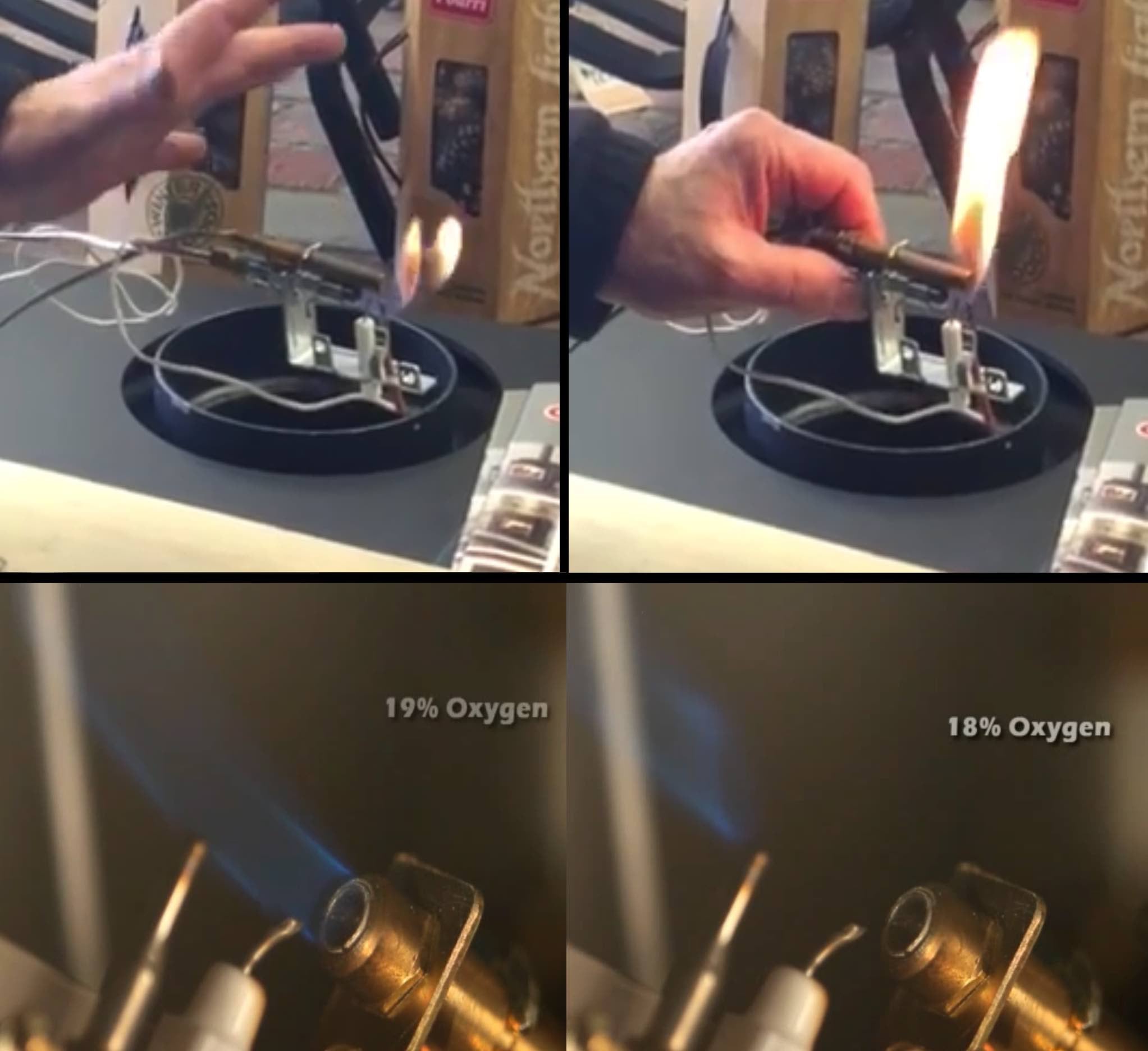
In the lower two photos, showing a different burner, the oxygen level in the room itself is depleted. You can see the flame lifting and jumping off the pilot burner as it searches for more air to burn. The flame lifts so far away from the burner that it is no longer near the tip of the thermocouple. As the millivolt signal decreases, the pilot flame drops out and the gas valve shuts off.
Thanks to @109A_5 for the YouTube video links.
@Cincodemayer214, did you try blowing the dust off of the pilot burner?
Edward Young Retired
After you make that expensive repair and you still have the same problem, What will you check next?
0


Categories
- All Categories
- 87.6K THE MAIN WALL
- 3.3K A-C, Heat Pumps & Refrigeration
- 59 Biomass
- 430 Carbon Monoxide Awareness
- 124 Chimneys & Flues
- 2.2K Domestic Hot Water
- 5.9K Gas Heating
- 120 Geothermal
- 168 Indoor-Air Quality
- 3.8K Oil Heating
- 78 Pipe Deterioration
- 1K Plumbing
- 6.6K Radiant Heating
- 394 Solar
- 16K Strictly Steam
- 3.5K Thermostats and Controls
- 56 Water Quality
- 51 Industry Classes
- 50 Job Opportunities
- 18 Recall Announcements