Approaches to reducing boiler size
Comments
-
@EdTheHeaterMan , good you brought this up. I am quite clear on what the terms mean.
Maintaining pressure during a call for heat will result in the shortest call time possible each time. It is heating the structure at a rate well beyond what was ever originally intended. I think we can agree on that. From lots of experience I know that It also causes totally full hot radiators and frankly, with boilers sized to the radiation like mine, significant overshooting on an average day on each and every call for heat. This then results in longer off cooling periods while all that excess heat dissipates. So I don't think the idea of doing this to supposedly maintain burner efficiency during what amounts to 15 minutes out of each hour makes sense or justifies the resulting unevenness of radiator conditions. Running this way also then creates the coldest possible start on every new call for heat because if I condense the steam production required for a given demand into a smaller window each hour the associated off time which then follows is longer is it not?
My point is that there is no actual advantage to totally filling these systems with steam ever. They were not designed to do that, and because as we all know lots of extra radiation is installed and totally filling it is never required to heat the structure. The notion that burner inefficiency justifies this pressure is simply not true.
Short call times is not an advantage for efficiency and certainly not for comfort. I have spent all these years extending the call time. To do that pressure cannot be allowed at any time.
1926 1000EDR Mouat 2 pipe vapor system,1957 Bryant Boiler 463,000 BTU input, Natural vacuum operation with single solenoid vent, Custom PLC control 1
1 -
about 2,000. Cedric is fired for 1,700.
The logic behind keeping the burner off part of the cycle ishort is to avoid the efficiency loss from reheating the boiler itself — and to avoid allowing any air back into the system.
The overall HEATING off cycle is controlled by the thermostat, not the boiler, and is a different matter altogether. In my case, Cedric is controlled by a mercury T87, centrally located, and there is a temperature swing in the structure of about 1 degree between the call for heat and the temperature reached after any overshoot from residual heat in the radiators (the T87 switches back off at about half a degree above where it switches on, the rest is residual heat). The time between calls varies with structure heat loss, and can be several hours — or less than half an hour (actually even less, if it both windy and cold — which, thankfully, rarely happens; I've never seen the system actually overpowered).
I estimate that the overall heating power available from the system is within 10% of the maximum historic demand — hardly what I would term overdesigned, either from the standpoint of the boiler or of the installed radiation.
Br. Jamie, osb
Building superintendent/caretaker, 7200 sq. ft. historic house museum with dependencies in New England 1
1 -
I've seen a quite a few people tell Paul he shouldn't assume everyone's system behaves like his.
Perhaps comparing 1000 - 2000 sqft systems to tiny 200-400 systems is a very bad idea as well.
Single pipe 392sqft system with an EG-40 rated for 325sqft and it's silent and balanced at all times.
0 -
I quite agree. I try not to, but…
Br. Jamie, osb
Building superintendent/caretaker, 7200 sq. ft. historic house museum with dependencies in New England0 -
I'm happy to be educated about which of the physics fundamentals change about this you guys would like to suggest do so due to size of the system. I freely admit that my inability to think of any certainly doesn't mean there aren't some that flip this whole thing upside down at a certain size.
In the mean time I will state again that even heat means long times between thermostat cut in and cut out not short. Perfectly even heat is a heat cycle (call) that never ends. So the bigger the disparity between time spent calling for heat and and not calling, the less even the heat. I don't think this one is size related either but let me know.
Firing into and maintaining a pressurized system on an average day is inputting heat at a rate multiples higher than is needed to meet the demand and achieves the opposite. The call time will be shortest and the difference between max and min temperatures each call cycle the radiators see will be greatest. That heat is not more even, more efficient, or more pleasant. When you aren't firing so hard and cut out is barely achieved and radiators aren't full to the max, the next cut in is a lot shorter wait.
1926 1000EDR Mouat 2 pipe vapor system,1957 Bryant Boiler 463,000 BTU input, Natural vacuum operation with single solenoid vent, Custom PLC control0 -
@PMJ said: "My point is that there is no actual advantage to totally filling these systems with steam ever. They were not designed to do that, and because as we all know lots of extra radiation is installed and totally filling it is never required to heat the structure."
I might Change one word here:
My point is that there is no actual advantage to totally filling My systems with steam ever. My system was not designed to do that, and because as we all know lots of extra radiation is installed on many systems just like mine, and totally filling it is never required to heat the structure.
And that, in truth, makes sense within this case.
For Paul’s steam may never reach one pound,
Nor Jamie’s “Cedric” build a single PSI —
(And who bestows a name upon a boiler?)
Thus radiators filled with steam throughout
May happen only on design-day cold,
And rightly so when winter shows its teeth.Yet other plants, oversized in scale —
Both boiler mass and radiator spread —
May find full steam in every section cast
Invites an overshoot of roomly heat.
For every system lives its private law;
No twin behaves in quite the selfsame way.In such a house as PMJ describes,
One call per hour may prove too long sustained.
Two measured calls within that hour’s span
May better suit the building’s tempered loss
And guard against excess beyond the mark.The thermostat now governs much of this:
Whether the old round T87F,
Whose anticipator warms by wire’s glow,
Or modern stats with cycles set per hour —
Their logic shapes the overshoot we see.Yet if, mid-call, the pressure climbs too high
And forces short returns of flame — two on,
Then three minutes off in restless turn —
Some tuning should be made before we dream
Of casting out the boiler for a new.Perhaps reduce the firing rate with care,
Or set the pressure control somewhat low,
Or mend the venting so the air escapes
Before the gauge begins its upward march.For steady flame within a call for heat
Is far preferred to cycling born of strain.This poetic verse was brought to you by ChatGPT
I asked it to change this into a poem:
And that makes sense in this situation.
Paul’s system may never reach 1 PSI of steam pressure — nor does Jamie’s Cedric (and honestly, who names their steam boiler?). In those systems, the radiators may only completely fill with steam on true design days, and that may be entirely appropriate under those conditions.
On other systems — particularly those that are oversized in both boiler capacity and radiator EDR — completely filling the radiators with steam can lead to excessive overshoot. Every system behaves differently.
For someone with a system like @PMJ is describing , it may not be desirable to drive the system to full steady-state operation and limit it to only one call for heat per hour. In that case, two calls for heat per hour might better match the building’s heat loss characteristics and reduce overshoot.
Thermostat behavior plays a significant role here. The accuracy and anticipator logic — whether it’s the classic anticipator in a Honeywell T87F or the cycles-per-hour (CPH) setting in a modern electronic thermostat — largely determine how much overshoot occurs.
However, during an active call for heat, if the boiler pressure reaches the pressure control setting and begins short-cycling — for example, two minutes on and three minutes off — that indicates a mismatch somewhere in the system.
Something needs tweaking, short of replacing the boiler with one more closely matched to the connected radiator EDR, other adjustments should be considered, such as:
- Reducing the firing rate (if combustion parameters allow),
- Adjusting the pressure control setting,
- Or improving system venting to reduce pressure buildup.
The goal is stable operation during a call for heat — not excessive pressure buildup followed by rapid cycling.
Edward Young Retired
After you make that expensive repair and you still have the same problem, What will you check next?
0 -
I think the goal is most consistent radiator temperature and to try to maintain steam condensation within the radiator for as long as possible, even extending well into the burner off time. Not letting the air back into the system maintains condensation within the radiator for a time far exceeding the burner on time. When the air is allowed back into the radiators the radiator temperature rapidly drops as condensation comes to a rapid halt, and it takes longer for the water in the boiler to come back to a boil upon the next initiation of the burner on time and takes time for the steam to re-enter the radiators for condensation to begin again. All this combines to require the call for heat duty cycle to be larger, fuel usage to increase, and comfort level to drop.
0 -
@EdTheHeaterMan , Thanks for the comments. I see folks running for the exits under the "Every System is Unique" banner but ok. My Mouat system is 100% stock piping as installed 100 years ago and obviously they did many systems to this standard. Granted, many systems have had unfortunate modifications done. My purpose is to discuss fundamentals which I don't think change all that much. Some systems are so baduly unbalanced that there is simply no way to get steam at all to some areas without pressure. I get that. But it is possible to discuss fundamentals still.
I am in this space on this thread because yet once again I see a case crying out for PWM which would help this OP's situation a lot more than any suggestion here. I get that there is no product available to help with that. It is very sad how all attempts to address this - even really good ones like Ecosteam have been rejected here as not worth it. Given the control tools developed especially in the last 30 years I find this astonishing. Extra boiler is easily tamed with PWM and is a lot less expensive that anything else.
It's the same drill, get a smaller boiler, adjust your pressure device better, buy some new vents, find someone to safely reduce the fire. All of which I think just avoid the elephant in the room. I like my big boiler, I don't use a pressure device anymore, I removed all the vents, and I didn't touch my 69 year old boiler fire. This is on completely original piped 100 year old Mouat system. My system is not some one- off.
1926 1000EDR Mouat 2 pipe vapor system,1957 Bryant Boiler 463,000 BTU input, Natural vacuum operation with single solenoid vent, Custom PLC control1 -
When you said, “I don’t use a pressure device anymore,” did you mean that your automatically fired steam boiler (a fossil-fuel burner controlled by a thermostat) no longer has a backup safety device to shut the burner down if the pressure reaches a predetermined limit?
If you’re saying the system has no pressure cutoff control — such as a safety set at 10 or 15 PSI — then I’m concerned there may be a misunderstanding about how boiler controls, plumbing codes, and building codes are intended to protect occupants.
Or did I misunderstand? Do you in fact have a high-limit pressure control installed, but it simply never operates because your control strategy prevents the boiler from reaching that pressure?
I just want to be sure we’re talking about the same thing before drawing conclusions.
Edward Young Retired
After you make that expensive repair and you still have the same problem, What will you check next?
0 -
The orignal vaporstat contol is still in place. The system just will never run long enough to develop enough pressure to trip it. If my plc control failed on somehow then the vaporstat will stop the boiler.
In addition, I have a clearly marked switch on the front of my control box that reverts all control right back to original.
1926 1000EDR Mouat 2 pipe vapor system,1957 Bryant Boiler 463,000 BTU input, Natural vacuum operation with single solenoid vent, Custom PLC control 1
1 -
Good grief, @EdTheHeaterMan ! Delightful, in a perverse sort of way!
And I agree with you on every point. No two systems are alike — and thus no two systems should be treated alike. I use Cedric only as an example (and, by the way, I name most of my equipment — a family quirk. Some are obvious, such as Fergie (a 1951 Ferguson tractor) or less so: Dragon (a small front end loader/backhoe) or Girl (our lawn tractor, for the poem "There once was a little girl… who had a little curl… right in the middle of her forehead. And when she was good… she was very very good… and when she was bad she was horrid!" and some much less so (Lady Be Good — a 1966 Buick Skylark Gran Sport convertible, which was the terror of the Exeter Dragway back in the day). The list could go on…
What was I saying?
Oh yes. I remember. Every situation is different. One hopes that the design phase was done well and the installation. Makes life simpler. But perhaps not, and then the ways and means to get the best out of the system will also be different; sometimes subtly so, sometimes drastically so. I have learned a tremendous amount from the professionals, such as yourself, here on the Wall,, and from Dan over the years, and I try with each individual question or problem which comes to our attention to address it with that accumulated knowledge, and also some further considerations drawn from various other disciplines. But in the end, as we used to say some 60 or so years ago now down at the quarter mile, you run what you brung, and make the best of it.
Br. Jamie, osb
Building superintendent/caretaker, 7200 sq. ft. historic house museum with dependencies in New England1 -
How are you going to condense steam well into the burner off time?
If the burner is off where's this supply of heat coming from?
Single pipe 392sqft system with an EG-40 rated for 325sqft and it's silent and balanced at all times.
 1
1 -
You should ask where's the supply of steam coming from. The boiler continues to supply steam at sub atmospheric absolute pressures to the radiator since air is not allowed back in. The saturated steam temperature decreases with absolute pressure according to the saturated steam tables. The radiator continues to heat the room but at a decreasing rate as the temp. of the radiator slowly declines, instead of rapidly declines when you allow air to come back into the radiator.
0 -
Do you have a way to create steam without heat?
The tiny amount of energy you can pull out of a modern residential sized boiler is so tiny it's irrelevant. And then you get to put it back the next time the burner fires anyway.
But we're talking a whopping 5000 btu/h if that and that's a pretty deep vacuum.
Single pipe 392sqft system with an EG-40 rated for 325sqft and it's silent and balanced at all times.
0 -
Anything additional that goes into the room when the boiler isn't firing is a plus. PMJ's controller will fire up the next burner cycle before the radiator stops giving off heat entirely, increasing comfort level in the room. Boiling is initiated almost instantly due to sub atmospheric pressure in the boiler, assuming it ever stopped if the cycle time is short enough.
0 -
I'll stick with the Ecosteam.
Single pipe 392sqft system with an EG-40 rated for 325sqft and it's silent and balanced at all times.
0 -
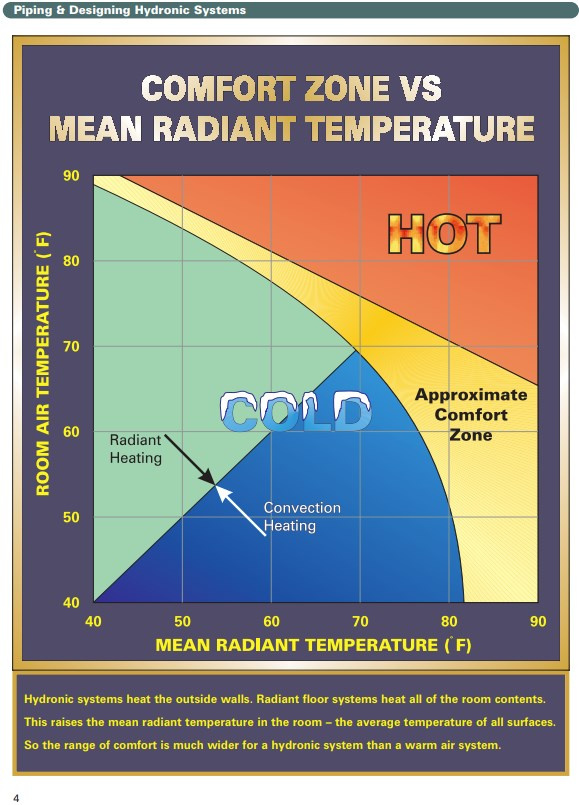
Mean radiant temperature vs. Room Temperature. To be comfortable at 68F, you want the radiator to be in the range of 71 F to 85 F. Pretty impossible in single pipe steam as most of us have it implemented but it demonstrates the desired goal. At 58 F room temp you need the radiant mean temp range to be even higher. Obviously this presumes one is sitting near the radiator.
 0
0 -
I think I finally get it. There are no fundamentals that apply here that can and should be discussed because every situation is different. Um well, ok.
Regardless of the resistance here, I will stick to the fundamentals anyway, and discussion of how they apply, which I think is what most readers are here for. Such as my statement that by definition how long the calls are is directly related to how even the heat is. For if the heat is perfectly even, the tstat would never see any change at all and there would be no cut ins or cut outs and calls for heat will be endless. Can we at least agree on that as a fundamental that applies everywhere to all systems? From there I simply observe that the standard control design will produce the shortest call for heat the boiler can possibly create, running it on high stopping only for max fill and pressure in the system until the tstat is satisfied. I then conclude ,correctly I think, that the standard control design is really not aligned very well with a desire to produce even heat. I'm not saying that everyone needs to desire even heat. I'm simply saying that if one does, the standard control is not well suited to produce that result, or certainly not near as good as it could be.
My Engineering School training brought me to this fundamental realization pretty early in my experience with my first steam system 34 years ago. It was the dramatic temperature changes the radiators went through every heat cycle that I didn't like. That is why I ended up working to improve the situation, which I have immensely, by identifying and applying the fundamentals like I was taught. I have a stock 100 year old piping system exactly as originally designed. My guess is that it is very similar to a lot that is out there and the things I am saying do apply quite generally.
1926 1000EDR Mouat 2 pipe vapor system,1957 Bryant Boiler 463,000 BTU input, Natural vacuum operation with single solenoid vent, Custom PLC control0 -
Regarding the possibility of operating a steam system under vacuum: I would love nothing more than a vacuum steam system with some sort of modulating burner, so that the BTU getting pumped into my living space matched the BTU leaving my living space. I know that R-718 works just fine for phase change heat transfer below 1 bar pressure.
I could also imagine the benefits even without a modulating burner. If my system could reliably go into hard vacuum between calls for heat, then all of the radiators would always be full of water vapor all the time. The combination of radiators, piping, and boiler would just be a huge 'heat pipe', similar to those used for CPU cooling. Vapor would start condensing in the radiators very very soon after the burner starts firing, and the call for heat might very well be satisfied before the boiler even gets to 212F.
Sadly this is not going to happen in my home. I'm not going to find vacuum steam vents, I am not going to replace my burner with something that modulates, not going to replace my boiler with something that optionally condenses vapor in the exhaust, and there is no way I will find the tiny (negligible at 2 psi, critical at -13) leaks in my 90 year old pipes, valves, and radiators. But yes, I can imagine a steam system that can work in vacuum at low steam temperatures.
What I can practically do in my home is reduce the firing rate of the boiler slightly, consistent with proper combustion and proper fuel temperature. I can also reduce the pressure settings slightly, limited by little things like not drawing air in through the vents when the burner cycles off.
Based on the points in
I should be able to get the firing rate lowered 15-30% during the regular boiler maintenance. This will better match steam production to the radiators, but will probably still leave the boiler oversized relative to the radiation. My understanding is that the limit here is proper flue temperature. My understanding of the benefit is that a small % more of the combustion heat will end up in the water rather than going up the flue, and the burner will run for a larger % of the time, so less time simply losing heat to the flue. But this will just be an incremental change in efficiency.
The other suggestion is to lower the pressure setpoints of my system, which I can do at the pressure control. The limit here is that the pressure shouldn't fall to zero when the burner cycles off while there is still a 'call for heat'. I think that the limit here is set by the LWCO, since the LWCO turns off the boiler for a while in order to sense the water level. I need to insure that the pressure doesn't drop to zero during the LWCO operation.
My boiler pressure drops at about 1 PSI per minute, and the LWCO shuts the burner off for 75 seconds. This seems to make my lower pressure limit 1.25 PSI, unless there is some way I can guarantee that the LWCO will operate in sync with the pressure control.
So my plan at the present time is to wait for the normal boiler service, get the boiler downfired then, and then adjust the pressure control so the low pressure is 1.3 PSI and the high pressure gives the same roughly the same or longer burner cycle time that I'm currently running.
Thanks for all of the input.
0 -
good plan. carry on!
Br. Jamie, osb
Building superintendent/caretaker, 7200 sq. ft. historic house museum with dependencies in New England0 -
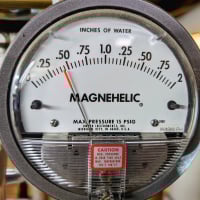
Got this email today 😄


 0
0




Categories
- All Categories
- 87.6K THE MAIN WALL
- 3.3K A-C, Heat Pumps & Refrigeration
- 59 Biomass
- 429 Carbon Monoxide Awareness
- 124 Chimneys & Flues
- 2.2K Domestic Hot Water
- 5.9K Gas Heating
- 119 Geothermal
- 168 Indoor-Air Quality
- 3.8K Oil Heating
- 78 Pipe Deterioration
- 1K Plumbing
- 6.6K Radiant Heating
- 394 Solar
- 16K Strictly Steam
- 3.5K Thermostats and Controls
- 56 Water Quality
- 51 Industry Classes
- 50 Job Opportunities
- 18 Recall Announcements