Help me understand

I have a hydronic baseboard system, with 3 zones and a buffer tank. I'm trying to understand how it works. The way I think it works is:
- One of the zone thermostats calls for heat
- The pump on the buffer tank outlet will start, and the zone valve opens, circulating the buffer tank to the zone.
- When the buffer tank temperature drops below the thermostat setting on the buffer tank, the pump on the boiler will start, circulating the boiler to the buffer tank
- When the boiler temperature drops, the aquastat on the boiler will trigger the boiler to fire (natural gas), until the boiler temperature reaches the aquastat temperature setting.
Is this a normal setup?
Here are my concerns:
- The buffer tank thermostat is dialed up to it's max setting of 180F, which says the boiler won't fire until the outlet temperature to the baseboards is below 180F.
- The aquastat is set for 195F, 20F drop, so the boiler temperature will fluctuate between 175F and 195F.
What affect does this have on the actual hot water temperature getting to the baseboards? During this recent cold period, the boiler is cycling about 5 mins on/10 mins off, while the house is generally cold (all zones are calling for heat most of the time)
Comments
-
More details will help you get a better answer: boiler type and BTU rating, size of house (sq ft), age of house, location, total linear feet of baseboard. All relevant factors in assessing (1) whether your boiler is oversized (probably), (2) whether you have enough radiation (maybe not if the house is always cold at design temperature), and (3) how to optimize or fix what you have.
-1 -
Thanks. The house is a 'story and a half' cape, built in two sections, the original section was built in the 1930's, the second in the 1980's. Located in the Philadelphia area. The ground floor totals 1800 sq ft, with 60 linear feet of baseboard in a single zone. The are two upstairs rooms with short knee-walls, totaling between the rooms and hallway another 800 sq ft, in 2 zones, with a total of another 24 linear ft of baseboard between them. Each of the upstairs rooms is it's own zone. The major issue is the ground floor. There are decent double glazed, argon filled windows throughout the house.
The boiler is perhaps 10 years old, (we bought in 2019), it was originally fuel oil fired, and we had it converted to NG in 2023, and that is when the buffer tank was installed. The boiler is a 120,000 BTU/Hr. Lennox.
House has a full basement, unheated. There is a spare zone valve installed with unconnected and capped pipes for future heat in the basement. If I ever get done insulating the basement walls, that is on 'the list' to do.
0 -
You mentioned the boiler is about 10 years old and was originally oil-fired. You bought the home in 2019 and converted the boiler to natural gas in 2023.
If I understand correctly, you have a Lennox COWB3 series boiler with a gas-fired power burner that replaced the original Beckett oil burner. At the same time the gas burner was installed, a buffer tank was also added. Correct me If I am not understanding your system.
Does the Lennox boiler provide domestic hot water at all? In other words, what supplies your hot water for showers and faucets?
To confirm that the tank is truly a buffer tank and that it’s installed correctly, could you provide the brand name and model number of the tank? Also, please share a few photos taken from far enough back to clearly show the boiler, the tank, and the piping from floor to ceiling. That would be very helpful.
Based on how you described the system operating, it would waste a lot of fuel if it were actually set up that way. I don’t believe someone would intentionally design a control system like that. A proper setup would have the boiler operate as a cold-start boiler using an L8148A control, which only fires the burner when there is a call for heat.
Because your system has two small (micro) zones, a buffer tank can make sense. Without one, if only a single bedroom zone calls for heat, the boiler water temperature will rise very quickly, hit the high limit, and shut the burner off. The zone then sits idle while the water cools, and the burner restarts for only a few minutes at a time. That short cycling never allows the burner to reach efficient operation.
When properly installed, the buffer tank adds water volume to the system. This increases burner run time and lengthens off time, which improves efficiency and saves fuel. That’s the main reason a buffer tank would be used in your situation.
The normal sequence of operation should be this:
A thermostat calls for heat → the zone valve opens → the zone valve end switch activates the boiler control → the circulator pump and burner turn on. Cooler water circulates through the boiler, buffer tank, and radiators while the burner gradually raises the water temperature. When the thermostat is satisfied, the system shuts down, possibly after a short thermal purge to use any remaining heat.If there is no thermal purge, the system shuts off immediately, and any leftover heat in the boiler or buffer tank is wasted unless another zone calls for heat soon afterward.
Edward Young Retired
After you make that expensive repair and you still have the same problem, What will you check next?
0 -
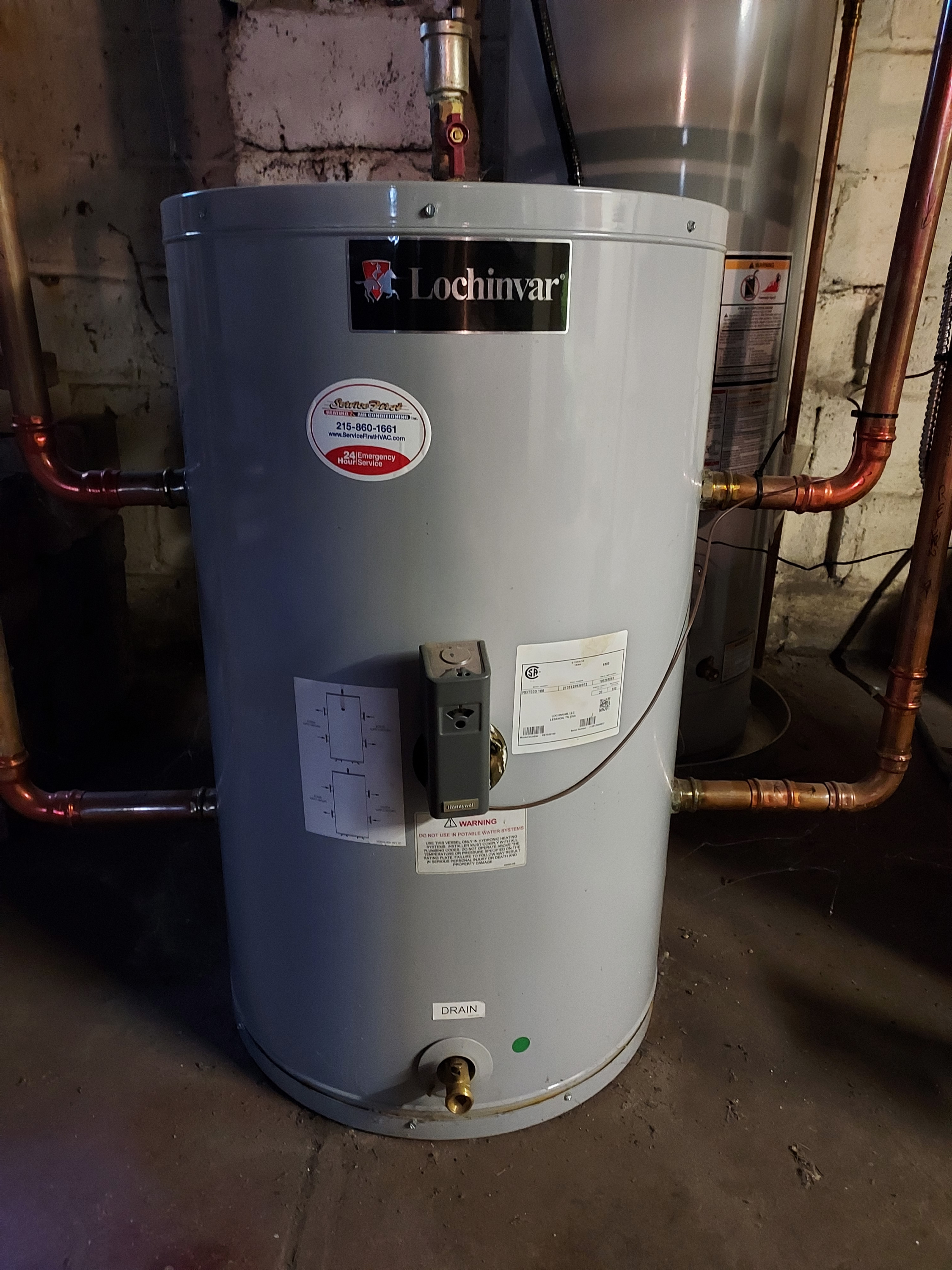
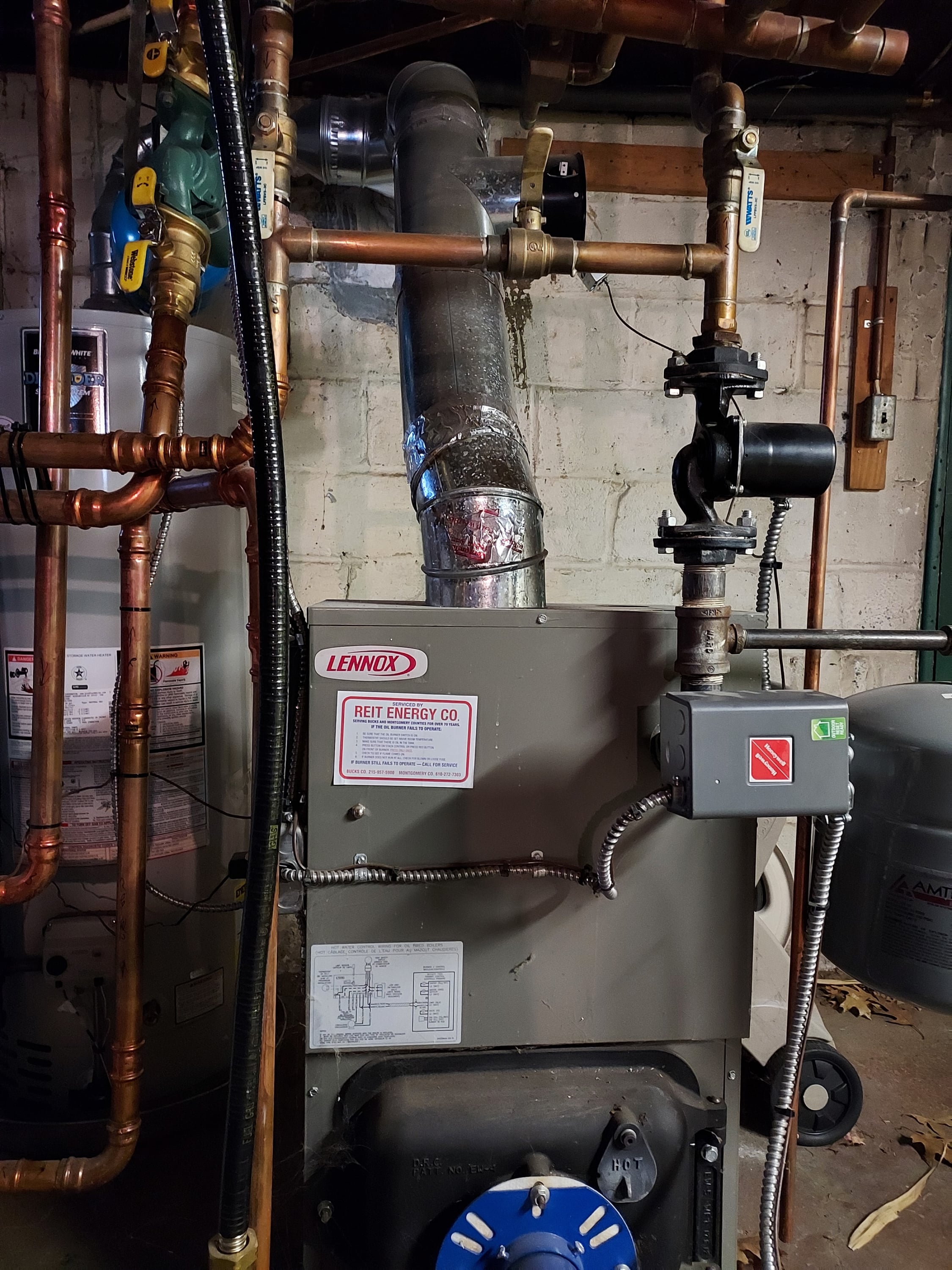
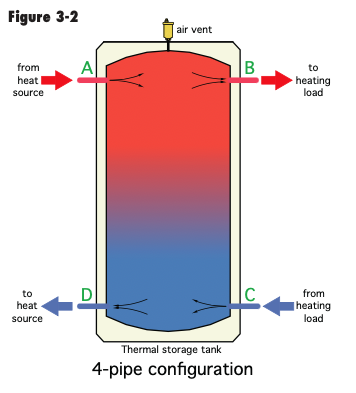
There is a separate water heater for domestic hot water. The boiler outlet goes through the black pump to the upper right connection on the buffer tank, and the lower right buffer tank returns to the boiler. The left upper tank connection goes to the green pump and to the baseboards. The returns come through 3 zone valves and to the lower left tank connection.
0 -
So a house of that vintage with decent replacement windows, 2600 sq ft total, in Philadelphia, your design day heat loss is probably under 20 BTU/hr/sq ft, so 50,000 BTU/hr or less total.
Since you did a gas conversion, your BTU input rate isn't necessarily what the boiler rating plate says, but what the gas conversion burner input rate is.
If the input rate is, say, 100,000 BTU/hr, with your non-condensing boiler running at, say, 80% dry gas efficiency, then you lose an additional 15% in the latent heat of the water vapor, so you're down to 65% overall combustion efficiency, or 65,000 BTU/hr output. Then you have additional thermal losses when the boiler shuts off and residual heat goes up the chimney. Then you're at 60,000 BTU/hr or less of useable heat.So (for example) a 100,000 BTU/hr input rate might not be unreasonable for your house with that boiler. But If your input rate is higher, it's probably more than you need, and that contributes to the short-cycling problem. The input rate of conversion burners can be changed, but your bigger problem is the incorrect setup of the buffer tank system that @EdTheHeaterMan and other pros can help you correct.
0 -
@jesmed1 The efficiency of the gas power burner inside the cast iron non-condensing boiler efficiency calculation you referred to is not 100% correct. An 80% efficiency rating for a non-condensing gas boiler already accounts for flue losses, including latent heat of water vapor. You don’t subtract an additional 15% for latent heat on top of that. That would be double-counting losses.
You are correct about the actual firing rate may not be what the boiler rating plate says it is. That may be different based on the gas burner's installer. If the installer dialed in to a 100,000 BTU input orifice for that burner then you have a boiler that has a 100,000 BTUh input. If the orifice is dialed in to 90,000 BTUh input, that is what the boiler is going to work with. To be sure of the actual input you can clock the gas meter when the only appliance operating is the boiler and see how much gas it uses.
Ask me how to do that if you are interested.
Edward Young Retired
After you make that expensive repair and you still have the same problem, What will you check next?
0 -
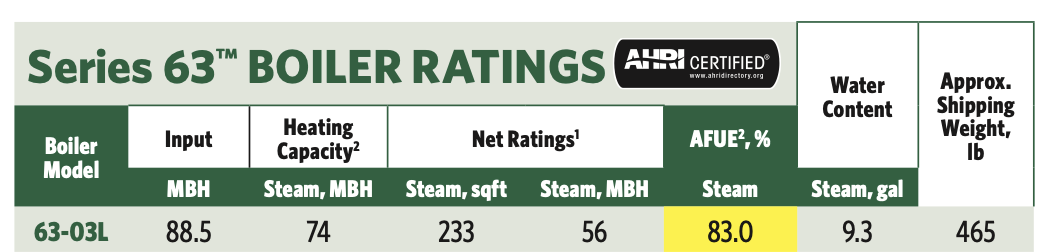
Trivia of the day… while the normal efficency for natural gas in a non-condensing application, is 80% (LP is slightly lower), the normal efficiency for fuel oil in the same application is 83%.
Br. Jamie, osb
Building superintendent/caretaker, 7200 sq. ft. historic house museum with dependencies in New England0 -
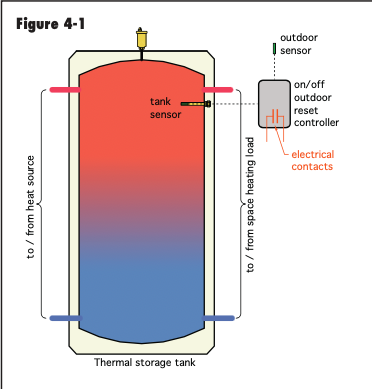
there are a number of ways to control that system. Commonly the control on the buffer tank runs the boiler to maintain the tank at say 160-180 degrees. So the buffer is always hot, ready for a heat call.
When a zone calls, the system pump pulls from the tank, as the tank temperature drops to 160 the boiler fires to bring the temperature up to 180
In some cases the boiler is controlled by an outdoor reset control, so the tank temperature varies a bit depending on outdoor temperature
Do you know what that tank control is set to, maybe 180? Also if it has a set or adjustable differential under the cover?
Also check the temperature settings on the boiler control aquastat, it should be set higher than the tank control setting. It may also have a differential setting.
Bob "hot rod" Rohr
trainer for Caleffi NA
Living the hydronic dream0 -
I looked at your post @jesmed1 about Dry gas efficiency and latent heat loss in the flue gas. If you read the information throroughly you will see and understand that a combustion analyzer that the industry uses for testing combustion efficiency of a cast iron boiler will give you the combined dry gas + latent loss for a total combustion efficiency. This illustration clearly demonstrates that a 80% efficient combustion includes the 13% Dry Gas Loss and the 7% Latent heat loss for a total of 20% stack loss
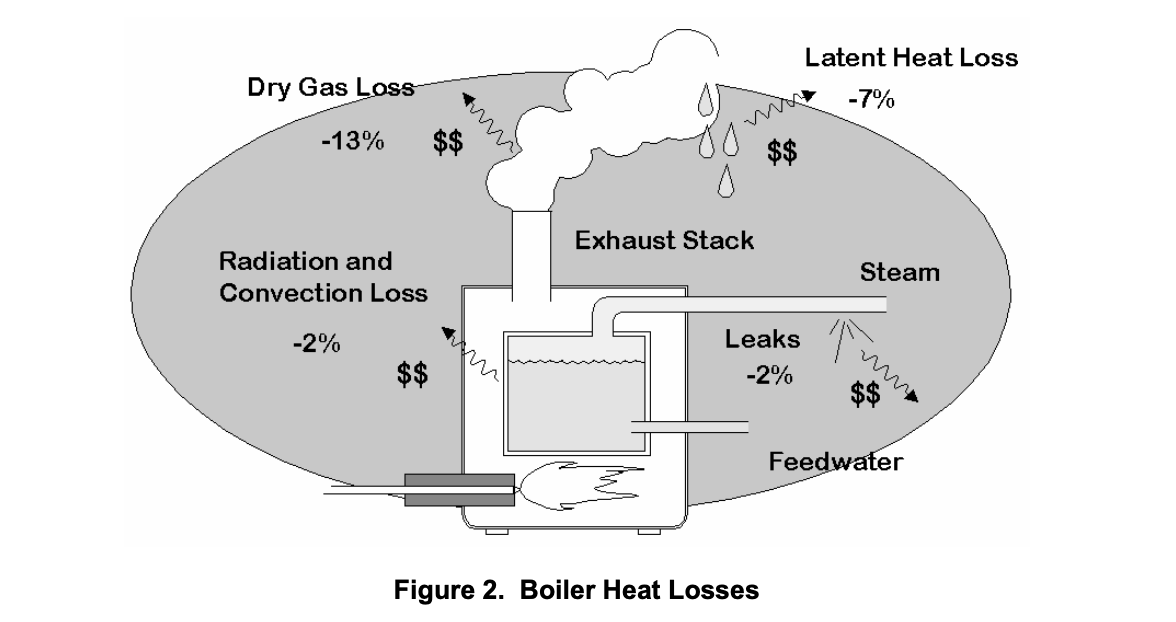
In your statement, it looks like the 80% combustion efficiency was combined with an additional 15% latent loss to arrive at a 65% effective efficiency. That can be a bit misleading, since the 80% combustion efficiency already accounts for latent heat losses based on the standard test methods and equipment used to establish that rating. Adding the latent loss again ends up double-counting it. Your earlier post bears that out with a 13% Dry Gas and 7% latent loss for a total combustion efficiency of 80% (See illustration from your post above)
The specialized laboratory equipment needed to separately measure dry gas and latent losses is very costly and not something that’s practical or necessary to use in the field on a regular basis. For most real-world evaluations, the published combustion efficiency numbers are sufficient.
There are, of course, other losses that combustion efficiency doesn’t capture. These include standby losses when the boiler is connected to a chimney, where draft can continue to pull heat from the cast-iron sections after shutdown. There are also jacket losses to the boiler room, along with potential losses from leaks, makeup water, and piping or pickup losses in unconditioned spaces. All of these can affect overall system performance and are worth considering.
My main point is simply that efficiency losses can be easy to overestimate if we’re not careful about how the numbers are applied. Sticking with established testing methods and documented performance helps keep the discussion clear and accurate.
I hope this better explains what I meant regarding your numbers.
Edward Young Retired
After you make that expensive repair and you still have the same problem, What will you check next?
 1
1 -
-
My atmospheric gas boiler begs to differ 😅
NJ Steam Homeowner.
Free NJ and remote steam advice: https://heatinghelp.com/find-a-contractor/detail/new-jersey-steam-help/
See my sight glass boiler videos: https://bit.ly/3sZW1el0 -
RE: Hot Rod's comment: I think that is how it works. The buffer tank thermostat is a simple dial, turned all the way up to a stop at 180. The Aquastat is set at 195, 20 degree drop. No outside air temperature adjustment.
So, the question is, what is the expected water temperature at the first baseboard? Will it ever approach the 195 boiler setting?
0 -
@EdTheHeaterMan is correct.
Br. Jamie, osb
Building superintendent/caretaker, 7200 sq. ft. historic house museum with dependencies in New England 1
1 -
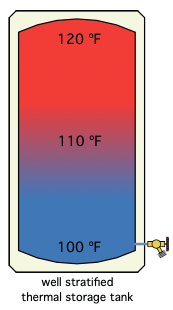
At some point the tank temperature will reach the control setting. If there is no heat loads being pulled off the tank will stratify. So with your tank control mid point in the tank, them upper portion of the tank will be close to whatever the high temperature setting is on the boiler, call it 195°.
As you start pulling heat out of the tank, the cooler return starts blending with the hot in the tank, so that outlet tempetature starts dropping. When the control on the tank drops to say 170° the boiler trips on.
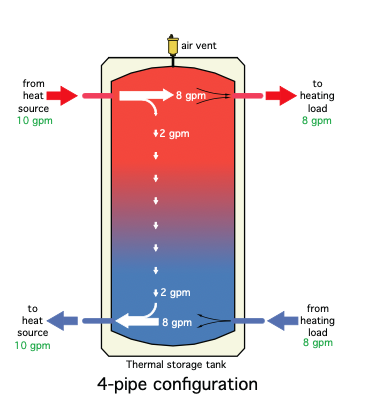
Now the flow through the tank gets more complex. It depends on the gpm that the boiler pump is moving into the tank vs the gpm going to the zones, so you have more temperature mixing and the stratification level breaks up, the tank will be fairly consistent temperature from top to bottom as both pumps mix the tank.
The very best way to maximize a tank drawdown is to pull the heating loads off the tank with a outdoor reset control. So on a mild day you may pull 150- 160 from the hot 195° tank. So you get a longer drawdown.
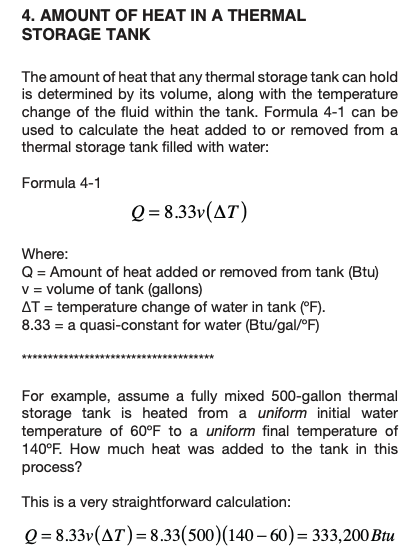
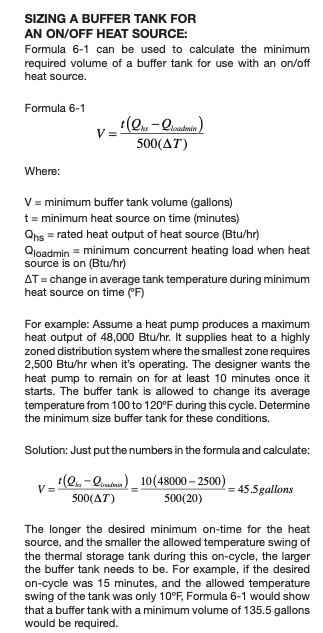
If you know the heat load of the various zones you can calculate an approximate time for the tank drawdown, boiler off cycle. Examples of the math below.
Is that an 80 gallon tank?
8.33 X 80 X (195-170)= 16,660 BTU stored in tank
You have about 100,000 boiler output. More than twice what you need!
84 total feet of fin tube X 500 btu/ ft= 42,000 btu/hr of heat emitter
Smallest zone of 12'? or 6,000 btu/hr
So for a 10 minute boiler run or on time
10 minute X (100,000- 6,000) = 940,000 ÷ 500x25 tank differential= 75 gallons of tank
If your tank is 80 gallons you should get around an 10-12 minute boiler run with just one small zone running.
With all zones calling 42,000 load, should be 15 minute or more boiler run time.
This is with the tank control set to a 25° differential.
It could be you tank control has a fixed differential, that could be 15°? You want an adjustable differential control to fine tune, or lenghten the boiler on/ off cycle.
Remove the cover on the HW tank control, there will be a small notched wheel to adjust the differential.
 Bob "hot rod" Rohr
trainer for Caleffi NA
Living the hydronic dream 1
1 -
I thank @EdTheHeaterMan for correcting some misunderstandings on my part about how combustion analyzers work, and thus actual vs. reported combustion efficiency. I've deleted one post and edited another one to prevent promulgation of incorrect information.
I am here to learn, and thankfully Ed and others here are good teachers!
2 -
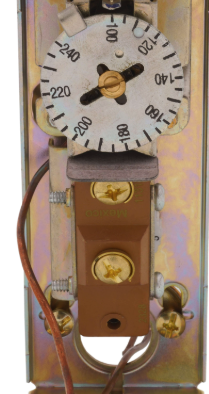
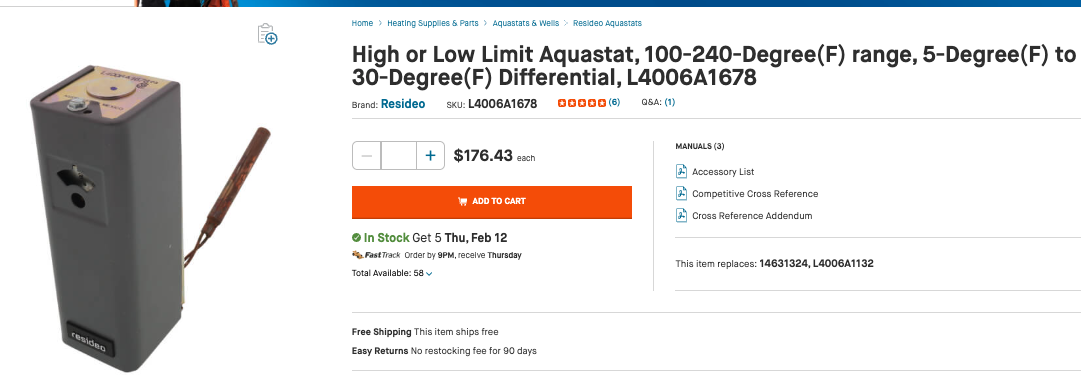
Here is a pic of a common Honeywell indirect tank temperature control. This model has an adjustable differential from 5- 30°
The white dial at the bottom, below the two brass screws is the adjustmemt. Probably labled 5- 30
I would set this to 180- 185 and the differential to 25 to see how that changes the run times.
A 10 minute on cycle is good to shoot for, even 8-9 minutes. But the longer the cycle the better. There is only so much you can do with a buffer on a high temperature system.
On low temperature radiant systems, for example, you could heat the tank to 180, and pull it down to 110-120. So you have a large 60° delta to leverage.
 Bob "hot rod" Rohr
trainer for Caleffi NA
Living the hydronic dream0 -
Boiler is grossly oversized. 84 feet of baseboard will only do 47000 btu. Gusee thats why it has a buffer.
1 -
So you're really saying, for 1800 sq ft on the first floor, and 900 sq ft on the second floor, with 100,000 btu boiler and ~100 ft of baseboard I don't have enough baseboard.
Seriously.
What I've learned from this forum is that there are so many variables in hydronic systems that almost every option is an "if we do X, we may cause a problem with Y".
I may start another thread about this.
I had my HVAC guy here yesterday to talk about the cold rooms that appear when the outside temperature falls below 10-15 F. He proposed 2 changes: The first floor has two loops (basically a letter B), and one side does better than the other generally. His proposal here is to split it into 2 zones, with the intent to clear the 'small' side first, and force more hot water towards the 'large' zone where it's colder.
Second proposal is to convert the 'larger, colder' zone to a 2 pipe zone with a dedicated return line away from the monoflow system that is there now, to get hotter water to the 'end' baseboards.
Future option would be to put in high efficiency baseboards—maybe with two feeds to each, which requires more extensive modeling, pump size increase, maybe total piping revision. Honestly, that sounds like way more cost that I'm willing to absorb.
Quote for the work is pending.
0 -
if you're going to start changing things your first step is to do a heat loss calculation. 50,000 btu/h sounds a bit small for that size area but depending on how it is constructed and arranged it could be enough, so you need to figure out how much heat it needs before trying to make changes to change how it heats. if the loss is more than 50,000 btu/hr the only way to fix it is to add more radiation.
0 -
one more question, are these indeed just fin tube baseboard or are these convector cabinets? fin tube on monoflo is a bit unusual although not unheard of.
0 -
He spent a LOT of time in the basement taking notes. He said before he sent out a quote, he needed to discuss his ideas with his team and do some calculations. I'll trust them to do the modeling. They have the software to do it.
The baseboards are standard finned baseboards.
House has a full, uninsulated, unheated, walk-out basement, and the hot water piping is around the basement perimeter. And the basement, on those really cold days, gets pretty cold—I'm guessing 50's.
0 -
If he spent all his time in the basement and didn't measure each room upstairs, he is doing you no good.
0 -
Yes he measured the rooms as well. Took pictures. All kinds of notes. Mumbled things like "why did they put 3/8 feeds to the baseboards"? Spent a lot of time shaking his head.
My interpretation: If this was a new build, they wouldn't do it this way. The goal is better, not perfect. Honestly, if I get a quote to tear it all out and start over, I know already what the answer is.
The idea of putting in mini splits for both AC and supplemental heat is hanging out there.
0 -
Look. You can measure , you can calculate. You can do what you want.
84 feet of baseboard will only do 47,000 btus. You can put a 500,000 btu boiler in and you won't get any more heat out of the baseboard.
If the rooms are cold its one of two things you have a water flow issue or your short on baseboard. I was only pointing out that you boiler is double the capacity of your baseboard.
If you want to find out if you have enough baseboard or not there is only one way to do that and that is with a heat loss calculation.
1





Categories
- All Categories
- 87.5K THE MAIN WALL
- 3.3K A-C, Heat Pumps & Refrigeration
- 61 Biomass
- 430 Carbon Monoxide Awareness
- 122 Chimneys & Flues
- 2.1K Domestic Hot Water
- 5.9K Gas Heating
- 118 Geothermal
- 170 Indoor-Air Quality
- 3.8K Oil Heating
- 78 Pipe Deterioration
- 1K Plumbing
- 6.6K Radiant Heating
- 395 Solar
- 15.9K Strictly Steam
- 3.5K Thermostats and Controls
- 57 Water Quality
- 51 Industry Classes
- 51 Job Opportunities
- 18 Recall Announcements