Approaches to reducing boiler size

I know that a steam boiler must be sized to match the radiators.
My rough understanding is that each radiator has the capacity to condense a certain amount of steam, and if the boiler cannot supply enough steam for all of the radiators in a system, then some radiators will not get steam.
This pretty much means that in an old house, where the radiators were sized 'pre-insulation', you end up with a boiler and radiator system that provide too many BTU for the house. In my home (built 1935) on the coldest day the boiler will fire for less than 1/4 of the time.
My question: is there a reasonable way to reduce the EDR of the radiators, so that a smaller boiler can be used to better match the heat load of the home? For example, if you insulate a radiator do you reduce its EDR without causing other problems. Or are there other techniques that will reduce the amount of the radiator that actually gets used?
I'm not planning on changing anything; just curious on this point.
Thanks
Jonathan
Comments
-
2 pipe steam you can orifice the radiator inlets. One pipe steam you can't do too much.
If it were me, I would do a heat loss calculation room x room. This will tell you how much you are over radiated.
As you mentioned above normally, we are taught to add up the edr of all radiators, then the boiler MFGs add to that EDR a factor of 1.33 for a steam boiler for piping and pickup.
Many including me think this factor of 33% is too high. I would make sure any boiler installed covers the actual radiator EDR and then lower the PU factor depending on how over radiated you are .


 3
3 -
As a practical matter… the easiest thing to do is just run the system for less time in any given hour… which you do most of the time anyway, since the system has to have enough capacity for the more extreme conditions.
There is almost no downside to that — very slightly less overall efficiency, but otherwise…
Sorry about being Mr. Obvious, but…
Br. Jamie, osb
Building superintendent/caretaker, 7200 sq. ft. historic house museum with dependencies in New England1 -
Fair enough; oversize the system and then run it part of the time. As you say, even a 'perfectly' sized system would run part of the time when the weather is warmer the coldest day you design for.
But how much is the actual efficiency impact of over-radiating the space, and then having a boiler oversized for the radiators?
My current estimate based on run time is that my house is over-radiated by a factor of 2 or 3, and the boiler is oversized by a factor of 2 for the radiators.
Thanks
Jonathan
0 -
Inevitably, some rooms will be warmer than others. You can put a blanket on the radiators in the warmest rooms to effectively reduce EDR for those rads.
Trying to keep Bernie burning!
1 -
I never said — and would never say — that the boiler should be oversized for the radiators. for a steam system In fact, I would nope that no responsible person would say that.
That it happens more or less routinely doesn't excuse it.
Let's try again. The boiler not ourput — most easily expressed in EDR — should never be significantly more than the installed radiation, also expressed in EDR. Because there is a built in safety factor in the EDR rating of the boiler, it can be less; with well insulated mains, as much as 20% less is usually satisfactory.
This is not rocket science. The job can be done in an afternoon with a table of radiator sizes and an adding machine.
Done correctly, you have a system which works together well. The boiler can reliably and evenly power the radiators. You can then control that with a thermostat so that the power delivered to the space by the system matches the power required to keep the house at the desired temperature — also evenly and reliably.
Provided the temperature swing from the thermostat — not the boiler or radiators — is kept reasonable, the efficiency impact from turning the system on and off, say once an hour, is minimal.
The efficiency impact of an oversize boiler in comparison to the radiation can, however, be significant, depending on just how bad the oversize is and how the boiler is controlled.
Br. Jamie, osb
Building superintendent/caretaker, 7200 sq. ft. historic house museum with dependencies in New England0 -
IF you are over radiated the you just won't ever completely fill the radiators on a balanced system. There is no issue with that. I.e., the system wouldn't know if you just cut 1/3 of the sections off each radiator. This is different than being properly radiated for the space but having an oversized boiler which can be problematic.
1 -
We're in a similar situation with two WGO-5 hot water boilers in a 100-year-old 4-unit condo building near Boston, and all original cast iron radiators. The boilers run about 25% of the time on a design day, similar to yours. Your boiler is making steam; ours is making hot water. Your boiler concentrates its heat into a few gallons of water to produce steam; ours distribute their heat into 100+ gallons of water each to produce lower-temp hot water. But both our systems run about 1/4 duty cycles on cold days.
Since these are non-condensing boilers running at 80%+ "dry gas" efficiency, the loss of almost 20% of the heat in the "dry gas" exhaust, plus another 7% or so latent heat of vapor loss (for oil) and 15% or so latent heat of vapor (for gas) is already "baked in" to the boiler, and those losses can't be recovered without changing horses to a condensing boiler with lower exhaust gas temps.
So those of us with non-condensing boilers are left with trying to make marginal improvements in overall system efficiency. For example, recovering some of the heat stored in the boiler's cast iron heat exchanger after shutdown. In my case, someof that heat gets recovered during a typical 2+ hour idle time, during which I have our circulators set up for a thermal post-purge until the supply temp drops to 90 F. But even without the post-purge, gravity circulation would continue to suck some of that residual heat out of the boilers. I've done some calculations, and I figure that there's at most maybe 10% of a typical cycle's (45 minute boiler run) heat left in the boiler water and heat exchanger. We recover some of that , but some of it goes up the chimney as air continues to draft through the boiler after shutdown. So maybe we lose 5% up the chimney and recover 5% in post-purge circulation.
Some people try to retain that last 5%-10% of residual heat by installing automatic vent dampers. The downside of those is that when the damper motor fails and the damper won't open, the failsafe switch prevents the burner from firing, and you have no heat. I've decided the marginal possible gain isn't worth the hassle.
But back to your original question, the reason boiler oversizing matters is that a larger boiler has more thermal mass in the heat exchanger and in the higher volume of water in the boiler, both of which increase the amount of stored heat that can be lost up the flue after boiler shutdown. If we had boilers that were, say, half the mass of our WGO-5, we'd have roughly half the number of BTU's stored in it after a cycle, and thus roughly half as much heat to lose up the flue. So maybe we'd go from losing, say, 10,000 BTU of a cycle's heat production up the flue post-shutdown to maybe 5,000 BTU, or a 5% overall efficiency improvement.
Our boilers run about 500 cycles per season, so 5,000 BTU saved per cycle would be 2,500,000 BTU, or about 18 gallons of oil (out of 600 gallons burned per boiler). That turns out to be about a 3% savings. It's something, but not much.
The numbers above are ballpark-ish, as there's no easy way to measure how much heat we lose up the flue after boiler shutdown. But based on the above, I'd be surprised if we saved more than 10% fuel by going to smaller boilers (even though I plan to do so when these fail).
0 -
Hmm. Ok, I started this thread mainly out of curiosity, but now it seems I might have something actionable to save fuel.
I have an oil fired single pipe steam system. It is reasonably well balanced with even temperatures throughout the house, and all the steam valves work properly. The mains in the basement are insulated with 1" fiberglass, the risers in the walls have the original asbestos insulation.
Last night I measured my radiators, and have 245 square feet of of EDR. The label on my boiler says:
I=B=R Input 1.20 USGPH
D.O.E. Heating Capacity 145,000 Btu/hr
Net I=B=R Output Steam 108 MBH 450 SQ. FT
I have an hour meter measuring the run time of the burner blower, and use 1.05-1.1 GPH averaged over a heating season.
Is this boiler oversized enough that it will make a significant difference to fuel consumption? The system seems to run just fine.
Thanks
Jonathan
0 -
@winnie said "Is this boiler oversized enough that it will make a significant difference to fuel consumption? The system seems to run just fine."
You may have missed my previous post before asking this question. My short answer is that, after a lot of data collection and calculation, I don't expect more that 10% fuel savings from reducing our boiler size/capacity by half. I'd be pleasantly surprised by better savings, but I don't think it's going to happen.
1 -
Your boiler is oversized enough (I wish people wouldn't do that, but…) that you may be able to improve things slightly. Oddly enough n(or maybe not!) the thing I would try first is the settings on the pressure control. You don't mention anywhere what your pressure control device is — or what pressures it is set at — but if this is a conventional two pipe steam system, or a one pipe system, set the cutin pressure at 0.5 psig and the cutout at 2.0 psig, and add a low pressure gauge if you can to verify those pressures. Various pressure control devices differ in how those two settings are made; if you could post a photograph of the device we can help with how to do this. If this is a two pipe vapour system, the two settings are different: cutin at 0.2 psig and cutout at 0.5 psig.
What is the objective here? The boiler is oversized for the radiation, so it is necessary for it to chut down from time to time to let the radiation "catch up". Th e shorter that shutdown time is, the greater your overall efficiency will be.
The second step is the thermostat. If it is a digital modern one, you may have better results setting it for 2 cycles per hour rather than one. Sometimes this helps. Sometimes not!
Br. Jamie, osb
Building superintendent/caretaker, 7200 sq. ft. historic house museum with dependencies in New England0 -
Thank you for the suggestions. I will get the information about the pressure control on Sunday and the thermostat on Sunday.
-Jonathan
0 -
@winnie , all of the houses built pushing 100 years ago with steam heat had extra radiation installed that was never intended to be filled. The steam was supplied by a continuously fired boiler that never ran on "high" like ours do. The systems were designed to have a big boiler operate in the middle of its range where it could be adjusted, partially filling radiation and adjusting that steam amount to the demand in real time. So adding up all the radiation and sizing a boiler based on that results in boilers that if only running on high will quickly overfill the radiators for the demand.
The unfilled part of radiators downstream of what is needed for the current demand has no effect on anything. No modification to that would be required to change to a smaller boiler. How much radiation gets used is controlled automatically by how much steam you put into it.
This is why the standard setup with a boiler sized to the installed radiation(or in your case even more) running on high until the thermostat is satisfied is often so unpleasant. It overfills the radiation, way past what would be needed for the average day demand if supplied continuously. When the tstat finally reacts and shuts the boiler down there is an unfortunately long wait period while all that supplied heat dissipates. The boiler and mains fill with air and cool more than they need to resulting in a longer reheat period on the next burn and longer time to steam. It is a roller coaster ride that should have much smaller hills and valleys.
What is needed is simply to spread out the required burn time per hour of whatever boiler is installed (in your case 15 minutes per hour on design day) into roughly two evenly spaced burns. Yours would end up probably 8-9 or so minutes each in the very cold. A way to facilitate longer colder start burns in moderate weather minutes also very helpful. The start/stop/length of the burns needs to react to the actual sensing of the steam level out in the system and adjust itself. A vent damper is absolutely required, it just can't sit on top of the boiler if you want it to last. It will keep the boiler much warmer between burns reducing time to steam on every burn. Mine is 30 years old and I have never had an issue with it.
Though hardly that complicated, no off the shelf control was ever accepted by the powers that be in steam to do these simple things at the residential level. So contractors have nothing to offer. So I did them myself many years ago. I also resurrected the lost concept of simple natural vacuum between the cycles which has a very significant evening out effect which is not well understood. Between the two things the result is dramatically more even and certainly more efficient heating.
You appeared to be mostly on an intellectual exercise to understand more about what you are observing. Hope this helps.
1926 1000EDR Mouat 2 pipe vapor system,1957 Bryant Boiler 463,000 BTU input, Natural vacuum operation with single solenoid vent, Custom PLC control 1
1 -
I must have some sort of weird setup. I have a mercury T87 thermostat. Vapourstat. 2 LWCOs. More radiation than needed for the house (although at -12 this morning… and the boiler sized to fit the radiation..
No other controls.
No insulation to speak of (house built from 1780 to 1893)
And the building, at the thermostat, stays within half a degree either way of the setpoint, in design cold or fall and spring.
How odd…
Br. Jamie, osb
Building superintendent/caretaker, 7200 sq. ft. historic house museum with dependencies in New England 2
2 -
@Jamie Hall , I think we've been around this block before. We understand that you are quite happy with your system and control and that you don't believe any improvement is possible, needed, or worth the effort , one or all three. Please rest assured that your position is really fine with everyone as far as I know. I do not write here with any interest in getting you to change it. I write for those who just might be interested in some improvement, not to debate with anyone what is good enough.
The thing is, I have experience with both systems. I started out 35 years ago with exactly yours. I had a mercury T87, a vaporstat, and a boiler sized to the radiation (1000 edr), and a house with no insulation. Was it ok? I guess so as it satisfied all the folks who lived there for 36 years before me and intermittent fire. No one changed anything. True enough, it couldn't be that bad.
But as an engineer I thought it could be a lot better and I was right. I realized that by definition, the more even the heat is the longer the calls would be - assuming the boiler is actually always providing enough net steam to raise the temperature. As we all must know, if the temperature was perfectly even at the thermostat, no cut in or cut out would ever occur and calls for heat would be endless. So, again by definition, calls for heat that always end with the boiler running on high, or, having been going on and off during the call due to pressure stops, will be shorter with more temperature variation during them per unit time than much longer calls than terminate unrelated to whether the boiler is running or not. This is not a matter of opinion, it is by definition. I also realized that any pressure was a sign of too much steam in the system and always a negative and that there really should be no need for a vaporstat, even with intermittent fire.
So now I am standing in what appears to be the unique position of actually having lived with and operated both systems and therefore able to comment on the relative performance of them.
1926 1000EDR Mouat 2 pipe vapor system,1957 Bryant Boiler 463,000 BTU input, Natural vacuum operation with single solenoid vent, Custom PLC control1 -
If it's still working 100 years from now, I'll take it. Well, 96. Cedric's system's birthday.
Br. Jamie, osb
Building superintendent/caretaker, 7200 sq. ft. historic house museum with dependencies in New England1 -
There's ambient room temperature fluctuation in the t-stat room and then there is radiator temperature fluctuation. The key is to have the minimum radiator temperature fluctuation because human beings are not t-stats. We feel the radiation of the radiator along with the convection of the ambient air and having that radiator get cooler in between heating cycles is simply never going to be as comfortable. Both situations could have an ambient air temp fluctuation of only 1/2 degree but will not feel the same.
1 -
This year my system piping turns 100 and my boiler is at 69 years.
1926 1000EDR Mouat 2 pipe vapor system,1957 Bryant Boiler 463,000 BTU input, Natural vacuum operation with single solenoid vent, Custom PLC control0 -
but the controls?
I just prefer simplicity and reliability. Don't mind me.
On another note… I have three trucks and two cars. It was -12 this mroning. One of the cars — a hybrid — started. The other, 10 years old, no hope. One of the trucks — 8 years old — no hope. The other two — one 53 years old, the other 30 — complained bitterly… and started; neither of them had been run since October.
Br. Jamie, osb
Building superintendent/caretaker, 7200 sq. ft. historic house museum with dependencies in New England1 -
I was complaining bitterly when I left the house this am as well. I don't think I can remember a colder winter. I know when I was young if I remember 1960-61 was bad.
My old man had a 41 Plymouth that would never start when cold. He used to have this great big heat lamp he would plug in and hang by the distributor when it got cold out. He always said the "distributor is too low to the ground" LOL. Then he got a 48' Nash. That one liked the cold even less. In fact it wouldn't start and the old Plymouth which was sitting in the garage unregistered actually started. So the Plymouth pushed the Nash around the block until it started.
0 -
'60 a- '61 was the coldest I've ever experienced around here. That -70 truck is the old Chevy 250 straight six. It may be a b___h at times but it always rends.
Br. Jamie, osb
Building superintendent/caretaker, 7200 sq. ft. historic house museum with dependencies in New England0 -
Your values of 245 connected EDR and 450 sq ft I=B=R NET steam indicate that the boiler will routinely reach its pressure limit during normal operation, assuming all other components are functioning properly. The oil burner producing this 450 sq ft steam output is currently firing at a rate of 1.20 GPH.
Early in my career working with oil burners, I learned that down-firing a boiler can improve overall operating efficiency in several ways. A reduced firing rate lowers fuel consumption per hour of burner operation. While the flame temperature is slightly reduced, resulting in marginally less instantaneous heat transfer to the boiler water, the reduced flue-gas volume slows the passage of combustion gases through the cast-iron heat exchanger. This increased dwell time allows more heat to be transferred into the boiler water, which in turn lowers the stack temperature and reduces stack losses. Provided the stack temperature is not allowed to fall excessively, flue-gas condensation will be minimal or nonexistent. This operating principle applies equally to hot-water boilers, steam boilers, and warm-air furnaces.
By reducing the burner firing rate from 1.20 GPH to approximately 1.00 GPH, the I=B=R NET steam rating is reduced to roughly 375 sq ft. If the burner can operate for approximately three minutes before steam production begins, the stack temperature can then be evaluated. For example, if the stack temperature measures 550°F at a 1.20 GPH firing rate and decreases to 400°F at 1.00 GPH, a further reduction to 0.90 GPH may be considered. At that firing rate, it is important to confirm that steam is still produced within four minutes and that the stack temperature remains at 350°F or higher.
Once the firing rate is optimized to produce steam within four minutes or less while maintaining a minimum stack temperature of 350°F, the boiler will be operating at a higher level of thermal efficiency.
Have your oil burner service provider check the firing rate of your burner as it stands now. Someone may have already reduced the firing rate. That would be a good thing. If not, then try the 1.00 Firing rate and again the 0.90 Firing rate to see if you get good combustion test numbers. Once you get good results then make a note of those settings with the actual nozzle rating and pump pressure and combustion test numbers with Smoke Spot reading Draft over the Fire and at the exhaust of the boiler (before the barometric draft control) and of course the CO PPM and Oxygen and Carbon Dioxide percentages with the stack temperature associated with those readings.
By lowering the firing rate you will in fact lower the Input, and the NET output accordingly, resulting if getting closer to the actual EDR of the building.
EDIT:
You can go too low with the firing rate. Just because 1.20 reduced to 0.90 may end up with a lower fuel bill, does not mean that you can keep going lower. There is a point where you get too small of a flame and end up burning lots of fuel for hours and hours and not make enough steam to get the heat to the farthest radiators, or to satisfy the thermostat.
Edward Young Retired
After you make that expensive repair and you still have the same problem, What will you check next?
3 -
It is popularly accepted that radiators were designed in the early 20th century to provide ample heat even with windows open, a response to health recommendations during the Spanish Flu pandemic (1918-1920). This design aimed to ensure fresh air circulation to combat airborne diseases, reflecting the belief that fresh air was essential for good health. There is no way to claim this was universal though without looking at the sqft of the radiator and the btu requirements of the room.
0 -
I think the controls they installed back then needed to be able to detect and maintain single digit ounces of pressure in the system and be able to react to changes due ONLY to changes in demand. That would be impossible with the radiation ever filling because filling spikes the pressure unrelated to demand well out of range making the whole control scheme unworkable. So lots of extra was installed to be able to heat at ultra low header pressures without filling even on design day.
The open windows idea may be true, but quantifying exactly how much extra radiation open windows required would obviously be challenging. My point is that significant extra radiation would have been required even with the windows closed. I also don't think filling all that what we know to be extra radiation to pressure at any time makes any more sense today than it did back then.
1926 1000EDR Mouat 2 pipe vapor system,1957 Bryant Boiler 463,000 BTU input, Natural vacuum operation with single solenoid vent, Custom PLC control0 -
To answer your original question about reducing the overall system size to improve efficiency the answer is YES it is possible, but it may be costly to do so.
You'd perform a heat loss calculation for every room and compare that to each rooms existing EDR btu/hr equivalent. You have two options at that point, replace the radiator with a properly sized one or remove sections from each radiator until it matches the desired EDR. Possible but potentially difficult.
Then you would size a new boiler to the new EDR. A match made in heaven. As mentioned the new boiler already comes with a 33% pickup factor so you could go a bit lower if you wanted.
Keep in mind though that even at 245 sq.ft. of EDR you are already at the low end of the boiler size spectrum. There are only a handful of boilers that are sized that low so if you were to get rid of some of the radiated EDR that you didn't need, you'd now need an even smaller boiler.
In the long run your thermostat will prevent the radiators from 100% filling up and getting too hot. It will maintain the temperature you desire. Your excessive EDR from your radiators essentially lowers your "design day" calculation. So your house will be comfortable at say -20F instead of 0F, as an example.
0 -
Back then requires some qualification. There were controls on some coal fired boilers which were sensitive to pressure — not all coal boilers had them, and oil boilers which came in relatively early never did. In fact, the fundamental effort behind all the assorted widgets and patented whatnots for vapour pressure steam systems was not to control boiler pressure in itself, but to control the differential pressure between the steam mains and the dry returns. Some of these gadgets were disarmingly simple — the Hoffman Differential Loop itself has no moving parts, although it does require a vent at the Loop (one single vent, thank you — the only one in the system) but others look like nightmares from Rube Goldberg's shop.
It is quite true that many structures were over designed for the "design day" or whatever. This was not entirely sloppy practice, nor was it always motivated by leaving windows open. Rather, in any cases it was quite deliberate, so that there was enough power available to actually raise the space temperature if the occupants desired to do so on a cold day. Folks back then weren't as fanatical about saving energy as some are today — but they were pretty fanatical about being comfortable when and as they wanted to be!
Br. Jamie, osb
Building superintendent/caretaker, 7200 sq. ft. historic house museum with dependencies in New England0 -
I agree not all coal boilers had pressure/damper control systems.
So I will talk specifically about the one installed in my house that did. Mouat. It was design to cover all heating requirements maintaining a header pressure of between .5 and 3 ounces. My point is that obviously that could not be done if the radiators ever filled. So if they weren't to fill on design day, quite a bit of extra was required. I have found that to be the case running the system - even on design day conditions I don't need to fill the radiators to heat the place. So I don't let them fill and I never see a header pressure over 2 ounces just like the designers said.
1926 1000EDR Mouat 2 pipe vapor system,1957 Bryant Boiler 463,000 BTU input, Natural vacuum operation with single solenoid vent, Custom PLC control0 -
Rather, in any cases it was quite deliberate, so that there was enough power available to actually raise the space temperature if the occupants desired to do so on a cold day. Folks back then weren't as fanatical about saving energy as some are today — but they were pretty fanatical about being comfortable when and as they wanted to be!
It was not uncommon at that time to continue the old custom of winterizing a house when travelling in the winter rather than leaving the house above 50f or whatever we do today. Quite a recovery when you return.
0 -
Oh yeah. My grandmother used to do that with Cedric's home. And… there was one winter when, for various urgent reasons, it was necessary to open the house … in January… well below freezing. And yes it can be done, but it was an interesting exercise and thank goodness it was steam heat with a good big margin over what was "necessary"!
Br. Jamie, osb
Building superintendent/caretaker, 7200 sq. ft. historic house museum with dependencies in New England0 -
I wanted to thank everyone for their input, especially the detailed information that @EdTheHeaterMan provided.
My system has some version of the Honeywell Pressuretrol PA404, but I've not been able to dig to find the exact model. Photo:
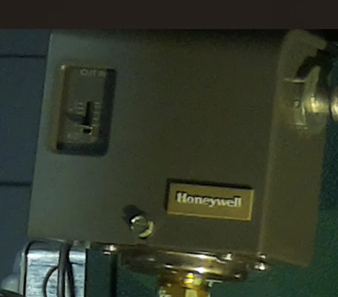
It also has a a 'Cycleguard' low water cut off system.
I set up a camera to follow the system during a recovery and get some timing.
From a fairly cool start, it takes about 6 minutes from when the thermostat calls for heat until the pressure gauge just twitches, and 19 minutes from the cold start to the first pressure cut-off (with one LWCO cycle in that period).
When I watch the sight glass first the water level rises and then falls after the system starts firing; is this fall an reasonable indication that the boiler is 'making steam'? If so, then it is about 1.5 minutes from first fire to first steam.
Once the system is firing in steady state, the pressure fluctuates (by the pressure gauge) between 2.3 and 4 psi. In steady state it takes about 115 seconds for the pressure to climb and 105 seconds for the pressure to fall, so once the system is in steady state the burner is running a bit more than half the time.
On the thermostat cycling, it looks like I have some room for adjustment; right now the temperature swings 2-3 degrees, and heating cycles are 1.5-2 hours apart. So I can improve that by tightening the deadband of the thermostat.
The flue has a new stainless liner if that makes a difference for suggested adjustments.
Thanks again.
0 -
If you could get your cutout pressure down your whole system would be happier… There is a screw on the top of your pressuretrol which is used to adjust the cutin. Turn that screw so that the cutin pressure — the metal bar on the scale — is just above the lowest marking (0.5 pounds).
Br. Jamie, osb
Building superintendent/caretaker, 7200 sq. ft. historic house museum with dependencies in New England0 -
Yes I would tighten that deadband and adjust down the pressuretrol. If you are doing recoveries then I might suggest that you try breaking those up and if it is very cold outside even eliminating them.
0 -
Perfect case here for modulation with burn length control. Classic actually. Match the boiler output to the demand with its burn time profile (not numbers on its name plate). The burns need to be shorter and spread out evenly and call for heat times lengthened. This simply cannot be accomplished with pressure controls. There never needs to be more than single digit ounces of pressure in these systems.
1926 1000EDR Mouat 2 pipe vapor system,1957 Bryant Boiler 463,000 BTU input, Natural vacuum operation with single solenoid vent, Custom PLC control0 -
For efficiency, control the boiler any way you want — but whatever yo do, don't let the off cycles be long enough to let the boiler metal cool. For cast iron, maybe two or three minutes. For steel keep the off cycles as short as the burner recycle will allow.
On steam, never let the off cycle pressure drop to zero.
Br. Jamie, osb
Building superintendent/caretaker, 7200 sq. ft. historic house museum with dependencies in New England0 -
If not already asked:
For an existing working boiler: Is a slightly undersized boiler preferable to a slightly oversized boiler given proper installation, maintenance and insulated pipes in a home that is insulated? Maybe it depends on the meaning of "slightly" but leave that up to the experts
Regards,
RTW
0 -
P.S. That is, what if boiler was properly sized, but an addition added more EDR therefore undersizing boiler output needs after doing the math
Regards
RTW
0 -
First off, for steam, the heat lad of the house affects the radiation required. The size of the boiler is related to the radiation, not directly the house heat load.
But to actually answer the question — if the piping is insulated even moderately well, and the installation is correct, then my approach would be to size the boiler EDR to slightly less than the EDR — perhaps even as low as 85% or the EDR — but not over.
Br. Jamie, osb
Building superintendent/caretaker, 7200 sq. ft. historic house museum with dependencies in New England 2
2 -
I'm really not following you on this one. Running the way you suggest here will be pressurized by the time the tstat is satisfied and the shortest call for heat time. On average days this then guarantees long off times to the next call for heat and therefore much colder starts on every new burn cycle.
As an example, on an average day my boiler might need to burn 25% of the time tops. If I run the way you suggest (as it did when I moved in), it will run some amount of reheat time and then 15 minutes of steam filling radiator time, banging off the vaporstat a couple times and satisfy the tstat. Then it would sit off for 45 minutes to an hour and face another reheat. All we need is 15 minutes or so actual steam production an hour. If that is done in one straight run it guarantees even longer off periods which you say you don't want doesn't it?
My first move was to install a vent damper on my 12 inch flue. Game changer. My next move was then to install a simple delay timer which said the boiler can only run 10 minutes on and 10 minutes off no matter what during a call for heat. This was more than needed on an average day but would do the job also in the cold which I knew took a 50% burn time. Even just this was way better and I assure everyone no less efficient. Call times lengthened obviously, heat more even, no pressure ever and time between calls shortened so maximum cool down time actually shortened. The boiler was never off as long as without the timer and total preheat times with the damper actually less. That was 20 years ago or so. I've added control enhancements since.
The next game changer was vacuum. Vacuum extends steam production after the burn stops many minutes, and starts steaming seconds on every new fire even with the boiler having been off 30 minutes due to the fact that burns start always in the deepest system vacuum. Steam literally never stops flowing into the radiators. The net effect of this is also game changing, and gets more an more evident as demand increases.
It is a legitimate question how on earth we ever got to filling completely and controlling these systems with pressure when they were designed originally intending never to have any. 100 years ago pressure was rightly regarded as the enemy and system manufacturers bragged about how low they could get it. That and that somehow today some claim that there is a perfect fixed speed boiler size for these systems that magically running only on high is just right for all demands that will vary by many multiples.
1926 1000EDR Mouat 2 pipe vapor system,1957 Bryant Boiler 463,000 BTU input, Natural vacuum operation with single solenoid vent, Custom PLC control1 -
Single pipe 392sqft system with an EG-40 rated for 325sqft and it's silent and balanced at all times.
0 -
1000.
1926 1000EDR Mouat 2 pipe vapor system,1957 Bryant Boiler 463,000 BTU input, Natural vacuum operation with single solenoid vent, Custom PLC control0 -
I believe there is some misunderstanding about the difference between a call for heat and a cycle.
To better understand what @Jamie Hall is saying about cycling — versus what @PMJ may be thinking about regarding a call for heat at a given outdoor temperature — let me clarify the difference.
Call for Heat
A call for heat occurs whenever the room temperature is below the thermostat setpoint and the thermostat’s R and W contacts are closed. That is the official “call for heat.”
During that call for heat, several things can happen:
- The burner may be operating and producing steam.
- The burner may shut off temporarily due to pressure.
- The steam pressure may rise and fall multiple times.
All of that can occur while the thermostat is still calling for heat.
Cycle
A cycle is when the burner turns on and off during that call for heat. This happens in furnaces, hot water boilers, and steam boilers whenever:
- A temperature limit switch opens,
- A pressure control opens,
- Or a timer interrupts the burner,
even though the thermostat is still calling for heat.
These cycles can be short or long depending on system conditions and outdoor temperature.
When @Jamie Hall suggested not allowing the steam boiler flame to stay off long enough for the metal to cool or the pressure to drop to zero , I believe he was referring to the burner cycling during a call for heat — not the overall thermostat call itself.
For example: If the outdoor temperature is 55°F in the morning and rises to 70°F in the afternoon, you would not expect the burner to run just to maintain steam pressure when there is no longer a demand for heat. At 70°F outside, there may be no call for heat at all. In that case, the burner should remain off and the boiler should cool down naturally.
That is not the situation being discussed.
The discussion is about burner cycling while there is still an active call for heat. If you were designing a control strategy, you would not want a timer set for 20 minutes on and 20 minutes off during an active call for heat. A long off-cycle allows the boiler metal to cool significantly and steam pressure to drop. When the burner restarts, it must reheat the boiler mass before returning to steady-state efficiency.
A boiler is typically most efficient after several minutes of operation, once it reaches steady-state conditions. A cold start uses additional energy to heat the metal and water before meaningful heat is delivered to the system.
If the off-cycle is limited to 5–10 minutes, the boiler remains hot. Steam pressure does not drop to zero, and the burner can return to steady-state operation much more quickly — often in less than a minute — because the boiler mass is already heated from the previous firing cycle.
That is the distinction being made:
We are not trying to prevent the boiler from cooling down when there is no call for heat.
We are trying to avoid excessive cooling during burner cycles within an active call for heat.Edward Young Retired
After you make that expensive repair and you still have the same problem, What will you check next?
1



Categories
- All Categories
- 87.6K THE MAIN WALL
- 3.3K A-C, Heat Pumps & Refrigeration
- 59 Biomass
- 429 Carbon Monoxide Awareness
- 124 Chimneys & Flues
- 2.2K Domestic Hot Water
- 5.9K Gas Heating
- 119 Geothermal
- 168 Indoor-Air Quality
- 3.8K Oil Heating
- 78 Pipe Deterioration
- 1K Plumbing
- 6.6K Radiant Heating
- 394 Solar
- 16K Strictly Steam
- 3.5K Thermostats and Controls
- 56 Water Quality
- 51 Industry Classes
- 50 Job Opportunities
- 18 Recall Announcements