That Pesky O₂ Molecule – How Oxygen Finds Its Way Back Into a Steam Boiler

In this weeks video, I talk about that pesky oxygen molecule and how, despite your best efforts, keeps finding its way back into the boiler water. The video goes over the damage it does and how to minimize the damage.
Boiler Lessons

Comments
-
An observation about where oxygen does its real damage:
You are right that oxygen enters cold water and we do of course see returns (usually at the boiler) rot out pretty quick.
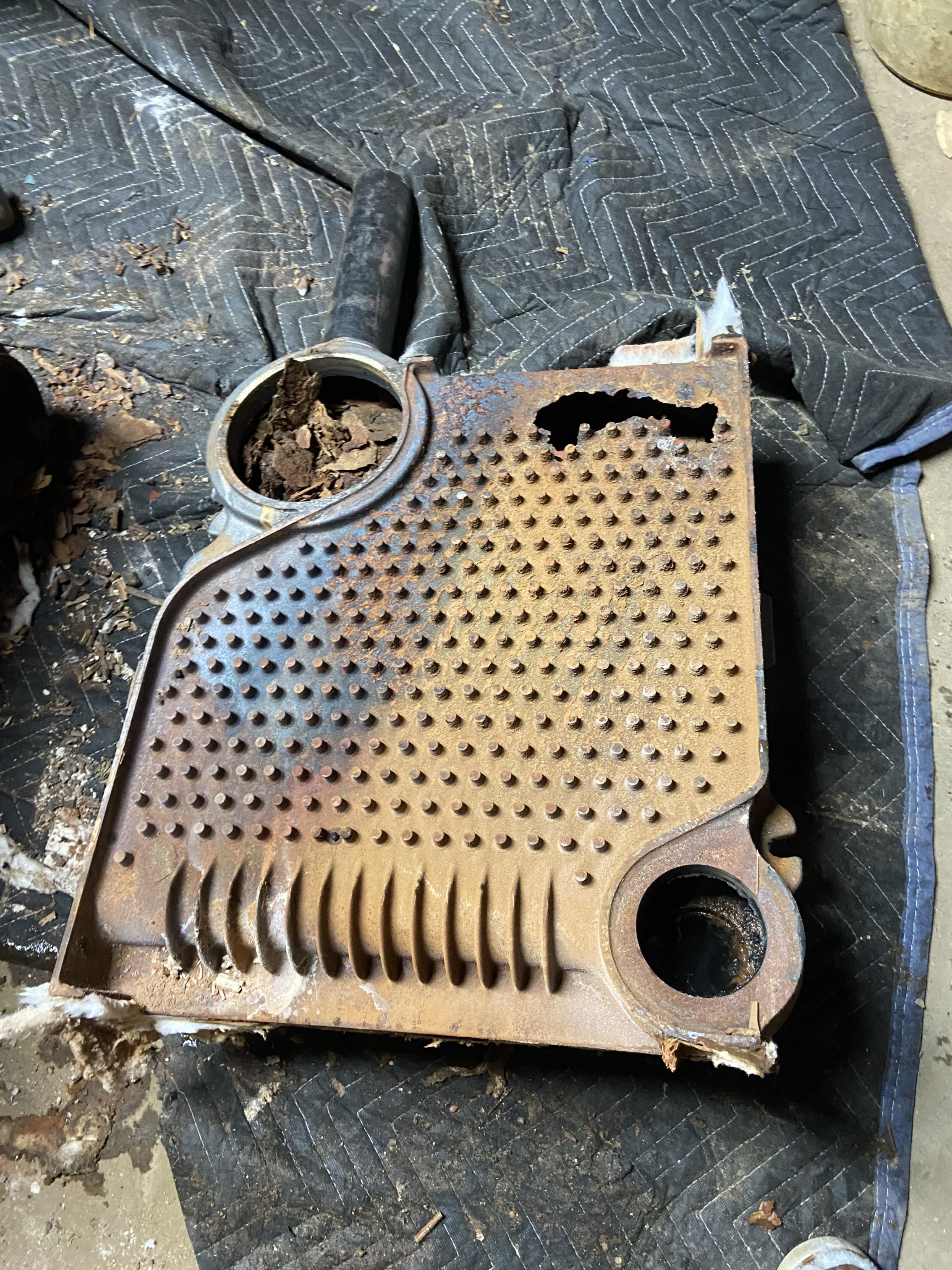
However, where do the boilers always fail? At the top of the section, every single time. How is that possible? There's no water up there, there's only air and steam, right?
You also said in your video correctly that the oxygen is forced out of the water as the water is heated. But I would ask "where does that oxygen go?" It is released into the steam chest, or the upper part of each section, where it is free to attack the cast iron. This is why I think it doesn't matter when you heat the water you add to the boiler—regardless that oxygen is going to be freed to attack the boiler.
So in my mind, the best way to keep your boiler from seeing premature rotting death is to use makeup water that was recently boiled, and to use a product such as 8-Way that has oxygen scavenging capability as well as the known corrosion-reducing pH booster chemicals.
Thank you for your video!
NJ Steam Homeowner.
Free NJ and remote steam advice: https://heatinghelp.com/find-a-contractor/detail/new-jersey-steam-help/
See my sight glass boiler videos: https://bit.ly/3sZW1el 1
1 -
Oxygen in hydronic systems gets consumed in the oxidation process. Within days or weeks you should end up with "dead" oxygen starved water. Air left over will be mostly nitrogen.
So if no additional water is added, or O2 is not being pulled in somewhere corrossion should stop.
Does that translate to steam systems? How much water should a typical system take on continually.
The pressure on the water has some to do with air solubility, but that is not an option in steam systems.
Steam specific manufacturers refer to mechanical deareation ad chemicals with sodium sulfite O2 scavengers, and ph control. So as @ethicalpaul suggests treating the steam boiler is just as important, maybe more so, as treating a hydronic boiler.
Some info from the Rhomar manual
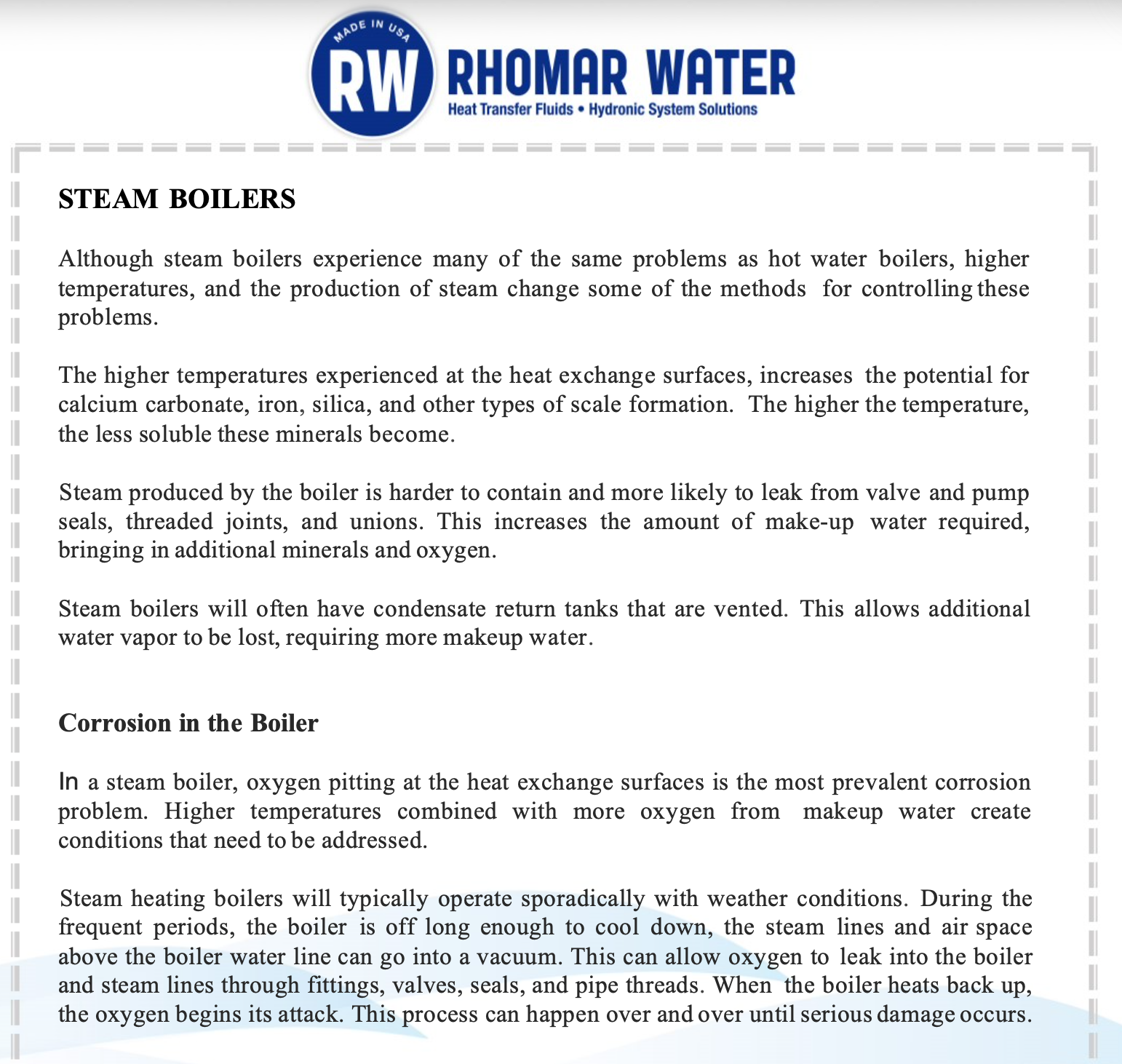
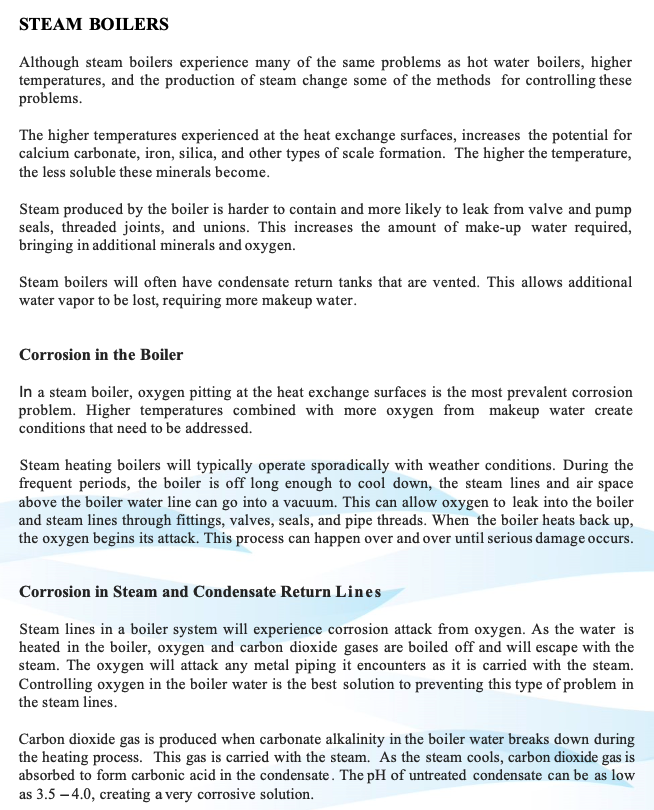 Bob "hot rod" Rohr
trainer for Caleffi NA
Living the hydronic dream
 2
2 -
you have it very easy. Your Utica has these side outlets to which you can attach an elbow and a nipple sloped toward the boiler with an optional reducer and ball valve
With this setup you can add treatment or even all your makeup water (I add only heated distilled water because I’m a fanatic)
I don’t recommend a separate water heater setup because it’s too easy to just pour it in yourself every few weeks (minimizing leaks is the first priority)
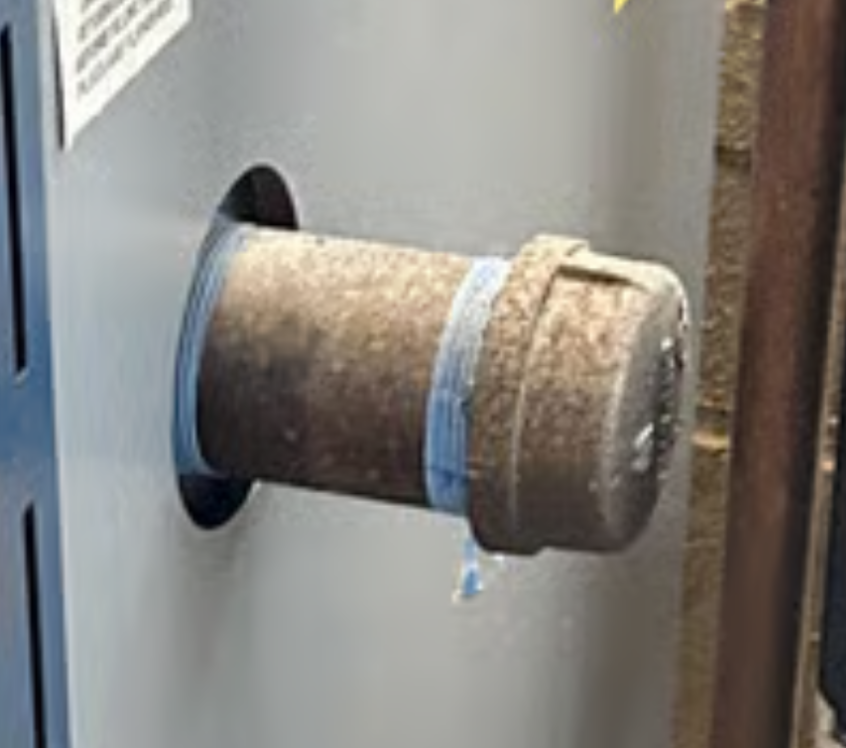
PS I see from your contractor’s sticker you are in Michigan. Hello from a native Michigander
NJ Steam Homeowner.
Free NJ and remote steam advice: https://heatinghelp.com/find-a-contractor/detail/new-jersey-steam-help/
See my sight glass boiler videos: https://bit.ly/3sZW1el
 2
2 -
Just cut out the soldered pipe, connected to the relief valve. Reinstall with threaded or compression fittings and piping
1 -
Thanks @hot_rod Always there to offer expertise.
@ethicalpaul good point
Ray Wohlfarth
Boiler Lessons0 -
Could we consider rot above the water line as a victim of O2?
What are folks view on a small carbon block filter on the feed water to remove chlorine and light solids… not worth the bother, no point?
0 -
Could we consider rot above the water line as a victim of O2?
Absolutely
What are folks view on a small carbon block filter on the feed water to remove chlorine and light solids… not worth the bother, no point?
Ezzy and Clammy do it. I exclusively use pre-heated distilled water for makeup water, so I'm not one to judge
NJ Steam Homeowner.
Free NJ and remote steam advice: https://heatinghelp.com/find-a-contractor/detail/new-jersey-steam-help/
See my sight glass boiler videos: https://bit.ly/3sZW1el0 -
I don't know physics or water chemistry or metal chemistry or anything like that. I have long assumed that there is not much corrosion below the water level, because that metal is totally submerged in water. The metal above the water line, tends to have water and moisture on it, without being submerged. Would assume that is more likely to corrode. And the more oxygen in that water, the higher the corrosion likelihood is. Can't remember ever seeing a boiler rust out at the actual water level itself.
0 -
Yes I have noticed the same thing from a distance of this forum @STEAM DOCTOR that all holes seem to always be at the top of the sections.
And yet the other major rot point always seems to be where the wet return hits the boiler, so something interesting happens there as well.
@Day_Tripper that is a lot more water than I like to see being added. Look for leaks of steam or water, especially the vents. There is also the possibility that your boiler has a hole in it as seen in the above picture (but probably smaller). I want to see less than 1" of drop in the gauge glass every month or so during the heating season. Using as much water as you are using will reduce the lifespan of your boiler. Of course if it already has a hole in it that concern is in the past.
Is your main concern with an external heater/bubbler that the potential for leaks increases with more connections?
No, just that it's a lot of hassle for minimal benefit
NJ Steam Homeowner.
Free NJ and remote steam advice: https://heatinghelp.com/find-a-contractor/detail/new-jersey-steam-help/
See my sight glass boiler videos: https://bit.ly/3sZW1el1 -
if your vents are letting steam out, that could be the whole leak.
the easiest way to test the boiler is to overfill it to the header and see if water starts raining down to the floor under the boiler
NJ Steam Homeowner.
Free NJ and remote steam advice: https://heatinghelp.com/find-a-contractor/detail/new-jersey-steam-help/
See my sight glass boiler videos: https://bit.ly/3sZW1el0 -
You are in a difficult situation with that removed radiation.
But you are exacerbating it with that 5 degree setback at night. I recommend stop doing that and see if the downstairs is able to stay comfortable.
If the upstairs gets too hot for your comfort at night, try covering one or more radiators with blankets until you are comfortable, but keep in mind doing so is similar to removing radiation and may make your system cycle more.
Cycling more isn't a big deal for gas, but could be more problematic for oil.
NJ Steam Homeowner.
Free NJ and remote steam advice: https://heatinghelp.com/find-a-contractor/detail/new-jersey-steam-help/
See my sight glass boiler videos: https://bit.ly/3sZW1el1 -
Hmmm… my experienced HVAC man advises weekly blowdowns of the rust separator on my single pipe low pressure system. Circa early 1900's, massive cast iron. This obviously means that I'm adding water from the city main 40-50 times a year. Any advice on this? Is there such a thing as an inline oxygen eliminator?
0 -
Can you send a photo of this "rust separator"? You might be referring to a float-style low-water cutoff device
NJ Steam Homeowner.
Free NJ and remote steam advice: https://heatinghelp.com/find-a-contractor/detail/new-jersey-steam-help/
See my sight glass boiler videos: https://bit.ly/3sZW1el 1
1 -
As water is heated, the o2 molecules are driven from the water. They bounce around the steam side of the boiler until they end up in the steam and out into the system.
Ray Wohlfarth
Boiler Lessons1 -
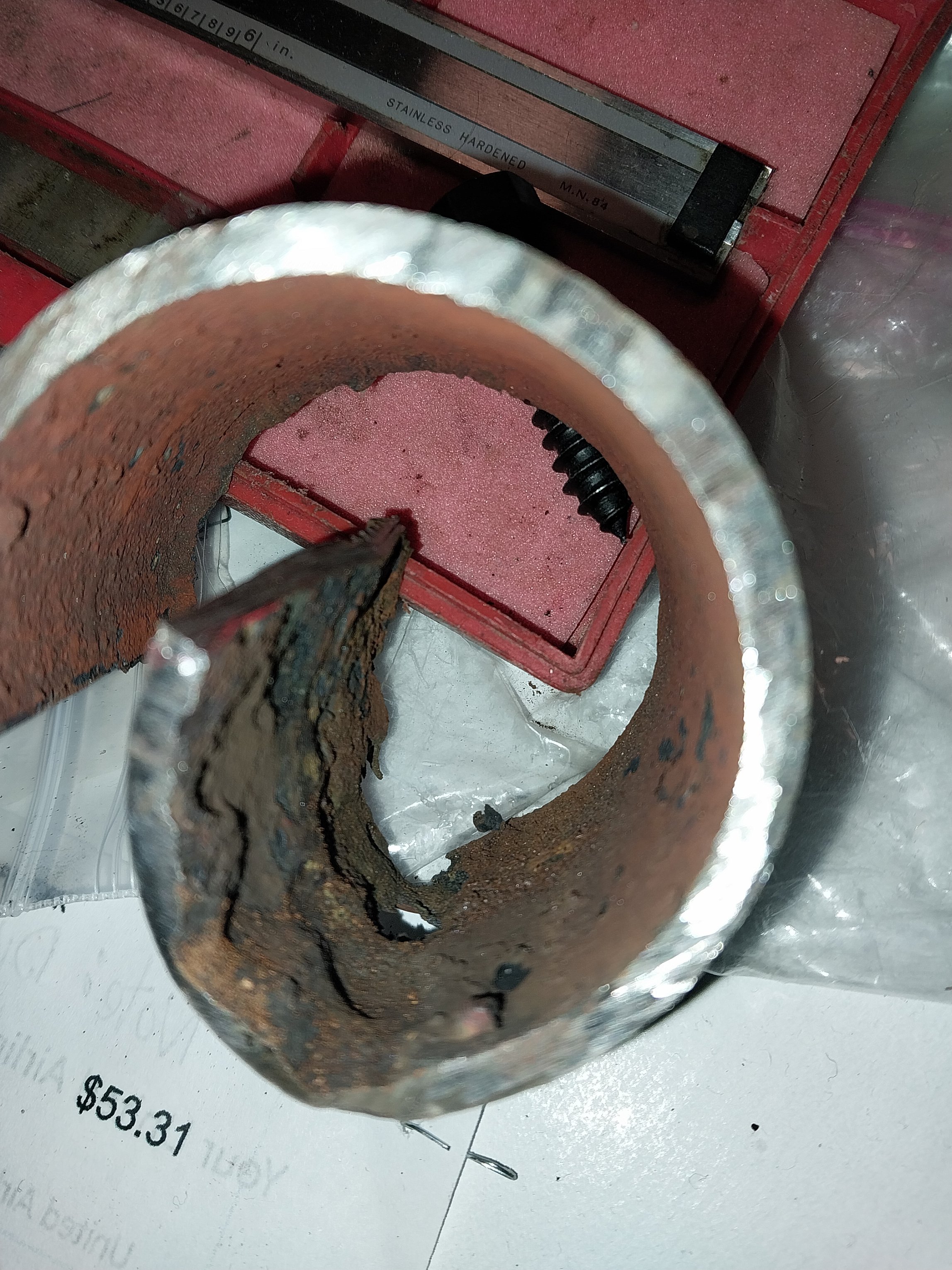
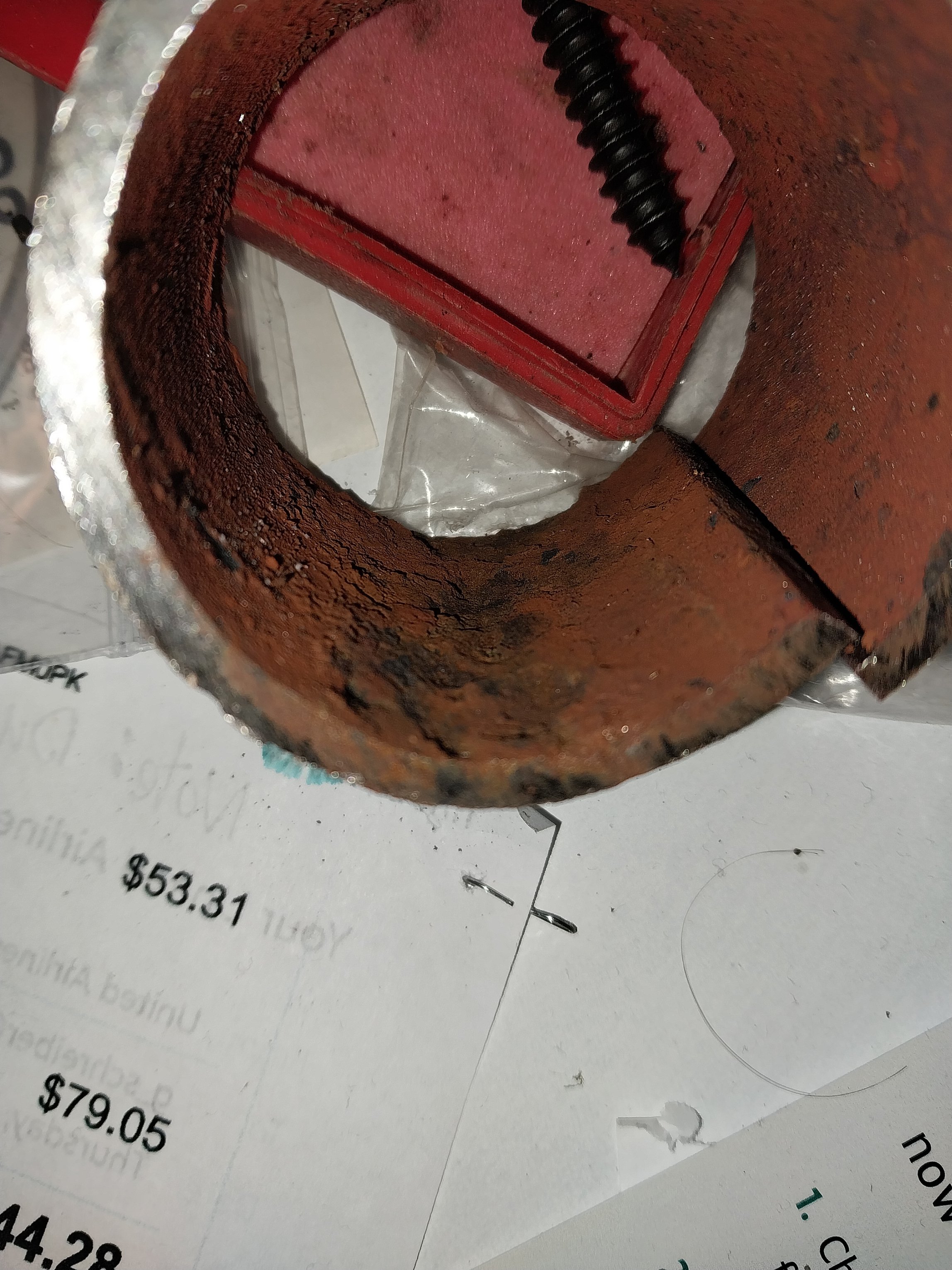
Do you think that Rectorseal 8-way can protect steam mains at all? They say it does but I'm skeptical unless there is a lot of carryover. Otherwise it should be distilled water I believe. Here's what 100 years of corrosion inside a steam main that is not pitched correctly looks like. This is the downstream end of a 16 ft. section that went into a Tee for the riser to an upstairs radiator and what it looked like after I cut through it and chiseled it out. Kept it as a souvenir. Even if it is basically distilled water I would think that it would absorb CO2 from the air in the main and create some carbonic acid. But it is obviously very hot and would limit absorption. In the off season I had cool distilled water pooled up in there and saturated with air containing CO2. Would be interesting to know what the pH was. Anyway, you can see that this main rotted out at and below the waterline and there is lots of meat still on the pipe in the upper areas.
 0
0 -
No, I don’t think 8-way protects the mains. I have thought about carryover helping but given that even a sagging, rusting main lasts 100 years, it hardly seems worth it to consider.
NJ Steam Homeowner.
Free NJ and remote steam advice: https://heatinghelp.com/find-a-contractor/detail/new-jersey-steam-help/
See my sight glass boiler videos: https://bit.ly/3sZW1el0 -
For comparison, here is the upstream end of that 16 ft. main that did have a small amount of downward pitch (unlike being level at the other end), and 1/2 in. higher elevation. Much less corrosion and presumably no standing water situation.
 1
1 -
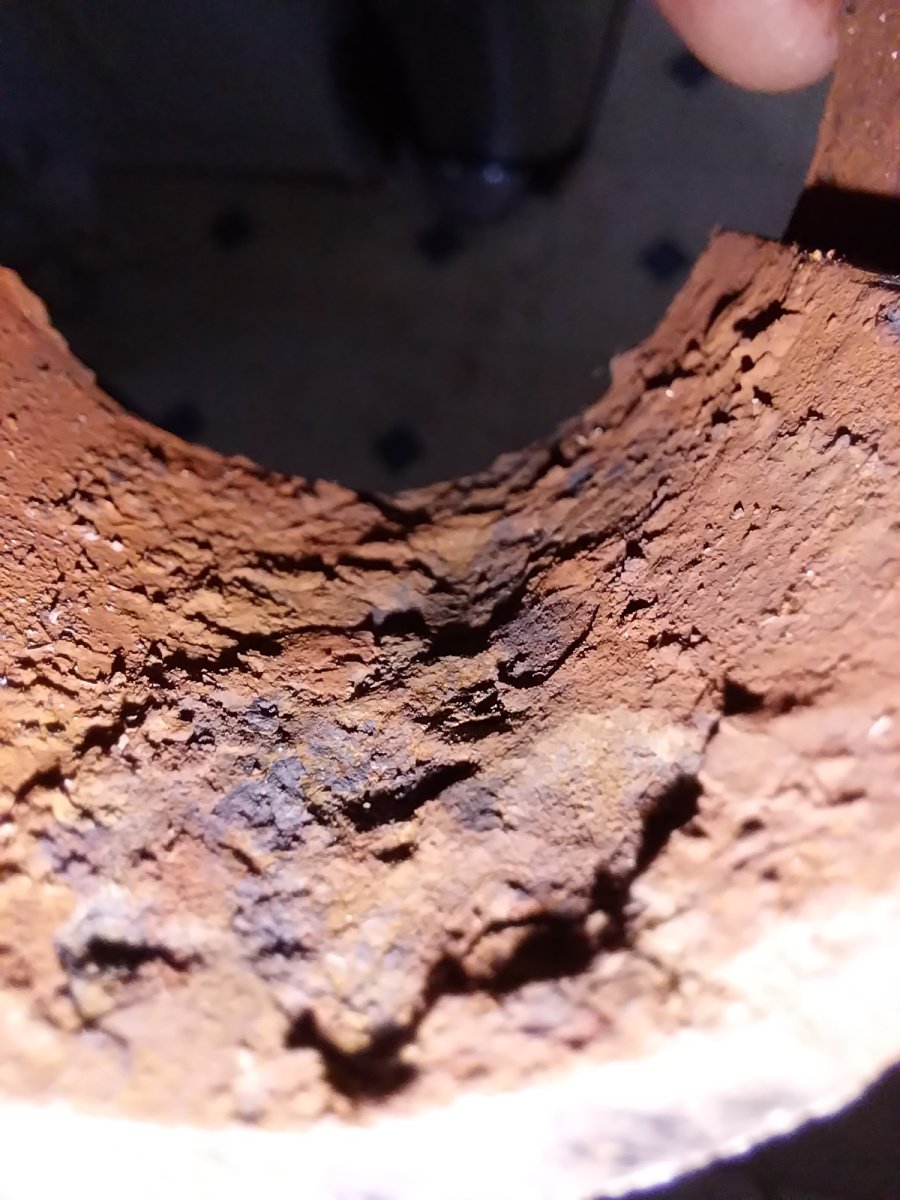
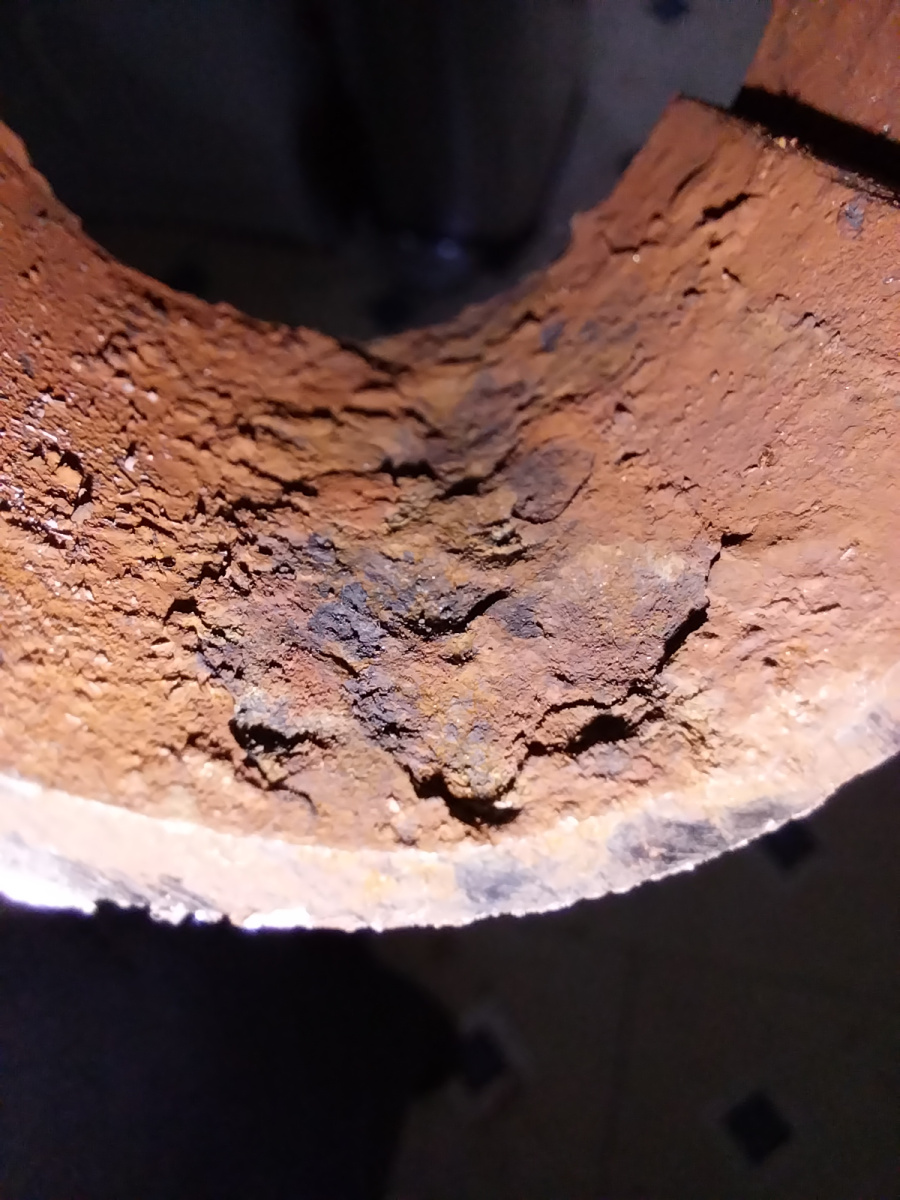
These pictures show corrosion on upstream end better. I'd estimate 1/2 way through penetration at the worst spots. Uneven corrosion must be due to localized differences in alloy composition, and once the pitting corrosion starts a self perpetuating small pool of water exists. Definitely a different situation from boiler corrosion with treated water and mostly de-aerated water and "maybe" some protective effect from scale buildup.
 0
0 -
I have the last radiator on a first floor run that blasts water out of the radiator vent. It has it's own wet return pipe to the main wet return. We have double checked everything for the cause. I have to add a small amount of water to the boiler once a week. For the summer I over fill the boiler with plenty of extra water and Steam Clean is used as a deterrent all of the time.
Any ideas ? Thanks.
0 -
this question would be better as its own discussion thread.
But I would suspect carryover is occurring
NJ Steam Homeowner.
Free NJ and remote steam advice: https://heatinghelp.com/find-a-contractor/detail/new-jersey-steam-help/
See my sight glass boiler videos: https://bit.ly/3sZW1el0 -
"Carryover is occurring ? " What is that ?
0 -
Carryover is when the boiler throws water up into the near boiler piping, and/or the header, and possibly as far as up to the radiators where it can potentially fill them and shoot water out of the vents, although that would be a pretty extreme case.
The easiest way to determine it's happening is to observe the gauge glass while this is happening. Does the level dive to the bottom of the glass?
NJ Steam Homeowner.
Free NJ and remote steam advice: https://heatinghelp.com/find-a-contractor/detail/new-jersey-steam-help/
See my sight glass boiler videos: https://bit.ly/3sZW1el0 -
Sorry for the late reply. The sight glass will drop about 2" during a heat cycle.
0 -
That's right at my personal limit…with that drop it's hard to know if it's carrying over or not, but in any case it's not a crazy amount.
Is the vent still blasting? Also define "blasting"—different people have different ideas of how much water is a lot
NJ Steam Homeowner.
Free NJ and remote steam advice: https://heatinghelp.com/find-a-contractor/detail/new-jersey-steam-help/
See my sight glass boiler videos: https://bit.ly/3sZW1el0 -
I'm a little bit late to the party but I'd say that weekly blowdowns (assuming you have a float type LWCO) are not required under one circumstance. If your boiler is in good operating condition and your float type LWCO has been cleaned and verified to be fully functional and maintained….than RectorSeal 8-way to the rescue!
I was doing weekly blowdowns to get the rusty, muddy sludge out of my LWCO in my ~45 year old Peerless. I took it apart, cleaned it, and put new gaskets on the LWCO and started using RectorSeal 8-way at 1oz/gallon probably 7+ years ago. My pH is about 10.5 and absolutely no more mud/gunk/rust build up inside my boiler. My LWCO water would drain perfectly clear (well, slightly purple) even after weeks/months of not doing a blowdown.
I do it once a month…ish now. Comes out clean every time. This heating season I have added water twice (manual fill only). Each time it was about an inch of water on the site glass.
1 -
And leaks add up fast. For about 10 years I had a leaking radiator. It leaked between two sections but leaked at the top of the radiator so only steam would come out, no water or drips. I considered it "minor".
It would not be visible to the naked eye but you could hear it if you got close to it when the boiler was operating under pressure, say 1-2psi. My boiler is oversized so it does cycle on pressure.
Blowdowns aside I was adding water weekly during the dead of winter. Probably about 1-2" per week on the site glass when it was really cold.
I removed the section of the radiator that was causing the leak and put the radiator back together. No more leak and I now add water maybe twice a year, not including what is lost during my occasional blowdown.
That "little", barely noticeable leak was probably losing a gallon or two of water per week during the coldest part of the year.
0



Categories
- All Categories
- 87.5K THE MAIN WALL
- 3.3K A-C, Heat Pumps & Refrigeration
- 59 Biomass
- 429 Carbon Monoxide Awareness
- 124 Chimneys & Flues
- 2.2K Domestic Hot Water
- 5.9K Gas Heating
- 119 Geothermal
- 168 Indoor-Air Quality
- 3.8K Oil Heating
- 78 Pipe Deterioration
- 1K Plumbing
- 6.6K Radiant Heating
- 394 Solar
- 15.9K Strictly Steam
- 3.5K Thermostats and Controls
- 56 Water Quality
- 50 Industry Classes
- 50 Job Opportunities
- 18 Recall Announcements